Oil Price Today (WTI/CL=F, Brent/BZ=F): Brent Hits $101 on Trump's Iran Exit Pledge — But OPEC Lost 7M Barrels
WTI falls to $98.85 as peace headlines dominate, yet 28 ships remain stranded at Hormuz, the Houthis fired missiles Saturday, and Commerzbank's post-war floor sits at $80 | That's TradingNEWS
Key Points
- Brent (BZ=F) surged 55% in March — a record since 1988 — peaking near $120 before dropping to $101 as Trump signaled a U.S. exit from Iran within two to three weeks.
- Iran struck a QatarEnergy-leased tanker with cruise missiles Wednesday morning while markets were selling oil on peace hopes — 28 ships remain stranded near Hormuz and OPEC output is down 7 million barrels per day.
- Commerzbank targets $80 post-war, Societe Generale warns of $150 if Bab el-Mandeb closes, and Macquarie puts $200 on the table if the Hormuz blockade holds two more months.
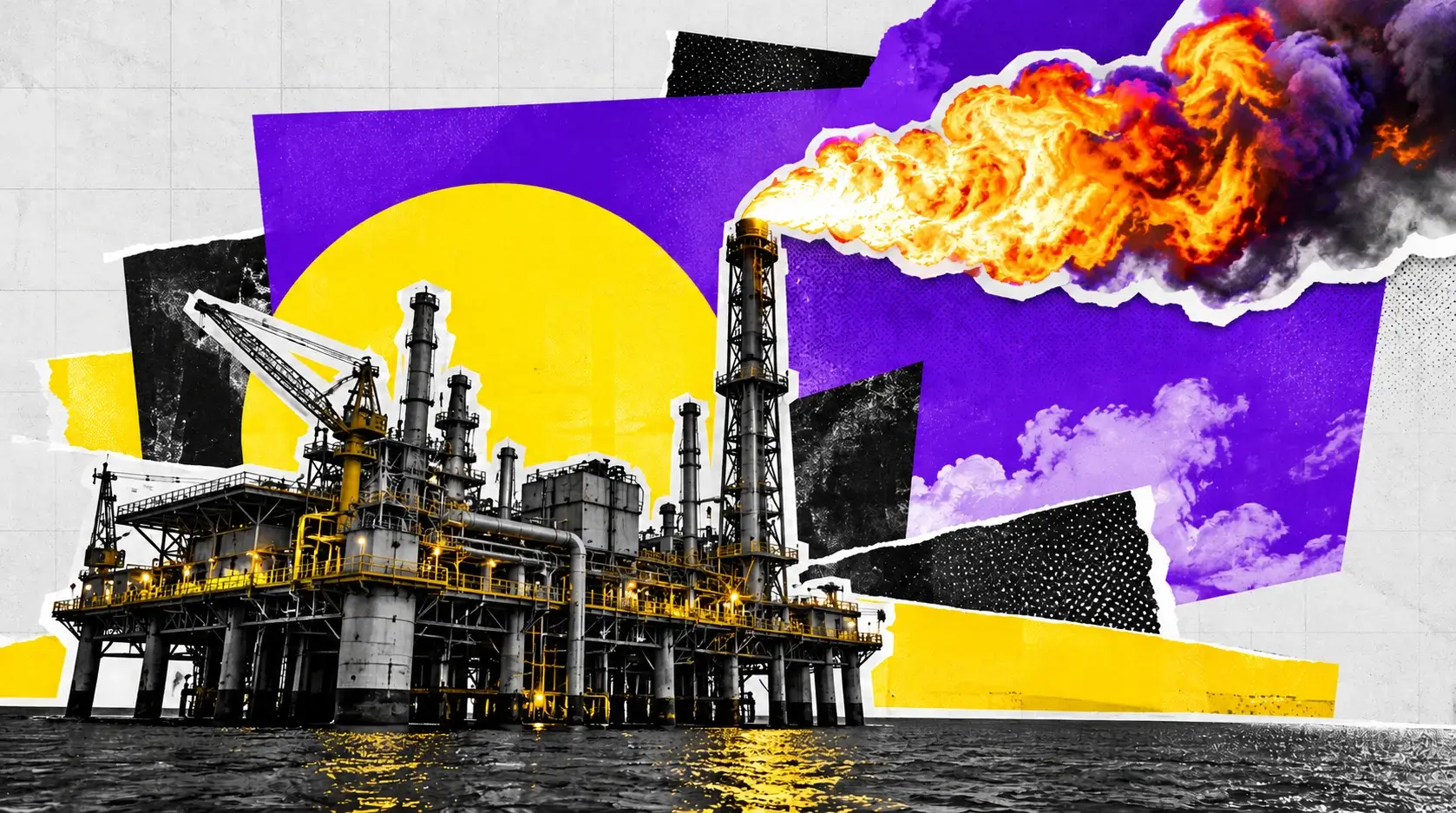
WTI Crude (CL=F) is trading at $98.85, down 2.50% on the session. Brent Crude (BZ=F) is at $101.10, off 2.72%. Murban Crude sits at $104.40, down 2.27%. Natural Gas is at $2.825, declining 2.05%. Gasoline is at $3.094, falling 3.42%. Heating Oil is at $4.002, down 2.72%. WTI Midland is at $103.10, dropping 2.89%. The OPEC Basket is at $123.20, up 5.20%. The Indian Basket is at $124.90, gaining 3.05%. Every one of those numbers sits in the context of the most extraordinary single-month oil price surge since Iraq invaded Kuwait in 1990. Brent (BZ=F) soared approximately 55% in March alone — a record for the contract dating back to its inception in 1988, surpassing the previous monthly record of 46% set in September 1990. WTI (CL=F) gained approximately 53% in March and posted its first settlement above $100 since July 2022 on March 30. The peak was nearly $120 per barrel for Brent. Wednesday's decline to $98.65 intraday — briefly below $100 for the first time in a week — followed Trump's statement that U.S. forces will leave Iran in two to three weeks. But the decline from $120 to $101 does not resolve the crisis. It reprices hope, not reality. The Strait of Hormuz remains effectively closed. A QatarEnergy-leased fuel tanker was struck by Iranian cruise missiles Wednesday morning — two of three intercepted, one hitting the vessel. The war is not over. The supply shock is not resolved. And the gap between the OPEC Basket at $123.20 and WTI at $98.85 is the market telling you exactly how distorted regional pricing has become.
March 2026: The Biggest Monthly Oil Surge Since the Gulf War — and Why the Numbers Are Worse Than They Look
Brent's 55% monthly gain in March 2026 does not just break records — it shatters the framework through which energy markets have operated for 35 years. The previous record was September 1990 when Iraq's invasion of Kuwait removed both countries' oil from the market simultaneously. That crisis resolved when coalition forces liberated Kuwait and Iraqi production gradually returned. The current crisis is structurally more complex. The Strait of Hormuz handles approximately 20% of global oil and 25% of global LNG traffic. Iran has not merely threatened to close the strait — it has effectively operationalized that threat through a combination of missile attacks on vessels, fees levied on approved transit, and the selective exemption of specific countries' tankers. Iran exempted Malaysian tankers from the Strait of Hormuz fee — a deliberate geopolitical signal about which relationships Tehran is maintaining during the conflict. Six Bangladeshi fuel ships received approval from Iran's security council to pass through. Twenty-eight oil and gas ships remain stranded near the Strait. These are not abstractions. They are physical bottlenecks in the global energy distribution system, and they do not clear overnight even if a ceasefire is announced tomorrow. ING commodities strategists Warren Patterson and Ewa Manthey stated explicitly: even if the Strait reopens, clearing the vessel backlog will take time, with production, exports, and LNG flows normalizing only gradually rather than immediately. The disruption is not binary — it does not switch off when the fighting stops.
OPEC Output Plunges 7 Million Barrels Per Day — the Supply Destruction That No One Is Fully Pricing
OPEC output has plunged 7 million barrels per day as war chokes supply — a figure that dwarfs every previous production disruption in modern history outside of the COVID-19 lockdowns. For context, Saudi Arabia produces approximately 9 to 10 million barrels per day at full capacity. The OPEC production collapse is equivalent to removing almost all of Saudi Arabia's output from the global market simultaneously. U.S. crude oil inventories saw a surprise 10 million barrel spike — a counterintuitive data point that reflects domestic refiners drawing on strategic reserves and imports while simultaneously struggling to source sufficient crude for jet fuel and diesel production. Oil refiners globally are bidding more aggressively for available crude as markets face shortages of jet fuel and diesel specifically — the two products most critical to commercial aviation and logistics. Korean Air raised its international one-way fuel surcharge to between 42,000 won and 303,000 won for April, compared to 13,500 won to 99,000 won in March. On long-distance routes to New York, Chicago, Washington, and Toronto, the surcharge increased 3.1 times to 303,000 won. Asiana Airlines raised its range to between 43,900 won and 251,900 won, from 14,600 won to 78,600 won in March. Jeju Air increased rates to between $29 and $68 from $9 to $22. Industry watchers warn that May surcharges on U.S. routes could reach the 500,000-won level if oil prices remain elevated. South Korea has imposed a two-day public sector driving ban — the first such restriction in 35 years — as it confronts structural energy vulnerability as a country heavily dependent on Middle Eastern oil.
The Strait of Hormuz Arithmetic: 20% of Global Oil, 4-5 Million Barrels Through Bab el-Mandeb, and the $200 Scenario
The physical geography of the oil supply crisis has three chokepoints that matter, and all three are under simultaneous pressure. The Strait of Hormuz is the primary constraint — approximately 20% of global oil flows through it. The Bab el-Mandeb Strait connecting the Gulf of Aden to the Red Sea carries four to five million barrels per day, according to Michael Haigh, global head of fixed income and commodities research at Societe Generale. The Suez Canal provides the alternative routing option but with sharply reduced capacity relative to normal Hormuz flows. If Houthi forces attempt to choke off the Bab el-Mandeb — adding four million barrels per day of disruption to the existing Hormuz closure — Societe Generale analysts said earlier in March that Brent (BZ=F) could reach $150 per barrel in April. Macquarie raised that ceiling further: two more months of war could send oil to $200 per barrel. That is not a fringe scenario. It is the arithmetic of what happens when 20% of global oil supply is removed from the market and the alternative routing through the Bab el-Mandeb is simultaneously threatened. Saudi Arabia's East-West pipeline carries approximately 5 million barrels per day to the Red Sea — David Roche of Quantum Strategy warned that any Bab al-Mandeb disruption would severely constrain that routing as well. Even the Suez Canal alternative would see capacity sharply reduced under that scenario. The $200 target requires sequential disruption — Hormuz plus Bab el-Mandeb simultaneously — but both chokepoints are already under active threat, making that scenario non-trivial.
Trump's $100 Oil Line, the Kharg Island Threat, and What "Taking the Oil" Actually Means for BZ=F
Trump's statement that the U.S. will leave Iran in "two to three weeks, whether we have a deal or not" drove Brent (BZ=F) down 4.52% to $99.20 and WTI (CL=F) down 4.04% to $97.30 in early Wednesday European trading. Brent briefly touched $98.65 before recovering toward $101. Those are the headline numbers. But Trump simultaneously threatened to destroy Iran's oil wells, power plants, and Kharg Island unless the Strait was reopened — a threat that, if executed, would remove roughly 90% of Iran's oil export capacity from the market permanently, not temporarily. Kharg Island handles approximately 90% of Iran's oil exports. David Roche of Quantum Strategy noted that markets are increasingly pricing in a more aggressive U.S. response including the possibility of seizing Kharg Island — which would choke off Iran's dollar revenues but risk triggering full-scale escalation with Tehran targeting critical Gulf infrastructure in retaliation. Trump's preferred option, which he disclosed in a Financial Times interview, was to "take the oil" — explicitly comparing the potential outcome in Iran to U.S. actions in Venezuela where Washington gained control over the country's oil sector after capturing Nicolás Maduro. That framing is not de-escalatory. It is a statement of strategic intent. A president who publicly signals intent to seize a country's oil infrastructure while simultaneously saying the military will leave in three weeks is sending contradictory signals — and markets are trading the contradiction rather than the headline.
Asia's $100 Oil Problem: Japan +5.24%, Korea +8.44%, and Why the Region's Relief Rally May Be Premature
Japan's Nikkei 225 closed 5.24% higher Wednesday. South Korea's Kospi surged 8.44%. Those moves reflect genuine relief that Trump signaled an end to the conflict — but they also reflect the desperate energy vulnerability of both countries that makes any peace signal disproportionately valuable to Asian markets. Japan and South Korea are among the world's most oil-import-dependent major economies, sourcing a substantial proportion of their energy needs from the Persian Gulf. The Iran war did not merely raise their fuel costs — it threatened their entire industrial energy supply chain. South Korea's March exports jumped 48.3% year-over-year in a sign that the underlying economic engine was still running, but the fuel surcharge explosions at Korean Air and Asiana document the direct cost transmission. Asia-Pacific LNG demand has plunged as Qatar outages and Hormuz disruption simultaneously bite — Qatar is a primary LNG supplier to Japan, South Korea, and other regional importers. Chevron reported "extensive damage" at a major LNG project. Asian LNG prices have surged to three-year highs, driving a rotation toward coal across the region. India boosted diesel exports to Southeast Asia to seven-year highs as it attempted to monetize its position as a refining hub not directly subject to the same supply constraints. China is reselling record LNG volumes as the global gas crunch deepens — a sign that Beijing is actively arbitraging the energy crisis rather than simply absorbing it. Oil-starved Asia is turning to Russia after U.S. waivers, with Bangladesh seeking a U.S. waiver for Russian diesel as the IMF warns of an energy shock. The region's relief rally Wednesday is justified by Trump's statement. It is not justified by the physical reality of oil supply, which will take weeks or months to normalize even in the best-case outcome.
The $80 Base Case, the $150 Stress Scenario, and Why Commerzbank's Forecast Is the Most Analytically Honest
Commerzbank economists Bernd Weidensteiner and Christoph Balz published the most useful structural framework for understanding oil (WTI/CL=F) pricing in the current environment. Their base scenario: the war ends in late May, the oil price falls rapidly thereafter but remains higher than pre-war levels at approximately $80. Pre-war Brent (BZ=F) was trading near $70 per barrel when the conflict began on February 28. Their $80 post-war floor reflects the permanent repricing of geopolitical risk premium and supply chain adjustment costs. The $80 target from Commerzbank implies Brent must fall another 20.9% from its current $101.10 to reach their base case post-war level. That decline will not happen overnight — as ING noted, vessel backlog clearance, production restart timelines, and LNG flow normalization all take weeks to months. The Societe Generale stress scenario of $150 by April requires another major supply disruption event — specifically the Bab el-Mandeb chokepoint being closed in addition to Hormuz. The Macquarie worst-case of $200 requires two additional months of full Hormuz closure from today's date. Both scenarios remain technically in play because the Strait is not yet open and Trump's 9 p.m. ET speech Wednesday has not yet been delivered. The EU warned explicitly on April 1 that energy prices will not fall even if the Iran war ends tomorrow — a recognition that the structural damage to supply chains, vessel availability, and refinery logistics cannot be reversed by a ceasefire announcement.
The Fracking Hedge: Why the U.S. Is Less Vulnerable Than in 1973 — but Not Immune at $100
Commerzbank's structural analysis of U.S. oil vulnerability makes a point that is counterintuitively important: the United States is significantly less exposed to $100 oil than it was during the 1973 oil crisis. U.S. net crude oil imports have fallen from approximately 10 million barrels per day around 2005 to approximately 2 million barrels per day today — an 80% reduction driven by the shale revolution and fracking technology expansion over the past two decades. The U.S. economy has also decoupled oil demand from GDP growth — after 1973, oil intensity per unit of economic output declined steadily. Critically, higher oil prices do not reduce overall U.S. purchasing power in the same way they did in the 1970s: what consumers lose at the pump, domestic oil producers gain. That internal transfer differs from the 1970s dynamic when oil price increases were pure wealth transfers to OPEC nations. U.S. gas prices topped $4 per gallon nationally as the Middle East conflict disrupted supply — painful for consumers but not economically catastrophic in the way that $4 gas combined with 1970s-era oil import dependence would have been. However, the global market price of oil is not determined by U.S. domestic production alone. Every barrel the world prices is priced on the same global benchmark regardless of whether American fracking can offset part of the domestic consumption gap. The 10-year Treasury yield at 4.336% combined with energy-driven CPI acceleration creates the stagflationary pressure that makes the Fed's position genuinely impossible — and that monetary policy paralysis is the secondary transmission channel through which $100 oil damages the U.S. economy even in the presence of domestic production strength.
Read More
-
Yen Stalls at 160 Despite a 3% JGB and Tokyo Core CPI at 2.0% — Intervention Sits at 164, Friday's Payrolls Decide
02.09.2026 · TradingNEWS ArchiveEnergy
-
QQQ ETF ($706.22) Slides 7.4% Below Its High as the Market Reprices the AI Capex Bill — $686.57 Target if $700 Breaks
22.10.2026 · TradingNEWS ArchiveStocks
-
XRPI ($7.00) and XRPR ($10.74) Slide Toward 52-Week Lows as Spot XRP ETF Flows Stall at $708,510
22.10.2026 · TradingNEWS ArchiveCrypto
-
NG ($2.775) Decoupled From Europe’s €88 Gas Crisis as LNG Feedgas Hits 18.9 Bcf/d — $3.30 Upside on Cold Weather
22.10.2026 · TradingNEWS ArchiveCommodities
-
Dollar-Yen (157.35) Loses 157.65 as the Yen Rallies on Haven Demand — 155 Target if 156 Breaks
22.10.2026 · TradingNEWS ArchiveForex
Korean Airlines, Indian Diesel, and the Consumer Price Transmission That Is Already Happening
The consumer-facing price transmission from WTI (CL=F) at $100 is not a future risk — it is happening in real time across multiple sectors and geographies. Korean Air's long-haul fuel surcharge tripled in a single month. Jeju Air's fuel surcharge increased 3.1 times. Industry watchers are projecting 500,000-won surcharges on U.S. routes by May if prices remain elevated. Nigeria is paying 65% more for gasoline as the Dangote refinery battles crude import costs. Australia cut its fuel tax in half as Middle East supply squeezes domestic petrol availability. South Korea is weighing public driving restrictions for the first time in 35 years. India's aviation market is being rocked by wild jet fuel price swings. India is simultaneously leaning on coal and renewables as war throttles gas supply, and boosting diesel exports to Southeast Asia at seven-year-high levels as it monetizes its refinery position. China sent fuel to struggling Southeast Asian economies despite its own export ban — a sign of Beijing managing regional relationships under energy stress. Gasoline at the U.S. pump hit $3.094 Wednesday, down 3.42% on the day from Wednesday's levels but still reflecting the accumulated war premium from a March that opened near $70 oil. Heating Oil at $4.002 is directly relevant to European and U.S. consumer energy bills. The EU's European Commission urged member states to make "timely and coordinated" preparations to secure oil supplies — bureaucratic language for "we are genuinely concerned about supply continuity into Q2."
The QatarEnergy Tanker Strike and the Proof That the War Premium Is Not Fully Priced
At approximately 2 a.m. Wednesday, a QatarEnergy-leased fuel oil tanker was struck by an Iranian cruise missile — Qatar's Ministry of Defence confirmed three cruise missiles were fired, two intercepted, and one hit the vessel. No crew casualties, no environmental impact — but a direct strike on a commercial energy cargo vessel affiliated with one of the world's largest LNG producers at the precise moment markets were pricing in de-escalation. That event is the clearest possible demonstration of the gap between Trump's geopolitical statements and the physical reality of the conflict. QatarEnergy's Ras Laffan facility — the hub for much of Qatar's LNG production — previously suffered an attack that ING's strategists characterized as shattering "the illusion of global gas abundance." Asian LNG demand has plunged not because demand has fallen but because supply reliability has collapsed. The tanker strike Wednesday underscores that any short-term oil (BZ=F) price decline driven by Trump's two-to-three-week exit statement is sitting on an extremely fragile foundation. An Iranian missile struck a ship while markets were selling oil on peace hopes. That juxtaposition is the defining tension in the energy market: political de-escalation narrative competing with kinetic military reality on the same day, in the same hour, pricing into the same market.
The $150 Bull Case Requires Bab el-Mandeb Closure — and the Houthis Are Already Engaged
Yemen's Houthis fired a barrage of ballistic missiles at Israeli military targets on Saturday, March 28 — their first direct involvement in the U.S.-Israel-Iran conflict and a development that significantly raises the risk of a second chokepoint crisis at the Bab el-Mandeb Strait. Michael Haigh of Societe Generale quantified the Bab el-Mandeb risk explicitly: four to five million barrels per day flow through that strait. If Houthi activity closes or significantly restricts that channel in addition to the Hormuz blockade, Societe Generale's $150 April scenario activates. The Houthi engagement is not a theoretical risk — they have demonstrated both the capability and the willingness to attack commercial shipping during the 2024-2025 period, and their re-entry into this conflict adds a second geographically distinct threat to global oil supply simultaneously. Gulf allies are privately making the case to Trump to continue fighting Iran rather than withdraw — specifically because they understand that a premature U.S. exit without a verifiable Hormuz reopening leaves the region's energy infrastructure vulnerable to continued Iranian proxies and direct action. Saudi Arabia's East-West pipeline at 5 million barrels per day and the Suez Canal routing capacity could both be impaired simultaneously if Houthi action intensifies at Bab el-Mandeb. The $200 scenario that Macquarie outlined is not crazy. It is the arithmetic of full dual-chokepoint closure, and one of those chokepoints just became active again on Saturday.
The Verdict on Oil (WTI/CL=F, Brent/BZ=F): Sell the Peace Rally Above $105, Buy the War Escalation Dip Below $95
WTI (CL=F) at $98.85 and Brent (BZ=F) at $101.10 are priced in a no-man's land between de-escalation hope and physical supply reality. The structural framework is clear. Commerzbank's base case of $80 post-war floor is the long-term destination if the conflict ends by late May and Hormuz reopens cleanly. The ING caveats about vessel backlog clearance and gradual normalization mean the path to $80 takes weeks to months even after a ceasefire. The Societe Generale $150 April scenario and Macquarie's $200 worst case remain live tail risks as long as Hormuz is closed and Houthis are engaged at Bab el-Mandeb. OPEC's 7 million barrel per day output collapse is the most severe supply disruption in modern history outside COVID-19. The QatarEnergy tanker strike on Wednesday confirmed that geopolitical risk is not fading — it is active while markets price hope. The tactical trade is sell BZ=F above $105 with a tight stop at $112 — the recent peace-hope rally has run its course and the physical supply reality will reassert pressure. Buy CL=F dips below $95 if they occur on further peace headlines, because the post-war floor of $80 with normalization lag means $95 represents aggressive downside pricing that underestimates the clearing time for the vessel backlog, refinery adjustment, and LNG flow restoration. The medium-term directional view: oil settles in a $85 to $105 range through Q2 2026 with violent intraday swings driven by Trump's statements and kinetic developments at the Strait. The long-term view depends entirely on whether Hormuz reopens, when it reopens, and whether the Houthi engagement at Bab el-Mandeb intensifies. Above $105 is a sell. Below $90 is a buy. Between $90 and $105 is the range where Trump's 9 p.m. Wednesday speech is the single most important price input in the world.