Oracle Bounces To $141.85 With $145.50 Overhead as $70B Capex Meets a $32B Cash Flow Base
The stock trades at 15.78 times forward non-GAAP earnings against a 24.49 times industry average | That's TradingNEWS
Key Points
- ORCL closed $141.85, up 9.22%, rebounding 24% from a $114.50 low but still 28% lower year-to-date.
- Remaining performance obligations reached $638 billion, up 363% and $85 billion sequentially.
- Fiscal 2026 free cash flow was negative $23.7 billion against negative $394 million a year earlier.
Oracle closed Monday at $141.85, up 9.22% on a broad artificial intelligence and cloud rally, after trading $139.90 in the afternoon session for an 8% gain. That advance carried into Tuesday, where options activity ran above normal volume and skewed directionally bullish alongside a fresh buy recommendation.
The starting point makes the move meaningful. The stock bounced from a 52-week low of $114.50 and now sits roughly 24% above it. Two weeks earlier it had printed $120.03 on July 20 with a 14-day relative strength reading of 32.72 — a whisker from oversold — after dropping 27.8% across a single month.
The damage remains severe despite the bounce. Oracle sits 28% below where it started 2026 and roughly 46.89% lower across 52 weeks. From the 52-week high of $345.72 set in September 2025, the decline runs close to 59%, and roughly $494 billion of market value has been erased.
The technical map overhead is dense. Immediate resistance sits at $145.50, the 38.2% Fibonacci retracement, roughly 2.6% above Monday's close. Above that the 50-period exponential average sits at $150.01, then $154.93, then $164.57, with the 100-period exponential average at $175.78. Reclaiming $200 — the level that would put the stock back in respectable territory for the year — requires a 40% rally from here.
The peer comparison is what makes the underperformance stand out. Across the artificial intelligence infrastructure complex, one data platform peer has surged 41% year-to-date and a neocloud provider trades up 19%, leaving Oracle the clear large-cap laggard in a group where the underlying demand narrative is identical.
The stock has traced this arc twice already. It peaked near $346 in September 2025, dropped roughly 48% to the $145 range by February 2026 on a slight revenue miss, massive capital expenditure guidance, questions around the flagship artificial intelligence project and a securities class action, rebounded roughly 70% from April lows, then collapsed again to $114.50.
At $141.85 the stock sits almost exactly where it bottomed in February. Eighteen months of extraordinary contract wins have produced a round trip to nowhere.
The $638 Billion Backlog Nobody Will Pay For
Remaining performance obligations ended the fourth quarter at $638 billion, up 363% year over year and up $85 billion sequentially from the third quarter. That is contracted revenue not yet recognized, and against fiscal 2026 revenue of $67.36 billion it represents roughly 9.5 years of the current run rate.
The trajectory is extraordinary. Second-quarter fiscal 2026 closed with $523 billion, up 438% year over year, driven by mega-deals with a frontier artificial intelligence lab and a social media platform. Adding $85 billion in a single quarter on top of that base means the company booked more future revenue in three months than it recognized across the entire fiscal year.
The demand driver is explicit: the large increases in backlog and revenue are driven by growing demand for cloud infrastructure serving artificial intelligence training and inferencing. Public cloud infrastructure revenue has been growing 93%, with the cloud segment as a whole running near 47% for the fiscal year.
The context across the sector reinforces the scale. Backlogs across the top four cloud providers now exceed $2.3 trillion, up 16% from the first quarter. Hyperscaler capital expenditure for 2026 is running above $860 billion, up 80% year over year, with a path toward roughly $1.2 trillion by 2027. Compute remains supply-constrained.
The market has assigned that backlog effectively zero value. A stock down 28% year-to-date while contracted future revenue rises 363% is pricing a specific concern: that converting $638 billion of obligations into recognized revenue requires capital the company has to borrow, at margins that have not been demonstrated, from counterparties whose own funding is uncertain.
That skepticism has precedent this earnings season. One search and cloud giant grew core services 24% and saw its stock decline 15% post-earnings. A memory manufacturer grew earnings 41% and fell by the same percentage. In each case the driver was negative cash flow from a capital expenditure surge rather than any operating deterioration.
Oracle is the most extreme expression of that pattern. Its backlog is the largest relative to revenue in the complex, and so is its cash burn.
Free Cash Flow Ran Negative $23.7 Billion
Fiscal 2026 free cash flow came in at negative $23.7 billion. The prior year figure was negative $394 million. That is a deterioration of $23.3 billion in twelve months, and it is the single number that explains the entire share price collapse.
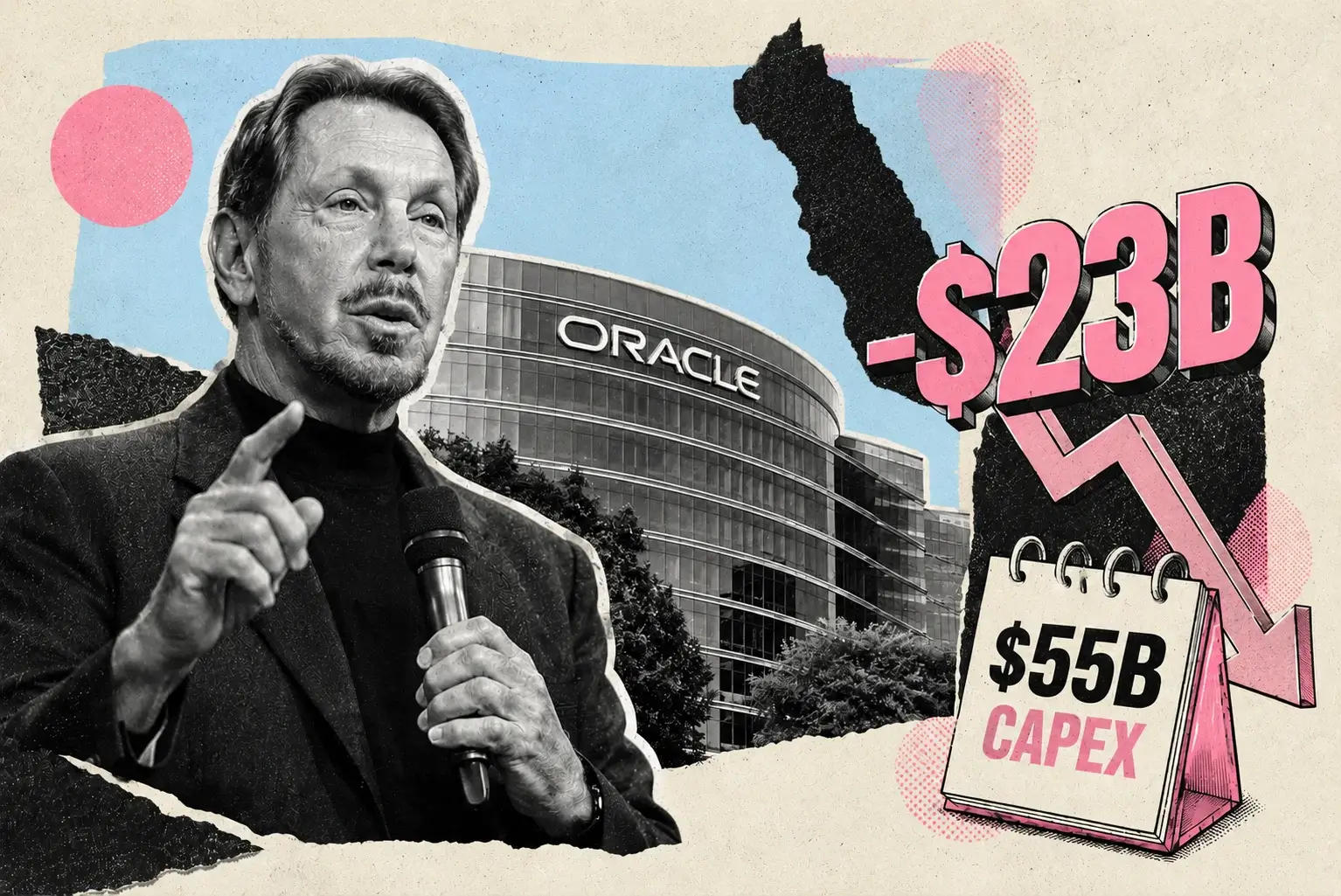
Operating cash flow was a record $32.0 billion, up 54%. The business generates enormous cash. Capital expenditure consumed all of it and $23.7 billion more.
The quarterly progression showed the problem building. Second-quarter free cash flow went negative by roughly $10 billion against a consensus expecting negative $5.2 billion — a miss of nearly double. Each subsequent quarter deepened the deficit rather than stabilizing it.
The forward path does not improve quickly. Negative free cash flow margins across the artificial intelligence infrastructure complex are expected to bottom around -5% to -6% in 2027 and 2028 before returning to profitability. For a company guiding to $90 billion of fiscal 2027 revenue, a -6% margin implies roughly $5.4 billion of continued burn at the trough — an improvement from $23.7 billion but still negative for two more years.
The tension sits between the two cash flow lines. Operating cash flow at $32.0 billion growing 54% describes a healthy underlying business. Capital expenditure at $55.7 billion describes a company converting that business into physical infrastructure faster than it can fund internally.
The bull framing is that this is a timing problem. Data centers built today generate revenue for a decade, and the $638 billion backlog is the contractual evidence that revenue exists. Under that view, the cash flow trough is the buying opportunity and the recovery follows mechanically once construction moderates.
The bear framing is that capital expenditure has consistently exceeded guidance, the funding gap is being closed with debt rather than equity, and the counterparty concentration in a single artificial intelligence lab creates a risk that no backlog figure captures.
Both readings use the same numbers. The stock at $141.85 is pricing the second one.
Capex Went To $55.7 Billion And Is Heading To $70 Billion
Oracle spent $55.7 billion on data centers in fiscal 2026, overshooting its own $50 billion guidance. That figure compares to $21.2 billion in fiscal 2025 — a 163% increase in a single year. The guidance itself had already been raised from $35 billion as of September.
Net capital expenditure for the current fiscal year is guided to roughly $70 billion. One research estimate has pushed fiscal 2027 capital expenditure to $83 billion from $72 billion, against a consensus near $60 billion, on the basis that newer-generation accelerators and broader cost inflation are lifting per-gigawatt build costs. Several project sites are expected to see first deliveries in the second half of calendar 2026 or the first half of calendar 2027.
The pattern of guidance being exceeded is the core credibility problem. Every capital expenditure number the company has published in the past eighteen months has been revised higher, and the fourth-quarter print landed $5.7 billion above the most recent version. Investors pricing a $70 billion year are implicitly pricing a $75 billion to $83 billion outcome.
The competitive dynamic makes moderation difficult. If incremental business arrives from frontier artificial intelligence labs, sticking to a capital plan becomes untenable, and competitors are unlikely to slow spending — they could treat any Oracle restraint as an opportunity to take share. That leaves management with a choice between a worse cash flow profile and a smaller backlog.
The peer comparison quantifies the gap. One hyperscaler competitor has guided fiscal 2027 capital expenditure to $255 billion to $260 billion against roughly $190 billion this year, funded entirely from $155.2 billion of annual operating income without external financing. Oracle's $70 billion to $83 billion sits against $32.0 billion of operating cash flow.
The ratio is what matters. The competitor spends roughly 1.6 times its operating income. Oracle spends between 2.2 and 2.6 times. That difference is the entire debt story.
Restructuring has been the offset. Beginning in March the company cut up to 30,000 employees, approximately 18% of its global workforce, in the largest restructuring in its history. Operating expense reduction of that magnitude funds a fraction of the gap.
$117 Billion Of Debt Makes It The Largest Non-Financial Issuer
Oracle carries approximately $117 billion of debt in the high-grade corporate bond index, making it the largest issuer outside the financial sector. That position was built to fund a data center program the company cannot finance from operations.
The raising continues. Roughly $30 billion in debt and equity financing was completed in early 2026 against a stated plan to raise $45 billion to $50 billion across the year. Another $40 billion of debt issuance has been flagged alongside a previously announced $20 billion at-the-market equity program.
The macro backdrop is unhelpful. The thirty-year Treasury sits at 5.232%, within basis points of levels last seen in 2007, and the ten-year at 4.686%. Markets price roughly 68% odds of a Federal Reserve hike in September. Borrowing costs for a $117 billion issuer rise mechanically with those levels, and each incremental billion is priced at higher yields than the last.
Artificial intelligence-related global debt issuance is projected to more than double to nearly $570 billion in 2026, with hyperscaler spending exceeding $1 trillion by 2027. Oracle competes for that capital against issuers with investment-grade balance sheets and positive free cash flow.
The financing partially routes around the balance sheet. Bring-your-own-cloud arrangements, customer prepayments and the frontier lab's own $122 billion fundraising at an $852 billion valuation all reduce the capital Oracle has to supply directly. That lab's revenue has grown from roughly $12 billion of annualized run rate in mid-2025 to approximately $25 billion in early 2026, and it has restructured into a public benefit corporation ahead of a potential fourth-quarter 2026 listing.
The counterparty concentration is the risk nobody has priced cleanly. A $300 billion-plus contract with a single customer, funded by that customer's ability to keep raising capital at escalating valuations, is a different credit than a diversified enterprise backlog.
The founder's personal exposure illustrates the leverage. A $40.4 billion guarantee tied to a family media transaction is backed by Oracle shares now worth roughly half their value when the commitment was signed. Personal wealth tied to the stock has fallen $207 billion from a peak near $388 billion in September 2025.
FY2026 Delivered $67.36 Billion And Record Margins
The operating results were strong and largely ignored. Fiscal 2026 revenue reached $67.36 billion, up 17.35% from $57.40 billion. GAAP operating income hit $20.6 billion, up 17%. Non-GAAP operating income reached a record $28.9 billion, up 16%.
Profitability improved faster than revenue. GAAP net income available to common shareholders reached $17.0 billion, up 36%. Non-GAAP net income grew to $22.2 billion, up 29%. GAAP earnings per share climbed to $5.83, up 34%, with non-GAAP earnings at $7.631, up 27%.
The fourth quarter alone delivered record revenue of $19.18 billion, up 21% year over year, against a $19.08 billion consensus, with adjusted earnings of $2.11 per share against $1.97 expected. Both lines beat. The stock fell 7% after hours on capital expenditure.
The prior quarter had shown the same pattern in reverse. Second-quarter revenue of $16.1 billion rose 14% with cloud revenue of $8.0 billion up 34%, and non-GAAP earnings of $2.26 beat consensus by more than 50% — though roughly $2.7 billion of that came from a one-time gain on the sale of a chip business stake rather than from operations.
That divestiture reflects a deliberate strategic shift toward chip neutrality, positioning the infrastructure business to run whichever accelerator a customer prefers rather than being tied to proprietary silicon. It also generated cash at a moment when cash was scarce.
The cloud segment is where the growth sits. Oracle Cloud Infrastructure competes against the three large hyperscalers by focusing on affordable artificial intelligence training workloads and accelerator availability, and it won frontier lab customers during periods when competitors ran out of capacity. Public cloud infrastructure revenue growth of 93% is the fastest in the large-cap complex.
The market's problem is not the income statement. It is the reconciliation between $17.0 billion of GAAP net income and negative $23.7 billion of free cash flow — a $40.7 billion gap that represents capital being converted into concrete and silicon on a bet about the next decade.
Read More
-
Yen Stalls at 160 Despite a 3% JGB and Tokyo Core CPI at 2.0% — Intervention Sits at 164, Friday's Payrolls Decide
02.09.2026 · TradingNEWS ArchiveEnergy
-
QQQ ETF ($739) Fades From an Early Tech Rally as a 77.9 ISM Prices Index Meets Micron's $61.5B Guide — $760 Record Test Ahead
01.10.2026 · TradingNEWS ArchiveStocks
-
XRPR and XRPI Follow XRP's $1.49 Test as Spot Funds Hold 1.16B XRP and a 1 Billion Token Escrow Release Lands — $1.70 in Play
01.10.2026 · TradingNEWS ArchiveCrypto
-
November NG Slips Below $3 as Decade-High Storage Meets Capped LNG Exports — $2.75 in Sight
01.10.2026 · TradingNEWS ArchiveCommodities
-
Dollar-Yen at 158 Presses Toward 160 as a 363 bp Carry Gap Meets Katayama-Bessent Intervention Risk — 159 in Sight
01.10.2026 · TradingNEWS ArchiveForex
FY2027 Guides To $90 Billion And $8.05
Management confirmed prior revenue guidance of $90 billion for fiscal 2027 and raised non-GAAP earnings per share guidance to $8.05 — growth of 18% after adjusting for one-time events including the chip business sale and warrant gains recognized in fiscal 2026. Cloud revenue is guided to grow 57% to 63%.
That $90 billion target represents 33.6% growth from $67.36 billion. For a company of this size, guiding to a third of incremental revenue in a single year is aggressive, and it is only credible because $638 billion of contracted obligations sits behind it.
First-quarter guidance called for non-GAAP earnings of $1.71 to $1.75 in constant currency, growth of 16% to 19%, and $1.72 to $1.76 in dollar terms, growth of 17% to 20%. Consensus entering the quarter had modeled 27% revenue growth and $1.69 of adjusted earnings.
The earnings guidance is the more interesting line. Growing adjusted earnings 18% while burning cash and adding debt requires the operating leverage from the workforce reduction to offset rising interest expense and depreciation from $55.7 billion of newly placed assets. Depreciation on that asset base alone runs several billion dollars annually once it enters service.
The composition question determines whether the guidance holds. Cloud infrastructure at 57% to 63% growth carries lower gross margins than the legacy database and applications business, which means revenue mix shift compresses corporate margin even as the top line accelerates. Converting the backlog profitably — not merely converting it — is the requirement.
The delivery schedule provides some visibility. The flagship campus has delivered 42% of its capacity with an additional 35% scheduled across the following three months. That would take the site to 77% delivered, which converts directly into recognized revenue as capacity comes online.
Fiscal 2027 is the year the thesis gets tested. Revenue either reaches $90 billion or it does not, cash flow either improves from negative $23.7 billion or it does not, and the backlog either converts or it sits.
Stargate Is 42% Delivered At Abilene And 7 Gigawatts Planned
The flagship Texas campus has delivered 42% of its planned capacity, with an additional 35% scheduled over the following three months. As of April the site was live with 1.2 gigawatts of cloud infrastructure. Progress on the large facilities serving the frontier lab has been characterized as significant.
The broader program spans multiple sites across Texas, Wisconsin, Michigan, New Mexico, Wyoming and Pennsylvania, with nearly seven gigawatts of planned capacity and over $400 billion in projected investment. Next-generation accelerators are planned for 2026 and 2027 deployment.
Seven gigawatts is a scale figure worth grounding. That is roughly the electrical demand of a mid-sized country's industrial base, being constructed for a single customer relationship across four years. The company is building facilities intended to draw clean energy from natural gas fuel cells to generate electricity with minimal emissions, alongside investments in high-performance networking and autonomous software.
The counterparty economics have strengthened. The lab's annualized revenue has roughly doubled from $12 billion in mid-2025 to $25 billion in early 2026, it completed a record $122 billion funding round at an $852 billion valuation, restructured into a public benefit corporation and is preparing for a possible fourth-quarter listing.
The technology risk is more subtle. The lab's custom inference silicon, designed with a semiconductor partner, has completed design and is on track for first data center deployment in the second half of 2026 — ahead of earlier projections. Custom accelerators optimized for specific architectures reduce the compute intensity of inference workloads, which could reduce the capacity a given revenue level requires.
That same partner has expanded custom chip work to two other major artificial intelligence developers, confirming that proprietary silicon has become an industry-wide movement. The implication for infrastructure providers is that the multiple of compute required per dollar of artificial intelligence revenue may compress over time.
Oracle's chip-neutral positioning partially hedges that. Selling the proprietary chip business and building to run whichever accelerator the customer specifies means the infrastructure remains relevant regardless of which silicon wins.
The concentration remains. Seven gigawatts built substantially for one relationship is the definition of counterparty risk.
The Google Partnership Is The Cheapest Growth Available
Shares jumped 7% on July 30 when the cloud partnership with the search giant was expanded to bring its frontier models into Oracle's enterprise applications portfolio. The integration puts those models directly into the finance and enterprise resource planning suite, giving customers artificial intelligence functionality without migrating clouds.
The strategic logic is unusually clean. Oracle captures value from artificial intelligence in its applications business without building foundation models, without the associated research spend, and without competing for accelerator capacity it needs for the infrastructure business. The partner gains distribution across Oracle's installed base of enterprise finance customers.
That asymmetry cuts both ways. The partner's models gain access to every Oracle customer inside the enterprise resource planning and finance suite — a distribution channel it could not otherwise buy. Oracle avoids a capital-intensive model development program it cannot currently fund. Whether the value accrues more to the distributor or the model provider over time is genuinely unclear.
For a company with negative $23.7 billion of free cash flow, partnering rather than building is the only rational choice. Every dollar not spent on model development is a dollar available for data center capacity that carries contracted revenue behind it.
The applications business has been expanding independently. New no-code and pro-code capabilities allow customers and partners to build agentic applications backed by specialized agent teams, business objects, workflows, approvals and governance. A large hospitality brand deployment integrates sales, service, loyalty and distribution into a connected platform.
Government work adds a stable revenue layer. A defense department contract worth up to $7 billion over ten years, and participation as a technology partner on a federal human resources modernization program, provide multi-year revenue with different risk characteristics than frontier lab infrastructure.
The workforce reduction of up to 30,000 employees, roughly 18% of the global base, was the cost side of the same equation. Cutting nearly a fifth of headcount while guiding to 33.6% revenue growth describes a company betting entirely on operating leverage from infrastructure rather than from people.
The Peer Contrast Is Brutal And Instructive
The comparison that matters most landed last week. One hyperscaler competitor reported fourth-quarter revenue of $90.01 billion, up 17.75%, with its cloud platform growing 43% and crossing $100 billion in annual revenue. Its commercial backlog jumped $51 billion in a single quarter to $678 billion, up 84%. The stock ripped 25.33% in seven sessions and added nearly $450 billion of market value in one day.
Oracle's backlog at $638 billion is 94% as large. Its backlog growth at 363% is more than four times faster. Its cloud infrastructure growth at 93% is more than double. And its stock is down 28% year-to-date while the competitor's has re-rated violently higher.
The difference is funding. The competitor generated $155.2 billion of operating income in fiscal 2026 and funds $255 billion of capital expenditure from operations without external financing. Oracle generated $32.0 billion of operating cash flow and funds $70 billion of capital expenditure with $117 billion of index debt and a $40 billion issuance plan.
That single distinction — internally funded versus debt funded — explains a 53-percentage-point divergence in year-to-date performance between two companies chasing identical demand.
The broader complex tells the same story. A data platform peer is up 41% year-to-date. A neocloud provider is up 19%. Oracle is down 28%. Across all of them the underlying artificial intelligence demand narrative is identical and the backlogs are growing. Only the balance sheets differ.
The rerating condition follows directly from that. Oracle's recovery requires four things to line up: converting the backlog into profitable cloud infrastructure revenue, demonstrating clear returns on the capital expenditure bill, easing the free cash flow overhang, and earning a valuation re-rating toward the level the stock held earlier in the year.
Multiple expansion is not the primary lever. The trailing earnings multiple at 24.06 times is already reasonable, and the forward non-GAAP multiple at 15.78 times sits well beneath an industry average of 24.49 times.
The stock is cheap. It is cheap because the cash flow is negative.
Targets Sit At $265 And Imply 87% Upside
Consensus is emphatically positive and emphatically wrong so far. Across 44 analysts the average rating is Buy with a twelve-month target of $248.15. A separate compilation puts the mean at $265.03, implying 87% upside from $141.85. A third across 35 analysts sets $268.26. Distribution runs 34% Strong Buy, 46% Buy, 17% Hold, zero Sell and 3% Strong Sell.
An 87% implied return on a $265 mean target for a company with a $638 billion backlog and 15.78 times forward earnings is either the most compelling large-cap setup in technology or evidence that the sell-side has not marked its models to the cash flow reality.
Recent commentary has turned constructive. A fresh buy recommendation landed Tuesday alongside above-normal, directionally bullish call volume. One target sits at $283. The framing across recent notes is that the artificial intelligence bet is sparking a revival, with backlog conversion driving a free cash flow recovery once margins bottom near -6% by 2028.
The skeptical case runs in the opposite direction and has been louder. One published view holds that the artificial intelligence investment cycle is roughly 17 times larger than the dot-com bubble, with only the dominant accelerator supplier generating genuine profit from it. Under that framework Oracle is the most leveraged expression of a capital cycle that ends badly.
The valuation math sits between them. At $141.85 with fiscal 2027 guidance of $90 billion revenue and $8.05 non-GAAP earnings, the stock trades at 17.6 times forward earnings and roughly 1.6 times forward sales. For 33.6% revenue growth, those are recovery-stock multiples, not growth-stock multiples.
The securities class action from the February decline remains outstanding, and a supplier facing its own class action over materials disclosure adds a peripheral complication to the fuel cell power strategy.
What the target dispersion actually reveals is that nobody has a framework for valuing a company whose contracted revenue exceeds nine years of sales while its free cash flow runs negative $23.7 billion.
Forecast: $150 On Follow-Through, $114.50 On A Failure
The immediate test is $145.50 — the 38.2% Fibonacci retracement sitting 2.6% above Monday's close. Clearing it opens the 50-period exponential average at $150.01, then $154.93, then $164.57, with the 100-period average at $175.78 as the extended objective. That last level would represent a 24% advance and would restore the stock to where it traded before the July collapse.
The bull path requires three things. First, first-quarter fiscal 2027 results confirming the $90 billion revenue guidance and $8.05 earnings target without a capital expenditure revision higher. Second, the flagship campus delivering the scheduled additional 35% of capacity, taking the site to 77% and converting into recognized revenue. Third, any evidence that free cash flow is troughing rather than deepening — the guided path toward -5% to -6% margins in 2027 and 2028 rather than another $23.7 billion year.
The bear path is a retest. Failing at $145.50 and losing $135 opens the July lows near $120.03 and then the 52-week low at $114.50 — a 19% decline from current levels. Another capital expenditure guidance raise toward the $83 billion estimate, a widening funding gap requiring debt beyond the $40 billion already flagged, or any deterioration in the frontier lab counterparty would deliver it.
The macro overlay works against the stock. The thirty-year Treasury at 5.232% and roughly 68% odds of a September rate hike raise the discount rate applied to a company whose entire value sits in cash flows that begin in 2028. Rising rates hurt Oracle more than any comparable large-cap because it is the most leveraged and the most back-loaded.
The setup is genuinely asymmetric in both directions. A $638 billion backlog growing 363%, 93% infrastructure growth, $32.0 billion of operating cash flow, a 15.78 times forward multiple against a 24.49 times industry average, and $265 consensus targets describe extraordinary upside. Negative $23.7 billion free cash flow, $117 billion of index debt, capital expenditure exceeding guidance every single quarter, and single-customer concentration describe extraordinary risk.
The trade: above $145.50 on a daily close, target $150 then $164.57. Below $135, target $120 then $114.50. The gap between them is the widest risk-reward in large-cap technology.