OXY Rips 4% to $53.90 as Evercore Double-Upgrade and Oil Spike Lift the Highest-Beta Major — Occidental's Deleveraging Story Targets $65
Occidental led ExxonMobil and Chevron with a 4% gain as Evercore lifted it two notches to Outperform, citing debt cut from $23B to $14B | That's TradingNEWS
Key Points
- OXY jumped 4% to $53.90, leading XOM (-1%) and CVX (+1%) as Evercore double-upgraded it to Outperform ($65 target) and oil spiked on Iran.
- It's a deleveraging story, not growth: debt slashed from $23B to $14B via the $9.7B OxyChem sale; buybacks seen resuming H2 2028.
- Risks: the $65 target sits below the $67 March high, consensus is Hold, the $8B Berkshire preferred drains $680M/year, and high beta cuts both ways.
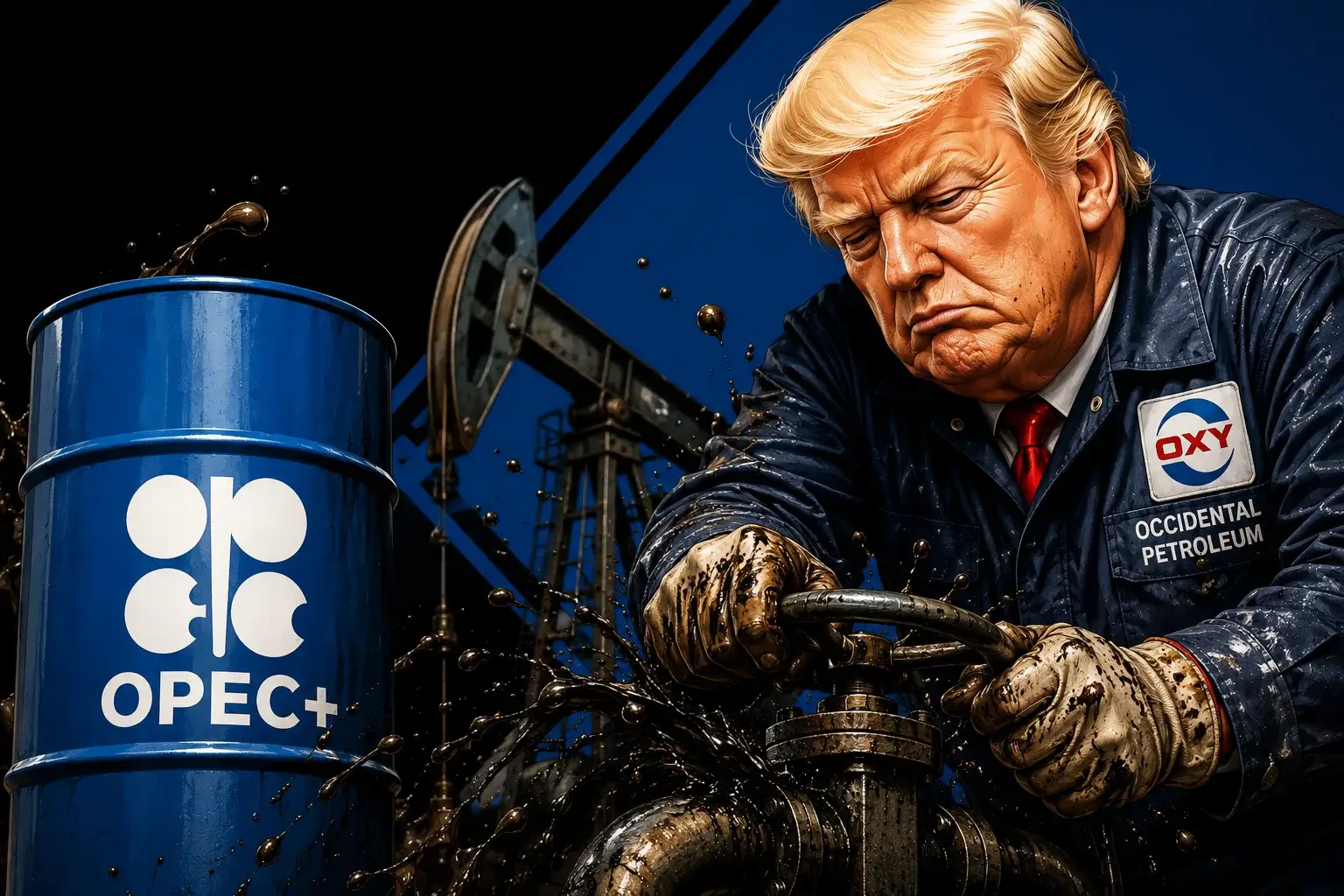
Occidental Petroleum (OXY) is the highest-beta oil major, and Wednesday it proved it in real time. The stock ripped 4% to $53.90 at midday while ExxonMobil slipped 1% to $140.51 and Chevron gained just 1% to $176.07. Two forces drove OXY's outperformance: a double-upgrade from Evercore ISI and a 5-6% spike in crude after Trump declared the U.S.-Iran ceasefire "over" ahead of the NATO summit. WTI jumped to $74.58 and Brent to $78.50 on the escalation, and OXY — carrying the most leverage to the oil price of any U.S. major — captured the move harder than its integrated peers.
The divergence tells the story of OXY's character. ExxonMobil and Chevron participated in the crude rally, but without a company-specific driver to match Evercore's OXY call. The Energy Select Sector SPDR Fund rose only 1%, muted because Exxon and Chevron's combined 41% weighting dragged on the fund despite the crude spike. OXY, with its pure-play exploration-and-production profile and highest oil-price beta among the majors, amplified the commodity move and got an analyst catalyst on top. The result was a 4% single-session gain that left the integrated majors in the dust.
The setup was primed for exactly this. OXY had shed roughly 15% over the prior month, compressing its valuation and creating a high-beta setup for a sharp recovery. When the oil spike and the Evercore upgrade hit simultaneously, the coiled stock snapped higher. Retail sentiment on Stocktwits flipped to "bullish" from "neutral" amid high message volumes. The stock that had lagged both crude and its E&P peers for weeks suddenly became the day's energy leader, rewarding investors who were long the most oil-levered major heading into the crude spike.
What makes OXY compelling here isn't just Wednesday's 4% pop — it's the combination of a deeply discounted valuation, the highest oil beta in the group, and a fresh analyst thesis that the market has underpriced the company's transformation. OXY trades around $53.90, up roughly 24% year-to-date but still well below its 2026 high of $67 from late March. The Evercore double-upgrade to Outperform with a $65 target implies 25% upside, and it rests on a deleveraging story the market hasn't fully recognized. OXY ripped 4% and left the majors behind Wednesday. The question is whether the deleveraging thesis and the oil beta carry it back toward its March highs, or whether crude's volatility cuts the other way.
The Highest-Beta Oil Major
Occidental's defining trait is that it moves more than any other U.S. oil major, up and down. OXY carries the highest oil-price beta among U.S. majors, which means its shares react more sharply to crude moves than ExxonMobil, Chevron, or ConocoPhillips. The reason is structural: OXY is a pure-play exploration-and-production company with heavy leverage to the oil price, both operationally and financially. When crude spikes, every dollar flows to OXY's top line with less of the refining, chemicals, and diversification cushion that dampens the integrated majors' moves. That's why OXY jumped 4% Wednesday while Exxon and Chevron managed just 1% or less.
The high beta comes from two sources. Operationally, OXY is a producer — its revenue is almost entirely tied to the price of the oil and gas it pulls from the ground, with no large refining segment to offset. Financially, OXY has historically carried more leverage than its peers, and leverage amplifies equity moves — when the underlying business improves, the equity rises faster because the debt is fixed. The combination makes OXY the most volatile major, capturing more upside when oil rips and more downside when it rolls over. It's the leveraged expression of the oil trade among the big names.
The high-beta setup was primed by the recent selloff. OXY had fallen roughly 15% over the prior month as crude collapsed during the June glut scare, compressing its valuation and coiling the stock for a sharp recovery. High-beta stocks fall harder in downturns and rebound harder in recoveries, and OXY's 15% drop created exactly the setup for Wednesday's 4% snap-back when oil spiked. The compressed valuation meant there was more room for a violent recovery, and the Evercore upgrade provided the catalyst to unlock it.
For the trade, the high beta is both the appeal and the risk. In a rising-oil environment, OXY offers amplified upside — it captures more of the crude rally than the integrated majors, as Wednesday demonstrated. But the same leverage works in reverse: if oil de-escalates and rolls toward $60, OXY falls faster than Exxon or Chevron. The high beta makes OXY the choice for investors who want maximum leverage to the oil price and are willing to stomach the volatility. It's not a defensive holding like Exxon; it's a leveraged bet on crude. Wednesday the bet paid off with a 4% gain. The high beta is why OXY leads the majors when oil rips — and why it trails them when oil falls.
Evercore's Double-Upgrade Is the Story
The catalyst that made OXY the day's standout was Evercore ISI's double-upgrade, and the timing was surgical. Evercore lifted OXY two full notches — from Underperform all the way to Outperform — and raised its price target to $65 from $58, landing the call on the exact morning crude spiked 5-6% on the Iran escalation. A two-notch upgrade is rare and signals a decisive shift in the analyst's view, and doing it on a day oil rips gives the stock a double tailwind: the commodity move and the analyst endorsement stacking together.
Evercore's thesis is specific and not about oil prices in the near term. The firm cited a materially de-levered balance sheet and a structural step-up in capital efficiency as the key factors reshaping OXY's free-cash-flow profile. The upgrade follows a prolonged period of underperformance by OXY versus both crude oil and the large-cap E&P group — the stock lagged even as oil moved, which created the discounted valuation Evercore is now calling. Analyst Stephen Richardson argued OXY is well-positioned to benefit from higher oil prices after reducing debt and improving its free-cash-flow profile, and that the market hasn't fully recognized the transformation.
Critically, Evercore was explicit that the upgrade is not a growth call. The firm projects OXY's free cash flow per share growing about 8% annually through 2030 at a flat $75 WTI and flat volumes — a rate that trails the roughly 20% Evercore sees at Chevron, ConocoPhillips, EOG, and Diamondback. So the bull case isn't that OXY grows faster than peers; it's that the stock is deeply undervalued relative to its improved fundamentals. Evercore argues investors are underestimating the durability of OXY's efficiency gains and the benefits of its simplified capital structure. The investment case rests on a re-rating from a discounted valuation, not superior production growth.
For the trade, the Evercore double-upgrade is the analyst validation of the deleveraging turnaround thesis. A two-notch upgrade from a respected firm, timed to an oil spike, is a powerful catalyst that shifted sentiment and drove the 4% gain. The $65 target implies 25% upside from the current $53.90, and the thesis — deleveraging plus efficiency reshaping the FCF profile — gives the stock a fundamental story beyond the oil beta. The upgrade marks a notable shift in Wall Street's view after OXY's prolonged lag, reflecting growing confidence that the aggressive debt reduction has fundamentally strengthened the company. Evercore's call is the story, and it's the reason OXY led the majors Wednesday.
It's a Deleveraging Story, Not a Growth Story
The single most important thing to understand about the OXY thesis is that it's a deleveraging story, not a growth story. Evercore was explicit: OXY's projected free cash flow per share growth of about 8% annually through 2030 trails the roughly 20% compound annual growth the firm sees at Chevron, ConocoPhillips, EOG, and Diamondback. OXY isn't going to out-grow its peers on production or cash flow. The bull case is entirely about the stock being cheap relative to its improved balance sheet and efficiency, with a path back to shareholder returns.
The distinction matters for how to value the stock. A growth story justifies a premium multiple — investors pay up for a company expanding faster than peers. A deleveraging-and-value story justifies a re-rating from a discount — the stock is cheap because it lagged, and the catalyst is the market recognizing the improved fundamentals and closing the valuation gap. Evercore's argument is that OXY trades at a deeply discounted valuation that doesn't reflect its stronger balance sheet and lasting efficiency improvements, and that the re-rating toward fair value is the upside. It's a mean-reversion trade on a transformed balance sheet, not a growth bet.
The efficiency improvements underpin the thesis. Evercore cited lower well costs and a strategically shallower base decline that reduce maintenance capital over time, which flattens and lifts free cash flow. Those operational improvements mean OXY needs less capital to sustain production, freeing up cash for debt reduction and eventually shareholder returns. The firm also pointed to OXY's long-life resource base across U.S. onshore assets, enhanced oil recovery operations, the Gulf of America, and the Persian Gulf as factors supporting resilient long-term cash generation. The efficiency gains are the operational side of the deleveraging story — they generate the cash that pays down debt and funds the eventual buyback.
For the trade, framing OXY correctly as a deleveraging story sets the right expectations. Investors shouldn't expect OXY to out-grow Diamondback or ConocoPhillips — it won't. They should expect the stock to re-rate from a discount as the market recognizes the balance-sheet transformation and the path to shareholder returns. That re-rating, combined with OXY's high oil beta, is the upside. The $65 Evercore target reflects this — it's a re-rating toward fair value, not a growth-driven target. Understanding that OXY is a value-and-deleveraging play rather than a growth play is the key to sizing the position and setting expectations. It's cheap and transformed, not fast-growing, and that's exactly the setup Evercore is calling.
Debt Slashed From $23B to $14B
The core of the OXY thesis is the balance-sheet transformation, and the numbers are dramatic. OXY carried $23 billion in debt a year ago; it's down to $14 billion now — a $9 billion reduction that fundamentally changes the company's risk profile and cash-flow potential. That aggressive deleveraging is what Evercore cited as the primary driver of its double-upgrade, because lower debt means less interest expense, more free cash flow, and a clearer path to shareholder returns. The debt reduction is the concrete evidence of the transformation the bull case rests on.
The deleveraging was funded partly by a major asset sale. OXY sold its OxyChem chemicals division to Berkshire Hathaway for $9.7 billion, and that cash went toward paying down the debt taken on for the 2024 CrownRock acquisition. Selling a non-core chemicals business to fund debt reduction is exactly the kind of portfolio simplification that strengthens the balance sheet — OXY shed a segment to focus on its core oil-and-gas business and de-lever simultaneously. The company also repaid $7.10 billion in principal debt recently, reinforcing the deleveraging momentum. The balance sheet went from stretched to manageable in a year.
The deleveraging matters because it de-risks the high-beta profile. OXY's high oil-price beta comes partly from its financial leverage, and reducing debt from $23 billion to $14 billion lowers that financial risk while preserving the operational oil leverage. A less-indebted OXY can weather an oil downturn better than the heavily-leveraged version that lagged crude all year, and it can capture more of an oil upturn because less cash flow goes to servicing debt. The deleveraging transforms OXY from a risky, over-levered producer into a cleaner, more resilient company that still offers high oil-price torque.
For the trade, the debt reduction is the fundamental catalyst that justifies the re-rating. A company that slashes debt by $9 billion in a year has materially improved its financial position, and if the market hasn't repriced the stock for that improvement, the stock is undervalued — which is precisely Evercore's argument. The deleveraging reshapes the free-cash-flow profile by cutting interest expense and freeing cash for shareholder returns, and it de-risks the balance sheet enough to let OXY better capitalize on the oil price. The transformation from $23 billion to $14 billion in debt is the concrete evidence behind the double-upgrade, and it's the reason OXY is a genuine turnaround rather than just a leveraged oil bet. The balance sheet was fixed; the market is starting to notice.
The Buyback Comes Back in 2028
The endpoint of the deleveraging story is the return of shareholder buybacks, and Evercore put a timeline on it: the second half of 2028. As OXY's debt reduction and efficiency gains free up cash, the company is expected to restart share repurchases, driven by increased free cash flow from lower well costs and declining maintenance capital. The buyback resumption is the concrete milestone that signals the transformation is complete — the point where OXY shifts from paying down debt to returning cash to shareholders. That prospect is a key part of the bull case.
The mechanism is the free-cash-flow improvement. Evercore's thesis is that OXY's lower well costs and shallower base decline reduce the maintenance capital needed to sustain production, which flattens and lifts free cash flow over time. As that free cash flow grows and the debt reduction completes, OXY has the capacity to fund buybacks. The 8% free-cash-flow-per-share CAGR through 2030 that Evercore projects — even at a flat $75 WTI — is what enables the shareholder returns. The buyback isn't dependent on an oil spike; it's a function of the structural efficiency gains generating growing cash.
The 2028 timeline is both a strength and a caveat. On the positive side, it gives investors a clear milestone to anchor the thesis — the buyback resumption validates the transformation and provides a catalyst for the stock. On the caveat side, 2028 is more than two years away, which means the shareholder returns are a medium-term prospect rather than an immediate one. Investors have to wait for the deleveraging to complete and the free cash flow to build before the buybacks materialize. That's a longer time horizon than a company already returning cash, which is part of why OXY trades at a discount.
For the trade, the buyback resumption is the medium-term catalyst that completes the deleveraging story. The path is clear: reduce debt (from $23B to $14B, largely done), grow free cash flow through efficiency gains (ongoing), and restart buybacks (H2 2028). Each step validates the thesis, and the buyback is the payoff. Investors positioning for the OXY turnaround are betting that the market re-rates the stock as this path plays out, closing the valuation gap toward the $65 Evercore target and beyond. The buyback in 2028 is the destination, and the deleveraging is the journey. For patient investors, the transformation and the eventual shareholder returns are the thesis. For traders, the oil beta and the Evercore catalyst are the near-term drivers. Both point the same direction, just on different timelines.
The Berkshire Halo — and the $8B Anchor
Occidental carries the Warren Buffett seal of approval, and it cuts both ways. Berkshire Hathaway owns more than 26% of OXY, a massive stake that lends the company institutional credibility few producers can match. When Buffett's firm holds more than a quarter of your company, it signals that one of the world's most respected value investors sees long-term value, which provides a floor of confidence for other shareholders. The Berkshire halo is a genuine asset — it validates the investment case and attracts investors who follow Buffett's lead. The recent $9.7 billion OxyChem sale to Berkshire deepened the relationship further.
But the Berkshire relationship has a cost, and it's substantial. Berkshire holds $8 billion in OXY preferred stock, on which OXY pays $680 million a year in perpetual dividends. That $680 million annual payment is a permanent drain on OXY's cash flow — money that goes to Berkshire rather than to debt reduction, buybacks, or common shareholders. The preferred is a legacy of the 2019 Anadarko acquisition that Berkshire helped finance, and it's an anchor on OXY's cash generation. Every year, $680 million flows to Berkshire before common shareholders see anything, which weighs on the free-cash-flow-per-share math.
The tension between the halo and the anchor defines the Berkshire relationship. On one hand, Buffett's 26%-plus stake and his willingness to buy the OxyChem business signal deep confidence in OXY's long-term value — a powerful endorsement. On the other, the $8 billion preferred and its $680 million annual dividend are a structural drag on OXY's cash flow that limits the capital available for common shareholders. OXY has been working to reduce the preferred over time, and eliminating it would meaningfully boost free cash flow per share, but for now it remains a significant anchor. The relationship is a net positive for credibility but a net cost for cash flow.
For the trade, the Berkshire connection is a mixed factor to weigh. The halo provides confidence and a quality signal — OXY isn't a speculative producer; it's a Buffett holding. But the $8 billion preferred and $680 million annual drain temper the free-cash-flow story that underpins the bull case. As OXY reduces the preferred and its free cash flow grows, the anchor's weight diminishes, which is part of the deleveraging thesis. The Berkshire halo attracts investors and validates the company; the Berkshire preferred drains cash and caps the upside. Both are real, and the net effect is a high-quality producer with a credibility boost and a cash-flow headwind. The Buffett stamp is worth having, but it comes with an $680 million annual bill.
New CEO Jackson Is Buying His Own Stock
Leadership changed at OXY, and the new CEO is putting his money where his mouth is. Vickie Hollub retired as CEO on June 1, 2026, after leading the company through the Anadarko and CrownRock acquisitions, and she was replaced by former Chief Operating Officer Richard Jackson. The transition to Jackson, who ran operations, hands the deleveraging-and-efficiency story to leadership deeply familiar with the operational improvements that underpin the thesis. And Jackson signaled his conviction directly: he bought 4,770 shares of OXY at $52.38 on June 23, a $249,852 purchase.
Insider buying by a new CEO is a meaningful bullish signal. When an executive buys his own company's stock with personal money, it signals genuine confidence in the company's prospects — Jackson is betting his own capital that OXY is undervalued at $52.38. That's a stronger signal than any earnings-call optimism, because it's money on the line. Jackson's purchase near current levels, just before the Evercore upgrade and the oil spike, suggests the new CEO saw the same discounted valuation and turnaround potential that Evercore later called. The insider buy aligns management's interests with shareholders and validates the bull case.
Jackson's operational background matters for the thesis. As the former COO, he oversaw the efficiency improvements — lower well costs, shallower base decline — that Evercore cited as the structural driver of OXY's improved free-cash-flow profile. Having the architect of those operational gains in the CEO seat provides continuity and execution credibility for the deleveraging story. Jackson knows the assets, the cost structure, and the path to the buyback resumption, which reduces the execution risk of the transformation. The leadership transition isn't a disruption; it's a promotion of the operator who built the efficiency gains.
For the trade, the new CEO's insider buy is a confidence signal that reinforces the Evercore thesis. Jackson buying at $52.38 tells investors that management sees value at these levels, which aligns with the discounted-valuation argument. Combined with Berkshire's 26%-plus stake and the Evercore upgrade, the insider buy adds another layer of conviction to the bull case — multiple sophisticated parties (Buffett, Evercore, the CEO) see value in OXY at current levels. The leadership transition to an operator who knows the efficiency story, paired with his personal stock purchase, strengthens the turnaround thesis. When the new CEO buys his own stock right before the catalysts hit, it's a signal worth noting. Jackson is betting on OXY, and Wednesday's 4% gain suggests the bet is early.
The Q1 Beat and the Q2 Rebound
OXY's earnings momentum supports the turnaround story. In Q1 2026, reported May 5, OXY delivered adjusted EPS of $1.06, crushing the $0.60 consensus estimate by $0.46 — a beat of roughly 77%. Revenue came in at $5.11 billion, missing the $5.44 billion estimate and down 8.3% year-over-year, but the massive EPS beat showed the operational efficiency flowing to the bottom line despite softer revenue. OXY posted a return on equity of 9.65% and a net margin of 19.98%, solid profitability metrics for a producer in a volatile oil environment. The quarter also featured $7.10 billion in principal debt repaid, reinforcing the deleveraging.
The Q1 beat validates Evercore's efficiency thesis. A 77% EPS beat on softer revenue means OXY is generating more profit per dollar of sales — exactly the efficiency improvement Evercore cited as reshaping the free-cash-flow profile. The lower well costs and reduced maintenance capital are showing up in the earnings, converting the operational gains into bottom-line results. The revenue miss reflects lower realized oil prices during the quarter, but the earnings beat shows OXY managing costs well enough to outperform on profit even when revenue disappoints. That's the efficiency story in the numbers.
The Q2 setup is even more dramatic. Analysts project a 374.4% year-over-year increase in EPS for the current quarter, a massive rebound driven by the oil-price recovery and the efficiency gains. That projected surge reflects the combination of higher realized prices and lower costs — OXY's high oil beta amplifying the crude recovery on the top line while the efficiency improvements expand margins. The Iran-driven oil spike, if it holds through Q2, would further boost the realized prices that drive the earnings rebound. OXY reports Q2 results on August 5, and the projected 374% EPS jump makes it a significant catalyst.
For the trade, the earnings trajectory reinforces the turnaround thesis. The Q1 77% beat showed the efficiency gains flowing to profit, and the projected 374% Q2 EPS surge reflects the oil recovery amplifying OXY's high-beta earnings. If OXY delivers on the Q2 rebound on August 5, it validates the Evercore thesis and could drive the stock toward the $65 target. The earnings momentum — a big Q1 beat, a projected massive Q2 rebound, and ongoing debt reduction — is the fundamental evidence that the transformation is working. Watch the August 5 print for realized prices and free-cash-flow generation, which reveal whether the efficiency-and-deleveraging story is delivering. The Q1 beat set the tone; the Q2 rebound is the confirmation. OXY's earnings are turning up, and the oil spike amplifies the trajectory.
Cheap on a Compressed Valuation
The valuation case for OXY rests on the recent selloff that compressed the stock. OXY had fallen roughly 15% over the prior month as crude collapsed during the June glut scare, leaving the valuation at more attractive levels heading into the rebound. Evercore's entire thesis rests on this: OXY trades at a deeply discounted valuation that doesn't reflect its stronger balance sheet and lasting efficiency improvements. The stock lagged both crude and its E&P peers, creating a gap between the depressed price and the improved fundamentals — and that gap is the upside.
The compression created the high-beta setup for a sharp recovery. When a stock falls 15% on an oil selloff while its fundamentals improve, it coils for a violent snap-back when sentiment turns. OXY's drop compressed its valuation multiples, and the Evercore upgrade plus the oil spike provided the catalyst to unlock the recovery — hence the 4% Wednesday gain. The discounted valuation meant there was more room for upside when the catalysts hit, which is why OXY outperformed the integrated majors that hadn't fallen as far. Cheap plus high-beta plus a catalyst equals a sharp recovery.
The valuation gap is the crux of Evercore's re-rating call. The firm argues the market has yet to fully price in OXY's ability to generate higher free cash flow and resume shareholder returns even without a sharp increase in oil prices. That's the key — Evercore thinks OXY is undervalued on its improved fundamentals alone, before any oil-price benefit. Investors are underestimating the durability of the efficiency gains and the benefits of the simplified capital structure, per Evercore. The deeply discounted valuation, relative to the transformed balance sheet, is the mispricing the upgrade is calling.
For the trade, the compressed valuation is the entry-point argument. OXY fell 15%, got cheap, and now offers a discounted entry into a transformed company with high oil beta. The Evercore $65 target implies 25% upside from the $53.90 level, driven by the re-rating from the discount toward fair value. The valuation case doesn't require an oil spike — Evercore argues OXY is cheap on its fundamentals alone — but the oil spike amplifies the upside through OXY's high beta. The combination of a compressed valuation, improving fundamentals, and high oil-price torque is the setup. OXY is cheap after the selloff, and the deleveraging story means the cheapness isn't justified by deteriorating fundamentals — it's a mispricing. That's the value case, and it's why Evercore double-upgraded the stock.
Read More
-
Yen Stalls at 160 Despite a 3% JGB and Tokyo Core CPI at 2.0% — Intervention Sits at 164, Friday's Payrolls Decide
02.09.2026 · TradingNEWS ArchiveEnergy
-
QQQ ETF ($706.22) Slides 7.4% Below Its High as the Market Reprices the AI Capex Bill — $686.57 Target if $700 Breaks
22.10.2026 · TradingNEWS ArchiveStocks
-
XRPI ($7.00) and XRPR ($10.74) Slide Toward 52-Week Lows as Spot XRP ETF Flows Stall at $708,510
22.10.2026 · TradingNEWS ArchiveCrypto
-
NG ($2.775) Decoupled From Europe’s €88 Gas Crisis as LNG Feedgas Hits 18.9 Bcf/d — $3.30 Upside on Cold Weather
22.10.2026 · TradingNEWS ArchiveCommodities
-
Dollar-Yen (157.35) Loses 157.65 as the Yen Rallies on Haven Demand — 155 Target if 156 Breaks
22.10.2026 · TradingNEWS ArchiveForex
The $65 Target Sits Below the 2026 High
The bull case has a specific ceiling worth flagging: Evercore's $65 target sits below OXY's own 2026 high. In late March, the stock surpassed $67 for the first time since May 2024 but failed to hold the level, and the $65 Evercore target sits below that March peak. That means even if OXY hits the Evercore target, it wouldn't reclaim its 2026 high — the analyst's bullish call implies upside that stops short of where the stock already traded this year. That caveat limits the perceived upside and reflects genuine caution about how high OXY can climb.
The sub-high target reflects the balance of the thesis. Evercore's $65 target implies 25.72% upside from the current $53.90, which is substantial, but the fact that it sits below the $67 March high signals the analyst isn't calling for a breakout to new highs — just a recovery toward the upper end of the recent range. That's consistent with the deleveraging-not-growth framing: OXY re-rates toward fair value, but fair value is around $65, not a new all-time high. The target is bullish but measured, reflecting the reality that OXY's 8% FCF growth trails peers and caps how much the stock can command.
The analyst consensus reinforces the measured view. Across 19 analysts, the consensus rating is Hold, with an average price target around $64.68 — close to Evercore's $65. The rating mix skews to Hold, with 14 Holds versus 8 Buys in one tally, reflecting the market's still-cautious stance despite the Evercore upgrade. The target range runs from $55 at the low to $75 at the high, with Barclays at $72 (Overweight), Raymond James at $75 (Outperform), and Wells Fargo at $72 (Overweight, Buy reaffirmed July 2). The bulls see $72-75, but the consensus Hold and the $64.68 average temper the enthusiasm.
For the trade, the sub-high target and the Hold consensus are the reality check on the bull case. The Evercore upgrade is a genuine positive, but the $65 target below the $67 March high and the still-cautious consensus signal that OXY's upside, while real, is bounded. Chasing after a 4% single-session gain carries obvious risk if Middle East tensions cool or if the Evercore thesis gets faded by other analysts. The remaining upside after Wednesday's gain is narrower than the raw 25% target suggests, because the stock already ran 4% and the target sits below the year's high. Investors should size positions with the ceiling in mind — the upside to $65 is attractive but capped, and the consensus Hold reflects genuine caution. The target is bullish but bounded, and the 2026 high sits above it.
Occidental vs Exxon vs Chevron vs Diamondback
Within the energy majors, OXY occupies a distinct position defined by its high oil beta and its deleveraging story. Against ExxonMobil, the largest and most diversified supermajor, OXY offers far more oil-price torque but less durability — Exxon's 43-year dividend and fortress balance sheet make it the defensive anchor, while OXY is the leveraged bet. Against Chevron, which pairs oil exposure with the Hess-fueled Guyana growth and the Microsoft data-center deal, OXY lacks the growth vectors but offers a purer, higher-beta play on crude. The integrated majors are ballast; OXY is torque.
Against the pure-play E&Ps, OXY's positioning is more nuanced. Evercore explicitly noted that OXY's projected 8% free-cash-flow growth through 2030 trails the roughly 20% at Diamondback, ConocoPhillips, and EOG. So OXY isn't the growth leader among producers — Diamondback and the others grow faster. What OXY offers instead is the deleveraging-and-value story: a transformed balance sheet, a discounted valuation, and the highest oil beta, backed by the Berkshire halo. It's a turnaround-plus-torque play rather than a growth play, which differentiates it from the faster-growing pure E&Ps.
The peer performance Wednesday illustrated OXY's high-beta advantage in a rising-oil environment. OXY jumped 4% while Exxon slipped 1% and Chevron gained 1% — the pure-play producer with the highest beta and a company-specific catalyst crushed the integrated majors. Diamondback, the other high-beta Permian pure-play, also outperformed the integrateds on the oil spike, up around 3.8% in the broader energy rally. The pattern is clear: in an oil rally, the high-beta pure-plays like OXY and Diamondback lead, while the diversified integrateds like Exxon and Chevron lag because their non-oil segments dampen the move.
For investors choosing among the majors, the decision comes down to risk appetite and thesis. Exxon is the choice for durability and dividend safety. Chevron is the choice for oil-plus-AI growth. Diamondback and the pure E&Ps are the choice for the highest production growth. OXY is the choice for a deleveraging turnaround with high oil beta and the Berkshire halo — a value-and-torque play for investors who believe the market underprices the balance-sheet transformation. OXY won't grow like Diamondback or offer Exxon's safety, but it offers the most leveraged recovery from a discounted valuation, validated by Evercore, Buffett, and the new CEO's insider buy. In the peer group, OXY is the high-beta turnaround — the leveraged bet on both crude and the deleveraging story.
High Beta Cuts Both Ways
The trait that made OXY the day's winner is also its biggest risk: high beta cuts both ways. OXY jumped 4% Wednesday because it carries the highest oil-price sensitivity among the majors, amplifying the crude spike. But that same leverage means OXY falls harder than its peers when oil rolls over. If the Iran situation de-escalates and crude heads back toward the $60 the glut scenario implies, OXY would decline faster than Exxon or Chevron, giving back Wednesday's gain and more. The high beta that rewards investors in a rally punishes them in a selloff.
The oil-price volatility makes OXY a treacherous hold. Crude is now a binary trade on the Strait of Hormuz — a sustained closure sends oil toward $105-120, while de-escalation sends it back toward $60. OXY's high beta means it amplifies both scenarios: a crude spike lifts OXY sharply, but a crude collapse crushes it. The stock had already fallen 15% over the prior month when oil dropped during the June glut scare, demonstrating the downside torque. Investors chasing OXY after the 4% gain face real risk if Middle East tensions cool and crude reverses — the high beta works against them just as fast as it worked for them.
The commodity sensitivity is quantifiable and severe. As a pure-play producer with high oil leverage, OXY's earnings and cash flow swing dramatically with crude — every move in the oil price flows disproportionately to OXY's bottom line and, through the high beta, to its stock. That sensitivity is why analysts recommend keeping position sizes measured given crude's volatility. OXY isn't a set-and-forget holding; it's a leveraged oil bet that requires active risk management. The 4% Wednesday gain could reverse just as quickly on a de-escalation headline, and the high beta means the reversal would be sharp.
For the trade, the high beta demands discipline and position sizing. OXY offers amplified upside in an oil rally — as Wednesday showed — but the same leverage creates amplified downside risk. Investors should size the position for crude's volatility, recognizing that OXY will move more than the integrated majors in both directions. The stock is a leveraged bet on the oil price and the deleveraging story, and both carry risk: oil could de-escalate, and the Evercore thesis could get faded. Traders should watch whether OXY holds above $53 and how crude settles as the Hormuz headlines evolve. The high beta is the appeal for those bullish on oil and the risk for everyone else. It cuts both ways, and in a market where crude can swing $15 on a headline, that's a real risk to manage. OXY led the majors up Wednesday; it would lead them down if oil reverses.
Where OXY Breaks From Here
Occidental is the highest-beta oil major, and Wednesday it proved it — OXY ripped 4% to $53.90 while ExxonMobil fell 1% and Chevron gained just 1%, because it carries the most leverage to crude of any U.S. major and got a perfectly-timed Evercore double-upgrade on the day oil spiked 5-6% on Trump killing the Iran ceasefire. The stock had fallen 15% over the prior month, compressing its valuation into a high-beta setup for exactly the sharp recovery Wednesday delivered. OXY led the majors, and the combination of oil torque and an analyst catalyst was the driver.
The Evercore double-upgrade is the story, and it's a deleveraging story, not a growth story. OXY slashed debt from $23 billion to $14 billion, helped by the $9.7 billion OxyChem sale to Berkshire, and structurally lowered well costs and base decline, reshaping its free-cash-flow profile and setting up a buyback resumption in H2 2028. Evercore's $65 target implies 25% upside, resting on the argument that the market underprices the balance-sheet transformation. The stock's 8% FCF growth trails the 20% at Chevron, ConocoPhillips, EOG, and Diamondback — this is a value-and-turnaround play, not a growth bet. The Berkshire halo (26%-plus ownership) and new CEO Jackson's insider buy at $52.38 add conviction.
The bear case is real and worth respecting. The $65 Evercore target sits below OXY's 2026 high of $67, the analyst consensus is still Hold (14 Holds vs 8 Buys), the $8 billion Berkshire preferred drains $680 million a year, OxyChem's outlook got cut to $800-900 million, and the high beta cuts both ways — if oil de-escalates toward $60, OXY falls faster than its peers. The upside is real but bounded, and the stock is a leveraged bet on both crude and the deleveraging thesis, either of which could disappoint.
The trade from here is to own the leveraged turnaround while managing the oil-price risk. Watch $53 as near-term support — holding it confirms the recovery, losing it signals the rally is fading. Watch the $65-67 resistance — the Evercore target and the March high cap the upside. Watch the August 5 Q2 earnings — the projected 374% EPS rebound is the catalyst that validates the efficiency-and-deleveraging thesis. And watch crude — OXY's high beta means it amplifies every oil move, up and down, so the Hormuz binary that runs the oil market runs OXY too. At $53.90 with a fixed balance sheet, high oil beta, the Berkshire halo, an insider-buying CEO, and a fresh Evercore double-upgrade, OXY is the leveraged bet on the deleveraging turnaround and the oil spike. Buy the torque and the transformation, but size it for crude's volatility. OXY led the majors up Wednesday — the question is whether oil and the thesis carry it toward $65, or whether the high beta cuts the other way.