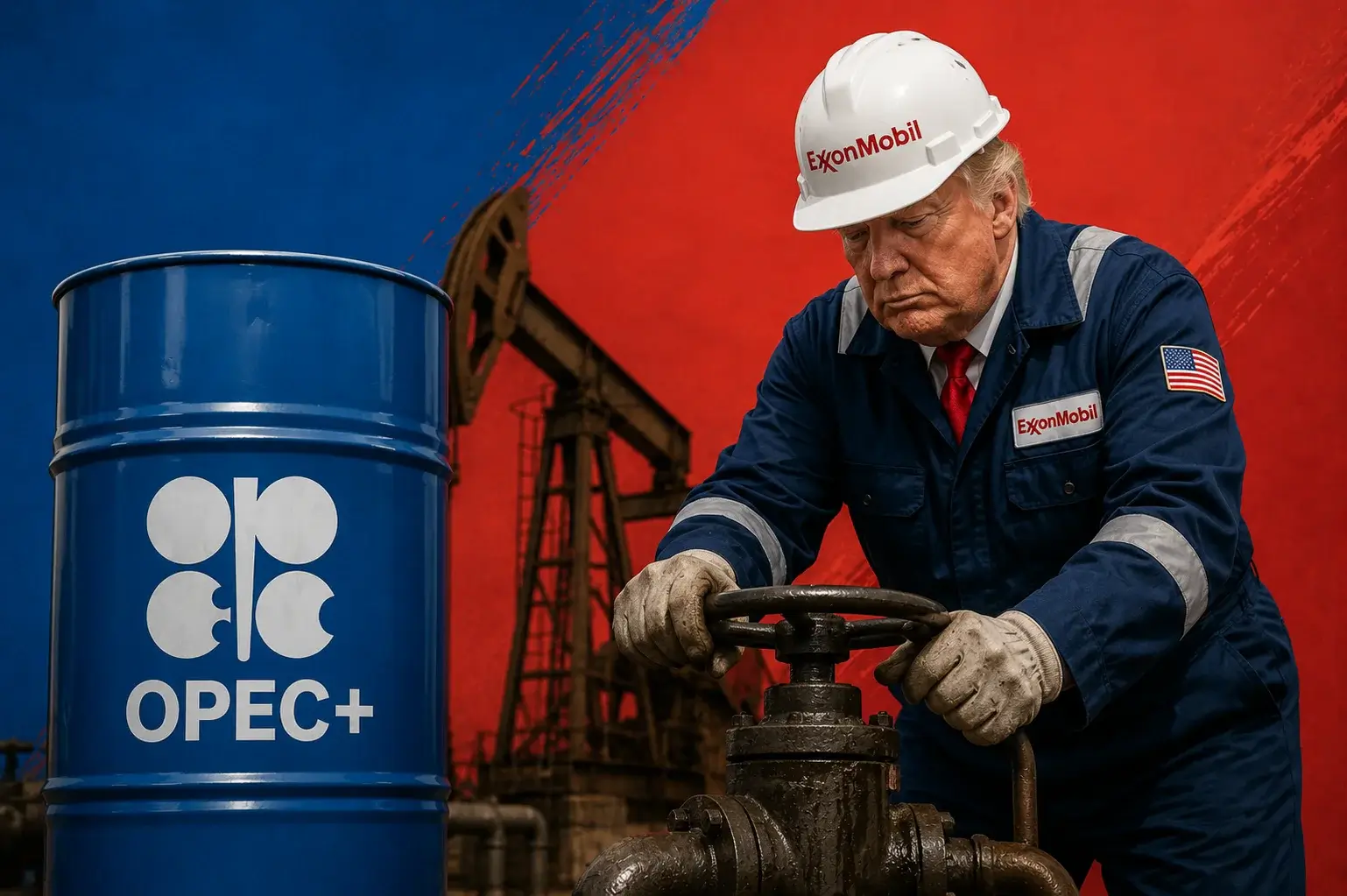
XOM Climbs to $142 as Oil Shock Sets Up a Q2 Profit Windfall — ExxonMobil Trades Below Pre-War Levels With 43-Year Dividend Intact
ExxonMobil gained 1.5% Wednesday on the crude surge, trading ~19% below its $176.41 52-week high with a Q2 net income estimate near $15.9 billion | That's TradingNEWS
Key Points
- XOM rose 1.5% to ~$142 as oil spiked on Trump's Iran remarks, trading below its pre-war price and 19% under its $176.41 high.
- Analysts see a Q2 windfall near $15.9B net income; consensus target $164-169 implies 15-20% upside, with a 2.99% dividend yield.
- Risks: a repeat of the Q1 hedging blunder (45% net income drop) and Trump's DOJ "gouging" probe pressuring Big Oil ahead of midterms.
ExxonMobil (XOM) is the ballast of the energy trade, and Wednesday it played the role exactly. As Trump declared the Iran ceasefire "over" at the NATO summit and crude ripped more than 5%, Exxon rose 1.5% to around $142 — a solid move, but a fraction of what the pure-play names did. Valero ripped 4.1%, Diamondback jumped 3.8%, Occidental caught 2.5% on an upgrade. Exxon, the largest and most diversified of the majors, moved slower because it always does. It doesn't have the torque of an E&P; it has the durability of a machine that makes money across upstream, refining, chemicals, and LNG no matter which way the barrel breaks.
The move built on a two-day energy rally. Tuesday, July 7, Exxon jumped 3.25% as the initial Strait of Hormuz tanker attacks sent crude higher, outpacing the 2.27% gain in the broader fossil-fuels sector. Chevron rose 2.61% and Shell added 3.71% the same session. Then Wednesday's escalation added another 1.5% as Trump killed the ceasefire and oil surged again. Over two sessions, Exxon climbed from roughly $137 toward $143, riding the crude spike that turned the entire energy complex into the market's one green corner while stocks got smoked.
The stock's relative restraint is a feature, not a bug. Exxon carries a $565 billion-plus market cap and a diversified earnings base that dampens its sensitivity to any single oil-price move. When crude spikes, the pure upstream names capture more of the immediate upside because every dollar flows straight to their top line. But when crude rolls over, those same names give it all back, while Exxon's refining and chemicals segments cushion the blow. The trade-off is smaller spikes for greater durability, and for the money that wants oil exposure without stomaching 4% daily swings, that's exactly the point.
What makes Exxon compelling here isn't Wednesday's 1.5% pop — it's where the stock sits after it. At around $142, XOM trades below its pre-Iran-War levels and well under its 52-week high of $176.41, even as the oil shock that should lift it intensifies. The company's own executives are warning crude could spike to $150-160 a barrel if supply disruptions persist. If they're right, Exxon's earnings power is about to explode while the stock trades at a discount to its recent highs. The ballast caught the bid Wednesday. The question is how much more it catches if oil keeps climbing.
Still Trading Below Its Pre-War Price
The most important fact about Exxon right now is the gap between the stock and the setup. At roughly $142, XOM trades below where it sat before the U.S.-Iran war began — a stock that should be a direct beneficiary of surging crude sitting at a discount to its own recent range. The 52-week span runs from $105.53 at the low to $176.41 at the high, and Exxon sits closer to the middle than the top, roughly 19% below its 52-week peak. For a company whose profits move with the oil price, trading below pre-war levels while oil rips is a dislocation.
The dislocation traces to the round trip crude took this year. When the Iran conflict flared in late February, oil spiked and energy stocks ran. Then the June 17 U.S.-Iran peace deal sent WTI down 15.5% from June 10, and the energy names gave back their war premium — Exxon among them, sliding as crude unwound. The stock got repriced for a world where Iranian barrels returned and oil normalized. Wednesday's escalation blew that assumption up, but the stock hasn't fully re-priced the new reality. It's caught between the peace-deal selloff and the fresh war premium.
That lag is the opportunity. BofA flagged it directly when it upgraded the stock, pointing out that shares were trading below prices from before the Iran war even started, and initiated a $154 target. The stock is pricing a benign oil environment that no longer exists. If crude holds its war premium — let alone climbs toward the $150-160 Exxon's executives are warning about — the earnings power the stock is discounting is far too low, and the gap between the $142 price and the $164-169 analyst consensus closes.
The five-year context frames the quality underneath the dislocation. Exxon has returned roughly 174% over five years, compounding through dividends, buybacks, and the Guyana-driven production ramp. That's not a broken stock trading below pre-war levels because the business deteriorated — it's a high-quality compounder that got caught in the oil-price round trip and hasn't re-rated for the fresh escalation. The setup is a quality name at a discount to its range, with an oil tailwind building and a Q2 profit windfall coming. Trading below its pre-war price isn't a warning sign here. It's the entry point.
The Q2 Profit Windfall Is Coming
Exxon told the market a windfall is coming, and it did so in writing. On July 7, the company filed an 8-K outlining the factors expected to shape its Q2 2026 performance, explicitly flagging the ongoing Middle East unrest as a significant consideration affecting oil supply and pricing. The filing was read across the Street as Exxon signaling a Q2 profit windfall as higher oil prices boost the bottom line. When a company pre-announces the drivers of a strong quarter, it's telling investors to raise their estimates, and the estimates are moving.
The numbers analysts are penciling in are substantial. Consensus points to Exxon reporting roughly $15.9 billion in adjusted net income for Q2, a strong recovery for a company whose full-year 2025 earnings totaled $28.84 billion. That would mark a sharp acceleration from Q1's $8.77 billion in underlying earnings, driven by the crude spike that lifted realized prices across Exxon's massive upstream base. With the company producing 3.3 million barrels of liquids and 8.4 billion cubic feet of gas per day, even a modest rise in realized prices flows to enormous absolute profit, and the Iran-driven spike is far from modest.
The mechanism is Exxon's scale. As one of the world's largest integrated producers, with 4.6 million barrels of oil-equivalent daily output when gas is included, Exxon captures the oil-price move across an operational footprint few companies can match. Rising benchmarks translate directly to enhanced cash flow, and the market knows it — institutional investors are rotating toward large-cap energy firms with resilient balance sheets precisely to capture this dynamic. Exxon is the biggest, most liquid way to own the Q2 profit surge the oil shock is generating.
The timing sets up a catalyst. Exxon reports Q2 results at the end of July, and if the $15.9 billion estimate holds, it would be among the strongest quarterly profits the company has posted in years. U.S. oil companies broadly are set to report their best quarterly profits in years, courting a possible clash with the White House over gas prices. For Exxon shareholders, the windfall is the near-term catalyst that could close the gap between the $142 stock and the $164-plus targets. The company pre-announced the drivers. The oil price is cooperating. The Q2 print is the moment the profit windfall shows up in the numbers, and the setup points to a strong one.
The Q1 Hedging Blunder That Could Repeat
The bull case has a genuine flaw, and it showed up in Q1. Exxon failed to capture the full profit from prior price surges because it locked in selling prices through financial hedges before the physical market broke above $100 a barrel. When crude ripped higher, Exxon was stuck selling at the lower hedged prices, missing the upside. The result was a steep 45% year-over-year decline in net income — a self-inflicted wound that had nothing to do with production or costs and everything to do with hedging the wrong way at the wrong time.
The risk is that it repeats in Q2. If Exxon carried similar hedges into the current quarter, the Iran-driven crude spike could once again find the company selling barrels at prices locked in before the escalation, capping the windfall the market is pricing. That's the tension in the $15.9 billion Q2 estimate — it assumes Exxon captures the higher prices, but the Q1 experience shows the company's hedging can blunt exactly that capture. A hedging structure that limited Q1 upside could limit Q2 upside too, and the market won't know until the print.
This is the wrinkle that separates Exxon from the pure-play producers on an oil spike. A company like Diamondback, running less hedged and closer to spot, captures more of the immediate crude move — which is part of why FANG jumped 3.8% Wednesday to Exxon's 1.5%. Exxon's hedging and its diversified, integrated model dampen its sensitivity to the barrel in both directions. On the way up, that's a drag; on the way down, it's protection. The Q1 blunder was the drag showing up at the worst possible time, right as prices broke higher.
For the Q2 setup, the hedging question is the swing factor between a monster quarter and merely a good one. If Exxon rolled off the restrictive Q1 hedges and is capturing closer to spot prices, the $15.9 billion estimate is achievable and the stock has room to run toward the targets. If the hedges carried over, the windfall gets capped and the stock could disappoint even in a strong oil environment. Investors watching the Q2 print should focus less on the headline oil price and more on Exxon's realized prices relative to the benchmark — that spread reveals whether the hedging blunder repeated. It's the single biggest risk to the profit-windfall thesis, and it's entirely within Exxon's own control.
A Fortress Balance Sheet
Whatever the hedging risk, Exxon's balance sheet is among the strongest in the entire market. The debt-to-equity ratio sits at 0.17 — remarkably low for a capital-intensive energy major — and interest coverage runs at 56 times, meaning the company earns 56 times what it owes in interest. Those figures describe a fortress. Exxon can fund its growth capital, sustain its dividend, and execute buybacks entirely from cash flow without straining its finances, which is exactly why institutional money rotates into it during volatility. It's the energy name that can't be broken by a downturn.
The balance-sheet strength is what makes Exxon defensive within a cyclical sector. Oil is a boom-bust industry, and most producers carry leverage that becomes dangerous when prices fall. Exxon's minimal debt means it can weather a crude collapse that would cripple a leveraged E&P, maintaining its dividend and buybacks through the trough while competitors cut. That durability is the core of the ballast thesis — Exxon offers oil exposure with downside protection that the pure-play names simply can't match, because their balance sheets can't absorb a sustained price drop the way Exxon's can.
The financial strength shows up in the ratings. GuruFocus scores Exxon's Financial Strength at 7 out of 10 within a GF Score of 68, reflecting the robust balance sheet and operational efficiency. The strong cash flow funds Exxon's growth without straining the balance sheet, which is precisely the combination that lets the company outperform even if oil prices stay flat — it doesn't need rising crude to fund its dividend and buybacks, it just needs to keep producing at low cost, which it does.
The fortress balance sheet also underpins the capital-return story that anchors the investment case. A company with 0.17 debt-to-equity and 56x interest coverage has enormous financial flexibility — it can raise the dividend for a 43rd straight year, buy back billions in stock, fund Guyana and LNG expansion, and still carry minimal risk. That flexibility is why Exxon can commit to $27-29 billion in annual capex while returning cash to shareholders without borrowing. In an industry where balance-sheet stress is the primary risk, Exxon's is a genuine competitive advantage, and it's the reason the stock functions as the defensive anchor of the energy trade rather than a leveraged bet on the barrel.
43 Years of Dividend Hikes
Exxon's dividend is a 43-year machine, and it's the backbone of the investment case. The company pays $1.03 quarterly, raised from $0.99 with the February 2026 ex-dividend, extending what is now 43 consecutive years of annual dividend increases — a streak that spans multiple oil crashes, recessions, and price cycles. That consistency makes Exxon a Dividend Aristocrat of the highest order, and it's why the stock is a core holding for income investors who want energy exposure with a payout they can count on through any environment. The yield sits at 2.99%, backed by the fortress balance sheet.
The 43-year streak is a statement about Exxon's business model and discipline. Maintaining and growing a dividend through the 2008 crash, the 2014-2016 oil collapse, the 2020 pandemic price war, and every cycle in between required a company built to generate cash across price environments. Exxon's integrated model — upstream, refining, chemicals, LNG — provides diversified cash streams that don't all move together, which is what lets the dividend keep rising even when one segment struggles. The payout isn't a promise Exxon hopes to keep; it's a commitment the business has honored for four decades and structured itself to protect.
The buybacks compound the capital return. Exxon returned $4.9 billion through stock repurchases in Q1 2026 alone, on top of the dividend, reducing the share count and boosting per-share metrics. The combination of a growing dividend and massive buybacks is the total-return engine that drove the stock's roughly 174% five-year return — investors got paid to hold through the cycle while the share count shrank. That dual capital return is more sustainable at Exxon than almost anywhere in the sector because the balance sheet funds it without strain.
For the current setup, the dividend and buybacks provide a floor under the stock. Even if the oil trade cools or the Q2 hedging blunder repeats, the 2.99% yield and the ongoing repurchases limit the downside — investors get paid to wait, and the buybacks provide steady demand for the shares. That floor is what makes Exxon a lower-risk way to play the energy tailwind. The pure-play names offer more upside torque but no dividend cushion; Exxon offers a 43-year payout, billions in buybacks, and a balance sheet that guarantees both continue. The capital return is the reason to own the ballast, and it's the reason the stock holds up when the barrel doesn't.
Guyana Is the Growth Engine
The knock on the majors is that they can't grow, and Exxon's answer is Guyana. The offshore Guyana development is one of the most prolific oil discoveries of the century, and Exxon operates it — production topped a record 900,000 gross barrels per day, and it keeps climbing. Guyana is the growth engine that lets Exxon expand production and cash flow even without rising oil prices, because it's adding barrels at some of the lowest costs in the industry. For a company that critics dismiss as a no-growth dividend payer, Guyana is the counterargument.
The economics are what make Guyana special. The offshore fields produce oil at breakeven costs well below current prices, which means every barrel Exxon adds there generates substantial free cash flow even if crude falls. That's the key to the "outperform even if oil stays flat" thesis — Exxon doesn't need higher prices to grow earnings; it needs to keep ramping low-cost Guyana barrels, which it's doing. The 900,000 gross bpd record is a milestone on a trajectory that continues higher, adding production and cash flow year after year regardless of the oil-price environment.
Guyana pairs with the Permian to form Exxon's upstream growth core. The Permian Basin, America's most prolific onshore field, provides scalable domestic production that Exxon can dial up or down with prices, while Guyana provides the low-cost offshore growth. Together they anchor Exxon's 4.6 million barrels of oil-equivalent daily output and its 19.3 billion barrels of proved reserves, 69% of which are liquids. That reserve base and production growth give Exxon a runway that most majors lack — it's not managing decline, it's managing expansion.
The growth engine reframes the valuation debate. A no-growth oil major deserves a low multiple because its earnings are purely a bet on the oil price. But a major with a genuine low-cost growth engine in Guyana and the Permian deserves more, because it can compound production and cash flow independent of the barrel. That's the case for Exxon commanding a premium to peers — it has the growth the others lack. GuruFocus scores Exxon's Growth at just 4 out of 10, reflecting the recent revenue decline, but that backward-looking score misses the forward Guyana ramp. The growth engine is real, it's low-cost, and it's the reason Exxon can outperform even in a flat-oil world. Guyana is the answer to the no-growth critique.
The LNG Land Grab
Beyond oil, Exxon is racing to dominate liquefied natural gas, and the timing is perfect. As the Iran conflict threatens Persian Gulf gas supply, global LNG demand is rising, and Exxon is expanding its footprint aggressively. Golden Pass LNG, a joint venture with QatarEnergy, shipped its first cargo in April 2026, opening a new earnings stream as global demand absorbs lost supply. The project positions Exxon to capture the premium pricing that comes when geopolitical disruptions tighten the gas market — exactly the environment the Hormuz standoff is creating.
The LNG expansion spans continents. Beyond Golden Pass in the U.S., Exxon is developing the Coral Norte FLNG project offshore Mozambique and signed a preliminary deal to supply LNG to South Africa's Zululand Energy Terminal, set to become that country's first LNG import facility. Add the 8-9 trillion cubic feet of gas discovered offshore Cyprus, and Exxon is assembling a global LNG portfolio spanning production, liquefaction, and long-term supply agreements. Each project adds a new stream of gas earnings that diversifies Exxon away from pure oil-price dependence.
The strategic logic is that LNG is the growth market of the energy transition. As the world shifts from coal and seeks cleaner-burning gas, and as geopolitical disruptions repeatedly threaten supply, LNG demand grows structurally. Exxon is building the infrastructure to serve that demand at scale, and the current Hormuz-driven supply anxiety accelerates the case — every threat to Gulf gas flows makes Exxon's diversified LNG portfolio more valuable. The company is positioning for a multi-decade LNG demand ramp, and the projects coming online now are the early innings.
For the investment case, LNG adds a growth vector that oil-price bears can't easily dismiss. Even in a scenario where oil demand plateaus, LNG demand keeps rising, and Exxon's expanding portfolio captures that growth. The Golden Pass first cargo, the Mozambique and South Africa projects, and the Cyprus reserves form a pipeline of gas earnings that layers on top of the Guyana oil growth. Together, oil and LNG give Exxon two independent growth engines, which is what a company needs to justify a premium multiple and sustain a 43-year dividend into the future. The LNG land grab is Exxon buying its next decade of growth while the market focuses on this quarter's oil price.
Read More
-
Yen Stalls at 160 Despite a 3% JGB and Tokyo Core CPI at 2.0% — Intervention Sits at 164, Friday's Payrolls Decide
02.09.2026 · TradingNEWS ArchiveEnergy
-
QQQ ETF ($706.22) Slides 7.4% Below Its High as the Market Reprices the AI Capex Bill — $686.57 Target if $700 Breaks
22.10.2026 · TradingNEWS ArchiveStocks
-
XRPI ($7.00) and XRPR ($10.74) Slide Toward 52-Week Lows as Spot XRP ETF Flows Stall at $708,510
22.10.2026 · TradingNEWS ArchiveCrypto
-
NG ($2.775) Decoupled From Europe’s €88 Gas Crisis as LNG Feedgas Hits 18.9 Bcf/d — $3.30 Upside on Cold Weather
22.10.2026 · TradingNEWS ArchiveCommodities
-
Dollar-Yen (157.35) Loses 157.65 as the Yen Rallies on Haven Demand — 155 Target if 156 Breaks
22.10.2026 · TradingNEWS ArchiveForex
Cheap on Forward Earnings, Rich on Trailing
Exxon's valuation tells two stories depending on which earnings you use. On trailing earnings, the stock looks expensive — a P/E around 23 to 24 times, elevated because 2025 earnings fell 14% and Q1 2026 net income dropped 45% year-over-year on the hedging blunder. That depressed earnings base inflates the trailing multiple, making Exxon appear richly valued. The skeptics, including analysts who cut targets ahead of Q2, argue the 23x-plus multiple represents overvaluation that already discounts Exxon's long-term free cash flow.
On forward earnings, the picture flips. The 2026 consensus EPS estimate has climbed to $9.21, up from $8.28, and against the roughly $142 stock price that's a forward P/E near 15 times — a reasonable multiple for a company with Exxon's quality, growth, and capital return. The gap between the 23x trailing and 15x forward multiple is the entire valuation debate. Bears anchor on the trailing figure and the depressed earnings; bulls anchor on the forward recovery, arguing the oil shock and Guyana ramp drive earnings sharply higher, collapsing the multiple. The Q2 windfall is the catalyst that would validate the forward view.
The other valuation metrics sit in a similar tension. EV/EBITDA jumped to 10.97x in Q1, elevated by the earnings decline, while the 2026 revenue forecast climbed to $368.3 billion and net income is forecast to grow 34% next year. A company growing net income 34% with a 15x forward multiple isn't expensive — it's reasonably priced for the growth. The trailing metrics reflect the trough Exxon just passed through; the forward metrics reflect the recovery it's entering, powered by higher oil and rising Guyana production.
For an investor, the valuation question is whether to trust the trailing trough or the forward recovery. The trailing 23x P/E says wait for a pullback; the forward 15x P/E says the stock is cheap for the growth coming. The tiebreaker is the oil environment and the Q2 print. If crude holds its war premium and Q2 delivers the $15.9 billion the estimates project, the forward earnings materialize, the multiple compresses, and the stock re-rates toward the $164-169 targets. If the hedging blunder repeats and oil rolls over, the trailing multiple stays elevated and the stock stalls. Exxon is cheap on forward earnings and rich on trailing — and the oil shock plus Q2 print determine which valuation wins.
The Analyst Consensus Sees 15-20% Upside
Wall Street is broadly bullish on Exxon, with real upside embedded in the targets. Across 20-22 analysts, the consensus rating is Buy, with 14 Buy ratings, 5 Holds, and zero Sells in one recent tally. The consensus price target clusters between $162.80 and $169.26, with MarketBeat at $164.70, Simply Wall St at $164, and StockAnalysis at $169.26. Against the roughly $142 stock, that implies 15-20% upside over the next 12 months — a meaningful return on top of the 2.99% dividend yield.
The bullish consensus rests on the quality-plus-oil-tailwind case. Analysts see Exxon benefiting from the strong commodity environment as one of the largest, most financially stable oil companies, with the size and balance sheet to reliably capture the upside. The most aggressive scenario runs to $240 assuming $100/barrel Brent in 2026 and a strong recovery in refining and chemicals — a bull case that Wednesday's oil spike toward the $150-160 Exxon's executives warn about makes less far-fetched than it sounded a month ago. Higher crude directly lifts the earnings that drive the targets.
Not every desk is cheerleading, and the recent cuts matter. Ahead of Q2 earnings, several firms trimmed targets: TD Cowen cut to $155 from $172 while keeping a Buy, and Morgan Stanley adjusted to $168. The bears argue Exxon's 23x-plus trailing multiple already fully discounts its long-term free cash flow, meaning the stock is priced for perfection. RBC holds a Hold rating. These cuts reflect skepticism that the forward earnings recovery is fully secure given the Q1 hedging miss and the political overhang, and they temper the bullish consensus with genuine caution.
The spread between the $155 low targets and the $169-240 high scenarios captures the range of outcomes. The floor cases assume Exxon captures modest oil upside with the hedging and political risks weighing; the ceiling cases assume the company captures the full crude spike and the refining-chemicals recovery. The Buy consensus and the 15-20% implied upside make Exxon an attractive risk-reward for the oil-tailwind thesis, but the target cuts warn that the setup isn't riskless. The analyst community sees Exxon as a quality name with real upside, tempered by execution and political risk — which is a fair read of a stock trading below its pre-war price with a Q2 windfall coming and a DOJ probe hanging overhead.
Trump's Gouging Probe Is the Real Overhang
The genuine threat to Exxon isn't oil prices — it's Washington. Trump has been ramping up pressure on Big Oil to lower gas prices ahead of the November midterms, and in late June he accused oil companies including Exxon and Chevron of "gouging" customers, ordering a DOJ probe into the industry. That's a direct political attack on the sector's profits at the exact moment those profits are set to explode on the oil spike. The overhang is real: Exxon is about to report its strongest quarterly profits in years into a political environment where those profits become a liability.
The timing creates a genuine clash. U.S. oil companies are set to post their best quarterly earnings in years, courting a confrontation with a President who has been pressing his longtime ally Big Oil to bring down gas prices. Exxon's Q2 windfall — the same $15.9 billion the bulls are celebrating — is precisely what makes it a target. A company reporting record profits while consumers pay high gas prices ahead of an election is a political piñata, and the DOJ probe gives the administration a tool to apply pressure. The better Exxon's quarter, the sharper the political scrutiny.
The industry's response has been to plead helplessness. Chevron's CFO said the majors are "doing everything we can" on gas prices and that there's "no quick fix" — a message that the price of gasoline is set by global crude markets, not corporate greed. That's factually true; Exxon can't lower pump prices when crude is spiking on a Middle East war. But the political reality doesn't care about the mechanics. An administration facing midterm pressure over gas prices needs a villain, and Big Oil reporting record profits is the obvious choice, regardless of whether the companies actually control the prices consumers pay.
For the stock, the political overhang caps the upside narrative just as the fundamentals improve. Even if Exxon delivers a monster Q2 and oil climbs toward $150, the DOJ probe and midterm rhetoric create a headline risk that can pressure the shares independent of earnings. The market has to price the possibility of windfall taxes, regulatory action, or sustained political attacks on the sector's profitability. That's the reason a stock trading below its pre-war price with a profit windfall coming hasn't simply run to its targets — the political risk is a real discount factor. Trump's gouging probe is the overhang that keeps Exxon cheap, and it won't lift until the midterms pass or the administration finds a different target.
Exxon vs Chevron vs ConocoPhillips
Within the majors, Exxon competes for capital against Chevron and ConocoPhillips, and each offers a different flavor of the oil trade. Chevron (CVX), up 2.61% on July 7's energy rally, is pursuing U.S. shale and new energy demand from the technology sector. Its Q1 EPS of $1.41 crushed the $0.97 estimate by 46%, fueled by the Hess acquisition that lifted production 15% to 3,858 thousand barrels of oil-equivalent per day. Chevron's differentiator is a 20-year natural gas partnership with Microsoft — a "behind-the-meter" deal to power data centers — plus a lithium foothold in the Smackover Formation. Chevron is the major making the boldest bet on tech-driven energy demand.
ConocoPhillips (COP) is the purer upstream play. Its Q1 EPS of $1.89 beat the $1.69 estimate by 12%, and it's committed to returning 45% of cash flow from operations to shareholders in 2026. The growth engine is real: Willow in Alaska reached 50% completion, Port Arthur LNG starts up in the second half of 2026, and management targets $7 billion of incremental free cash flow by 2029. As a pure-play E&P, ConocoPhillips carries the highest commodity sensitivity of the three — it captures more upside when oil rips but offers less downside protection than the integrated majors.
Exxon's position against the two is scale and diversification. Where Chevron bets on tech-driven demand and ConocoPhillips offers pure upstream torque, Exxon leverages its massive global scale across upstream, refining, chemicals, and LNG to lead in absolute size and stability. It produces more than either peer, carries the strongest balance sheet, and offers the longest dividend streak at 43 years. The trade-off is that Exxon's diversification dampens its oil-price torque — it rose less than the pure-plays Wednesday — but it provides the most durable, lowest-risk exposure to the energy tailwind.
The choice among them comes down to risk appetite. ConocoPhillips offers the most oil-price torque for investors who want maximum leverage to crude. Chevron offers a growth story tied to tech demand and the Hess integration. Exxon offers the ballast — the largest scale, the strongest balance sheet, the longest dividend, and the Guyana-plus-LNG growth engine that works even if oil stays flat. For the money that wants to own the oil shock with the least risk of a balance-sheet blowup or a dividend cut, Exxon is the anchor. It won't spike like ConocoPhillips or pivot like Chevron, but it's the major built to compound through any environment. In the peer group, Exxon is the quality-and-durability choice.
The Texas Move and the $150 Oil Warning
Two corporate developments frame Exxon's current moment. First, the company completed its redomiciliation from New Jersey to Texas, effective July 1, 2026, transitioning its parent legal entity to ExxonMobil Holdings Corporation under the Texas Business Organizations Code. The move came with a board reset and a corporate-governance restructuring, and the market read it as a positive structural development — aligning Exxon's legal home with its operational base in Spring, Texas, and signaling a leaner corporate structure. Trading continued seamlessly under the same XOM ticker.
Second, and more consequential for the stock, Exxon's executives issued a striking warning about oil supply. Management flagged that global oil inventories are near historic lows, with the potential for crude prices to spike to $150-160 per barrel in the coming weeks if supply disruptions persist. Coming from the world's largest integrated producer with unmatched visibility into global supply, that warning carries weight. It's not a trader's speculation — it's the assessment of the company that sees the physical barrels move, and it points to an oil environment far more bullish than the current $75 WTI.
The $150-160 warning reframes the entire Exxon thesis. If crude climbs toward those levels, Exxon's earnings power explodes — the $15.9 billion Q2 estimate would look conservative, the forward EPS would blow past $9.21, and the bull-case $240 target scenario built on $100 Brent would look outdated. The company is essentially telling investors that the oil market is tighter than the price suggests and that a supply-driven spike is a real risk. For a stock trading below its pre-war price, that warning is a signal that the earnings the market is discounting are far too low.
The tension is that the same $150 oil that would enrich Exxon's shareholders would intensify the political overhang. Crude at $150 means gas prices soar, which means the Trump gouging probe and midterm pressure escalate sharply. Exxon's own warning about $150 oil is simultaneously the bull case for its earnings and the trigger for the political risk that caps its stock. That paradox — great for profits, terrible for politics — is the defining tension in the Exxon trade right now. The Texas move streamlined the company; the $150 warning defined the opportunity and the risk. Both point to a stock at an inflection: cheap, with a profit windfall coming, and a political target on its back.
Where XOM Breaks From Here
Exxon is the ballast of the energy trade, and the setup is compelling. At around $142, the stock trades below its pre-Iran-War price and 19% under its 52-week high of $176.41, even as the oil shock that should lift it intensifies. It caught the crude bid Wednesday with a 1.5% gain, added to Tuesday's 3.25% pop, and it's positioned to capture a Q2 profit windfall that analysts estimate near $15.9 billion. The stock offers a 43-year dividend at a 2.99% yield, a fortress balance sheet at 0.17 debt-to-equity, and a Guyana-plus-LNG growth engine that works even if oil stays flat.
The bull case is quality at a discount with an oil tailwind. The forward P/E near 15 is reasonable for a company forecast to grow net income 34%, the analyst consensus at $164-169 implies 15-20% upside, and Exxon's own executives are warning crude could hit $150-160 — a scenario that would blow past every current estimate. The Guyana ramp toward and beyond 900,000 gross bpd, the Golden Pass LNG first cargo, and the $4.9 billion quarterly buybacks form a compounding machine that has returned 174% over five years. If oil holds its war premium, the stock re-rates toward its targets.
The bear case is real and worth respecting. The Q1 hedging blunder that drove a 45% net income decline could repeat, capping the Q2 windfall the bulls are counting on. The trailing 23x P/E looks expensive, and TD Cowen and Morgan Stanley cut targets on valuation concerns. Most significant, Trump's DOJ gouging probe and midterm pressure on Big Oil create a political overhang that caps the upside just as profits explode — and the $150 oil that would enrich Exxon would escalate that political risk sharply. The paradox is that Exxon's best-case earnings scenario is also its worst-case political scenario.
The trade from here is to own the ballast for the oil tailwind while respecting the risks. Watch the Q2 print at end-July — the key is Exxon's realized prices versus the benchmark, which reveals whether the hedging blunder repeated. Watch crude toward the $150 Exxon warns about — if it climbs, the earnings and the stock follow, but so does the political scrutiny. Watch the DOJ probe and midterm rhetoric — the overhang that keeps the stock cheap. At $142 with a Q2 windfall coming, a 43-year dividend, a fortress balance sheet, and 15-20% upside to the consensus, Exxon is the quality way to play the energy shock. It won't spike like the pure-plays, but it's the anchor built to compound through the cycle. Buy the ballast, mind the politics, and watch the realized prices.