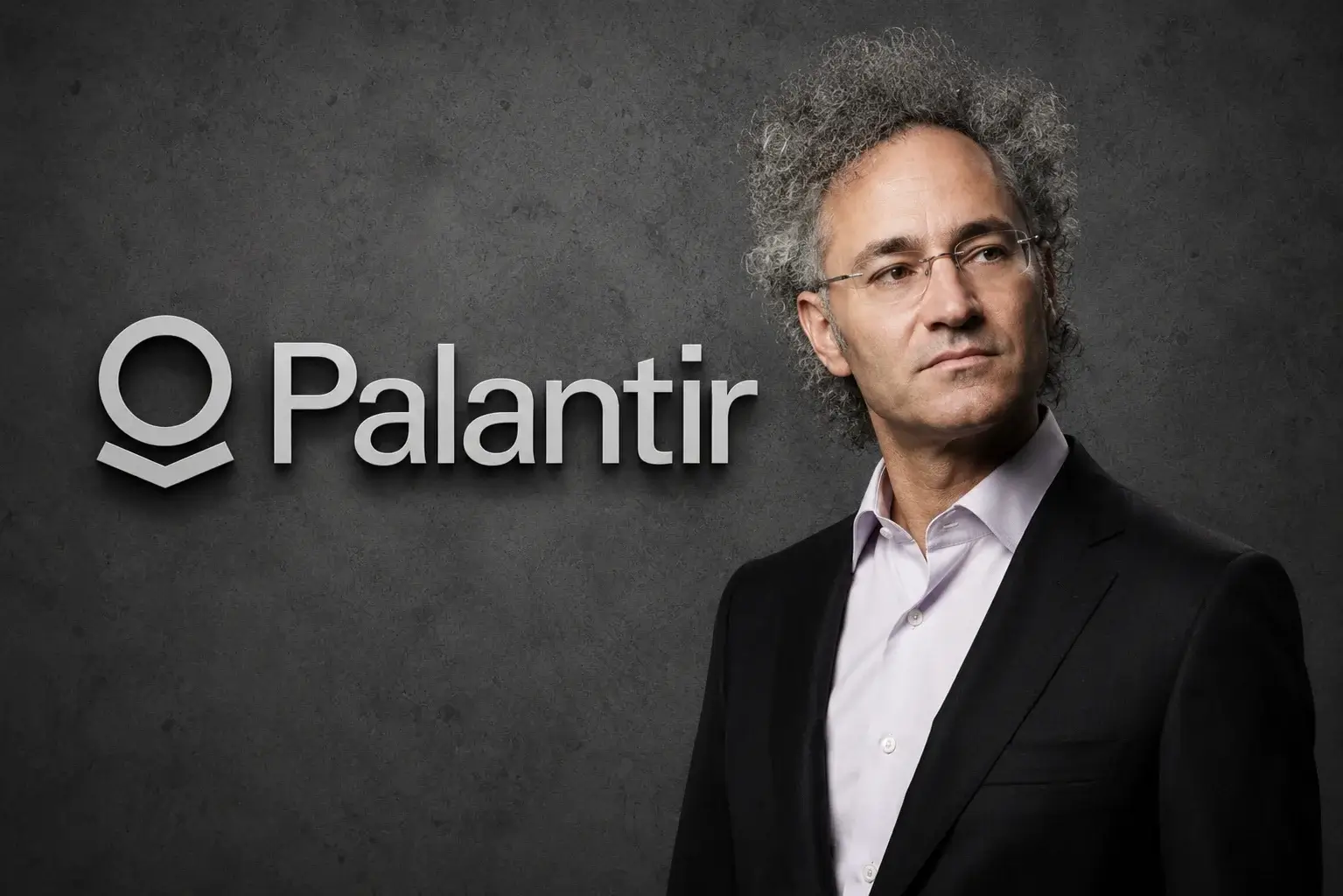
Palantir Stock Price Forecast: PLTR Shares at $137 With Pentagon Program-Of-Record Catalyst — Commercial +137%, Valuation at 227x
Q1 revenue $1.63B beat, FY26 guide raised to $7.66B (+71%), Maven contract ceiling at $1.3B | That's TradingNEWS
Key Points
- PLTR trades $136.88 (-20% YTD) with Q1 revenue +85% to $1.63B and net income 4x to $870M; FY26 guide $7.66B.
- Maven Smart System now official Pentagon program of record; contract ceiling raised to $1.3B through 2029.
- Consensus PT $195.16; range $70 (Jefferies bear) to $260 (bull); valuation at 227x P/E, 60-80x fwd sales.
Palantir Technologies (PLTR) is trading near $136.88 heading into Tuesday's session, after closing at that level on May 22 and slipping 0.39% on the day before the Memorial Day holiday weekend. The stock sits roughly 33% below its November 2025 all-time high of $207, and it has declined approximately 18-20% year-to-date in 2026 — a striking divergence from one of the strongest fundamental quarters in the company's history. The 52-week range stretches from a low that has tracked $130-$135 in recent sessions to that $207 peak, with the past two weeks defining a consolidation between $128 (the downside stop bullish chart-readers are using) and $144-$145 resistance from the post-Q1 reaction high. Market capitalization sits at roughly $328-$338 billion depending on the intraday print, with a beta of 1.34 (meaningfully above the broader market's 1.0) and intraday volatility of 3.51% — both confirming that PLTR remains one of the most sentiment-sensitive single names in the S&P 500. A buy signal was issued from a pivot bottom on May 13 and has produced a 5.25% rise since, with accumulated-volume support at $135.91 marking the immediate floor that bulls are defending.
Q1 2026 Earnings Recap: The $1.63B Beat And Why It Wasn't Enough
The May 4 Q1 2026 release was, by almost any conventional metric, one of the strongest reports in Palantir's history as a public company, and the post-print reaction is the single most informative data point for the current setup. Revenue printed at $1.63 billion versus the $1.54 billion LSEG consensus — a $90 million beat that translated into 85% year-over-year growth, the fastest pace of revenue acceleration since at least 2020 when the company went public via direct listing. Adjusted EPS came in at $0.33 versus the $0.28 expected (an 18.96% surprise), and net income quadrupled to $870.5 million ($0.34 per share) from $214 million ($0.08 per share) a year earlier. Total contract value (TCV) bookings rose 138% to $4.3 billion, net dollar retention reached 139%, and the print marked the 10th consecutive quarter of accelerating revenue growth — the kind of structural acceleration pattern that is exceptionally rare in software at this scale. Yet the stock fell roughly 12% the day after the print and has not recovered, with the post-earnings slide reflecting investor anxiety about the valuation rather than the underlying numbers. CEO Alex Karp's shareholder letter framed the disconnect directly: "There seems to be a rotation amongst AI model companies who engage in an intensely competitive race in which we have seen token costs suffer a thousandfold decline over just a few years and where winners and losers swap places every six months. Our path has been different, building a juggernaut of a business that is delivering results to our partners in the world as it is today."
FY 2026 Guidance Raised To $7.65B-$7.66B (+71% YoY)
Alongside the Q1 beat, Palantir lifted its full-year 2026 revenue guidance to $7.65 billion to $7.66 billion, implying an annual revenue jump of 71% and substantially above the prior $7.27 billion LSEG consensus. The February pre-raise guidance was $7.182-$7.198 billion, which means management has lifted the full-year revenue framework by roughly $460 million in three months — a guidance trajectory consistent with the 10-quarter accelerating-growth pattern. U.S. commercial revenue is now guided to exceed $3.1 billion in 2026, which would represent at least 115% year-over-year growth on top of the 137% YoY growth posted in Q4 2025. For perspective, the entire commercial segment (U.S. and international combined) was less than $3.1 billion three years ago, which is the math that Morgan Stanley's Sanjit Singh referenced when he wrote after Q4 2025 that "with 2026 guidance targeting growth of +61%, PLTR is on course to reach $10B in revenue at the fastest growth rate and highest margins perhaps in software history, underscoring its status as a clear AI winner." The Q1 raise reinforces that trajectory rather than challenging it.
The Maven Smart System: Pentagon Program Of Record
The single most important development for Palantir's long-term thesis in the past 90 days was the March 2026 designation of the Maven Smart System (MSS) as an official Pentagon "program of record" — a determination signed by Deputy Secretary of Defense Steve Feinberg that fundamentally changes the durability of Palantir's government revenue line. "Program of record" status in defense-contracting terms is about as permanent as anything gets: it places Maven inside the military's formal multi-year budget system with a protected line item across budget cycles. Experimental programs get cut in budget contractions; programs of record don't. The Maven contract ceiling trajectory tells the underlying story: $480 million in May 2024, raised to $1.3 billion in May 2025, with a separate $795 million modification added later in 2025 — a 2.7x expansion in 18 months that reflects accelerating Pentagon adoption rather than a one-off contract win. The effective contract lifespan extends to 2029. Maven itself is a command-and-control AI platform ingesting data from more than 150 sources — satellite imagery, drone video, radar, infrared sensors, signals intelligence — and running computer-vision algorithms to identify battlefield targets in near-real-time. The National Geospatial-Intelligence Agency has stated Maven can generate 1,000 targeting recommendations in the time a human analyst produces one, which captures the labor-substitution math that drives further procurement expansion. MSS is now a core component of the DoD's Combined Joint All-Domain Command and Control (CJADC2) infrastructure, integrated across the Army, Air Force, Space Force, Navy, and Marine Corps.
U.S. Commercial Surge And The AIP Platform
The most underappreciated driver of Palantir's growth is not the government business — it's the commercial side, and specifically the AIP (Artificial Intelligence Platform) software layer that has become the company's enterprise wedge. Q4 2025 U.S. commercial revenue grew 137% year-over-year, and the FY 2026 commercial guide implies that triple-digit pace continues. The AIP platform — which sits on top of Foundry and connects enterprise data to large language models in a way that preserves data sovereignty and security guarantees — has been the differentiating product Palantir's sales motion has wrapped around since 2024. The "boot camp" go-to-market motion that Wedbush's Daniel Ives has flagged repeatedly involves embedding Palantir engineers inside customer organizations for 1-5 day sprints that produce a working AIP deployment by the end — a sales-engineering model that has compressed the typical enterprise software sales cycle from 18 months to 3 months and produced the surge in commercial bookings. Notable commercial milestones include AI modernization deals with the USDA, expansion deals with industrial customers (Airbus, BP, Stellantis), and several healthcare and financial-services wins. The commercial business is now structurally insulated from the government-contract-cycle volatility that historically defined the Palantir investment case.
Government Segment: $2.4B Of $4.47B In 2025, +53% Growth
The government segment remains the foundation of Palantir's revenue profile and the larger of the two business lines on a trailing basis. Government revenue accounted for $2.4 billion of total $4.47 billion 2025 revenue, with the segment growing 53% in 2025 alone. With the Maven program-of-record designation locking in the multi-year DoD revenue stream, the question is no longer whether government revenue grows but how quickly it scales relative to the commercial surge. Palantir is positioned to capture a meaningful slice of the Pentagon's $25 billion 2026 AI budget — Wedbush's Daniel Ives' previous $140 price target was framed around the company capturing "even a sliver" of that budget, which itself implies meaningful upside from current Maven run-rate revenue. The Iran war has accelerated DoD AI procurement broadly, and Palantir's positioning as the de-facto "Pentagon AI architect" means each new Hormuz escalation, each new battlefield deployment, and each new NATO integration translates directly into incremental Palantir revenue. The flip side: the same government revenue concentration creates dependency risk if Pentagon priorities shift or if procurement reform compresses the contract-ceiling expansion path that has defined recent years.
The Valuation Question: 227x P/E And 60-80x Forward Sales
The single largest source of disagreement on Palantir is valuation, and the math is genuinely jarring. PLTR trades at a 227x trailing P/E and roughly 60-80x forward sales depending on the day — multiples that place it as one of the most expensive stocks in the S&P 500 on virtually every conventional ratio. Operating margin sits at 40.9%, profit margin at 36.3%, return on equity at 26.0%, and trailing-twelve-month revenue at $4.48 billion. Those numbers individually look software-elite. The question is whether the 60-80x forward sales multiple is justified by the structurally faster growth and structurally larger TAM that Palantir's defenders argue for, or whether the multiple normalizes lower as growth decelerates. The bear case from Jefferies sits at a $70 12-month price target — roughly 51% downside from current spot — and is anchored on the simple argument that even continued growth at 60% per year cannot sustain 60-80x sales indefinitely, and that a multiple compression to even 20-30x forward sales (still elite by software standards) would reset the stock toward the $70-$90 range regardless of fundamental progress.
The Analyst Wedge: $70 Bear, $195 Consensus, $260 Bull
The institutional analyst landscape for PLTR captures the rare combination of consensus-Buy rating with extreme target dispersion. The 34-analyst average target sits near $198, with the consensus median at $195.16 (MarketBeat) or $193.95 (Public.com, 21 analysts). The rating breakdown is 43% Strong Buy, 19% Buy, 33% Hold, 5% Sell — a "consensus Buy" framing but with a meaningful Hold cohort. The price-target range stretches from $70 (Jefferies, 51% downside) to $260 (the highest published bull case). Morgan Stanley's Sanjit Singh holds $205 with an equal-weight rating, originally established after Q4 2025 and reaffirmed in his April 16 pre-earnings note arguing that "the setup heading into Q1 may be more favorable than the stock's recent performance suggests" and that current prices imply approximately 44% upside to the $205 target. Oppenheimer initiated coverage at Outperform with a $200 price target. Mizuho's Gregg Moskowitz trimmed his target to $185 from $195 (Outperform rating) on valuation-recalibration grounds ahead of Q1, but maintained the bullish thesis. Wedbush's Daniel Ives has been a long-standing bull and raised targets multiple times. A DCF-based price target hit $202 from one analyst, and TipRanks noted post-Q1 that one analyst sees "70% upside" from current levels. Louie DiPalma reiterated his Buy citing "exceptional growth, profitability and defense-AI momentum." The wedge — $70 to $260 — defines a 190-point range on a stock currently at $137, which captures the genuine difficulty of valuing a hypergrowth software-defense hybrid.
Read More
-
Yen Stalls at 160 Despite a 3% JGB and Tokyo Core CPI at 2.0% — Intervention Sits at 164, Friday's Payrolls Decide
02.09.2026 · TradingNEWS ArchiveEnergy
-
QQQ ETF ($706.22) Slides 7.4% Below Its High as the Market Reprices the AI Capex Bill — $686.57 Target if $700 Breaks
22.10.2026 · TradingNEWS ArchiveStocks
-
XRPI ($7.00) and XRPR ($10.74) Slide Toward 52-Week Lows as Spot XRP ETF Flows Stall at $708,510
22.10.2026 · TradingNEWS ArchiveCrypto
-
NG ($2.775) Decoupled From Europe’s €88 Gas Crisis as LNG Feedgas Hits 18.9 Bcf/d — $3.30 Upside on Cold Weather
22.10.2026 · TradingNEWS ArchiveCommodities
-
Dollar-Yen (157.35) Loses 157.65 as the Yen Rallies on Haven Demand — 155 Target if 156 Breaks
22.10.2026 · TradingNEWS ArchiveForex
Technical Levels: $128 Stop, $144-$145 Resistance, $135.91 Volume Support
The chart structure for PLTR is now in a tight consolidation around the post-Q1 reaction zone, and the levels traders are anchoring to define the immediate map. Accumulated-volume support sits at $135.91 — the level that has held through multiple intraday tests since the post-earnings flush — with the proximate downside stop sitting near $128.75 (the level beneath the May 13 pivot-low candle that confirmed the recent buy signal). On the upside, the prior week's high near $144-$145 is the immediate resistance, and a clean weekly close above that level is the breakout trigger long-side traders are waiting for, with $150-$155 as the next major test and $165-$170 as the structural reclaim level that would put the November $207 high back in play. The relative-strength setup has improved into late May, with the stock outperforming the broader software complex (which has been weak on AI-disruption fears) by a meaningful margin in the past two weeks. The Q1 buy signal from May 13 has produced 5.25% upside thus far, and a continued accumulation pattern would target $144-$150 in the immediate term.
Competition: Snowflake, Databricks, And The Anthropic CoWork Threat
The competitive landscape for Palantir is unusually multi-vector, and the most-cited threats span three distinct categories. In the data-platform layer, Snowflake (SNOW) remains the closest publicly traded analog, though Snowflake's AI-platform layer (Cortex) has been slower to ramp than AIP and Snowflake's revenue growth rate has decelerated more sharply than Palantir's. Databricks remains private but is the more direct competitor on the AI-platform side, and the eventual IPO will create a clean valuation reset event for the sector. In the LLM-native layer, the most-discussed threat is Anthropic's Claude with the Cowork product — one Motley Fool piece in April was titled "Could Anthropic's Claude Cowork Say 'Checkmate' to Palantir's Artificial Intelligence Platform (AIP)?" — which is the kind of headline that has weighed on PLTR multiple compression in 2026 as investors price in the possibility that vertical-AI platforms get disintermediated by horizontal LLM agents with deeper context. Karp's response in the Q1 shareholder letter was direct: Palantir's bet is on operational integration with customer data, security, and the world-as-it-is rather than on building the next foundation model. The third vector is C3.ai (AI), which has been a public-market competitor but has struggled with execution and is trading at a fraction of PLTR's multiple. The competitive thesis from Palantir bulls is that AIP's combination of data integration, security, and government-trust moat is genuinely durable; the bear thesis is that LLM commoditization will compress the value of any vertical-AI platform layer over time.
Sector Context: AI Software In A Risk-On Tape But Compressing Multiples
The broader sector context matters as much as the company-specific story for PLTR's near-term path. Software multiples have compressed meaningfully in 2026 as investors price in AI-disruption risk across the enterprise SaaS stack — every major software incumbent from Salesforce to Adobe to Workday is now trading well below its 2024-2025 forward-multiple peak, even as fundamental growth remains intact for most. Palantir has fallen with the sector despite outpacing on growth, which is exactly the multiple-compression-despite-fundamental-strength setup that Mizuho cited when trimming its target. The Adam Parker Trivariate Research framing — that S&P 500 earnings are projected to grow 23% in 2026 (and 16% in 2027) while forward P/E has "modestly contracted" — captures the sector-wide picture but understates the specific compression in hypergrowth software, where forward sales multiples have fallen 30-40% from peaks. PLTR's relative outperformance versus the broader software complex (the iShares Expanded Tech-Software ETF IGV and the Invesco Dynamic Software ETF PSJ) has actually been positive over the past three months, despite the headline 20% YTD decline. The Technology Select Sector SPDR Fund (XLK) is up roughly 12% YTD on Nvidia and Micron leadership, which highlights how concentrated the AI rally has been versus the broader software universe.
Risks: Valuation, Concentration, And Execution
The risks to the bull case fall into four buckets and warrant explicit consideration. First and largest is valuation — at 60-80x forward sales, even a slight growth slowdown can trigger a major correction in the share price, which is the explicit basis for Jefferies' $70 target. The math is unforgiving: if the FY 2026 revenue guide ($7.66B, +71%) decelerates to even 50% growth in FY 2027, the stock can compress meaningfully on multiple contraction alone. Second is government revenue concentration: with 54% of 2025 revenue from government customers and the Maven program now a single anchor product, any change in Pentagon AI procurement priorities or any meaningful contract delay creates outsized downside. The May 2026 DEF 14A filing notes that Palantir's contracts with state militaries and intelligence services subject it to ESG-related divestment pressure from some institutional holders, and the Project Maven scrutiny has not abated. Third is commercial execution at scale: the 137% U.S. commercial growth rate has been driven by the boot-camp sales motion, but sustaining that pace as the segment scales above $3 billion requires the model to translate to enterprise customers with 5+ year purchase cycles. Fourth is the LLM-competition threat — the Anthropic Claude CoWork narrative is the most-cited but not the only one. If a horizontal AI agent makes Palantir's vertical-platform layer redundant for certain use cases, AIP growth slows.
The Verdict: A High-Conviction Setup In Either Direction
PLTR's current $136.88 print sits at the intersection of one of the strongest fundamental setups in public software history and one of the most extreme valuation premiums of the past decade. The bull case anchors on three pillars: a Q1 print that beat consensus by 6-7% and accelerated to 85% YoY growth, a 71% FY 2026 revenue guide that puts the company on track for $10 billion run-rate by FY 2027 at "the fastest growth rate and highest margins perhaps in software history" (per Morgan Stanley), and the Maven program-of-record designation that locks in a multi-year defense revenue line through 2029 with a contract ceiling already at $1.3 billion. The bear case anchors on one pillar that's just as concrete: 227x trailing P/E, 60-80x forward sales, and the simple math that even continued execution at the current growth rate cannot sustain those multiples indefinitely. The analyst consensus of $195.16 implies roughly 42% upside from current spot, and the trajectory toward the $200-$205 target band that Morgan Stanley, Oppenheimer, and the DCF-based bullish desks are anchored to is plausible if commercial growth holds above 100% and government revenue compounds through the Maven anchor. The risk to that target is the Jefferies $70 bear case, which becomes operative if FY 2027 growth decelerates meaningfully and the multiple compresses to even elite-software (rather than hypergrowth) levels. The trade that defines the next six months is the same trade that has defined the past six: whether the marginal investor treats PLTR as a defense-tech platform that earns its multiple, or as a richly valued software name with valuation gravity yet to play out.