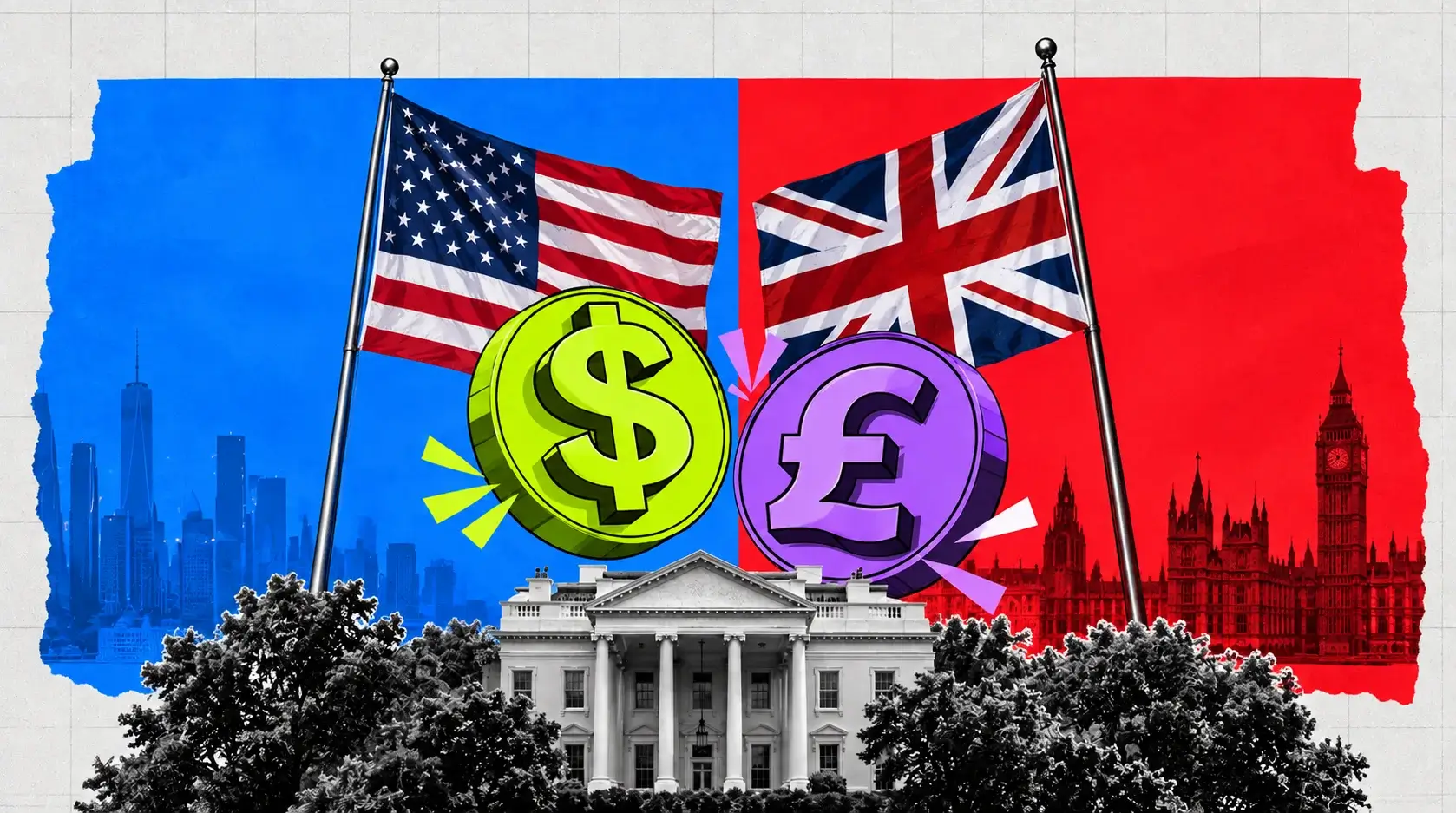
Pound Recovers to 1.3270 From 1.3137 Low as BoE Hike Bets and Weaker Dollar Lift Sterling — Break of 1.3283 Opens 1.3420
The 10-year Treasury yield fell to 5.05% while UK August GDP beat forecasts | That's TradingNEWS
Key Points
- GBP/USD trades at 1.3270, up 0.69%, after a session range of 1.3197 to 1.3283.
- UK GDP grew 0.1% in August against a forecast 0.1% contraction, after 0.4% in July.
- The Bank of England held Bank Rate at 3.75% in a 6–3 vote, with three members backing a hike to 4%.
Sterling is leading the majors against the dollar on Thursday. GBP/USD traded at 1.3270 at 16:16 CEST, up 0.69% from Wednesday’s close of 1.3197, with a session range of 1.3197 to 1.3283. The pound has now erased the entire post-CPI selloff and pushed back above Wednesday’s pre-release high of 1.3275.
Wednesday’s swing set the stage. The pair opened that session at 1.3255, traded near 1.3265 around midday London time, then collapsed to 1.3137 after the US inflation release, a 15-week low and the weakest level since late June. The pound fell 0.5% from the open to 1.3194 before recovering overnight to 1.3236 in early Asian trade.
The recovery came in two legs. The first came overnight as US Treasury yields slipped. The second came at 7:00 a.m. London time, when UK GDP data beat forecasts and pushed the pair to 1.3264. The US producer price data at 1:30 p.m. London time added a third push as the 10-year Treasury yield dropped sharply.
The monthly picture shows the damage the dollar rally did before Thursday. GBP/USD stood at 1.3420 on September 30 and 1.3539 on August 31. At 1.3270, the pair is down 1.1% since the end of September and 2% since the end of August. Over the past month, sterling has weakened 1.03%, and over 12 months it is down 1.42%.
The 2026 context frames the current level. GBP/USD averaged 1.3448 from January through September. The current price sits 1.3% below that average, and the October monthly average sits at 1.3151, showing how much of the month the pair spent below 1.32.
Sterling is outperforming the euro. GBP/EUR held broadly unchanged at €1.1816 while both currencies rallied against the dollar. EUR/USD gained 0.5% to 1.1217 Thursday, a similar move to the pound’s 0.69%, but the pound has held its 2026 range far better. EUR/USD has fallen 6.5% from its January peak and sits at a 17-month low; GBP/USD sits only at a 15-week low.
That relative strength is the thesis. The pound’s bounce rests on more than a weaker dollar. The Bank of England is closer to a rate hike than the European Central Bank, UK growth is beating expectations, and the gap between UK and US policy rates is narrow. Those factors give sterling a firmer floor than the euro, and they make 1.3283, Thursday’s high, the level that decides whether the recovery extends.
The Dollar Side: 18-Month High Wednesday, Reversal Thursday
The dollar remains the dominant driver. The US dollar index hit an 18-month high on Wednesday after US consumer inflation rose to 3.7% in September, above forecasts. After the CPI release, the index faded to 101.74. Heading into the week, it stood at 102.06 with a weekly high of 102.53.
Thursday extended the reversal. The dollar weakened 0.38% against sterling during the early European session, 0.48% against the euro, 0.22% against the yen and 0.59% against the Swiss franc. The pound’s gain built through the day as US data arrived.
The bond market triggered the move. The 10-year Treasury yield fell 14 basis points to 5.05% after the September producer price data, from 5.19% before the US open. Both the 10-year and 30-year yields fell more than 13 basis points, putting the 30-year on track for its biggest drop since November 25, 2024. The 10-year touched 5.36% on October 7, its highest level since 2002.
The decline came on hot data. The September Producer Price Index rose 1.3% for the month and 6.3% over 12 months, the biggest monthly increase since March 2022. Forecasts called for 0.6% and 5.5%. In a normal regime, that print would lift US yields and the dollar. Instead, investors bought Treasuries as US equities sold off on AI financing fears.
US equities explain the shift. The Nasdaq Composite fell 1.05% to 26,411.88 after a 1.9% drop Wednesday, with chip stocks down for an eighth straight session and CoreWeave falling 6.89% to $61.25 on debt concerns. South Korea’s Kospi dropped 7.57% overnight. When US assets sell off on credit fears, Treasury demand rises and the dollar’s yield advantage narrows.
The dollar rally had been crowded. Four straight weekly gains built large long-dollar positions into the CPI release. When the inflation data failed to push yields higher, those positions began to unwind, which accounts for part of the pound’s 86-pip range Thursday.
The dollar index sets the near-term direction. A sustained move below 101.50 would likely push GBP/USD through 1.3283 toward 1.3350. A rebound above 102.53 would bring 1.3137 back into play within days.
Friday is the next test. Fed Chair Kevin Warsh speaks, offering the market’s last major policy signal before the Fed’s pre-meeting blackout. His tone on the October meeting will move the dollar more than any UK data due before the end of the month.
UK GDP Beats: 0.1% Growth in August Against a Forecast Contraction
The UK data gave sterling its own support. The UK economy expanded 0.1% month-on-month in August, slowing from 0.4% growth in July but beating expectations of a 0.1% contraction. July’s 0.4% gain matched June’s growth, giving the economy three straight positive months.
The three-month view looks stronger. UK GDP grew 0.4% in the May-to-July period compared with the previous three months. With August adding 0.1%, the economy is on course for a much stronger third quarter than the Bank of England expected.
The Bank’s own forecast is the benchmark. The Bank’s latest third-quarter growth projection stands at 0.4%, itself an upgrade from an earlier expectation of 0.1%. A quarter that exceeds 0.4% would show the economy running hotter than the central bank’s models, which strengthens the case for tighter policy.
The market reaction was immediate. GBP/USD rose to 1.3264, up 0.25% from Wednesday’s close, after the release. The data reinforced expectations of a November Bank of England rate hike.
Growth matters more than usual for sterling right now. In most cycles, the UK economy’s weakness has limited how far the Bank of England can tighten. This year, energy prices from the Middle East conflict are pushing inflation higher while growth holds up. That combination gives the Bank room to raise rates without triggering a recession, which supports the pound.
The contrast with the eurozone is sharp. Eurozone growth forecasts stand at 0.9% for 2026, and the ECB has signaled patience despite 3.8% inflation. UK growth is outperforming expectations while inflation rises, which points to a more hawkish central bank and a firmer currency.
The labor market adds context. The UK unemployment rate stood at 4.9%, with the harmonized rate for the first quarter of 2026 at 5.0%, above Germany’s 3.9% and the US rate of 4.3% but below France’s 8.2%. A 4.9% unemployment rate gives the Bank some slack, which tempers the hawkish case.
Public finances remain a background risk. Public sector net debt reached 95.1% of GDP at the end of August, up from 93.8% a year earlier. Rising debt with higher interest rates raises fiscal costs, which could weigh on gilts and sterling if markets start pricing fiscal stress.
Bank of England at 3.75%: Three Votes for a Hike
The Bank of England is the pound’s main support. At its September 16 meeting, the Monetary Policy Committee voted 6–3 to maintain Bank Rate at 3.75%. Three members voted to raise the rate by 25 basis points to 4%. The split was identical to July’s.
Three dissenters in two consecutive meetings is a strong signal. The committee needs only two more votes to shift to a hike. The August GDP beat adds weight to the hawkish side, and the next meeting in November is now a live decision for markets.
The inflation outlook drives the debate. UK CPI inflation rose to 3.1% in August from 2.9% in July and is likely to rise further over coming quarters. The MPC expects inflation to reach slightly above 4% in the first quarter of 2027. Before the Middle East conflict, the Bank expected inflation to fall to 2% from April 2026 and stay there for the rest of the year.
Services inflation offers some relief. Services inflation was 3.4% in August, unchanged from July and down from 4.5% in March. The Bank watches services closely because they reflect domestic costs. A stable services rate suggests energy is driving the headline increase, not wage-driven second-round effects.
The rate path has reversed. UK interest rates rose from 0.1% in December 2021 to 5.25% in August 2023, then fell by 1.5 percentage points from August 2024 to December 2025. Bank Rate has held at 3.75% since. A November hike would mark the first increase since 2023.
The policy gap with the Fed is narrow. The Fed’s target range stands at 3.75%-4.00% after its September hike. Bank Rate at 3.75% matches the lower end of that range, leaving a gap of 0 to 25 basis points. That compares with a 125-to-150-basis-point gap between the Fed and the ECB’s 2.50% deposit rate.
That gap explains sterling’s resilience. The rate differential is the main driver of major currency pairs. A near-zero gap between the UK and US means sterling doesn’t face the same carry disadvantage the euro faces. If the Bank of England hikes in November and the Fed holds in October, the gap would flip in sterling’s favor.
The risk is a Fed move first. If the Fed hikes on October 28, its range would rise to 4.00%-4.25%, opening a 25-to-50-basis-point gap over the Bank of England until November. That would pressure sterling in the short term.
Fed Odds: October Hike Pricing Jumps From 22% to 49%
The Federal Reserve sets the other side of the pair. Before Wednesday’s CPI, futures priced a 22.1% chance of a 25-basis-point hike at the October 27-28 FOMC meeting. After the release, odds jumped above 49% before settling below 45%. December hike odds stand at 89.7%.
The US inflation data justifies the pricing. September CPI rose 3.7% annually against a 3.6% forecast, with core at 2.6% against 2.5%, up from 3.4% and 2.4% in August. Thursday’s producer price data added more pressure: core producer prices rose 0.5% for the month and 5.0% over 12 months.
But US growth showed cracks. Retail sales rose 0.8% in September against a 0.3% forecast, but the control group rose just 0.1% against 0.3%, after 1.4% in August. Gasoline drove most of the headline. Stalling real consumer demand with rising prices raises the risk of a growth slowdown, which tends to pull US yields lower over time.
The Fed has already moved once this cycle. It raised its target range by 25 basis points to 3.75%-4.00% in September, its first increase since 2023. September minutes showed most participants saw another increase as likely appropriate by year-end.
Politics complicate the timing. The November 3 midterms fall one week after the FOMC meeting, and White House officials have publicly urged the Fed to wait for October inflation data. A Fed seen as yielding to political pressure would weaken the dollar’s policy credibility.
The sequencing of central bank decisions matters for GBP/USD. The Fed decides on October 28. The Bank of England’s November meeting follows. If the Fed holds in October and the Bank of England hikes in November, the policy gap would turn in sterling’s favor for the first time this cycle. That scenario supports a move toward 1.3420, the September 30 level.
If both hike, the gap stays narrow and the pair likely trades in a range. If the Fed hikes and the Bank of England holds, sterling would face a 25-to-50-basis-point carry disadvantage and likely return to the 1.3137 low.
Market pricing suggests the second scenario, both central banks tightening, is the most likely. That keeps GBP/USD range-bound rather than trending.
UK Inflation at 3.1%: Lower Than the US and Eurozone, Rising Faster
UK inflation sits at a different point in its cycle. CPI inflation was 3.1% in August, up from 2.9% in July. RPI inflation was 3.4% in August. UK inflation was 3.8% a year earlier in August 2025, so the current level is lower than last year but rising again.
The comparison with other economies favors sterling. US CPI stands at 3.7% and eurozone inflation at 3.8%. UK inflation at 3.1% is the lowest of the three, while Bank Rate at 3.75% is higher than the ECB’s 2.50% and matches the low end of the Fed’s range. That gives the UK the highest real policy rate of the three: positive by 65 basis points, against a deeply negative eurozone real rate and a US real rate close to zero at the low end of the Fed’s range.
Positive real rates support a currency. They mean holding sterling deposits earns a return above inflation, attracting international capital. The pound’s real-rate advantage over the euro explains why GBP/EUR has held at €1.1816 while EUR/USD hit a 17-month low.
But UK inflation is rising faster than expected. The Bank expects it to reach slightly above 4% by the first quarter of 2027. If that happens with Bank Rate still at 3.75%, the real rate would turn negative, removing sterling’s advantage. That trajectory is why three MPC members want to hike now.
Energy is the main driver. The Middle East conflict has pushed Brent crude to $103.97, up 66% from a year earlier. The UK imports a large share of its energy, so higher oil and gas prices feed directly into household bills and business costs. The UK’s energy exposure sits between the eurozone’s high dependence and the US’s net-exporter status.
Services inflation is the key to the Bank’s next move. At 3.4% in August, unchanged from July and well below March’s 4.5%, services inflation shows domestic price pressure is contained. If the September figure shows services rising again, the case for a November hike would strengthen sharply.
The September UK CPI release is the next major domestic catalyst for sterling. A print above 3.3% would likely push the pair toward 1.3350 as markets price a higher chance of a November hike. A print at or below 3.1% would weaken the hawkish case and return attention to the dollar side.
Read More
-
Yen Stalls at 160 Despite a 3% JGB and Tokyo Core CPI at 2.0% — Intervention Sits at 164, Friday's Payrolls Decide
02.09.2026 · TradingNEWS ArchiveEnergy
-
Coreweave Sinks to $60.96 as CDS Spreads Top 1,000bp and $35B Debt Outweighs Equity
15.10.2026 · TradingNEWS ArchiveStocks
-
XRP-USD Slides to $1.30 as $2.18B of Tokens Move to Exchanges and ETF Demand Fades — $1.25 Next Unless $1.32 Is Reclaimed
15.10.2026 · TradingNEWS ArchiveCrypto
-
Brent Slides to $103.97 and WTI Holds $94.47 as Sanctions Talk Meets Hormuz Supply Loss — $102 Floor, $110 Upside
15.10.2026 · TradingNEWS ArchiveCommodities
-
Nasdaq Drops to 26,411, S&P 500 at 7,686, Dow Gains 169 Points as CRWV Slides 7% on AI Debt Fears
15.10.2026 · TradingNEWS ArchiveMarkets
-
Euro Recovers to 1.1217 From 1.1114 Low on Dollar Retreat — Resistance at 1.1251 Caps Upside
15.10.2026 · TradingNEWS ArchiveForex
Sterling vs. Euro: Why the Pound Held Up Better
The divergence between the two European currencies is clear. GBP/USD sits at a 15-week low with a recovery to 1.3270. EUR/USD hit a 17-month low at 1.1114 before recovering to 1.1217. GBP/EUR held at €1.1816. The euro gained 0.09% against sterling during the European morning, essentially flat.
Monetary policy explains most of the gap. The ECB raised its deposit rate to 2.50% in September but signaled patience, and markets priced out an October hike, with traders expecting a hold on October 29 followed by a December move. The Bank of England has three members voting for an immediate hike. The market sees the Bank of England as more willing to tighten.
Growth adds to the gap. UK GDP beat expectations in August, and the third quarter is tracking above the Bank’s 0.4% forecast. Eurozone growth forecasts stand at 0.9% for 2026, and the region faces fiscal stress from France, where the French-German 10-year bond spread has widened toward 130 basis points.
Energy exposure hits the euro harder. Eurozone energy inflation reached 18.8% in September, pushing headline inflation to 3.8%. UK inflation at 3.1% shows less energy pass-through so far. Europe’s heavier reliance on imported energy weakens its terms of trade more than the UK’s.
Fiscal risk sits on both sides. UK public sector net debt stands at 95.1% of GDP, up from 93.8% a year earlier. That’s a risk for gilts and sterling, but it hasn’t produced the spread widening seen in France. UK fiscal stress would need a specific trigger, such as a budget announcement, to move the pound.
For GBP/USD, the euro comparison sets a floor. When the dollar strengthens, both currencies fall, but sterling falls less. When the dollar weakens, both rise, but sterling holds its gains better. That relative strength makes 1.3137 a firmer support for GBP/USD than 1.1114 is for EUR/USD.
The cross can move independently. If the ECB surprises with an October hike or the Bank of England holds in November, GBP/EUR would likely fall toward €1.17. If the Bank of England hikes and the ECB holds, the cross could push toward €1.19, which would support GBP/USD above 1.33 even if the euro weakens.
Real Rates and Carry: Sterling’s Hidden Advantage
The real-rate math gives sterling an edge that headline moves don’t show. With Bank Rate at 3.75% and CPI at 3.1%, the UK’s real policy rate stands at a positive 0.65%. The US real rate at the Fed’s 4.00% upper bound and 3.7% CPI sits at a positive 0.30%. The eurozone’s real rate at a 2.50% deposit rate and 3.8% inflation sits at a negative 1.30%.
That ranking matters for capital flows. Investors seeking inflation-protected returns favor currencies with higher real rates. Sterling’s real rate exceeds the dollar’s on this measure, which partly explains why the pound recovered faster than the euro after Wednesday’s dollar spike.
Long-term rates add context. The US 10-year real yield stood at 2.92% on October 8, with the 10-year breakeven at 2.35% and the nominal 10-year at 5.28%. Long-dated US real yields near 3% still give the dollar an advantage at the long end of the curve, which limits how far sterling can rally.
Carry trades have shifted. A trader borrowing in euros at 2.50% to buy sterling deposits at 3.75% earns 125 basis points of carry. That trade supports sterling against the euro but doesn’t directly affect GBP/USD. Against the dollar, carry is close to neutral at 0 to 25 basis points.
The direction of real rates is what moves the pair. If UK inflation rises toward 4% without a Bank of England hike, the UK real rate would turn negative and remove sterling’s advantage. If the Bank hikes in November while UK inflation stays near 3.1%, the real rate would rise toward 0.9%, strengthening the pound.
The US side moves too. If US CPI keeps rising and the Fed holds, US real rates fall, weakening the dollar. If the Fed hikes while inflation peaks, US real rates rise.
For the forecast, real rates point to modest sterling strength. The UK has the highest real policy rate of the three major economies, a central bank leaning toward a hike and growth beating expectations. Those factors don’t overpower a strong dollar trend, but they give the pound a cushion during dollar rallies and extra lift during dollar retreats.
Risk Sentiment and Energy: The Global Backdrop
Global risk conditions shaped Thursday’s currency moves. The AI and semiconductor selloff spread from Wall Street to Asia overnight. South Korea’s Kospi fell 7.57%, Japan’s Nikkei lost 5% and Taiwan’s weighted index dropped 3.41%. In New York, the S&P 500 traded at 7,686.53, down 0.42%, and the Nasdaq at 26,411.88, down 1.05%.
The stress originated in US assets, which weakened the dollar. Investors moved into Treasuries, gold and the Swiss franc rather than into dollar cash. Gold futures rose 1.79% to $4,181.30. The VIX traded at 17.70, up 4.9%. The franc gained 0.59% against the dollar, the strongest among the majors.
European equities split. Germany’s DAX fell 115 points to 25,183, while Britain’s FTSE 100 rose 50 points to 10,778. The FTSE’s gain reflects its heavy weighting toward energy, mining, banks and consumer staples, the defensive sectors outperforming globally. The FTSE’s resilience supports UK asset demand and, indirectly, sterling.
Energy prices are a two-sided risk for the pound. Brent fell 1.97% to $103.97 Thursday after a US official said the administration was weighing easing sanctions on Russian shadow-fleet tankers. WTI traded at $94.47. The Strait of Hormuz is blocking an estimated 8.3 million barrels a day, 36% of Gulf oil.
High energy prices push UK inflation higher, which supports a Bank of England hike and the pound. But they also hit UK growth and the trade balance, which weakens the currency over time. The net effect depends on how the Bank responds. So far, the hawkish response has dominated, which has supported sterling relative to the euro.
A ceasefire in the Gulf would change the picture. Brent falling below $90 would lower UK inflation expectations, reduce the case for a November hike and probably weaken sterling against the dollar in the short term. It would help the euro more, given Europe’s heavier energy dependence.
Friday’s Asian session is the next checkpoint. A second sharp decline in the Kospi would extend global risk aversion and Treasury demand, keeping the dollar under pressure. A stabilization in Asian technology stocks would reduce Treasury demand, lift US yields and probably pull GBP/USD back toward 1.3200.
Technical Map: 1.3137 Floor, 1.3283 Pivot, 1.3420 Target
The chart has clear boundaries after Thursday’s recovery. Support starts at 1.3197, Wednesday’s close and Thursday’s session low. Below that, Wednesday’s post-CPI low at 1.3137, a 15-week low, is the key floor. A break below it would expose 1.3100 and the 1.3000 psychological level, 2% below current levels.
Resistance is layered above. Thursday’s high at 1.3283 and Wednesday’s pre-CPI high at 1.3275 form the first ceiling. The 1.3300 round number follows. Above that, the September 30 close at 1.3420 is the next major target, followed by the August 31 level at 1.3539.
The structure has improved. Wednesday’s spike low at 1.3137 and Thursday’s recovery above 1.3275 form a classic reversal pattern: a sharp sell-off on news, followed by a full retracement within 24 hours. That pattern often marks a short-term low when the follow-through holds.
The confirmation level is 1.3283. A daily close above Thursday’s high would signal that the reversal has momentum beyond short-covering. That would target 1.3300 first, then 1.3350 and 1.3420. A failure to close above 1.3283 would leave the pair in a 1.3137-1.3283 range.
The broader trend remains down. GBP/USD has made lower highs since August, falling from 1.3539 at the end of August to 1.3420 at the end of September and 1.3137 on Wednesday. The 2026 average of 1.3448 sits well above the current price. Reversing that trend requires a sustained move above 1.3420.
Momentum favors a test of resistance. Thursday’s 0.69% gain is the pound’s strongest daily move in more than a week, and it came on a combination of UK data and dollar weakness. Moves driven by both sides of a pair tend to carry further than moves driven by one.
The daily close sets the bias. A close above 1.3283 targets 1.3350 within days. A close back below 1.3197 would confirm the bounce has failed and put 1.3137 back in play. Friday’s Warsh speech is the most likely trigger for either outcome.
Scenarios Into the Fed and BoE: 1.3000 Downside, 1.3420 Upside
The base case is a range with an upward tilt. If Warsh keeps October open without committing to a hike, the September UK CPI print supports the Bank of England’s hawkish wing, and the AI selloff stabilizes, GBP/USD trades between 1.3150 and 1.3350 into the Fed decision on October 28. Rallies toward 1.3350 meet sellers, and dips toward 1.3150 attract buyers as the Bank of England’s November hike case firms. The pair likely ends October between 1.3220 and 1.3320.
The bullish case needs a dovish Fed and a hawkish Bank of England. If Warsh signals patience, US yields fall below 5.00% and the dollar index breaks 101.50, GBP/USD clears 1.3283 and targets 1.3350, then 1.3420. A Fed hold on October 28 followed by a Bank of England hike in November would flip the policy gap in sterling’s favor and extend the move toward 1.3539. The 1.3420 target represents a 1.1% gain from current levels.
The bearish case requires a hawkish Fed and soft UK data. If Warsh signals that October is live, US yields rebound above 5.20% and the dollar index reclaims 102.53, GBP/USD breaks 1.3197 and retests 1.3137. A weak UK CPI print that reduces November hike odds would add pressure. A Fed hike on October 28 with a Bank of England hold in November would push the pair toward 1.3100 and potentially 1.3000, a 2% decline.
The probabilities favor the base case with an upward lean. The Bank of England’s 6–3 vote split, the August GDP beat and the near-zero policy gap with the Fed all support sterling relative to other major currencies. The dollar’s strength remains the main headwind, and its direction depends on the Fed.
Three triggers will decide the path. First, Warsh’s tone on Friday. Second, the September UK CPI release, where services inflation will drive November hike expectations. Third, the US 10-year yield, where a hold below 5.10% keeps the dollar under pressure.
Verdict: Mildly Bullish, 1.3283 Is the Line
GBP/USD’s 0.69% rally to 1.3270 rests on firmer ground than the euro’s bounce. The pair recovered the entire post-CPI drop to 1.3137, a 15-week low, as the US 10-year Treasury yield fell 14 basis points to 5.05% after a 6.3% producer price print and US equities sold off on AI financing fears. UK GDP grew 0.1% in August against a forecast 0.1% contraction, putting the third quarter on track to beat the Bank of England’s 0.4% projection.
The policy setup supports sterling. Bank Rate stands at 3.75%, with three MPC members voting for a hike to 4% at both the July and September meetings. That leaves a gap of 0 to 25 basis points with the Fed’s 3.75%-4.00% range, far narrower than the euro’s 125-to-150-basis-point disadvantage. UK inflation at 3.1% gives the UK a positive real policy rate of 0.65%, the highest among the three major economies. The Bank expects inflation to rise above 4% by early 2027, which keeps a November hike in play.
The dollar remains the main risk. October Fed hike odds jumped from 22.1% to as high as 49% after the US CPI print, and a Fed move on October 28 would reopen a carry gap in the dollar’s favor before the Bank of England can respond. GBP/USD is still down 1.1% since September 30 and 2% since August 31, and the pair sits 1.3% below its 2026 average of 1.3448.
The forecast is mildly bullish. Expect GBP/USD to hold the 1.3197-1.3137 support zone and test 1.3283-1.3300 in the coming sessions, with a daily close above 1.3283 opening a path to 1.3350 and 1.3420 into the Bank of England’s November meeting. A daily close below 1.3137 would invalidate the setup and target 1.3100 and 1.3000. Until the Fed decides on October 28, 1.3283 is the line that separates a range trade from a sustained sterling recovery.