
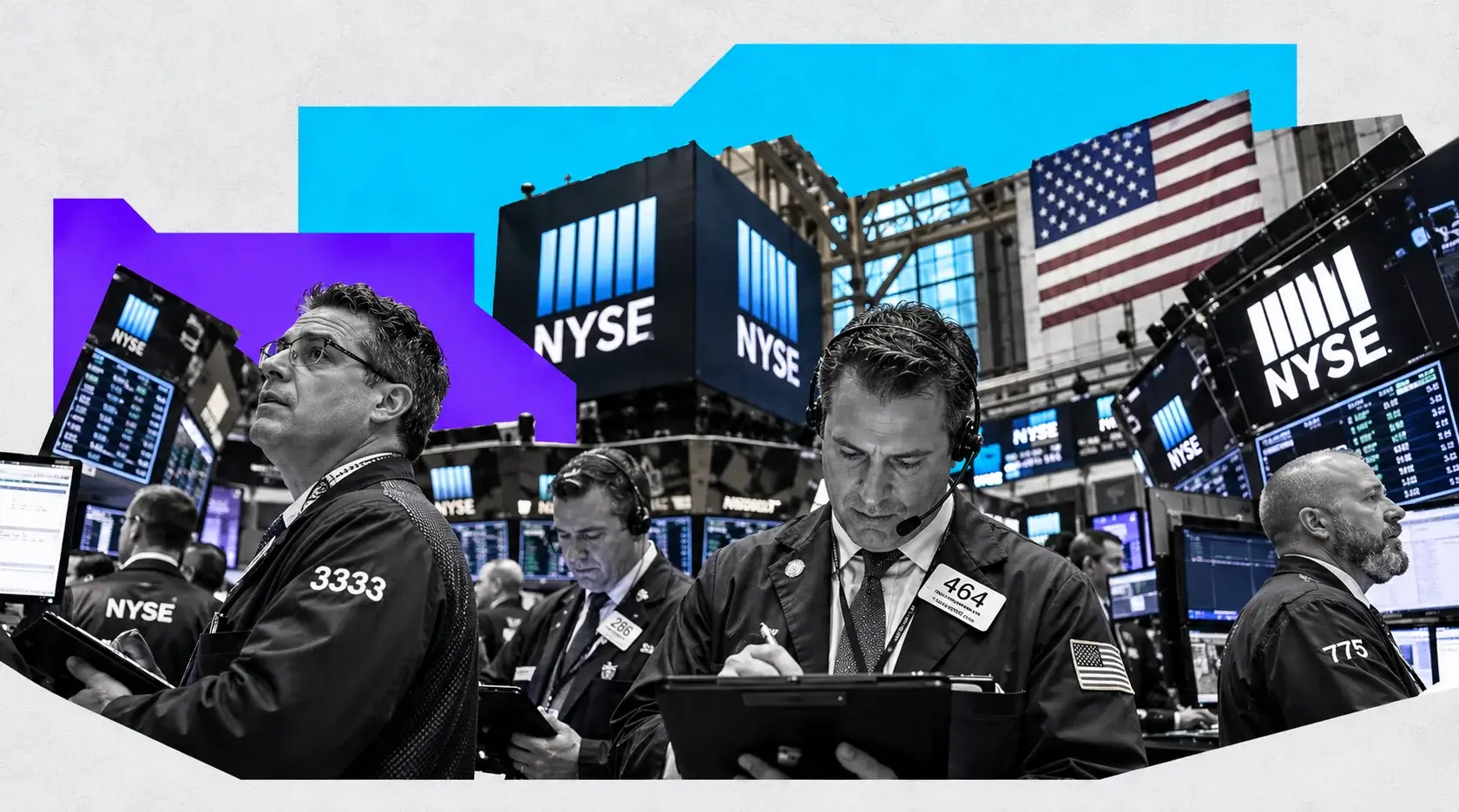
S&P 500 Dips 0.13%, Nasdaq Flat at 26,404, Dow Drops 217 Points While Bitcoin at $80,858 Sends MSTR Up 12%
A 5.004% 10-year yield and 53% October hike odds stalled the post-Fed rebound | That's TradingNEWS
Key Points
- The 10-year yield rose 5 basis points to 5.004%, pushing October Fed hike odds to 53.1% from 27.2%.
- Strategy (MSTR) jumped 11.87% to $147.95 as bitcoin climbed 5.42% to $80,858 on the SEC exemption.
- Nucor (NUE) dropped 5.33% after Q3 guidance of $5.55-$5.65 per share missed the $6.20 consensus.
Thursday's relief rally ran straight into the level that has dictated every session this month. The 10-year Treasury yield pushed back above 5% on Friday, climbing more than 5 basis points to 5.004% after sliding on Thursday, and the buyers who chased chips and megacaps 24 hours earlier stepped away. By late morning the averages had drifted into the red.
The S&P 500 sat at 7,627.68, down 10.08 points or 0.13%. The Dow Jones Industrial Average gave up 217.07 points, or 0.42%, to 51,560.97. The Nasdaq Composite held at 26,404.02, off 14.28 points or 0.05%, and the Russell 2000 slid 24.19 points, or 0.84%, to 2,850.44. The small-cap index is doing the worst of the damage, which fits a tape where the cost of money is the only variable that matters.
The market already absorbed the Fed's first hike. What it is repricing now is the second one. Fed funds futures are pricing a 53.1% probability of another 25-basis-point move at the October meeting, up from 27.2% a week earlier. That shift, from odds weighted against a move to odds weighted toward one, explains why every tick higher in the long end hits equity multiples directly. A 10-year at 5.004% offers a risk-free return that competes head-on with the earnings yield of an S&P 500 trading above 7,600, and the portfolio managers running that comparison are not rushing to add broad exposure on a Friday.
The only corner of the market running clean is the one with a hard, dated catalyst. Bitcoin blew through $80,000 and printed $80,858.25, up 5.42% in 24 hours. Strategy (MSTR) jumped 11.87% to $147.95 on 20.0 million shares, and Robinhood (HOOD) climbed 7.91% to $118.49. The spark was regulatory rather than macro: the SEC granted a five-year exemption for tokenized stock trading on Thursday, and crypto-linked equities are the one group treating Friday like a green light.
Everything outside that pocket leans on the tape's weakest leg, which is breadth. Shortly after 11 a.m. ET the S&P 500 was down 0.12% with only 119 of its 500 members trading higher. The index looks calm only because a handful of heavyweights are offsetting a broad retreat underneath them.
Layer on an options expiration estimated at $7 trillion in notional value, a steelmaker guidance miss, a 29% biotech collapse and the end of Warren Buffett's run as Berkshire Hathaway chairman, and Friday is shaping up as a session where the index level hides far more selling than it shows. The S&P 500 is heading for a losing week despite Thursday's 1.14% jump, which says plenty about how much ground Monday through Wednesday cost.
Index Scoreboard: SPX 7,627.68, IXIC 26,404.02, DJI 51,560.97, RUT 2,850.44
The four benchmarks tell four different stories, and the spread between them is the clearest read on positioning into the weekend.
The S&P 500 is giving back 10.08 points from Thursday's close of 7,637.76, which came on a 1.14% rebound from Wednesday's Fed-hike selloff. Friday's 0.13% dip keeps most of that bounce on paper, but with fewer than a quarter of members trading higher, the index is being held up by weight, not participation. Two weeks ago the S&P 500 closed the post-payrolls session at 7,718.60. Friday's level sits 1.2% below that mark, and the 7,600 area is now the line bulls need to defend into the close.
The Nasdaq Composite is the best of the four, down just 0.05%. It led Thursday's rebound with a 1.69% jump to 26,418.30 as chip and AI names rallied. Friday's flat reading reflects a split inside the index: Amazon and Alphabet are bid, crypto proxies are ripping, and those gains offset losses in Netflix, Super Micro Computer and a Nasdaq-listed biotech that lost almost a third of its value.
The Dow is where the pain concentrates. The blue-chip average is down 217.07 points after shedding as much as 244 points, or 0.5%, earlier in the session. The context sharpens the move. On Wednesday the Dow fell 614 points, or 1.18%, to 51,479, led lower by IBM at -4.32%, Goldman Sachs at -3.92% and Boeing at -3.69%. Thursday recovered 316 points to 51,778.04. Friday has handed back more than two-thirds of that, leaving the Dow only 82 points above Wednesday's post-Fed low.
The Russell 2000 got smoked. At 2,850.44, down 0.84%, it trails the Nasdaq by 0.79 percentage points. Small caps were the weak spot Thursday too, closing at the lows of the day with a 0.6% gain at 2,874.63. Two straight sessions of small caps fading is a pattern, not noise. Smaller companies carry more floating-rate debt and less pricing power, so a 10-year at 5.004% and a Fed signaling another hike hit them first and hardest.
The VIX tells a calmer story than the breadth figures. The volatility index traded at 15.31, down 0.13. A sub-16 VIX on a day with this few advancers points to selling that is orderly rather than panicked, consistent with rotation out of rate-sensitive groups instead of a liquidation. It also shows the options market has priced little stress into Friday's expiration, which raises the stakes for the final hour.
From Futures Bid to Flat Open: How the Tape Turned Before 10 A.M.
The session started with a bid that evaporated before the opening bell. At 5 a.m. ET, futures were leaning higher on Thursday's momentum and falling crude. S&P 500 futures traded at 7,727.50, up 0.26%. Nasdaq 100 futures stood at 29,895.75, up 0.51%, and Dow futures at 52,304.00, up 0.16%. Asia helped: Japan's Nikkei rose more than 1% after the Bank of Japan lifted its benchmark rate by 25 basis points to 1.25%, the highest level in 31 years.
That optimism faded as Treasury yields climbed through the European morning. By 9:13 a.m., S&P 500 futures had slipped to 7,700.00, down 0.09%. Dow futures had dropped 160 points, or 0.31%, to 52,060, and Russell 2000 futures were down 0.37% at 2,886.10. The overnight gain disappeared in four hours, and the swing tracked the bond market almost tick for tick.
The cash open was mixed. In the first minutes the S&P 500 gained 0.11%, the Dow lost 0.13% and the Nasdaq gained 0.39%, with the Russell 2000 also up 0.39%. That was the high-water mark for small caps. The Russell went from a 0.39% gain to a 0.84% loss by late morning, a 1.23-point intraday reversal that shows how fast the rate trade reasserted control.
The 9:15 a.m. data did not help. August industrial production came in flat against expectations for a 0.3% gain, with manufacturing output contracting for the first time in eight months. The 10-year pushed from just under 5% to 5.004% in the half hour after the open, and the Nasdaq's early 0.4% gain shrank to nothing by 11 a.m.
Pre-market positioning had flagged the split. At 8:50 a.m. ET the S&P 500 was indicated to open 0.1% lower, the Nasdaq 100 0.2% higher and the Russell 2000 0.4% lower. The same divergence, with large-cap tech holding and small caps bleeding, has defined the tape all morning. It is the signature of a market that trusts balance sheets loaded with cash and distrusts balance sheets loaded with debt.
Friday's calendar adds two more variables. The Fed's post-meeting speaking blackout is over, with Governor Michelle Bowman and Kansas City Fed President Jeffrey Schmid scheduled to speak. Bowman used a London appearance to release an outside review finding that Fed staff knew, or should have known, that Silicon Valley Bank was vulnerable before its 2023 collapse, with deposits that were 94% uninsured. The report revisits the exact mechanism now back in focus: long-duration Treasury holdings losing value as rates rise. With the 10-year at a 19-year high, that history is not academic for regional bank investors, and the KBW-style lenders are trading lower with the rest of the rate-sensitive complex.
The Fed's 3.75%-4.00% Range and the October Hike Math
Everything on Friday's tape traces back to Wednesday. The FOMC statement raised the federal funds target range by 25 basis points to 3.75%-4.00%, the first increase since July 2023, on a 12-0 vote. The July meeting had held rates at 3.50%-3.75% on a 9-3 split, so the committee moved from three hawkish dissenters to full unanimity in seven weeks.
The mechanics followed. The implementation note lifted the interest rate on reserve balances to 3.90% and set the standing overnight repo rate at 4.0%, effective September 17. The statement described economic activity as expanding at a solid pace, domestic spending as resilient and productivity growth as strong, and it closed with a line that left no room for interpretation: the committee will deliver price stability.
Chair Kevin Warsh reinforced the message at his press conference, saying the plain fact is that inflation is too high and has been for too long. He noted inflation has run above target for more than five years while unemployment sits at 4.1%, which frees the committee to focus on the price side of its mandate. That combination, a tight labor market and sticky prices, is the textbook setup for a hiking cycle rather than a single insurance move.
The dot plot confirmed it. A strong majority of the 18 participants see another increase in 2026, and year-end rate projections span 4.1% to 4.4%. The remaining meetings fall on October 27-28 and December 8-9. The 53.1% October probability shows the market is splitting the difference between those two dates, but the direction is no longer in doubt.
The market's reaction arc has been unusual. Wednesday's session sold off hard, with the Dow down 1.18%. Thursday flipped, as investors read the hike as the Fed getting ahead of inflation rather than falling behind it, with oil sliding and yields easing. Friday is the third act: the realization that credibility comes with a price tag, and that price tag is a policy rate headed toward 4.25% while the 10-year sits above 5%.
The political overlay adds noise without changing the math. The president publicly backed Warsh after the decision despite calling for lower rates beforehand. For equities, the takeaway from the Fed's own numbers is simple enough: the easing cycle of late 2024 and 2025, which took the range down to 3.50%-3.75%, has been formally reversed. Every valuation model built on a falling discount rate now needs rebuilding, and that process rarely finishes in a single week.
Read More
-
Yen Stalls at 160 Despite a 3% JGB and Tokyo Core CPI at 2.0% — Intervention Sits at 164, Friday's Payrolls Decide
02.09.2026 · TradingNEWS ArchiveEnergy
-
Coinbase Surges to $192.59 as SEC Exemption Reverses the CLARITY Act Hit — Break of $200 Targets $225
18.09.2026 · TradingNEWS ArchiveStocks
-
Etherum Climbs to $2,585 as SEC Exemption Puts On-Chain Stocks on Ethereum Rails — Break of $2,600 Opens $3,000
18.09.2026 · TradingNEWS ArchiveCrypto
-
WTI Holds $101.21 as Brent Drops $4.85 From Its $108.68 High on Saudi Rerouting — Break of $100 Opens $95
18.09.2026 · TradingNEWS ArchiveCommodities
-
TSLL ETF ($9.82) Doubles Tesla's 2.71% Bounce as Fed Hike Raises the Cost of 2X Leverage
17.09.2026 · TradingNEWS ArchiveMarkets
-
GBPUSD Steadies at 1.3371 as Hawkish BoE Split and 0.5% Retail Beat Cushion a 176-Pip Slide — Break of 1.3350 Opens 1.3300
18.09.2026 · TradingNEWS ArchiveForex
The 10-Year at 5.004% and the 30-Year at 5.333%: Duration Sets the Price of Everything
The bond market is running this tape. The 10-year yield at 5.004% is back above the threshold it first breached earlier this week, when it touched its highest level since July 2007 and snapped an eight-session rising streak only on Thursday. The 30-year yield rose more than 3 basis points to 5.333%, holding a 33-basis-point premium over the 10-year.
The speed of the move is the real problem. On August 28, ahead of the Fed chair's Jackson Hole speech, the 10-year traded at 4.676%. Three weeks later it is 33 basis points higher. That is a violent repricing for the benchmark that sets mortgage rates, corporate borrowing costs and the discount rate on every growth stock in the S&P 500. Equities absorbed the first leg because earnings kept beating. They are struggling with the second leg because it arrived alongside an actual hike and a signal of more.
This is not a U.S.-only story. Yields are rising again across Germany, France and the United Kingdom on Friday, and the dollar index is edging toward 100.5. The European Central Bank raised three of its rates this week, the Bank of Japan moved to 1.25% overnight, and the Bank of England held but is fighting the same energy-driven inflation. When every major central bank tightens in the same week, there is no offshore bid to cap U.S. yields. The global duration trade is one-directional.
The Bank of Japan decision carries its own risk. Tighter Japanese policy has historically unwound the yen carry trade, in which investors borrow cheaply in yen to buy higher-yielding assets abroad. The yen weakened after Friday's split vote, so the unwind has not started, but the conditions for it are building. A sudden yen reversal would pull capital out of U.S. assets, Treasuries and equities alike, at the worst possible moment.
For the sectors, the 5% line sorts winners from losers cleanly. Small caps, with their floating-rate debt, are down 0.84%. Housing-linked names face mortgage rates tied to a 10-year at 19-year highs. Auto retailers, dependent on financed purchases, have been hammered all week. The groups holding up either have net cash, like the megacap platforms, or a catalyst big enough to override the discount rate, like the crypto names.
Thursday showed what happens when the 10-year dips below 5%: chips and big-cap tech caught a bid and the S&P 500 added 1.14%. Friday shows the reverse. Until the long end stabilizes decisively below 5%, every rally in rate-sensitive equities will run on borrowed time.
August Industrial Production Flatlines as Factory Output Drops 0.3%
The morning's hard data landed on the soft side, and it complicates the Fed's solid-growth narrative. The G.17 release showed industrial production unchanged in August after a 0.2% gain in July, missing expectations for a 0.3% increase. Manufacturing output fell 0.3% against expectations for a 0.3% rise, ending a run of seven consecutive monthly gains.
The composition matters more than the headline. Utilities output jumped 1.8%, and mining ticked up 0.1%. Strip out the weather-driven utilities surge and the underlying industrial economy contracted. Durable goods manufacturing dropped 0.5%, with broad-based declines across categories, while nondurables were unchanged.
The market-group detail is worse for the capex story. Business equipment output fell 0.5% after a 1.0% gain in July. Defense and space equipment dropped 1.2%. Construction supplies slid 0.7%, the weakest reading in the group and a direct read-through from mortgage rates tied to a 5% 10-year. Materials output rose 0.2%, but that was driven by a 0.7% jump in energy materials, which reflects $100 oil more than genuine industrial demand.
Capacity utilization held at 76.3%, a tenth below the 76.4% forecast and 3.1 percentage points under its 1972-2025 average of 79.4%. Manufacturing utilization fell 0.3 percentage point to 75.7%, 2.5 points below its long-run norm. Year over year, total industrial production is up 1.4%, with the index at 103.1% of its 2017 level.
The report lands in an awkward spot for policymakers. On Thursday, the Philadelphia Fed manufacturing survey fell to 37.8 in September from 47.4 in August, still deep in expansion territory but pulling back from its highest reading since April 2021. Surveys have been running hot while hard output has not confirmed them. August's flat print widens that gap.
For the Fed, a single soft factory month does not change the calculus while inflation runs above target and weekly jobless claims hover near their lowest levels since 1969. For equities, the print is a problem in both directions. It is not weak enough to take an October hike off the table, and it is weak enough to question the earnings trajectory for industrials and materials. That explains why steel, machinery and auto names are among Friday's laggards, and why the Dow, heavy with cyclicals, is underperforming the Nasdaq by 0.37 percentage points.
Bitcoin at $80,858 Lights Up MSTR, COIN, HOOD and the Crypto Complex
The one group trading like it is a different market is crypto. Bitcoin reclaimed $80,000 at the U.S. open and printed $80,858.25, up 5.42%, or $4,153.91, on the day. Earlier in the week, after the Senate failed to advance the CLARITY Act and the Fed hiked, bitcoin dropped to $75,972. The rebound from that low runs 6.4% in less than three sessions.
The equity proxies amplified the move. Strategy (MSTR), the largest corporate holder of bitcoin, jumped 11.87% to $147.95 on 20.0 million shares, adding $6.2 billion in market value to reach $58.8 billion. The stock still trades 61.6% below its level of a year ago and far under its 52-week high of $365.21, which explains the violence of the squeeze. Heavily shorted, high-beta names move hardest when the underlying finally turns.
Coinbase (COIN) rallied 6.71% to $185.64 by mid-morning, with gains extending toward 9% as bitcoin pressed higher. Robinhood (HOOD) climbed 7.91% to $118.49, lifting its market value to $106.5 billion. Circle Internet Group (CRCL) gained 6.11% to $90.29, and Galaxy Digital (GLXY) added 4.80% to $23.35.
The miners and treasury companies joined in. MARA Holdings (MARA) rose 8.81% to $12.66 on 25.9 million shares, Bitmine Immersion Technologies (BMNR) climbed 7.82% to $25.76 on 21.8 million shares, and Bitdeer Technologies (BTDR) added 6.85% to $12.01. Hyperliquid Strategies (PURR) gained 5.90% to $13.59, tracking a double-digit move in the HYPE token overnight. Webull (BULL) climbed 4.67% and Bullish (BLSH) added 4.41%.
The breadth inside the crypto complex contrasts sharply with the broader tape. On a day when 381 S&P 500 members are lower, virtually every crypto-linked equity is green, and most are up more than 4%. That is not a macro trade. Bitcoin is rising against a 10-year at 5.004% and a dollar index near 100.5, both of which would normally weigh on it. The driver is structural, and it came out of Washington on Thursday.
The risk profile is equally clear. Most of these stocks remain 30% to 60% below their year-ago levels, and a Friday squeeze in a beaten-down group can reverse just as fast if bitcoin loses $80,000 over the weekend. Coinbase earns on volume, so it benefits regardless of direction. Strategy and the miners live and die on the bitcoin price itself, which makes them the higher-risk expression of the same theme.
The SEC's Tokenized-Stock Exemption Is the Real Engine Behind COIN and HOOD
The catalyst behind Friday's crypto rally is a document, not a price chart. On Thursday the SEC issued its Innovation Exemption, an order granting temporary, conditional relief to Tokenized Securities Venues, or TSVs, from the definition of an exchange under the Securities Exchange Act of 1934. The relief lets those venues trade tokenized versions of listed U.S. stocks through permissioned automated market makers and liquidity pools.
The order runs five years and carries a second piece that matters for market structure: liquidity providers that supply tokenized stock to those pools using proprietary capital are exempt from dealer registration. That combination, a venue exemption plus a dealer exemption, is what turns tokenized equities from an offshore experiment into a regulated U.S. business line.
The guardrails are tight. Venues must meet conditions covering public notice, transaction transparency, trading-halt coordination, books and records, and technology safeguards. The exemption applies symbol limits and volume caps calibrated to limit-up, limit-down tiers. A tokenized share must carry the same rights and privileges as the underlying security, which separates real tokenized stock from synthetic products that only track a price. Issuers can object to their stock being listed. The exemption does not extend to decentralized finance.
For Coinbase and Robinhood, the read-through is direct. Both have built infrastructure for on-chain assets, and both now have a five-year window to route tokenized stock trading through a sanctioned channel. The two stocks each gained 5% on Thursday when the order dropped and added another 7% to 9% on Friday. Figure Technology (FIGR), which operates blockchain-based lending and securities infrastructure, rose 5.46% to $35.55 on the same logic.
The timing sharpens the impact. The SEC acted two days after the CLARITY Act failed in the Senate, a setback that had knocked bitcoin toward $75,000 and pushed crypto equities lower. The exemption effectively routes around Congress, using the SEC's existing statutory authority to open a lane that legislation had failed to open. Traders read that as a signal that the regulatory path for digital assets runs through the agency even when Capitol Hill stalls.
The limits matter for anyone chasing the move. The relief is temporary, the caps constrain early volume, and durable rulemaking will be required to keep on-chain markets viable after five years. Revenue from tokenized stock trading will not show up in a meaningful way in 2026 results. What the market is pricing on Friday is optionality, and in a tape starved for catalysts, optionality with a five-year runway is enough to rip a group higher.
Nucor and Steel Dynamics: Record Guidance That Still Missed the Bar
The steel sector delivered the clearest example of a market that punishes anything short of perfection. Nucor (NUE) lost 5.33% after its third-quarter guidance called for earnings of $5.55 to $5.65 per diluted share for the quarter ending October 3. The $5.60 midpoint sits 10% below the $6.20 consensus, even though it more than doubles the $2.63 Nucor earned in the third quarter of 2025 and tops the $5.04 it posted in the second quarter of 2026.
The segment detail explains the miss. Nucor expects higher earnings in steel mills on stronger average selling prices and stable volumes, partly offset by rising costs of products sold. Steel products earnings should rise on higher volumes and pricing. The drag is raw materials, where earnings are set to fall on lower pricing and shipments. Corporate and eliminations expense will also rise, partly because the second quarter included a $61 million non-cash gain, or $0.20 per share, tied to Nucor's stake in fusion company Helion.
Capital returns stayed aggressive. Nucor repurchased 2.03 million shares during the quarter at an average of $247.04 and has returned $1.36 billion to stockholders year to date through buybacks and dividends. Full results arrive after the close on October 26.
Steel Dynamics (STLD) fell more than 2% on a similar setup. Its guidance filing projected third-quarter earnings of $5.34 to $5.38 per diluted share, against $3.69 in the second quarter and $2.74 a year earlier. The $5.36 midpoint lands 4% short of the $5.60 consensus. The company pointed to metal margin expansion, record shipments, higher realized selling values and lower scrap costs in its steel operations, plus a fabrication backlog extending into the first quarter of 2027. Metals recycling earnings are expected to decline on tighter spreads.
The reaction says more about expectations than about the business. Both companies are guiding to some of the strongest quarters in their histories, driven by Section 232 tariffs at 50% that have cut imports' share of U.S. steel consumption from 25% to 14%. The problem is that the stocks priced in even more. With the August industrial production report showing durable manufacturing down 0.5% and construction supplies down 0.7% on the same morning, the market has no appetite to pay for a cyclical peak.
The steel selloff also feeds the Dow's underperformance. Materials and industrials are among the weakest groups on Friday, and the combination of a guidance miss, soft factory data and a 5% 10-year gives cyclical holders three reasons to lighten up before the weekend.
Netflix, Palo Alto and Xenon: Where the Sellers Hit Hardest
The biggest single-stock damage came from biotech. Xenon Pharmaceuticals (XENE) collapsed 29% after the company voluntarily paused new patient enrollment in its ongoing Phase 3 trials of azetukalner, its lead candidate for focal seizures in epilepsy. The shares were already down 22.24% before the open. A pause in late-stage enrollment for a company whose valuation rests on one asset is the worst kind of uncertainty, since it raises questions about safety or design without answering them.
Netflix (NFLX) slid 4.41% to $71.99 on 35.0 million shares after a downgrade to underweight with a price target cut to $57 from $80. The call centers on engagement: a projected 21% year-over-year decline in hours viewed for Netflix's top 100 originals and a weaker content slate in the back half of 2026, which the downgrade argues will cap margin expansion in 2027 and 2028. The $57 target sits 21% below Friday's price. The drop erased $13.8 billion in market value, leaving Netflix at $299.8 billion, and extended a streak of four straight lower closes. The stock is down 38.6% over 52 weeks.
Palo Alto Networks (PANW) fell 4.14% after a rating cut to market perform, citing stretched valuations following a sector-wide cybersecurity rally. In a tape where the discount rate just moved up, premium-multiple software is the first place portfolio managers trim.
The hardware side of AI bled too. Super Micro Computer (SMCI) dropped 4.36% to $38.59 on 19.2 million shares. CoreWeave (CRWV) hovered at $80.08, up 0.26%, after falling Thursday on plans to raise capital through a $3 billion convertible debt sale and a stock offering. Capital raises at these valuations with a 10-year at 5.004% get a cold reception.
Autos rolled over. Ford (F) fell 4.11% to $13.05, and Stellantis (STLA) lost 5.25% to $4.78. The auto dealers took a beating on Thursday, with AutoNation (AN) down 10.49% to $174.88, and the pressure from financing costs has not eased. Capri Holdings (CPRI) fell 4.02% on weak luxury demand, and Clarivate (CLVT) dropped 5.89% after launching a $75 million tender for its 2028 secured notes.
Berkshire Hathaway's class B shares dipped 0.3% after Warren Buffett, 96, stepped down as chairman effective immediately, becoming chairman emeritus while remaining a director. His son Howard, a board member since 1993, becomes chairman, with Greg Abel continuing as CEO. The muted move reflects a long-planned succession, but Berkshire is up just 1% year to date against an 11.5% gain for the S&P 500, a gap that has widened as capital chased the AI trade.
Megacaps, Semis and SNDK: Narrow Leadership Keeping the Nasdaq Flat
The Nasdaq's 0.05% dip hides a split tape, and the handful of names on the bid side explain why the index is not deeper in the red.
Nvidia (NVDA) led all U.S. stocks in volume with 46.7 million shares by late morning, trading at $219.75, up 0.19%. At a $5.306 trillion market value, even a flat Nvidia anchors the index. Amazon (AMZN) added 1.06% to $253.86, extending Thursday's 2% gain, and Alphabet (GOOGL) rose 0.76% to $349.97. Those three alone represent more than $12 trillion in market value, and their resilience is the reason the S&P 500 is down only 0.13% while 381 of its members slide.
The other megacaps are not helping. Apple (AAPL) slipped 0.57% to $335.08, and Tesla (TSLA) lost 0.67% to $363.76. Intel (INTC) gave back 1.42% to $107.25 on 43.5 million shares after jumping 7% on Thursday, when its CEO said memory chip demand is not slowing and prices will keep rising. That comment lifted Micron more than 5% Thursday and sparked a 3% jump in the semiconductor index. Friday's partial giveback is standard post-spike profit-taking rather than a thesis change.
The standout in hardware is Sandisk (SNDK). The storage maker rallied 5.85%, or $94.51, to $1,708.90, adding $13.8 billion to reach a $250.2 billion market value. Momentum in AI data-center storage demand and its inclusion in the S&P 100 on September 21 are driving the bid. The stock has gained 1,479% over 52 weeks, one of the most extreme runs in the large-cap universe. MaxLinear (MXL) gained 4.21% to $78.15 and ChipMOS (IMOS) added 6.39% as the memory and connectivity trade extended.
Chip stocks had snapped back from a selloff earlier in the week, sparked when leading AI labs called for a slowdown in AI development. The PHLX Semiconductor index entered Friday down only slightly on the week, a sharp recovery from the Monday-Tuesday lows. That resilience matters. It shows investors separating fear about AI's long-term trajectory from the near-term demand data for memory and storage, which keeps coming in strong.
Chinese tech joined the bid. Alibaba (BABA) climbed 4.30% to $113.21, Bilibili (BILI) rose 4.48% and Kingsoft Cloud (KC) added 4.32%, supported by a yuan at its strongest level since 2022 and anticipation of a Xi-Trump meeting.
The problem is concentration. Leadership built on Nvidia, Amazon, Alphabet and Sandisk is narrow, and narrow leadership into a 5% 10-year leaves the index exposed if any one of those names cracks. Thursday's rally was broad, with NYSE advancers leading decliners 1,768 to 956. Friday's is not.
$7 Trillion Triple Witching and the SpaceX Rebalance Into the 4 P.M. Print
Friday is the third Friday of September, which makes it quarterly triple witching: stock options, index options and index futures all expire at once. The notional value set to expire is estimated at $7 trillion, representing 25% of total U.S. options exposure and the second-largest expiration on record. That figure was $6.2 trillion as recently as late August.
The size alone guarantees heavy volume and mechanical flows, especially in the final hour. Dealers who sold options must unwind hedges, institutions must roll futures positions into December, and large strikes act as magnets for the index into the close. A sub-16 VIX suggests the market expects the expiry to pass without a disorderly move, but with breadth this weak, a pin near a round number like 7,600 or 7,650 on the S&P 500 is plausible.
Layered on top is a major index rebalance. SpaceX (SPCX), which joined the Nasdaq-100 in July, will see its weighting more than double at the close, rising to 2.82% from 1.28% as more shares become tradable after recent lockup expirations. That triggers an estimated $15.5 billion to $22 billion in programmatic buying. The new weight takes effect Monday, September 21.
The stock is not trading like it knows that. SpaceX fell 2.13% to $151.51 on 39.1 million shares, the third-highest volume of any U.S. stock by late morning, after edging up to $155.11 in pre-market. At a $2.0 trillion market value, it now sits among the heaviest Nasdaq-100 components. The shares debuted at $135 on June 12 and hit a record $225.64 four days later; Friday's price is 33% below that peak. Front-running traders who bought ahead of the rebalance are selling into the known close-auction demand, which is typical behavior on rebalance day.
The S&P 100 addition of Sandisk, also effective September 21, adds another block of closing-auction demand. Between the options expiration, the Nasdaq-100 reweighting and the S&P 100 change, Friday's closing print will carry flows that have nothing to do with fundamentals.
That distinction matters for reading the session. Sharp moves in the final 30 minutes reflect mechanical positioning more than a shift in investor conviction. The real signal will come Monday, when the expiration and rebalance flows are gone and the market has to trade on yields, oil and the October Fed odds alone.
Lockheed Martin (LMT) offers a quieter reminder of the geopolitical backdrop. The stock edged 0.17% higher to $539 in pre-market after the administration approved a $24.3 billion sale of 48 F-35 fighters to Saudi Arabia, along with 49 engines and parts.
Oil at $97, Brent at $102.54, Hormuz Headlines and a Global Tightening Wave
Crude was the tailwind behind Thursday's rally, and on Friday it stalled. The October WTI contract traded at $97.00, down 0.24%, after dropping as low as $95.51 overnight. Brent fell more than 2% to $102.54 early in the European session, marking a third straight daily decline after settling near $104 on Thursday. The pullback came as Saudi Arabia loaded more crude via Oman and product inventories built in the U.S., Singapore and Europe.
The geopolitical risk has not faded. A tanker was hit by an unknown projectile in the Strait of Hormuz early Friday, causing a fire that was later extinguished, hours after another vessel came under attack. Iran claimed it struck a ship attempting an illegal crossing. The president said he faces a big decision over whether to launch a major assault on the Iranian regime ahead of a meeting next week with the leaders of Saudi Arabia, the UAE, Qatar, Bahrain, Kuwait and Oman. The Houthis have intensified attacks on Saudi targets and launched a ground offensive aimed at the Bab el-Mandeb Strait. The Iran war is nearing its seventh month.
Oil's resilience near $100 despite easing supply fears is the core inflation problem. Energy costs feed directly into the headline inflation numbers the Fed is fighting, and a return above $105 on any escalation would lock in the October hike. That is why oil and the 10-year have moved in tandem all week, and why Friday's stalled crude decline coincides with yields pushing back above 5%.
Metals diverged. Gold futures traded at $4,388.10, down 0.26%, after touching $4,432.30 overnight, a $44.20 intraday reversal as real yields climbed. Silver outperformed, rising 2.34% to $67.64 early in the session. Energy shipping caught a bid, with tanker operator TORM (TRMD) gaining 4.46% to $38.26 as Hormuz disruptions push freight rates higher.
The global central bank picture reinforces the pressure. The Fed hiked, the ECB raised three rates, the Bank of Japan moved to a 31-year high, and the Bank of England held with hike concerns weighing on U.K. stocks. The FTSE 100 dropped 0.3% to 10,785 early Friday even after U.K. retail sales rose 0.5% in August against expectations for a 0.2% decline. China's yuan hit its strongest level since 2022.
That synchronized tightening is the backdrop for the entire U.S. tape. Energy-driven inflation is forcing every major central bank to lean hawkish at once, which removes the usual offset of one region easing while another tightens. As long as Brent holds above $100 and Hormuz headlines keep flaring, the long end of the curve has no reason to rally.
Session Verdict: Mixed-to-Bearish Tape, Crypto the Only Clean Bid
Friday's session grades as mixed with a bearish tilt. The headline indexes show modest losses, with the S&P 500 down 0.13% at 7,627.68, the Nasdaq down 0.05% at 26,404.02, the Dow down 0.42% at 51,560.97 and the Russell 2000 down 0.84% at 2,850.44. Beneath those numbers, the internals are weak: only 119 S&P 500 members higher shortly after 11 a.m., small caps reversing a 0.39% opening gain into a 0.84% loss, and cyclicals under pressure from a flat industrial production report and a steel guidance miss.
The dominant theme is the 10-year yield back at 5.004%. The Fed's move to 3.75%-4.00% was absorbed in two sessions. The October follow-through, now priced at 53.1%, has not been. Until the long end stabilizes decisively below 5%, rate-sensitive groups such as small caps, homebuilders, auto retailers and premium-multiple software will keep leaking.
Leadership is narrow and catalyst-driven. The crypto complex is the only group rallying broadly, with Strategy up 11.87%, Robinhood up 7.91%, MARA up 8.81% and Coinbase up 6.71% or more, powered by bitcoin at $80,858 and the SEC's five-year tokenized-stock exemption. Nvidia, Amazon, Alphabet and Sandisk are keeping the Nasdaq flat. Everything else trades like a market waiting for permission from the bond market.
The day's losers reinforce the message that expectations are too high for anything short of a clean beat. Nucor guided to earnings more than double last year's and still fell 5.33%. Netflix lost $13.8 billion on an engagement warning. Xenon collapsed 29% on a trial pause. Palo Alto dropped 4.14% on valuation.
For the close, three forces dominate. The $7 trillion triple-witching expiration will drive mechanical swings in the final hour. The Nasdaq-100 rebalance will force $15.5 billion to $22 billion of SpaceX buying at 4 p.m. And any Hormuz headline over the weekend will set Monday's opening tone through oil and yields.
The S&P 500 is on track for a losing week despite Thursday's 1.14% rally, the Dow sits just 82 points above Wednesday's post-Fed low, and the 10-year is back above the level that triggered the week's selling. The bounce stalled where the bond market told it to stall. The session favors traders positioned in catalyst-driven names with net-cash balance sheets over those holding broad beta, and the verdict for Friday is mixed-to-bearish, with the 5% line on the 10-year and $100 Brent as the two levels that will decide whether next week opens with a recovery or another leg lower.