S&P 500, Nasdaq Futures Climb, Dow Lags as SPCX Soars 9.4% and Super Micro Jumps to $36.69
AI hardware recovers $274 billion premarket after Super Micro guides $18.5B to $19.5B in sales | That's TradingNEWS
Key Points
- SpaceX SPCX rises 9.4% premarket after Q3 revenue jumps 161% to $14.58B against a $12.72B estimate.
- Super Micro SMCI gains 12.7% to $36.69 after guiding Q1 sales to $18.5B–$19.5B from $14.5B–$15.5B.
- Netflix NFLX falls 6% to $64.57 as Q4 revenue guidance of $13.442B misses the $13.517B consensus.
U.S. stock futures were higher at 8:13 a.m. ET on Wednesday, October 21, 2026, and the bid had a clear address. S&P 500 futures traded at 7,773.00, up 17.75 points or 0.23%. Dow futures sat at 52,801, up 82 points or 0.16%. Nasdaq 100 futures led at 29,860.25, up 185.00 points or 0.62%. Earlier in the session, at 6:07 a.m. ET, Dow futures had actually been down 66 points while Nasdaq 100 futures were up only 87 points, so the tech skew grew as the morning went on rather than fading.
The setup reverses Tuesday’s leadership. Tuesday was a value, small-cap and health care session in which the Dow added 529.85 points and the Nasdaq Composite slipped 0.02%. Wednesday morning hands the baton back to AI hardware, and the trigger came from two after-hours reports: SpaceX (SPCX) posted third-quarter revenue of $14.58 billion against a $12.72 billion consensus and its first profitable quarter as a public company, and Super Micro Computer (SMCI) preannounced September-quarter sales of $18.5 billion to $19.5 billion against prior guidance of $14.5 billion to $15.5 billion.
Premarket, SpaceX traded up 9.4%, Super Micro rose 12.7% to $36.69, Dell gained 5.5%, Hewlett Packard Enterprise added 4.5%, Vertiv rose 5.1%, Intel climbed 2.3%, AMD added 1.8%, Nvidia gained between 1.5% and 2.1% depending on the print, and CoreWeave rose between 2.2% and 2.5%. Across 26 AI hardware names, premarket gains put back $274 billion of market value, or 17% of the $1.6 trillion those stocks lost during last week’s rout.
The losers list is concentrated in post-earnings disappointments. Netflix (NFLX) fell 6% to $64.57 after guiding fourth-quarter revenue to $13.442 billion against $13.517 billion expected. Intuitive Surgical (ISRG) dropped 7.5% to $405.00 despite a beat on both lines. Danaher slid 4.07% premarket and Thermo Fisher gave up between 0.9% and 2% after beating estimates. The health care sector ETF, which closed at a record on Tuesday, was down 0.47% premarket.
The thesis for the session is narrow and specific. The AI trade has two fresh data points showing spending is still flowing, but the tape is not going to award full credit until Meta Platforms reports after the 4:00 p.m. ET close and tells the market where its $130 billion to $145 billion 2026 capital budget is headed. Tesla reports in the same window. Everything between the 9:30 a.m. open and the 4:00 p.m. bell is positioning against those two prints, with a 10-year Treasury yield at 5.12% and Brent crude back at $109.64 limiting how far multiples can stretch.
Overseas markets gave a mixed backdrop. Korea’s Kospi rose 2.8% to 5,709 after dropping 3.73% on Tuesday on AI concerns, and Japan’s Nikkei 225 gained 1.15% to 64,813 on chip strength. Hong Kong’s Hang Seng fell 0.4% to 23,768, the Shanghai Composite eased 0.3% to 3,724, and India’s Nifty 50 closed down 0.34% at 22,811.35. In Europe, Stoxx 50 futures were up 0.42% ahead of the cash open, with Germany’s DAX indicated 0.45% higher.
Tuesday’s Close: Dow Ripped 529.85 Points While the Nasdaq Stalled
The prior session ended with three indexes telling three different stories. The Dow Jones Industrial Average gained 529.85 points, or 1.02%, to close at 52,495.88. It opened at 51,959.21, traded a range of 51,910.92 to 52,689.81, and at its intraday low was down 55 points from the 51,966.00 prior close. The blue-chip index sits 4.1% below its 52-week high of 54,744.33, and 22 of its 30 components finished green.
The S&P 500 rose 21.84 points, or 0.28%, to 7,712.57. It opened at 7,679.01, below the 7,690.73 prior close, dipped as much as 0.3% to 7,668.03, then rallied to 7,748.42 before giving back part of the move into the bell. The benchmark is 1.7% below its 52-week high of 7,844.52, which was set earlier this month. Its 52-week low is 6,316.91.
The Nasdaq Composite finished at 26,424.82, down 0.02%. That flat close hides a wide session. The index was down more than 250 points at its low and up 171 points at its high, which means a 420-point round trip ended where it started. Apple fell 1.00% after a downgrade to hold, Meta Platforms lost 1.59% for a fifth straight decline, and Alphabet also closed lower. Nvidia slipped 0.29% to $216.47. Microsoft and Broadcom hovered near unchanged most of the day. The Philadelphia Semiconductor Index fell 0.29% to 11,283.81, giving back part of Monday’s rebound.
Volatility compressed. The CBOE Volatility Index dropped 6.1% to 17.31, its lowest reading in several sessions. Volume was light relative to the move in the Dow, with 15.91 billion shares changing hands across U.S. venues against a 20-session average of 17.15 billion. That 7% shortfall in volume is a detail worth holding onto when judging how much conviction sat behind the rotation.
Year to date, the Nasdaq Composite is up 3,182.83 points, or 13.7%, while the Russell 2000 is up 291.51 points, or 11.7%. The gap between the two has been narrowing during October, and Tuesday was the sharpest single-day example of that convergence this month.
Oil fell on Tuesday after spiking intraday. Brent touched $111.99, a five-month high, on tanker attacks, a mine strike near the Strait of Hormuz and claims of strikes on Saudi sites, then settled at $108.79 after Iran and Pakistan held mediation talks. West Texas Intermediate briefly topped $100 before falling to $95.65 on the expiring front month. The 10-year Treasury yield dropped 6 basis points to 5.08% at one point, and the dollar index touched 101.50, its lowest level since October 1. Lower yields and cheaper crude did the heavy lifting for every rate-sensitive group on the board.
The market’s three-way split matters for Wednesday because futures are now pricing the opposite leadership. If Nasdaq 100 futures hold a 0.62% gain into the open while Dow futures stay up only 0.16%, the session starts as a mirror image of Tuesday, and the question becomes whether the rotation money stays put or chases the AI rebound.
Breadth Was the Real Signal: Russell 2000 +1.65%, Equal Weight Beat the S&P by 87 Basis Points
The cleanest read on Tuesday comes from breadth, not from the S&P 500’s 0.28% headline. The Russell 2000 jumped 1.65% to 2,773.42, the best performance among the major indexes. The Invesco S&P 500 Equal Weight ETF (RSP) gained 1.15%, outpacing the cap-weighted benchmark by 87 basis points. On the New York Stock Exchange, advancers beat decliners 1,614 to 559, a ratio of 2.9 to 1, and a sharp reversal from Monday’s tech-only rebound.
When the average stock beats the index by that margin, the megacaps are dragging. That is exactly what happened. Meta, Apple and Alphabet together erased tens of billions in market value, offsetting gains in Eli Lilly and Tesla among the ten largest U.S. companies. Remove that drag and the S&P 500 would have posted a gain closer to the equal-weight figure.
The rotation has been building for more than a week. The 25 best-performing Russell 1000 stocks of the first half of 2026 fell 19% on average last week, while last year’s laggards caught bids. That reversal in momentum lined up with a squeeze in the bond market and growing doubts about whether AI spending will earn a return. Tuesday extended the pattern, with the Dow and small caps carrying the tape.
Fund flows show how conflicted positioning is. The iShares Russell 2000 ETF (IWM) saw $1.1 billion of outflows on the day, then rallied 1.66%. The Invesco QQQ Trust took in $4.8 billion of inflows and slipped 0.10%. The iShares 20+ Year Treasury Bond ETF (TLT) lost $3.1 billion in outflows while rising 0.84%. Money moved into the Nasdaq vehicle and out of the small-cap and long-bond vehicles, and price did the reverse in all three cases. That kind of divergence usually reflects hedging and repositioning rather than fresh directional conviction.
There is a case that this breadth surge is more durable than a one-day squeeze. Earnings beats are spreading across sectors that are not tied to AI, including credit bureaus, toys, defense, industrials and pharmaceuticals. Lower oil and lower yields help those groups directly through input costs and discount rates. And with the Federal Reserve priced for a skip in October and a hike in December, the cost of capital is not falling fast enough to rescue long-duration tech multiples on its own.
The counterargument arrives in the premarket. If SpaceX and Super Micro have convinced the market that the AI spending cycle is intact, money that rotated into the Russell 2000 and equal-weight names can rotate right back. The tell at the open will be whether the Russell 2000 holds above 2,773 while the Nasdaq 100 rallies. A session where both lift is a broadening market. A session where small caps give back Tuesday’s 1.65% while chips rip is a return to narrow leadership, and narrow leadership into a Meta capex print is a fragile setup.
Health Care Hit a Record as Yields and Oil Backed Off
Health care led all 11 S&P 500 sectors on Tuesday with a 2.37% gain and closed at an all-time high. The Health Care Select Sector SPDR (XLV) finished at a record $179.86, up 2.26%, which pushed it into overbought territory on short-term momentum gauges. Eli Lilly reached a record high and moved past Berkshire Hathaway by market value. UnitedHealth, Merck, Johnson & Johnson and Amgen, all Dow components, rallied together, and Amgen, Pfizer, Johnson & Johnson and AbbVie each gained more than 2%. Moderna hit its highest level since 2022.
The sector move was helped by a sell-side upgrade of the group, but the larger driver was money leaving tech. Health care offers earnings visibility that AI-linked names do not, and with the 10-year yield at 5.1%, a pharmaceutical company growing earnings at a steady clip with a dividend looks more attractive than a hardware stock priced on 2028 estimates.
Real estate was the second-best sector at 1.70%, followed by utilities at 1.26%, financials at 1.20%, consumer discretionary at 0.91%, consumer staples at 0.62% and materials at 0.55%. The common thread through real estate, utilities and financials is rate sensitivity. When the 10-year yield fell 6 basis points intraday to 5.08%, those groups caught bids instantly. Communication services lagged on Meta’s 1.59% drop and Alphabet’s decline. Energy underperformed as Brent gave back $3.20 from its $111.99 intraday high to settle at $108.79.
Wednesday’s premarket shows the health care trade taking a breather. XLV was down 0.47% before the bell, with Intuitive Surgical down 7.5% and Danaher down 4.07%. Thermo Fisher was lower despite a beat. Abbott reported in line. Elevance Health crushed estimates. The sector is no longer moving as a single block, and that is normal after a record close on a 2.37% day.
The concern for health care bulls is the rotation dependency. If Wednesday’s AI rebound sticks, the same funds that bought Lilly and UnitedHealth on Tuesday may trim those positions to buy Nvidia, Dell and Super Micro. Health care’s gains this week have been a function of tech weakness as much as sector strength. A sustained bid in the group needs company-specific catalysts, and Wednesday morning produced mixed ones.
There is also a valuation question at the record. Thermo Fisher trades at 36.98 times trailing earnings, above its five-year median of 31.75 times, and that premium is now being tested by a stock falling on a beat. When a sector at an all-time high starts selling good news, the easy part of the move is usually over. Health care can still outperform into Meta’s print as a defensive hedge, but its leadership role from Tuesday is unlikely to repeat with the same force today.
Tuesday’s Earnings Scorecard: Equifax, Hasbro and 3M Ripped, GM Got Smoked
Equifax (EFX) was the top performer in the S&P 500 on Tuesday, rising 11.33%. The credit bureau earned $2.26 per share on an adjusted basis against a $2.20 estimate, with revenue of $1.69 billion matching expectations and growing 10% from a year earlier. Verification demand, broader credit-market activity and AI-driven cost savings offset weakness in mortgage volumes. The company trimmed its 2026 revenue outlook, and the stock rallied anyway, which tells you how low the bar had been set.
Hasbro (HAS) rose 11.20%. The toymaker posted adjusted earnings of $2.90 per share against a $1.86 consensus, a 56% beat. Revenue climbed 15% to $1.595 billion versus $1.476 billion expected, and the company raised its full-year revenue and digital-gaming forecasts on record Magic: The Gathering sales.
3M (MMM) gained 5.78% and led the Dow’s 529.85-point advance. Adjusted earnings came in at $2.50 per share against estimates ranging from $2.38 to $2.41. The company lifted its full-year profit outlook to as much as $9.15 per share and expanded its data-center partnership with Amazon, issuing a warrant that allows an Amazon subsidiary to buy more than $521 million of 3M stock tied to billions in potential purchases of its Expanded Beam Optics technology. That gives a century-old industrial a direct revenue link to AI infrastructure.
Northrop Grumman (NOC) rose 4.73%. The defense contractor earned $7.89 per share against a $7.18 estimate on revenue of $11.12 billion, in line with forecasts, and raised its annual profit outlook on a record backlog. Defense demand tied to the Middle East conflict continues to feed results across the sector.
General Motors (GM) was the day’s cautionary tale. The stock fell 6.84% to $77.10 on 21.15 million shares despite adjusted earnings of $3.70 per share beating the $3.63 estimate and adjusted EBIT rising 22% to $4.1 billion. GM tightened full-year adjusted earnings guidance to $12.75 to $13.75 per share, a midpoint of $13.25 that landed below the $13.41 consensus, and cited higher commodity costs and lower expected truck sales. A new $20 billion buyback with no stated time frame did not move the needle. GE Aerospace also fell 5% despite a profit beat.
The pattern is consistent with a market that is getting more selective. Clean beats with raised outlooks get paid, as Equifax, Hasbro, 3M and Northrop showed. Beats paired with soft guidance get sold, as GM and GE Aerospace showed. That framework carries straight into Wednesday’s premarket, where Netflix and Intuitive Surgical are falling on the same logic and Elevance and Capital One are rising on it.
Other notable Tuesday moves included Marsh McLennan, IQVIA, MSCI and Martin Marietta, all of which gapped higher in premarket after results, and KeyCorp, which rose after maintaining full-year guidance. Applied Materials fell 1.9% as semiconductor equipment names weakened.
Read More
-
Yen Stalls at 160 Despite a 3% JGB and Tokyo Core CPI at 2.0% — Intervention Sits at 164, Friday's Payrolls Decide
02.09.2026 · TradingNEWS ArchiveEnergy
-
TSLA ($386.95) Runs 9% in 4 Sessions on Merger Talk — Q3 Margins Decide $415 or $360
21.10.2026 · TradingNEWS ArchiveStocks
-
XRP ($1.38) Adds $4.1B in Market Value as RLUSD Tops $2.5B — Path to $1.55 Runs Through $1.48
21.10.2026 · TradingNEWS ArchiveCrypto
-
Brent ($109) Swings $3 on Iran Headlines While U.S. Distillates Sit at 1982 Lows — $115 Target if $112 Breaks
21.10.2026 · TradingNEWS ArchiveCommodities
-
BBUL Fund Surges 14% as QNX’s Record Quarter Lifts BB, but Volatility Decay Limits the Hold
20.10.2026 · TradingNEWS ArchiveMarkets
-
GBP/USD (1.3400) Rejected at 1.3410 for a 2nd Day as UK Inflation Hits a 12-Month High — Budget and Fed Set the Break
21.10.2026 · TradingNEWS ArchiveForex
SpaceX Blew Through Estimates With $14.58 Billion in Revenue
SpaceX reported after Tuesday’s close and the print beat on nearly every line. Third-quarter revenue rose 161% from a year earlier to $14.58 billion, against a $12.72 billion consensus and up from $5.6 billion in the same quarter of 2025. Net income came in at $4.4 billion, or $0.35 per share, swinging from a loss a year ago and marking the company’s first solidly profitable quarter since its public listing. Adjusted EBITDA rose 306% to $8.81 billion, and operating income was $2.79 billion.
The mix shift is the story. The Super Intelligence segment, built on xAI and now Cursor, grew revenue 830% to $7.56 billion, which is 51.9% of total revenue, up from 14.6% a year earlier. Cursor contributed $608 million after the acquisition closed on August 14. For the first time, AI is SpaceX’s largest revenue source.
Starlink still earns most of the profit. Connectivity revenue rose 69% to $5.25 billion, and the segment generated $2.37 billion in operating profit at a 36% margin. Consumer subscribers reached 13.6 million after adding 1.6 million in the quarter. Monthly average revenue per user rose 5% sequentially to $69 from $66. Starlink is now contracted for nearly 12,000 aircraft. The company also flew its first revenue-generating Starship mission, placing 26 Starlink V3 satellites in orbit on the vehicle’s 14th flight, with data capacity ten times that of a single Falcon 9 Starlink launch.
Spending is the line that will keep bears engaged. Capital expenditures hit $19.59 billion in the quarter, 134% of revenue, with $16.44 billion of that, or 84%, going to AI compute. Management guided fourth-quarter capex to $35 billion to $40 billion on new computing equipment. It also guided first-quarter 2027 revenue to $33 billion to $37 billion, which would more than double the third-quarter figure, and Elon Musk said annual recurring revenue next year would land between $500 billion and $1 trillion.
The stock reaction has been strong but not euphoric. Shares rose 4% in early after-hours trading to $154, extended to an 8% after-hours gain, and traded up 9.4% premarket on Wednesday. Even with that jump, SpaceX sits 21% below its record close of $201.80 from June 16. The level traders are watching at the open is $150, and whether the stock can hold above it through the session.
The bear read is simple: $4.4 billion in net income includes items that will not repeat every quarter, and management guided fourth-quarter margins back toward second-quarter levels. Operating income of $2.79 billion, not net income, is the number to compare against next quarter. The bull read is that SpaceX just demonstrated an AI revenue line of $7.56 billion growing at 830%, and that number feeds directly into chip, server and memory demand.
Space peers joined the move. Rocket Lab, Planet Labs and Intuitive Machines gained between 2% and 4% premarket, and EchoStar, which holds SpaceX shares, rose 4.3%. Traditional aerospace names did not participate, which keeps the rally tied to the AI and satellite narrative rather than to the defense trade that lifted Northrop on Tuesday.
Tesla Gets a Merger Catalyst Hours Before Its Own Report
The SpaceX call delivered a second headline that may matter more than the numbers. Elon Musk said both SpaceX and Tesla have formed special committees of independent directors to evaluate a potential merger at the request of shareholders. He called the idea a good one, said he is a conflicted party and cannot take part in the committee discussions, and cautioned that treating a deal as certain would be overstating it. No terms have been agreed.
The approval threshold is steep. On the Tesla side, any combination would need a yes from 50% of all outstanding shares, not just the shares that vote. That is a high bar for a company with a large retail base that historically does not vote at full participation. Any deal would also face regulatory review on both sides.
Tesla (TSLA) closed Tuesday at $373.71, up $5.65 or 1.5%, then rose to $380.29 in after-hours trading, a 1.8% gain. Premarket, the stock added between 1.8% and 2%. That is a muted reaction to a formal step toward combining a company worth well over $1 trillion with an AI and satellite business, and the restraint reflects the fact that Tesla reports its own third-quarter results after Wednesday’s close.
The consensus bar for Tesla is low after heavy cuts. Estimates call for adjusted earnings of $0.44 to $0.45 per share on revenue of $27.94 billion to $28.13 billion, flat from a year ago, against $0.50 per share and $28.1 billion in the third quarter of 2025. The 90-day revision to earnings estimates stands at minus 18.7%. Consensus EBIT is $760 million at a 2.7% margin, up from $400 million and a 1.4% margin in the second quarter.
The baseline from the second quarter was weak. Automotive gross margin excluding regulatory credits fell to 16.3%, operating income dropped 57% to $398 million, free cash flow was negative $1.09 billion, capex was $5.8 billion, and regulatory credit revenue fell 67% to $146 million. Full-year 2026 capex guidance is above $25 billion. Third-quarter deliveries were 486,532 vehicles and energy storage deployments were 13.7 gigawatt-hours, with a 22,141-unit inventory drawdown that could help working capital.
The swing factor tonight is automotive gross margin. If it stabilizes above 16.3%, the merger narrative layers on top of an improving core business. If it falls further, the merger talk will look like a distraction from a shrinking auto margin. Options are pricing a move of 6% to 7.5% in either direction after the report. Tesla’s call starts at 5:30 p.m. ET, an hour after Meta’s.
For the broader market, the Tesla-SpaceX link adds a new channel for AI sentiment. SpaceX’s Super Intelligence revenue of $7.56 billion is the kind of number that, folded into Tesla, would reshape how investors model Tesla’s AI exposure. That is a story for weeks, not hours, but it gives Tesla bulls a reason to hold through tonight’s print.
Super Micro’s $18.5 to $19.5 Billion Preannouncement Relit AI Hardware
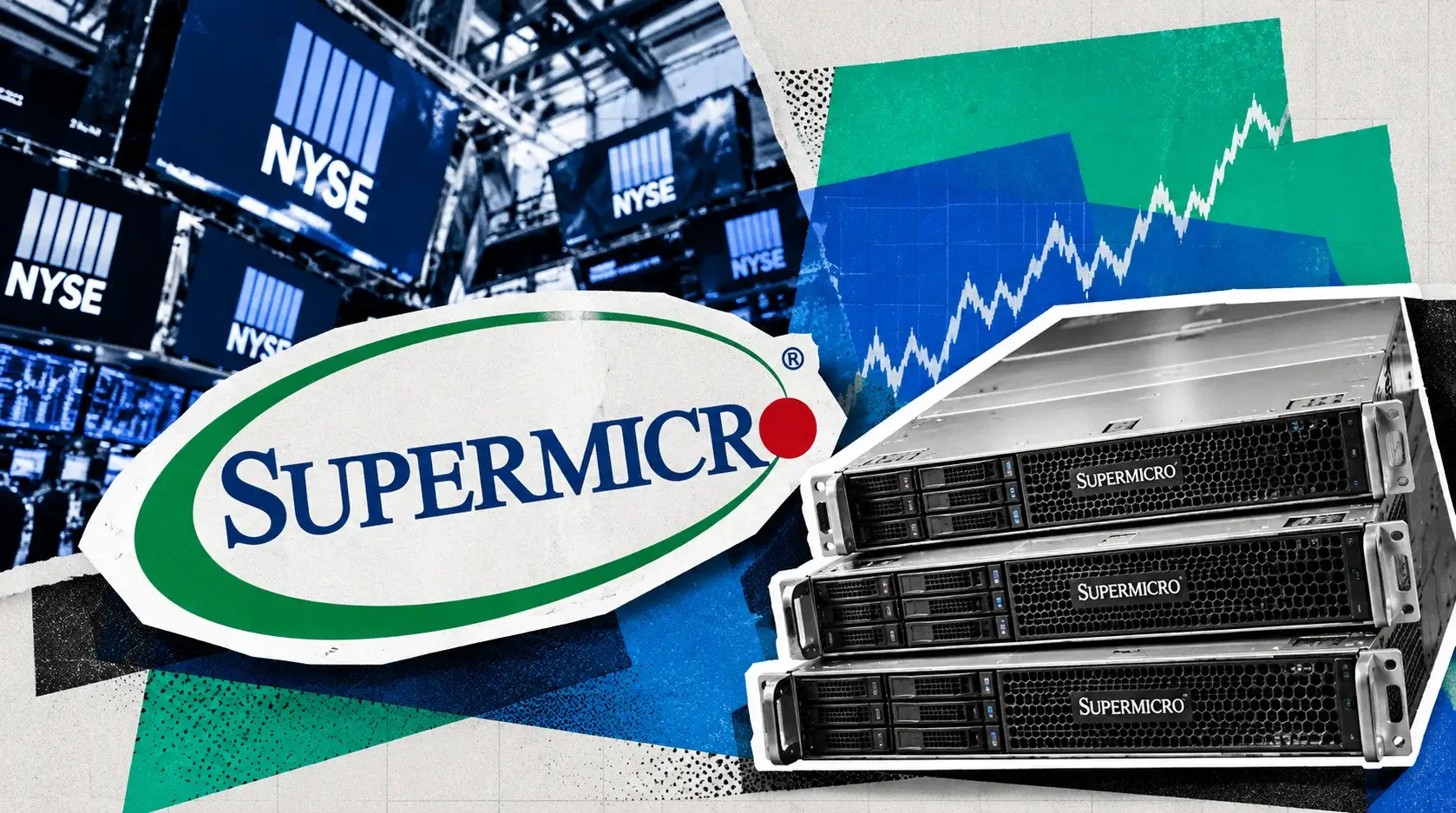
Super Micro Computer filed an 8-K after Tuesday’s close disclosing preliminary results for its fiscal first quarter, which ended September 30. The company now expects revenue of $18.5 billion to $19.5 billion, far above its prior guidance of $14.5 billion to $15.5 billion and a consensus of $15.23 billion. Even the low end of the new range sits 19.4% above the top of the old guidance. The midpoint of $19 billion is 25% above consensus.
Margins improved alongside volume. Super Micro guided gross margin to 12.0% to 12.5%, up from 10.4% to 10.8%, and attributed the range to customer and product mix. For a server maker that has fought margin compression for most of the past two years, a 160-basis-point lift at the midpoint matters as much as the revenue number. The figures are preliminary and unaudited, and full results come with the earnings call on November 3, 2026.
The stock closed Tuesday’s regular session at $32.47, up 1.15% for the day and 11% for the year. It hit $37.51 in after-hours trading, a 15% jump, and traded at $36.69 premarket on Wednesday, up 12.7%. If that gain holds through the close, it would be the stock’s biggest one-day advance since August. Over the prior 20 trading days, Super Micro had fallen 8.42% and traded between $31.27 and $45.15.
Companies rarely preannounce unless the gap with expectations is large, and that is why this filing carries extra weight. It is not a forecast for a future quarter that could slip. It is a report on a quarter already closed, and it says customers bought far more AI servers than anyone modeled. Microsoft, Google, Amazon and Meta are expected to spend more than $700 billion on AI infrastructure this year, and Super Micro’s number is direct evidence that the money is reaching hardware vendors.
The read-through hit every link in the chain. Dell rose 5.5% premarket from a $461.56 close, and Hewlett Packard Enterprise rose 4.5% from $56.09. Vertiv added 5.1%. Micron gained 2.5% after falling 15.9% over the past month. Nvidia rose up to 2.1% after a 5.2% monthly decline. Neocloud operators CoreWeave and Nebius rose more than 4% in after-hours trading, with CoreWeave holding a 2.2% to 2.5% gain premarket. CoreWeave was at the center of last week’s selloff on concerns about its debt load and the profitability of the AI buildout.
There is a caution in the data. Super Micro remains unprofitable on a trailing basis and cash-flow negative, so the guidance raise does not fix its balance sheet. The 12.0% to 12.5% gross margin, while higher, is still thin for the amount of capital tied up in inventory. And a single quarter of upside does not settle the question of whether hyperscaler spending will continue at this pace into 2027.
Still, the timing is what moves the tape. Super Micro and SpaceX landed the night before Meta reports, and they handed AI bulls two hard data points to carry into the print.
Netflix and Intuitive Surgical Show the Market Is Selling Soft Guidance
Netflix (NFLX) reported third-quarter revenue of $12.874 billion, up 12% from a year earlier and $2 million short of the $12.876 billion consensus. Earnings were $0.87 per share against an $0.82 estimate. Operating income was $4.46 billion against $4.258 billion expected, an operating margin of 34.6%, and free cash flow was $2.884 billion. On the backward-looking numbers, the quarter was solid.
The guidance was not. Netflix guided fourth-quarter revenue to $13.442 billion and earnings to $0.67 per share, against estimates of $13.517 billion and $0.73. That is a $75 million revenue gap and an 8% earnings gap. The company narrowed full-year revenue guidance to $51.1 billion from a prior range of $51.0 billion to $51.4 billion, landing below the $51.2 billion midpoint. Advertising revenue guidance for 2026 was lowered, with the advertising shortfall reported at $300 million.
The stock had already fallen 1.66% in Tuesday’s regular session before the report. It traded down 6% at $64.57 premarket, with an earlier low showing a 7% decline. The after-hours drop erased $17 billion in market value. Two brokerages trimmed targets on concerns about growth visibility. Investors who bought Netflix as a steady compounder are now asking whether the advertising tier can scale fast enough to offset slowing subscriber growth in mature markets.
Intuitive Surgical (ISRG) is a sharper case of a beat getting sold. The company earned $3.00 per share on an adjusted basis against a $2.64 estimate, a 14% beat, on revenue of $3.049 billion against $2.906 billion expected. Adjusted operating income was $1.27 billion versus $1.129 billion. The company shipped 546 da Vinci systems and guided full-year 2026 worldwide procedure growth to 14% to 15%.
The stock fell 7.5% to $405.00 premarket after rising 1.11% in Tuesday’s regular session. Two items drove the selling. First, Intuitive disclosed a $450 million pretax antitrust litigation settlement charge that weighed on GAAP net income. Second, management described the U.S. procedure slowdown as the weakest it has seen since the pandemic and cut a target tied to procedure demand. For a company valued at $151 billion on the assumption of durable double-digit procedure growth, any slowdown commentary is expensive.
The two names share a lesson for the rest of the week. Headline beats are not enough. Netflix and Intuitive both topped earnings estimates, and both are falling more than 6% because the forward picture got cloudier. Meta and Tesla face the same test tonight, and Meta in particular has precedent: the stock fell 8% after its last report despite an earnings beat because free cash flow disappointed.
Pegasystems, Accenture after a brokerage turned cautious, and Alpha Teknova, down 27.9% to $5.33 after pricing a $40 million stock offering at $5 per share, rounded out the premarket losers list.
Wednesday Morning Earnings: Capital One, Elevance and AT&T Beat Big
The before-the-bell slate was heavy and mostly strong on the numbers, with reactions split along the guidance line.
Capital One Financial (COF) rose 3.3% to 3.6% premarket after reporting adjusted earnings of $6.69 per share against a $5.50 estimate, a 22% beat. Net income reached $3.5 billion, or $5.61 per share, up from $3.2 billion, or $4.83 per share, a year earlier. Revenue was $16.34 billion against $16.2 billion expected, net interest income was $12.9 billion versus $12.732 billion, and net interest margin came in at 8.41%. Net charge-offs were $3.1 billion and the 30-plus-day auto delinquency rate stood at 4.64%. The Discover integration continues on schedule. The stock had gained 0.87% in Tuesday’s session.
Elevance Health (ELV) delivered the biggest beat of the morning, with adjusted earnings of $6.99 per share against a $4.70 estimate, 49% above consensus. Revenue reached $50.4 billion against $49.29 billion expected, and the company raised its outlook.
AT&T (T) posted adjusted earnings of $0.65 per share against $0.60 expected on revenue of $32.2 billion versus $31.69 billion, and reported its best consolidated service revenue growth in more than four years.
Danaher (DHR) reported adjusted earnings of $2.11 per share, up 11.5% and above the $1.92 estimate, on revenue of $6.6 billion, up 8.5%. Net earnings rose 34.5% to $1.71 per diluted share and free cash flow was $1.6 billion. The problem was core growth: non-GAAP core revenue rose only 3.0%, or 5.5% excluding respiratory products. The stock was down 4.07% premarket.
Thermo Fisher (TMO) reported adjusted earnings of $6.68 to $6.69 per share against a $6.40 estimate on revenue of $12.14 billion versus $11.95 billion, citing new product launches. The stock fell between 0.9% and 2% premarket despite the beat, with a $254 billion market cap and a trailing P/E of 36.98 leaving little room.
Abbott (ABT) reported adjusted earnings of $1.42 per share, matching estimates, on sales of $13.013 billion, up 14.5% reported and 7.0% on a comparable basis. GAAP earnings fell to $0.53 per share from $0.94. Abbott tightened full-year adjusted EPS guidance to $5.50 to $5.55, reaffirming the midpoint, and projected 6% comparable sales growth for 2026. Electrophysiology sales rose 15.0%.
Philip Morris International (PM) posted adjusted earnings of $2.36 per share, up 5.4%, against a $2.31 estimate, on net revenue of $11.4 billion. Reported diluted EPS fell 4.9% to $2.12. Total shipments rose 0.6% with smoke-free shipments up 2.7%, and smoke-free products accounted for more than 40% of net revenue in the quarter.
NextEra Energy, CME Group and Moody’s also reported before the open. The collective message from the morning slate is that corporate profits are holding up well. The market’s selectivity is about guidance and growth durability, not about whether companies can beat a quarter.
Macro Grip: 10-Year at 5.12%, Brent at $109.64, Dollar at 101.76
The macro backdrop is not giving equities much help on Wednesday morning. The 10-year Treasury yield rose 1 basis point to 5.12%, reversing part of Tuesday’s 6-basis-point drop to 5.08%. Short-dated bills are pinned near the policy rate, with the 4-week bill at 4.00% and the 8-week bill at 4.08%. At 5.12%, the 10-year sits 112 basis points above the 4.00% top of the federal funds range, a steep term premium that keeps pressure on long-duration growth valuations, including the AI names rallying premarket.
Oil reversed higher overnight. Brent edged up 85 cents to $109.64 early Wednesday and traded back above $110 at points, after Iran told Pakistan’s army chief there would be no talks with Washington until its demands were met. December WTI, now the front-month contract, rose 76 cents to $98.58 early and traded at $99.04 later in the morning, up 1.25%. The $3 gap between Tuesday’s $101.79 expiring contract and Wednesday’s December price reflects the roll, not a collapse. Diesel tightness remains a pressure point even if diplomatic headlines improve.
Crude supply data arrives at 10:30 a.m. ET, when the Energy Information Administration releases weekly inventories for the week ended October 16. The prior week showed a draw of 8.6 million barrels, and Tuesday night’s industry data showed another 4.9 million-barrel crude draw. A third straight large draw would support crude prices and push inflation expectations higher.
The dollar index was little changed at 101.76 after falling 0.2% on Tuesday and touching 101.50, its lowest since October 1. That retreat extends a pullback from an 18-month high near 103 reached last week. The dollar has been caught between safe-haven demand tied to the U.S.-Israeli conflict with Iran and pressure from falling yields during last week’s AI selloff. Protests in France weighed on the euro this morning, which helped the dollar recover its earlier losses.
Gold fell for a fourth straight session to $4,113.50 an ounce, down 0.66%, and touched a seven-week low. The metal is down 5.28% over the past month and sits 27% below its all-time high of $5,608.35 from January. December gold futures traded at $4,136.20, $18 above spot. Silver fell 1.4% to $57.18 an ounce and copper declined. The precious metals selloff ties directly to rate expectations: higher-for-longer policy raises the opportunity cost of holding a non-yielding asset.
The Treasury auctions a reopened 20-year bond at 1:00 p.m. ET. With the 10-year at 5.12% and outflows of $3.1 billion from long-bond ETFs on Tuesday, demand at the long end will be watched closely. A weak auction that pushes the 10-year back toward 5.15% would hit tech stocks in the afternoon, right before Meta and Tesla report.
The macro picture adds up to a ceiling on multiples. Equities can rally on earnings, but with oil above $98, the 10-year above 5.1% and the Fed still in a hiking cycle, there is little room for valuation expansion.
Fed Blackout, Record-Low Housing Data and the December Hike
The Federal Reserve is in its pre-meeting blackout ahead of the October 27 to 28 FOMC meeting, with the decision due at 2:00 p.m. ET on October 28. The federal funds target range sits at 3.75% to 4.00% after September’s unanimous quarter-point hike. September consumer prices rose 3.7% from a year earlier, above the 3.6% estimate, and Fed staff projected inflation will stay above the 2% target until 2029.
Market pricing has swung hard this month. Odds of an October hike jumped to 44% on the morning of the September CPI release on October 14, up from 20% before the report, and peaked near 50% after it. They have since fallen steadily. CME FedWatch put October hike odds at 14.9% on Tuesday, down from 22.1% a week earlier, and the figure stood at 16% on Wednesday morning. Prediction markets priced an 87% chance of a hold. December is a different story: traders see a 90% to 92% chance of a quarter-point hike at the December 8 to 9 meeting, and nearly every economist in a major survey expects the Fed to skip October and hike in December.
Fed Chair Kevin Warsh has kept the hawkish tone. He has said inflation is too high and that too many price categories are rising faster than 3%. Minutes from the September meeting, released October 7, showed every participant supported that hike and most officials saw another increase as likely appropriate by year-end. Several officials have signaled the Fed can wait until December, which is why October odds have faded.
Housing data released Tuesday showed the cost of that policy. September housing starts fell 5.2% to a 1.221 million annual rate, well short of the 1.30 million consensus and down from a revised 1.288 million in August. Single-family starts dropped 4.6% to 859,000 and permits slipped 0.2%. Pending home sales fell 7.3% to an index reading of 66.0, the lowest since the series began in 2001, with declines in every region and an 11.3% drop from a year earlier. Homebuilder sentiment fell to its lowest level since 2012.
With mortgage rates above 7%, housing is already doing restrictive work that the Fed would otherwise have to do through additional hikes. Widespread price cuts and incentives will squeeze margins at large homebuilders and building-materials suppliers. The pending home sales collapse, which measures signed contracts, points to weaker existing-home sales over the next one to two months.
For equities, the housing weakness cuts two ways. It pulls yields lower, which helped rate-sensitive sectors rally on Tuesday. But it also signals that the oil shock and higher rates are slowing a large part of the economy. The Atlanta Fed’s GDPNow estimate for third-quarter growth stood at 3.50% on Tuesday against a 3.60% consensus, so the economy is still running hot overall. That combination of hot growth, sticky inflation and a crumbling housing sector is exactly the backdrop that keeps the December hike priced at 90%.
Meta and Tesla After the Close Will Decide Whether the AI Bid Sticks
Meta Platforms reports third-quarter results after Wednesday’s close, with its call at 4:30 p.m. ET. It is the first hyperscaler to report this season, which makes its capital spending commentary the most consequential data point of the week for chip, server and memory stocks.
Consensus calls for adjusted earnings of $6.67 to $6.77 per share on revenue of $63.35 billion to $63.4 billion, inside the company’s guided range of $61 billion to $64 billion. Some forecasts sit higher at $63.8 billion. The earnings number is not the problem. Free cash flow is. Meta generated only $784 million in free cash flow in the second quarter against a full-year 2026 capex budget of $130 billion to $145 billion, which was raised last quarter. The stock fell 8% after its July report despite beating earnings, because cash flow disappointed.
The stock enters the report weak. Meta fell 1.59% on Tuesday to $689, its fifth straight decline, and is down 11% from its October 13 high of $771.27. That pullback lowers the bar somewhat, but it also shows how nervous investors are about AI spending returns.
The swing factor is any early signal on 2027 capex. Meta has not given a 2027 figure. A higher capex outlook would lift Nvidia, Super Micro, Dell, Micron and the rest of the AI hardware chain that is rallying premarket today. It could also revive concerns about returns among investors focused on free cash flow. A flat or lower capex signal would do the reverse: it would ease cash-flow concerns at Meta but hit the hardware names that just rallied on Super Micro’s number. There is no outcome that pleases every part of the AI trade.
Tesla reports in the same window with its call at 5:30 p.m. ET. Its swing factor is automotive gross margin after the second quarter’s drop to 16.3%, plus any detail on the special committee process with SpaceX.
The rest of the after-hours slate is deep. Texas Instruments, Lam Research, IBM, CSX, Kinder Morgan, Las Vegas Sands, Southwest Airlines, United Rentals, Crown Castle, Rollins, Globe Life and Packaging Corporation of America all report after the bell. Lam Research matters most for the chip complex, with its read on wafer fab equipment demand landing on the same night as Meta’s capex guide. Texas Instruments gives an analog and industrial read that ties into the broadening trade.
All of this means the regular session is likely to trade cautiously into the close. Traders who bought AI hardware premarket on Super Micro and SpaceX will have to decide by 4:00 p.m. ET whether to hold through Meta’s number. The more of the premarket gap that holds into the bell, the more confidence the market has that Meta will confirm spending. The more that fades, the more traders are hedging against a repeat of July.
Verdict: Mixed Session, Bullish Lean on Tech, With Meta as the Referee
The session sets up as mixed with a bullish lean toward technology. Futures point to a Nasdaq-led open with Nasdaq 100 futures up 0.62% at 29,860.25, S&P 500 futures up 0.23% at 7,773.00, and Dow futures up 0.16% at 52,801. That leadership is the opposite of Tuesday, when the Dow rose 1.02% to 52,495.88, the Russell 2000 jumped 1.65% to 2,773.42, the S&P 500 added 0.28% to 7,712.57, and the Nasdaq Composite finished flat at 26,424.82.
The bullish case rests on hard numbers delivered overnight. SpaceX posted $14.58 billion in revenue, up 161%, with AI revenue of $7.56 billion up 830%, and spent $16.44 billion on AI compute in a single quarter. Super Micro preannounced $18.5 billion to $19.5 billion in revenue, 19.4% above the top of its own guidance, with gross margin lifted to 12.0% to 12.5%. Those are not forecasts. They are reports on a closed quarter that show AI money is still reaching hardware vendors, and they recovered $274 billion of the $1.6 trillion lost in last week’s AI rout before the bell.
The case for caution is just as concrete. The 10-year yield sits at 5.12%, Brent is back at $109.64, December WTI is near $99, and the Fed is priced for a 90% chance of a hike in December. Netflix is down 6% and Intuitive Surgical is down 7.5% on beats with soft guidance, which shows the market will punish any forward weakness. Meta enters its report down 11% from its October 13 high after falling 8% on its last beat.
The levels to watch are specific. On the S&P 500, a close above Tuesday’s 7,748.42 high would confirm the tech rebound is adding to the broadening rather than replacing it, with the 7,844.52 record 1.7% overhead. On the Nasdaq Composite, holding above 26,424.82 keeps the AI bid intact into the close. On the Russell 2000, holding 2,773.42 means small caps are not being sold to fund chip buying. SpaceX needs to hold $150, and Super Micro needs to hold the $36 area through the session for the premarket gap to count.
The broadening trade from Tuesday still sets the floor for this market. Breadth of 1,614 advancers to 559 decliners on the NYSE, equal weight beating cap weight by 87 basis points, and earnings beats across credit bureaus, toys, defense, pharma and banks all point to a market that does not depend on AI alone. The AI rebound is the upside lever on top of that floor, and Meta’s 4:30 p.m. capex call decides whether that lever holds or snaps back by Thursday’s open.