S&P 500 (SPX) Back Above 7,400, Nasdaq Jumps 2.3%, Dow Adds 311 Points on Microsoft's 14% Azure-Fueled Rip
Microsoft surged 14.2% after Azure grew 43% and crossed $100 billion in annual revenue | That's TradingNEWS
Key Points
- S&P 500 +1.1% near 7,400; Nasdaq 25,005.66 +2.30%; Dow 51,905.62 +311.48 (+0.60%), recovering half of Wednesday's 1,153-point drop.
- Microsoft +14.2% on $90.01B revenue, $4.74 adjusted EPS vs $4.24 expected, Azure +43% past $100B annual, backlog +84% to $678B.
- Meta -9.2% as free cash flow collapsed 91% to $784M on $31.08B capex; EPS $6.18 missed $7.22 and 2026 capex floor rose to $130B.
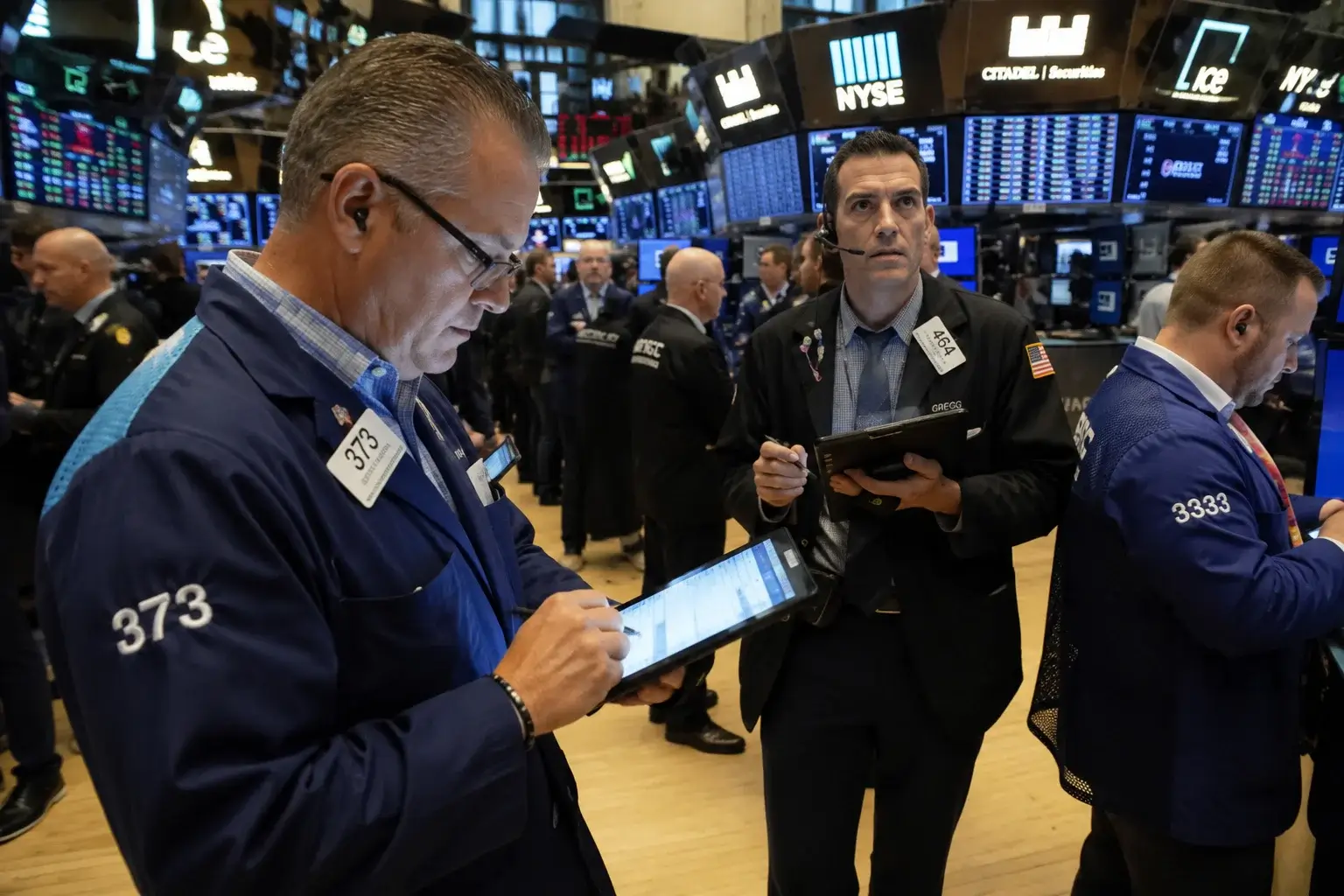
Wall Street bought the Fed dip inside the first hour. The S&P 500 is up roughly 1.1% and back through 7,400 after closing Wednesday at 7,316.15. The Nasdaq Composite is doing the heavy lifting at 25,005.66, up 562.72 points or 2.30%, with the Nasdaq-100 stronger still at +2.79%. The Dow Jones Industrial Average printed 51,905.62, up 311.48 points or 0.60%, as of 10:18 a.m. Eastern. That recovers about half of Wednesday's damage — a session in which the Dow shed 1,153 points, the S&P fell 1.52% to 7,316.15 and the Nasdaq dropped 1.74% to 24,443, the worst single day in seven weeks.
The composition of the bounce matters more than the size. This is a mega-cap and semiconductor rally, not a broad one. The Russell 2000 sits at 2,931.36, up 25.61 or 0.88% — barely a third of the Nasdaq's move on a day when small caps should be the natural beneficiary of a bond-market pause. Breadth is narrow enough that a single name, Microsoft, is responsible for a meaningful slice of the index-level gain, while Meta Platforms subtracts from the same tape. When two members of the same seven-stock cohort move 23 percentage points apart in one session, the index number stops describing the market and starts describing an argument about capital allocation.
Volatility confirms the relief without confirming conviction. The VIX is at 18.24, down 11.7% on the day after spiking to 20.66 into Wednesday's close, a 13.45% jump. That is a mechanical unwind of Fed-event premium, not a re-rating of risk. Gold futures at $4,154.50, up 1.40%, tell the other half of the story: the hedge bid did not leave when equities came back. Investors are paying up for equity beta and inflation insurance in the same session, which is what happens when the growth signal and the price signal point in opposite directions on the same eight-thirty release.
The overseas tape agrees with the caution. Britain's FTSE 100 rose 0.4%, France's CAC 40 gained 0.9%, Germany's DAX added 0.2%. Asia was mixed rather than constructive: Hong Kong's Hang Seng edged up 0.2% to 25,858.88 while the Shanghai Composite lost 0.6% to 3,804.69, with Tokyo and Seoul carrying the heaviest losses overnight on memory-chip exposure. Context on the hole still open: the Nasdaq-100 entered correction Wednesday, closing 9.8% below its early-June record. A 2.8% bounce does not repair that, and it has to be repaired with the long end of the Treasury curve at 2007 levels and two of the four largest capex commitments in the AI complex reporting after tonight's bell.
Microsoft's $90 Billion Quarter and the Azure Line That Reset the Tape
Microsoft is up 14.2% and adding roughly $260 billion of market value on a fiscal fourth quarter that beat on every line investors had flagged as a risk. Revenue landed at $90.01 billion, up 18% against an $87.62 billion consensus. Adjusted earnings came in at $4.74 per share versus $4.24 expected — a 12% beat on the bottom line, and a 23% year-over-year increase. GAAP diluted EPS was $4.81, up 32%, on net income of $35.77 billion against $27.23 billion in the year-ago quarter. Revenue in the comparable quarter last year was $76.4 billion on $3.65 of EPS, which frames how much operating leverage this print carried.
Azure was the number that reset the tape. Growth accelerated to 43% year over year, and 43% at constant currency, from 40% in the prior quarter, against a Street looking for 40% and 40.2% respectively. That pushed full-year Azure revenue past $100 billion for the first time, up 41% across fiscal 2026. At that scale the business trails only Amazon Web Services and sits ahead of Google Cloud. Intelligent Cloud, the segment housing Azure, delivered $39.31 billion, up 31.6% and ahead of the $38.16 billion consensus. Microsoft Cloud in aggregate reached $59.3 billion, up 27%. Productivity and Business Processes, which carries Office, Dynamics and LinkedIn, produced $37.85 billion, up 14.3% against a $37.19 billion estimate.
The backlog is the part that reframes the AI-monetization debate. Commercial remaining performance obligations jumped 84% year over year to $678 billion, a $51 billion sequential build from $627 billion. That is contracted revenue, not pipeline, and it is the strongest available rebuttal to the argument that hyperscaler capex is being deployed against demand that has not materialized. Microsoft 365 Copilot crossed 30 million paid seats, up from just over 20 million in April — a 50% sequential increase in the single most disputed disclosure in the company's AI narrative, and the metric that converts a large free user base into recurring revenue.
Full-year figures compound the point. Fiscal 2026 revenue reached $331.8 billion, up 18%. Operating income rose 21% to $155.2 billion. GAAP net income climbed 31% to $133.7 billion and EPS 32% to $17.95. Operating cash flow was $182.9 billion for the year and $55.4 billion in the quarter, with $10.2 billion returned through dividends and buybacks. Operating margin ticked up to 45% even as gross margin compressed to 67% on AI infrastructure costs. September-quarter guidance came in at $89.85 billion to $90.95 billion, above Street models, with Azure guided to 45% constant-currency growth against 41.4% consensus. Sell-side targets moved to $600, $650 and $647 at three shops; one outlier trimmed to $512 from $545.
The Capex Reclassification Nobody Should Read Past
Two details inside the Microsoft print deserve more scrutiny than the headline beat received. First, the quarter carried a $3.2 billion gain tied to the company's investment in Anthropic. Strip that and diluted EPS is $4.74 rather than $4.81 — which is precisely the adjusted figure the Street compared against $4.24, so the beat survives the adjustment intact. But the quarter also absorbed Xbox impairment charges and severance costs, partially offset by lower-than-expected outlays on the company's first-ever voluntary retirement program. That is a lot of moving parts in one period, and the clean read is the operating line and the backlog, not the EPS headline.
Second, and considerably more consequential: the reduction in the calendar-2026 capital expenditure outlook to approximately $175 billion from roughly $190 billion is an accounting change, not a spending cut. Microsoft lengthened the assumed useful life of its office and data center properties to 25 years from 15 years and adjusted the treatment of certain leases, with the change taking effect in fiscal 2027. The buildings and the silicon are still being bought on the same schedule. The depreciation is being spread across a decade longer. Anyone reading that $15 billion delta as capital discipline has misread it, and management said so directly on the call, emphasizing that infrastructure construction plans have not been scaled back in any material way.
The quarter's actual spending tells the honest version. Capital expenditures including finance leases hit $41 billion, up 69% year over year, against a feared $42 billion — a modest beat that mattered enormously to sentiment given how Alphabet's capex raise was received last week. Property and equipment additions were $35.8 billion in the quarter and $115.9 billion across the fiscal year. The finance chief pointed to further capex growth in fiscal 2027, citing demand signals across the portfolio, while committing to remaining free cash flow positive next year. That last clause is doing the heaviest work in the entire release, because it is the precise differentiator against both Meta and Alphabet.
The distinction is the whole trade right now. There are two ways to spend $175 billion on AI infrastructure: one where contracted backlog compounds faster than the depreciation schedule, and one where it does not. Microsoft showed a $51 billion sequential backlog build against a $41 billion quarterly capex bill, with operating margin expanding rather than contracting. That is the first hyperscaler print this cycle where the coverage ratio moved in the right direction. The stock's 14% move is not enthusiasm about artificial intelligence in the abstract. It is a repricing for the possibility that this particular buildout amortizes on something close to the promised schedule.
Meta's $784 Million: When a Record Quarter Prints a Cash Problem
Meta Platforms is down 9.2% and testing the low $530s after a quarter that beat on revenue and broke on everything investors have been watching for two quarters. Revenue reached $60.80 billion, up 28% year over year and roughly $600 million above the $60.17 billion consensus — the largest revenue quarter in company history. Advertising revenue rose 27%, with ad impressions up 14% and average price per ad up 12%. Demand is not the issue. The core business is healthy and the engagement metrics held. Conversion of that demand into cash is the issue, and it has become severe.
Diluted EPS came in at $6.18 against $7.22 expected, a miss of nearly 14%. Net income fell 14% to $15.85 billion. Total costs and expenses surged 55% year over year to $42.0 billion, the widest operating cost increase Meta has reported in recent years, dragging operating margin to 31% from 43%. Roughly $3.58 billion of that was one-time: a $2.4 billion legal charge the company declined to attribute to a specific matter, plus $1.18 billion in severance. Management noted that excluding both items operating income would have risen 9%. That framing sets a low bar, because 9% operating income growth against 28% revenue growth is still punishing negative operating leverage. Reality Labs lost more than $4.6 billion in the quarter.
The cash flow statement is where the stock broke. Operating cash flow rose nearly 25% to $31.86 billion. Capital expenditures including finance-lease principal payments reached $31.08 billion, consuming 97.5% of it. Free cash flow came in at $784 million against $8.55 billion a year earlier — a 91% collapse, with the free cash flow margin falling to 1.3% from roughly 18%. Meta also raised the floor of its full-year capex guidance to $130 billion to $145 billion from $125 billion to $145 billion, the second increase this year after an original sub-$100 billion plan, and lifted its expected effective tax rate for the remaining quarters to 15%–17% from 13%–16%. Last year's total capex was $72 billion. The bill is roughly doubling.
Guidance sealed the reaction. Third-quarter revenue is set at $61 billion to $64 billion, a $62.5 billion midpoint below the $63.15 billion consensus. That implies roughly 25% growth at the midpoint against 28% delivered — deceleration, on a spending curve that is still steepening. The technical picture is deteriorating in parallel: the stock is retesting a $521.50 double-bottom with RSI near 16, and $495.30 is the next reference below that. Meta has now converted two consecutive revenue beats into double-digit drawdowns, which is the market stating plainly that the top line is no longer the variable under discussion.
One Session, Twenty-Three Points of Spread: The Capex Split Goes Live
The 14.2% gain in Microsoft against the 9.2% decline in Meta is the widest same-day divergence between two Magnificent Seven members this cycle, and it is not a sentiment accident. Both companies spent the same order of magnitude on AI infrastructure this quarter — $41 billion against $31.1 billion. One reported a $51 billion sequential increase in contracted backlog with an expanding operating margin. The other reported free cash flow of $784 million and a twelve-point margin contraction. The market did not reward AI spending today or punish it. It priced the demonstrated return on it, name by name, and the spread between the two verdicts is the story of the session.
The structural difference is a cloud business. Microsoft has a counterparty who pays for the compute at a contracted rate, which converts capex into a receivable with a term and a price attached. Meta's compute is consumed internally — model training, recommendation systems, personal agents, new products — and monetizes indirectly through advertising yield on a lag nobody can size with confidence. Management said on the call that a significant portion of compute goes toward training models, growing the core business and delivering agents, while flagging an ambition to build a large business serving external customers as well. That is a plan, not a backlog. Alphabet hit the same wall last week when free cash flow turned negative for the first time on record alongside a raised 2026 capex outlook.
That produces a clean three-way sort across the hyperscaler complex. Microsoft: heavy spend, contracted offset, explicit free-cash-flow-positive commitment for fiscal 2027. Alphabet: heavy spend, negative free cash flow, rising capex. Meta: the heaviest spend as a share of cash generation of the three, no cloud revenue line at all, capex floor raised twice inside a single year. Multiple compression should follow that ordering unless the monetization evidence changes, because sustained capital intensity mechanically means each dollar of sales produces less cash after investment — and a lower multiple applied to the same growth rate is the arithmetic result, not a sentiment overlay.
Which makes tonight's Amazon print the arbiter of whether this stays a stock story. If AWS growth accelerates for a fourth consecutive quarter and the capex guide lands inside the range already discounted, the differentiation thesis holds and Meta's problem is Meta-specific. If Amazon raises capex without a corresponding AWS acceleration, the market has to conclude that the cloud offset does not scale with the spend, and this becomes a sector de-rating rather than a dispersion trade. One desk framed the split as a tale of two AI investment strategies — one company growing profits while spending heavily, the other letting the costs consume the bottom line.
Semis Claw Back Seven Percent With a Twenty-Five Percent Hole Still Open
The chip complex is the second engine of today's tape. The iShares Semiconductor ETF is up more than 7%. Lam Research leaped 18.3% after posting record quarterly revenue and earnings, the largest single-day move in the group. Advanced Micro Devices rallied 7.3%. Micron, Nvidia, Intel and Broadcom all participated. The leveraged vehicles amplified it without repairing much: the 3x semiconductor product bounced to $99.79, which recovers only 44% of Wednesday's dollar loss despite the flattering percentage optics. Five semiconductor names have been doing nearly all the work in the sector's moves in both directions for weeks.
Wednesday's carnage frames the scale of what remains unrepaired. Micron fell 9.9%. Applied Materials dropped 8.4%. AMD lost 5.5%. Nvidia shed 3.5%. That came on disappointing results out of SK Hynix and a broader reassessment of whether AI capital spending has run ahead of end demand. The Philadelphia Semiconductor Index is down roughly 25% since late June, having surged more than 87% in the second quarter — its best quarter on record. The 3x product ended 2025 at $42.03, ran to $266.71 by June 30, and closed Wednesday at $91.99: a 65.5% July drawdown that still leaves it up 118.9% for 2026. Both facts are accurate, and both belong in the same sentence.
Concentration is the mechanism behind the violence. Micron, AMD, Nvidia, Intel and Broadcom together make up roughly 36% to 37% of the semiconductor ETF, with semiconductor-equipment firms adding another 24%. Micron alone carried 8.55% of the benchmark as of June 30, AMD 8.10%, Nvidia 6.82%, Intel 6.34%, Broadcom 6.08%. When memory pricing is the marginal variable and memory is that heavily weighted, the index becomes a leveraged bet on a single input cost. The 50-day rolling standard deviation of daily returns for the group reached its highest level since May 2020 earlier this month. That works in both directions and has now done both inside eight weeks.
The Lam print is the constructive data point, and it is a real one rather than a positioning artifact. Semiconductor capital equipment revenue is the cleanest available read on whether hyperscaler capex commitments are converting into actual purchase orders, and record revenue says they are. Set that against SK Hynix's miss and the picture is a supply chain where equipment demand holds while memory economics deteriorate — consistent with Microsoft's backlog build and inconsistent with the argument that the entire complex is a circular financing loop. It does not resolve the debate. It does mean today's 7% rests on a delivered number, which is more than can be said for several bounces this month.
The Leverage Sitting Underneath the Bounce
The unresolved risk in this tape is not valuation. It is collateral. Prime brokers including Goldman Sachs and JPMorgan Chase have been issuing margin calls to hedge funds with concentrated AI exposure, demanding additional collateral to maintain existing borrowing levels. Market participants stress that most of these were triggered automatically by contractual risk provisions rather than discretionary decisions by risk committees — which is precisely why they matter to price. Automatic mechanisms do not pause to assess whether a drawdown is fundamental or technical. They sell into whatever bid exists.
The concentration figures explain the sensitivity. Goldman disclosed that as of June 30, roughly 16% of its prime brokerage exposure sat directly in AI memory-chip-related names. The same desk reported that the cumulative increase in hedge fund gross leverage across the first five months of 2026 was the largest recorded since the bank began tracking the data in 2016. Positioning in semiconductors remained at the 98th percentile of the past five years even after four consecutive weeks of net selling in early July — managers were trimming a position that kept growing as a share of portfolios anyway. Layer in the index math, where the top ten S&P 500 components now account for roughly 40% of total market value, above the 2000 peak, and the plumbing is doing more work than the fundamentals.
The live case study broke this morning. Situational Awareness LP, the AI-dedicated fund that scaled a $225 million seed into more than $20 billion and returned 439% net through the end of June, is unwinding positions after steep losses. Its prime brokers — Bank of America, Goldman Sachs and JPMorgan Chase — have been working with the firm to meet margin requirements or reduce exposure in orderly fashion, and were marketing a block of its long and short holdings ahead of today's open. The disclosed portfolio spanned the full infrastructure stack: power generation, storage, AI data center operators. Every one of those sub-groups was already under pressure before the block hit the market.
A forced unwind of that size in names that thin is the specific mechanism that converts a correction into an air pocket. It also cuts the other way on days like today, because short-side covering inside a marketed block adds to the bounce — worth remembering before reading a 7% semiconductor move as a fundamental all-clear. One widely watched tactical positioning gauge flagged conditions as oversold enough to warrant a buying opportunity, citing falling bond yields, a weakening dollar, resilient corporate earnings and easing Middle East tensions. Tactical is the operative word in that sentence. Meanwhile Berkshire Hathaway's cash pile reached a record $397 billion, which is its own commentary on the opportunity set.
Warsh's Nine-Three Hold and the Bond Market's Reply
The Federal Reserve held the target range at 3.50%–3.75% for a fifth consecutive meeting, and the vote was 9–3. The three dissents — from the Cleveland, Minneapolis and Dallas presidents — favored a quarter-point hike. Markets had priced roughly 35% odds of an increase going in, making this one of the least predictable meetings in years. The chair described the disagreement as the good family fight he had asked for, and got it. Elevated inflation stemming primarily from higher energy prices was the stated backdrop, with the persistent Middle East conflict clouding the outlook.
He also declined, again, to offer forward guidance. The committee needs to observe market reaction to developments direct and unfiltered, he said, adding that decisions by the committee matter a great deal and that it will not hesitate to act where necessary and appropriate. He characterized the current stance as watchful thinking rather than watchful waiting, reiterated the 2% target and the importance of restoring credibility after years of overshoot, and confirmed press conferences will continue through year end. He made no change to the shortened statement format in his second meeting as chair.
The bond market's response was the market event of the week. The 30-year Treasury yield surged 12 basis points to 5.21%, the highest since 2007 and a nineteen-year peak. The 10-year rose more than seven basis points to 4.677%. The two-year fell four basis points to roughly 4.24%. That is a textbook bear steepener carrying a specific message: traders removed the near-term hike from the front end while simultaneously demanding more compensation at the long end for inflation risk they believe the committee is under-addressing. A central bank that will not guide gets priced by the curve instead, and the curve delivered its verdict inside ninety minutes.
Today the long end has stabilized rather than reversed. The 10-year eased to 4.65% from 4.67% late Wednesday, and the 30-year is holding between 5.20% and 5.24% after Wednesday's move up from 5.09%. That pause is a precondition for the equity bounce, not a resolution of it. September is now a live meeting by consensus, with market pricing for a hike simply pushed forward rather than removed, and one large asset manager positioning for a hawkish tilt with as many as three hikes. Incoming inflation prints between now and then are the entire input, which places unusual weight on a data calendar that just delivered two conflicting readings inside the same release window.
A 5.20% Long End Is the Real Constraint on This Multiple
For equity investors, the 30-year at 5.21% is the binding constraint on everything else discussed today. Discount-rate math is unsentimental: the longer the duration of the cash flows, the more a twelve-basis-point move at the back end costs in present value. The names carrying this market — hyperscalers committing $130 billion to $175 billion annually against returns that arrive in 2028 and beyond — are the longest-duration equities in the index by construction. A nineteen-year high in the 30-year is not a background condition for that cohort. It is the discount rate applied directly to the thesis, and it moved the wrong way this week.
The steepening is the informative part rather than the level. A front end that fell four basis points while the back end rose twelve is the market saying the policy rate is roughly appropriate for now and the terminal inflation rate is not. Term premium is being rebuilt. Long-dated inflation risk is being repriced upward. Neither of those unwinds on a single benign core PCE print, and both of them compress the multiple the market will pay for cash flows that have not yet arrived. That is the mechanism behind the Nasdaq-100's 9.8% drawdown from its June record, and it operates independently of whether any individual AI capex program earns its cost of capital.
The chair's own framing amplifies the transmission. By noting that tightening in financial markets is already doing part of the Fed's work, and by declining to guide, he has effectively deputized the bond market as a policy instrument. That is coherent as doctrine and volatile as practice: every inflation surprise now transmits straight into the long end without a communication layer to absorb it, and from the long end straight into equity valuations. Wednesday demonstrated the full pipeline — a hold with no fresh projections produced a 1,153-point Dow decline and a nineteen-year yield high on the same afternoon, with industrials down 3.42% and technology down 2.36% on the session.
Which is why today's stabilization near 5.20% matters more to the tape than Microsoft's beat does in isolation. Strong earnings lift a stock; only a settled long end lifts a market's willingness to pay forward multiples across the board. Energy is the channel to watch — with crude near $89 and the region escalating, the inflation path that would push the 30-year through 5.25% runs through the oil complex, not through wages or shelter. Equity investors who have never traded a bond in their lives need that yield on the screen every session for the rest of the quarter.
Read More
-
Yen Stalls at 160 Despite a 3% JGB and Tokyo Core CPI at 2.0% — Intervention Sits at 164, Friday's Payrolls Decide
02.09.2026 · TradingNEWS ArchiveEnergy
-
GLD ETF Sheds Value With Bullion as North American Funds Stay $7.7B in the Red
10.09.2026 · TradingNEWS ArchiveStocks
-
XRP ETF Flows: 7 Funds Split $1.682B With the Complex at Just 1.68% of Market Cap
10.09.2026 · TradingNEWS ArchiveCrypto
-
NG Breaks $2.90 With Production at 113 Bcf/d and LNG Feedgas Capped at 18.3 Bcf/d
10.09.2026 · TradingNEWS ArchiveCommodities
-
USD/JPY Holds Below the 157.23 Average as 2 Central Banks Tighten in 48 Hours
10.09.2026 · TradingNEWS ArchiveForex
Oil Backs Off $90 Even as the Strikes Widen
Crude is easing on a day the escalation deepened, which is the sort of dislocation that usually resolves violently in one direction. Brent lost about 2% to $88.93 a barrel and West Texas Intermediate fell 1.6% to $83.09, after the United States launched a heavy wave of strikes against Iran late Wednesday in retaliation for missile attacks on American forces across the region. Central Command said its forces hit dozens of Islamic Revolutionary Guard Corps sites. Iran's IRGC has threatened further escalation, and Tehran continues to insist on maintaining control of the Strait of Hormuz.
Wednesday was the mirror image. Brent gained 7.9% to close at $90.74 and WTI advanced 6.6% to settle at $84.46 after the president said the U.S. would hit Iran hard following an attempted surprise attack on American forces — ballistic missiles that Central Command said were intercepted after targeting a U.S. base in Jordan. Iran-allied militias in Iraq launched drones at oil facilities in Saudi Arabia's Riyadh and Eastern regions. U.S. and Saudi warplanes struck those militias jointly. Houthi forces in Yemen have targeted the pipeline Riyadh is using to move crude to Yanbu on the Red Sea while Hormuz shipping is disrupted, and have threatened a blockade of Saudi Arabia outright. Two vessels were hit by a drone attack at Egypt's Port Damietta, a liquefied natural gas hub, with no claim of responsibility.
The physical market is tightening underneath the headlines, which is the part the equity tape is ignoring. U.S. commercial crude inventories posted their largest draw since mid-June. The Strategic Petroleum Reserve declined for an eighteenth consecutive week, to the lowest level since 1983. Both choke points for Middle East oil exports — Hormuz and the southern Red Sea — are contested simultaneously, and the conflict has now expanded from one to the other. That is a supply structure with no visible slack and a materially diminished policy buffer if a real disruption lands.
For equities, the transmission channel is inflation, not energy sector earnings. June's benign core PCE was built substantially on a 9.2% decline in gasoline during a ceasefire window that has already closed. A sustained move back above $90 in Brent rebuilds the energy contribution to headline inflation into the August and September prints — the exact data the Fed said would determine September, and the exact mechanism the three dissenters cited in their vote. Today's crude pullback is therefore doing more for the equity multiple than it is for Exxon Mobil or Chevron, both of which rallied Wednesday as energy and consumer defensives were among the only sectors higher. Anyone treating the oil tape as a sector story is watching the wrong ticker entirely.
Away From Big Tech: ICE Pays $167 for MarketAxess and the Scoreboard Splits
The day's largest single-stock move belongs to MarketAxess, up 29.6% to around $163 after Intercontinental Exchange agreed to acquire the electronic fixed-income trading platform for $167 per share in cash. Total enterprise value is roughly $5.7 billion, a 33% premium to Wednesday's close and approximately 10.6 times last-twelve-months EBITDA pro forma for full run-rate expense synergies. ICE is targeting $100 million in annual cost savings within three years — about 22.8% of implied standalone EBITDA — funded entirely with newly issued debt across bonds, term loan and commercial paper. Initial gross leverage lands near 3.4 times, with management guiding to 3.0 times or below within eighteen to twenty-four months. ICE also raised baseline quarterly repurchases to $400 million from $350 million and traded roughly flat at $154.50. Closing is expected in the first half of 2027, subject to shareholder and regulatory approval.
The strategic logic deserves attention given where rates sit. MarketAxess connects approximately 2,100 institutional investors and broker-dealers across more than 90 countries in corporate bonds, municipal bonds, emerging market debt and Eurobonds. Its shares had lost nearly 31% this year, valuing the company near $4.5 billion at Wednesday's close. Total daily volume fell 11% in the second quarter while competitor Tradeweb posted an 18.2% volume increase, though block and portfolio protocol activity rose and Mid-X volume more than doubled. ICE is buying a structurally advantaged asset at a cyclical low, in a market about to absorb enormous issuance, and betting that fixed income electronification still has years to run.
Elsewhere the earnings scoreboard split hard along guidance lines. EMCOR Group climbed 13.7% on a blowout second quarter. GE HealthCare gained 12.15% to $71.90. Sandisk rebounded 7.3% to $1,090 after sector-wide profit-taking left it roughly 54% below its record high. On the other side, Alnylam Pharmaceuticals tumbled 21.1% on a revenue miss and a disappointing full-year guidance revision. Teladoc Health sank 18.4% after missing second-quarter revenue, lowering its 2026 outlook and reporting continued contraction in its BetterHelp segment. LKQ fell 13.7% on an earnings miss, reduced guidance and European operational disruption.
Qualcomm dropped 4.8% in a move that captures the current regime precisely. Fiscal third-quarter revenue came in at $9.9 billion against a $9.67 billion consensus, a clear beat. Adjusted EPS was $2.21 against a $2.23 estimate — a two-cent shortfall — and the stock lost nearly 5%. That asymmetry is what happens to semiconductor multiples when positioning is at the 98th percentile and prime brokers are calling for collateral. Mastercard, Bristol-Myers Squibb and Coinbase also report today, broadening the read across payments, healthcare and crypto beta.
What Tonight Decides: Apple's Margin Line and Amazon's Capex Number
Two prints after the close carry more weight than anything trading between now and four o'clock. Amazon shares are up around 3% to $233.45 into a report where the capex line matters more than the growth line. AWS has accelerated for three consecutive quarters — 20% in the third quarter of 2025, 24% in the fourth, 28% in the first quarter of 2026 — and estimates were marked up into the print, with one desk lifting its number to 33% on frontier-lab demand flowing through Bedrock. Anywhere in the low-to-mid 30s would mark a fourth straight acceleration on an already enormous base, something the chief executive himself called very unusual when first-quarter numbers landed.
The risk sits on the other line entirely. Amazon is running at roughly a $200 billion annual capex rate, and tracked consensus for 2026 has crept up nearly $2 billion since Alphabet reported, to around $207 billion, which suggests a raise is partly priced. The read-through from Alphabet's reaction is explicit: another capex increase likely brings selling pressure regardless of the AWS number, and whether the actual figure lands near $207 billion or well above it matters more than the cloud growth rate. Options imply a move of roughly 6% to 7% in either direction against a 6% average across the last four prints. AWS is expected to double compute capacity by the end of 2027 to service frontier-lab contracts. On the retail side, the Prime Day shift into June pulled roughly $7 billion of sales into the second quarter, flattering the top line and complicating the North America margin comparison.
Apple reports the same evening, and it is Tim Cook's final earnings call before John Ternus takes over on September 1. Consensus sits near $108.9 billion in fiscal third-quarter revenue, up 14% to 16% from $94.04 billion, with EPS around $1.89 against $1.57 a year ago. April guidance called for 14% to 17% revenue growth, gross margin of 47.5% to 48.5%, and operating expenses of $18.8 billion to $19.1 billion. Apple has beaten EPS estimates in each of its last four quarters. The call begins at 5 p.m. Eastern with Cook and finance chief Kevan Parekh.
Margin is the whole story. The AI-driven memory chip shortage has already forced price increases on Macs and iPads, and the September-quarter gross margin guide will reveal whether Apple is absorbing that cost or passing it through. Services, a record $30.9 billion last quarter against $26.6 billion a year prior, is the second pressure point. Apple briefly touched a $5 trillion market capitalization Tuesday after passing Nvidia as the most valuable public company, with the stock up 25% year to date and a high of $342.89. Priced for perfection, reporting into a memory-cost squeeze, on the night the market is actively re-rating capital intensity.