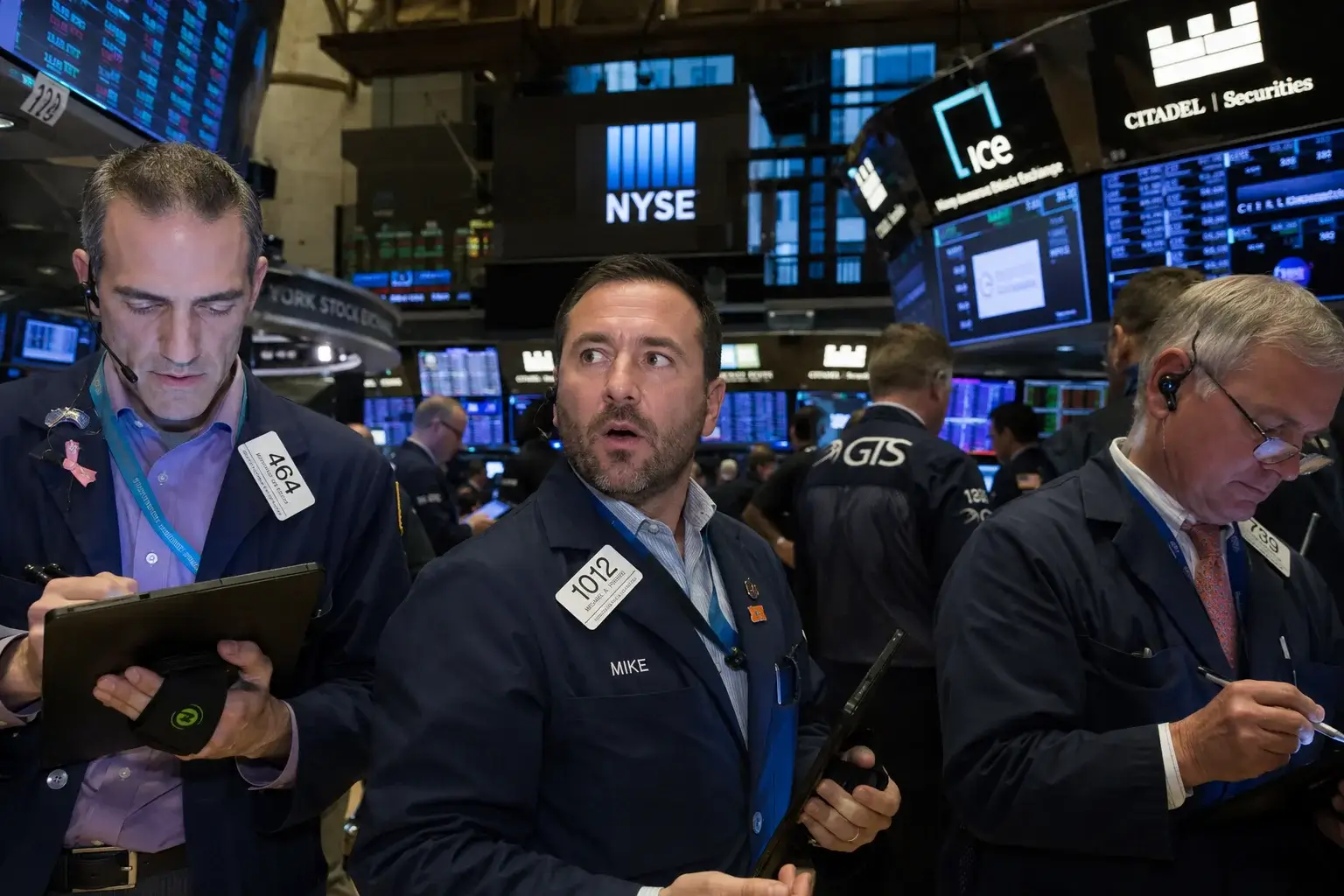
S&P 500 Slides 0.8%, Nasdaq Loses 1.5% and Dow Falls 365 Points as Brent Crude Breaks $100 and Google Drops 5% on $205 Billion Capex Guide
Brent crude crossed $100.05 a barrel, up 6.4%, after Houthi forces struck two Saudi tankers in the Red Sea | That's TradingNEWS
Key Points
- Brent crude hit $100.05, up 6.4% and its first move above $100 since late May, after Houthi attacks on two Saudi tankers in the Red Sea.
- Alphabet raised 2026 capex to $195–$205 billion from $180–$190 billion and posted negative $5.9 billion free cash flow despite 82% cloud growth to $24.77 billion.
- Tesla set a record $28.24 billion in revenue but earned just $0.33 per share as operating margin collapsed to 1.4% and capex rose 142% to $5.79 billion.
Wall Street walked into Thursday carrying two separate problems and found out within ninety minutes that they were the same problem. The Dow Jones Industrial Average opened down roughly 365 points, or 0.7%, off Wednesday's close of 52,218.58. The S&P 500 slid 0.8% from 7,498.96, and the Nasdaq Composite dropped 1.5% from 25,690.90, the worst of the three by a wide margin. Dow futures had been down as much as 600 points in the hour before the open, an unusually violent pre-market move for a session with no scheduled central bank event.
The proximate cause was crude. Brent futures crossed $100.05 a barrel by 9:15 a.m. Eastern, up 6.4% on the day and above the triple-digit line for the first time since late May. West Texas Intermediate advanced more than 5% to $91.08, its highest since June 11. Both benchmarks had settled Wednesday at $94.07 and $86.83 respectively, which means the overnight and early-session move added roughly six dollars to Brent in less than eighteen hours.
The second problem arrived Wednesday evening in the form of capital expenditure guidance from Alphabet and Tesla, the first two of the Magnificent Seven to report. Both companies posted negative free cash flow for the quarter. Alphabet fell 5.1% in pre-market trade to $324.47 after closing Wednesday at $341.91. Tesla dropped 7.7% to $345.18 from a $374.01 close. Between them, those two names carry enough index weight to account for a meaningful share of the Nasdaq's decline on their own.
Volatility repriced accordingly. The VIX pushed to 17.75, up 6.67%, after spending most of the prior week below 17. Gold offered no shelter, sliding 1.44% to $4,092.20 as real yields climbed — a reminder that when the inflation impulse comes from energy rather than from growth, bullion trades against the rate move rather than with the geopolitical headline. Russell 2000 futures were roughly flat at 2,970.40 into the open, small caps for once not the worst-performing corner of the tape.
Overseas markets had gone the other way. The Kospi rose as much as 3.5% and Japan's Nikkei added 0.5% on the theory that Alphabet's spending plan is a revenue line for Asian chipmakers. Europe's Stoxx 600 gained 0.6%, the FTSE 100 climbed 1.2% to 10,716.97, and the DAX advanced 0.6% to 25,155.41, all carried by energy, defense and resource names offsetting technology weakness. The US was the outlier, because the US index is where the capex payers live.
Brent Through $100 Is the Only Macro Variable That Matters Right Now
The escalation that pushed Brent through the century mark was specific and maritime. Iran-backed Houthi forces claimed missile and drone attacks on two Saudi oil tankers, identified as the Encelia and the Layla, in the Red Sea. Maritime monitors reported a vessel struck roughly 70 nautical miles southwest of Al Shuqaiq on Saudi Arabia's Red Sea coast, with a fire on board and no reported casualties. The Encelia subsequently began broadcasting a "not under command" status, which in ship-tracking terms means it may have lost the ability to steer.
That matters because the Bab el-Mandeb strait handles somewhere between 12% and 15% of global maritime trade annually, worth more than $1 trillion. It has been functioning as the workaround for the Strait of Hormuz, where crossings collapsed to single digits by Tuesday. If both chokepoints degrade simultaneously, the tanker fleet has to reroute around the Cape, adding weeks and cost to every Asia-bound cargo. Shippers had already started avoiding Bab el-Mandeb before Thursday's strike, forcing Red Sea traffic through the Suez Canal on longer and more expensive voyages.
The military backdrop keeps thickening. US forces completed a twelfth consecutive night of strikes on Iranian targets. President Trump threatened to bomb bridges and power plants and repeated threats against a suspected nuclear site at Pickaxe Mountain. Secretary of State Marco Rubio characterized the Houthis as having been drawn into Tehran's fight, and both Washington and Tehran spent the week talking down the prospect of near-term negotiations.
The physical market is tightening underneath the headlines. US crude inventories posted a surprise build of 2.6 million barrels, but strategic reserves sit at a 43-year low, which strips the government of its usual shock absorber. Brent is now up roughly 36% for July alone — the third-largest monthly gain in a decade — and more than 60% year to date. Prices had given back the entire war premium earlier this month, trading below the pre-conflict level near $72 before the ceasefire collapsed.
Sell-side commodity desks are already writing the next leg. One widely circulated forecast puts Brent above $120 by the fourth quarter if disruptions persist, with a tail case taking out the $128 highs set during the Russia-Ukraine shock. Traders quoted on the tape were more modest, calling $100 a comfortable near-term target for the bulls. The distinction hardly matters for equities. At $100 Brent, the inflation math changes, and at $120 it changes violently.
Alphabet Beat Every Line on the Income Statement and Lost Five Percent Anyway
Alphabet's second quarter was, on the fundamentals, close to flawless. Revenue came in at $119.80 billion, up 24% year over year against a consensus near $116.93 billion. Google Cloud produced $24.77 billion, growing 82% — the fastest rate that division has reported in at least three years — and beating expectations by a wide margin. Search revenue rose 17% to $63.3 billion, a hair under the $63.4 billion the Street modeled. Cloud backlog ballooned past $500 billion, with figures circulating around $514 billion against a cloud revenue run rate near $100 billion. Contracted business of that magnitude implies years of visibility.
The headline earnings number was $9.11 per share, which looks like a spectacular beat against a $2.89 consensus until you read the footnotes. Roughly six to seven dollars of that figure came from unrealized gains on Alphabet's stakes in Anthropic and SpaceX. Strip those out and core operating EPS lands near $2.85 to $2.90 — essentially in line, not ahead. The market did that arithmetic in about four minutes.
What actually broke the stock was the spending line. Alphabet lifted full-year 2026 capital expenditure guidance to $195 billion to $205 billion, up from $180 billion to $190 billion. Analysts had penciled in something closer to $186 billion to $188 billion. That is the third consecutive quarterly raise: $175 billion to $185 billion in February, $180 billion to $190 billion in April, now $195 billion to $205 billion in July. At the revised midpoint, capex would represent roughly 42% of Alphabet's annualized revenue run rate — a capital intensity ratio that belongs to a pipeline operator, not an advertising business.
Second-quarter capex alone hit $44.9 billion, and free cash flow turned negative at minus $5.9 billion. CFO Anat Ashkenazi told analysts the company remains supply-constrained and will keep investing as long as returns look attractive, adding that Alphabet plans to lean on third-party cloud providers to meet demand it cannot serve internally. Through the first half, $78.6 billion has already gone out the door, and management signaled the ramp does not peak this year.
Shares fell roughly 5% in extended trade Wednesday and opened Thursday down 5.1% at $324.47. A separate headwind landed alongside the print: European regulators fined the company €890 million, roughly $1 billion, over preferential treatment of its own services — Alphabet's first penalty under the Digital Markets Act. The fine is rounding error against the capex number, but it does not help the narrative.
Tesla Sold More Cars Than Ever and Barely Made Any Money Doing It
Tesla's second quarter was the cleanest illustration this earnings season of volume without profit. Revenue hit a record $28.24 billion, up 26% year over year and well ahead of the roughly $26.3 billion consensus. Deliveries had already been disclosed at 480,126 vehicles, up 25% and the best second quarter in company history, against expectations closer to 406,600. Energy storage deployments reached 13.5 gigawatt-hours, up more than 40%.
Then the margin line. Adjusted earnings came in at $0.33 per share against estimates ranging from $0.50 to $0.55, an 18% decline year over year. GAAP net income fell 5% to $1.11 billion, or $0.32 per share. Operating income collapsed 57% to $398 million, taking operating margin down to 1.4%. Automotive revenue grew 23% to $20.52 billion, but automotive gross margin excluding regulatory credits printed 16.3% against a 18.4% estimate — the specific number that did the damage.
The spending side explains most of it. Operating expenses rose 47% to $4.35 billion as the company pushed money into AI infrastructure and research. Capital expenditures jumped 142% to $5.79 billion. Operating cash flow was strong at $4.70 billion, up 85%, but free cash flow still swung to negative $1.09 billion from a positive $1.44 billion in the first quarter — though the burn was far shallower than the negative $3.64 billion analysts had modeled.
Elon Musk framed 2026 as a "massive capex year," and CFO Vaibhav Taneja confirmed full-year capital spending above $25 billion, earmarked for six new factories, AI compute, the Cybercab ramp, and Terafab, the manufacturing platform behind Optimus. Musk said a Terafab location announcement is close and defended the outlay directly, arguing the investments will generate substantial returns. Optimus production remains on track for later this year, with initial builds routed into an internal training program rather than commercial deployment.
The autonomy business is quietly compounding. Active Full Self-Driving subscriptions reached 1.48 million, up 56%, with more than 55% of new North American deliveries including FSD. Annual recurring revenue from self-driving now stands at $791 million. Taneja also disclosed that Tesla exited the quarter with its largest order backlog since 2023, a demand signal the headline numbers buried.
Reported results included a $1.005 billion unrealized gain on Tesla's SpaceX stake, which the company excluded from non-GAAP figures. Asked about persistent speculation that the two companies might combine, Musk acknowledged overlap but declined to address it on the call. Shares fell 7.7% pre-market to $345.18.
Two Negative Free Cash Flow Prints in One Night Is the Actual Story
Alphabet and Tesla are not comparable businesses, and the market did not treat them as such — one has $514 billion of contracted cloud backlog, the other has a 1.4% operating margin. But both reported negative free cash flow for the same quarter on the same evening, and both did it because capital expenditure ran ahead of the cash the operating business threw off. That coincidence is what the tape is repricing, and it is why the Nasdaq is down 1.5% while the Dow is down 0.7%.
For three years the AI trade has been financed out of operating cash flow. Hyperscalers spent enormous sums, but they spent them from surplus. The moment the largest and most profitable advertising business on earth prints negative free cash flow while raising its spending guide for the third consecutive quarter, the question changes from "how fast is cloud growing" to "when does this convert." Alphabet's own answer — supply-constrained, demand strong, will keep spending as long as returns are attractive — is an honest answer that provides no date.
The read-through queue is immediate. Microsoft, Meta and Amazon all report over the coming week, and each has already signaled elevated infrastructure budgets. Alphabet's revised guidance is the largest absolute figure among them, which sets the anchor. If the other three escalate in kind, the sector-level free cash flow picture deteriorates further. If they hold the line, Alphabet gets singled out as the outlier and the group stabilizes. There is no third path where investors ignore the number.
Asia read the same headlines and drew the opposite conclusion, which is the tell. Samsung Electronics and SK Hynix both gained more than 3%, and the Kospi — the cleanest listed proxy for AI capital spending — rose as much as 3.5%. MSCI's Asia Pacific gauge climbed 1%. When one company announces it will spend $205 billion, the vendors get paid and the shareholder funds it. The market is now sorting names into those two buckets in real time.
That sorting explains why Nasdaq 100 futures erased their earlier losses overnight before rolling back over during the US session. The chip bid was real. It just was not large enough to offset megacap index weight and a six-dollar move in Brent arriving in the same window.
ServiceNow Delivered the One Print That Argued the Other Direction
ServiceNow went into Wednesday's close as the most damaged large-cap in enterprise software, down roughly 33% year to date, 47% over twelve months, and trading at $95.46 after a 6.47% same-day decline sparked by a Pegasystems miss that landed like a sector warning. Then it beat everything.
Revenue reached $3.99 billion, up 24% against a $3.92 billion consensus. Subscription revenue came in at $3.877 billion, growing 23% in constant currency — 150 basis points above the high end of management's own guidance. Current remaining performance obligations, the metric that triggered an 18% single-day collapse three months ago, hit $13.2 billion, up 21% and 21.5% in constant currency, a clean 200 basis point beat against guidance. Operating margin printed 29.5%, three full points above plan. Non-GAAP earnings landed at $0.90 against $0.8625 expected. Total remaining performance obligations stand near $29 billion.
The AI numbers cleared the bar management set for itself. ServiceNow AI annual contract value surpassed $1 billion. The company closed 123 deals worth more than $1 million in net new ACV, up 40% year over year, and ended the quarter with 658 customers generating more than $5 million in annual contract value, up roughly 23%. Full-year subscription revenue guidance was raised to $15.76 billion to $15.78 billion, the second increase this year.
Two caveats deserve equal weight. CFO Gina Mastantuono attributed roughly half of the quarterly beat to US federal on-premise revenue pulled forward from the third quarter into the second — timing, not incremental demand. And the company flagged an estimated $35 million foreign exchange headwind to third-quarter cRPO growth from dollar strength since March. Third-quarter guidance calls for subscription revenue of $3.975 billion to $3.980 billion, 20% growth, with cRPO growth of 20% in constant currency and operating margin of 31%.
That third-quarter cRPO guide is where the analyst community split. Deceleration from 21.5% to roughly 19.5% to 20% is the number bears will point at. The counterargument is that large contracts are still being signed at accelerating rates and AI is adding contract value rather than cannibalizing the platform. Management reaffirmed a $32 billion revenue target for 2030 and CEO Bill McDermott flagged cybersecurity as now a ten-figure business.
Shares traded up 7.46% at $102.58 pre-market. The 52-week range remains $81.24 to $210.20, which frames how much damage a single quarter has to undo.
IBM's Mainframe Collapse Exposed the Enterprise Budget Rotation
IBM had already detonated once. A rare preliminary disclosure a week earlier sent the stock down 25% in a single session, the sharpest one-day decline in its history. Wednesday's full report confirmed the damage and added a guidance cut on top.
Second-quarter revenue was $17.16 billion, up just 1% year over year against a $17.58 billion consensus. Adjusted earnings of $2.93 missed estimates in the $2.97 to $3.01 range. Net income slipped to $2.17 billion, or $2.30 per share, from $2.19 billion and $2.36 a year earlier. Full-year constant-currency revenue growth guidance was cut to 4% to 5% from a prior target above 5% — a figure management had reaffirmed as recently as April.
The Infrastructure segment did the damage, falling 7%, with IBM Z mainframe sales plunging 42%. CFO James Kavanaugh said that single line shaved more than five percentage points off overall growth. Software rose 5% to $7.76 billion, also short of estimates, though Red Hat accelerated to 11% growth and recurring software revenue — roughly 80% of the software base — grew 8%, helped by record HashiCorp bookings and a strong start from Confluent.
CEO Arvind Krishna's explanation is the part that should concern every enterprise software holder. Tens of large deals slipped in the final weeks of June because clients redirected quarterly budgets toward AI hardware and memory chips instead of software and infrastructure. Krishna framed it as timing rather than demand loss, noting roughly one-third of the deferred deals have already closed in the third quarter, and said there is no evidence of customers abandoning the mainframe franchise. Management maintained its commitment to roughly $1 billion of incremental free cash flow for the year and targeted a full-year pre-tax margin expansion of about one percentage point.
Whether that budget reallocation is an IBM execution problem or an industry-wide shift is the live question, and Wednesday produced evidence on both sides. Pegasystems dropped 16% on a top- and bottom-line miss that read as confirmation. ServiceNow's beat-and-raise read as refutation. The honest answer is probably that AI infrastructure spending is crowding out traditional IT upgrades, and platforms with credible AI attach rates are surviving it while those without are not.
IBM shares wavered after hours, initially rising around 3% before fading, trading near $205. After a 25% single-day loss, the bar for a positive reaction was already on the floor.
The Semiconductor Complex Split Into Two Entirely Different Markets
STMicroelectronics delivered the session's most brutal single-name move outside the megacaps, and it did so on a quarter that was actually good. Second-quarter revenue rose 26% to $3.49 billion with earnings per share of $0.31, both ahead of expectations. But EBITDA came in at $679 million against a $797.7 million consensus, and third-quarter revenue guidance of $3.70 billion, plus or minus 3.5%, landed below the $3.72 billion to $3.79 billion range analysts modeled.
The stock fell as much as 17% intraday in Europe, the steepest decline since July 2025, and traded down 16% at $55.28 in US pre-market. Analysts pinned the guidance shortfall partly on a slower iPhone 18 ramp, while noting that stronger gross margin guidance and a better fourth-quarter outlook point to a more constructive 2027. The company also raised its data center revenue ambition to more than $1 billion in 2026 and well above $2 billion in 2027. One sell-side view captured the mood precisely: a June pre-announcement had already created elevated expectations, and this print did not do enough to clear them. Even after the collapse, STMicro remains up more than 110% in 2026.
Contrast that with memory. Micron traded at $964.42, up 0.4%. Sandisk changed hands at $1,570.04, down 1.9% but at a price that would have been unimaginable eighteen months ago. Analysts covering the space expect memory contract prices to rise at least 25% from the second quarter to the third, with data-center-driven shortages showing no sign of easing. SK Group's chairman went so far as to call current memory prices "abnormally high" and suggested the industry should prioritize expanding supply over harvesting the shortage. SK hynix's US-listed shares gained 2.8% to $169.88.
That is the split. Analog and automotive semiconductors are still working through a cyclical recovery that keeps disappointing on timing. Memory and AI-adjacent logic are in a genuine supply squeeze with pricing power. The two groups now trade on completely different clocks, and the SOX-style index-level view obscures more than it reveals.
The large-cap logic names traded with the broad tape rather than with either extreme. Nvidia slipped 1.3% to $209.26 and Advanced Micro Devices fell 1.2% to $545.97, both modest declines relative to the Nasdaq's 1.5% drop — which, on a day when Brent broke $100, counts as relative strength.
Read More
-
Yen Stalls at 160 Despite a 3% JGB and Tokyo Core CPI at 2.0% — Intervention Sits at 164, Friday's Payrolls Decide
02.09.2026 · TradingNEWS ArchiveEnergy
-
T-Rex 2X Inverse MSTR ($4.39) Rips 10.44% as Strategy Pauses Bitcoin Buys for a 2nd Week — $4.63 Close Opens $5.27
15.09.2026 · TradingNEWS ArchiveStocks
-
XRPR ($10.59) and XRPI ($7.04) Open at Highs and Close at Lows After Senate Kills CLARITY Act
15.09.2026 · TradingNEWS ArchiveCrypto
-
NG ($2.908) Holds Above $2.80 Low as LNG Feedgas Hits 18.8 Bcf and TTF Trades 9.2x Henry Hub
15.09.2026 · TradingNEWS ArchiveCommodities
-
USD/JPY (155.09) Faces 275bp Policy Gap as BOJ Prepares 31-Year-High Rate — Close Below 154 Opens 153.40
15.09.2026 · TradingNEWS ArchiveForex
Jobless Claims at 187,000 Put a Rate Hike Back on the Table
The 8:30 a.m. data did the equity market no favors. Initial jobless claims for the week ended July 18 came in at 187,000 against a 212,000 consensus, an exceptionally low print that follows 208,000 the prior week. In a normal cycle that is unambiguously good news. In this one, it removes the last argument against a hawkish Federal Reserve.
Treasury yields had already been climbing. The 10-year note yield rose more than three basis points Wednesday to 4.695%, the highest since January 2025, while the 2-year — the maturity most sensitive to policy expectations — added more than three basis points to 4.334% and hit a fresh multi-month high Thursday. Both the 10-year and 30-year sit at their highest levels since May. The mechanism is straightforward: oil at $100 lifts headline inflation expectations, inflation expectations lift nominal yields, and a labor market printing sub-190,000 claims removes the offsetting growth worry that would normally cap the move.
Fed funds currently sit in a 3.50% to 3.75% range under Chair Kevin Warsh, whose tenure has been marked by raised inflation projections and explicit signaling that policy could tighten further. Roughly half of FOMC officials have penciled in a rate increase this year. Futures markets now assign something near 77% odds to a September hike, up sharply from around 54% earlier this month when softer jobs data briefly cooled the trade. Odds of any cut in 2026 have effectively gone to zero.
The July 28-29 meeting is not the live one — markets overwhelmingly expect a hold — but the statement language and any revision to the inflation framing will set September pricing. One veteran labor economist framed the tension well, noting the economy may be running hot today while the employment path ahead turns rockier as energy prices reverse course overnight, and that officials worried about inflation still have to watch a labor market where jobs are increasingly hard to find for recent graduates.
For equities, the arithmetic is unforgiving. Higher discount rates compress the present value of long-duration cash flows precisely when the largest index constituents have just told investors those cash flows arrive later than expected. That is why the Nasdaq is underperforming by nearly a full percentage point. Rate risk and capex risk are hitting the same names.
The Rotation Ledger: Defense and Energy Bid, Everything Fuel-Sensitive Offered
Lockheed Martin was the session's cleanest winner and did it on fundamentals rather than headlines. Second-quarter net earnings came in at $1.8 billion, or $7.94 per share, against $342 million and $1.46 per share in the year-ago quarter, and management raised full-year guidance. Shares rose more than 5% in early trading. That reverses a difficult start to the year, when first-quarter earnings of $6.44 missed a $6.70 estimate and segment operating margins compressed to 10.1% on F-16 profit adjustments and C-130 delivery delays.
The balance sheet story behind it is a record $194 billion backlog, roughly two and a half years of annual revenue, spanning F-35, PAC-3, THAAD and space systems. The company also has a pending $3.45 billion acquisition of Ultra Maritime, announced earlier this month, which pushes it into higher-margin undersea and anti-submarine warfare within Rotary and Mission Systems. That deal is not yet in guidance.
European defense and industrials rallied on the same logic. Airbus jumped 7.0% after announcing a €5 billion buyback alongside targets implying near-doubling of profit by 2029. Randstad surged 13.9% on labor demand strength, and Hiab gained 11.2% on stronger orders. The FTSE 100's 1.2% advance to 10,716.97 was carried largely by energy majors and defense primes, the two groups that benefit directly from the conditions crushing US technology.
The mirror image is anything that burns jet fuel or diesel. Airlines and cruise operators have been the reliable casualty of every leg higher in crude this month, and American Airlines reported before the bell with guidance that already framed adjusted earnings between negative $0.20 and positive $0.20 — effectively a coin flip on printing a loss before the latest oil move.
Gold's behavior deserves attention because it contradicts the intuitive trade. Bullion fell 1.44% to $4,092.20 despite a widening regional war, because the dominant input for gold is real yields, and real yields are rising. When the geopolitical shock arrives through the energy channel, it lifts breakevens, lifts nominal yields, and strengthens the case for tighter policy — all of which work against the metal. The dollar eased modestly while the yen held above 163 on Bank of Japan tightening speculation.
Below the Megacaps the Tape Was Considerably Uglier Than the Index Print
Index-level declines of 0.7% to 1.5% understate what happened to individual names Thursday morning. Rollins fell 20% to $34.77 after missing on both revenue and earnings, a violent reaction for a commercial services business that normally trades like a bond proxy. Albertsons dropped 18% to $11.95. Bio-Rad Laboratories fell 10% to $274.09. Those are not speculative small caps — they are established mid- and large-cap operators taking double-digit hits on ordinary earnings disappointments, which is what happens when index-level valuations leave no cushion for a miss.
The gainers told the reflation story. Cleveland-Cliffs rose 13% to $10.72, consistent with the broader bid for resource and materials exposure. Thermo Fisher Scientific added 4.4% to $549.75. Domo jumped 34% to $4.21 after agreeing to sell its AI and data platform to Progress Software for $400 million — a reminder that the AI arms race is still generating exit liquidity for subscale assets.
Wednesday's session had produced its own set of outliers worth carrying forward. GE Vernova fell roughly 9% on mixed second-quarter results, a notable break in a power-infrastructure name that has been one of the cleanest AI-adjacent trades of the cycle. Pegasystems tumbled 16%. Wabtec gained more than 10%. AT&T rose more than 3% after topping expectations, which quietly makes telecom one of the few sectors delivering unambiguously this quarter.
The Thursday morning docket added more. T-Mobile US was expected to post $2.59 per share on $22.94 billion in revenue before the open, and Honeywell was modeled at $4.81 per share on $9.51 billion. Both are read-throughs on different parts of the economy — consumer subscription health in one case, industrial and aerospace demand in the other — and both landed into a tape with no appetite for ambiguity.
Speculative froth persisted at the very bottom of the market cap spectrum, with several sub-$5 names gapping 30% to 100% on volume and no discernible catalyst. That combination — violent punishment of real businesses that miss, alongside untethered squeezes in micro caps — is a familiar late-cycle signature. It tends to show up when positioning is crowded in a narrow set of winners and liquidity underneath has thinned out.
Intel After the Bell Is the Session's Real Second Act
Intel reports second-quarter results after Thursday's close, and the setup is genuinely binary. Consensus sits near $14.42 billion in revenue with adjusted earnings around $0.22 per share, against $13.58 billion and $0.29 in the first quarter. The revenue figure is only slightly above the midpoint of the company's own $13.8 billion to $14.8 billion guidance range, leaving essentially no room for a low-quality beat. Options markets are pricing a roughly 15% post-earnings move against a 12.4% historical average.
Two numbers matter more than the headline. Data Center and AI revenue needs to reach approximately $5.56 billion to satisfy management's indication of double-digit sequential growth — that segment grew 22% year over year to $5.05 billion in the first quarter and has become the centerpiece of the equity story. And gross margin needs to hold near 39% while the 18A process ramps, because manufacturing transitions have historically been where Intel's margin promises go to die. CFO David Zinsner told investors supply constraints that hurt first-quarter revenue would ease through the rest of the year, and this print is the first real test of that claim.
The strategic backdrop has improved materially. Apple and Microsoft have joined Intel Foundry's 18A early design partner program — the two largest custom silicon buyers in the West, one designing Mac and iPhone chips, the other building Azure Maia AI accelerators. A commercial order from either would convert Foundry from a cost center into an external revenue line, which is the entire bull case. Separately, reports indicate Intel is seeking a partner to help operate its Ohio One campus, with SK hynix among those considered; SK hynix has publicly denied any acquisition talks in an exchange filing and to reporters. The $28 billion New Albany project is scheduled to go live in 2030.
Positioning is the risk. Intel is up 163% in 2026, the best-performing large-cap chip name of the year, but has corrected roughly 17% from its peak amid sector rotation. Shares traded at $102.14 pre-market, down 0.4%, sitting 16.7% above the 100-day moving average of $89.28 and 59.8% above the 200-day at $65.17. Technicians flag $98.97 as the resistance the stock must reclaim and $89.45 as the level that opens a path toward $82.72. The US government's stake carries an unrealized gain of roughly $26.5 billion.
What Has to Clear Before This Tape Can Turn
The near-term calendar is dense and none of it is soft. Flash US purchasing managers' indexes for manufacturing and services arrive Friday, and after a 187,000 claims print, a hot services reading would push September hike odds higher still. The European Central Bank decision lands Thursday against an inflation backdrop that oil has just rewritten. The FOMC meets July 28-29, and while a hold is close to fully priced, the framing around energy pass-through will drive September positioning. Microsoft, Meta and Amazon report over the following week, and each will be judged against the same capital intensity yardstick Alphabet just moved.
Levels are worth marking. The S&P 500 closed Wednesday at 7,498.96 and traded down 0.8% Thursday morning, putting Monday's 7,443.28 close directly in play as first support. The Nasdaq Composite's 25,508.07 close from Monday serves the same function after Thursday's 1.5% decline from 25,690.90. The Dow's Monday close of 51,839.26 sits roughly where a 365-point loss from 52,218.58 lands, making that the line to watch on the industrial average. A VIX at 17.75 is elevated relative to the past month but nowhere near panic, which cuts both ways — there is room for volatility to expand if the oil trade keeps running.
The organizing question for the rest of the summer is whether AI capital expenditure produces returns on a timeline shareholders will tolerate. Alphabet's cloud backlog above $500 billion says the demand is contracted and real. Its negative $5.9 billion free cash flow says the conversion is slower than the spending. ServiceNow's beat says platforms with genuine AI attach rates are still compounding. IBM's mainframe collapse says budgets are being reallocated away from everything else to pay for it. All four statements are true simultaneously, which is why the tape is rotating this violently between groups rather than simply selling off.
Brent at $100 is the variable that can override all of it. Energy-driven inflation pushes yields higher, pushes the Fed toward tightening, compresses equity multiples, and squeezes margins across transport, chemicals, and consumer goods. Every one of those channels works against the same long-duration technology complex that is already absorbing a capex shock. Until the Red Sea and Hormuz risk premium comes out of crude, the equity market is trading two problems that reinforce each other.