Sterling Stuck at 1.3474 as Two Hawkish Central Banks Cancel Each Other Out — 1.3300 Break Opens the Low 1.32s Before Back-to-Back Meetings
The Bank held 7-2 in June with two votes for 4% while services inflation runs 3.7% and transport hits 6.8% on motor fuel | That's TradingNEWS
Key Points
- GBP/USD trades 1.34744 between a 50-period MA at 1.34840 and a 200-period MA at 1.34700.
- The BoE holds Bank Rate at 3.75% against a Fed midpoint of 3.625%, a 12.5 basis point gap.
- UK services inflation ran 3.7% in May with transport at 6.8%, the highest since December 2022.
GBP/USD trades 1.34744, up 0.05% on the session after a choppy week that saw the pair rally to a multi-week high above 1.3560 and retrace nearly all of it. The 50-period moving average sits at 1.34840. The 200-period sits at 1.34700. Spot is wedged between them, 9.6 pips below the first and 4.4 pips above the second.
Two moving averages converging 14 pips apart with price sandwiched in the middle is the numerical definition of a market that has lost its trend and not yet found the next one. The pair entered the week at 1.3394 against the dollar on July 10 and is 80 pips higher after five sessions that produced a 190-pip round trip.
The thesis is that cable has no engine and no yield gap. The Bank of England holds Bank Rate at 3.75%. The Federal Reserve holds a target range of 3.50% to 3.75%, a 3.625% midpoint. That is a 12.5-basis-point differential in sterling's favor — effectively nothing. Both central banks removed their easing bias. Both have hawkish dissenters. Neither is cutting. In a typical policy-divergence setup, one side offers a clean counterweight to the other. Here, neither does, and that is a reasonable part of why the pair rallied and retraced rather than sustaining last week's breakout.
That leaves GBP/USD unusually sensitive to the dollar and to sterling sentiment, and both of those are being driven by inputs that have nothing to do with the exchange rate. The dollar is being set by crude — WTI at $79.74 and Brent at $85.01, both up more than 11% this week on a sixth consecutive night of U.S. strikes against Iran. The Dollar Index sits at 100.75, unable to clear 101.39 since June 24. Sterling's own domestic tail risk resolves today, with the Labour succession being confirmed.
The distance to the levels that matter tells the story. A close above 1.3450 opens the 1.35 handle — the pair is already through it and cannot hold. A break below 1.3300 signals dollar strength taking control, 174 pips down.
Nothing in between generates a signal.
The Week: A 1.3560 Rally, a Full Retrace, Nothing Gained
The five-session tape is a failed breakout and it deserves precise accounting because the failure is the information.
Sterling opened the week at 1.3394 on July 10. It rallied above 1.3560 midweek on the back of the U.S. inflation data, touching a multi-week high, then retraced most of that move to close the week at 1.34744. That is a 166-pip rally followed by an 86-pip give-back — a 52% retracement of the entire advance inside three sessions.
The catalyst for the rally was real. Headline U.S. CPI fell 0.4% in June against a 0.2% expected decline, the largest single-month drop since April 2020, pulling the annual rate to 3.5% from 4.2% against a 3.8% consensus. Core was flat at 2.6% year over year, three-tenths below forecast and the lowest since February. Producer prices fell for the first time in nearly a year. The dollar dropped 0.6% on the release and near-term Fed hike odds collapsed to 15% from roughly 40%.
The framework going into the week was explicit. The forecast range was 1.3200 to 1.3550, with a close above 1.3450 opening the 1.35 handle and a break below 1.3300 signaling dollar strength taking control. The scenario that lifts cable back toward 1.35 was described as a genuinely soft core print combined with a chair who sounds more balanced than his dot plot suggests.
Sterling got exactly half of that. The core print was genuinely soft — flat on the month against a 0.2% expected rise. The chair was not balanced. Kevin Warsh testified before Congress the same morning and told lawmakers the Fed has no tolerance for persistently high inflation.
Half a catalyst produced a full round trip.
The rest of the week did the damage. The pair retreated on Tuesday after touching a near three-week high overnight as renewed geopolitical tensions bid the dollar. It edged lower again on Wednesday as Middle East escalation boosted demand for the safe haven. Six consecutive nights of U.S. strikes against Iran drove Brent up 11% and the dollar with it.
From the June 24 low at 1.3165, cable is up roughly 1.62%. That is the entire trend, and it took four weeks.
A 12.5 Basis Point Yield Gap Is Not a Trade
Strip everything else out and cable reduces to an arithmetic problem with no answer.
The Bank of England's Bank Rate is 3.75%. The Federal Reserve's target range is 3.50% to 3.75%. Take the midpoint and the differential is 12.5 basis points in sterling's favor. Take the upper bound and it is zero. There is no meaningful yield gap pulling this pair in either direction, and that is the single most important fact about GBP/USD in 2026.
Compare that with the euro cross, where the same Bank Rate of 3.75% sits 150 basis points above the ECB's 2.25% deposit rate. That gap is doing real work — GBP/EUR trades 1.1738, a one-year high for sterling and near the top of its 2026 range, well above the 1.1402 low set on March 1. The pound has a rate story against the euro. It has none against the dollar.
Both central banks pulled the same lever in the same week in June and it cancelled out. The Bank held at 3.75% on June 17 in a 7-2 vote with two members voting to raise to 4%. The Fed held at 3.50% to 3.75% on June 17 at Warsh's first meeting, removed its easing bias, and published a dot plot showing nine of eighteen officials projecting at least one hike before year end — a sharp shift from March's one-cut median.
Two hawkish holds. Two sets of dissenters pointing higher. Zero divergence.
That is why this pair cannot trend. Currency trends require a policy gap that widens or narrows on data. Cable has a gap of 12.5 basis points that has not moved since March, and the market has no mechanism to price a differential that does not exist.
What it leaves is a pure dollar-beta instrument. When DXY rises, cable falls. When DXY stalls at 101.39 — which it has since June 24 — cable grinds sideways. Every meaningful move in GBP/USD this year has been a dollar move wearing a sterling ticker.
The forecast distribution reflects that. One published path has cable at 1.3332 late in 2026, 1.3349 in one month, 1.3351 in three months, 1.3437 in six months, and 1.3546 in one year. That is a 214-pip range across twelve months on a pair trading 1.3474. The base case for the rest of 2026 is 1.30 to 1.40.
Nobody has a view because there is nothing to have a view about.
The BoE Held 7-2 With Two Votes for 4%
The Bank of England's June decision is the most hawkish thing sterling has going for it and it is a hold.
At its meeting ending June 17, the Monetary Policy Committee voted by a majority of 7-2 to maintain Bank Rate at 3.75%. Two members voted to increase by 0.25 percentage points to 4%. That was the fourth consecutive hold, and rates have been cut by 1.5 percentage points from the cycle peak of 5.25% reached in August 2023.
The framing is what matters. The Committee said the decision reflected continued uncertainty around inflation and the wider economic outlook, and that it stands ready to act as necessary to ensure CPI inflation remains on track to meet the 2% target in the medium term. Monetary policy cannot influence energy prices, the Bank noted, but is being set to ensure the economic adjustment to them occurs in a way that achieves the target sustainably. The policy stance required will depend on the scale and duration of the shock and how it propagates through the economy.
The Governor said he was very encouraged by the U.S.-Iran talks and that holding was a sensible decision.
Those talks are dead. Both sides have confirmed the memorandum is no longer in force after six consecutive days of exchanged attacks. Every input the Bank cited as a reason for optimism on June 17 has reversed inside four weeks.
The energy assumptions in that decision are the ones that will break first. The MPC noted that global energy prices had fallen since the previous meeting but remained higher than pre-conflict and continued to be volatile. Specifically, the spot price of Brent crude and UK wholesale gas had averaged $100 per barrel and 116 pence per therm since the April Monetary Policy Report, against $66 per barrel and 87 pence per therm in the period before the February Report.
Read that: the Bank was working off a $100 Brent average, was encouraged that it had come down, and Brent is now $85.01 and rising 11% a week.
Based on energy market pricing as of June 15, the MPC projected CPI inflation at a little under 3% in the third quarter and a little over 3¼% in the fourth — lower than its April forecast. That June 15 energy pricing is now three weeks and one war stale.
Services at 3.7% Is What Keeps the Hike Live
The number the Bank actually watches is not the headline, and it is going the wrong way.
UK CPI inflation was 2.8% in the twelve months to May, unchanged from April after falling from 3.3% in March. That is above the 2% target but inside the Bank's ±1 percentage point tolerance band. Core inflation ran 2.6% in May, up from 2.5% in April but down from 3.1% in March, and the lowest since July 2021. CPIH, the broader measure including owner-occupier housing costs, held at 3.0%. RPI ran 3.1%.
Services inflation was 3.7% in May and rising. That is the problem.
Services is the domestically generated component — wages, rents, restaurants, the part of the basket that monetary policy can actually touch. It hit a 31-year high of 7.4% in the spring and summer of 2023 before easing. At 3.7% and climbing, it is the reason two MPC members voted for 4% and the reason a third hike is still in the conversation despite a headline sitting inside the tolerance band.
The composition of the May print explains the tension. Transport made the largest upward contribution to the monthly change, with transport inflation rising to 6.8% in the twelve months to May — its highest rate since December 2022 — reflecting continued pressure from motor fuel prices. Food and non-alcoholic beverages made the largest offsetting downward contribution, falling from 3.0% in April to 2.2% in May, the lowest since December 2024.
That is an inflation profile driven entirely by the pump, with the domestic services component stubbornly firm underneath it.
Now layer this week on top. Brent is $85.01 and up 11%. WTI is $79.74. Six nights of strikes have taken the sanctions waiver, the blockade, and the Strait of Hormuz off the negotiating table. Transport inflation at 6.8% on motor fuel does not decelerate from here — it accelerates, and it feeds directly into a services number already at 3.7%.
With services rising and global energy markets volatile, the May data is not clear evidence that inflationary pressures are easing. That was the assessment before this week.
The next inflation print is the last one before the MPC decides.
Brent at $100 Since April Is the Bank's Whole Problem
The energy transmission into UK policy is more direct than in the U.S., and it is why sterling's rate story is more fragile than the 7-2 vote suggests.
The Bank's own reference numbers make the scale plain. Since the April Monetary Policy Report, Brent has averaged $100 per barrel and UK wholesale gas 116 pence per therm. Before the February Report, those figures were $66 and 87 pence. That is a 51.5% increase in the crude reference and a 33.3% increase in gas, sustained across a full quarter, in an economy that imports its energy and passes it through to the consumer faster than most.
Prior to the conflict, the Bank expected inflation to fall to around 2% from April and stay close to 2% for the rest of 2026. Instead it projects a little under 3% in the third quarter and a little over 3¼% in the fourth. That is the energy shock, and it is roughly 125 basis points of inflation the Bank did not want and cannot control.
High energy prices remain a concern for industry. The government is hoping to address that with the British Industrial Competitiveness Scheme, which does not start until April 2027 — nine months of exposure with no policy offset.
The asymmetry with the Fed is what matters for cable. The U.S. is a net energy exporter producing near 13.4 million barrels a day. The UK is a net importer. The same barrel that improves America's terms of trade degrades Britain's, and the same barrel that gives the Fed a reason to keep a hike live gives the Bank a growth problem it has to weigh against an inflation problem.
That is why sterling does not get a clean hawkish bid out of $85 Brent. Higher crude makes a BoE hike more likely and a UK recession more likely at the same time, and the currency has to price both.
The Bank said explicitly that the required policy stance depends on the scale and duration of the shock and how it propagates. Six nights of strikes with a threat to hit Iranian infrastructure next week is a scale and duration nobody at the June meeting modeled.
The July 30 Monetary Policy Report Is Sterling's Real Catalyst
The date that decides the second half is eleven business days out and it is not the Fed.
The next scheduled MPC meeting concludes July 30, and it carries the quarterly Monetary Policy Report containing the Bank's full forecasts of the UK economy. That is the meeting where the June 15 energy assumptions get marked to market, and the mark is not going to be flattering.
The setup is a genuine two-sided event, which is rare for this pair. The hawkish case: services inflation at 3.7% and rising, transport at 6.8% on motor fuel, Brent back at $85 with an 11% weekly move, and two committee members already voting for 4%. Flipping two more votes takes the hike, and the Q4 projection of a little over 3¼% gets revised higher on the new energy path. That is a genuine sterling catalyst and it is the only one on the calendar.
The dovish case: the labour market. Job vacancies have fallen to their lowest level in five years. The number of young people not in education, employment or training has exceeded one million for the first time in thirteen years. Monthly GDP grew 0.1% in May, in line with consensus, following a 0.1% contraction in April and 0.3% growth in March. Quarterly GDP grew 0.6% in the first quarter, unrevised — solid by recent standards and already three months stale.
A committee looking at 3.7% services inflation and a five-year low in vacancies does not hike. It holds and writes a hawkish paragraph.
The sequencing matters for cable. The Fed decides July 29. The Bank decides July 30. That is a 24-hour window where the 12.5-basis-point differential either persists or moves for the first time since March, and both outcomes are live. Fed pricing has 66.3% odds of a hold at 3.50% to 3.75%, with roughly 73% odds of a hike before December.
Two hawkish holds inside 24 hours and cable stays exactly where it is. Anything else and the pair finally has a reason to move.
The forecast path — 1.3349 in one month, 1.3351 in three — says the market expects two holds.
The Fed Turned Hawkish and the Dot Plot Says 3.8%
The dollar side of this pair changed regime in June and the market is still adjusting to it.
The Federal Reserve held its target range at 3.50% to 3.75% on June 17, Chair Warsh's first meeting. It removed its easing bias. The accompanying dot plot pointed to a year-end rate near 3.8%, implying a possible hike, with nine of eighteen officials projecting at least one increase before year end. In March, the median had been for one cut. U.S. inflation was revised up to 3.6% for 2026 on the energy shock.
That is a 180-degree turn inside one quarter, and it is what lifted the dollar to a 13-month high and knocked cable to 1.3165 on June 24.
The June CPI print interrupted it. Headline fell 0.4%, core came in flat, PPI declined for the first time in nearly a year, and June payrolls printed just 57,000. Near-term hike odds collapsed to 15% from 40%. Cable rallied 166 pips and touched 1.3560.
It did not hold, because the market refused to extrapolate. The 73% probability of a hike before December was set on July 17, three days after the softest inflation print in five months, with WTI at $79.74 in full view. The disinflation was 100% energy — the energy index fell 5.7% and gasoline dropped 9.7%, both the steepest declines since April 2020, manufactured out of the July 1 crude low when Brent traded below $70.
Crude has since ripped straight back. July CPI lands August 12 and carries the reversal. Twelve-month energy is still up 15.7% and gasoline up 26.7%.
That is the mechanism holding cable under 1.35. Every escalation in Hormuz is a dollar bid — first through crude and inflation expectations, then through the safe-haven flow that runs to the reserve currency by default. Six nights of strikes produced a $9 move in Brent and an 86-pip give-back in sterling.
The rates complex confirms it. The 10-year sits at 4.525%, down more than 4 basis points. The 2-year is at 4.124%, down 3. The 30-year is at 5.061%, down more than 3. Every point on the curve bid while the dollar rises is a risk-off configuration, and cable is a risk currency.
DXY at 100.75 has failed at 101.39 since June 24. That failure is the only reason cable is at 1.3474 rather than 1.33.
Burnham Gets Confirmed Today and the Tail Risk Dies
Sterling's domestic overhang resolves on the calendar today, and it is the cleanest positive on this list.
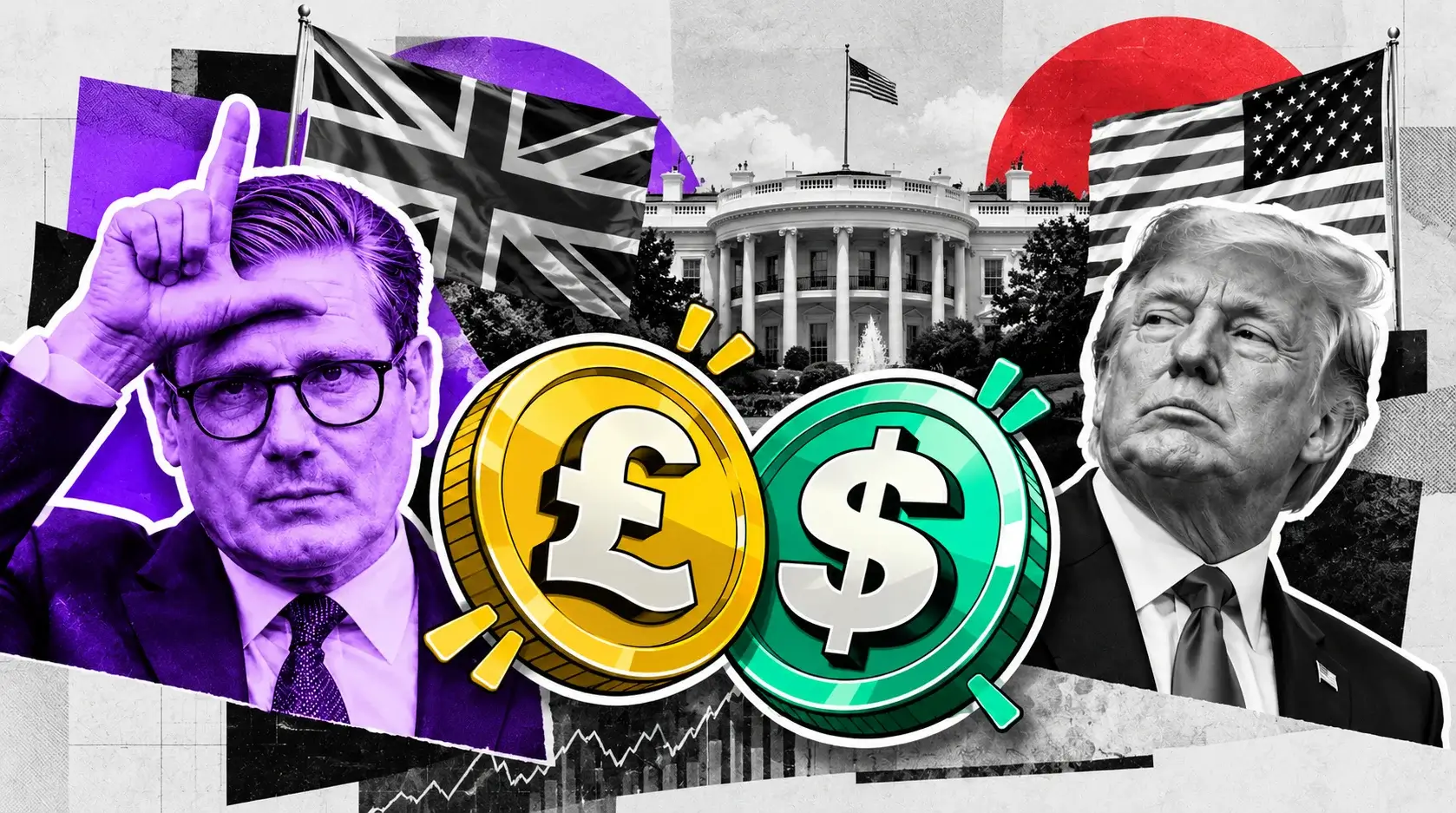
Sir Keir Starmer announced his resignation on June 22. Rather than the drawn-out contest markets feared, Andy Burnham secured the backing of more than 80% of the Parliamentary Labour Party and is expected to be confirmed as leader on July 17, taking office shortly after.
That political risk had been the pound's main domestic driver — more than the Bank of England. A leadership vacuum in a country running a 117.5% household debt-to-disposable-income ratio, with a fiscal position already under scrutiny and an energy shock feeding through the CPI, is exactly the kind of thing that puts a discount on a currency. An orderly succession removes a tail risk that had been discounting the pound.
The mechanics matter. A contested leadership race would have meant weeks of policy uncertainty, a live question about the fiscal rules, and a gilt market that had to price a range of possible chancellors. An 80% endorsement of a single candidate collapses that distribution to a point. Whatever the market thinks of the outcome, it now knows the outcome, and known outcomes carry no risk premium.
The result is a pound supported from both sides against a euro that has lost its hawkish story — eurozone inflation fell to 2.8% in June from 3.2% in May, taking the September ECB hike from a coin flip to unlikely and putting an 88% probability on a hold at 2.25% on July 23. That is why GBP/EUR is at 1.1738 and a one-year high.
Against the dollar it buys nothing, and that is the point of this whole pair. Cable is 1.3474 on the day the tail risk dies, because the tail risk was never what was setting the price. The dollar was.
The 2026 range tells you how much sterling has actually gained from all of this. The high was 1.3817 in late January. The low was roughly 1.32 in late June — a seven-month low. Spot at 1.3474 sits 343 pips below the high with the political overhang cleared, the Bank hawkish, and the euro cross at a one-year high.
Sterling has fixed its own problems. It has not fixed the dollar's.
The Labour Market Is the Crack in the Hawkish Case
The data nobody is quoting is the reason the July 30 hike does not happen, and it is deteriorating faster than the inflation picture is improving.
Job vacancies have fallen to their lowest level in five years. The number of young people not in education, employment or training has exceeded one million for the first time in thirteen years. Those are not soft-landing statistics. They are the leading indicators of a labour market that has stopped absorbing new entrants, and they sit underneath a services inflation reading of 3.7% that the hawks are using to argue for 4%.
Both cannot persist. Services inflation is wage inflation with a lag, and wage inflation does not survive a five-year low in vacancies. Either the labour data is wrong or the services print is about to roll over, and the MPC has to decide which before July 30.
The growth picture supports the dovish read. Monthly GDP grew 0.1% in May, in line with consensus, after a 0.1% contraction in April and 0.3% growth in March. That is an economy averaging 0.1% a month across a quarter — annualized, roughly 1.2%, and that was before Brent went back to $85. Quarterly GDP at 0.6% in the first quarter was solid by recent standards and is now a rear-view number.
Productivity across the whole economy increased 0.9% in the first quarter versus the prior quarter, which is the one genuinely constructive data point in the set. House prices rose 3.8% over the year to April.
The household balance sheet is where the energy shock lands. Debt stood at 117.5% of disposable income in the fourth quarter of 2025. An economy where households owe 1.18 times their annual disposable income does not absorb a 51.5% increase in the Bank's Brent reference and a 33.3% increase in wholesale gas without cutting something else, and what gets cut is the discretionary spending that generates the services inflation the hawks are worried about.
That is the self-correcting mechanism the Bank is betting on. Monetary policy cannot influence energy prices, but the energy prices are doing the tightening for it.
Two members voted for 4% anyway. If they get two more, cable goes to 1.36. If they lose one, it goes to 1.33.
Read More
-
Yen Stalls at 160 Despite a 3% JGB and Tokyo Core CPI at 2.0% — Intervention Sits at 164, Friday's Payrolls Decide
02.09.2026 · TradingNEWS ArchiveEnergy
-
QQQ ETF ($706.22) Slides 7.4% Below Its High as the Market Reprices the AI Capex Bill — $686.57 Target if $700 Breaks
22.10.2026 · TradingNEWS ArchiveStocks
-
XRPI ($7.00) and XRPR ($10.74) Slide Toward 52-Week Lows as Spot XRP ETF Flows Stall at $708,510
22.10.2026 · TradingNEWS ArchiveCrypto
-
NG ($2.775) Decoupled From Europe’s €88 Gas Crisis as LNG Feedgas Hits 18.9 Bcf/d — $3.30 Upside on Cold Weather
22.10.2026 · TradingNEWS ArchiveCommodities
-
Dollar-Yen (157.35) Loses 157.65 as the Yen Rallies on Haven Demand — 155 Target if 156 Breaks
22.10.2026 · TradingNEWS ArchiveForex
Sterling Is Winning Against the Euro and Losing Against Nothing
The cross-rate picture isolates exactly what is wrong with cable, and it is worth the detour because it proves the pair is not a sterling problem.
GBP/EUR was quoted at 1.1738 on July 11, near the top of its 2026 range and well above the year's low of 1.1402 set on March 1. That is a one-year high for the pound and a 2.95% gain from the March floor. The forecast range is 1.1650 to 1.1850.
Two things drove it and they compounded. First, the rate gap stopped narrowing. The Bank is at 3.75%; the ECB is at 2.25%. That 150-basis-point gap was expected to close as the ECB kept hiking. With eurozone inflation back at 2.8% and the council on hold at an 88% probability for July 23, it is now expected to stay at 150 basis points — and the UK's own services problem at 3.7% means the Bank is in no hurry to cut either. Sterling keeps its yield advantage. Second, the political risk resolved.
So sterling has a 150-basis-point yield advantage over the euro and a 12.5-basis-point advantage over the dollar. Against the euro that produces a one-year high. Against the dollar it produces a pair pinned between two moving averages 14 pips apart.
The arithmetic closes the loop. GBP/EUR at 1.1738 multiplied by EUR/USD at 1.1445 implies GBP/USD near 1.3434 — within 40 pips of spot. Cable is the residual of two cleaner trades, and it inherits the dollar's strength through the euro leg while contributing sterling's strength through the cross.
That is why nothing works here. Every bullish sterling development gets fully expressed against the euro and fully absorbed by the dollar before it reaches cable. The Burnham confirmation, the hawkish 7-2 vote, the 3.7% services print — all of it is already in GBP/EUR at 1.1738.
The pound is not weak. The dollar is strong, and the dollar is strong because six nights of strikes in Hormozgan province took Brent up 11% in a week and put a 73% probability on a Fed hike before December.
EUR/USD is capped between 1.1300 and 1.1500. Cable is capped between 1.3300 and 1.3550. Same cap, same reason.
The Chart: 1.3450 Opens 1.35, 1.3300 Opens the Low 1.32s
The technical structure is unusually clean and unusually useless, which is a fair description of the pair.
Spot sits 1.34744. The 50-period moving average is at 1.34840, 9.6 pips above. The 200-period is at 1.34700, 4.4 pips below. The convergence of the two suggests recent directional momentum has moderated, leaving traders focused on whether price can establish a fresh trend. As of July 14, the pair was near its 8-day EMA, near its 21-day EMA, near its 50-day EMA, and near its 100-day EMA — simultaneously. Every timeframe agrees on nothing.
The framework levels are the ones with information. A close above 1.3450 opens the door to the 1.35 handle — spot cleared it and could not hold. A break below 1.3300 signals dollar strength taking control, 174 pips down. The weekly range called 1.3200 to 1.3550, and the actual high was 1.3560 with the low near 1.3369.
Above 1.3560, the 2026 high at 1.3817 is the only reference — 343 pips, or 2.55%, overhead. Below 1.3300, the June 24 low at 1.3165 sits 309 pips down, and the seven-month low near 1.32 is the intervening test.
The trend from the June 24 low at 1.3165 is up roughly 1.62% across four weeks. That is a 21-pip-per-week grind, which is not a trend. It is drift.
The scenario map is explicit and both branches are live. If core U.S. inflation comes in at 0.3% or hotter and Warsh declines to rule out a September hike, the dollar firms quickly and cable tests the low 1.32s. The scenario that lifts it back toward 1.35 is a genuinely soft core print combined with a chair who sounds more balanced than his dot plot suggests.
Cable got the soft core — flat at 0.0% against 0.2% expected. It did not get the balanced chair. It touched 1.3560 and gave it back.
That is the cleanest read available on this pair. It requires two conditions to move and it has only ever gotten one at a time. The dollar is the binding constraint, DXY at 100.75 is 64 basis points below the 101.39 resistance that has capped it since June 24, and cable is on the other side of that trade.
The University of Michigan sentiment and inflation expectations release lands at 10:00 a.m. ET and is the session's only scheduled input.
The Trade: 1.3300 Floor, 1.3560 Cap, Two Meetings in Twelve Days
The levels are tight and the asymmetry is roughly symmetric, which is the honest answer. GBP/USD trades 1.34744. The 200-period MA at 1.34700 is 4.4 pips below and the 50-period at 1.34840 is 9.6 pips above. Support runs 1.3400, then 1.3369 as the week's low, then 1.3300 where dollar strength takes control. Below that, 1.32 is the seven-month low and 1.3165 is the June 24 base. Resistance is 1.3450 as the trigger, 1.3550 as the range top, 1.3560 as the week's high, and 1.3817 as the 2026 peak.
The base case is continuation of the grind into the two central bank meetings. The Fed decides July 29 with 66.3% odds of holding at 3.50% to 3.75%. The Bank decides July 30 with its quarterly Monetary Policy Report. Two hawkish holds inside 24 hours leave the differential at 12.5 basis points and the pair exactly where it is, which is what the forecast path at 1.3349 in one month expects.
The bull case needs the Bank to flip two votes. It has two dissenters at 4% already, services inflation at 3.7% and rising, transport at 6.8% on motor fuel, and a Brent reference that has to be marked from the June 15 assumption to $85.01. That is the only genuine catalyst on the calendar and it is the one nobody is positioned for. Get it and cable clears 1.3560 with 1.3817 as the objective — a 2.55% move.
The bear case needs nothing new. Brent at $85.01 and WTI at $79.74, both up 11% on the week with a presidential commitment to strike Iranian infrastructure next week, feed the August 12 CPI print. If July inflation carries the energy reversal, the 73% probability of a Fed hike before December goes higher, DXY clears 101.39, and 1.3300 breaks toward the low 1.32s.
The labour market is the wildcard nobody prices. Vacancies at a five-year low and youth NEET above one million for the first time in thirteen years do not coexist with 3.7% services inflation for another quarter. One of those numbers is wrong.
Watch 1.3300 and watch DXY at 101.39. Sterling has cleared its political overhang, holds a 150-basis-point advantage over the euro, and sits at a one-year high on the cross. Against the dollar it has 12.5 basis points and a war.