Stock Market Today: Dow 49,293 Slips But S&P 6,934, Nasdaq 23,500 Hold as MU +6.9% and IBRX +31% Outperform
Wall Street trades mixed with Russell 2000 edging higher, AI chips like NVDA and MU extend gains, PNC beats with 11% 2026 growth guidance, COP is hit by a $53 WTI breakeven downgrade, while IBRX, NVO and ASTS surge on powerful stock-specific catalysts | That's TradingNEWS
Wall Street Snapshot: Indices Mixed, Small Caps Lead
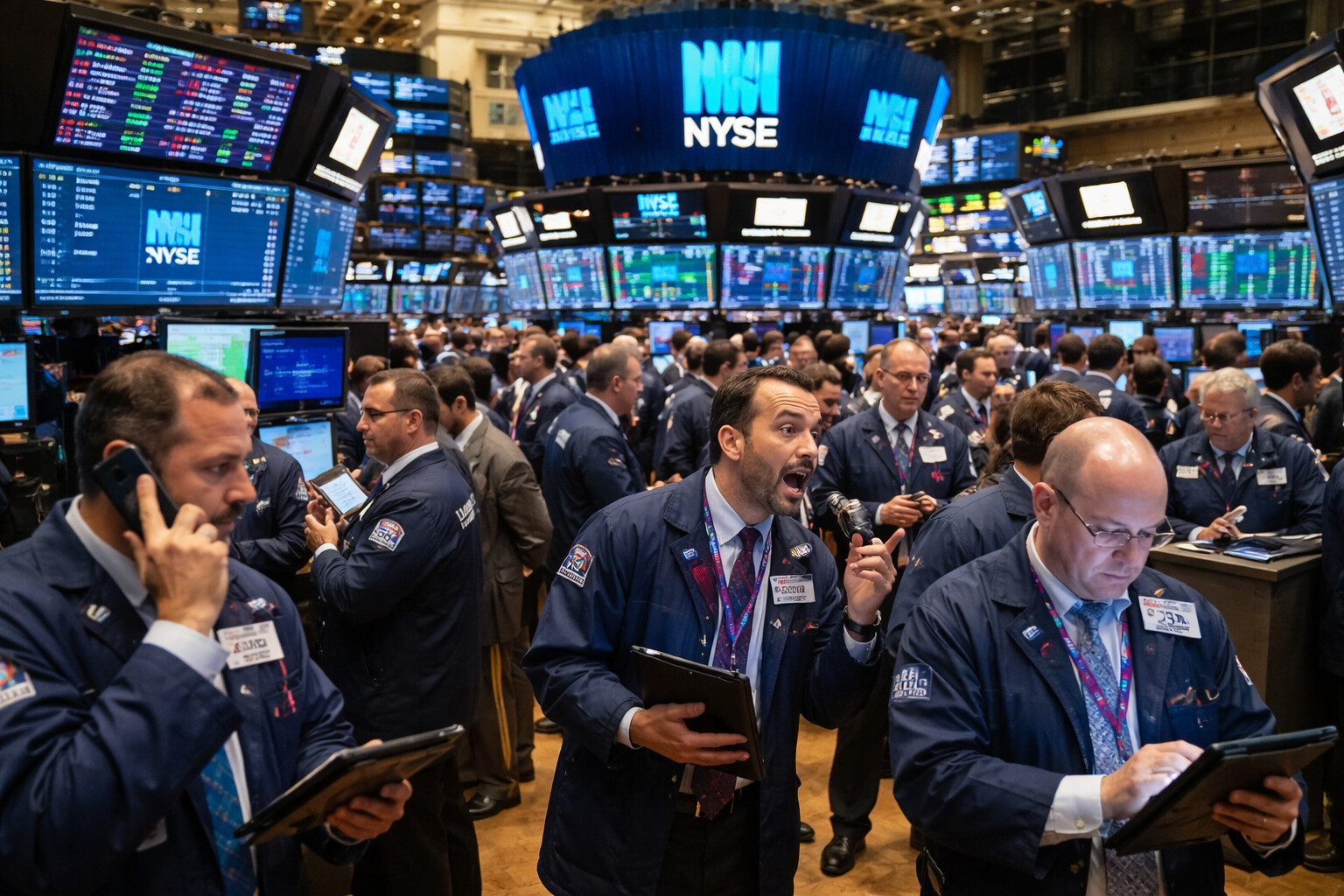
U.S. stocks on January 16, 2026 trade in a tight range, with the major indices drifting while leadership rotates under the surface. The Dow Jones Industrial Average trades around 49,292.57, down about 0.30%, giving back part of the AI-fueled rebound. The S&P 500 stands near 6,933.81, off roughly 0.15%, and the Nasdaq Composite hovers around 23,500.15, lower by about 0.13%. By contrast, the Russell 2000 outperforms with a gain of about 0.33% at 2,683.31, showing renewed appetite for smaller, domestically focused names. The Barron’s 400 Index lags at roughly 1,477.97, down around 0.41%, signaling that breadth remains fragile even as headline indices hold near highs.
Market internals confirm this tension: on the NYSE, around 1,590 stocks trade lower versus approximately 850 advancers, despite futures opening higher and early gains of about 0.3% in the S&P 500, roughly 100 points (+0.2%) in the Dow, and around 0.5% in the Nasdaq.
In macro pricing, the U.S. 10-year yield sits near 4.192%, up about 0.335 percentage points, but still trapped in the range that has held since early December. The VIX near 15.88 and only slightly higher shows controlled risk-off rather than stress. The U.S. Dollar Index trades around 99.33, Bitcoin (BTC-USD) near $94,680.61 is down about 0.54%, front-month crude oil is roughly $59.79 and up about 1.01%, while COMEX gold around $4,608.40 per ounce is off 0.3% but still on track for a weekly gain. The picture is a late-stage bull market: indices close to records, valuations full, risk appetite intact, but investors increasingly choosy about what they own.
AI And Semiconductors: NVDA MU SNDK TSM Anchor Nasdaq
The growth engine remains the AI and semiconductor complex, which continues to dictate the tone of the Nasdaq. NVIDIA (NASDAQ: NVDA) trades more than 1% higher intraday, pushing back toward a breakout zone around the low $190s after a recent pullback. As long as data-center demand and AI accelerator orders hold, NVDA stays a core driver of index-level performance and justifies a Buy on pullbacks stance despite a rich multiple.
Upstream, the cycle is reinforced by Taiwan Semiconductor Manufacturing (NYSE: TSM). A blowout fourth quarter coupled with a U.S.–Taiwan trade deal, under which Taiwanese chip and tech companies plan to deploy at least $250 billion into U.S. production capacity, extends the visibility of the AI infrastructure build-out. That commitment underpins multi-year demand for foundry capacity and strengthens the case for TSM as a Buy, especially for investors looking at the backbone rather than the front-end AI brands.
Within memory, Micron Technology (NASDAQ: MU) is the day’s standout. The stock jumps about 6.9% after board member Mark Liu purchases roughly $7.8 million of stock in the open market. That insider buy lands after a massive 218% one-year rally driven by DRAM and NAND pricing leverage in AI and high-performance computing. When a director commits that much capital after a 3x move, the signal is clear: insiders believe Micron’s earnings power is still underpriced. The verdict is Bullish, Buy, accepting volatility but backed by tangible earnings growth.
In related names, SanDisk (NASDAQ: SNDK) adds around 1.1% following a 5.5% gain in the previous session after fresh price-target hikes. Western Digital (NASDAQ: WDC), which spun off Sandisk in early 2025, slips roughly 0.4%, while Seagate Technology (NASDAQ: STX) climbs about 2.3%. The market is distinguishing between memory-levered plays and slower legacy storage revenues. SNDK and STX look like Buy-on-weakness candidates tied to the same AI and data-center demand theme, while WDC screens more as a Hold as it works through its own transition.
For the Nasdaq Composite, the takeaway is straightforward: as long as NVDA, MU, SNDK, TSM, AMD and other AI-linked names hold key moving averages and keep raising the earnings bar, the index remains structurally bullish, with corrections more about positioning than fundamentals.
Transports And Travel: JBHT And DAL Diverge On Valuation
In transports, the message is that quality is not enough when valuation is stretched. J.B. Hunt Transport Services (NASDAQ: JBHT) reported fourth-quarter revenue of about $3.10 billion, down 2% year over year but in line with expectations, and earnings of $1.90 per share, beating the $1.81 consensus. Despite that beat, shares initially fell roughly 4% in extended trading as the market focused on weaker final-mile demand and softer volumes across segments.
By the regular session, JBHT has turned modestly higher near $206.80, up about 0.14%, and is sitting at a fresh 52-week high. The stock is up roughly 6.3% year to date and has rallied around 50% in three months, pushing its multiple from about 20x expected earnings to nearly 29x. That kind of rerating leaves almost no buffer if freight pricing or volumes roll over. The stock shifts into Hold territory: a great company, but a valuation that already assumes a clean cyclical upturn.
Airlines present a different story. Delta Air Lines (NYSE: DAL) cut 2026 EPS guidance to a $6.50–$7.50 per-share range, under the prior ~$7.30 consensus midpoint. After a call with the CFO, the market has refocused on the pieces that matter more than a modest guidance trim: strong free-cash-flow generation, low leverage, and a premium-heavy revenue mix anchored by loyalty and maintenance, repair and overhaul businesses. In a sector where balance sheets usually dominate the narrative, Delta’s diversified, premium-driven model stands out. DAL remains a Buy, positioned as a structural leader rather than a cyclical trade.
For the broader transport space, the conclusion is that premium operators with diversified cash flows like DAL still earn a Buy, while winners such as JBHT that have been repriced aggressively now sit in Hold territory unless earnings growth accelerates further.
Energy And Power: COP MGY CEG VST EQNR Under Policy And Capex Pressure
Energy is split between upstream breakeven math and downstream policy risk. ConocoPhillips (NYSE: COP) faces selling pressure after being cut to underperform from neutral. The numbers explain the downgrade: Conoco’s oil breakeven around $53 per barrel on WTI leaves only a narrow cushion above a forecast $57 WTI strip, especially compared with peers sitting at lower breakevens. Its debt-adjusted free-cash-flow yield near 4.4% is also uncompetitive in a sector where investors can find higher yields with less cost risk.
Long-cycle spending compounds the issue. Large capex commitments to the Port Arthur LNG project and the Willow development, with start-up roughly two and four years away, respectively, tie up cash and weigh on near-term distributions. At an assumed 45% return-of-cash-flow policy, the view is that COP will struggle to sustain recent cash returns if oil averages the bank’s $57 assumption instead of higher prices. With spot WTI just under $60 at about $59.79, that skepticism is justified. Conoco screens as Hold to light Sell for investors demanding high near-term cash yields rather than distant growth.
On the other side, Magnolia Oil & Gas (NYSE: MGY) benefits from a rating upgrade and a price-target boost from $26 to $28, implying about 24.5% upside from the previous close. The key differentiator is cost: a breakeven near $37 on WTI gives Magnolia a much larger safety margin if crude trades sideways or drifts lower. With solid operating momentum heading into 4Q25 and 2026 and the possibility of stronger production guidance, MGY justifies a Buy call within mid-cap E&Ps.
In power, policy risk dominates. Constellation Energy (NASDAQ: CEG) drops roughly 9.27%, and Vistra (NYSE: VST) sinks around 7.1%, as markets react to expectations that the White House will sign an agreement with governors in PJM states to address surging electricity costs. Such an agreement would likely curb pricing power and squeeze margins for generators and integrated utilities. Given the size of the move and uncertainty around final policy details, both CEG and VST now sit in Hold to high-risk Speculative Buy only territory until regulatory clarity improves.
In renewables, Equinor (NYSE: EQNR) edges up about 0.36% after a U.S. federal judge allows the Empire Wind offshore project to restart, reversing a prior halt by the Trump administration. That ruling removes a key overhang for Equinor’s U.S. offshore portfolio. However, the long payback and political sensitivity of offshore wind mean EQNR remains a Hold rather than a high-conviction Buy.
Financials: PNC STT RF Split The Banking Tape
Financials show clear winners and losers. PNC Financial Services (NYSE: PNC) rallies around 3.4% after delivering a stronger quarter. Revenue of about $5.96 billion beats the consensus $5.89 billion, and EPS of roughly $4.88 tops the $4.22 forecast. Management’s guidance for total revenue growth of about 11% by the end of 2026, versus analyst expectations near 8.7%, confirms that loan growth and fee businesses are pulling together. PNC is a clear Buy, offering scale, credible guidance and improving operating leverage.
At State Street (NYSE: STT), the market reaction is different. The stock falls about 3.6% after the bank reports nearly $3.7 billion in quarterly revenue, which it describes as “record,” but net income declines from about $783 million to $747 million. EPS at roughly $2.42 badly misses the $2.79 consensus. The miss highlights how fee-based custodial income and cost controls are not keeping pace with expectations in a late-cycle environment. After the rerating, STT screens as Hold to mild Sell, especially for investors looking for clean earnings momentum.
Regions Financial (NYSE: RF) also disappoints. The stock drops about 3.2% after net income of roughly $534 million is flat year over year, and adjusted EPS of about $0.57 misses the $0.61 consensus. In a backdrop where credit is still benign and funding costs have stabilized, the market wants operating leverage; flat earnings are not enough. RF is a Hold, supported somewhat by valuation but lacking a near-term growth catalyst.
At the index level, the S&P 500 Financials complex remains anchored by solid credit quality and a steepening curve, but investors are rewarding banks like PNC that pair healthy balance sheets with growth and are punishing any misses in EPS or revenue trajectory.
Biotech And Pharma: IBRX Momentum Versus NVO Fundamentals
High-beta healthcare is back on traders’ screens. ImmunityBio (NASDAQ: IBRX) explodes another 31% on top of a prior 31% surge. The driver is updated guidance indicating that revenue from its bladder-cancer therapy Anktiva is expected to jump about 700% year over year to around $113 million. The company also secured approval from the Saudi Food and Drug Authority for the use of Anktiva in non-small-cell lung cancer, opening up a second indication and a new market at once. That combination of triple-digit percentage growth and new approvals justifies a Speculative Buy stance for aggressive investors, but the binary nature of biotech risk means position sizes must be small and expectations disciplined.
In large-cap pharma, Novo Nordisk (NYSE: NVO) climbs about 4.5% after U.K. regulators approve a higher maximum weekly dose of Wegovy, lifting the cap to 7.2 mg from 2.4 mg. This higher dose should improve efficacy for certain patients and could extend treatment duration, which enhances the revenue runway of the obesity franchise. With GLP-1 demand still exceeding supply in many markets and new dosing flexibility, NVO remains a solid Buy, supported by durable secular growth rather than a one-off catalyst.
Satellites And Asia Tech: ASTS And CPNG Draw Focused Capital
Outside mega-cap tech, investors are targeting specific growth narratives. AST SpaceMobile (NASDAQ: ASTS) rallies about 7.2% after a 6.3% gain the day before. The catalyst is its selection as an eligible vendor to the U.S. Missile Defense Agency under the SHIELD program. This does not instantly transform ASTS into a defense behemoth, but it validates the company’s satellite-communication technology in a highly demanding security environment and sets the stage for future contract flow. Given its early-stage status and heavy capex needs, ASTS is a Speculative Buy, suitable only for investors who can absorb sharp drawdowns.
In Asian e-commerce, Coupang (NYSE: CPNG) gains more than 3% after a major bank upgrades the stock to Buy, arguing that most regulatory noise in Korea is now priced in. With logistics scale, strong brand recognition and stabilized regulation, the risk-reward skew has improved. For investors comfortable with Korean macro and FX exposure, CPNG looks like a Buy, particularly if the company can sustain double-digit revenue growth while expanding margins.
Read More
-
Yen Stalls at 160 Despite a 3% JGB and Tokyo Core CPI at 2.0% — Intervention Sits at 164, Friday's Payrolls Decide
02.09.2026 · TradingNEWS ArchiveEnergy
-
QQQI ($53.80) Turns Nasdaq Volatility Into a 14.2% Monthly Yield as Assets Top $15B — Big Tech Earnings Set November
27.10.2026 · TradingNEWS ArchiveStocks
-
IBIT ETF Captures 100% of $110.3M as Spot Funds Snap Outflow Streak, but October Stays $202M Negative Ahead of the Fed
27.10.2026 · TradingNEWS ArchiveCrypto
-
NG($3.002) Takes the Front Month Near a Multi-Month Low as Record Production Meets Mild Weather — Break of $2.945 Opens $2.80
27.10.2026 · TradingNEWS ArchiveCommodities
-
USD/JPY (157.86) Squeezed Between a 2.8-Point Carry Edge and Tokyo’s 160 Line — BoJ Hawkish Hold Friday Sets the Break
27.10.2026 · TradingNEWS ArchiveForex
Software, Defense, Gold And Dollar: Rotation Below The Surface
Intraday, early strength in the Nasdaq and S&P 500 has faded as software names resume their slide. High-multiple application and infrastructure software that briefly bounced are turning lower again, reflecting a market that will not pay 2025–2026 valuations for anything without clear earnings acceleration. This helps explain why the Dow is only modestly negative while the Nasdaq and S&P 500 also shade slightly lower: value and cyclicals are partially offsetting pressure in expensive software.
Defense stocks in Europe show a different pattern. Norwegian defense group Kongsberg jumps around 6.1% as concerns grow over President Trump’s repeated statements that the U.S. needs Greenland for security reasons and as a major U.S. bank lifts its target price from 300 kroner to 335 kroner. The move underlines the broader trend: more defense spending across NATO and rising demand for air-defense capabilities. For global investors, the defense complex remains a Buy theme, with Kongsberg one of the clearer European beneficiaries.
Gold and the dollar reflect a moderated risk environment. Gold futures around $4,608.40 per ounce are down roughly 0.3% on the day after U.S. jobless claims fell, lowering the odds of imminent Fed rate cuts and reducing immediate safe-haven demand. Still, gold is on track for a weekly gain as geopolitical risks in Iran and Greenland and worries about policy mistakes keep strategic allocations elevated. With the Dollar Index near 99.33 and evidence that foreign demand for U.S. assets remains strong, the widely discussed “de-dollarization” theme remains more narrative than reality. Gold sits in Hold to modest Buy territory as a portfolio hedge rather than a pure momentum play.
Crypto Sentiment: BTC And XRP React To Policy Delays
In digital assets, the tone softens. Bitcoin (BTC-USD) trades around $94,680.61, down roughly 0.54%, while XRP-USD also sells off following a delay to a key crypto bill that was expected to clarify regulation. After a powerful rally supported by ETF inflows and institutional interest, traders are taking gains as leverage builds in derivatives markets and as regulatory timelines slip.
Correlations remain elevated between BTC-USD, XRP-USD and high-beta tech: when AI and growth names weaken, crypto tends to follow. At current levels, the stance on BTC-USD and XRP-USD is Hold to selective trimming on strength rather than aggressive buying, until regulatory momentum and spot ETF flows reaccelerate.
Macro And Politics: Fed Path, Valuation Risk And Election Volatility
Macro commentary from large asset managers converges on one point: the underlying economy still looks solid. Earnings growth, margins and sales trends across the S&P 500 remain above long-run averages, and markets still expect the Federal Reserve to cut rates later in 2026, which would support equity valuations and credit markets.
The risk is valuation and positioning. With the S&P 500, Nasdaq, and Dow hovering near all-time highs and U.S. households holding record levels of equity exposure, any disappointment on growth, inflation or earnings can trigger sharper drawdowns. The upcoming U.S. midterm elections add another layer of uncertainty, with potential shifts in fiscal policy, regulation of tech and energy, and geopolitical stance. Recent headlines around tensions in Iran, the strategic status of Greenland, and debates over the Fed’s independence are already feeding into volatility expectations, even if they have not derailed the bull market.
In Europe, the Stoxx 600 trades about 0.2% lower, with most major bourses in the red. Without the same AI leadership present in the U.S., European indices are more sensitive to macro worries and policy risk. That reinforces the U.S. market’s position as the core risk benchmark world-wide.
Index Verdicts: S&P 500 Nasdaq Dow Russell 2000 Buy Sell Or Hold
For the S&P 500, near 6,933.81 and down only about 0.15% on the day and around 0.3% for the week, the market looks fairly valued rather than cheap. Earnings are holding up, but multiples are elevated and breadth is weak. The index is a Hold, with selective Buys in AI infrastructure, high-quality financials like PNC, and structural growth in healthcare such as NVO.
The Nasdaq Composite, supported by NVDA, MU, SNDK, TSM, ASTS, CPNG and broader AI exposure, still has a strong growth spine. Given the scale of capex commitments and the earnings power in leading chips and memory, the stance is Bullish, Buy on pullbacks, acknowledging valuation risk but backed by real numbers.
The Dow Jones Industrial Average, around 49,292.57 and down 0.30%, reflects rotation more than structural weakness. With diversified exposure across industrials, financials, consumer and selective tech, the Dow is a Hold with a tilt to Buy in components tied to AI, defense and premium travel such as DAL.
The Russell 2000, at roughly 2,683.31 and up 0.33%, finally shows signs of life after long underperformance. In an environment of stable rates, a gently steepening curve and contained inflation, profitable small caps with clean balance sheets offer leverage to domestic growth. The small-cap space is a Speculative Buy, focusing on cash-generating businesses rather than unprofitable growth.
Across sectors, AI semiconductors (NVDA, MU, SNDK, TSM) and select banks (PNC) are clear Buys. Premium travel (DAL) is a Buy versus more fragile carriers. High-breakeven energy (COP) and power names under political pressure (CEG, VST) lean Sell or Hold until policy risk is priced. High-beta biotech (IBRX) and space communications (ASTS) are Speculative Buys only for risk-tolerant capital. Large-cap obesity and GLP-1 exposure (NVO) remains a structural Buy backed by regulatory momentum and strong demand.