Stock Market Today: Dow DJI Climbs 212 Points, S&P 500 SPX and Nasdaq IXIC Rebound as 3M (MMM) and GM Crush Q2 Marks
Chip stocks revived with the KOSPI up 3.56% and Nvidia (NVDA) up 2% on its Nebius (NBIS) stake | That's TradingNEWS
Key Points
- 3M (MMM) ripped 6% after Q2 adjusted EPS of $2.40 beat $2.24 and it raised full-year guidance to $8.80–$8.95.
- GM added 3% on adjusted EPS of $3.57 versus $3.18 expected, with adjusted EBIT up 29.8% to $3.9 billion.
- Nasdaq IXIC jumped 0.9% to 25,689.19 as chips revived; VIX fell 6.17% to 17.50 despite Iran strikes.
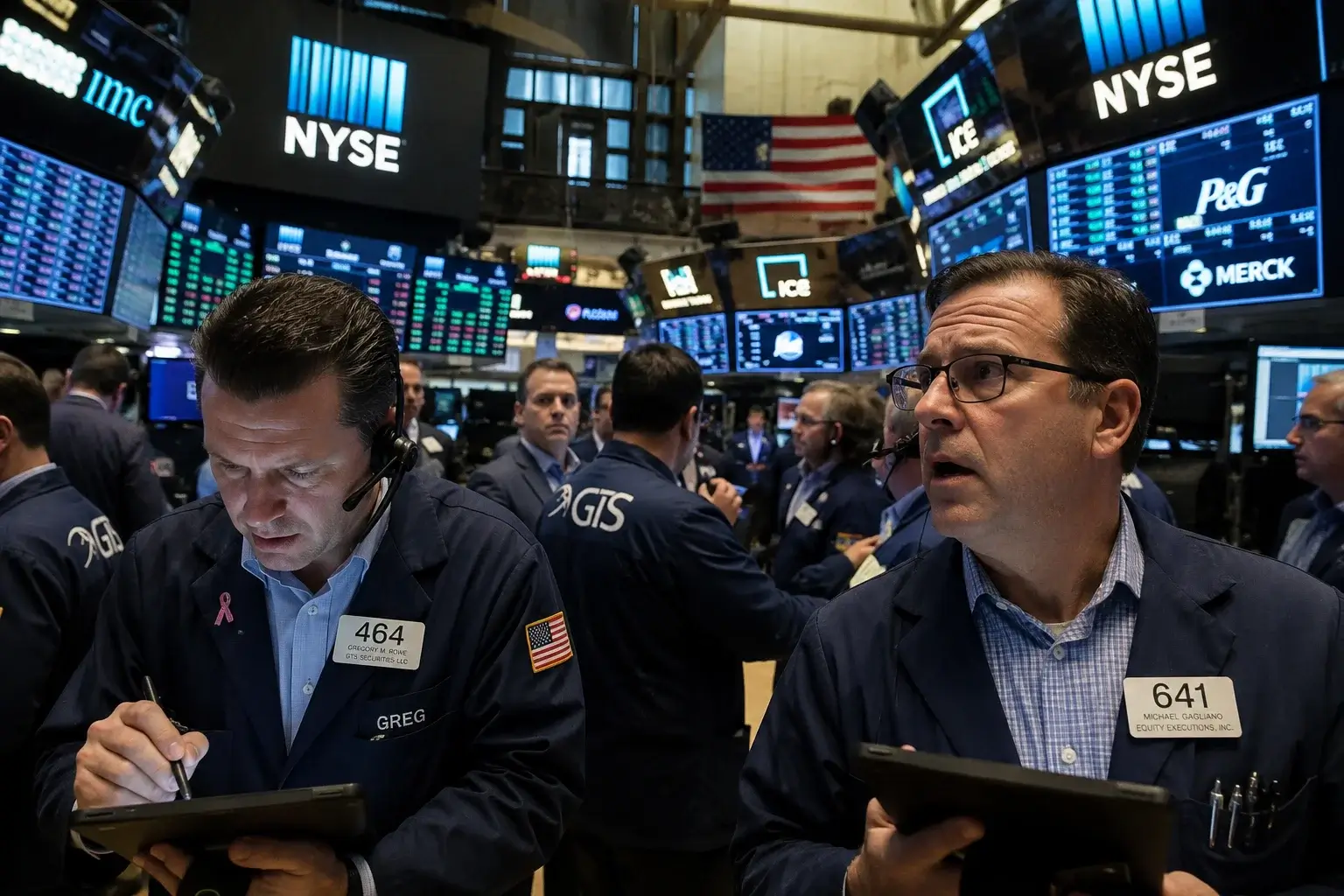
The bid came back the moment the opening bell rang. The S&P 500 (SPX) climbed 0.6% out of the gate Tuesday, the Nasdaq Composite (IXIC) jumped 0.9% to print 25,689.19, and the Dow Jones Industrial Average (DJI) tacked on 212 points, or 0.4%, inside the opening half hour before settling into a steadier 0.2% gain. That reversed most of Monday's damage, when the SPX rolled over 0.19% to close at 7,443.28, the IXIC edged down 0.05% to 25,508.07, and the DJI got smoked for 307.16 points, or 0.59%, to 51,839.26 as a 2%-plus slide in Apple dragged the price-weighted average lower.
The turn was built on two legs. Semiconductor names ripped back to life overnight, and the first wave of Tuesday earnings blew through the marks. South Korea's KOSPI led the global chip revival with a 3.56% surge, and that momentum carried straight into US pre-market futures, where the Nasdaq-100 contract had been up 1.3% before the cash open. The rotation that had punished chips through the middle of July flipped hard, and the desk leaned into it.
Sitting underneath the rally is a market still doing the math on two live threats: a fresh 50% US tariff salvo aimed at Canadian goods, and a ninth consecutive day of US strikes on Iran that has crude jumping and the Houthis threatening a naval blockade off Saudi Arabia. Both hung over the session. Neither stopped the buyers.
The thesis running through Tuesday's tape is straightforward: earnings are winning the argument. With the SPX sitting 129 points off its intraday recovery high and the DJI clawing back toward 52,050, the numbers coming out of 3M and General Motors gave the bulls a concrete reason to fade the geopolitical noise. Volatility agreed — the VIX collapsed 6.17% to 17.50, a level that signals a market pricing calm rather than crisis. The question that defines the rest of the week is whether the megacap gauntlet, starting with Alphabet on Wednesday, validates that calm or blows it apart.
3M Rips More Than 6% and Powers the Dow
3M (MMM) was the single biggest engine under the Dow Tuesday, ripping 6.3% in the pre-market and extending toward a 9% intraday gain after the industrial conglomerate blew through its second-quarter marks and raised full-year guidance. The print landed as a genuine turnaround signal from a name that spent years buried under PFAS litigation and restructuring drag.
The headline numbers left no ambiguity. Adjusted earnings came in at $2.40 per share against a consensus of $2.24, a beat of $0.15. Revenue hit $6.5 billion, up 5.6% year over year and ahead of the $6.4 billion the Street penciled in. GAAP earnings jumped to $1.78 from $1.34 a year earlier, a 33% climb. Adjusted operating margin expanded 40 basis points to 24.9%, keeping the company's operating profitability near the 25% line that management flagged as the quarter's signature achievement.
The segment breakdown carried the story. Safety and industrial, 3M's largest unit, brought in $3.09 billion, an organic jump north of 8% driven by electrical markets, adhesives, abrasives, and industrial specialties. Transportation and electronics reached $2.07 billion, a 6.2% rise, with soft auto demand offset by strength in data centers and semiconductors — a direct hook into the AI infrastructure trade. The company returned $1.4 billion through dividends and buybacks and generated $1.3 billion in adjusted free cash flow.
The guidance raise is what put the rocket under the stock. 3M lifted its full-year adjusted EPS range to $8.80 to $8.95, up from a prior $8.50 to $8.70 and comfortably above the $8.74 the Street had modeled. It also bumped its adjusted organic sales growth outlook above 3.5%, from a prior target near 3%.
Two announcements sharpened the AI angle. 3M named Microsoft (MSFT) as the first hyperscaler to deploy its Expanded Beam Optics technology inside AI data centers, and it locked a long-term deal with Airbus to supply advanced insulation for the A220. Management is repositioning a Post-it-Notes maker as a materials supplier to the fastest-growing corners of the tape, and Tuesday the market paid up for it.
General Motors Beats and Lifts 2026 Guidance
General Motors (GM) followed with its own beat before the bell, and the stock added 3% as the automaker crushed expectations and raised full-year profit guidance. Adjusted earnings landed at $3.57 per share, blowing past the $3.11 to $3.18 the Street modeled, on revenue of $48 billion that topped the $47.1 billion consensus.
The margin story did the heavy lifting. GM posted adjusted EBIT of $3.9 billion for the quarter, a 29.8% year-over-year increase, and expanded profit margins from 6.4% to 8.2% against the same period last year. That kind of operating leverage from a cyclical automaker running into tariff headwinds is exactly what the bulls needed to see. Management declared a quarterly dividend of $0.18 per share and lifted its full-year outlook, extending a run that saw first-quarter adjusted EPS of $3.70 clear the mark by more than 30%.
The North American engine remains the driver. GM sold 714,896 vehicles in the second quarter and leaned on pricing power in trucks and SUVs to protect margins even as unit volumes softened. The company had already revised its full-year adjusted EBIT forecast upward after the first quarter, and Tuesday's raise builds on a guidance path that now stretches into the $11.50 to $13.50 adjusted EPS range for 2026.
The stock's setup coming in was constructive. GM closed Friday at $76.07 after slipping 2.1%, and the analyst consensus target sat near $95.85 — a gap that reflected the Street's willingness to look through cyclical auto softness after a 43% one-year run. The Q2 print gave that thesis fresh legs, and shares pushed back toward $78 in early trade.
What the desk watched beyond the headline was the mix: EV profitability, China operations, and the durability of North American pricing. GM has been aggressive on cutting EV losses, and the margin expansion suggests the discipline is landing. Against a tariff backdrop that keeps threatening auto supply chains, a Detroit automaker raising guidance is a statement. The tape rewarded it, and GM joined 3M as the second industrial-complex beat to anchor Tuesday's advance.
Halliburton Beats but Gets Sold on Energy Fear
Not every beat got bought. Halliburton (HAL) topped estimates on both lines and still got dumped, sliding 3.6% in the pre-market as the energy tape and Middle East fear overrode the numbers. The oilfield-services giant delivered adjusted earnings of $0.55 per share against a $0.5421 consensus and revenue of $5.714 billion that handily beat the $5.543 billion the Street expected.
The revenue line carried real sequential momentum, up 5.8% from the $5.402 billion posted in the first quarter of 2026. Adjusted net income reached $461 million, while GAAP net income printed $534 million, or $0.64 per diluted share, boosted by a $95 million pre-tax credit tied to impairments and other items. Operating income came in at $778 million on a reported basis and $683 million adjusted. The company returned capital through $200 million in stock buybacks and a $0.17 per-share dividend.
So why the selling? The beat was narrow — $0.55 landed just 1.5% above consensus, squarely in the in-line camp — and the press release offered no specific numerical guidance for coming quarters. When a services name delivers a modest top-of-estimate print without a forward roadmap, and does so into a session where the energy complex is wrestling with a war premium that keeps threatening demand destruction, the crowd sells first and asks questions later.
The backdrop is the real culprit. Crude has been whipsawing violently. WTI touched $90 a barrel Monday amid the tit-for-tat US-Iran exchanges before easing back, and Brent swung toward $90 on the international benchmark. At $81 a barrel, US crude still sits well below the Iran-scare highs that pushed prices past $112, and that disconnect — elevated but off the peak, with 43 days of US supply left, the lowest inventory in 45 years — leaves services names caught between a bid on scarcity and a fear of slowing activity.
Halliburton's slide underscored the day's fault line. The industrial beats got rewarded because they carried guidance raises and clean margin stories. The energy beat got faded because it arrived without a forward number into a geopolitically fragile tape. Same beat, opposite reaction — the market is grading on the outlook, not the quarter.
The Chip Revival Flips the July Rotation
The semiconductor complex did an about-face Tuesday, and that reversal is the technical spine of the whole session. Chips had been the market's punching bag through the middle of July, with the sector posting losses across a volatile stretch that saw money rotate out of semis and into other corners of Big Tech. Tuesday that trade flipped, and it flipped globally.
South Korea's KOSPI Composite (KS11) surged 3.56%, driven almost entirely by strength in semiconductor names, and that overnight leadership set the tone for the US open. The Nasdaq-100 futures contract had jumped 1.3% before the cash session even started, the clearest signal that the chip bid was back and carrying size. When the bell rang, the IXIC's 0.9% pop to 25,689.19 was led by the same names that had been dead weight a week earlier.
The rotation that had defined recent sessions is instructive. In the prior stretch, money was paring exposure to key chip names and crowding into megacap software and platform stocks — Amazon, Alphabet, and Microsoft each moved up around 3% on one recent session while Micron got smoked for 8% and Lam Research and AMD each dropped 3%. That was the sell-chips, buy-platforms trade. Tuesday it reversed, with the semis leading and the tape broadening out.
The setup matters because it defines what the AI trade is searching for. The market has been hunting for the next catalyst after a series of sector rotations churned positioning without resolving direction. Every leg of the AI complex — the chipmakers, the hyperscalers, the neocloud providers, the data-center infrastructure names — has been trading in and out of favor as the desk tries to figure out whether the capex cycle can sustain the valuations.
Tuesday's answer, at least for one session, was that the chip bid can reassert itself fast when the news flow cooperates. The VanEck Semiconductor complex had traded 2.5% higher on a recent rebound session, and the pattern repeated. The revival gives the bulls a foundation heading into the megacap earnings that will actually test whether the AI spending narrative holds. For now, the chips are back in the driver's seat, and the Nasdaq is following them higher.
Nvidia's Nebius Stake Feeds the AI Infrastructure Bid
The single sharpest AI headline Tuesday came from Nvidia (NVDA), which climbed 1.3% to 2% after disclosing it beneficially owns a stake north of 9% in neocloud provider Nebius Group (NBIS). The revelation sent Nebius ripping 7.6% and, at points, up toward 9%, as the market re-rated a name now formally tied to the world's most important AI chipmaker.
The stake is a passive holding of 9.3%, and it partly folds in the $2 billion investment Nvidia publicly announced back in March. The disclosure crystallizes a relationship the market had been pricing in pieces — Nvidia backing the neocloud layer that rents out its own GPUs — and gives Nebius a validation stamp that few infrastructure upstarts can claim. For a company whose entire business model rests on deploying Nvidia silicon at scale, having Nvidia as a 9%-plus owner reshapes the risk calculus.
The move fed a broader bid across the AI-adjacent momentum complex. IREN Limited ripped 19.57% and Archer Aviation (ACHR) surged 19.59% as the fast-money names tied to data-center power, compute buildout, and next-generation infrastructure caught the updraft. These are the high-beta expressions of the same trade — when the AI narrative is on, they move in multiples of the index.
What makes the Nvidia-Nebius tie so resonant is the structural question it answers. The market's central AI debate is whether the capex being poured into GPUs and data centers generates the returns to justify it. When Nvidia takes an equity stake in the neocloud layer, it signals conviction that the demand for rented compute is durable enough to warrant not just selling chips but owning a piece of the businesses deploying them. That vertical integration is a vote of confidence the desk reads loud and clear.
The timing amplified it. With the megacap earnings gauntlet opening Wednesday, every data point on AI spending intent gets magnified. Nvidia's stake disclosure landed as a pre-earnings reminder that the infrastructure buildout has real capital behind it, not just narrative. The chip revival and the Nebius pop reinforced each other, and together they gave the Nasdaq its leadership. The AI trade found its catalyst — at least until Alphabet's numbers hit the tape.
Trump's 50% Canada Tariff Salvo Rattles Trade
Hanging over the entire session was a fresh escalation on trade. President Trump unveiled a new raft of 50% tariffs on an array of Canadian goods — beer, hockey sticks, milk, and chemicals among them — that threatens to reignite a tit-for-tat trade war between the two neighbors. The duties are set to take effect in 30 days, after the administration accused Canada of "discrimination" in its trading practices.
The market's reaction was measured rather than panicked, and the reason sits in the fine print. The White House exempted Canadian oil imports from the tariff regime, a carve-out that matters enormously given crude is already trading at its highest level since mid-June on the back of the Iran conflict. Slapping duties on Canadian oil into a market already fighting a war premium would have been a self-inflicted inflation shock, and the exemption defused that particular landmine.
Still, the 50% figure is aggressive, and the categories hit — consumer staples like beer and dairy, plus industrial chemicals — reach into supply chains that feed US manufacturers and retailers. A trade war with Canada, the United States' largest trading partner by some measures, carries the risk of retaliatory duties that could ripple through autos, agriculture, and materials. That backdrop makes GM's guidance raise look even more impressive: the automaker lifted its outlook despite a tariff environment that keeps threatening cross-border auto supply chains.
The 30-day runway before the tariffs bite gives both sides room to negotiate, and the market appears to be pricing a meaningful chance the escalation gets walked back or softened before implementation. The measured equity response — indices green across the board despite the news — suggests the crowd is treating this as an opening bargaining position rather than a fixed policy. That read could prove complacent if Canada retaliates hard.
For now, the tariff salvo functions as a slow-burn overhang rather than an acute shock. The exemption on oil removed the immediate inflation trigger, and the 30-day delay pushed the real consequence into next month. But it adds another variable to a macro picture already crowded with a shooting war, a fragile earnings season, and a Fed trying to read inflation crosscurrents. The trade risk didn't derail Tuesday. It just deepened the pile of things that could.
Iran, Oil, and the Houthi Blockade Threat
The war stayed front and center. US forces carried out a ninth consecutive day of strikes against Iranian military targets overnight, part of a campaign the administration frames as degrading Iran's ability to threaten commercial shipping. Then the escalation widened: Yemen's Iran-aligned Houthis announced a naval blockade on Saudi Arabia, threatening to open a new front and endanger global trade and energy supplies well beyond the Persian Gulf.
The oil tape captured the tension. Crude touched $90 a barrel Monday amid the weekend's tit-for-tat exchanges before easing slightly Tuesday morning, with Brent swinging back toward $90 on the international benchmark. US WTI sat at $81, still elevated but well short of the $112-plus highs the Iran scare produced at its peak. That gap between the war premium and the peak defines one of the more perplexing disconnects on the tape — crude is pricing real risk without pricing catastrophe.
The supply picture underneath is genuinely tight. US crude inventory sits at 43 days of supply, the lowest in 45 years, which leaves the market vulnerable to any disruption that actually chokes off physical barrels. A Houthi blockade of Saudi shipping in the Red Sea would do exactly that, threatening to reroute or halt tankers and inject a scarcity premium the current price hasn't fully absorbed. The market is watching the strait chokepoints and the shipping lanes with unusual intensity.
There was a flicker of de-escalation hope earlier in the week. An Iranian Foreign Ministry spokesman signaled that intermediaries had continued exchanging messages amid the strikes and that negotiations could be pursued based on national interests. That diplomatic thread is what let equities improve by midmorning even as the strikes continued — the crowd is betting on an off-ramp emerging within the coming month.
The energy sector's split reaction told the story. Halliburton beat and got sold on the fear that a demand-destroying spike or a broader conflict hurts activity. At the same time, the oil exemption on the Canada tariffs kept a lid on the inflation impulse. The war is the market's biggest tail risk, but the tape is pricing a resolution rather than an escalation. Every headline out of the region moves the needle, and the balance between the scarcity bid and the demand fear will define crude's path from here.
The Earnings Scorecard Is Running Hot
The single most bullish data point Tuesday wasn't any one company — it was the aggregate. Of the 66 S&P 500 names that have posted second-quarter results so far, 88% have cleared bottom-line marks. That beat rate is running well above historical norms, and it is the statistical backbone of the market's willingness to fade the geopolitical noise and buy the dip.
An 88% beat rate this early in the season sets a high bar for interpretation. It signals that corporate America entered the quarter with conservative guidance and is now clearing it comfortably, a dynamic that tends to fuel upward earnings revisions as the season progresses. When the breadth of beats is this wide, the market reads it as confirmation that the underlying profit cycle is intact even as the macro backdrop throws off warning signs.
Tuesday's slate reinforced the pattern. 3M beat and raised. GM beat and raised. Halliburton beat, even if the stock didn't reward it. Hasbro beat with revenue up 16% and lifted full-year guidance on broad-based strength across the business. The industrial and consumer names are delivering, and the guidance raises matter more than the quarters themselves because they extend the earnings runway into the back half of 2026.
The reporting cadence is accelerating. The floodgates that opened with the first wave of industrial names widen dramatically this week as the megacap platforms report, and the market's read on the season will pivot hard on those numbers. So far, the season is off to a strong start, and that strength is doing real work in offsetting the tariff and war overhang.
The risk embedded in a hot beat rate is expectations creep. When 88% of names beat, the marginal beat stops moving stocks, and the market starts demanding not just a clear of the bar but a raise of the outlook and a clean forward story. That is precisely why Halliburton got sold — it beat but didn't raise. The bar for reward is climbing as the season proves out. The names that clear it, like 3M and GM, get bought aggressively. The names that merely meet it get faded. The scorecard is running hot, and it is asking companies for more than just a number.
Read More
-
Yen Stalls at 160 Despite a 3% JGB and Tokyo Core CPI at 2.0% — Intervention Sits at 164, Friday's Payrolls Decide
02.09.2026 · TradingNEWS ArchiveEnergy
-
T-Rex 2X Inverse MSTR ($4.39) Rips 10.44% as Strategy Pauses Bitcoin Buys for a 2nd Week — $4.63 Close Opens $5.27
15.09.2026 · TradingNEWS ArchiveStocks
-
XRPR ($10.59) and XRPI ($7.04) Open at Highs and Close at Lows After Senate Kills CLARITY Act
15.09.2026 · TradingNEWS ArchiveCrypto
-
NG ($2.908) Holds Above $2.80 Low as LNG Feedgas Hits 18.8 Bcf and TTF Trades 9.2x Henry Hub
15.09.2026 · TradingNEWS ArchiveCommodities
-
USD/JPY (155.09) Faces 275bp Policy Gap as BOJ Prepares 31-Year-High Rate — Close Below 154 Opens 153.40
15.09.2026 · TradingNEWS ArchiveForex
The Megacap Gauntlet That Defines the Week
Everything Tuesday was prologue. The week's real test begins Wednesday when Alphabet (GOOG, GOOGL) reports, kicking off a megacap gauntlet that includes Tesla (TSLA), Intel (INTC), and IBM (IBM) — the results that will determine whether the AI-driven rally can sustain itself or cracks under the weight of its own valuations.
The Street has been raising expectations into these prints, and Alphabet carries outsized importance. As one of the hyperscalers pouring capital into AI infrastructure, its capex commentary will be scrutinized line by line for signals on whether the spending that props up the entire chip complex — and by extension the Nebius and IREN trades — is accelerating or plateauing. A raise-and-spend message validates the buildout. A cautious tone on capex discipline could puncture the momentum the semis just reclaimed.
Tesla brings a different set of variables: deliveries, margins, and the FSD and robotaxi narrative that gives the stock its optionality premium. Intel arrives wounded — the chipmaker is planning a new round of layoffs as part of a broader efficiency drive, with more than 5,000 US employees already cut across California, Oregon, Arizona, and Texas. Its data-center reorganization signals a company fighting to stay relevant in an AI race it has largely watched from the sidelines. IBM, which recently got smoked for 25% on a single session after warning that second-quarter profits would come in light on soft software and infrastructure demand, has to prove that warning was an aberration rather than a trend.
The stakes are structural. The market has churned through weeks of sector rotation without resolving the central question of whether AI capex generates adequate returns. These four names, reporting inside a compressed window, will supply the hard data the narrative has been running ahead of. If the capex intent holds and the guidance impresses, the chip revival that lit up Tuesday extends into a durable leg higher.
If the numbers disappoint or the AI spending shows signs of moderating, the rotation that has whipsawed positioning all July gets violent again. The VIX at 17.50 is pricing calm, but that calm is a bet that the megacaps deliver. The gauntlet starts Wednesday, and it will define whether this rebound is a foundation or a fakeout.
Rates, the Fed, and the Inflation Crosscurrent
The bond market flashed its own set of signals Tuesday, and they cut against the equity calm. The 10-year Treasury yielded 4.59% while the two-year sat at 4.20%, a curve that has been steepening as long-term yields rise on the twin pressures of the Iran war premium and the tariff-driven inflation risk. Elevated fuel costs from the crude spike are feeding directly into the inflation outlook, and that is keeping upward pressure on the long end.
On the policy front, the market is pricing patience. The CME FedWatch tool showed an 83.4% probability that the Federal Reserve leaves rates unchanged at its July meeting, a near-lock that reflects a central bank caught between cooling core inflation and the fresh pro-inflationary impulse from oil and tariffs. Recent June inflation data had come in weaker than expected, which fueled a semiconductor-led rally earlier in the month, but the war and trade escalations since then have muddied the disinflation story.
The crosscurrent is the defining tension for rates. On one side, the June print showed inflation genuinely cooling, which argues for a Fed that can eventually ease. On the other, a crude spike that has WTI at $81 and Brent near $90, combined with a 50% tariff salvo on Canadian goods, threatens to reignite the very price pressures the Fed spent two years fighting. Long-term yields rising after the US and Iran extended strikes tells you which force the bond market fears more right now.
That backdrop leaves the Fed boxed in. Cutting into a war-driven oil spike and a fresh tariff wave risks looking premature if inflation reaccelerates. Holding steady while growth signals soften risks falling behind the curve. The 83.4% no-change reading says the market expects the Fed to sit on its hands and wait for the crosscurrents to clarify — a stance that keeps the two-year anchored near 4.20% while the long end drifts on the inflation premium.
For equities, the rate picture is a slow-moving headwind rather than an acute threat. A 4.59% ten-year is elevated but not disruptive, and the VIX collapse to 17.50 suggests the stock market isn't losing sleep over it. But if the war premium pushes yields materially higher, the valuation math on the AI complex — the same high-multiple names leading the tape — gets harder fast. Rates are the quiet variable that could turn loud.
The Movers Beyond the Headliners
Beneath the 3M and GM headlines, Tuesday's tape churned with a full slate of secondary movers that filled out the earnings picture. Hasbro (HAS) climbed on a strong report, with revenue up 16% year over year on broad-based strength across the business and a full-year guidance upgrade — the kind of beat-and-raise the market is rewarding wherever it appears.
Steel Dynamics (STLD) traded 1.9% lower on a mixed quarter that captured the market's growing selectivity. The steelmaker posted earnings of $3.69 per share, missing the $3.77 consensus, even as revenue of $6.092 billion blew past the $5.570 billion the Street expected. A revenue beat paired with an EPS miss is precisely the profile the crowd fades in a market grading on the bottom line, and STLD's slide showed it.
Cracker Barrel (CBRL) added 2.34% in the pre-market after completing a sale-leaseback deal on 26 company-owned store locations with an institutional real estate buyer, netting roughly $77 million in proceeds. The operational metrics underneath were soft — comparable-store restaurant sales fell 2.5% and comparable retail sales rose 0.5% over the first 11 weeks of its fiscal fourth quarter — but the market focused on the balance-sheet move and the cash it freed up.
Interactive Brokers (IBKR) rose 3.26% heading into its own report, riding the momentum of a market where trading-volume-levered names benefit from elevated volatility and active positioning. EQT (EQT) ticked up 0.61% ahead of results due after the closing bell, with the natural-gas producer coming off record production volumes from its fiscal first quarter and looking to consolidate that operational strength.
The dispersion across these names tells the session's real story. The market isn't buying everything or selling everything — it is discriminating hard on the quality of the beat and the strength of the forward guidance. Hasbro's raise got rewarded. Steel Dynamics' EPS miss got punished despite a revenue beat. Cracker Barrel's financial engineering got a pass even with soft comps. That level of selectivity, this early in a season running an 88% beat rate, signals a market that has already priced a lot of good news and is now demanding companies clear an elevated bar to earn a pop. The headliners set the tone. The movers beneath them confirmed the discipline.
Gold, the VIX, and the Risk Appetite Signal
The cross-asset tape sent a clear message about positioning Tuesday, and it was a message of controlled risk-taking rather than fear. Gold pushed up 1.36% to $4,070.40 an ounce, holding its bid as the war premium and inflation crosscurrents kept safe-haven demand alive even as equities rallied. When gold and stocks rise together, it signals a market hedging tail risk while still leaning into upside — a barbell of caution and conviction.
The volatility read was the sharpest tell. The VIX collapsed 6.17% to 17.50, a level that historically signals a market pricing calm rather than crisis. That plunge came on a day carrying a shooting war, a 50% tariff escalation, and a Houthi blockade threat — the kind of headline stack that would normally spike volatility. Instead the fear gauge dropped, which tells you the earnings strength and the chip revival overwhelmed the macro anxiety in the options market. The crowd is buying dips, not hedging crashes.
The Russell 2000 futures had pointed 0.87% higher into the open, a signal that the risk appetite extended beyond the megacaps into the small-cap complex that tends to lead when the market is genuinely leaning offensive. Broad participation like that — small caps up, chips up, industrials up on earnings — is the profile of a rally with breadth rather than a narrow melt-up in a handful of names. That breadth is what separates a durable move from a fragile one.
The gold bid alongside the equity rally is the nuance worth parsing. It isn't a contradiction — it's a market that has learned to hold both the offensive and defensive positions at once. Money is chasing the AI and earnings upside while keeping a gold hedge against the war and inflation tails. That dual positioning reflects a tape that respects the geopolitical risk without being paralyzed by it.
The composite signal from the cross-asset picture is a market that has made its bet: earnings and the AI capex cycle win, the war finds an off-ramp, and the tariffs get negotiated down. The VIX at 17.50 is the purest expression of that bet. It is a wager on calm into the teeth of a megacap earnings week that will either vindicate the confidence or expose it. The risk appetite is real. Whether it survives Wednesday's Alphabet print is the only question that matters.
The Levels That Matter Into the Close
With the SPX pushing back through 7,480 and the DJI clawing toward 52,050, the recovery reclaimed most of Monday's ground and set up the key technical battle into the back half of the week. The Nasdaq's print at 25,689.19 put the composite within striking distance of the 26,000 handle it lost during the mid-July chip slide, and reclaiming that level would confirm the semiconductor revival has legs.
The reference points are clean. The SPX closed Monday at 7,443.28 and needs to hold above that pivot to keep the rebound intact; a failure back below it would signal the bounce was a one-day reflex rather than a genuine turn. The DJI's Monday close at 51,839.26 is the corresponding floor for the price-weighted average, and 3M's 6%-plus surge alone did much of the work lifting it back above that mark. The Nasdaq's recovery hinges on whether the chip bid that drove the KOSPI's 3.56% surge sustains through the US session and into the megacap prints.
The catalyst calendar defines the risk. Alphabet reports Wednesday, and its capex commentary will move the entire AI complex — the chips, the neoclouds, the data-center names. Tesla, Intel, and IBM follow, each carrying its own landmine. Layer on the tariff escalation that bites in 30 days and a war that produced a ninth day of strikes, and the tape is navigating a dense field of binary events. The 88% beat rate is the bullish anchor; the megacap gauntlet is the swing factor.
What the market is pricing, with the VIX at 17.50 and gold at $4,070.40, is a base case where earnings carry the day and the geopolitical tails stay contained. That is a specific bet, and it is a confident one. The 10-year at 4.59% and the two-year at 4.20% keep the rate backdrop in the frame without dominating it, and the 83.4% odds of a Fed hold remove near-term policy risk from the equation.
The setup into the close is a market that shook off two genuine threats on the strength of a hot earnings start and a chip revival. Buyers reclaimed the tape. The question the rest of the week answers is whether the megacaps ratify that confidence — or whether Tuesday's rebound was the calm before the gauntlet.