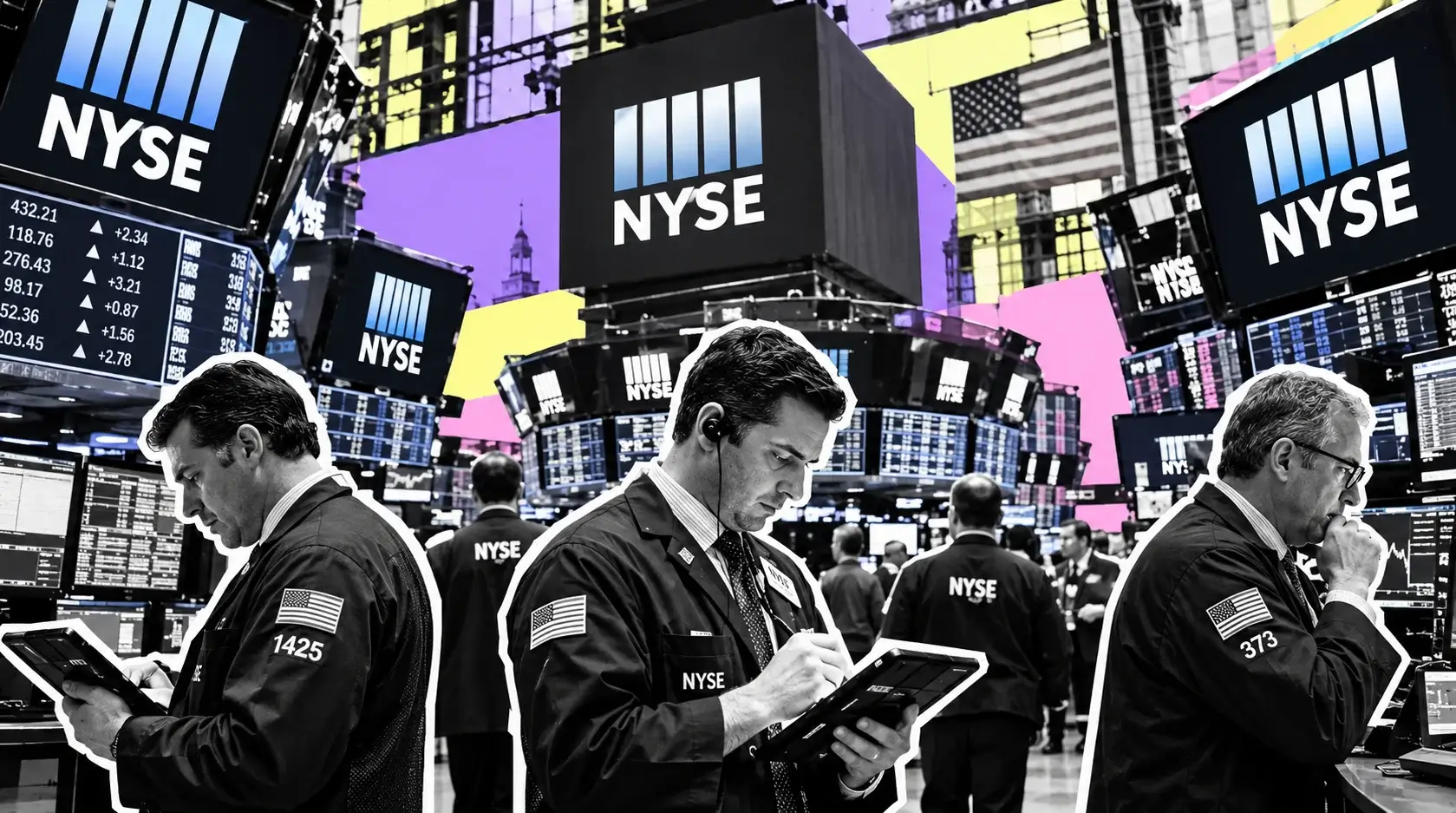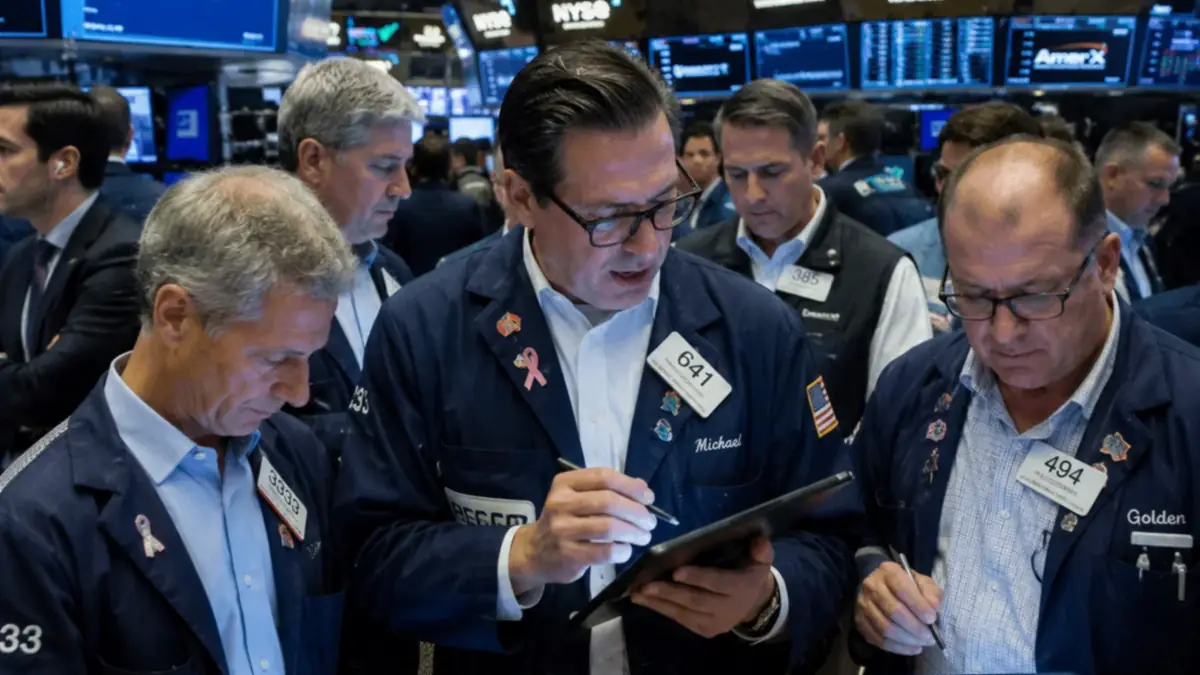
Stock Market Today: Dow Reclaims 50,000 as Cisco Detonates 14%, Nvidia Rides H200 China Approval
S&P 500 and Nasdaq notch fresh records while Doximity craters 23% on weak guidance | That's TradingNEWS
Key Points
- Dow tops 50,000 as Cisco soars 14% on AI guidance; S&P 500 and Nasdaq notch fresh record highs
- Nvidia gains 2% after U.S. clears H200 chip sales to roughly 10 Chinese firms amid Trump-Xi summit.
- Doximity craters 23% on weak guidance; import prices hit a three-year high as oil cools a second day.
The Dow Jones Industrial Average has finally accomplished what eluded it for the better part of three months — it has climbed back above the 50,000 threshold, trading higher by a range of roughly 215 to 373 points depending on the minute you check, a gain of about 0.4% to 0.8%, with prints clustering between 49,907 and 50,080. That round number carries genuine psychological weight on a trading floor, and the path back to it has been anything but a straight line. The blue-chip gauge's record close stands at 50,188.14, set on Feb. 10, which puts the index within a rounding error of an all-time high it has not seen in a full season. The S&P 500 is up somewhere between 0.3% and 0.6%, changing hands around 7,480 to 7,486 and building on a record-setting Wednesday that saw it notch fresh intraday and closing peaks. The Nasdaq Composite has tacked on anywhere from 0.1% to 0.7%, sitting near 26,560 to 26,581 and likewise fresh off a closing record of its own. The Russell 2000 is trailing the larger gauges with a softer 0.2% advance near 2,850, a familiar pattern in this rally — the small-cap cohort continues to lag while the megacaps do the heavy lifting. The VIX has nudged up to roughly 18, the picture of a market that is confident but not careless.
The single largest force behind the Dow's move back over 50,000 wears the ticker CSCO. Cisco Systems is trading higher by somewhere between 13% and 17% on the session — call it a 14% to 15% surge to around $116.63 — after the networking giant delivered a fiscal third-quarter report and forward guidance that left the analyst community well behind. The company steered current-quarter adjusted earnings to a band of $1.16 to $1.18 on revenue of $16.7 billion to $16.9 billion, against Street expectations sitting near $1.07 and roughly $15.82 billion. That is not a narrow beat to be explained away — it is a billion-dollar revenue gap above where the models were set, the kind of guidance revision that forces a wholesale repricing of a stock. Chief Executive Chuck Robbins is pairing that upside with a hard edge: a workforce reduction affecting fewer than 4,000 employees, under 5% of total headcount, framed explicitly as a redeployment of capital toward silicon, optics, security, and artificial intelligence. The market is reading those cuts not as a signal of distress but as a sign of discipline — a legacy hardware name with decades of history repositioning itself as an AI infrastructure play, and being rewarded handsomely for the pivot. For a stock long treated as a slow-growth dividend payer, the move represents a genuine re-rating of the underlying business.
Nvidia Rides the China Thaw While a Chip Debut Steals the Spotlight
Nvidia (NVDA) is higher by more than 2%, with several desks marking the move closer to 2.5%, on a tangible catalyst rather than vague sentiment: reporting that Washington has cleared roughly ten Chinese firms to purchase the H200 accelerator. It is worth being precise here — no chips have physically shipped, and that distinction matters a great deal, because this is regulatory approval rather than booked revenue. The gap between a cleared export license and a recognized sale can be wide, and it can take quarters to close. Still, the directional message for the most heavily weighted stock in the market is hard to mistake, and it reframes the China overhang that has dogged the name for the better part of two years. Chief Executive Jensen Huang happens to be on the ground in Beijing as part of the U.S. delegation, which only tightens the storyline and gives the market a reason to believe the thaw is more than rhetorical.
The semiconductor narrative runs well past Nvidia. Micron Technology (MU) has been a co-leader of the chip rally that powered Wednesday's advance, a reminder that the strength in the group extends into memory as well as logic. But the marquee event in the primary market belongs to Cerebras Systems, which priced its initial public offering at $185 per share — comfortably above the expected $150 to $160 range — raising at least $5.5 billion and stepping onto the Nasdaq under the ticker CBRS. That stands as the largest IPO of the year so far, and the fact that it cleared above its range speaks volumes about the current appetite for AI silicon exposure among institutional buyers. Creative Planning Chief Executive Peter Mallouk made the case on financial television that chipmakers are undervalued as a group, characterizing the sector's strength as a function of genuine earnings power rather than speculative excess — in his framing, demand is running well ahead of the industry's ability to supply it, and that imbalance leaves room for the move to extend.
The Beijing Summit Delivers Symbolism, Thin Substance on Iran
President Trump and Chinese President Xi Jinping have opened a two-day summit in Beijing, and the market is treating the imagery as a mild positive even as the concrete deliverables remain frustratingly vague. Trump arrived with a CEO delegation that reads like a market-capitalization leaderboard — Tesla's (TSLA) Elon Musk, Nvidia's (NVDA) Jensen Huang, Apple's (AAPL) Tim Cook, and Boeing's (BA) Kelly Ortberg among the names in the room. Xi told the executives that "China's door will only open wider" and that American companies could be "deeply involved" in the country's reform agenda — phrasing he has deployed before to limited practical effect, but phrasing the market still likes to hear spoken aloud. The choreography matters, even when the substance is thin, because it lowers the temperature on a relationship that has been a persistent source of tail risk.
On the substance itself, the two sides agreed that the Strait of Hormuz must remain open and free of militarization or tolling, and the broader agenda stretched across tariffs, Taiwan, and artificial intelligence. Treasury Secretary Scott Bessent said the two "AI superpowers" intend to build a protocol on best practices, partly to keep advanced models out of the hands of non-state actors, and he framed the U.S. willingness to engage as a position of strength rather than concession. But on the war in Iran specifically, the closed-door session produced very little. Rystad Energy's Jorge León put it plainly — unless Beijing perceives a clear benefit for itself, whether avoiding a more severe energy shock or extracting concessions from Washington, it is unlikely to fully deploy whatever leverage it holds over Tehran. The positioning takeaway is straightforward: this summit is not the place to price in a near-term de-escalation in the Middle East, and anyone hoping the meeting would crack the oil market's war premium will likely be disappointed.
Oil Cools a Second Day, but the War Premium Stays Embedded
Crude is taking a breather. West Texas Intermediate (CL=F) is lower by around 0.3% near $100.75 to $101.67, and Brent (BZ=F) is off roughly 0.4% near $105.20, having closed below $106. That marks the second consecutive session of softening — but the word "softening" deserves heavy context, because the structural picture remains deeply troubling. The International Energy Agency expects the market to stay severely undersupplied through October even if the conflict were to end next month, which is a remarkable statement about how much damage has already been done to the supply chain. Flows through the Strait of Hormuz fell by nearly 6 million barrels per day in the first quarter following the outbreak of hostilities in late February, according to Energy Information Administration data, and only a trickle of tankers has managed to clear the Persian Gulf since. Washington has continued sanctioning entities tied to Iranian crude sales to China, the largest buyer of that oil, tightening the screws further. The lesson for anyone watching the tape: the daily price action looks calmer, but the damage to supply is real, it is not quickly reversible, and the inflation channel running from energy prices straight into the broader economy is still wide open.
Economic Data Shows a Consumer Holding On as Inflation Runs Hot
Three releases landed before the bell, and together they tell a single coherent story — the consumer is resilient, but inflation is anything but tame. Retail sales rose 0.5% in April, matching the consensus estimate to the decimal, though decelerating sharply from March's downwardly revised 1.6% pace. Look under the hood and the print is considerably softer than the headline suggests: gas station sales jumped 2.8%, the single biggest category gainer, driven purely by surging fuel prices rather than any real increase in demand, so stripping out fuel leaves the figure closer to 0.3%, and excluding autos it rose 0.7%. The cracks were concentrated in the discretionary corners of the economy — department stores fell 3.2%, autos and parts slipped 0.4%, clothing dropped 1.5%, and furniture sank 2%. With consumer spending accounting for 68% of GDP, this is not a footnote to be skimmed past. TradeStation's David Russell captured it well, describing a consumer who is not in recession but is no longer powering the economy forward either — the foundation is intact, but it is no longer doing the work of growth.
Initial jobless claims rose 12,000 to 211,000 for the week ended May 9, above the 205,000 consensus, with continuing claims climbing to roughly 1.78 million. The absolute level remains low by any historical standard — employers are not conducting mass layoffs, and the labor market has not cracked — but the direction of travel is the wrong one, and it is worth watching whether the trend hardens in the weeks ahead.
The genuinely ugly number was on the import side. Import prices spiked 1.9% in April, more than double the 0.9% forecast, lifting the trailing twelve-month rate to 4.2%, the hottest reading since October 2022. Fuels and lubricants surged 16.3%; petroleum products jumped 19%. Export prices climbed 3.3% on the month for an 8.8% annual rate, the steepest since September 2022. Stack that on top of Wednesday's Producer Price Index, which ran nearly triple the increase economists had expected, and the inflation backdrop becomes the clear overhang sitting beneath an otherwise euphoric tape. This is the tension at the heart of the session: equities want to celebrate, but the price data keeps refusing to cooperate.
The Earnings Scoreboard Splits Into Clear Winners and Losers
The post-earnings reactions are scattered widely across the risk spectrum. Doximity (DOCS) is the session's clear casualty, down somewhere between 19% and 23% and on track for its lowest level since its June 2021 IPO, after fiscal fourth-quarter adjusted earnings of 26 cents per share missed the 28-cent consensus and — more damaging still — both first-quarter and full-year revenue guidance landed below expectations. A single quarterly miss is survivable; a miss paired with a guide-down on both the near-term and full-year outlook is what turns a stock into the worst performer on the board. Bullish (BLSH), the cryptocurrency exchange, fell 8% to 9% on adjusted net income of $20.3 million against $23.9 million expected, with adjusted revenue of $92.8 million falling short of the $94.9 million estimate — a clean miss on both lines.
The other side of the ledger looks far healthier. StubHub (STUB) popped 13% to 14% on first-quarter revenue of $446 million and adjusted EBITDA of $72.1 million, both comfortably ahead of the $432 million and $65.1 million the Street had penciled in. Yeti Holdings (YETI) surged 10% to 12% after adjusted earnings of 26 cents per share crushed the 18-cent estimate on revenue of $380.4 million versus $374.7 million expected — a decisive beat on both the top and bottom lines. Biogen (BIIB) rose about 4% in a counterintuitive move, advancing its experimental Alzheimer's drug into a Phase 3 trial despite missing the primary endpoint in the Phase 2 study, on the strength of demonstrated cognitive benefit; the market chose to focus on the path forward rather than the missed goal. Klarna Group (KLAR) jumped after swinging to a $1 million profit from a $99 million loss a year earlier, a meaningful turn for the buy-now-pay-later lender. Jack in the Box (JACK) added roughly 1% on second-quarter adjusted EBITDA of $51.3 million, above the $50.3 million estimate, even as earnings and revenue both missed — a mixed report the market treated gently. Versant Media Group (VSNT) climbed 11%, and Honda Motor (HMC) gained 4%, rounding out a session in which the earnings-driven moves were unusually large in both directions.
A Leadership Handover at Viking Holdings
Viking Holdings (VIK) delivered a rare structural story. For the first time since its 1997 founding, someone other than Torstein Hagen will run the cruise operator. Chief Financial Officer and President Leah Talactac — who joined the company in 2006 and led its 2024 IPO, the largest NYSE listing of that year — steps into the chief executive seat, with Hagen moving to Executive Chairman to focus on long-term strategy and Linh Banh stepping in as the new CFO. First-quarter results were mixed: revenue beat expectations, but the loss came in wider than analysts had modeled. Shares, already up 15% on the year heading into the session, rose about 3% — the market is comfortable with a managed, orderly succession rather than a forced one, and the continuity of Hagen remaining as Executive Chairman clearly softened what might otherwise have been a jarring transition for a founder-led company.
The Hyperscaler Value Debate Grows Louder
Here is a framing that should reshape how the desk thinks about mega-cap technology: analysts are now openly describing the hyperscalers as value plays. Morgan Stanley named Alphabet (GOOG), Microsoft (MSFT), Amazon (AMZN), and Meta (META) among its preferred holdings, citing strong forward earnings at undemanding valuation levels — a case the firm first laid out in early April alongside Goldman Sachs. The setup is worth understanding in detail: when the Magnificent Seven pulled back nearly 10% during the first month of the Iran war while analysts simultaneously raised their earnings forecasts, the group's multiple compressed to its cheapest level since "Liberation Day," at one point only marginally pricier than the Consumer Staples sector despite profit growth running roughly three times faster. Last month's reports validated the thesis — cloud growth accelerated to multi-year highs at Alphabet, Microsoft, and Amazon, and Meta posted its fastest revenue growth since 2021. The Magnificent Seven has since rebounded more than 25% off its late-March lows, with CSCO and AMZN each higher by roughly 30% over two months and NVDA up about 25%.
Read More
-
Yen Stalls at 160 Despite a 3% JGB and Tokyo Core CPI at 2.0% — Intervention Sits at 164, Friday's Payrolls Decide
02.09.2026 · TradingNEWS ArchiveEnergy
-
QQQ ETF ($706.22) Slides 7.4% Below Its High as the Market Reprices the AI Capex Bill — $686.57 Target if $700 Breaks
22.10.2026 · TradingNEWS ArchiveStocks
-
XRPI ($7.00) and XRPR ($10.74) Slide Toward 52-Week Lows as Spot XRP ETF Flows Stall at $708,510
22.10.2026 · TradingNEWS ArchiveCrypto
-
NG ($2.775) Decoupled From Europe’s €88 Gas Crisis as LNG Feedgas Hits 18.9 Bcf/d — $3.30 Upside on Cold Weather
22.10.2026 · TradingNEWS ArchiveCommodities
-
Dollar-Yen (157.35) Loses 157.65 as the Yen Rallies on Haven Demand — 155 Target if 156 Breaks
22.10.2026 · TradingNEWS ArchiveForex
The Bond Market Flashes a Quiet Warning
For all the record-chasing in equities, there is a yellow light blinking in fixed income. The 10-year Treasury yield (^TNX) sits around 4.44% to 4.46%, easing modestly from Wednesday's roughly 4.47% close as summit-driven haven demand picked up overnight — but it remains near its highest level since last July. The complication is what that does to relative valuation. The S&P 500's realized earnings yield is roughly 3.4%, below the 10-year's roughly 4.5%, which leaves the stock-bond gap at about negative 110 basis points — the widest negative reading since 2003. Put in plain terms, the 10-year Treasury now pays more than the S&P 500 earns. Bonds are competing for capital more aggressively than they have in two decades, and that dynamic is the single most important risk to the narrative that equities can keep printing records indefinitely.
Russell 1000's Hidden AI Winners and a Constructive Copper Setup
The mega-caps should not be allowed to hog the entire story. Within the Russell 1000, 16 names have gained more than 1,000% since the broad market bottomed on Oct. 12, 2022 — led by Vertiv Holdings (VRT), up an astonishing 3,307%, with AppLovin (APP) higher by 2,420%. The AI infrastructure trade has minted enormous winners well below the level of the headline tickers, and that breadth beneath the surface is one of the more encouraging features of this rally.
Over in commodities, Jefferies laid out a constructive copper case. Mining equities are currently pricing copper near $6.17 per pound, slightly below the London Metal Exchange's $6.39 per pound, while the analysts see the metal climbing to at least $8.00 per pound on a sustained basis over the next three to five years, driven by electrification and infrastructure demand — and they describe that forecast as conservative given the Middle East war-related risks layered on top. Higher copper prices sustained over time translate directly into upside for the copper miners.
Whirlpool Gets Cut as the K-Shaped Economy Widens
Not everything on the tape is rallying. Goldman Sachs downgraded Whirlpool (WHR) to neutral from buy and set a $53 price target — implying 27% downside from Wednesday's close — citing industry and macroeconomic pressure the bank expects to outweigh even the company's largest price increase in more than 30 years, its $150 million-plus in planned cost reductions, and a slate of new product launches. Shares slipped about 1% before the bell; the stock has already shed roughly 50% over the trailing twelve months. That weakness rhymes with a broader theme visible across the consumer economy. Bank of America data shows lower-income households are more than twice as likely as wealthier ones to skip a summer trip this year, and travel-related spending is down year over year for the bottom income cohort even as upper-income travel spending accelerates. Regular gasoline now averages $4.51 a gallon against $2.98 before the war began; jet fuel is up roughly 62% over the same span. This is not one economy moving together — it is two, pulling in opposite directions.
Tape Internals and the Global Backdrop
Wednesday's record was deceptively narrow. Only six of the eleven GICS sectors finished higher, led by communication services at plus 2.65%, with information technology at plus 0.98% and consumer discretionary at plus 0.75% behind it, while utilities lagged at minus 1.26%, financials at minus 1.07%, and real estate at minus 0.90%. Overseas, Asia closed mixed — Japan's Nikkei 225 slid 0.98%, South Korea's Kospi rallied 1.75%, and Hong Kong's Hang Seng finished roughly flat. The standout was Samsung, which hit a fresh record, higher by as much as 5%, even after a brief $66 billion market-value wipeout tied to a labor dispute — more than 41,000 workers are threatening an 18-day strike beginning May 21, which South Korea's finance minister warned could threaten national growth, exports, and financial stability. Elsewhere, Gold is down about 0.4% near $4,690 an ounce, Bitcoin is trading roughly between $79,900 and $80,200, and the Dollar Index is up about 0.2% near 98.6.
Where the Weight of the Evidence Points
Pulling the session together, the message is one of strength shadowed by a genuine and growing risk. The Dow back above 50,000, the S&P 500 and Nasdaq sitting on records, and an earnings season running hot all argue for staying constructive on equities — and the leadership remains exactly where it has been, in the AI and quality-technology complex, where CSCO, NVDA, and the hyperscaler group are backing their share-price gains with actual numbers rather than hope. The strongest earnings reactions of the session, STUB and YETI, were clean beats on both the top and bottom lines that earned their double-digit moves honestly.
But the risks are not hypothetical, and they are not far from the surface. The negative 110-basis-point gap between the S&P 500's earnings yield and the 10-year Treasury — the widest since 2003 — sits alongside import prices at a three-year high and a Producer Price Index that ran triple expectations, and together they make a strong case for keeping a seatbelt fastened. The names most exposed to that pressure — rate-sensitive sectors and companies levered to the lower-income consumer, WHR chief among them — are where caution is most warranted. The disappointments, DOCS above all with its guidance cut, are reminders that this tape is not forgiving of misses. The posture that fits the evidence is a constructive lean toward leadership, a defensive eye on the laggards, and full respect for the inflation print humming underneath it all.