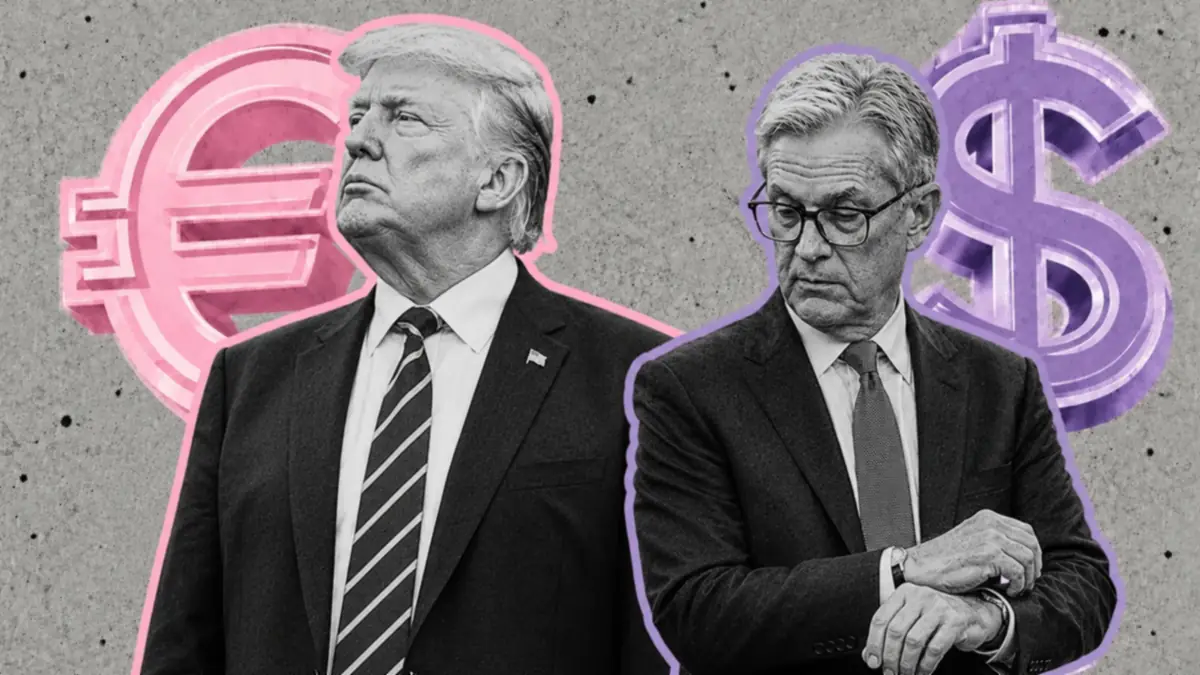
EUR/USD Price Forecast: Euro Pinned Near 1.1705 as Inflation Shock and a Hawkish Fed Hand the Dollar Control
The pair grinds at a one-week low as a 6% US PPI print lifts Treasury yields | That's TradingNEWS
Key Points
- EUR/USD slips to a one-week low near 1.1705 as the dollar reclaims momentum across the board
- A 6% US PPI print and 3.8% CPI lift Treasury yields, with the Fed now openly floating rate hikes.
- An 87% priced-in June ECB hike can't lift the euro; 1.1660 channel floor is the key level to watch
EUR/USD is firmly on the back foot on Thursday, changing hands somewhere in the $1.1705 to $1.1712 corridor, down roughly 0.1% on the day and pinned close to its weakest levels in nearly a full week. The pair has now slipped for several consecutive sessions, peeling steadily away from last week's highs above the 1.1790 level and surrendering the momentum that the euro had patiently built through the early part of May. The character of the move matters every bit as much as the move itself — this is not a violent or disorderly repricing, it is a slow, grinding bleed lower, precisely the kind of price action that tends to occur when one currency quietly loses its narrative rather than when the other side suddenly discovers a powerful one. And that is exactly the situation the market finds itself in right now. The euro has not done anything particularly wrong this week; the dollar has simply reasserted itself with conviction, and the single currency is being carried lower by the resulting undertow. Quotes across the various data feeds have clustered tightly together — one source marked it near $1.1705, another at $1.1712, a third had spot closer to $1.16785 — and that genuinely narrow dispersion only underlines the central point, which is that this is a controlled, orderly retreat rather than anything resembling a panic. The pair is consolidating in the lower portion of a range that has broadly contained it between roughly 1.168 and 1.178, and it is doing so without the kind of directional conviction that would signal the next major leg has already begun in earnest.
The Inflation Shock That Handed the Dollar Its Momentum Back
The entire complexion of the EUR/USD tape this week traces directly back to a single source: hotter-than-expected U.S. inflation. Both the producer and the consumer price releases surprised firmly and unambiguously to the upside, with the Producer Price Index running at 6% year-over-year — its highest reading since 2022 — and the Consumer Price Index spiking to 3.8%. Those two prints, landing back-to-back within the same week, did something very specific and very consequential to the currency market. They triggered a sharp rise in U.S. Treasury yields and reignited broad-based demand for the dollar across virtually every major pair. The mechanism at work here is not complicated, but it is powerful: hot inflation forces the market to reprice the Federal Reserve as higher-for-longer, richer yields in turn make the dollar materially more attractive to hold, and a risk-sensitive currency like the euro gets pushed firmly onto the defensive as a direct consequence. The April report drew additional fuel from a notable jump in shelter costs alongside an energy-price surge that traces its origins back to February. There is a credible and increasingly discussed scenario, flagged by a number of analysts, in which the Core Personal Consumption Expenditures index — the Fed's single preferred inflation gauge — is now on track toward 3.3%, a level that would keep the central bank firmly and uncomfortably boxed in. The shelter component and the energy spike are emphatically not the kind of one-off statistical noise that conveniently washes out the following month; they are sticky by nature, and the market understands that perfectly well, which is the core reason the dollar's bid has held its ground this week rather than fading away as quickly as it arrived.
The Fed Quietly Abandons Its Easing Bias
The most important structural shift sitting underneath the EUR/USD pair is the steady, deliberate transformation of the Federal Reserve's policy posture. The central bank is, in measured but entirely unmistakable fashion, walking away from its easing bias — and a growing contingent of policymakers is now openly discussing not merely holding rates steady but the genuine possibility of hiking them from here. Boston Fed President Susan Collins framed the dilemma directly and without hedging: the ongoing conflict in the Middle East is obscuring what might otherwise be a visible disinflationary trend, but if that conflict drags on, she sees real and concrete room for a federal funds rate hike. That is a remarkable place for the policy conversation to have travelled to, given where expectations sat only months ago. The broader backdrop to all of this is the Senate confirmation of Kevin Warsh as the new Fed chair. The market's initial instinct was to read Warsh as a potential dove, given the political context surrounding his nomination, but the more sober and considered analysis — and crucially, the one the tape itself is now respecting — is that a single chair cannot unilaterally steer an entire committee, and in the current inflationary environment it is highly unlikely his colleagues would fall in behind a dovish program even if he were inclined to pursue one. The latest figures on employment, inflation, and GDP collectively suggest that current monetary policy is not actually choking off economic growth in any meaningful way, which carries a pointed implication: the United States can comfortably tolerate higher interest rates than the market spent the bulk of 2026 assuming it could. Every incremental step in that repricing process functions as a direct tailwind for the dollar and an equally direct headwind for EUR/USD.
The ECB's June Hike Is Priced In, and Therefore Disarmed
On the other side of the pair, the European Central Bank is dealing with a problem that is subtle but genuinely constraining for the euro: its widely anticipated June rate hike has already been so thoroughly absorbed by the market that it has lost much of its power to actually lift the currency. The market is currently pricing in an 87% probability of a rate hike in June, along with a cumulative total of roughly 70 basis points of tightening by year-end — which amounts to very nearly three full rate hikes baked into the curve. The difficulty this creates for the euro is structural rather than temporary. When expectations are already set that aggressively, it becomes extremely hard for the ECB to "outhawk" the market — to deliver something more aggressive than what traders have already positioned for — and without that capacity to surprise on the hawkish side, the euro simply cannot rally on interest rate expectations alone. Compounding the problem, the recent run of Eurozone economic data has been highlighting an genuinely unattractive combination: weakening economic activity sitting alongside strengthening price pressures. That is not a backdrop that builds a strong case for multiple confident rate hikes. The most probable path is that the ECB delivers what is best understood as an insurance hike in June — a single, cautious move taken because the situation has not improved enough to justify standing still — and then settles onto hold at least through September while it gathers more data across the summer months. ECB Chief Economist Philip Lane has added a further layer to the picture, warning that higher global energy prices linked to geopolitical tensions could force the central bank to respond more aggressively if inflation risks genuinely intensify, while ECB policymakers have separately signalled that the Middle East situation and oil prices would need to change markedly to steer them away from a hike. The euro, in other words, is caught between an inflation problem that argues for tightening and a growth problem that argues against it.
Read More
-
Yen Stalls at 160 Despite a 3% JGB and Tokyo Core CPI at 2.0% — Intervention Sits at 164, Friday's Payrolls Decide
02.09.2026 · TradingNEWS ArchiveEnergy
-
QQQ ETF ($706.22) Slides 7.4% Below Its High as the Market Reprices the AI Capex Bill — $686.57 Target if $700 Breaks
22.10.2026 · TradingNEWS ArchiveStocks
-
XRPI ($7.00) and XRPR ($10.74) Slide Toward 52-Week Lows as Spot XRP ETF Flows Stall at $708,510
22.10.2026 · TradingNEWS ArchiveCrypto
-
NG ($2.775) Decoupled From Europe’s €88 Gas Crisis as LNG Feedgas Hits 18.9 Bcf/d — $3.30 Upside on Cold Weather
22.10.2026 · TradingNEWS ArchiveCommodities
-
Dollar-Yen (157.35) Loses 157.65 as the Yen Rallies on Haven Demand — 155 Target if 156 Breaks
22.10.2026 · TradingNEWS ArchiveForex
The Oil Wildcard and the Strait of Hormuz Equation
Sitting above and around all of the central bank mechanics is the single largest swing factor for this pair: oil, and specifically the fate of the Strait of Hormuz. The relationship here cuts in a direction that is not always intuitive at first glance. A genuine reopening of the Strait would, in the near term, actually weigh on the dollar — oil prices would likely fall quickly, fears about inflation would ease, and the market would move to price in a higher probability of Fed rate cuts, all of which would tend to lift EUR/USD. But that near-term relief contains a sting in its tail. With the war over and global economic activity picking back up, the resulting surge in demand could keep inflation elevated for longer, and might eventually force the Fed into rate hikes anyway to drag inflation sustainably back toward the 2% target it has been missing since 2021. There is also a second, opposite scenario that traders have to weigh: the Strait stays closed for an extended period, oil prices remain elevated, and the Fed turns hawkish regardless — which, given how bearishly positioned the market currently is on the dollar, would hand the greenback a powerful and painful boost. Notably, there is an emerging argument that the U.S. and China are between them quietly shielding the global economy from a full-blown oil shock: the U.S. has been actively ramping up production and exports, lifting sanctions on producer nations, and initiating sales from G7 strategic reserves, while China has meaningfully reduced its imports. Those combined actions underpinned a sharp downward revision from the International Energy Agency, which now expects global oil demand to decline in 2026 by 420,000 barrels per day, a dramatic shift from its previous estimate of just 80,000. Without that cooperation, Brent would in all likelihood have surged toward the levels last seen at the start of the Ukraine conflict. For EUR/USD, the lesson is that the oil tape is the master variable, and it is capable of overriding the central bank story in either direction.
The Technical Picture: A Pair Pinned at the Floor of Its Channel
The chart structure mirrors the fundamental standoff with real precision. On the daily timeframe, EUR/USD rejected the resistance zone clustered around the 1.18 handle and has since drifted down to test the support zone near 1.1660, which aligns closely with the 50-day Exponential Moving Average sitting at roughly 1.1697. The pair is positioned right on the lower boundary of an ascending channel pattern — a genuinely pivotal location. If price holds here, buyers have a clean, well-defined setup: they can step in with risk defined just below the support and position for a rally back toward the resistance, with the first upside barrier at the nine-day EMA near 1.1730, followed by the 12-week high of 1.1849 reached on April 17. A break above that level would open the path toward the upper channel boundary around 1.2040, and beyond that the 1.2082 region, the highest since June 2021. The bearish case is equally clear-cut: sellers want to see price break decisively beneath the channel floor and the 50-day EMA, which would put downward pressure on the pair toward the 1.15 handle and, further out, the nine-month low of 1.1411 recorded on March 13. The momentum indicators are uniformly noncommittal — the 14-day Relative Strength Index is hovering right around the 50 mark, signalling balanced momentum rather than any strongly directional move, and on the shorter 4-hour and 1-hour timeframes the price is consolidating near a broken upward trendline, with sellers holding the better risk-to-reward setup around that trendline while buyers wait for either a drop into deeper support or a clean reclaim of the broken line. It is, in short, a coiled pair waiting for a catalyst to choose its direction.
Where the Weight of the Evidence Ultimately Points
Pulling every thread into a single consolidated view, EUR/USD is a pair where the immediate balance of forces tilts modestly but clearly in the dollar's favour, and the honest characterization is a bearish-leaning Hold — a market where the path of least resistance points lower in the near term, but where the conviction to chase it aggressively is tempered by just how much dollar strength is already in the price. The case weighing on the pair is substantial and well-documented: a 6% PPI print and a 3.8% CPI reading driving Treasury yields higher, a Federal Reserve actively shedding its easing bias with individual policymakers now openly floating hikes, the confirmation of Warsh against a committee unlikely to turn dovish, resilient U.S. employment and GDP data confirming the economy can absorb higher rates, and persistent Middle East and Strait of Hormuz uncertainty feeding defensive dollar demand. Set against that, the euro is not without its own supports — an 87% probability of a June ECB hike, roughly 70 basis points of tightening priced by year-end, Philip Lane's explicitly hawkish warning on energy-driven inflation, and the simple fact that EUR/USD has still managed to gain more than 4.5% over the trailing twelve months as narrowing rate differentials did their work. But the problem for the euro is that its hawkish story is already fully priced and therefore largely spent, while the dollar's story is still actively being repriced in real time. The disciplined posture here is to respect the lower boundary of that ascending channel as the line that genuinely matters: a defended channel floor near 1.1660 to 1.1697 keeps the consolidation thesis alive and leaves room for a pullback toward 1.1730 and beyond, while a clean, confirmed break below it shifts the entire structure bearish and brings 1.15 and ultimately 1.1411 into live play. Until oil resolves and the Strait of Hormuz question is answered one way or the other, the pair is likely to keep grinding within its range — but the grind, for now, has a downward bias, and the burden of proof sits squarely with the euro bulls.