Stock Market Today: S&P 500 Dips, Dow Sinks 228 Points, Nasdaq Holds 26,086 as PPI Shocks at 1.4%; Nvidia, Micron Power Chip Rally
April wholesale inflation runs 6% annually, the hottest since December 2022, lifting the 10-year yield to 4.48% | That's TradingNEWS
Key Points
- April PPI jumps 1.4% versus 0.5% expected, the hottest monthly print since March 2022.
- 10-year Treasury yield hits 4.48%, a ten-month high, as annual wholesale inflation runs 6%.
- Nvidia (NVDA) rises 2% to $224.51, Micron (MU) gains 4.5% as Huang joins Trump's Beijing summit.
The April Producer Price Index detonated the cleanest soft-landing thesis Wall Street had been running with, climbing 1.4% on the month versus a 0.5% consensus and rewriting March's print upward to 0.7% from the originally reported figure. That is the largest single-month wholesale inflation gain since March 2022, and on a twelve-month basis the index now sits at 6%, the hottest annual read since December 2022 and roughly 110 basis points above the 4.8% to 4.9% Street estimate. Core PPI was equally ugly, advancing 1% on the month against a 0.3% forecast, with the twelve-month core measure jumping into a 4.4% to 5.2% range depending on the component cut. Layered on top of Tuesday's hot Consumer Price Index print, the message is unambiguous: pipeline costs are accelerating, and the pass-through to consumer prices is still ahead of the data, not behind it. Chris Rupkey of FWDBONDS framed the moment bluntly, arguing the Federal Reserve cannot credibly even discuss cuts at this juncture regardless of the political pressure being applied from the White House. The implication is straightforward — the front end of the rate-cut curve has to be repriced lower in probability, and the long end of Treasuries has to absorb that adjustment.
Indices Split Down the Middle as Tech Refuses to Sell Off
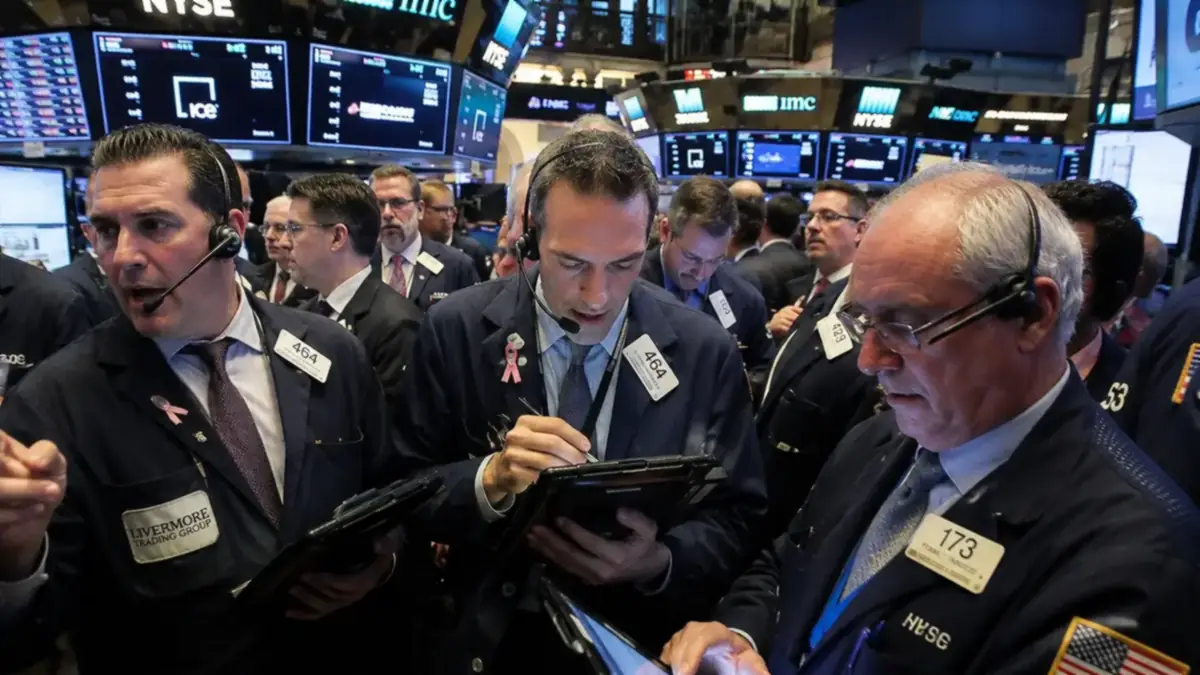
The opening reaction told the story in one glance. The Dow Jones Industrial Average traded down 228 points or 0.5% with prints clustered near 49,551, dragged lower by retail, banking, and rate-sensitive sectors that bear the brunt of higher real yields. The S&P 500 dipped 0.2% to roughly 7,389, slipping further from Monday's record above 7,400. The Nasdaq Composite, against the gravitational pull of the inflation print, eked out a 0.1% to 0.2% gain near 26,086 to 26,118 because the chip complex went vertical for the second time in three sessions. The Russell 2000 was the genuine victim, dropping 0.71% to 2,822.69 in the classic small-cap response to rising real yields and tightening credit conditions. Volatility moved but did not panic — the VIX added 1.5% to 18.26, an elevated reading by 2025-2026 standards but well shy of stress levels.
Treasury Yields Punch a Ten-Month High and Reset the Curve
The bond market did exactly what it was supposed to do. The 10-year Treasury yield jumped to 4.475% with intraday prints touching 4.48%, the highest level since roughly July 2025 and a notable break of the trading range that had held through the spring. The 2-year yield, by contrast, ticked slightly lower to 3.994%, which is the signal worth dissecting — the curve is steepening on inflation persistence rather than on Fed easing expectations, and that is a structurally different regime than the bond market priced as recently as last month. The U.S. Dollar Index firmed 0.23% to 98.52, finding support from the rate differential repricing. Gold futures eased 0.19% to $4,677.60 an ounce after a heavy run, while Bitcoin slipped to roughly $79,585 to $80,200, modestly softer over twenty-four hours. The reaction function is consistent — long-end yields rising on inflation is bearish for the same equity cohorts that rallied on disinflation hopes earlier this year.
Semiconductor Bid Returns With a Vengeance Despite Hedge Fund Selling
The chip tape Wednesday was a clinic in narrative-driven price action. Nvidia (NVDA) ran 2% higher to $224.51, adding $3.73, with the move squarely attributed to Jensen Huang's last-minute boarding of Air Force One at Anchorage for the Beijing summit. Micron Technology (MU) added between 4% and 4.5% as the memory-chip pricing story continues to dominate the AI infrastructure trade. Qualcomm (QCOM) climbed between 1.5% and 5% intraday, Intel (INTC) gained 1.5% to 3% to roughly $119.27, and GlobalFoundries (GFS) tacked on 2.90% to $74.24. The VanEck Semiconductor ETF (SMH) advanced about 1%, while the PHLX Semiconductor Index (SOX) added 130.64 points or 1.11% to 11,847.90. The session-level gains are unremarkable in isolation, but the cumulative move is not — the SOX is up 59% since the end of March, an extraordinary run by any historical comparison, and the data tells a story of who has been doing the buying. Goldman Sachs prime-brokerage analysts led by Vincent Lin reported that hedge funds have been meaningful net sellers of U.S. semiconductors and semiconductor equipment names through the rally, with the selling driven primarily by long liquidations rather than fresh short positioning. That positioning detail matters because it means the marginal buyer in chips right now is not the smart money, and the smart money is using strength to lighten exposure. Adam Crisafulli at Vital Knowledge described the Huang-Beijing reaction as fundamentally irrational, noting that the CEO of the largest company on the planet accompanying a sitting president on a geopolitically significant trip is hardly novel and certainly not a reason to chase chip stocks at fresh highs.
The Fab Bottleneck Becomes the Trade That Pays
A separate strand of the semiconductor story deserves its own framing. Cantor Fitzgerald analyst C.J. Muse revived the old line that "real men have fabs" to make the case that manufacturing capacity is rapidly becoming the binding constraint across the chip value chain. Taiwan Semiconductor is already under-shipping versus end demand, and the second-tier foundries UMC and Vanguard have started raising prices as capacity utilization tightens further. Muse named Samsung Electronics, Intel, and GlobalFoundries as the most direct beneficiaries, and the Korean side of that trade was visible Wednesday with Samsung Electronics (005930.KS) up 1.79% to ₩284,000. The structural read is that fabs have moved from being commodity capital sinks to being scarce assets with genuine pricing power, and any company that can put up wafer capacity inside Western jurisdictions now has a meaningfully different valuation argument than it did in 2024. Intel's pivot to a foundry-first identity is in this sense being validated by the supply data, not just by management storytelling.
Memory Pricing Becomes a Macro Variable
Bloomberg's data set on earnings transcripts revealed that memory pricing has been cited more than 550 times in 2026 quarterly reports and calls, already exceeding any full year on record going back to 1999. Micron and Samsung are printing record highs because pricing power is finally translating into margin and free cash flow, while downstream consumer hardware names including HP Inc. (HPQ) and Nintendo (NTDOY) are getting compressed by the input cost. Michael Brown at Pepperstone framed the dynamic crisply, noting that the memory crunch is worse than initially feared and could plausibly persist toward 2030 in some form. The deeper consequence is that memory has effectively been reclassified from commodity input to scarce strategic resource, with knock-on effects across data center economics, AI accelerator margins, and consumer electronics pricing. That reclassification is what is keeping MU and SK Hynix bid even on inflation-shock sessions like Wednesday's.
Beijing Summit Pulls in the CEO Roster
President Donald Trump arrived in Beijing for a two-day summit with Chinese President Xi Jinping, with trade and AI penciled as the priority agenda items rather than the Iran war, which Trump told reporters is "very much under control." The CEO manifest accompanying him reads like a market-cap roll call — Tesla's Elon Musk, Apple's Tim Cook (AAPL), BlackRock's Larry Fink (BLK), Boeing's Kelly Ortberg, Cargill's Brian Sikes, Citigroup's Jane Fraser (C), and the late-add pair of Nvidia's Jensen Huang and Qualcomm's chief executive, both of whom boarded during the Anchorage refueling stop. The Huang invitation reportedly came directly from Trump after national security hawks inside the White House tried to keep him off the list out of concern he would push for reopening the Chinese market to higher-end accelerators. In parallel, Treasury Secretary Scott Bessent and Chinese Vice Premier He Lifeng wrapped up three hours of pre-summit talks at Incheon International Airport in South Korea focused on the trade and economic file. The composition of the delegation is itself a market signal — when the largest American technology, finance, and industrial chiefs are physically in Beijing simultaneously, the probability of a tradable announcement on tariffs, accelerator export rules, or commercial aviation rises sharply over a forty-eight-hour window.
Alibaba Reveals the True Cost of the AI Arms Race
Alibaba (BABA) delivered a March-quarter report that was a textbook case of why the AI capital expenditure cycle is going to keep compressing near-term margins across the cloud-and-platform complex. Adjusted EBITA collapsed 84% year over year to 5.1 billion yuan, equivalent to roughly $750.9 million, on a revenue base that grew just 3%. The crush came from a combination of AI infrastructure spending, cloud capacity buildout, and continued investment in the rapid-delivery business that targets fulfillment within an hour. The single number that justifies the long-term thesis sat inside the segment breakdown — cloud revenue grew 38% on an annualized basis to $6.13 billion, broadly in line with Street estimates and pointing to genuine traction in the AI monetization layer. The strategic update was also material: management separated AI operations from cloud computing and elevated CEO Eddie Wu to head the newly created Alibaba Token Hub unit, an explicit signal that AI monetization is being managed as a standalone profit-and-loss line rather than as a cost center inside cloud. The price action told its own story. After dropping as much as 4% in premarket and 2% in the opening tape, BABA reversed sharply to trade 5.68% higher at $142.44, adding $7.66, as the market gave more weight to the 38% cloud growth and the structural reorganization than to the EBITA collapse. Tencent (700.HK) also missed sales expectations in its release and closed at HK$462.60, up 1.18%.
Earnings Tape Runs Loud With Outsized Single-Stock Moves
The morning premarket and overnight earnings flow produced some of the largest single-name moves of the quarter. Nebius Group (NBIS) surged 14.09% to $204.35 on a result that materially exceeded expectations. Eos Energy Enterprises (EOSE) added 10.25% to $8.93. On the punishment side, Wix.com (WIX) cratered 30.98% to $52.38 in one of the more violent earnings reactions of the season, Dynatrace (DT) dropped 10.35% to $35.15, Doximity (DOCS) lost 2.34% to $25.83, and USA Rare Earth (USAR) fell 3.39% to $24.68. Cisco Systems (CSCO) traded modestly higher at $100.50 into its after-the-bell report, with the chart setup balanced ahead of the print. Tuesday's after-hours flow set the tone — Karman fell nearly 11% on an aerospace-and-defense miss at 11 cents EPS versus the 12-cent consensus from FactSet despite a revenue and EBITDA beat, Resideo Technologies sagged 7% after guiding current-quarter EPS to 71 to 75 cents against an 84-cent consensus and revenue to $1.916 billion to $1.940 billion against a $2.01 billion estimate, and nuclear name Oklo slipped 2% after reporting a net loss of $33.1 million against a $32.1 million estimate and an operating loss of $51.2 million against a $44.3 million expectation. Birkenstock (BIRK) fell more than 5.5% after missing on both top and bottom lines in fiscal Q2 with management citing the Iran war's drag on the EMEA region.
Nextpower and EchoStar Provide the Premarket Upside
Nextpower delivered the cleanest upside surprise of the morning, jumping 14% premarket after raising full-year revenue guidance to a range of $3.8 billion to $4.1 billion from the previous $3.6 billion to $3.8 billion band, and topping fiscal Q4 estimates on both adjusted earnings and revenue per FactSet. EchoStar advanced about 4.5% after the Federal Communications Commission greenlit the company's $40 billion spectrum sale, with 50 megahertz going to AT&T (T) and 65 megahertz going to SpaceX. That FCC approval is not a routine event — it is a significant reshaping of the wireless spectrum map and a near-term liquidity infusion for EchoStar with longer-term implications for the build-out economics at both AT&T and SpaceX.
Walmart Cuts 1,000 Corporate Jobs and Explicitly Decouples It From AI
Walmart (WMT) slipped roughly 1% in premarket after confirming a corporate restructuring that will cut or relocate approximately 1,000 workers under EVP Daniel Danker and Global CTO and Chief Development Officer Suresh Kumar. The memo emphasized eliminating duplicate teams and streamlining for faster delivery and scaling, not AI substitution. A company spokesperson explicitly told reporters the move was structural rather than AI-driven, which is notable because it stands in contrast to Meta Platforms (META) and Microsoft (MSFT), both of which are running large headcount reductions explicitly tied to AI reinvestment cycles. Walmart entered the session up 17% year to date, and the muted price reaction suggests the market is reading the restructuring as efficiency gain rather than demand weakness.
Warsh Heads Toward the Fed Chair Confirmation
Kevin Warsh is on track to be confirmed as the next Federal Reserve chair as soon as today, following his Senate confirmation Tuesday to the Federal Reserve board of governors. Jerome Powell's term as chair expires Friday, and Powell has indicated he plans to remain on the board as a governor until his term ends in 2028. The next FOMC meeting is mid-June, which gives Warsh roughly a month to settle into the chair before having to deliver a policy statement that addresses a cumulative two-month spike in both consumer and producer inflation. The transition is occurring at the worst possible macro moment for a new chair to establish credibility — cutting now would look like political accommodation, holding now keeps real rates restrictive into an economy already showing growth deceleration, and hiking is effectively off the table given the White House's stance.
Morgan Stanley Lifts Its S&P 500 Target to 8,000
Mike Wilson and the Morgan Stanley equity strategy team raised the year-end S&P 500 target to 8,000 from 7,800, and set a 12-month target of 8,300. From Tuesday's 7,400 close, that translates to roughly 8% upside on the year-end objective and 12% on the rolling 12-month view. Wilson framed the call explicitly as an earnings story rather than a multiple expansion story, citing positive operating leverage and AI adoption as the engines, and noting that the index's resilience through geopolitical risk, private credit concerns, and AI disruption all supports the constructive view. The technical takeaway is that one of the most-followed strategists on Wall Street is calling for continued upside even with inflation accelerating, which suggests sell-side consensus is leaning on the earnings beat rate rather than on rate-cut probabilities.
Earnings Scorecard Looks Strong But the Tape Is Punishing Misses
The composition of the first-quarter reporting season is statistically impressive but practically asymmetric. FactSet pegs the S&P 500 beat rate at 84%, the highest since the second quarter of 2021, and Bloomberg-tracked aggregate profit growth has come in at 27%, more than double the 12% analyst expectation entering the season. Roughly 83% of the 440 S&P 500 companies that reported by May 8 had beaten estimates per Reuters. The problem is that the market reaction function has been brutally asymmetric. The four-day price move around beats has averaged 1.1%, barely above the 1% five-year average, while the four-day move around misses has averaged -4.9%, materially worse than the -2.9% historical norm. This week confirmed the pattern. Constellation Energy (CEG) beat estimates and still slipped 1% Monday. On Holdings (ONON) topped estimates and raised guidance and traded lower Tuesday. Under Armour (UAA) and Hims & Hers Health (HIMS) each fell double digits on misses. That spread between beat reaction and miss reaction is what positioning data looks like when the marginal long is stretched.
Read More
-
Yen Stalls at 160 Despite a 3% JGB and Tokyo Core CPI at 2.0% — Intervention Sits at 164, Friday's Payrolls Decide
02.09.2026 · TradingNEWS ArchiveEnergy
-
QQQ ETF ($739) Fades From an Early Tech Rally as a 77.9 ISM Prices Index Meets Micron's $61.5B Guide — $760 Record Test Ahead
01.10.2026 · TradingNEWS ArchiveStocks
-
XRPR and XRPI Follow XRP's $1.49 Test as Spot Funds Hold 1.16B XRP and a 1 Billion Token Escrow Release Lands — $1.70 in Play
01.10.2026 · TradingNEWS ArchiveCrypto
-
November NG Slips Below $3 as Decade-High Storage Meets Capped LNG Exports — $2.75 in Sight
01.10.2026 · TradingNEWS ArchiveCommodities
-
Dollar-Yen at 158 Presses Toward 160 as a 363 bp Carry Gap Meets Katayama-Bessent Intervention Risk — 159 in Sight
01.10.2026 · TradingNEWS ArchiveForex
Oil Steadies Into the Beijing Summit, Strait of Hormuz Tightens
Oil eased modestly after rising close to 8% across the prior three sessions on Iran war headlines. West Texas Intermediate (CL.1) traded between $101.15 and $102.63 a barrel, while Brent (BZ=F) sat in the $106.90 to $107.55 range. The supply story underneath the headline price is more important than the daily move. Satellite imagery shows no ocean-going tankers at Iran's Kharg Island over the past several days, the first sign of an extended halt at the country's main export hub since hostilities began, a direct consequence of the U.S. Naval blockade of the Strait of Hormuz. The Iran question is not expected to dominate the Trump-Xi agenda despite China being Iran's largest oil customer and a key diplomatic partner — Trump's framing that Iran is "very much under control" is being read as a deprioritization rather than a resolution. The risk skew on crude remains asymmetric — the supply disruption can intensify faster than diplomatic progress can be priced in.
Copper Hits a Record and Silver Joins the Industrial-Metals Bid
Copper futures struck a fresh all-time high while silver futures (SI=F) rallied alongside, with gold drifting lower in the same window. The split tells a precise story about what kind of demand is driving the metals complex right now. Data centers do not run on chips alone — they require power infrastructure, wiring, cooling systems, backup equipment, grid upgrades, and physical construction, all of which translate to direct copper demand. Silver participates because of its industrial uses in electronics, electrical equipment, and solar. Gold lagging while industrial metals rip is the cleanest possible signal that the buying is infrastructure-driven rather than safe-haven-driven. For positioning, that means the AI capital expenditure thesis is now physically embedded in commodity markets, not just in equity multiples.
Financials Lag and Send a Quiet Warning
JC Parets of All Star Charts flagged the relative chart of S&P financials versus the broader index as the most bearish chart in the market right now. The argument is structural — banks sit at the heart of credit creation, and historically healthy bull markets show participation from financials. When the sector lags this aggressively for this long, ignoring the divergence has been historically expensive. The State Street Financial Select Sector SPDR ETF (XLF) traded at $51.13, down 0.88%, while the S&P 500 itself was off only 0.10% at 7,393.47. The gap is the data point. Whether the divergence resolves higher through a financials catch-up or lower through a broader correction is the open question, but the divergence itself is informative. American Electric Power (AEP) is a separate weak spot on the rate-sensitive side, dropping 3.76% to $126.97, a clean case of long-end yield pain hitting a regulated utility.
Citi Pushes Back on the Inflation Panic
The dissent worth taking seriously came from Citigroup. Andrew Hollenhorst's team argued there is no real evidence inflation will continue to accelerate, even after Tuesday's CPI and Wednesday's PPI. The reasoning rests on demand-side data — growth has slowed over the past two quarters, consumer spending has held up but moderated from a previously very strong pace, and softer consumer demand should make it progressively harder for firms to pass cost increases through to retail prices. The supporting evidence comes from the curve itself — the 2-year yield ticking lower to 3.994% even as the 10-year jumped suggests the market is pricing inflation persistence at the long end without pricing more tightening at the front. If Citi is right, the current PPI shock is partly a backward-looking artifact of energy and import-channel effects rather than a forward-looking trajectory. That is a meaningful pushback against the consensus rate-cut delay narrative.
Asia Closes Mixed With Korea Leading on the Memory Trade
Asian sessions traded with the Beijing summit on the radar. South Korea's Kospi ripped 2.63% to 7,844.01, the standout performance, while the Kosdaq slipped 0.20% to 1,176.93. Japan's Nikkei 225 added 0.84% to 63,272.11 and the Topix climbed 1.20% to 3,919.48. Australia's ASX fell 0.46% to 8,630.40. China's CSI 300 rose 1.02%, Hong Kong's Hang Seng was 0.15% higher in the final hour, and India's Nifty 50 added 0.56%. The Kospi outperformance is the cleanest readthrough of all the Asian moves — Samsung Electronics and SK Hynix dominate the index weighting, and the global memory pricing dynamic is being directly translated into Korean equity performance.
Tuesday's Sector Rotation Sets the Reversal Context
Looking back one session helps explain the Wednesday rotation. On Tuesday, seven of eleven GICS sectors closed higher, with health care leading at +1.93%, consumer staples adding 1.56%, and financials gaining 0.72%. The laggards were consumer discretionary at -1.06%, information technology at -0.99%, industrials at -0.40%, and materials at -0.14%. Wednesday morning has effectively reversed that — technology is bouncing while defensives lag — which means leadership remains narrow and concentrated, and the rotation between growth and defensives is now happening on a near-daily cadence rather than over weeks. That kind of rapid sector cycling typically precedes either a meaningful regime shift or a volatility expansion, and the VIX inching above 18 is consistent with the latter.
Chinese ETFs and Cross-Border Positioning
The cross-border tape into the summit was lackluster. The iShares MSCI China ETF (MCHI) traded around premarket softness of 0.2% before rallying to $59.29, up 1.86% intraday, while the KraneShares CSI China Internet ETF (KWEB) was up 0.4% premarket and settled at $30.18, gaining 3.55% on the session. Alibaba's intraday reversal carried meaningfully into both ETFs given the position weighting. The pattern across U.S.-listed Chinese equities is consistent with what tends to happen during high-profile bilateral meetings — initial caution, then a relief rally if no major adverse announcement materializes in the early hours of the diplomatic event.
Synthesis and Outlook
Stitching the pieces together produces a market structure that is unusual but not without precedent. Earnings are running 27% growth on an 84% beat rate, which historically is melt-up fuel. Inflation has reaccelerated on both the consumer and producer measures, which historically caps multiples. The Fed is mid-transition into a new chair under maximum political stress. The chip sector has rallied 59% off the March lows with hedge funds documented as net sellers into the strength. Memory and copper are at record-level pricing dynamics that look structural rather than cyclical. Financials are diverging negatively from the index in a way that historically demands attention. Oil sits in the low $100s with Iranian export infrastructure halted by naval blockade. And the Trump-Xi summit is happening with the largest American technology and financial CEOs physically in Beijing, raising the probability of a binary news catalyst within a forty-eight-hour window. The Nasdaq's resilience near 26,086 is being carried by the AI infrastructure complex — Nvidia at $224.51, Micron extending its memory-pricing run, Intel and GlobalFoundries reflecting the fab capacity story, and Alibaba's cloud line growing 38%. The Dow's vulnerability at 49,551 is being driven by rate-sensitive cyclicals — financials, utilities, banks, and the consumer cohort that absorbs the pass-through from higher producer prices. The S&P 500's 7,389 print is essentially the weighted average of those two forces, which is why the index keeps oscillating around the 7,400 line without producing a decisive break in either direction. The path to Morgan Stanley's 8,000 target requires the inflation prints to peak inside the next two months, the Fed transition to occur without a credibility shock, and the chip rally to find a second wave of marginal buyers given that hedge funds are already lightening up. The path to a 5% correction requires only one more hot inflation print, one disappointing major-cap earnings miss, or one adverse headline from the Beijing summit. The asymmetric earnings-reaction data is telling traders that positioning is leaning long enough that the downside path is the more dangerous of the two scenarios to underweight. The constructive case rests on memory chip pricing, fab capacity scarcity, copper demand from AI infrastructure, and the 27% earnings growth backdrop. The cautious case rests on lagging financials, accelerating producer prices, hedge fund selling into the chip rally, and a Fed transition occurring at the worst possible moment for monetary credibility. The honest read of mid-May 2026 is that the market is being asked to absorb a structural inflation reset, a leadership transition at the Fed, a geopolitical summit with binary outcome potential, and an earnings season that is statistically strong but positionally exhausted, all simultaneously. The indices can grind toward 8,000 on the S&P 500 from here, but the path will not be smooth, and the dispersion between sector winners and sector losers is going to widen further before any new equilibrium emerges.