
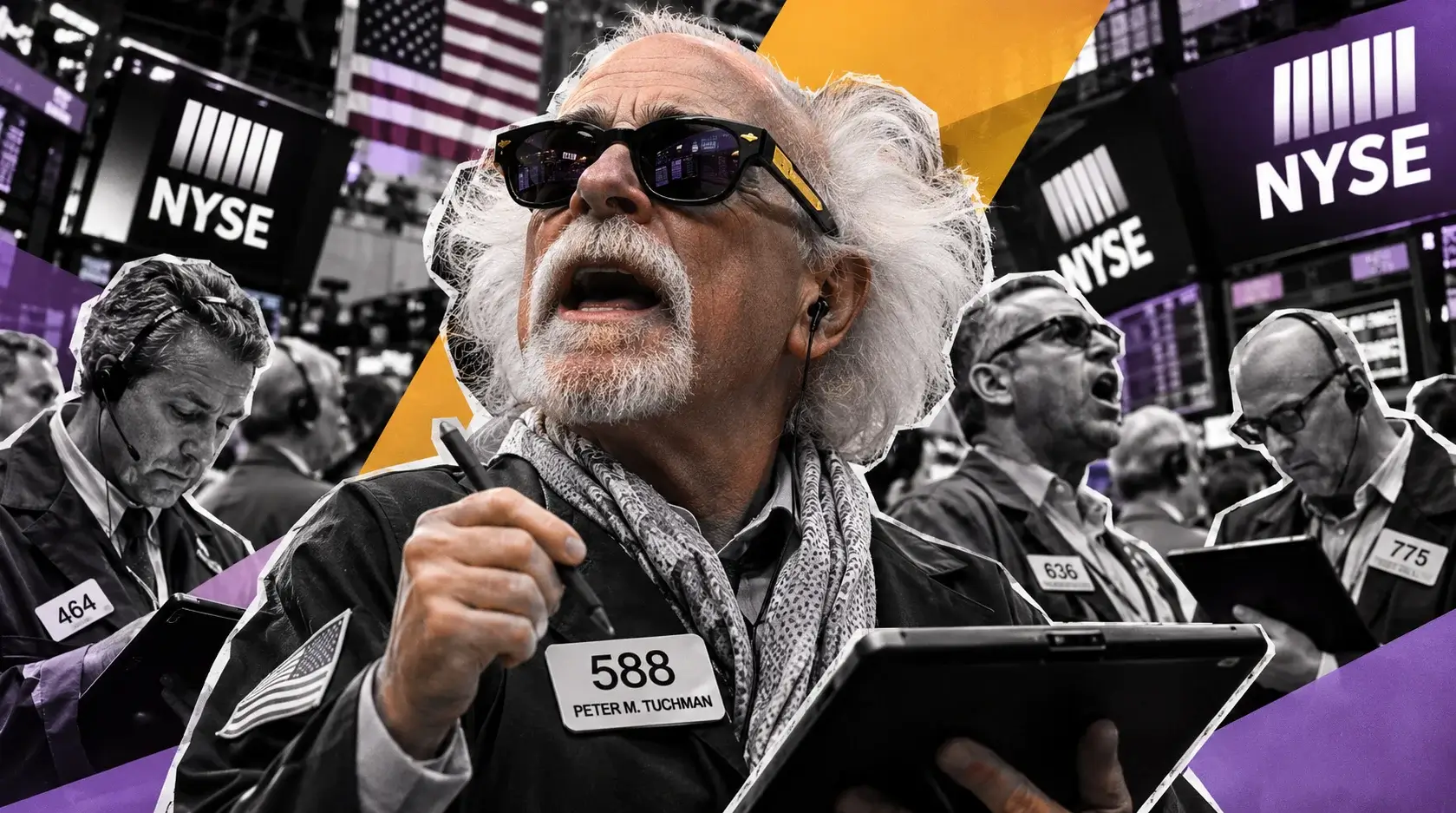
Stock Market Today: Nasdaq IXIC Drops 2.4%, Dow DJI Green, S&P 500 SPX Eyes 7,400 as NVDA Sheds 8%
Chips crack while retail rips; S&P 500 must reclaim 7,237 to open 7,400 | That's TradingNEWS
Key Points
- Nvidia NVDA fell 8.27% to $151.40, erasing 35% of Monday's 31.48% Huang-reinstatement surge
- Analog Devices ADI sank 18.55% to $308 after guiding Q1 EPS to $3.82 despite a $4.06 beat
- Consumer confidence jumped to 103.3 vs 92.1 expected, its highest reading since January 2025
Monday was a governance trade that got sold as an AI trade, and Tuesday's tape is pricing the difference. One day after the S&P 500 had its best session since April 2025, the index sits at 7,156.01, down 81.16 points or 1.12%. The Nasdaq Composite has lost 577.14 points, or 2.40%, to 23,512.42. The Dow Jones Industrial Average is the exception. It is up 66.36 points at 49,661.67, carried by consumer and health care names that have nothing to do with GPUs. That split is the whole session. The money that piled into semiconductors on Monday is walking back out, but it is not leaving the market. It is going into retailers that just printed beats, into a $41 billion biotech takeover and into defensive sectors.
The spark for Monday's surge was one filing. In a Form 8-K dated November 23, NVIDIA's board said it voted unanimously to reinstate Jensen Huang as President, CEO and director, effective immediately. The board said it had received input from senior levels of the U.S. government and was confident his return poses no national security risk. Huang resigned on November 12, and on November 17 the board said it did not intend to bring him back. The reversal sent Nvidia up 31.48% to $165.05. The S&P 500 closed at 7,237.17, up 4.73%. The Nasdaq finished at 24,089.56, up 6.51%. The Dow ended at 49,595.31, up 3.01%.
The reinstatement did not change Nvidia's order book, its gross margin or the capex budgets of its hyperscaler customers. It removed a leadership discount, and once that discount was gone, the question at Tuesday's open was what was left to buy. In chips, the answer so far is very little. Nvidia is down 8.27%, AMD has lost 11.70%, Micron has dropped 11.59% and the Philadelphia Semiconductor Index has fallen 6.17% to 8,996.18. Analog Devices beat on both lines and posted a record fiscal year, and it has been cut 18.55%.
The thesis here is that AI hardware has lost its ability to reward good news, while the rest of the market keeps rewarding it. Dick's Sporting Goods, Abercrombie & Fitch, Kohl's and Dollar Tree all beat and rallied by double digits. Insmed jumped 14% on an all-cash bid. Consumer confidence printed 103.3 against a 92.1 consensus. The tape is not risk-off. It is AI-off, and those are very different trades heading into Wednesday's October PCE report and a December 9 Fed meeting where a quarter-point hike is all but priced.
Index Scoreboard: Nasdaq IXIC Bleeds While Dow DJI Holds the Line
The gaps between the major averages show where the pressure sits. The Nasdaq Composite at 23,512.42 is down 2.40% and has given back 39% of Monday's 1,471.83-point gain. It has also traded below Monday's intraday low of 23,794.96. That is the most important technical fact of the day: Monday's range did not hold for the tech-heavy index. The Nasdaq-100, tracked by QQQ, has done worse, with QQQ down 2.79% from Monday's $651.03 close. QQQ gained $42.58 on Monday and has now lost $18.16 of it, a give-back of more than 40% in a single morning. Before Tuesday's open, QQQ was still below its 20-, 50- and 200-day moving averages even after Monday's 7% jump.
The S&P 500 at 7,156.01 has returned one-quarter of Monday's 326.78-point gain. It opened at 7,159.23, down 1.08%, which put it right on Monday's intraday low of 7,152.86. That floor has been tested several times and has held so far. Monday's close left the S&P 500 7.7% below its record high and still in correction territory, even after it reclaimed 7,000.
The Dow at 49,661.67 is up 0.13%. Earlier it was ahead by 201.62 points, or 0.41%, at 49,796. The blue-chip average opened down 0.26% at 49,466.16, turned positive by 9:44 a.m. ET, gave up almost all of its gain at the 11:03 a.m. low, and then turned higher again. Amgen, Nike and Salesforce have been the main supports. Monday's 1,447.98-point rally left the Dow 9.4% below its all-time high. The index broke below 50,000 on November 19 for the first time since June, and that level is the overhead line.
The Russell 2000 has swung around the flat line. It traded at 2,680.93, up 11.27 points or 0.42%, in the first hour, and IWM was later off 0.16%. Small caps falling 0.16% while the Nasdaq-100 drops 2.79% is not a broad liquidation. It is a sector rotation.
The scoreboard reads like this. The narrowest, most crowded AI growth exposure is down 2% to 3%. The broad cap-weighted benchmark is down 1%. The price-weighted industrial average is up. Small caps are flat. That ordering is the reverse of Monday, when the Nasdaq rose 6.51% against 3.01% for the Dow. Traders are not dumping equities. They are reversing a leadership bet that was put on in a single session on a single headline.
From Futures to Midday: How the Tape Unfolded
The overnight session set the tone early. At 4:34 a.m. ET, Nasdaq-100 futures were down 0.6%, S&P 500 futures were off 0.2% and Dow futures were flat. By 5:50 a.m. ET, Nasdaq-100 futures had slid 1.21%, S&P 500 futures 0.50% and Dow futures 0.14%. The selling grew as Nvidia reversed in premarket trade. At 7:47 a.m. ET the Nasdaq-100 contract was down 2%, and at 9:01 a.m. ET it was off 2.3%. In the hour before the open, S&P 500 futures traded at 7,190, down 64.25 points or 0.89%. Nasdaq futures were at 26,354, down 454.50 points, and Dow futures were at 49,458, down 219 points.
Asia had chased Monday's U.S. rally hard, which made the gap worse. Japan's Nikkei 225 jumped 3.9% to 58,644.63 as traders returned from a holiday, with Nvidia suppliers and chip names leading. South Korea's KOSPI rose 6.3% to 5,006.03, with Samsung Electronics and SK Hynix each up 6.7%. Taiwan's Taiex surged almost 9%, and TSMC and Foxconn closed limit-up. Australia's ASX 200 rose 1.8% to 8,726.40. Asian buyers paid Monday's prices just as U.S. traders started taking profits. London's FTSE 100 traded flat into the U.S. open.
The opening print was the low-conviction part of the day. At 9:30 a.m. ET the S&P 500 was down 1.02% and the Nasdaq Composite and Nasdaq-100 were each down 1.71%. Fourteen minutes later the S&P 500 had cut its loss to 0.62%, and the Dow and small caps had turned positive. At 9:51 a.m. ET the Nasdaq-100 had narrowed its decline to 1.49%. For half an hour it looked like the dip would be bought.
That rebound faded at 10:22 a.m. ET, when chip stocks hit a new session low. SMH was down 7.19% at that point and the Nasdaq was off 1.77%. By 10:26 a.m. ET the Nasdaq-100 was down 2.50%, a fresh low. At 11:03 a.m. ET the losses widened again. Chips and the Nasdaq-100 made new lows and the Dow gave back almost all of its gain. By 11:34 a.m. ET the indexes had bounced off that second low. The S&P 500 was down 0.96%, the Nasdaq Composite was off 2.21%, the Dow was up 0.26%, QQQ was down 2.79% and SMH had lost 8.29%.
The pattern is lower highs in semiconductors at every turn. The 10:22 a.m. bounce failed. The 11:03 a.m. flush went deeper than the open. Each attempt by the broad market to recover ran into a fresh wave of chip selling. Dip buyers are present in the S&P 500 and the Dow, but they are not stepping into AI hardware, and that holds back every rally attempt in the Nasdaq.
Chips Get Smoked: SOX, AMD, Micron and the Give-Back Math
The Philadelphia Semiconductor Index is down 6.17% at 8,996.18, and the triple-leveraged SOXL has dropped 18.97%. The steepest single-stock losses are in the names that rallied hardest on Monday, which tells you who did the buying. Monday's chip move was chasing and short covering, not new accumulation.
AMD is the worst of the large caps. It was down 8.03% at 10:01 a.m. ET, 11.70% at 11:01 a.m. ET, and at one point fell 10.75%. Micron has dropped 11.59% from Monday's close of $707.70, which puts the stock near $625.68. Micron rallied 19.04% on Monday, adding $113.19 per share from Friday's $594.51 close. Tuesday's decline has taken back more than $82 of that, so more than 70% of the Huang-reinstatement gain in memory has already disappeared. Broadcom is down 4.50%, Intel has lost 5.80%, TSMC's U.S. listing is off 3.47%, and SanDisk and SK Hynix's U.S.-traded exposure are each down more than 6%. Marvell fell between 3.3% and 4.3% in premarket trading and the selling picked up after the open. CoreWeave, which rallied 22.3% on Monday, fell 5.4% before the bell.
The give-back math sorts the market. QQQ has returned more than 40% of Monday's gain. Nvidia has returned 35% of its gain. Micron has returned more than 70%. Hewlett Packard Enterprise has given back more than 85%. The further a stock sits from Nvidia's own story, the more of Monday's move it has lost. That makes sense. Huang's return was specific to Nvidia, and the read-through to memory, servers and analog chips was always speculative.
Options pricing warned about this before the open. The spread between the VXN, which measures Nasdaq-100 implied volatility, and the VIX closed Monday at 9.69, up 0.33 points on the day. That is above its 20-day average of 8.98 and in the 90th percentile of the past 60 sessions. Nasdaq protection got more expensive during Monday's surge, not cheaper. Traders were buying hedges into the rally, which is not how a durable bottom behaves. The VXN stood at 36.31 before Tuesday's open.
Chip stocks have now absorbed a CEO resignation, an earnings report, a board reversal and a reinstatement in under two weeks, and the sector is still below where it started the month. For the semiconductor group, Monday's 31% Nvidia print looks like a single-session squeeze inside a downtrend, not a trend change. Until the SOX recovers Monday's highs, the group is acting like a source of funds, not a destination for them.
Nvidia After Huang's Return: The Governance Fix Is In, the Valuation Debate Is Back
Nvidia at $151.24 is down 8.37% from Monday's $165.05 close and down 6.74% at its first-hour mark. The stock fell 4.4% in premarket trading, slipped to a 4.89% loss at 9:01 a.m. ET and a 5.64% loss at 10:01 a.m. ET, and reached 8.27% by 11:01 a.m. ET. Each hour has been worse than the one before. Before the reinstatement, the stock closed Friday at $125.53, so it remains $25.71 above that level. Bulls will point to that cushion and say Monday's re-rating has held. Bears will point to a 35% give-back in one morning and say the governance premium is already fading.
The operating picture is strong and was strong before Huang's departure. Last week Nvidia reported fiscal third-quarter revenue of $115.8 billion, ahead of a $109 billion consensus, with data center revenue of $107.6 billion. It guided fourth-quarter revenue to $130 billion. Those numbers came out while the company was run by interim CEO Colette Kress, the CFO, and they did not stop the stock from falling. On November 16 Nvidia dropped another 4% as the S&P 500 fell 1.9%, and the VIX jumped 22% to 23.56. Two days before the print, the stock had erased its 2026 gains and was down 24% from a 52-week high set a month earlier.
The reinstatement filing says the board voted unanimously and is confident Huang is the right person to lead the company. It also says that Huang will cooperate with the board's independent investigation and has agreed to appear before Congress on the national security questions around the company. Neither of those processes is finished. A congressional appearance on chip export policy and intelligence-service contacts is a headline risk the tape has not priced, and Tuesday's premarket selling was also tied to a tariff report hitting the chip complex.
That leaves a stock with growing revenue and a contested multiple. The market has decided that leadership continuity is worth something. Monday's 31.48% gain added $960 billion in market value. Tuesday's 8% retreat signals that traders will not pay for that continuity a second time. Nvidia's next test is whether it can hold above $150 into Wednesday's PCE print. A close below that round number would mean more than 40% of the reinstatement gain is gone. That would put the $140 to $145 zone back in play, where the stock spent much of the Huang-less week.
Analog Devices: Record Year, 18% Haircut
The clearest example of the market's tolerance for good semiconductor news is Analog Devices. It has dropped 18.55% to $308.49, down from Monday's close of $378.75, which itself came after a 9.49% rally. The stock is on track for a seven-month low. ADI was up 42.74% over twelve months going into the print.
The quarter was strong. Fiscal fourth-quarter adjusted earnings were $4.06 per share, against a $3.90 consensus and $2.26 a year earlier. Revenue reached $4.37 billion against expectations of $4.33 billion. For fiscal 2026, revenue climbed 38% to a record $15.2 billion. Operating cash flow was $6.2 billion and free cash flow was $5.5 billion, and the company returned $5.4 billion to shareholders through dividends and buybacks. Management said more than two-thirds of fiscal 2026 growth came from markets that are not centered on AI, and that AI infrastructure spending kept driving its data center and automated test equipment businesses.
The guide and the balance sheet caused the selloff. For the first quarter of fiscal 2027, ADI projects revenue of $4.4 billion, plus or minus $150 million, and adjusted EPS of $3.82, below consensus. That is a sequential earnings decline from the $4.06 just reported. On the call, management cited higher AI-related token and cloud costs and a full quarter of Olive expenses as near-term operating expense pressures. Inventory days rose to 141, 13 days above the company's five-year average. For a broad-line analog supplier coming out of a cyclical upturn, a falling EPS guide plus rising inventory is the combination that makes portfolio managers question whether the recovery has peaked.
The premarket move showed how fast sentiment turned. ADI was off 9.8% at $341.59 early, 11.29% at $335.99 before the open, and more than 14% at the bell. It then kept falling through the morning, reaching 15.59% at 10:01 a.m. ET and finally 18.55%. A stock trading at 49 to 50 times trailing earnings before the report had no room for a sequential slowdown, whatever the full-year growth rate.
ADI matters for the broader tape because it is not a pure AI name. It sells into industrial, automotive, communications and consumer end markets. When a company with that diversification gets punished like a crowded momentum stock, the problem is the multiple the whole semiconductor sector carries into 2027, not one company's guide. The market is repricing the group's earnings power at a higher cost of capital, with the 10-year Treasury yield near 4.92% and a December rate hike priced.
Read More
-
Yen Stalls at 160 Despite a 3% JGB and Tokyo Core CPI at 2.0% — Intervention Sits at 164, Friday's Payrolls Decide
02.09.2026 · TradingNEWS ArchiveEnergy
-
VIG ETF Gains 2.1% to $240.77 as Nvidia-Free Dividend Growers Lag the Rally; $253.75 High Back in Sight
23.11.2026 · TradingNEWS ArchiveStocks
-
Bitcoin Slips to $59,823 as IBIT Bleeds $509M; Reclaiming $62,000 Opens $66,000
24.11.2026 · TradingNEWS ArchiveCrypto
-
January Natural Gas Sinks 5.9% to $3.529 as Weekend Models Erase 34 HDDs; $3.75 Back in View
23.11.2026 · TradingNEWS ArchiveCommodities
-
USD/JPY Climbs to 159.13 as Nvidia Rally Drains Yen Haven Bid; 160.50 Tests Tokyo's Line
23.11.2026 · TradingNEWS ArchiveForex
HPE, Semtech and Dell: Beat-and-Raise Doesn't Pay in AI Hardware
Analog Devices was not the only company whose results were sold. Hewlett Packard Enterprise reported after Monday's close at 4:05 p.m. ET. Fourth-quarter revenue jumped 50% to $14.5 billion, and the company raised its fiscal 2027 revenue outlook to a range of $59.4 billion to $63.1 billion. Cloud & AI revenue grew 68.6% from a year earlier. The stock fell 13.14% to $41.71. It had surged 17.38% to $48.02 on Monday, so more than 85% of that gain is gone, though the stock remains above Friday's $40.91 close.
The selling followed the margins. Adjusted gross margin fell 2.2 points from the prior quarter. Management expects Cloud & AI operating margin of 14% in fiscal 2027, down from 18.4%. That is the core concern about AI hardware in 2026 and 2027: revenue grows fast while the margin on each dollar of server and networking sales shrinks as component costs rise and customers push back on price. HPE is selling more AI infrastructure than ever and earning less per unit, and the market treated the lower margin as the more important number.
Semtech followed the same script. It beat and guided higher, then fell 8.4% in premarket trading, and the decline reached 14.17% by 10:01 a.m. ET. Dell Technologies, which reports after Tuesday's close, fell 7% before the open as traders cut exposure ahead of the print. Consensus for Dell is $6.55 per share on $49.24 billion of revenue. With HPE as the template, Dell must clear those figures and show stable server margins to avoid the same treatment.
Agilent was the exception. It reported adjusted EPS of $1.86 against $1.73 expected and revenue of $2.04 billion against $1.99 billion, raised guidance for the quarter and the full year, and rose 6.8% in premarket trading. It was the only beat-and-raise of the morning that the market rewarded, and it is not an AI hardware company. That contrast sums up the session. The same earnings outcome gets opposite reactions depending on whether the company sits inside the AI capex chain.
Outside of earnings, Dycom Industries fell 12.10% after announcing a new $200 million buyback alongside third-quarter results. Engineering and construction peer Jacobs also slipped despite a strong fourth quarter that ended fiscal 2026 with a 1.4x book-to-bill and a 24% increase in gross backlog. Data center construction and telecom infrastructure names that rode the AI buildout are being sold alongside the chips. The trade is being unwound across the whole supply chain, not one ticker at a time.
Anthropic Breaks Its $83 IPO Price
The most symbolic move of the morning came from the newest large-cap AI listing. Anthropic, trading under ANT, fell as much as 6% in premarket trade to $82.30, below its $83 initial public offering price for the first time. The decline later reached 9% below the offer as AI selling picked up after the open.
The IPO arithmetic shows how fast the mood has changed. Anthropic priced 980 million shares at $83 on November 18, above a $70 to $78 marketed range, and raised $81.3 billion, the largest IPO share sale on record. At the offer price the company was valued at $1.5 trillion, ahead of SpaceX's listing. When trading opened on November 19 at 11:50 a.m. ET, the stock printed $111.50, 34% above the offer, and briefly pushed the company's valuation past $2 trillion. It touched $114.99 to $115.10 early, fell to a session low of $92.72, and closed its first day at $97.17, up 17% from the offer.
Four sessions later, that 17% premium is gone. The IPO came in at 31 times sales on the deal price, and listings priced above 20 times sales have historically traded at least 25% below their first close within a year. The September-quarter revenue run rate was $68 billion. Amazon and Google will together own close to 30% of the company after the IPO through a special nonvoting share class, and both also sell compute to it.
The concerns being priced now are capital intensity, an unpublished credit rating, potential supply from insider selling and ordinary post-IPO profit-taking. None of those are new. What changed is the market backdrop. On debut day the S&P 500 was still 7% above Tuesday's level, the Fed debate was about the size of a December hike rather than whether one would happen, and Nvidia had a CEO in place. A record IPO met a tape that had stopped paying for AI scale.
A record IPO trading below its offer within a week tends to mark late-cycle behavior in a theme. It does not mean the AI trade is over. It means the marginal buyer of AI exposure now demands a lower entry price than issuers set a week ago. Every AI-linked secondary offering and IPO in the pipeline now has a fresh negative reference point. For Nvidia, AMD and Micron, Anthropic's break below $83 adds supply pressure. Funds that bought the IPO need to make room, and they are not adding chip exposure while the new position is underwater.
Retail Rips: Dick's, Abercrombie, Kohl's and Dollar Tree Beat and Raise
While chips sold off, retailers delivered one of the strongest single-day earnings runs of the holiday season. Kohl's, Dick's Sporting Goods and Abercrombie & Fitch all rose on solid quarters and guidance, and that cluster is what is keeping the Dow green.
Abercrombie & Fitch rose 22.47%. Its third-quarter release showed record net sales and the 16th consecutive quarter of growth. Growth accelerated across regions and brands from second-quarter levels, with Hollister up 11% in the back-to-school quarter and Abercrombie brands up 12%. The fourth-quarter outlook calls for net sales growth of 7%, net income per diluted share of $4.40 to $4.60, and at least $120 million in share repurchases.
Dick's Sporting Goods rose 14.28% and traded at $151.96 in premarket. Its 8-K shows non-GAAP EPS of $1.94 against a $1.41 consensus and diluted EPS of $1.87, up from $0.86 a year earlier. Consolidated revenue rose 23.2% to $5.13 billion against $5.08 billion expected. Dick's comps rose 2.6% on top of a 5.7% gain a year earlier. Foot Locker comps rose 0.5%, with the U.S. Foot Locker banner up 4.1%, but the Foot Locker business still posted a $40.9 million operating loss. Full-year EPS guidance rose to $11.40 to $12.25. Dick's bought back 6.7 million shares for $903 million in the quarter and declared a $1.25 dividend.
Kohl's surged 15.33%. The street expected the department store chain to break even, and it reported adjusted EPS of $1.76 on $3.5 billion of revenue, a 3% sales beat. Comps rose 1.2%, and tariff rebates and income tax benefits helped the bottom line. Kohl's raised full-year guidance for sales, operating margin and earnings. From Monday's $21.20 close, the stock traded at $23.88 in premarket, near the top of its 52-week range of $11.38 to $25.60.
Dollar Tree rose 11.4% to $154.96 and set a 52-week high, up from a $139.10 close. Adjusted EPS of $1.16 beat $0.91 by $0.25, and revenue of $5.08 billion rose 6.9% against $5.04 billion expected, with comparable traffic up 3.8%. Fiscal 2026 EPS guidance moved to $8.05 to $8.25 from $7.70 to $8.05, and $0.65 per share of that comes from tariff refunds. Fourth-quarter earnings guidance came in below consensus.
Burlington rose 9.05% even though total sales growth of 8% to $2.932 billion came with only a 1% comp, which the CEO called disappointing. Best Buy posted 6.1% comps against 2.3% expected, its best in five years. Revenue rose 5% to $10.2 billion and adjusted EPS was $1.62 against $1.49. The stock rose 5% in premarket and then gave it back to trade 0.15% lower.
Health Care Gets the Bid: Sanofi's $41 Billion Insmed Deal and the Defensive Rotation
The other source of strength is health care, led by the morning's biggest deal. At 1:30 a.m. ET, Sanofi said it agreed to buy Insmed for $175 per share in cash, a total of $41.0 billion. The offer is a 17.4% premium to Insmed's Monday close and a 46% premium to its November 18 close, the day before media reports of a possible deal. Insmed traded at $170.54, up 14.39%, which leaves a $4.46 spread to the offer, or 2.6%. That spread prices high confidence that the deal closes. Sanofi is funding the deal with cash on hand and new debt and expects to close in the first half of 2027, pending an Insmed shareholder vote and U.S. and other regulatory approvals.
The strategic logic centers on Brinsupri, Insmed's lead drug, which brought in $1.09 billion of U.S. revenue from August 2025 through September 30, 2026. Sanofi says the deal should add to EPS by the end of 2028 and does not change its 2026 guidance. Sanofi's own shares rose 8.62%, an unusual rally for an acquirer paying a 46% premium, and a sign the market believes the respiratory franchise is underpriced at $175.
The deal fits a wider rotation into the sector. Early in the session, health care (XLV), consumer staples (XLP) and financials led the S&P 500 sectors, while technology (XLK) fell 3%. Amgen has been one of the main supports for the Dow. In smaller biotech, Cogent Biosciences rose 17.18% after a release at 9:27 a.m. ET, Kymera Therapeutics gained more than 10%, and diabetes device maker Embecta jumped 28.54%. Amentum climbed 15.69% and Fluence Energy rose 10.79%.
Rotation into health care makes sense with a rate hike priced and the 10-year yield above 4.9%. Large-cap pharma and biotech offer cash flows that do not depend on a capex cycle, valuations that never reached semiconductor multiples, and an M&A bid that is now visible. A $41 billion all-cash deal at a 46% premium tells portfolio managers that strategic buyers see value in the sector, and that gives a floor that AI hardware does not have.
The same logic explains why consumer discretionary, Monday's second-best sector at a 4% gain, is holding up while technology, which rose 9% on Monday, unwinds. Retail and health care both have earnings support this week, and chips have only momentum. When momentum reverses, money looks for earnings, and on Tuesday the earnings are in malls and drug pipelines, not in data centers.
Consumer Confidence at 103.3 Against the Fed's Hiking Path
The 10:00 a.m. ET macro release was a sharp upside surprise. The Conference Board's Consumer Confidence Index rose 11.4 points to 103.3 in November from an upwardly revised 91.9 in October. The consensus was 92.1, and the reading beat every forecast in the survey. It is the highest level since January 2025 and the second straight monthly gain. The Present Situation Index jumped 13.7 points to 132.8 and the Expectations Index rose 9.9 points to 83.6. The share of consumers saying jobs are plentiful rose 4.6 points to its best level since May 2025, and the share saying jobs are hard to get fell 3 points.
The Conference Board linked the jump to lower uncertainty after the midterm elections. Confidence rose sharply among Democrats and independents and slipped among Republicans. The figure that matters for the Fed is inflation expectations. Consumers' average 12-month inflation expectation eased to 5.7% from 5.8%, the second straight monthly decline, but 5.7% is still far above the Fed's 2% target.
Strong confidence is a double-edged result for equities right now. It supports the retail rally. Shoppers who feel better about jobs going into Black Friday make the Dick's, Kohl's and Abercrombie guidance more believable. It also gives Fed Chair Kevin Warsh no reason to slow the tightening cycle. The Fed raised rates a quarter point in September, its first hike since 2023, and held in October on a 10-2 vote. A quarter-point move on December 9 would take the fed funds target range to 4.00% to 4.25%. Fed funds futures price a 95% probability of a 25 basis point hike and a 5% chance of 50 basis points. Traders also revived bets on at least two more hikes after Monday's rebound, as AI-driven inflation concerns pushed hike expectations back up.
Wednesday's calendar is heavy because Thursday is a holiday. October PCE, the second estimate of third-quarter GDP, durable goods, weekly jobless claims and the Fed's Beige Book all land in one session. The October PCE is the last inflation reading before the December decision. A hot core print would move the debate from 25 to 50 basis points, and for growth stocks trading at 40 to 50 times earnings, that is a bigger risk than any single CEO headline. Treasury is also auctioning $70 billion of five-year notes at 1:00 p.m. ET after a $28 billion two-year floating-rate note reopening at 11:30 a.m. ET, so supply is landing on the curve the day before the data.
Rates, Dollar, Oil, Gold, Bitcoin and the VIX
The cross-asset picture shows an equity-specific unwind, not a broad flight to safety. The 10-year Treasury yield is at 4.916%, down 0.2 basis points, close to unchanged. It peaked at 5.310% on October 5, its highest since 2007, and has come down since. Long-duration Treasuries are firm, with TLT up 0.24%. With the 10-year this stable, the bond market is not reading Tuesday's chip selloff as a growth shock. It is waiting for PCE.
The dollar index is at 104.19, down 0.10%. Last week it hit a 19-month high on strong core retail sales and hawkish Fed commentary. A dollar near 104 with Fed hikes priced keeps pressure on multinational earnings and on dollar-denominated commodities.
Oil is mixed. WTI crude was at $79.89 before the open, down 0.35%, and the January contract later traded at $81.33, up $1.16 or 1.45%. Brent was at $86.55, down 0.15%. Brent settled 5.85% lower on Monday at its weakest level since August 31 after President Trump signaled restraint on new strikes against Iran. Ship attacks near the Strait of Hormuz continue, but the market has moved from pricing a supply shock to pricing a surplus as Hormuz flows recover. Lower crude is a quiet tailwind for the retailers rallying today, since cheaper gasoline frees up holiday spending.
Gold has fallen $46.30, or 1.27%, to $3,605.10, and GLD is down 1.90%. Gold usually catches a bid on a risk-off tech day, so its decline confirms that real yields and the dollar matter more than haven demand right now. Last week, high yields kept gold capped near $3,848.
Bitcoin has dropped $3,090.63, or 4.92%, to $59,732.18, below $60,000. It fell toward its third test of $62,000 on Anthropic's debut day and has now broken through. It is trading like a leveraged version of the Nasdaq-100, not a hedge.
The VIX is at 27.35, up 0.73 points or 2.74%, after printing 28.28 before the open. Monday's session pushed it down 9.3% to 26.62, which was still a high level for a day with a 4.73% rally. A VIX that stays near 27 after the best session in 19 months, and keeps rising while the Dow is green, shows that traders are paying to hedge into strength. That fits the VXN-VIX spread in the 90th percentile of the past 60 days.
Breadth and Rotation: Concentrated Pain, Wide Participation
Monday's rally was broad. NYSE advancers beat decliners 4.3 to 1 and Nasdaq advancers beat decliners 3.95 to 1. Nine of 11 S&P 500 sectors rose, led by information technology up 9%, consumer discretionary up 4%, communication services up 3.6% and materials up 2.3%. Twenty-eight of 30 Dow components gained. Volume reached 22.37 billion shares against a 20-session average of 19.50 billion.
Tuesday's selling is not broad. It is heavy in one group. The SOX is down 6.17%, SMH has lost 8.29% and QQQ is down 2.79%, while the Russell 2000 has stayed between up 0.42% and down 0.16%. The equal-weight trading in small caps and the green Dow both point to a market where most stocks are holding Monday's gains. The handful that led Monday is getting hit. That concentration is the main reason this session reads as a rotation and not the start of another leg down.
Pinterest is a good example of money looking for anything outside the AI hardware stack. It rose 12.6% to $19.04 by 10:00 a.m. ET and later traded as high as $19.47, after a 10% gain on Monday. The move followed a filing after Monday's close that strengthened change-in-control protections for senior employees' bonuses and stock awards. That sparked takeover speculation, though there are no reported deal talks. Pinterest had fallen more than 24% over the past month, and its intraday range was $17.10 to $19.36. Within the sector, Reddit rose 1.7% and Spotify gained 1.6%, while Alphabet and Meta traded lower.
The losers were concentrated in the AI supply chain. ADI fell 18.55%, Semtech 14.17%, HPE 13.14%, Dycom 12.10%, AMD 11.70%, Micron 11.59% and Nvidia 8.27%. Shoe Station Group fell 21.92%, the biggest non-tech loss of the morning. The leaders came from everywhere else: Embecta up 28.54%, Abercrombie up 22.47%, Cogent up 17.18%, Amentum up 15.69%, Kohl's up 15.33%, Dick's up 14.28%, Insmed up 14.39%, Pinterest up 12.6% and Dollar Tree up 11.4%.
That leadership list is what a market looks like when it reallocates rather than de-grosses. Total equity exposure is flat to slightly lower, and the mix is shifting from AI capex beneficiaries to consumer, health care and special situations. The risk is timing. Rotations this sharp tend to reverse once the overloaded group gets cheap enough, and Wednesday's PCE print decides whether the multiple compression in chips is finished or just starting.
Key Levels and Session Verdict
For the S&P 500, the floor is the 7,150 to 7,153 zone. Monday's intraday low was 7,152.86, Tuesday's open printed 7,159.23, and the morning low has tested that band repeatedly. A close below 7,150 would mean the index has lost more than a quarter of Monday's gain and the 7,000 level reclaimed on Monday is back in play. On the upside, the first test is Monday's 7,237.17 close. Above that, Monday's 7,296.16 intraday high is the pivot. Reclaiming 7,296 opens a path to 7,400, which lines up with the 7,342 level where the index traded on November 17 before the Nvidia-driven drop. The 7,400 target requires semiconductors to stop leaking. It does not require them to lead.
For the Nasdaq Composite, the damage is more technical. The index has broken Monday's 23,794.96 low and sits at 23,512.42. Holding 23,500 is the minimum condition for bulls. Getting back above 23,795 would turn today's breakdown into a failed one, with 24,089.56 and Monday's 24,353.65 high as the next levels. The Nasdaq is 13.1% below its all-time high and back in correction territory.
For the Dow, 49,033 is Monday's low and the support, while 50,000 is the round-number ceiling the index lost on November 19. A close above 49,810 would put it at its best level since that breakdown.
Wednesday's 8:30 a.m. ET releases matter most. Core PCE above consensus would push December pricing toward 50 basis points and hit high-multiple tech again. An in-line or soft print would give the Nasdaq room to recover part of Tuesday's losses before the Thanksgiving break. Thursday's market is closed and Friday closes at 1:00 p.m. ET, so positioning into the long weekend will amplify whatever the PCE shows. Dell's report after Tuesday's close is the last AI hardware test of the week.
The verdict on November 24 is a mixed session with a bearish tilt in technology and a bullish undertone everywhere else. Breadth is holding, the Dow is green, small caps are flat, retail and health care are rewarding beats, and consumer confidence just hit its best level since January 2025. Chips are the exception. The market has stopped rewarding AI hardware beats, punished ADI, HPE and Semtech for good quarters, and pushed the year's biggest IPO below its offer price within four sessions. Monday's 4.73% rally was a relief rip on a governance headline. Tuesday shows that the AI hardware trade still has no fundamental buyer at these prices. As long as the S&P 500 holds 7,150, the broad market stays in recovery mode with a 7,400 upside target. A semiconductor index that cannot recover its Monday high leaves the Nasdaq as the weak link going into the last inflation print before the Fed's December decision.