Stock Market Today – Presidents Day 2026: Wall Street Pauses After AI Shock Week
S&P 500 holds around 6,836 as Nasdaq lags, software and wealth managers sell off on AI fears while AMAT, RIVN and MRNA outperform and Bitcoin climbs back toward $69K | That's TradingNEWS
Stock Market Today – Presidents Day 2026, Wall Street frozen after an AI-driven hit week
US indices into the long weekend – negative week, mixed close
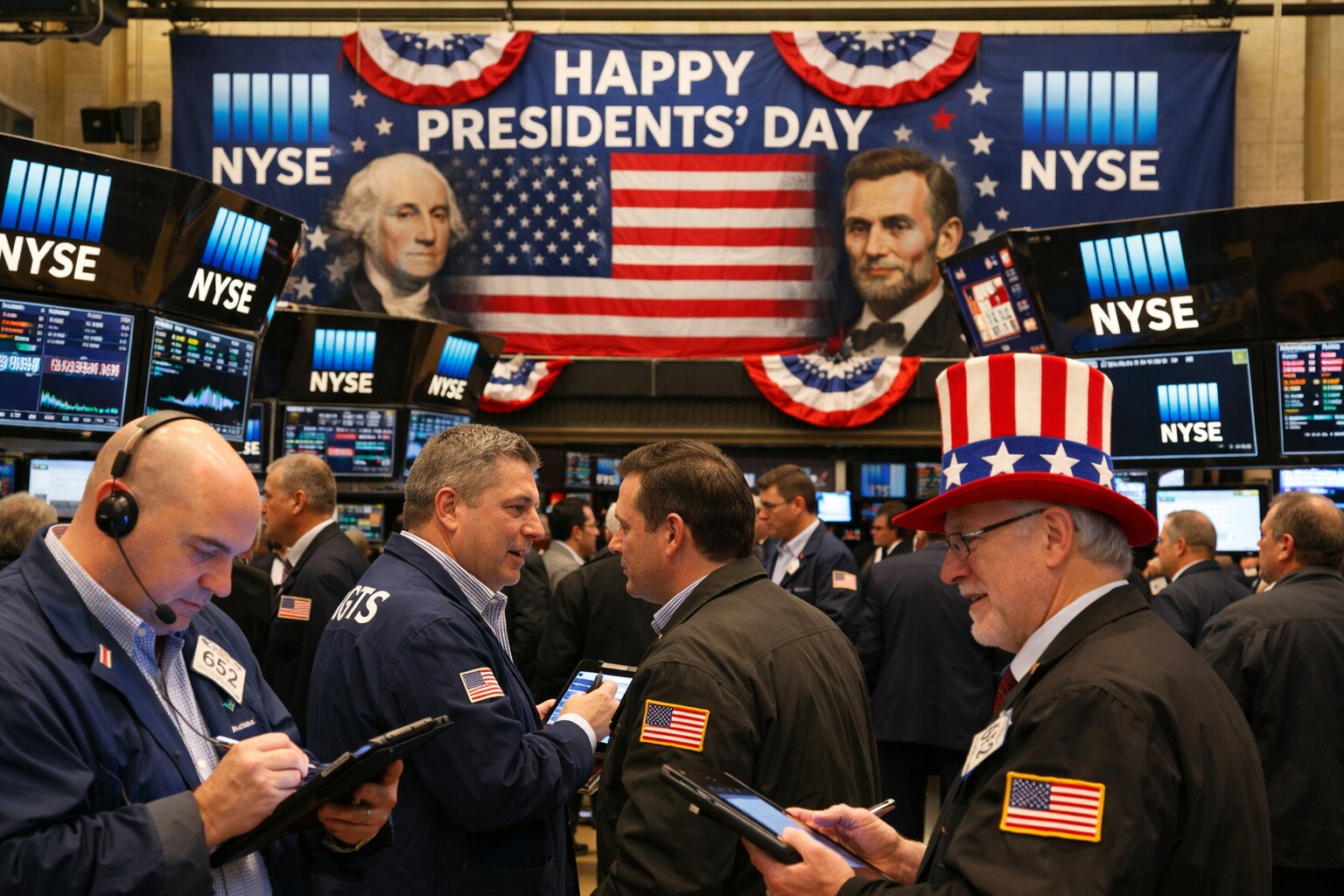
US cash equities are shut today for Presidents Day 2026, with the New York Stock Exchange and Nasdaq reopening Tuesday, Feb. 17 at 9:30 a.m. ET. The closure comes right after a volatile week where all three benchmarks finished lower even though Friday’s session looked calmer on the surface. The S&P 500 ended Friday barely positive, around 6,836 and up roughly 0.05% on the day. The Dow Jones Industrial Average added about 0.1%, while the Nasdaq Composite slipped roughly 0.2% into the close. Those small moves hide the real story: for the full week the S&P 500 dropped about 1.4%, the Nasdaq lost more than 2%, and the Dow fell about 1.2%, marking one of the sharpest weekly setbacks since late 2025. The key point for Trading News readers is that the holiday break arrives exactly when the market is trying to digest both a friendlier inflation trend and a brutal repricing of anything exposed to artificial intelligence disruption.
Inflation cools, Fed cuts back on the table but not enough to save the week
The macro backdrop into the holiday is better than the price action suggests. January Consumer Price Index data showed headline CPI rising only 0.2% month-on-month and 2.4% year-on-year, with core CPI up 0.3% m/m and 2.5% y/y. Both headline readings came in a tenth below consensus. That was enough to push futures pricing toward a June rate cut, with markets now leaning toward at least two 25-basis-point cuts by the end of 2026 rather than just one. Lower inflation directly supports the multiple on the S&P 500 and Nasdaq, because it caps the upside risk for long-term yields, but the tape made it clear on Friday that macro is not the only driver. The intraday pattern was classic “good news, bad mood”: initial relief after the CPI release, then fading strength into the afternoon as AI-linked selling pressure returned. That is exactly why the indices could finish the day flat to slightly green and still register heavy weekly losses.
AI disruption trade – software, logistics and wealth managers repriced lower
The dominant equity story going into Presidents Day is the AI scare trade. Investors are no longer just buying anything with “AI” in the deck; they are marking down business models that look vulnerable to automation. The iShares Expanded Tech-Software Sector ETF (IGV) is already down about 22% year-to-date, a brutal de-rating for a segment that had been treated as the obvious winner of the AI cycle. At the index level, the broader Technology sector (XLK) is off around 2.5% over the same period, while non-tech sectors like Energy (XLE), Consumer Staples (XLP) and Materials (XLB) are up by double-digit percentages. That relative move is exactly what you expect when the market decides old winners are over-owned and over-valued. The AI shock then spilled into more traditional industries. In transportation and logistics, C.H. Robinson Worldwide (CHRW) and Universal Logistics Holdings (ULH) finished the week with losses in the high single to low double-digit range, roughly −11% and −9%, after a Florida-based competitor unveiled an AI freight engine designed to handle higher volumes without increasing headcount. In wealth management, Charles Schwab (SCHW) fell roughly 10% and Raymond James (RJF) around 8% for the week as a new AI-driven tax optimization platform raised questions about how long traditional advisory fees can stay at current levels. The common denominator is margin risk: wherever AI can substitute for expensive human labor or high touch workflows, the market is now compressing the multiple ahead of the actual earnings impact.
Megacap tech under pressure while AI infrastructure winners like AMAT still outperform
The Nasdaq underperformance last week came from the top down. All of the “Magnificent Seven” megacaps ended the week lower, including Nvidia (NVDA), Microsoft (MSFT) and other AI flagships, as investors questioned whether profit growth can keep pace with the price action from 2023–2025. Despite that, the AI story is not collapsing; it is fragmenting. Hardware and equipment suppliers riding the data-center build-out continue to be rewarded. Applied Materials (AMAT) is a clean example. The stock jumped roughly 8–11% on Friday, trading near the mid-$350s, after the company posted quarterly revenue of about $7.0–7.1 billion and adjusted earnings per share near $2.38, both above expectations. Guidance for the next quarter pointed to revenue in the mid-$7 billion range and EPS potentially above $2.40, with management explicitly tying demand to AI-related wafer fab equipment and advanced packaging. Year-to-date, AMAT shares are up around the mid-20% range and more than 50% over twelve months, showing investors are still willing to pay up for tangible, capacity-linked AI beneficiaries even as they punish software and fee-driven platforms. The message for Nasdaq positioning is clear: AI infrastructure remains in a bull phase, while AI-exposed service and software models are being repriced toward more realistic assumptions.
Earnings standouts: RIVN, MRNA, and the losers PINS, DKNG, plus ROKU and CART
Stock-specific earnings moves added another layer to Friday’s tape ahead of the holiday. Rivian Automotive (RIVN) rallied roughly 26% to about $17.7 per share after a strong fourth quarter report. The company beat revenue expectations, narrowed losses versus the prior year and confirmed that its R2 midsize EV is on track for customer deliveries before the summer, reinforcing the path toward scaling volumes without another immediate capital raise. That combination of revenue growth, visible product pipeline and a slightly less aggressive cash burn trajectory triggered short covering and forced long-only managers to reassess their underweight. Moderna (MRNA) climbed about 10% after posting quarterly revenue above consensus thanks to more resilient demand for its Covid vaccine and reiterating a guidance line pointing to roughly 10% revenue growth in 2026. The market had previously assigned a low multiple to the pipeline, treating Covid as a fading one-off; this print forced a modest re-rating of the platform value. On the losing side, Pinterest (PINS) dropped more than 20% after missing revenue expectations and issuing guidance that triggered doubts about how well its discovery platform can defend ad pricing in an AI-heavy environment where recommendation engines can be replicated. DraftKings (DKNG) fell in pre-market trade after guidance disappointed relative to bullish expectations around prediction market expansion. In contrast, Roku (ROKU) spiked around 15% pre-open on a clean earnings beat and solid guidance, and Maplebear (CART), better known as Instacart, jumped roughly 12% on revenue growth near 12% to $992 million, even though its quarter was dented by a $60 million regulatory settlement with the Federal Trade Commission. The pattern is straightforward: where management provides precise numbers and credible roadmaps, especially around cash flow timing, the market can look through noise; where the story is vague or clearly vulnerable to AI or competition, price reacts violently.
Read More
-
Yen Stalls at 160 Despite a 3% JGB and Tokyo Core CPI at 2.0% — Intervention Sits at 164, Friday's Payrolls Decide
02.09.2026 · TradingNEWS ArchiveEnergy
-
QQQ ETF ($739) Fades From an Early Tech Rally as a 77.9 ISM Prices Index Meets Micron's $61.5B Guide — $760 Record Test Ahead
01.10.2026 · TradingNEWS ArchiveStocks
-
XRPR and XRPI Follow XRP's $1.49 Test as Spot Funds Hold 1.16B XRP and a 1 Billion Token Escrow Release Lands — $1.70 in Play
01.10.2026 · TradingNEWS ArchiveCrypto
-
November NG Slips Below $3 as Decade-High Storage Meets Capped LNG Exports — $2.75 in Sight
01.10.2026 · TradingNEWS ArchiveCommodities
-
Dollar-Yen at 158 Presses Toward 160 as a 363 bp Carry Gap Meets Katayama-Bessent Intervention Risk — 159 in Sight
01.10.2026 · TradingNEWS ArchiveForex
Sector rotation: defensives and cyclicals quietly outperform growth and software
Beneath the index moves, sector behavior into Presidents Day shows a classic risk rebalancing rather than a full-blown risk-off. Defensive segments such as utilities and real estate logged gains of around 2.7% and 1.5% on the week, as investors rotated toward yield and stable cash flows while software and AI-linked names sold off. At the same time, cyclical but cash-generating sectors like Energy (XLE), Consumer Staples (XLP) and Materials (XLB) are already up double-digits year-to-date, supported by persistent demand, reasonable valuations and some inflation hedge appeal. That combination has left XLK lagging even though long-term AI narratives remain intact. For Nasdaq and S&P 500 traders, this internal rotation is critical: the market is not abandoning equities, it is re-pricing which earnings streams deserve a premium multiple and which sectors should fund that premium. Weak hands in high-multiple software and fee-heavy financials are being shaken out; money is moving toward sectors that can show real cash today plus optionality rather than just blue-sky AI stories.
Holiday calendar: cash equities and bonds closed, futures partial, crypto and gold as live risk gauges
Today’s Presidents Day schedule is straightforward for trading operations. NYSE and Nasdaq are fully closed, with the next regular session starting Tuesday at 9:30 a.m. ET and closing at 4:00 p.m. ET. The US Treasury and corporate bond markets, following the SIFMA calendar, are also shut, which means cash bond liquidity is effectively zero until tomorrow; only futures and limited electronic venues are active for hedging. Equity and rate futures on CME and ICE are running on shortened holiday hours, so price discovery is open but thinner than usual. For 2026 as a whole, the US stock market recognizes 10 full holidays: New Year’s Day on Jan. 1, Martin Luther King Jr. Day on Jan. 19, Presidents Day / Washington’s Birthday on Feb. 16, Good Friday on April 3, Memorial Day on May 25, Juneteenth on June 19, Independence Day observed on Friday July 3, Labor Day on Sept. 7, Thanksgiving on Nov. 26 and Christmas Day on Dec. 25. There are early 1 p.m. ET closes on Black Friday, Nov. 27, and Christmas Eve, Dec. 24. Parallel to equities, the bond market also closes for Indigenous Peoples’ Day in October and Veterans Day in November and has additional early closes before key holidays such as Good Friday, Memorial Day and Independence Day. While stocks are paused, crypto and commodities keep trading. Bitcoin (BTC-USD) snapped back roughly 5% on Friday, reclaiming levels near $69,000 after dropping toward $65,000 during last week’s equity sell-off, helped by renewed optimism that Congress will pass a digital-asset regulatory framework this year. COMEX gold April futures (GC=F) held just below the psychological $5,000 per ounce line after rebounding from steep prior losses, while oil and power markets continued to reflect strong data-center-driven electricity demand. For traders, Bitcoin, gold and major FX pairs are effectively the live sentiment proxies while Dow, S&P 500 and Nasdaq cash markets are offline.
Trading News verdict – Nasdaq, S&P 500 and Dow: HOLD core exposure, buy AI-fear dips selectively, not a broad SELL
Pulling the full picture together – softer inflation, a clear Fed path toward gradual rate cuts, aggressive AI repricing, violent single-name earnings moves and a holiday-thinned liquidity backdrop – the call on US large-cap indices is nuanced but decisive. With headline CPI at 2.4% and core at 2.5%, the macro environment is finally converging toward the Fed’s target zone, which gives policymakers room to cut without signaling panic. Futures pricing for roughly two cuts by year-end 2026 is entirely compatible with mid-single-digit earnings growth and a price-to-earnings multiple for the S&P 500 that stays above the long-run average but below the extremes of the last AI euphoria wave. At the same time, the AI scare trade is not just noise; it is doing the Fed’s job at the micro level by deflating the most stretched valuations in software, ad-tech and high-fee financials. That internal correction reduces the risk of a systemic bubble while opening up better entry points. Against that backdrop, the Trading News stance on the S&P 500, Nasdaq Composite and Dow Jones Industrial Average is HOLD, with a bullish bias on AI-fear-driven pullbacks rather than a broad SELL or aggressive BUY at current levels. The indices are not cheap enough to justify an outright buy-the-index call after a single weak week, but they are also not at risk of an imminent macro-driven collapse with inflation sliding and the Fed edging toward cuts. The preferable approach is to maintain core index exposure, overweight AI infrastructure, energy, staples and materials, and stay underweight expensive software and fee-based service names that cannot show how AI enhances revenue instead of eroding margins. If the AI panic extends and pushes the Nasdaq and software proxies like IGV significantly lower from here, that would likely mark an opportunity to add risk rather than a reason to capitulate, as long as the macro prints and Fed trajectory remain intact over the next few months.