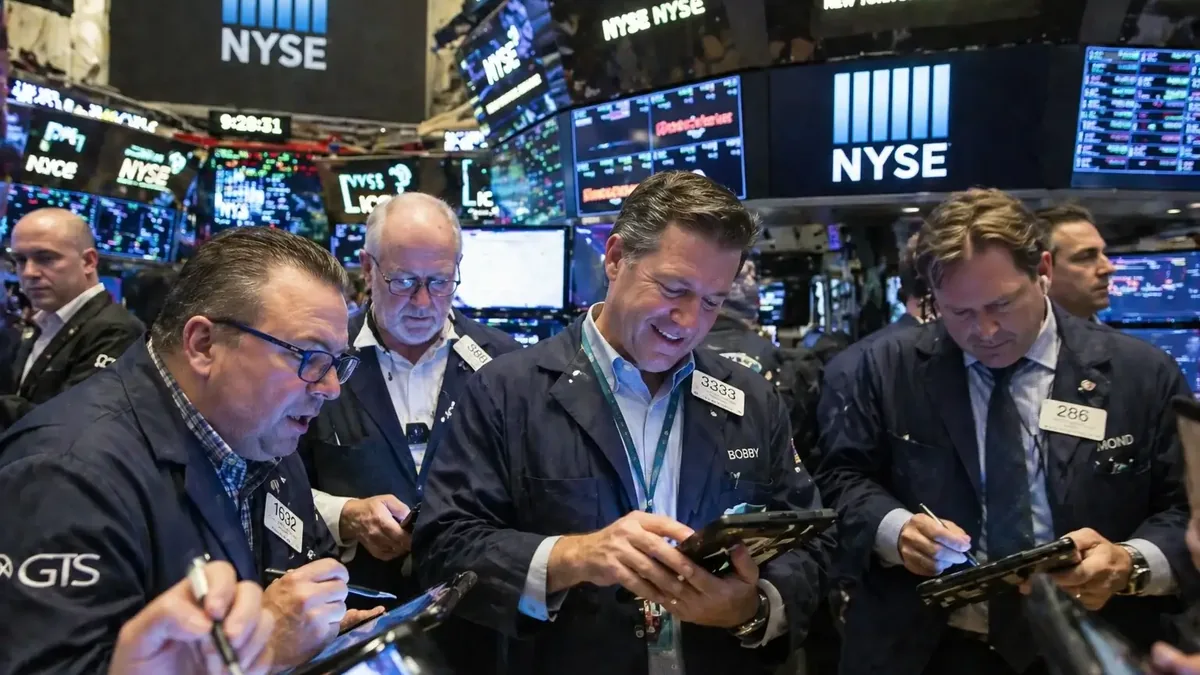
Stock Market Today: S&P 500 (SPX), Nasdaq (COMP) Tumble as OpenAI Stumble Crushes NVDA, ORCL; Dow (DJIA) Holds Flat on KO Surge
Chip stocks crater as OpenAI revenue concerns shake AI complex | That's TradingNEWS
Key Points
- Nasdaq (COMP) sinks 1.30% to 24,562 as OpenAI miss hammers NVDA -3%, ORCL -4%, AMD -4.6%, AVGO -4.2%
- Dow (DJIA) flat at 49,159 as Coca-Cola (KO) jumps 5.9% on earnings beat; GM rallies on guidance hike
- Brent crude tops $111, WTI above $100 after UAE exits OPEC May 1; gold drops 2.6% to $4,572
The melt-up that carried the S&P 500 (SPX) and the Nasdaq Composite (COMP) to fresh all-time closing highs on Monday hit a wall on Tuesday, with risk appetite crumbling under the weight of two distinct shocks: a Wall Street Journal scoop revealing that OpenAI is tracking behind its own internal revenue and user-growth targets, and a fresh leg higher in crude oil after Tehran's offer on the Strait of Hormuz failed to thaw negotiations with the White House. The S&P 500 dropped roughly 0.73% to 7,121.46, surrendering 52.45 points, while the tech-heavy Nasdaq slid 1.30% to 24,562.86, shedding 324.24 points. The Dow Jones Industrial Average (DJIA) clung to flat ground at 49,159.13, propped up almost single-handedly by Coca-Cola's (KO) earnings beat, and the Russell 2000 (RUT) gave back 1.29% to 2,752.22. The CBOE Volatility Index (VIX) reasserted itself with a 3.00% jump to 18.56, a clean signal that the dispersion under the index surface is widening fast.
The OpenAI Domino: Why a Private Company's Numbers Are Reordering Public Tech
The session's defining catalyst originated outside the equity market entirely. According to the Journal's reporting, OpenAI has trailed its own internal benchmarks for both top-line growth and weekly active users on ChatGPT, falling short of an aspirational year-end goal of 1 billion weekly active users. CFO Sarah Friar reportedly told leadership she is concerned the company may be unable to honor future computing contracts if revenue acceleration does not materialize, against a fiscal-year cash burn pegged at $25 billion. Sam Altman and Friar pushed back publicly with a joint statement to Reuters declaring they are "totally aligned" on continuing to acquire compute aggressively, but the damage to sentiment was already done. Equally telling: OpenAI's share of generative-AI web traffic reportedly slipped to 64.5% in January from north of 80% a year earlier, with Alphabet's Gemini and Anthropic's Claude eating market share in the coding and enterprise verticals where margins are richest.
That single thread reverberated through every public name tied into OpenAI's $600 billion-plus data-center commitment ecosystem. Oracle (ORCL), which holds a five-year, $300 billion compute supply contract with OpenAI, was the most punished name in the S&P 500's mega-cap tech cohort, slipping roughly 4.04% to $165.97 after dropping as much as 7.5% in the premarket. Coreweave (CRWV), a leveraged neocloud levered directly to hyperscaler AI demand, fell about 7.51%. SoftBank Group (SFTBY), one of OpenAI's anchor investors, was eviscerated overnight in Tokyo, ending down 11.05% at $15.94 in U.S. trading.
Semiconductors Snap Their Streak: SOX Surrenders Record Run
The PHLX Semiconductor Index (SOX) lost 4.85% to 9,902.81, a 505.23-point one-day drawdown that effectively closes the door on the index's record 18-session winning streak. The iShares Semiconductor ETF (SOXX) sympathized lower by 4.88% to $433.18. Nvidia (NVDA), which crossed the $5 trillion market-capitalization threshold during Monday's session, retraced 2.96% to $210.19. Broadcom (AVGO) was hit harder, off 4.25% at $400.43. Advanced Micro Devices (AMD) gave back 4.64% to $319.11 after bleeding as much as 6% premarket. Marvell Technology (MRVL) shed 4.39% to $151.27, while Qualcomm (QCOM) — boosted Monday on reports of a smartphone-chip collaboration with OpenAI on hardware ambitions — gave back roughly 3.5%. Intel (INTC) lost about 4%. Arm Holdings (ARM) was the marquee unwinder, sinking 8.73% to $197.04 in a textbook profit-taking move; the British chip designer had run more than 50% off its early-April lows, and Tuesday's downdraft erased a hefty slug of that gain in a single tape.
The takeaway is structural rather than cosmetic. When OpenAI accounts for a meaningful slice of forward bookings across Oracle's cloud business, Nvidia's GPU shipments, Broadcom's custom silicon orders, and AMD's MI-series accelerator pipeline, any wobble in the customer's ability to fund those commitments propagates straight into multiples that are stretched on the assumption of indefinite straight-line capex growth. The names are not broken — Nvidia's data-center revenue and AMD's accelerator share gains are real — but the disclosure is a reminder that the demand side of this trade is concentrated in a handful of customers who are themselves still pre-profit at scale.
Oracle (ORCL): Concentration Risk Is the Story
The $300 billion OpenAI contract is the asset and the liability simultaneously. Oracle's transformation from a legacy database vendor into a hyperscaler-adjacent AI infrastructure provider has been the single biggest re-rating story in enterprise software over the past eighteen months. But the spread between Oracle's contracted revenue with OpenAI and OpenAI's actual ability to generate the operating cash flow to honor those payments is the only number that matters now. With shares at $165.97 and the stock having delivered a 7%+ premarket gap that partially closed during the regular session, the risk-reward has flipped decisively neutral. Stance: hold. Aggressive longs need to see OpenAI either accelerate enterprise monetization or secure additional primary capital before justifying fresh entries; aggressive shorts are betting against a contract that does not unwind cleanly given the strategic interlock with U.S. AI leadership ambitions.
Coca-Cola (KO): The Dow's Lone Hero in a Defensive Rotation
Coca-Cola was the standout performer in the Dow, climbing 5.93% to $79.92 on its largest single-session gain since November 2020. Adjusted EPS landed at 86 cents versus the 81-cent LSEG consensus, and revenue of $12.47 billion topped the $12.24 billion expected. The S&P 500 Consumer Staples sector index (XX:SP500.30) gained 1.18% to 941.07, and the Energy sector index (XX:SP500.10) rose 1.62% to 881.92, while the Information Technology sector (XX:SP500.45) tumbled 1.94% to 6,045.43 — a near-3-percentage-point performance gap between staples and tech that captures the day's defensive rotation in a single ratio. Other Dow components also caught a defensive bid, with UnitedHealth (UNH) up 2.34% to $362.98, Travelers (TRV) gaining 2.23% to $310.52, and Johnson & Johnson (JNJ) climbing 2.47% to $230.90. Stance on KO: buy on any pullback to the $77–$78 zone. Pricing power, international volume mix, and the durability of the operating model into a stagflation-tinged macro all argue for ownership while tech multiples digest.
General Motors (GM): A Rare Cyclical Beat That Stuck
General Motors detonated estimates with adjusted EPS of $3.70 against the LSEG consensus of $2.62, a 41% beat. Management raised 2026 EBITDA guidance to $13.5–$15.5 billion, an increase of $500 million from the prior outlook. Shares ran roughly 4–5% higher in early trade before fading with the broader cyclical tape, last printing $76.01, off 2.50% from the previous close in the late-morning print as industrial weakness leaked across the sector. The S&P 500 Industrials sector closed at 1,437.06, down 1.58% — its worst showing since March 30, the S&P 500's low-water mark since the Iran war began. Pentair (PNR) was the worst sector laggard, falling more than 8% after issuing soft Q2 guidance. Stance on GM: buy. The combination of guidance raise, EPS beat of that magnitude, and the fact that the stock initially gapped higher before macro pressure compressed the gain is exactly the setup that rewards patience after consolidation.
Energy and the UAE Fault Line in OPEC
WTI June futures (CL00) jumped 4.09% to $100.31 per barrel, with the contract briefly trading above $99.90 on a 3.5% intraday move. Brent for June delivery (BRNM26) gained 3.26% to $111.76, having pierced $110 again as Iranian de-escalation hopes deflated. Front-month Brent for July delivery printed above $105 as well, more than 3.5% higher. The catalyst stack was layered: the United Arab Emirates announced it will exit OPEC effective May 1, in a statement framed as a national-interest decision following a comprehensive review of its production policy and capacity. The UAE was OPEC's third-largest producer in February behind Saudi Arabia and Iraq and joined the cartel in 1967, seven years after its founding. Rystad Energy's head of geopolitical analysis Jorge León flagged that alongside Saudi Arabia, the UAE is one of the few members with meaningful spare capacity, the very mechanism through which OPEC exerts market influence. The departure raises legitimate questions about whether the cartel can continue to function as a coordinated supply manager.
President Trump canceled the planned dispatch of envoy Steve Witkoff and Jared Kushner to Pakistan over the weekend, with the Truth Social messaging pivoting to phone-based negotiations. Iranian Foreign Ministry spokesperson Esmaeil Baqaei stated no meetings are currently planned between Tehran and Washington. Iran's offer to reopen the Strait of Hormuz contingent on the U.S. lifting its naval blockade and ending the war was discussed by Trump and his national-security team, but the linkage to postponed nuclear concessions is reportedly the sticking point. AAA gasoline prices hit $4.18 per gallon, a fresh wartime high, having risen $1.19 since the war began on February 28. Citigroup raised its Q2 Brent forecast to $110/bbl from $95/bbl and warned a sustained Strait disruption could push the average to $130/bbl in Q2.
BP and the European Tape
The Stoxx Europe 600 index closed off the day's best, slipping 0.49% to 605.85 after spending stretches of the morning in positive territory. The CAC 40 lost 0.52% to 8,099.25, the DAX gave back 0.32% to 24,006.45, and the FTSE 100 dipped 0.17% to 10,303.40. The FTSE MIB bucked the trend, climbing 0.58% to 47,948.27, and Spain's IBEX 35 added 0.38% to 17,759.40. Oil and gas equities led European sector gains with a 1.8% advance, while bank stocks rose more than 1.1% ahead of a regional earnings cluster. BP printed a sharp first-quarter profit jump, with management characterizing the oil-trading desk's performance as "exceptional" — a direct beneficiary of the volatility regime crude has settled into post-February. Novartis and Barclays also reported. The U.K. 10-year gilt yield climbed back above 5%, on track for its highest closing level since 2008, with resurgent inflation and political uncertainty around Prime Minister Keir Starmer weighing on sterling.
Apple (AAPL) Setup Into Thursday's Print
UBS's David Vogt raised the firm's Apple price target to $287 from $280, implying roughly 7.2% upside from Monday's close, citing supply-chain strength and sustained demand share gains for the iPhone 17 series that should drive iPhone revenue up approximately 20% year-on-year despite the ongoing memory-component supply crunch. Shares were last at $271.37, up 1.41% on the day, a notable outperformance versus the broader Mag 7 cohort given the tech complex was selling off hard. Stance: buy ahead of the print, with the recognition that the iPhone unit cycle is still tracking in upgrade territory and Services margin expansion remains a credible second leg.
Magnificent Seven Earnings Gauntlet: Wednesday and Thursday
Five of the seven mega-cap titans report this week. Alphabet (GOOG, last $348.89), Amazon (AMZN, $259.87), Meta Platforms (META, $668.94), and Microsoft (MSFT, $425.15) all print Wednesday after the bell. Apple lands Thursday. The setup is unforgiving. Meta's Q1 revenue is expected to land near $55.6 billion, a 31% year-on-year jump, but the bigger question for the call is the commercial monetization path for Muse Spark, Meta's first closed-source AI model, which moves the company decisively away from its open-source posture toward direct competition with OpenAI's GPT and Google's Gemini in paid services. Capex guidance is projected at $135 billion, which alongside the recent 10% workforce reduction and the $14.3 billion Scale AI investment plus the hiring of former GitHub CEO Nat Friedman, sets a high bar for return-on-invested-capital narratives that need to translate into ad-revenue automation and creative-tool monetization.
Read More
-
Yen Stalls at 160 Despite a 3% JGB and Tokyo Core CPI at 2.0% — Intervention Sits at 164, Friday's Payrolls Decide
02.09.2026 · TradingNEWS ArchiveEnergy
-
CHAT Fund Holds $96.37 as Korean Memory and Chip Exposure Drive a 109.73% Year — Break of $98.02 Opens $105.20
18.09.2026 · TradingNEWS ArchiveStocks
-
First-Generation XRPR and XRPI Ride XRP's Rebound to $1.386 as Spot Funds Post First Outflow — Break of $1.40 Opens $1.54
18.09.2026 · TradingNEWS ArchiveCrypto
-
NG Holds $2.9255 as Storage Surplus Narrows From 5.5% to 3.7% in 3 Weeks — Break of $3.00 Opens $3.15
18.09.2026 · TradingNEWS ArchiveCommodities
-
Dollar Surges to 157.90 as BoJ's Divided Hike Fails to Lift the Yen — Break of 158.87 Opens 159
18.09.2026 · TradingNEWS ArchiveForex
UPS (UPS) and the Logistics Read-Through
UPS posted adjusted EPS of $1.07 on revenue of $21.2 billion, beating the LSEG consensus of $1.02 EPS on $20.99 billion in revenue. Yet the stock fell 4.85% to $102.99 as investors looked through the headline beat and focused on the 2.3% dip in U.S. domestic volume. CEO Carol Tomé characterized the quarter as a "critical transition," reaffirming the full-year 2026 revenue target of $89.7 billion. The cost-take-out program harvested $600 million in the quarter and remains on pace to cut $3 billion from the cost base by year-end. Stance: hold. The cost program is real, but the demand signal is the larger concern, and a logistics name that cannot grow domestic parcel volume in a consumer environment showing nominal resilience is telling investors something about real activity.
Spotify (SPOT): When Subscriber Math Stops Working
Spotify was the day's most violent earnings move in the large-cap streaming complex, falling 11.40% to $439.30 after Q2 premium-subscriber growth guidance came in below analyst expectations and ad-supported revenue declined 5% year-on-year. Headline revenue grew 10% year-on-year, in line with company guidance, with subscriber growth of 9%. The market's read: a recent price increase is starting to bite at the user-acquisition margin, and the engagement levers from the AI personalization beta and mobile free-tier enhancements are not yet large enough to plug the deceleration. Stance: hold, leaning sell on any bounce. The compounding case for SPOT was always that premium ARPU and ad revenue would inflect simultaneously; the Q2 print decouples those two stories.
The Memory Supercycle: Micron (MU) and SanDisk (SNDK)
Even on a broadly negative tape, the memory complex's structural setup remains the most asymmetric story in semis. Micron (MU) trades at $495.25, off 5.59% on the day's risk-off positioning, with market capitalization closing in on $600 billion. SanDisk (SNDK) sits at $999.11, down 6.64%, but is up roughly 3,190% over the trailing twelve months — a number that captures just how violently this complex has been re-rated. Melius Research's Ben Reitzes upgraded Micron Monday, citing the "unusual durability" of AI-driven demand that could carry the cycle through 2030. The dynamic is straightforward: hyperscalers and chip designers like Broadcom (AVGO) are abandoning quarterly purchasing in favor of five-year supply agreements to lock in 2028 HBM and enterprise NAND allocations. The consumer cost is the kicker — analysts are pointing to 17% PC price inflation this year, with SSD prices already triple December 2025 levels as Samsung and SK Hynix prioritize high-margin HBM for AI over commodity DRAM and NAND. Stance on MU: buy on any pullback to the $470–$480 zone. Stance on SNDK: hold; the stock is structurally well-positioned but the run is parabolic and the entry is no longer favorable.
Bitcoin (BTC), MSTR, and the Crypto Tape
Bitcoin hit a 12-week high of $79,488 on Monday on the early read of Iran's Strait of Hormuz proposal before retreating to roughly $77,000 as Trump's skepticism leaked. By Tuesday's late morning the token was at $75,807, off 2.95% on the session and 3.0% on a 24-hour basis. The structural bid remains real — spot Bitcoin ETF inflows are pacing for $5 billion in April, double the March pace. Strategy (MSTR), Michael Saylor's vehicle, has bought $4.1 billion in Bitcoin in April including a $255 million purchase last week funded by common stock issuance, taking the corporate treasury holding to 818,334 BTC valued at over $63 billion — surpassing BlackRock's (BLK) client holdings on the spot ETF. MSTR shares last printed $162.49, off 3.97%. The $80,000 level is the technical battleground, and BTC Markets' Rachael Lucas flagged that level as a critical psychological zone where many recent buyers approach breakeven, generating predictable profit-taking pressure. Stance on BTC exposure: hold. Stance on MSTR: hold; the stock's leverage to BTC works both ways and the equity-funded BTC purchases are dilutive in a sideways tape.
Bond Market and the Fed Calculus
The U.S. 10-year Treasury yield (BX:TMUBMUSD10Y) climbed 6.7 basis points to 4.374%, with bonds losing ground on the inflation passthrough from oil. The Dollar Index (DXY) added 0.25% to 98.74. Senator Thom Tillis (R., N.C.) told reporters Monday night that there is a rational basis for Fed Chair Jerome Powell to remain on the central bank's board for a period after his term as chair expires May 15, allowing the Fed construction-project inspector general review and the DOJ appeal of a federal judge's ruling against the probe's subpoenas to proceed. The political layer matters because the Powell succession question is the dominant bond-market risk premium right now, and any signal of orderly transition versus contested transition flows directly into the term premium on the long end. Gold (GC00) tumbled 2.58% to $4,572.80 on the rate move, even as oil-driven inflation expectations theoretically argue for support — a sign that the dollar bid is dominating.
Industrials and the Real-Activity Question
The Industrials sector's 1.5% decline to 1,437.06 was the worst since March 30, the broader S&P 500's low since the Iran war kicked off. Pentair's 8% slide on weak Q2 guidance is a single data point, but the sector's path lower carries information. Industrials had outperformed in recent sessions on a reflation read; Tuesday's reversal suggests positioning is rotating out of cyclicals as the oil shock starts to look more like a margin compressor than a top-line catalyst.
Asia Closes Lower: Nikkei Pulls Back from Record
Japan's Nikkei 225 closed down 1.02% at 59,917.46, a clean reversal from Monday's record. The Topix bucked the trend, gaining 0.99% to 3,772.19. The Bank of Japan held its policy rate at 0.75% in a 6-3 split decision, with three dissenting members proposing a hike to 1.00% on the view that Iran-war supply-side risks have skewed price risks to the upside. The BOJ cut its FY2026 growth forecast to 0.5% from 1.0% and raised its core inflation outlook sharply to 2.8% from 1.9%, materially above the 2.0% target. South Korea's Kospi added 0.39% to 6,641.02 while the Kosdaq lost 0.86% to 1,215.58. Australia's S&P/ASX 200 fell 0.64% to 8,710.7. Hong Kong's Hang Seng lost 0.95% to 25,679.78 and mainland China's CSI 300 dropped 0.27% to 4,758.21. India's Nifty 50 declined 0.40% to 23,995.70.
Consumer Confidence Holds the Line
The Conference Board's Consumer Confidence Index rose to 92.8 in April, beating economist forecasts, with March revised slightly higher. Conference Board Chief Economist Dana Peterson flagged that confidence edged up despite material concern about rising gasoline prices following the Brent crude surge tied to the Middle East war. The print is a counterweight to the bearish industrial signal: at the household level, the consumer is still functioning, even if logistics names like UPS are signaling cooler underlying parcel volumes.
After-Hours Movers from Monday's Late Tape
LendingClub (LC) jumped nearly 14% in extended trading Monday after Q1 results topped estimates. Nucor (NUE) added more than 3% on Q1 EPS of $3.23 versus the $2.82 LSEG consensus. Bed Bath & Beyond surged 28% on Q1 revenue of $247.8 million, beating the $240.1 million FactSet estimate.
The AI Talent Migration That Matters
Independent of the OpenAI revenue concerns, the structural setup at Meta (META) and Alphabet (GOOG) is being shaped by an aggressive talent exodus. Former Google DeepMind star David Silver secured a $1.1 billion seed round for a startup called Ineffable Intelligence. Former Meta AI chief Yann LeCun's AMI Labs closed a $1 billion raise. The flow of senior architects out of trillion-dollar incumbents into independent labs that can offer equity upside the giants cannot match is the longer-run question that does not show up in any single quarter's print but shapes the multi-year frontier-model landscape. Architectural arbitrage — startups exploring non-transformer designs that Meta and Google have deprioritized — is where private capital is flowing.
Earnings Calendar: Tuesday's Post-Close Gauntlet
Visa (V), T-Mobile US (TMUS), Booking Holdings (BKNG), Robinhood (HOOD), Starbucks (SBUX), Caesars Entertainment (CZR), CoStar (CSGP), Enphase Energy (ENPH), NXP Semiconductors (NXPI), and Waste Management (WM) all report after Tuesday's close. The Visa print in particular is the tape's clearest read on consumer-spending velocity post-oil-shock, and Robinhood will deliver the cleanest sample on retail risk appetite after a quarter in which speculative options volume spiked to one of the most aggressive levels in market history per Macro Charts data flagged in the Daily Chartbook.
Other Standouts on the Tape
Sherwin-Williams (SHW) opened higher but sold off with the cyclicals to $330.78, off 1.58%. Incyte (INCY) was effectively flat at $96.10 after a clean beat with Q1 adjusted EPS of $1.81 on revenue of $1.27 billion, with flagship Jakafi up 7% to $757.8 million but Opzelura missing despite 20% year-on-year growth; the company reaffirmed full-year revenue guidance at $4.77–$4.94 billion and named Suketu Upadhyay as new CFO from Zimmer Biomet (ZBH) and Bristol Myers Squibb (BMY). Zimmer Biomet itself was hammered 7.70% to $85.46 on the executive departure and standalone concerns. Palantir (PLTR) was off 1.18% to $141.41, continuing a choppy April after its run.
The Cross-Asset Synthesis and the Trade
The day's tape can be reduced to a single thesis: the AI capex narrative is being stress-tested for the first time at the customer level rather than at the supplier level, and the equity market is demanding to see the demand-side cash flows that justify $600 billion in committed compute infrastructure over the next several years. Until Wednesday's Alphabet, Amazon, Meta, and Microsoft prints provide hard datapoints on Azure, AWS, and GCP AI revenue runs, and until Apple delivers the iPhone unit-cycle confirmation on Thursday, the path of least resistance for the Nasdaq is sideways-to-lower with elevated single-name dispersion. The defensive rotation showing up in Coca-Cola, UnitedHealth, and the broader staples and energy sectors is the textbook playbook in this environment.
The actionable conclusions: buy Coca-Cola (KO) on dips into the high $77s as the defensive bid extends, buy General Motors (GM) on the guidance raise and 41% EPS beat against a depressed sentiment backdrop, buy Apple (AAPL) ahead of the Thursday print with the iPhone cycle and Services margins both still constructive, and buy Micron (MU) on memory-supercycle structural demand into any pullback toward $470. Hold Nvidia (NVDA), Broadcom (AVGO), and Oracle (ORCL) — the long-term theses are intact but the near-term setup demands proof points that only earnings season can deliver, and the customer-concentration risk via OpenAI is the new variable that needs to be reweighted into models. Hold Spotify (SPOT) leaning sell into bounces given the subscriber-growth deceleration, and hold UPS (UPS) given the volume signal underneath the EPS beat. The bullish secular thesis on AI infrastructure has not been broken by Tuesday's reporting; the marginal bull on Tuesday morning needed to be reminded that customer health is a real-time variable, not a permanent assumption. The bearish trade is to lean into Oracle and the AI-infrastructure-only names where revenue is concentrated in one or two pre-profit customers; the bullish trade is to use the dispersion to add quality at better prices in Apple, Coca-Cola, GM, and Micron. Overall posture: cautiously bullish on selective quality, bearish on concentration-risk infrastructure plays until the Wednesday and Thursday prints rewrite the picture.