TSMC Stock Price Forecast: TSM $367 AI Foundry King Targets $467 on 66.2% Margins and 3nm Dominance
Q1 revenue surges 40.6% to $35.9B with net income up 58% y/y; Q2 guide implies $39-$40.2B | That's TradingNEWS
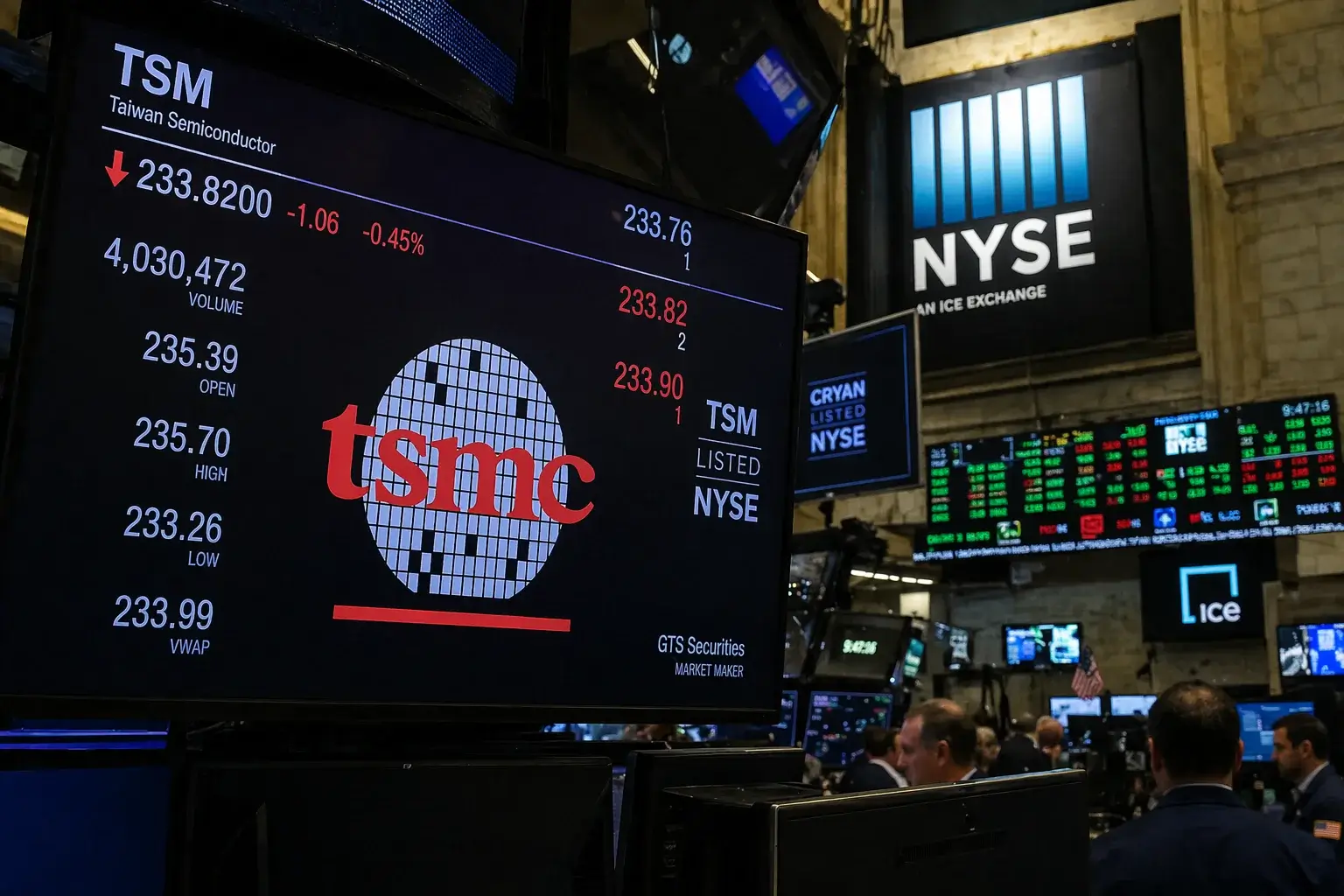
Taiwan Semiconductor Manufacturing (NYSE:TSM) is trading at $367.11, up 0.24% on the session, with a market capitalization that has now swelled to roughly $1.67 trillion — and the operating fundamentals underneath that valuation are getting stronger, not weaker, even as the stock has already delivered a 144% advance over the past twelve months. The fiscal first-quarter print delivered at the start of April crushed the top and bottom lines, guided the June quarter into double-digit sequential expansion territory, and reinforced a structural thesis that places TSMC at the absolute center of the artificial intelligence hardware buildout. With revenues compounding at over 35% year-over-year, gross margins hitting 66.2%, and operating margins clearing 58%, the foundry is no longer behaving like a cyclical semiconductor company — it is trading like an industrial monopoly with software-grade profitability, and the market has yet to fully reprice it accordingly.
Q1 2026 Results: $35.9 Billion in Revenue and Margins That Don't Belong to a Foundry
The Q1 print was an unambiguous beat across every single line that matters. Revenue came in at $35.9 billion, up 40.6% on a dollar basis and 35.1% in NT dollar terms — versus consensus estimates that the company exceeded by more than $400 million. Net income landed at $18.13 billion, a stunning 58% year-over-year increase, while diluted earnings per share printed at $3.49 — also up 58% y/y and ahead of analyst expectations by $0.16. Gross profit reached $23.7 billion (+52.3% y/y), operating income hit $20.3 billion (+61.9% y/y), pre-tax income reached $21.77 billion (+59.6% y/y), and cash flow from operations climbed to $22.15 billion (+17% y/y).
The margin structure is where the real story lives. The 66.2% gross margin expanded 7.4 percentage points year-over-year and 3.9 points sequentially — and beat the top end of prior guidance by 120 basis points. The 58.1% operating margin climbed 9.6 points y/y and 4.1 points sequentially. The 50.5% net margin is something investors typically associate with branded software companies, not capital-intensive chip manufacturers running billion-dollar fabs. Return on equity hit 40.5%. Equivalent wafer shipments grew 5.4% sequentially and 28.1% year-over-year, confirming that revenue is expanding on both unit volume and meaningfully improved product mix rather than simple price inflation.
The 3nm Node Is Now 34% of Advanced Revenue — That's the Margin Engine
Here is where the operational detail becomes investment-critical. Within the 7nm-and-below bucket — which accounts for 74% of total wafer revenue — the node distribution has shifted aggressively toward the leading edge. The 7nm share compressed to 17% from 20% last quarter, the 5nm node dropped to 49% from 52%, and 3nm sales surged to 34% of the advanced-node category. On a total-revenue basis, 3nm now represents 25% of wafer revenue. This matters enormously because management has explicitly guided that 3nm gross margins will cross the corporate average in the second half of 2026 — meaning what has been a margin headwind during ramp-up is about to flip into a margin tailwind right as capacity continues to expand. The full wafer breakdown shows 3nm at 25%, 5nm at 36%, 7nm at 13%, 16/20nm at 7%, 28nm at 7%, 40/45nm at 3%, 65nm at 4%, 90nm at 1%, 0.11/0.13um at 1%, 0.15/0.18um at 2%, and 0.25um-plus at 1%. Leading edge (7nm or below) revenue has climbed to an NT$780 billion quarterly run-rate — more than double the NT$340 billion pace of Q1 2024.
Q2 Guidance: $39-$40.2 Billion in Revenue Implies +32% y/y at the Midpoint
Management's guide for the second quarter is aggressive and confident. Revenue is projected between $39 billion and $40.2 billion, which translates to sequential growth of 8.6% to 12% — with the midpoint at 10.3% — and year-over-year expansion of roughly 32% at the midpoint on a 1 USD = 31.7 NTD FX assumption. Gross margin is guided between 65.5% and 67.5%, with operating margin between 56.5% and 58.5%. Those are extraordinary numbers for a business of this scale operating in this capital intensity class. Full-year 2026 capital expenditure guidance has been revised to the high end of the $52-56 billion range, reinforcing that management is not just responding to demand — it is committing the capital to meet it structurally. FY2026 revenue growth is expected to clear 30%.
The Platform Mix Tells You Exactly Where the Money Is Coming From
High-performance computing now represents 61% of Q1 revenue, smartphones 28%, Internet of Things 6%, automotive 4%, digital consumer electronics 1%, and other 2%. The sequential growth trajectories show precisely where AI demand is hitting: HPC +20%, digital consumer electronics +28%, other +17%, IoT +12% — while smartphones declined 11% on normal seasonality combined with elevated memory pricing, and automotive fell 7%. HPC is compounding at high-40s year-over-year growth, which is the clearest possible signal that the AI capital expenditure cycle running through Nvidia's Blackwell, AMD's MI350, Apple's A19, Broadcom's custom ASICs, and every major hyperscaler's silicon is driving structural demand that cannot be replicated anywhere else in the industry.
N2 Ramp and the Capacity Expansion Pipeline
The 2nm node entered high-volume manufacturing in Q4 2025 with yields that management described as "good" on the Q1 earnings call. N2 is now ramping in multi-phase fashion across both the Hsinchu and Kaohsiung facilities, with demand confirmed from both smartphone and HPC AI customers. Capacity through 2026 is already oversubscribed. Management expects N2 to become "another large and long-lasting node," while A16 (1.6nm) is scheduled to follow in 2027. The fab pipeline is equally aggressive: a new N3 fab in Tainan coming online in H1 2027, the Arizona Fab 2 running 3nm production in H2 2027, and the Japan Fab 2 scheduled for 2028. The Arizona Fab 21 is currently ramping 4nm with 3nm due in 2027 and 2nm committed for 2028. Japan and Germany fabs are under construction.
Importantly, management flagged two explicit margin headwinds during the Q1 call. First, the 2nm ramp is expected to dilute 2026 full-year gross margin by 2-3 percentage points, with the dilution beginning in the second half. Second, overseas fab ramp-ups in Arizona, Japan, and Germany are guided to dilute gross margin by another 2-3 percentage points in early stages — widening to 3-4 percentage points in later stages over the coming years. Offsetting these pressures: the N3 node crossing the corporate gross margin average in H2 2026. Management's long-term through-cycle gross margin target remains +56% with ROE in the high-20s — and current performance is running dramatically above those targets.
Valuation: TSM Trades at 23.82x Forward Earnings vs Peer Group at 32.14x
Here is where the dislocation becomes impossible to ignore. TSM is trading at a forward P/E of 23.82x against a semiconductor sector median of 32.14x — a 25.8% valuation discount. Forward EV/EBITDA sits at 13.43x versus the sector's 14.05x, forward EV/EBIT at 16.97x, and the PEG ratio at 0.88 against a sector median of 1.46. Against specific peers, the gap is even more pronounced: Nvidia (NVDA) trades at 24.19x forward, Broadcom (AVGO) at 34.89x, Applied Materials (AMAT) at 35.35x, ASML Holding (ASML) at 40.08x, and Intel (INTC) at an extraordinary 123.21x forward. TSM at 23.56x is the cheapest leading-edge semiconductor in the public market by a substantial margin. Against the broader market, the comparison is slightly richer — the S&P 500 trades around 27x earnings and the NASDAQ-100 at 30x earnings — but when adjusted for growth, TSM's PEG of 0.88 prices the stock at roughly half the sector growth-adjusted multiple.
Running a discounted cash flow model on current metrics produces an even more compelling picture. TTM EPS sits at $12.04, and if 32% y/y growth holds through the next twelve months before settling to 5% annualized beyond that, applying a 7.5% discount rate produces a fair value of approximately $543 per share — composed of $529 in discounted terminal value plus $14.48 in next-year discounted cash flows. That implies 47% upside to the current $367 quote. A separate valuation approach using the three-year median EV/EBITDA multiple produces a $467.34 target, which implies roughly 26% upside. Both frameworks converge on the same directional conclusion: this stock is mispriced.
Revisions Grade A: Consensus EPS for Dec 2026 Has Jumped from $9.56 to $15.54
The earnings revisions metric is telling the cleanest story of any factor grade. Analyst consensus EPS for December 2026 has climbed from $9.56 to $15.54 over approximately 18 months — a +62.6% cumulative revision — and the six-month revision trend alone sits at +23.5%. December 2027 consensus is at $19.19 and December 2028 at $24.54, with the revision direction running one-way higher for 18 consecutive months. This is the single most important input professional analysts track, and on TSM the signal is overwhelmingly bullish. EBITDA estimates for 2026 and 2027 have been revised higher by 10.4% and 3.3% respectively. Revenue is now expected to grow at a 27% CAGR through 2028, with 29% EBITDA growth and 23% free cash flow growth over that same horizon.
Factor Grades: Profitability A+, Growth B+, Momentum B+, Valuation D
The Seeking Alpha Quant system paints a consistent picture across every factor except the valuation multiple. Profitability earns the rare A+ grade — gross margin at 61.9% (trailing twelve months), EBITDA margin at 69.6%, net margin at 46.5%, return on total capital at 21.7%, and return on total assets at 22.0%. Growth scores B+ with revenue growth y/y at 30.66%, forward revenue growth at 32.64%, EBITDA growth at 32.80%, and forward EPS growth at 39.60%. Momentum is B+ with 3-month performance at +8.21%, 6-month at +25.56%, 9-month at +50.86%, and 1-year at +144.17%. The valuation D is a pure sector-relative flag — in absolute terms, TSM is cheaper than the sector on every forward multiple that matters, which makes the D more of a sizing consideration than a reason to avoid the stock.
The Real Risk: Taiwan Strait Geopolitics
The one risk that cannot be dismissed is geopolitical. A Taiwan Strait contingency would take leading-edge supply offline for the entire global semiconductor industry — a binary outcome that is not fully priced into the current multiple. Beijing has no operational reason to move against Taiwan in the next 24 months, and Washington has been systematically raising the cost of that calculus. The mitigation is that TSMC is actively globalizing production capacity. Arizona's Fab 21 is already producing 4nm, with 3nm scheduled for 2027 and 2nm committed for 2028. Japan and Germany fabs are under construction. None of that fully replicates Taiwan's 2nm capacity in time to absorb a severe disruption, but it lowers the probability that a geopolitical shock zeroes the business. Customer concentration is a secondary consideration — Apple represents approximately 25% of revenue and Nvidia roughly 18% — but neither customer can diversify at the leading edge without effectively building a second TSMC, which they cannot do.
Competitive Landscape: Samsung Is Behind, Intel Is Bleeding Customers
The competitive moat is widening rather than narrowing. Samsung Foundry's 2nm yields remain well below TSMC's production-grade levels. Intel's 18A process is technically improving but faces capacity constraints and continues to lose customers — Broadcom and Nvidia have both committed their 2026 silicon to TSMC rather than hedging with Intel. Intel received $8 billion in CHIPS Act funding during the Biden administration specifically to build competitive foundry capacity, and that investment has not closed the gap in a way that matters to hyperscaler buyers. TSMC currently runs up to 90% market share in advanced chips. The supply-side pressure point for TSM comes from ASML — the only company making extreme ultraviolet lithography machines, with individual systems costing $400 million or more. Further ASML price increases represent a modest margin risk, but that dynamic cuts both ways since TSMC is ASML's largest customer by scale.
Balance Sheet: Net Cash Expanding Toward $190 Billion by 2028
The balance sheet reality is almost absurd for a business of this capital intensity. Despite aggressive capex — which is stepping up materially this year to $52-56 billion — the company is expected to grow its net cash position toward $190 billion on the balance sheet by 2028. That provides enormous strategic flexibility to continue extending the technology lead, absorb any geopolitical disruption in relative comfort, and even pursue share repurchases — though TSMC has never been particularly aggressive on buybacks historically. Leverage is effectively a non-issue. Free cash flow conversion on mature nodes runs at more than 40%, and as the 3nm node crosses corporate-average margins in H2 2026, the cash generation trajectory becomes even more powerful.
Read More
-
Yen Stalls at 160 Despite a 3% JGB and Tokyo Core CPI at 2.0% — Intervention Sits at 164, Friday's Payrolls Decide
02.09.2026 · TradingNEWS ArchiveEnergy
-
CHAT Fund Holds $96.37 as Korean Memory and Chip Exposure Drive a 109.73% Year — Break of $98.02 Opens $105.20
18.09.2026 · TradingNEWS ArchiveStocks
-
First-Generation XRPR and XRPI Ride XRP's Rebound to $1.386 as Spot Funds Post First Outflow — Break of $1.40 Opens $1.54
18.09.2026 · TradingNEWS ArchiveCrypto
-
NG Holds $2.9255 as Storage Surplus Narrows From 5.5% to 3.7% in 3 Weeks — Break of $3.00 Opens $3.15
18.09.2026 · TradingNEWS ArchiveCommodities
-
Dollar Surges to 157.90 as BoJ's Divided Hike Fails to Lift the Yen — Break of 158.87 Opens 159
18.09.2026 · TradingNEWS ArchiveForex
The Analyst Consensus: Wall Street Strong Buy, SA Buy, Quant Hold
Wall Street consensus rates TSM at Strong Buy with a composite score of 4.57. Seeking Alpha analyst consensus rates it Buy at 3.93. The Quant system has it at Hold at 3.49 — a rating driven almost entirely by the valuation D flag, since every other factor scores positively. The divergence between Wall Street's aggressive Strong Buy stance and the Quant's Hold reflects the core debate: is TSM cyclical and therefore deserving of a multiple closer to historical semiconductor averages, or is it an industrial monopoly that should trade at a structural premium? The operating data increasingly supports the monopoly framing.
Price Action Context: The Stock Is Up 144% in a Year Yet Still Cheap
The 144% one-year gain in NYSE:TSM tells you the market has been catching up to the fundamental reality — but the valuation compression relative to peers tells you it hasn't caught up enough. Shares rose 8.2% over the past month, meaningfully outpacing the S&P 500 (^GSPC) at 7,125 over that same window. Despite the strong Q1 print, the immediate post-earnings reaction was muted — shares actually declined 3% the session results dropped and then recovered roughly 1.97% the following day, netting to essentially a wash. That underwhelming response makes sense only if expectations were already elevated or if the preliminary revenue disclosure on April 10 had telegraphed most of the beat. Both explanations hold. The lack of aggressive post-earnings follow-through despite raised guidance and expanded margins means the stock became fundamentally cheaper rather than more expensive on an earnings-yield basis.
My TSM Call: Strong Buy with $467 Primary Target and $543 DCF Fair Value
NYSE:TSM at $367 is a Strong Buy with a 12-month price target of $467.34 on the EV/EBITDA multiple framework, and a DCF fair value of $543 implying up to 47% upside on a longer horizon. The investment case rests on five pillars that all point the same direction. First, TSMC owns the leading-edge foundry monopoly and that position is widening rather than contracting — the 2nm node is already oversubscribed through 2026 and customers cannot migrate elsewhere. Second, the AI capital expenditure cycle is structural rather than cyclical, with $700 billion in 2026 hyperscaler commitments and essentially every dollar of leading-edge AI silicon passing through TSM fabs. Third, operating leverage is visibly working — 66.2% gross margins, 58.1% operating margins, and 50.5% net margins are not foundry numbers, they are industrial monopoly numbers. Fourth, the 3nm node crossing corporate average margins in H2 2026 unlocks another leg of margin expansion precisely when the 2nm ramp begins creating the opposite pressure. Fifth, the stock trades at a 25.8% forward P/E discount to the semiconductor sector despite having the strongest growth profile, the cleanest competitive moat, and the best profitability metrics in the peer group.
The probability-weighted scenario distribution favors the upside meaningfully. Roughly 55% probability weight goes on the bull case — the stock grinds higher through 2026 as earnings revisions continue pushing consensus EPS toward $17-$18 and the multiple expands modestly, producing 25-35% returns over the next twelve months. Roughly 30% weight sits on the base case — range-bound consolidation between $360 and $420 as the market digests capex intensity and absorbs 2nm dilution concerns, producing 0-10% returns. The remaining 15% weight covers the downside scenario — a Taiwan geopolitical shock, a serious AI capex pullback, or an unexpected Intel 18A breakthrough that disrupts customer loyalty, producing 20-40% drawdowns.
The single most important variable over the next six months is the 3nm margin crossover. If management's H2 2026 timing proves accurate, consensus will be forced to mark up 2027 EPS aggressively, and the multiple discount will begin closing on its own through pure earnings growth. The geopolitical risk remains the tail event worth sizing for rather than being paralyzed by. Entry logic: buying at $367 with stops below $335 offers roughly 9% downside against $467-$543 upside targets — a reward-to-risk profile between 3-to-1 and 5-to-1 that is difficult to replicate elsewhere in large-cap technology. Apple's (AAPL) upcoming leadership transition under John Ternus on September 1 removes zero TSMC-specific risk since Apple cannot migrate its silicon production away from Taiwan in any meaningful timeframe. The Amazon-Anthropic deal worth up to $25 billion further reinforces the AI compute demand trajectory that underpins TSM's HPC-driven revenue expansion.
Bottom line: TSM is the single cleanest AI-infrastructure long in the public semiconductor universe, and it trades at a discount to companies that depend entirely on its fabs to produce their own silicon. That dynamic is mathematically unsustainable. Either the peer group compresses to TSM's multiple, or TSM expands to the peer group's multiple — and given that earnings revisions are running one-way higher and the operational moat is widening, the resolution almost certainly comes through TSM rerating upward rather than peers rerating downward. Position accordingly.