Stock Market Today: S&P 500 (SPX) Cracks 7,100, Dow (DJIA) Soars 1,019 Points, Nasdaq (IXIC) Hits Record as Iran Reopens Strait of Hormuz
DJIA jumps to 49,597, SPX hits 7,132, IXIC climbs to 24,473 as WTI crude crashes 12% to $82; Netflix (NFLX) sinks 9%, cruise stocks rip 9% | That's TradingNEWS
Key Points
- Dow (DJIA) jumps 1,019 to 49,597, S&P 500 (SPX) hits 7,132, Nasdaq (IXIC) at 24,473.
- Iran reopens Strait of Hormuz; WTI crude crashes 12% to $82, energy ETF (XLE) plunges 5.4% on supply relief.
- Netflix (NFLX) drops 9% on weak Q2 guide; cruise names RCL, NCLH, CCL surge 9% on fuel cost relief.
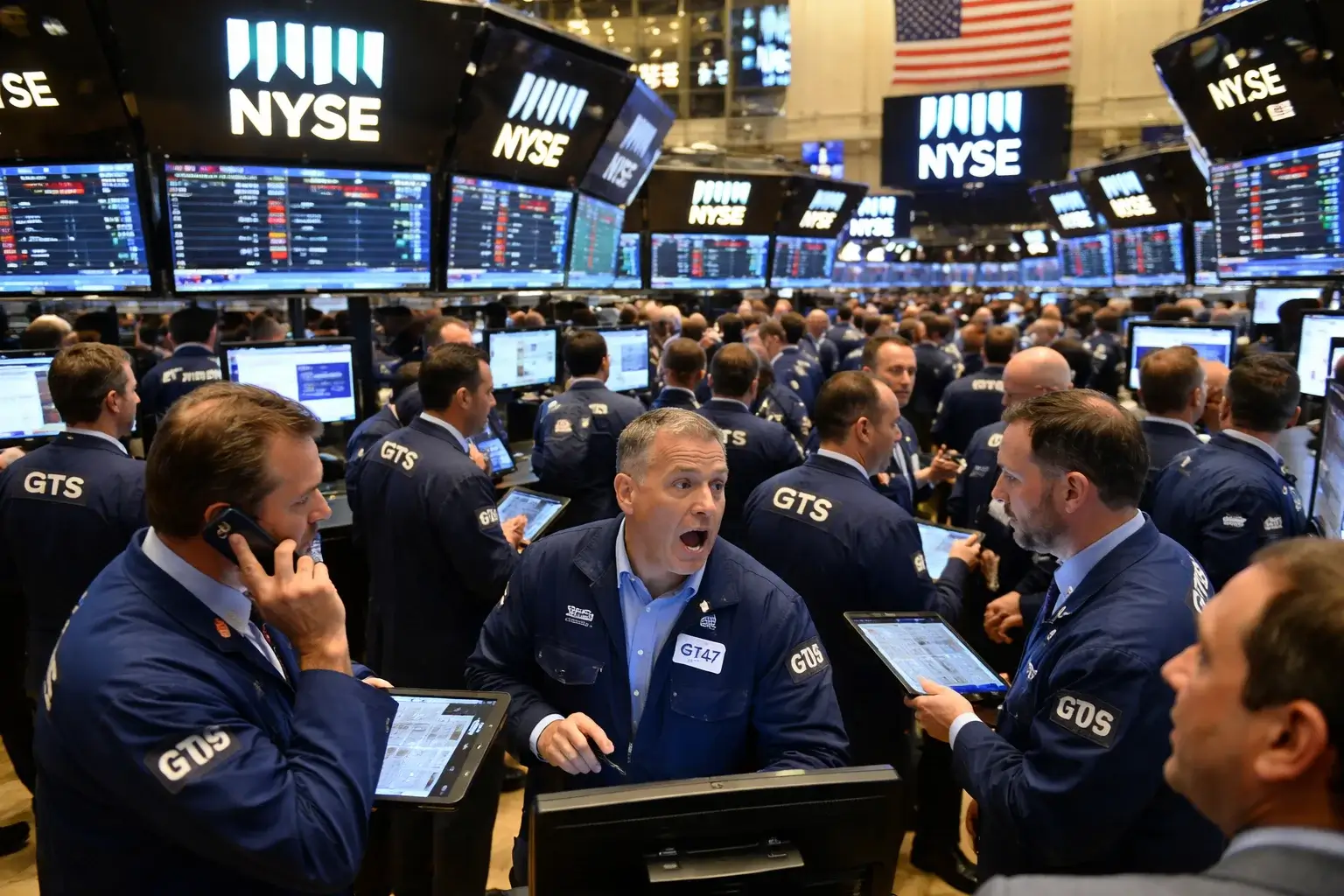
The risk-on machine throttled to its loudest setting of 2026 on Friday, with the headline benchmarks blowing through every prior ceiling after Iran formally reopened the Strait of Hormuz to commercial shipping for the duration of the Israel-Lebanon truce. The Dow Jones Industrial Average (DJIA) rocketed 1,019.05 points, or 2.10%, to 49,597.77, the most muscular single-session point advance the blue-chip gauge has produced since the April 2025 ceasefire move. The S&P 500 (SPX) cracked the 7,100 handle for the first time in its history, tacking on 91.04 points, or 1.29%, to 7,132.32 — a level no equity strategist on the Street had penciled in for the index when it was flirting with a near-correction in late March. The Nasdaq Composite (IXIC) ripped 1.54% to 24,473.31, locking in a 13-session winning streak that has no parallel since the post-crisis melt-up of July 2009. The Russell 2000 (RUT) finally joined the party with conviction, surging 2.13% to 2,777.53 — eclipsing the prior January 22 record of 2,735 and confirming that breadth is no longer the rally's Achilles heel. Volatility collapsed alongside the rally, with the VIX sliding 1.34% to 17.70, a print that screams complacency-meets-relief.
Hormuz Opens, Trump Pockets the Win, and the Geopolitical Premium Evaporates
The trigger landed at roughly 8 a.m. Eastern via a Telegram-style X post from Iranian Foreign Minister Seyed Abbas Araghchi, who declared that "the passage for all commercial vessels through Strait of Hormuz is declared completely open for the remaining period of ceasefire," with traffic routed through the corridor announced earlier by Iran's Ports and Maritime Organisation. The 10-day Israel-Lebanon ceasefire, which President Donald Trump confirmed went into force at 5 p.m. ET Thursday, has created the diplomatic oxygen Tehran needed to climb down from its naval brinkmanship. Trump posted to Truth Social shortly after the Iranian announcement with the line, "IRAN HAS JUST ANNOUNCED THAT THE STRAIT OF IRAN IS FULLY OPEN AND READY FOR FULL PASSAGE. THANK YOU!" — followed by a sterner reminder that the U.S. Navy's blockade of Iranian ports stays in force until a comprehensive peace deal is signed, though he insisted "MOST OF THE POINTS ARE ALREADY NEGOTIATED." Adding fuel to the de-escalation thesis, Axios reported that Washington is floating a $20 billion package in which frozen Iranian assets would be returned in exchange for the regime's enriched-uranium stockpile.
Crude Caves: WTI Slices Through $80, Energy Equities Take the Beating
Oil's reaction was the cleanest expression of the new geopolitical regime. May-dated West Texas Intermediate (CL) collapsed as much as 12.69% to $82.67 a barrel, with intraday prints visiting $80.64 — a brutal round-trip from $105.63 touched earlier in the week. June Brent (BZ) shed 11.80% to $87.66, also retracing a substantial chunk of the war premium that had been baked in since the conflict's flashpoints in March. The unwind in crude was a guillotine for energy equities. The Energy Select Sector SPDR (XLE) was sliced 5.43% to $53.51, the sector's most violent single-day loss since April 2025. The cross-asset signal here is unmistakable: the war premium is draining out of barrels and the peace dividend is being injected into equities, with the rotation arithmetic playing out in real time.
Cruise Names Rip, Boeing Reclaims Altitude — Consumer Discretionary Owns the Tape
The S&P 500 consumer discretionary sector led all 11 GICS groupings on Friday with a 2.50% gain, and the leadership inside the cohort was concentrated in the names most exposed to a functioning Hormuz. Royal Caribbean (RCL) detonated higher by roughly 9%, with Norwegian Cruise Line (NCLH) and Carnival (CCL) posting gains of similar magnitude as fuel-cost relief and reopened global itineraries reset earnings models overnight. Boeing (BA) climbed 4% on the same logic — restored long-haul travel demand and an easing of jet-fuel cost pressure for its airline customers. Amazon (AMZN) and Airbnb (ABNB) also caught durable bids as discretionary spending intentions firmed. The trade here writes itself: any name whose unit economics were squeezed by $100 crude or whose customer was deferring travel is being repriced higher.
Netflix Implodes 9% — Reed Hastings Exits, Q2 Guide Whiffs, $2.8 Billion Paramount Breakup Fee Masks the Truth
The session's most-watched single-stock train wreck belonged to Netflix (NFLX), which gapped down nearly 9% to $98.09 in early trade, marking what would be its worst session since October 22's 10.1% rout if losses hold into the close. The streamer's first-quarter print looked superficially clean — revenue of $12.25 billion topped the $12.18 billion LSEG consensus and grew 16% from the $10.54 billion booked a year earlier. Net income landed at $5.28 billion, or $1.23 a share, but that figure is not comparable to the Street's 76-cent estimate because it was distorted by a $2.8 billion termination fee paid by Paramount after Netflix walked away from the Warner Bros. Discovery acquisition. Strip the breakup payment out and the operational performance becomes a far more sober affair. The forward guide is what truly broke the stock: Q2 EPS of 78 cents undershot the 84-cent consensus, and the $12.57 billion revenue outlook missed the $12.63 billion analyst bar. Layer on the announcement that co-founder and Chairman Reed Hastings will exit the board in June when his term expires, and the market is being asked to underwrite a Netflix without its founder's guiding hand at exactly the moment the post-Warner strategic vacuum is widest. Spotify (SPOT) dropped 2% in sympathy. Call this one a sell into strength until management articulates a credible content-investment roadmap that doesn't lean on one-off windfalls.
Alcoa Misses on Both Lines, Affirm Gets a Morgan Stanley Hug, Uber Buys More Delivery Hero
Aluminum producer Alcoa (AA) sank 5.33% to $66.66 after delivering a double miss — adjusted EPS of $1.40 versus the $1.49 LSEG consensus, and revenue of $3.19 billion against the $3.28 billion expectation. The disappointment is particularly biting given the tailwind aluminum has enjoyed from tariff-driven price strength, and it suggests cost pressure inside the operating base is eating the top-line benefit. Stay on the sidelines until management proves the margin compression is transitory.
Affirm (AFRM) jumped between 3% and 6% intraday after Morgan Stanley's James Faucette named it a top pick, arguing that fears around the buy-now-pay-later platform's private-credit exposure are overstated and that consensus margin and earnings revisions are skewed to the upside. With AFRM still down 19% year-to-date in 2026, the risk-reward setup is genuinely attractive — call this one a buy for those willing to underwrite the credit-cycle thesis.
Uber (UBER) added 2.48% to $78.38 after the Financial Times reported the ride-share giant inked an agreement to buy an additional 4.5% stake in Delivery Hero, acquiring roughly €270 million of stock at €20 a share from Prosus — the German group's largest holder, which is unwinding its position to comply with EU competition rules. The price represents a 22% premium to the one-month average despite trading slightly below Thursday's €20.14 close, and it consolidates Uber's strategic position in European food delivery.
Tesla (TSLA) climbed 3.07% to $400.82 after Reuters confirmed nine engineering postings in Taiwan tied to Elon Musk's Terafab project — a vertically integrated semiconductor complex spanning logic, memory, packaging, test, and lithography mask production, all under one roof. Recruiting from the same talent pool that feeds TSMC (TSM) is a serious signal of intent on the AI-chip vertical integration thesis.
Microsoft (MSFT) deserves a separate mention: the stock is on track for its best four-day stretch in six years as the AI capex narrative reasserts itself.
Bank Earnings: Truist and State Street Beat, Fifth Third Gets Half Credit
The pre-bell financial print added another supportive layer to the rally. Truist Financial (TFC) topped both the top and bottom lines, while State Street (STT) also exceeded estimates and notched a fresh all-time intraday high — joining a record-breaking move across the financials complex that included Bank of New York Mellon (BK), Interactive Brokers (IBKR), and Northern Trust (NTRS). Fifth Third (FITB) was the laggard of the trio, matching consensus on EPS but undershooting on revenue. The broader takeaway is that the U.S. consumer remains in healthier shape than the bear case anticipated, which is exactly what equity bulls needed to validate the multiple expansion now in train.
Tech Leadership Goes Vertical: SOXX, XLK, and the Magnificent Seven Reclaim the Throne
The Technology Select Sector SPDR (XLK) became the first large-cap sector ETF to reclaim record-high status, missing its own peak by just five cents on Thursday before clearing it Friday morning. The iShares Semiconductor ETF (SOXX) has now logged eight consecutive intraday record highs and is on pace for its 13th straight session in the green — a streak matched by XLK, the Nasdaq Composite, and the Nasdaq 100 (NDX). The closest historical analog is July 2009, the only other moment when the Nasdaq Composite, NDX, and XLK lined up with this kind of synchronized record-chasing. The Roundhill Magnificent Seven ETF (MAGS) climbed more than 2% on Wednesday's record session and continues to power the leadership.
The breadth of the new-high list is the most bullish signal embedded in this tape. AMD (AMD), Dell (DELL), Analog Devices (ADI), Garmin (GRMN), Keysight (KEYS), Monolithic Power Systems (MPWR), Seagate (STX), Teradyne (TER), Tower Semiconductor (TSEM), and Western Digital (WDC) all printed fresh all-time intraday highs. Industrial cyclicals joined the move via Hilton (HLT), Jabil (JBL), Kirby (KEX), Matson (MATX), and Powell Industries (POWL). Real estate participated through Digital Realty (DLR) and Equinix (EQIX). Consumer-side records came from eBay (EBAY) and Cummins (CMI), with NiSource (NI) doing the work in utilities.
The Fastest Round-Trip Since 2020 — And the Most Hated Rally Since 2009
The pace of this recovery is itself a story. The S&P 500's full round-trip from a near-correction (-9%) to a new all-time closing high consumed just 54 trading sessions, the most rapid such recuperation since 2020. The 11-session burst from the March 30 trough to a record print stands as the fastest comeback among all 9%-or-greater pullbacks in data going back to at least 1990. Skepticism remains widespread among professional allocators, which is precisely the conditioning that powers melt-up tape action — the rally is climbing a wall of disbelief, with shorts being squeezed into capitulation and underweights being forced to chase. The setup remains constructive: relative valuations have not reset to euphoric extremes given the magnitude of the geopolitical de-risking, earnings momentum is intact, and the macro slowdown narrative is being undercut by Friday's cooler-than-expected Producer Price Index print and the resilient bank earnings.
Options Expiry Wildcard — Nearly $2 Trillion in Notional Rolls Off
Friday is also April's monthly options expiration, and per Tier1 Alpha's tally, an estimated $1.97 trillion in notional open interest tied to the S&P 500 and the SPDR S&P 500 ETF Trust (SPY) is rolling off. That doesn't include contracts on other indexes, sector ETFs, and individual single-name options reaching expiry. Dealer hedging flows around such a large complex are a mechanical headwind to volatility on the day but can produce sharper intraday swings as positions are rebalanced. Anyone reading too much directional signal into Friday's afternoon tape should remember that gamma decay and pin risk are doing significant work alongside the genuine fundamental flows.
Asia Diverges, Europe Roiled by Alstom — A Fragmented Global Picture
The American melt-up did not extend cleanly to Asia. Japan's Nikkei 225 was hit by profit-taking after Thursday's record close, sliding 1.75% to 58,475.90, while the Topix slipped 1.41% to 3,760.81. Bank of Japan Governor Kazuo Ueda's comments that the central bank must factor low real rates into its policy framework added to the cautious tone. South Korea's Kospi shed 0.55% to 6,191.92, though the small-cap Kosdaq advanced 0.61% to 1,170.04. Australia's S&P/ASX 200 was marginally lower. China's CSI 300 dropped 0.17%, and Hong Kong's Hang Seng eased 0.95% — though Hangzhou-based developer Manycore Tech ripped on debut, opening at HK$20.7 against an offer price of HK$7.62 in a $156 million listing. India's Nifty 50 stood out with a 0.40% gain.
Europe got blindsided by French train manufacturer Alstom (ALO), which collapsed nearly 30% after slashing its core profit margin guidance to 6.5% from a prior range of 8% to 10%, making it the worst performer on the Stoxx 600. The Stoxx Europe 600 itself managed a 1.49% gain to €621.50 despite the Alstom drag. Polish (EPOL), Dutch (EWN), and Taiwanese (EWT) country ETFs all printed records, underscoring how localized the global risk-on impulse really is.
Bitcoin Moonshot, Gold Refuses to Quit, Treasury Yields Sink
Crypto joined the celebration with conviction. Bitcoin (BTC-USD) surged 5.42% to $77,986.01, demonstrating that the digital-asset complex now responds to peace-deal headlines with the same intensity as the equity tape. Gold (GC) refused to give back its safe-haven bid despite the risk-on rotation, climbing 1.89% to $4,899.20 — a tell that some institutional flow remains hedged for a peace-deal collapse scenario. The U.S. 10-year Treasury yield dropped 8.8 basis points to 4.232%, an aggressive bull-flattening move that reflects easing inflation expectations as the crude shock unwinds. Former Treasury Secretary Henry Paulson's warning about the need for an emergency "break-the-glass" plan if Treasury demand collapses is worth filing under "tail risk to monitor," but it isn't moving the price action right now.
Read More
-
Yen Stalls at 160 Despite a 3% JGB and Tokyo Core CPI at 2.0% — Intervention Sits at 164, Friday's Payrolls Decide
02.09.2026 · TradingNEWS ArchiveEnergy
-
T-Rex 2X Inverse MSTR ($4.39) Rips 10.44% as Strategy Pauses Bitcoin Buys for a 2nd Week — $4.63 Close Opens $5.27
15.09.2026 · TradingNEWS ArchiveStocks
-
XRPR ($10.59) and XRPI ($7.04) Open at Highs and Close at Lows After Senate Kills CLARITY Act
15.09.2026 · TradingNEWS ArchiveCrypto
-
NG ($2.908) Holds Above $2.80 Low as LNG Feedgas Hits 18.8 Bcf and TTF Trades 9.2x Henry Hub
15.09.2026 · TradingNEWS ArchiveCommodities
-
USD/JPY (155.09) Faces 275bp Policy Gap as BOJ Prepares 31-Year-High Rate — Close Below 154 Opens 153.40
15.09.2026 · TradingNEWS ArchiveForex
Ratings Cards: The Hard Calls
This tape rewards conviction, so here are the calls. Royal Caribbean (RCL), Norwegian Cruise Line (NCLH), and Carnival (CCL) are buys as long as fuel costs hold below $90 Brent and bookings momentum sustains — the operating leverage is staggering when oil de-rates this fast. Boeing (BA) is a buy on the same logic, with the added kicker of a delivery cadence that's finally working. Uber (UBER) is a buy post the Delivery Hero stake-up — the European platform consolidation thesis is now on firmer footing. Tesla (TSLA) is a buy for those underwriting the Terafab vertical-integration thesis; the Taiwan hiring spree is not corporate theater. Microsoft (MSFT), AMD (AMD), and the broader semiconductor complex via SOXX (SOXX) remain buys on dips — the 13-session winning streak doesn't unwind without a catalyst, and there's no catalyst in sight.
Affirm (AFRM) is a buy for risk-tolerant capital — the Morgan Stanley call has substance and the 19% YTD drawdown leaves room for mean reversion. Truist (TFC) and State Street (STT) are buys on the back of clean Q1 prints and a healthy U.S. consumer signal. Fifth Third (FITB) is a hold until the revenue pacing gets cleaner.
Netflix (NFLX) is a sell into any bounce until the post-Hastings strategic vacuum is filled and the Q2 guide proves to be conservative rather than structural. Alcoa (AA) is a hold — the tariff tailwind is real but the cost-base problem needs management proof. The Energy Select Sector SPDR (XLE) is a sell in the near term — the 5.43% rout is the opening salvo, not the climax, if Hormuz stays open and crude grinds toward the mid-$70s. Spotify (SPOT) is a hold — the Netflix sympathy selling is overdone, but there's no catalyst to chase ahead of its own print.
The Bottom Line: Bullish, With Eyes on Hormuz
The tape is screaming bullish, and the right posture into next week is to ride the leadership, fade the laggards, and respect the fact that the entire edifice rests on a 10-day ceasefire that could be tested at any moment. The Strait of Hormuz being "completely open" is a Schrödinger's cat — open today, potentially closed tomorrow if any single round of negotiations falters. But the market has decided the base case is a permanent peace deal within roughly six months — the timeframe Gulf and European officials are reportedly floating — and price action is now front-running that outcome. Stay long the Magnificent Seven, ride the cruise and travel reflation, accumulate semiconductor exposure on any pullback, and use the energy weakness as a chance to right-size sector beta rather than chasing it lower. The S&P 500 at 7,132 is not the top — it's the new floor that the next leg has to defend.