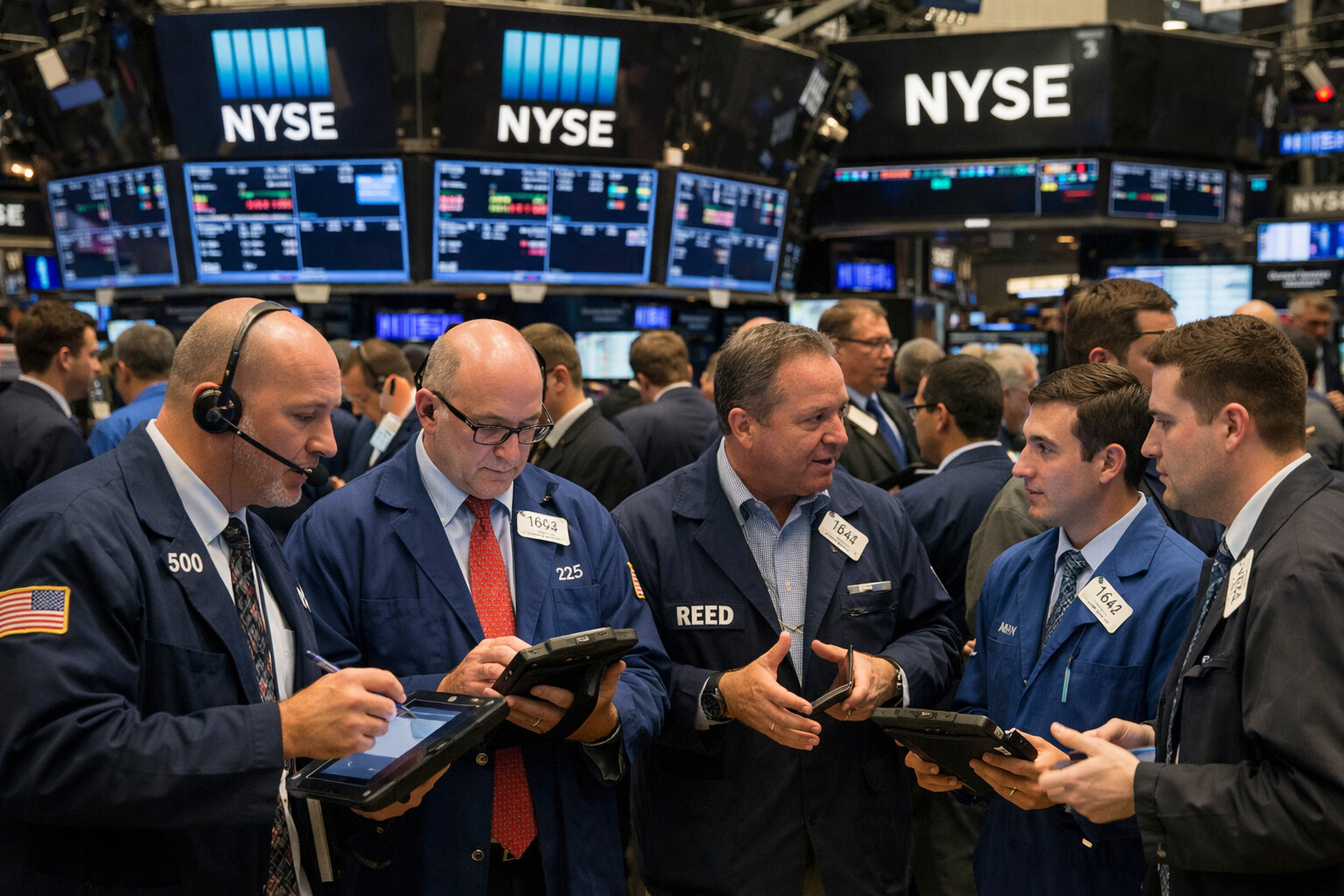
Stock Market Today: Dow, S&P 500 and Nasdaq Drop as Warsh Fed Pick Hits Gold
Dow trades near 48,950, S&P 500 around 6,960 and Nasdaq about 23,650 while gold sinks toward $5,020, silver hovers near $98 and Sandisk spikes over 20% as Apple, Exxon, Chevron and Bitcoin adjust to Warsh’s Fed nomination and hotter PPI | That's TradingNEWS
Stock Market Today: Fed shock, metals crash and crowded trades finally get tested
Index performance and risk mood across Wall Street
U.S. equities are trading lower but not collapsing, with the pullback looking like a reset after a hyper-strong January rather than a full-scale unwind. The Dow Jones Industrial Average (DJIA) is down around 0.2–0.3%, hovering near 48,950 after dropping roughly 160 points at the lows. The S&P 500 (SPX) is off about 0.2–0.3% around 6,960, while the Nasdaq Composite (COMP) is weaker by roughly 0.3–0.5% near 23,640 as large-cap tech continues to digest a heavy earnings week and a violent swing in macro expectations. The Russell 2000 (RUT) is the clear laggard, sliding about 1.2% to the 2,620 region, signaling that higher-beta domestic cyclicals are feeling the rate and volatility shock more acutely than the megacap complex. Despite today’s red tape, all three major U.S. benchmarks are still set to finish January in positive territory: the Dow up around 2%, the S&P 500 about 1.8%, and the Nasdaq close to 1% for the month, extending the broader bull trend but with a much more fragile risk profile than just a week ago.
Warsh as Fed chair nominee: what really changes for rates and risk assets
President Trump has ended months of speculation by naming Kevin Warsh as his choice to succeed Jerome Powell as Chair of the Federal Reserve. Warsh is a former Fed governor (2006–2011) with a track record of pushing back on aggressive quantitative easing and warning about inflation risks, yet in recent TV appearances he has explicitly argued that “we can lower interest rates a lot” and backed Trump’s pressure for cuts. The market is now forced to price a more nuanced Fed: not a blindly dovish political appointee, but a chair who is hawkish on credibility and balance-sheet excess while still willing to cut the federal funds rate if growth softens or financial conditions tighten too abruptly. Immediate price action reflects this duality. The 2-year Treasury yield is roughly flat to slightly lower around 3.55%, suggesting the front end still expects cuts over the next 12 months, while the 10-year (≈4.25%) and 30-year (≈4.88%) have moved a few basis points higher, a classic bear steepener that prices less extreme easing and a bit more long-term inflation and term premium. For equities, that combination means the era of “rate cuts at any cost” is off the table; price-to-earnings expansion will have to be earned via real earnings growth, not just multiple inflation driven by a hyper-dovish Fed chair.
Hot PPI and the inflation signal behind the headline
The Producer Price Index (PPI) for December came in meaningfully hotter than consensus. Headline PPI rose 0.5% month-over-month, versus 0.2% previously and around 0.3% expected. The core PPI print was even more aggressive, up roughly 0.7% versus an expected 0.3–0.4%. That is not the kind of number the Fed can ignore, particularly at the moment of a chair transition. The good news: the year-over-year PPI rate has eased to about 3.0%, down from 3.5% at the end of 2024 and creeping closer to the Fed’s 2% inflation objective. The composition also matters. Nearly all of the upside surprise came from services, with services PPI up around 0.7% while final demand goods were basically flat. That lines up with the thesis that Trump’s tariffs and supply-side shocks are pushing up specific prices but not yet reigniting a broad goods inflation spiral. For Nasdaq growth names and long-duration assets, the key takeaway is simple: a Warsh Fed confronted with sticky services inflation will be less tolerant of speculative excess and more inclined to insist on real disinflation progress before delivering the kind of rapid cuts that equities have been pricing.
Dollar rebound and volatility: DXY, VIX and the pressure on crowded trades
The nomination has pushed the U.S. dollar index (DXY) higher, up around 0.4–0.5% near 96.7, reversing part of January’s slide and quickly tightening financial conditions for global risk assets priced off the dollar. At the same time, the Cboe Volatility Index (VIX) is up around 6% near 17.4–17.9, still far from panic territory but clearly signaling that the low-volatility melt-up phase is over for now. A stronger dollar plus higher long-end yields is toxic for crowded “debasement” trades: gold, silver, and to a lesser degree high-beta crypto and speculative tech names. The bifurcation is clean: quality large caps with real cash flows are holding up, while instruments whose main bull case was “the Fed will always bail us out” are repricing fast.
Gold and silver: from vertical to vicious in one session
The most dramatic move of the day is in precious metals. Gold futures (GC=F), which punched above $5,600/oz at yesterday’s euphoric peak, are now trading in the $5,000–5,050 zone, down roughly 6% on the session. Silver futures (SI=F) have been hit even harder, sliding more than 13–16% toward $96–99/oz, after briefly losing the psychologically important $100 level. Spot markets echo the futures carnage, with platinum and palladium also suffering double-digit intraday losses. This is not about a change in gold’s long-term narrative in one day; it is a positioning event. Gold and silver had become crowded trades, with both assets up roughly 80% and 200%+ respectively over the past year. A credible Fed chair nominee who is unlikely to tolerate runaway inflation or overt political capture forces leveraged longs to de-risk. As positions are unwound, anything linked to that trade — precious-metals miners, leveraged ETFs, gold-backed products — is underperforming hard and will likely remain volatile until margin calls and forced selling run their course. Structurally, the secular case for some gold allocation in a world of twin deficits and geopolitical risk is intact, but the risk/reward here shifts from “chase” to “patience”. For tactical traders, this day marks the exhaustion of the parabolic phase; long-term investors should treat fresh buys as gradual scale-ins, not aggressive momentum trades.
Read More
-
Yen Stalls at 160 Despite a 3% JGB and Tokyo Core CPI at 2.0% — Intervention Sits at 164, Friday's Payrolls Decide
02.09.2026 · TradingNEWS ArchiveEnergy
-
AMD ($560.68) Rebounds 10% From Its October Low on the Meta Helios Win — November 3 Report Holds the Key to $649
27.10.2026 · TradingNEWS ArchiveStocks
-
Ethereum ($2,312) Lags Bitcoin and AI Stocks as BitMine Nears Its 5% Cap — Break of $2,295 Opens $2,200
27.10.2026 · TradingNEWS ArchiveCrypto
-
Brent ($113.88) Trades a $2.35 Range as Houthi Strikes Meet Saudi-Iran Diplomacy — Break of $117 Unlocks $120
27.10.2026 · TradingNEWS ArchiveCommodities
-
Nasdaq Rips 1.3%, S&P 500 Hits 7,728, Dow Stalls as BA Drops to $171
27.10.2026 · TradingNEWS ArchiveMarkets
-
GBP/USD (1.3310) Can’t Cash In on 5.43% Gilt Yields as Budget Risk Meets a Firm Dollar — Break of 1.3274 Opens 1.3200
27.10.2026 · TradingNEWS ArchiveForex
Energy and oil majors: XOM and CVX in focus as crude steadies
In energy, the tape is more nuanced. West Texas Intermediate (CL=F) is slightly firmer, up about 0.2–0.3% around $65.6/bbl, still on track for a solid weekly gain after a multi-month grind lower. Supply discipline from OPEC+ and steady demand expectations tied to AI-driven power consumption are supporting the floor in crude. Yet Exxon Mobil (XOM) is down roughly 1–2% around $138–139 despite posting a clean earnings beat: adjusted EPS of about $1.71 versus roughly $1.68 expected and revenue of $82.3B vs $81.4B consensus. Exxon also printed its highest full-year net production in more than 40 years at about 4.7M barrels of oil equivalent per day and plans $27–29B of capex in 2026 after spending roughly $29B in 2025. The issue is not the quarter; it is positioning and the macro overlay. With long-end yields backing up and investors rotating away from duration and “bond proxies”, even high-quality energy cash machines see de-risking. Chevron (CVX) delivered Q4 EPS of about $1.52 vs $1.45 expected on record production, but the stock is basically flat to slightly down as revenue of $46.9B missed the Street. The message: fundamentals support long-term “Hold/Bullish” on integrated oil, but the market is no longer in the mood to pay up for solid numbers without a fresh catalyst. On a 6–12 month horizon, the combination of disciplined capex, high free cash flow, and buybacks keeps XOM and CVX in the “Buy on weakness” bucket rather than outright sells.
Tech and AI complex: Apple’s beat, Sandisk’s explosion, Microsoft’s hangover
The Nasdaq is down modestly, but under the surface dispersion is extreme. Apple (AAPL) is trading choppy, roughly 1–2% lower intraday after an initial pop, despite delivering another blockbuster quarter. EPS came in at $2.84, comfortably ahead of the $2.67 consensus, on revenue of about $143.8B vs $138.5B expected. iPhone revenue surged 23% year-over-year to ≈$85.3B, powered by the iPhone 17 cycle, and Greater China (including Hong Kong and Taiwan) sales jumped roughly 38% to $25.5B, completely flipping the “China slowdown” narrative. At around $258–259/share, the stock is near its highs, but the intraday fade tells you positioning was stretched and expectations were lofty. The quarter justifies a “Hold with a mild bullish bias”: the numbers support the valuation, but the Warsh nomination and hot PPI cap multiple expansion.
The standout outperformer is Sandisk (SNDK), the poster child of AI infrastructure leverage. The stock is up 20–24% today, trading around $600+ after a quarter that blew away already-aggressive expectations. Management guided fiscal Q3 adjusted EPS to about $12–14 per share versus consensus closer to $5, and ramped data center revenue by roughly 64% quarter-on-quarter. Full-year guidance improved sharply, with the Street’s revenue expectations for the next quarter nearly doubled (guidance $4.4–4.8B vs consensus around $2.6B). After a 1,000%+ move over the last year, today’s spike signals that AI-levered memory remains the current cycle’s leadership, but also that risk is asymmetric: from here, the stock sits firmly in “Trim/Reduce into strength” territory for professional money rather than a fresh entry for late buyers.
Elsewhere in tech, KLA Corp (KLAC) is down around 8% after issuing lighter-than-hoped guidance for non-GAAP gross margin in the fiscal third quarter, highlighting that not every name in the semiconductor and equipment stack is a straight AI winner. Western Digital (WDC) is modestly higher after issuing a constructive outlook (Q3 EPS guide ≈$2.30 vs $1.96 expected, revenue guide ≈$3.2B vs $3.0B), but that move is dwarfed by Sandisk’s surge. Microsoft (MSFT), which dropped about 10% in the prior session on AI-spend digestion, is edging slightly higher as dip-buyers test the waters, yet the reflex is clearly different: investors now demand clean upside operating leverage, not just AI narratives and capex ramps. Net-net, the AI complex remains secularly bullish, but selectivity is critical. SNDK and similar parabolic leaders sit in the “Reduce/Take profits” camp; resilient platform names like AAPL and MSFT lean “Core Hold” with elevated volatility rather than high-conviction new buys at these levels.
Consumer, payments and telecom: Visa, AmEx, Deckers and Verizon
In payments, Visa (V) delivered a fundamentally strong quarter yet trades 1–1.5% lower. Adjusted EPS printed about $3.17 vs $3.14 expected on revenue of roughly $10.9B vs $10.69B, driven by robust cross-border volumes and resilient consumer spend. The stock’s reaction is influenced by Trump’s push for a credit-card rate cap, which acts as a valuation overhang. At current levels, the quarter itself supports a “Hold/Bullish” stance on V over the medium term, but regulatory torque argues against chasing.
American Express (AXP) is down around 1–2%, even with double-digit revenue growth, as the White House push to cap card rates and heightened macro uncertainty around premium consumers keep investors cautious. The stock shifts into a “Neutral/Hold” bucket: earnings quality is solid, but regulatory risk and late-cycle credit concerns limit upside.
On the consumer and lifestyle side, Deckers Outdoor (DECK) is a major outperformer. The owner of Hoka and UGG saw shares spike about 11–15% after reporting Q3 EPS of roughly $3.33 on $1.96B in revenue, comfortably beating estimates. Hoka sales climbed around 18%, UGG about 5%, and management raised full-year guidance to $5.40–5.43B in revenue and EPS of $6.80–6.85, both above prior ranges and Street forecasts. After a brutal 12-month drawdown where the stock had lost over half its value, today’s move marks a trend inflection; from here, DECK sits in “Hold/Opportunistic Buy on dips” territory, not a blind chase after a one-day squeeze.
Verizon (VZ) is also outperforming, up roughly 5–7.5% after adding about 616,000 wireless postpaid phone subscribers in the quarter, far ahead of expectations, and guiding solidly for the coming year. Heavy holiday promotions compressed some near-term margins, but the market is focusing on the subscriber momentum. In a world of higher yields and renewed rate uncertainty, a high-dividend, cash-rich telecom with improving operating trends naturally screens as a “Defensive Buy/Hold” name.
Financial conditions, cryptos and high-beta risk
The shock in rates and the dollar is spilling over into crypto and high-beta risk pockets. Bitcoin (BTC-USD) is down around 1%, trading near $82,000–83,000 after touching $84,600 overnight. Other major tokens like XRP and Ethereum (ETH) are under pressure as well, with broader headlines calling out a synchronized hit after the Warsh nomination. The dynamic is straightforward: a more credible, potentially less aggressively dovish Fed plus hotter PPI undermines the pure “dollar debasement” and “relentless liquidity” story that has driven speculative flows for months. As long as 10- and 30-year yields grind higher and the dollar stays bid, crypto behaves like a high-beta macro factor, not a decorrelated hedge. Tactical stance: short-term bearish to neutral, biased “Hold/Reduce”, not “Buy the dip” until rates volatility cools and the Fed path is clearer.
Breadth, sentiment and insider behavior: what the smart money is signaling
Market breadth is soft. About 10 of 11 S&P 500 sectors are in the red, with materials down roughly 1.2–1.4% as the metals crash drags miners and commodity plays. Only industrials are marginally green, up about 0.1%, showing some resilience as investors rotate into names less exposed to pure financial-asset froth. Sentiment surveys paint a less fearful backdrop than the index move implies. AAII bullish sentiment sits in the mid-40% range, above its long-run average (~37.5%) for nine of the last twelve weeks, while bearish sentiment has slipped below its historical norm (~31%). That means retail is still relatively optimistic despite recent wobble. More importantly, corporate insiders are voting with their wallets. Roughly 1,000 executives have sold stock this month versus just over 200 who bought, the highest sell-to-buy ratio in about five years. That doesn’t mean an immediate top, but it is a clear yellow flag for forward returns from current levels. When insiders aggressively harvest gains while retail sentiment remains upbeat, risk-reward for broad S&P 500 exposure shifts toward “Hold/Trim” rather than “aggressively add”. The VIX near 17–18 confirms a regime shift: not crisis, but no longer the ultra-low-volatility backdrop that justified very rich multiples without earnings support.
Tactical view: buy, sell or hold across key buckets
Putting the cross-asset signals together, the tape is sending a consistent message. The Warsh nomination plus hotter PPI and a firmer dollar are tightening financial conditions at the margin, and that is forcing a de-rating in the most crowded “easy money” trades.
For U.S. indices, the S&P 500 (SPX) and Nasdaq (COMP) sit in “Hold/Neutral, slight downside skew” territory at current levels. Earnings season has not been a disaster — AAPL, SNDK, V, XOM, CVX all delivered respectable to outstanding numbers — but valuations already discount a lot of good news. The Dow (DJIA), with its stronger dividend and value tilt, looks more defensible and leans “Hold with mild bullish bias”, especially if long yields stabilize rather than spike.
For sector and single-stock calls based on today’s moves:
• High-beta AI winners like SNDK: Reduce/Take profits, strong long-term story but risk is now skewed to the downside after enormous YTD gains and euphoric guidance reaction.
• Quality megacap tech like AAPL and MSFT: Core Hold, structurally bullish, but not compelling fresh buys into a Fed-credibility repricing and a stronger dollar.
• Integrated oils XOM and CVX: Buy on weakness / Overweight vs index, supported by multi-year production, disciplined capex and attractive shareholder returns even in a mid-60s oil environment.
• Defensive yield names like VZ: Buy/Hold, as they benefit from investors rotating toward cash-rich, high-dividend franchises in a more volatile macro environment.
• Consumer growth such as DECK: Hold, opportunistic Buy on dips, recognizing the sharp rerating but respecting the upgraded guidance and strong brand momentum.
• Crypto and precious metals: Short-term Bearish/Reduce, long-term thesis intact for gold but the immediate risk is further forced selling and volatility as positioning resets.
Overall, the market is not breaking; it is repricing. A credible, less overtly dovish Fed chair-elect, firmer inflation at the producer level, a rising DXY, and heavy insider selling all argue for tighter risk management and more selective stock picking. Broad beta longs in Nasdaq and S&P 500 shift from an easy “Buy” to a disciplined “Hold/Trim”, while cash-generating cyclicals and high-quality defensives with real earnings power — energy majors, select telecom, and best-in-breed consumer names — emerge as the relative outperformers in a market that is finally being forced to distinguish between narrative and cash flow.