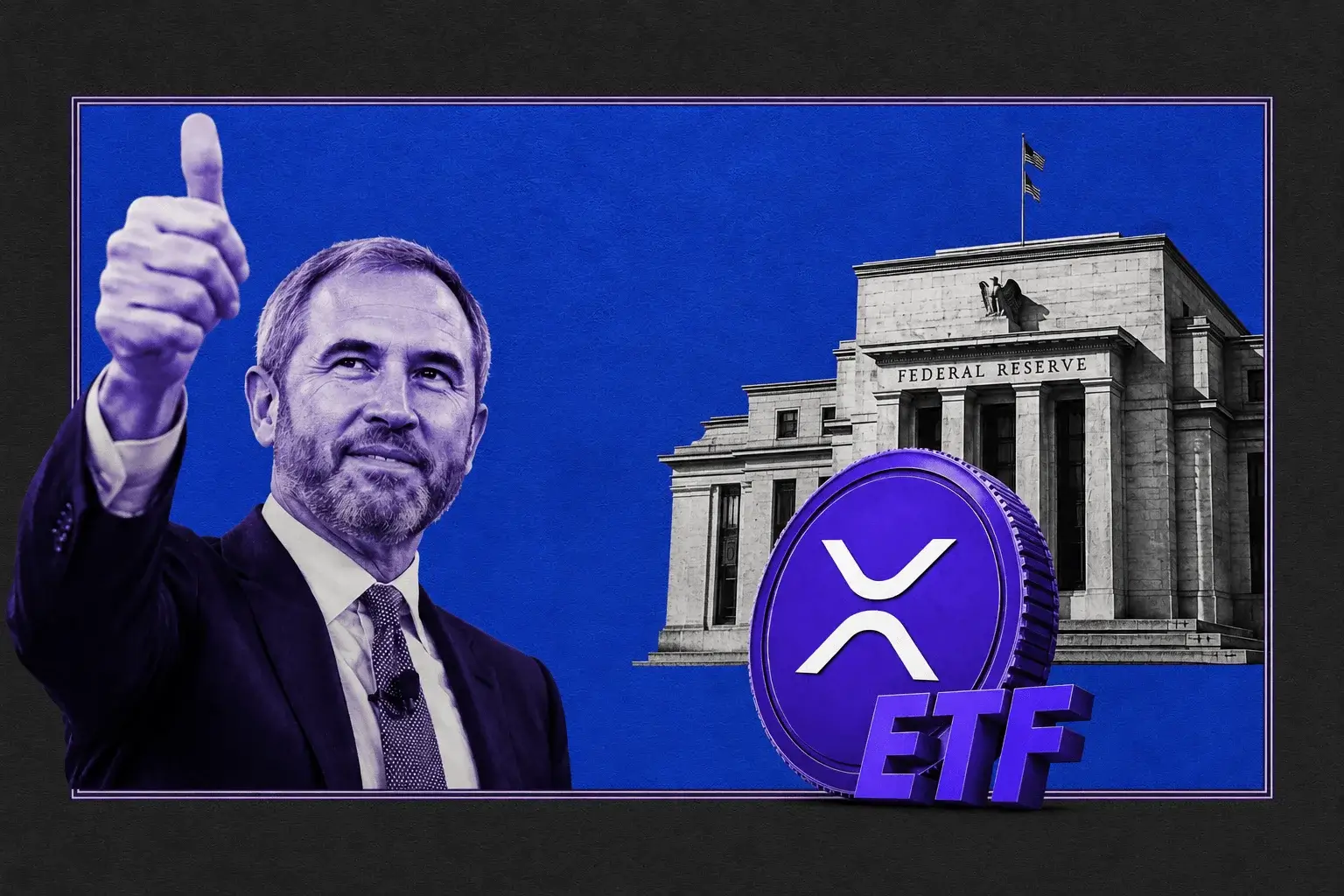
Two Funds Supply the Entire XRP ETF Tape: Monthly Flows Collapse 79% From May as Every Product Hits a Record Low
Bitwise holds $312.82 million and three funds control 82% of category assets, with five of seven printing zero on August 6 | That's TradingNEWS
Key Points
- XRP ETFs drew $3.45 million on August 6 after a $3.58 million outflow, the first since July 8.
- Cumulative inflows reached $1.51 billion while assets total $993.38 million after price losses.
- Monthly flows fell from $131.94 million in May to $27.29 million in July, down 79%.
US spot XRP exchange-traded funds recorded $3.45 million of net inflows on August 6, reversing the prior session's outflow. The recovery came from exactly two issuers: Bitwise's XRP ETF pulled in $2.89 million and Franklin Templeton's XRPZ added $561,560. No other XRP ETF recorded net flows during the session.
Five of seven products printed zero. That is the state of this category — a market where two funds are the entire tape.
Cumulative net inflows across the complex now stand at $1.51 billion, with one measurement putting the figure at $1.516 billion. Total assets under management sit at $993.38 million, equal to 1.50% of XRP's total market capitalization.
The token itself closed at $1.03 on August 7, down roughly 1.7% on the session, trading between $1.015 and $1.041 against a 52-week range of $1.0095 to $3.3818. XRP is down 43% year to date and roughly 70% below its $3.65 record from July 2025, with a market capitalization near $64 billion. It has just posted its lowest daily close of 2026.
Read the two headline numbers together and the entire story emerges. Cumulative inflows of $1.51 billion against assets of $993.38 million means roughly $520 million of the capital that entered these funds has been erased by price. Investors put in a billion and a half dollars and hold a billion.
That is not a criticism of the products — they track XRP, and XRP fell 43%. It is the honest measure of what the wrapper has delivered.
The comparative context makes it sharper. Also on August 6, spot Ethereum ETFs attracted $92.15 million, spot Bitcoin ETFs took $137.6 million with BlackRock's IBIT supplying $128.3 million, and Solana ETFs were the only major crypto ETF segment in negative territory at $859,450 of outflows.
XRP's $3.45 million was 3.7% of Ethereum's daily figure and 2.5% of Bitcoin's.
Yet the flows have been persistent in a way no other altcoin ETF class has matched. Since the start of July there have been only a handful of outflow sessions, the largest a $7.29 million withdrawal on July 8. That persistence is real. It is also arriving at a scale that cannot move a $64 billion asset.
August 5 Broke a Month-Long Streak — and One Fund Did It
The session before Thursday's recovery is more instructive than the recovery itself.
On August 5, US spot XRP ETFs recorded net outflows of $3.58 million — the first negative flow day since July 8, ending a streak of mostly positive daily inflows. The entire withdrawal came from the Bitwise XRP ETF. Every other US spot XRP fund reported no net flows for the day.
That single-fund concentration matters for interpretation. Official issuer data showed 293.9 million XRP held by the Bitwise trust through August 4, 2026. ETF outflows reflect shareholder redemptions rather than a discretionary decision by the sponsor — the trust may distribute XRP in kind or sell tokens to satisfy cash redemption orders, and authorized financial firms handle share creation and redemption under the trust's operating documents.
So the correct description of August 5 is a reported $3.58 million net redemption at one fund, not a bearish market call by an asset manager. Bitwise Investment Advisers sponsors the product; it does not choose the direction of flows.
The reversal on August 6 with $2.89 million returning to the same fund suggests investors came straight back after a one-day pause in buying, which supports the redemption interpretation rather than a strategic exit.
The sequence leading into it was thin but positive. August 4 recorded $0 in net inflows. August 3 brought $1.15 million. July 31 delivered $7.69 million, July 30 added $5.98 million, and July 29 produced $584,710 — with Franklin Templeton's product the sole contributor while every other fund printed zero.
Those five sessions brought in approximately $15.4 million combined before inflows paused. The flat August 4 session extended the streak of trading days without outflows to four, and then August 5 ended it.
Category daily trading volume has been running around $10.35 million. A market where the entire seven-fund complex trades $10 million a day, holds $993 million of assets, and can be moved into negative territory by a single $3.58 million redemption is not a deep institutional market.
It is a niche product set with a persistent but tiny bid, and the daily flow data reflects that precisely.
$520 Million Was Destroyed Between Inflow and Asset
Run the arithmetic on the gap because it is the cleanest measure of this category's performance.
Cumulative net inflows: $1.51 billion. Total net assets: $993.38 million. Difference: roughly $517 million, or 34.2% of everything that entered.
That destruction happened because the funds do exactly what they promise — hold XRP. The token has fallen 43% year to date and sits roughly 70% below its record. Money arriving at $2.40, $1.85, $1.40 and $1.10 has been marked down accordingly.
The trajectory of cumulative flows against price makes the pattern explicit. Cumulative inflows climbed above $1.2 billion in early January 2026, fell back to $1.17 billion by the end of that month after redemptions, then recovered steadily: $1.30 billion by late April, $1.40 billion in May, and the $1.50 billion record in late July. That is $330 million added across six months — roughly $55 million monthly on average.
The 2026 contribution to the cumulative total is $329 million. Everything else was raised in the first two months after the November 2025 launch.
So across 2026, institutional and retail capital has added $329 million through regulated wrappers while the asset they purchased fell more than 40%. That is buying into a nine-month decline, steadily, without a single month of aggregate redemption beyond one exception since launch.
Whether that is conviction or capitulation-in-slow-motion depends entirely on what happens next. The behaviour is unambiguously accumulation. The result so far is unambiguously a loss.
The structural read is that these products have functioned as a supply sink — locking away tokens that would otherwise sit on exchanges — without functioning as a price driver. The complex holds between 978.9 million and 992.4 million XRP against a 62.53 billion circulating supply. That is 1.57% of the float.
For comparison, US spot Bitcoin ETFs hold 1,224,454 BTC against roughly 19.9 million circulating — over 6% of supply.
Net XRP fund assets equal 1.50% of the token's market capitalization. The equivalent Bitcoin figure is 6.08%. That four-times gap in penetration is why identical flow persistence produces entirely different price outcomes across the two categories.
Three Funds Hold 82% of Category Assets
The concentration inside the complex is severe and it shapes every flow print.
By cumulative net inflows: Bitwise leads at $510.21 million, Canary Capital's XRPC sits second at $468.12 million, Franklin Templeton's XRPZ third at $426.53 million, and Grayscale's GXRP fourth at $131.46 million. The 21Shares product, TOXR, remains the only fund in the category still carrying negative cumulative net inflows since launch.
By assets: Bitwise holds $312.82 million, Franklin's XRPZ roughly $254 million to $258 million, Canary's XRPC approximately $250.2 million to $253.20 million, 21Shares' TOXR near $116.7 million, and Grayscale's GXRP around $59.4 million.
Those top three total roughly $818 million against a complex-wide figure near $997 million — 82% of category assets across three of seven products.
Bitwise's share of cumulative inflows is 33% of the $1.51 billion total, the largest of any single product. Canary's XRPC accounts for 31%.
The daily flow pattern is more concentrated still. On July 16, the category's best inflow day of that month at $6.78 million, Bitwise contributed $4.41 million — 65.0% of the total. On August 5 it accounted for 100% of the outflow. On August 6 it supplied 84% of the inflow.
Contrast that with the launch period, when flows were genuinely broad. The January 6 session illustrates what a strong day looked like at the peak: $46.10 million across the complex, with $16.61 million into the category leader adding 7.16 million tokens, $12.59 million into XRPZ adding 5.43 million tokens, $9.89 million into GXRP adding 4.26 million, and $7.01 million into TOXR adding 3.02 million.
Four funds each taking eight figures. Compare that to August 6, when two funds took seven figures combined and five took nothing.
The narrowing is the most important structural change in this category over eight months. Breadth existed at launch and has since collapsed into two distribution channels — which means a single allocator decision at either one determines whether the category prints positive or negative on any given day.
Grayscale's GXRP holds $59.4 million against $131.46 million of cumulative inflows, meaning it has given back more than half. The 21Shares fund has never been cumulatively positive.
Consolidation risk in a category this small is closure risk.
Flows Decelerated 79% From May to July
The trend inside the monthly data is the bear case, and it is not subtle.
April brought $81.59 million. May delivered $131.94 million — the strongest inflow month of 2026, achieved without a single day of net outflows, an accomplishment unmatched by any other altcoin ETF class and notable because Bitcoin's ETFs bled a record amount in the same window. June added $59.46 million. July contributed $27.29 million, a fourth consecutive positive month but 79% below May.
The category also logged eight consecutive positive weeks heading into July.
Then the pace collapsed. Against a six-month average of roughly $55 million monthly, July's $27.29 million ran at half rate. August's first four sessions produced $1.15 million, zero, minus $3.58 million and $3.45 million — a net of $1.02 million across four trading days.
Annualize that August pace and the category would raise $64 million in a year. The bull case requires $10 billion.
The comparison with the rest of the crypto ETF complex last week showed XRP standing out for the right reason and the wrong magnitude. XRP-focused ETFs attracted $15 million in net inflows while Bitcoin ETFs saw $0.6 million in net outflows, Solana ETFs lost $17 million and Ethereum ETFs posted a modest $0.4 million of inflows.
XRP won that week. It won it with $15 million.
Then August arrived and the picture inverted entirely: Bitcoin ETFs took $626 million across three sessions and $137.6 million on August 6, Ethereum funds pulled $92.15 million in a single day, and XRP managed $3.45 million.
The pattern across 2026 is a category with genuine loyalty from a narrow base and no ability to scale that base. Persistent, positive, and immaterial.
What would change it is platform-scale allocation from wirehouses and model portfolios, and that requires something the flows cannot provide on their own.
The Launch Was the Best of 2025 and Nothing Has Matched It
The history matters because it establishes what this category is capable of when conditions align.
XRPC debuted on Nasdaq on November 13, 2025 and produced the most successful exchange-traded fund launch of 2025 by first-day trading volume across any asset class. The Bitwise product followed on November 20. Grayscale's GXRP listed on NYSE Arca on November 24. XRPZ and TOXR came shortly after.
Across that entire first month, US spot XRP funds did not record a single net outflow day. That performance surprised participants who had assumed institutional adoption of XRP would lag Bitcoin and Ether. It did not.
The conditions were specific: the SEC case against Ripple had been dropped in August 2025, removing the single largest binary risk keeping large capital pools away from the asset, and generic listing standards issued in September 2025 cleared the path for the products to come to market quickly.
Cumulative inflows crossed $1.2 billion within roughly two months. The first daily net outflow did not arrive until January 7, 2026, when $40.8 million left the funds — nearly two months after the primary launch wave. Notably, the Bitwise product bucked that trend entirely, taking in $2.44 million and reducing the aggregate outflow.
Everything raised beyond $1.17 billion has come in the seven months since, at a decelerating pace, into a falling asset.
The Bitwise fund's own path illustrates the plateau. It first hit $500 million of cumulative inflows on June 29 at $505 million, dropped below that level at the start of July on redemptions, and has since recovered to $510.21 million. Its US and European XRP products combined had attracted more than $200 million during 2026 by late June.
So the category's honest arc is: explosive launch on regulatory resolution, then eight months of maintenance flows while the price halved.
That is not a failure of the products. It is evidence that the SEC case resolution was the catalyst, it was fully monetized in November and December 2025, and no second catalyst has arrived.
XRPI at $5.87 Shows What Daily-Reset Leverage Costs
The leveraged vehicle in this complex deserves separate treatment because its performance is a lesson in structure rather than direction.
XRPI trades at $5.87, up 1.30% on the session. That compares against $7.63 on April 1, 2026 and $7.64 at a close on April 6 — a decline of roughly 23% across four months. Over the same window the underlying token fell from the $1.40 area to $1.07, approximately 24%.
Read that carefully. A leveraged product declined 23% while its unleveraged underlying declined 24%. In a directional market, leverage should have multiplied the loss. Instead it roughly matched it — which sounds like outperformance until you understand why.
Daily-reset leverage in a volatile, range-bound asset erodes value even when the underlying ends flat. XRP's summer has been precisely that: a $1.05 to $1.16 band with repeated failed breakouts. Every reversal inside that band compounds the reset drag. The product captured none of the leverage benefit on the way down because the path was choppy rather than trending, and it will capture none of it on the way up for the same reason.
The share-price ledger across the complex tells the broader story. XRPC trades at $11.36, XRPZ at $11.62, GXRP at $20.73, and XRPR at $8.75 against a prior close of $8.63.
Compare those to earlier reference points. In June, XRPI sat near $7 with a 52-week low of $6.50, and XRPR near $10 with a floor around $9.50. By July 22 XRPI had fallen to $6.24 and XRPR to $9.27, with share prices down roughly 43% on the year. Both have since broken through those June floors — XRPI to $5.87 and XRPR to $8.75.
Every product in this complex is at or near its all-time low, which is the correct outcome for funds tracking an asset at its 52-week low.
For anyone considering exposure, the structural point is that XRPI's daily reset makes it a trading instrument only. The spot vehicles — XRPC, XRPZ, the Bitwise fund, GXRP — deliver clean tracking. XRPR sits in between.
The Funds Hold 978.9 Million Tokens Against Monthly Escrow
The supply arithmetic determines whether ETF accumulation can ever matter.
The complex holds between 978.9 million and 992.4 million XRP, worth roughly $1.01 billion to $1.02 billion at $1.03. Bitwise's trust alone held 293.9 million tokens through August 4. Earlier measurements put the category at 800 million and then 840 million tokens locked, so the trend has been steady accumulation — roughly 180 million additional tokens absorbed since June.
Against that, Ripple's escrow releases up to 1 billion XRP per month, with most typically re-locked. Net additions to circulating supply run 200 million to 400 million monthly.
Do the comparison directly. The ETF complex has absorbed roughly 180 million tokens over two months — about 90 million monthly. Net escrow release runs 200 million to 400 million monthly. Supply is entering at between 2.2 and 4.4 times the pace the regulated wrappers are absorbing it.
That is before accounting for the other sellers. Long-term holders who accumulated in the 2022 to 2023 base have been trimming into any strength, and a large break-even sell wall sits overhead from buyers at higher levels.
The net result is a price that grinds sideways and then lower despite steady demand. The flows are real. They are simply not large enough to clear the overhang.
Circulating supply stands at 62.53 billion out of the 100 billion created at inception, with 55 billion originally placed into escrow in 2017. Projections put circulating supply at 73 billion to 84 billion by the end of 2030 — a midpoint near 78 billion and dilution of roughly 25%.
Any long-dated valuation has to clear that dilution. A $3 XRP in 2030 is not a $188 billion market cap on today's supply. It is a $234 billion market cap on 2030 supply.
There is one genuinely constructive on-chain signal. Whales holding between 10 million and 100 million XRP have continued accumulating through the decline, and exchange supply sits at a seven-year low with centralized exchange balances near three-year lows.
Two accumulating cohorts — ETFs and whales — against escrow and long-term holder distribution. At $1.03, the sellers are winning.
Read More
-
Yen Stalls at 160 Despite a 3% JGB and Tokyo Core CPI at 2.0% — Intervention Sits at 164, Friday's Payrolls Decide
02.09.2026 · TradingNEWS ArchiveEnergy
-
BFLY ($9.58) Reprices as Chip Platform as Embedded Revenue Jumps 150% — $11.00 on a Breakout
22.09.2026 · TradingNEWS ArchiveStocks
-
XRP-USD ($1.5176) Tests Multi-Month Ceiling as ETF Inflows Reach $1.68B With Zero Outflow Days — $1.60 Next
22.09.2026 · TradingNEWS ArchiveCrypto
-
Brent ($97) Extends 4-Day Slide From $108 Peak as Saudi Hormuz Exports Hit 2.9M bpd — $91 Next on a Deal
22.09.2026 · TradingNEWS ArchiveCommodities
-
Nasdaq Extends Record at 27,222, S&P 500 Holds 7,767, Dow Slides 0.40% as SCHW Drops 5.70%
22.09.2026 · TradingNEWS ArchiveMarkets
-
GBPUSD Capped Below 1.3440 EMA Cluster as Record £8.8B Debt Interest Hits Sterling — 1.3250 in View
22.09.2026 · TradingNEWS ArchiveForex
CLARITY Slipped and the $10 Billion Condition Is Untouched
The bull case for this category has always been conditional, and both conditions have moved further away.
The Senate postponed a floor vote on the CLARITY Act until after its August recess, with the next opportunity in September. Lawmakers return September 14. The bill would establish a federal digital asset market structure and clarify regulatory responsibilities between the securities and derivatives regulators. Prediction markets have cut 2026 passage odds to 28% from an 82% peak.
The most-cited bull target for XRP — $8 by the end of 2026 — is explicitly contingent on two things: CLARITY passage and $10 billion of cumulative ETF inflows. Cumulative inflows currently stand at $1.51 billion. That is 15.1% of the required threshold, with flows running at $27.29 million monthly.
A separate estimate puts CLARITY passage as unlocking roughly $8 billion of ETF inflows against the $1.49 billion accumulated at the time. A first-year projection had ranged from $4 billion to $8.4 billion and has not been tested by a full bull cycle — allocation decisions have been made during a drawdown rather than an expansion.
The deeper structural obstacle is the nature of XRP's current legal status. Its classification as a commodity was established through joint interpretive guidance issued by the securities and derivatives regulators in March 2026. Interpretive guidance is not statute. No amount of adviser testing converts into platform-scale allocation while the underlying asset's commodity classification rests on guidance that the next set of regulators could reverse.
That is precisely why the flows have plateaued at maintenance levels. Wirehouse platforms and model-portfolio allocators require durable legal certainty, not an interpretive letter. Bitcoin got a statutory-equivalent position through years of case law and product history. XRP has eleven months of guidance.
Utility development continues in the background. Flare's FXRP market on Ethereum crossed $1 million as XRP-based collateral saw rapid borrowing demand, and the XRP Ledger was processing record volumes with daily transactions hitting 3 million on March 15, 2026 — a threefold increase from mid-2025 averages, driven by automated market maker pools, tokenized assets and RLUSD-denominated settlement flows.
None of that has produced ETF flow. September 14 is the date that could.
What the Cross-Category Comparison Actually Shows
Place XRP's ETF complex against the other three major crypto categories and the scale problem becomes unmissable.
Bitcoin: $79.21 billion of assets, $51.5 billion of cumulative net inflows, 1,224,454 BTC held, and net fund assets equal to 6.08% of market capitalization. BlackRock's IBIT alone holds $47.08 billion — 47 times the entire XRP complex.
Ethereum: cumulative inflows above $11.2 billion, assets near $10.2 billion, and August flows of $92.15 million in a single session.
XRP: $1.51 billion cumulative, $993.38 million of assets, 1.50% of market cap penetration, and $3.45 million on its best August day.
Solana: cumulative inflows above $1.12 billion, roughly $1 billion of assets, and outflows of $859,450 on August 6.
XRP and Solana are the same size and both are roughly one-fiftieth of Bitcoin's complex. The difference is that XRP's flows have never gone cumulatively negative in a month beyond one exception, while Solana's have deteriorated to $14.6 million monthly with outflows appearing.
That relative resilience is genuine and it is the strongest argument for the category. XRP funds took $15 million in a week when Bitcoin ETFs were net negative, Solana lost $17 million, and Ethereum managed $0.4 million. On a week when everything else struggled, XRP was the only positive.
But relative resilience at $15 million a week does not move a $64 billion asset. It takes roughly 133 weeks of that pace to reach the $10 billion threshold the bull case requires.
The Bitcoin complex just demonstrated what scale looks like: $626 million across three sessions plus $137.6 million on the fourth. It also demonstrated the limit of even that — Bitcoin gained roughly $1,000 on $763.6 million of creations.
If $763.6 million cannot move Bitcoin decisively, $3.45 million cannot move XRP at all.
The honest framing for anyone holding these products is that the ETF wrapper solved access, custody and operational complexity. It did not solve demand, and demand is the variable that determines returns.
What Would Change the Arithmetic
Define the evidence in advance, because the flow headlines will keep arriving at immaterial scale.
First marker: breadth returning. The January 6 session had four funds each taking eight figures. August 6 had two funds taking seven figures combined and five taking nothing. A genuine turn shows GXRP, TOXR, XRPR and the index vehicle participating consistently rather than printing zero. Until then, the category's flow direction is a function of two allocators.
Second marker: monthly flows above $150 million. May's $131.94 million was the best month of 2026 and it did not stop the price from falling. Reaching the $10 billion cumulative threshold from $1.51 billion requires $8.49 billion of new money — at $150 million monthly that is 57 months. At $500 million monthly it is 17 months. The category needs a step change, not an improvement.
Third marker: statutory clarity. CLARITY passage would replace March 2026's interpretive guidance with law, which is the precondition for platform-scale allocation. Odds sit at 28% with the vote pushed to September at the earliest and a 60-vote cloture threshold requiring cross-party support.
None of the three has triggered.
What would confirm the bear case: the flow pause extending from August's $1.02 million four-day net into outright monthly redemption, a second fund following the 21Shares product into cumulative negative territory, and consolidation pressure producing a closure. That last risk is real — the Bitcoin category just produced its first liquidation when a $14.7 million fund could not cover operating costs against a $47.08 billion leader. Grayscale's GXRP at $59.4 million and the 21Shares TOXR at $116.7 million face the same arithmetic against a $312.82 million category leader.
Small funds face a structural disadvantage because fixed operating costs do not shrink with assets. In a category where three products hold 82% of assets and daily volume across all seven is $10.35 million, that math is unforgiving.
The one genuinely encouraging structural fact: not a single month of aggregate redemption beyond one exception since November 2025. That base has not broken.
Scenarios Into September 14
Base case, roughly 50% weight: flows continue at the current $1 million to $10 million weekly pace with two issuers supplying nearly all of it. XRP holds $1.00 to $1.12, the complex's assets stay between $980 million and $1.05 billion, and cumulative inflows drift toward $1.55 billion by month-end. XRPI holds $5.60 to $6.20, XRPR $8.50 to $9.30. No structural change. Base case leaves the category exactly where it is.
Bull case, roughly 25%: the Senate takes up CLARITY after September 14 and passes it. Statutory clarity replaces March's interpretive guidance, platform allocators clear XRP for model portfolios, and cumulative inflows begin closing the gap toward the $8 billion unlock estimate. XRP reclaims $1.11 at the 50-day moving average and targets $1.36 at the 200-day, with the $8 end-2026 target requiring both passage and $10 billion of flow. The funds re-rate directly with the token: XRPI toward $7.60, XRPR toward $11.
Bear case, roughly 25%: CLARITY slips past September into 2027, the 28% passage probability compresses further, and August's flow pause extends into the category's first month of aggregate redemption. XRP breaks $1.0095 and the $1.00 floor that has held all year, opening $0.90. Fund assets fall below $900 million, cumulative inflows stall at $1.52 billion, and a second issuer announces closure. XRPI breaks $5.50 toward $5.00.
The distribution is unattractive because the upside is gated on a 28% legislative event and the downside requires only that nothing changes. Prediction markets price a 59% chance XRP touches $1.00 during August against 29% for $1.20.
What makes the category worth watching rather than owning is the persistence. Money has arrived every month bar one since November 2025, through a 43% year-to-date decline, without capitulating. That behaviour usually precedes a repricing.
It has been precisely wrong for eight months.
Levels and Verdict
The XRP ETF complex holds $993.38 million of assets against $1.51 billion of cumulative net inflows — meaning roughly $517 million of the money that entered has been erased by a token that fell 43% year to date and sits 70% below its $3.65 record. Net fund assets equal 1.50% of XRP's market capitalization against Bitcoin's 6.08%.
August 6 delivered $3.45 million, with Bitwise supplying $2.89 million and Franklin Templeton's XRPZ $561,560 while five of seven funds printed zero. August 5 recorded the first outflow since July 8 at $3.58 million, entirely from one fund. August 4 was flat. The four-session net is $1.02 million.
Monthly flows have decelerated from $131.94 million in May to $59.46 million in June to $27.29 million in July — a 79% decline from the peak. The 2026 contribution to cumulative flows is $329 million, averaging $55 million monthly across six months.
Concentration defines the category. Bitwise at $510.21 million of cumulative inflows and $312.82 million of assets, Canary's XRPC at $468.12 million and roughly $250 million, Franklin's XRPZ at $426.53 million and roughly $254 million. Three funds hold 82% of assets. Grayscale's GXRP has given back more than half its $131.46 million. The 21Shares TOXR has never been cumulatively positive.
Share-price levels: XRPI at $5.87, having broken its $6.50 June floor and lost 23% in four months on daily-reset drag. XRPR at $8.75 through its $9.50 floor. XRPC $11.36, XRPZ $11.62, GXRP $20.73. Every product sits at or near an all-time low.
Verdict: the wrapper works and the demand does not scale. Own the spot vehicles — XRPC, XRPZ or the NYSE Arca leader — if you want XRP exposure without custody, and avoid XRPI entirely unless trading intraday, because daily reset destroys capital in a $1.05 to $1.16 range.
The trade is the token, not the fund. Long only above $1.11 with a stop below $1.06. The $10 billion cumulative flow condition sits 6.6 times above current levels and requires a September CLARITY vote priced at 28%.
Money has arrived every month bar one for nine months into a 43% decline. That is either the best contrarian signal in crypto or the most patient losing trade in it.