
USD/JPY Holds 156.50 as Washington Joins Tokyo in Buying Yen — First Coordinated Action Since 1998
Japan spent a record ¥11.73 trillion in April and May and USD/JPY returned above the intervention level within six weeks | That's TradingNEWS
Key Points
- USD/JPY fell to 156.5110, down 0.59%, after touching 155.20 intraday on confirmed joint intervention.
- Japan's MOF and the US Treasury bought yen through the New York Fed, the first coordinated action since 1998.
- The BoJ held at 1.00% on an 8-1 vote against a Fed target range of 3.50%–3.75%, a gap of 250 basis points.
USD/JPY fell to 156.5110 on Monday, down 0.59% from the prior session, after briefly plummeting to 155.20 intraday and finding short-covering that lifted it into consolidation around congestion support near 157.00. By the European session the pair changed hands near 156.70, having pared roughly half its losses from the low. The five-day moving average sits at 156.34 and the 50-day at 156.94, with the Fibonacci pivot at 156.38, which places spot almost exactly at the midpoint of its own short-term structure.
The yen has strengthened toward 155 per dollar, bringing its gains to about 5% over three sessions. Across the past month the currency has appreciated 3.44%. Over twelve months it remains 6.62% weaker, which frames how far this move has to run before it reverses anything structural.
The trigger was confirmation from Japan's Finance Ministry that it carried out coordinated yen-buying operations with the US Treasury last week, following the currency's slide to 40-year lows. That confirmation converted a suspicion into a policy fact and forced every short-yen position in the market to reprice tail risk that had been assumed away.
The descent was fast and it took out levels in sequence. The pair approached 164.00 before falling rapidly, breaking below 160.00 and then 158.00 in quick succession. It then sliced through 157.50, the level that had served as the prior downside target, while trading below the 50-period EMA and breaking a major ascending trendline. Relative strength readings turned negative alongside the price break, reinforcing the case for further declines toward lower support.
The broader dollar tape gave no cover. The dollar index slipped 0.19% to 99.7210 as West Texas Intermediate collapsed 6.21% to $79.41 on President Trump calling off strikes against Iran, which reduced near-term inflation anxiety and pulled the greenback lower across the board. EUR/USD reached approximately 1.1559 and sterling approached a two-week high.
Sterling was weakest of all against the yen on Monday, which is the tell. When the funding currency in the largest carry trade in global markets rallies 5% in three sessions, the damage lands on every cross simultaneously rather than only on the dollar pair.
Momentum readings are stretched. The pair is technically oversold with the relative strength index below 30 and price trading beneath its lower Bollinger Band, which is the configuration that produces violent short-covering bounces without changing the underlying direction.
The First Joint US-Japan Intervention Since 1998
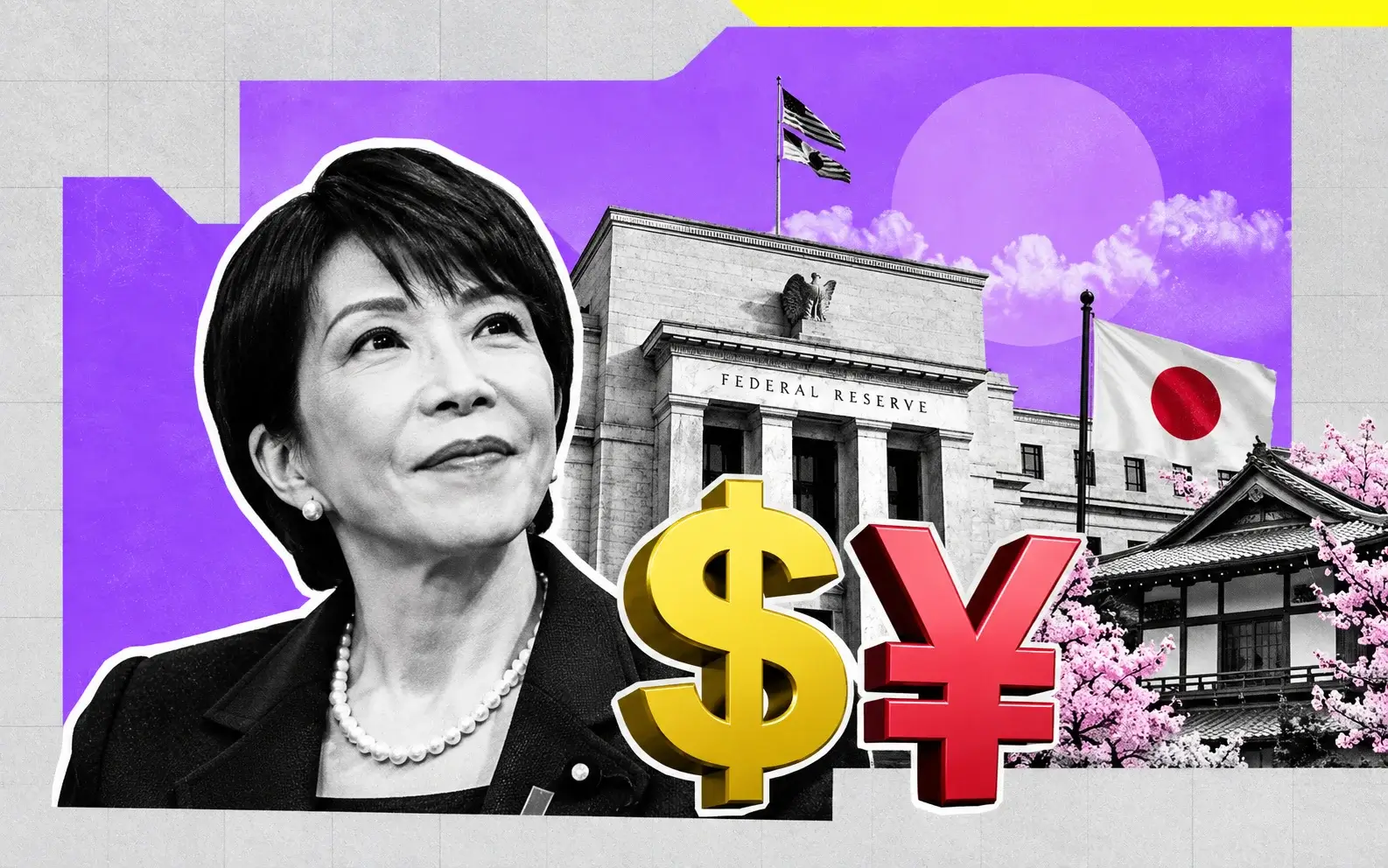
Japan's Ministry of Finance confirmed that after it bought yen in the New York market last week, the US Treasury Department also participated in buying yen through the New York Fed to curb the currency's excessive volatility and disorderly depreciation. That is the first joint US-Japan foreign exchange intervention since 1998, and it carries a policy signal far stronger than any unilateral Japanese operation.
The distinction matters more than the size. Unilateral Japanese intervention is a national treasury spending its own reserves against a global market and losing, which is exactly what happened in April and May. Coordinated intervention means the issuer of the currency being sold has publicly endorsed the operation, which removes the single largest asymmetry that carry traders have exploited for four years.
Finance Minister Satsuki Katayama stated that if the yen experiences sharp volatility again, Japan and the United States will not hesitate to take further joint action. Treasury Secretary Scott Bessent separately indicated Washington is prepared to repeat the intervention if necessary. The market cannot predict the timing or scale of what comes next, and that uncertainty is now the operative deterrent rather than any single price level.
Speculation has extended to a third participant. Reporting has raised the possibility that South Korea joined the effort, which would broaden this from a bilateral operation into something closer to a regional accord and would materially change the capital available to defend the yen.
The resource question is where skepticism enters. The US Treasury's Exchange Stabilization Fund held assets of approximately $13 billion and €25 billion. That figure alone is nowhere near sufficient for a large-scale sustained campaign against a market that turns over trillions daily. The combined resources of Japan and a potential third party change the arithmetic, but the ESF on its own functions as a signal rather than a weapon.
The tactical read from the desks is that the window is narrow. Price action alone looks like intervention, and the Ministry of Finance has a limited period to do damage on the USD/JPY chart and crack some support levels. Given that joint action with the United States remains ongoing, the pair could decline below 155 if stop losses trigger.
That is the entire near-term setup: an official campaign with a finite budget attempting to break a technical level before the market recovers its nerve.
Bessent's To-Do List Named the Size
The most unusual disclosure of the entire episode came from a photograph. Under a "To Do" heading, Treasury Secretary Bessent's list was written to read "Buy Japanese Yen (JPY) $5-10 bil." The image circulated publicly on August 1 and effectively pre-announced both the direction and the approximate scale of US participation.
Bessent had already generated headlines by saying in a Fox Business interview on Thursday that the yen is very undervalued and that excess volatility is not healthy. A sitting US Treasury Secretary describing another country's currency as undervalued is a policy statement, not market commentary, and it inverts decades of American reluctance to comment on exchange rates outside of trade disputes.
The $5 billion to $10 billion figure is small in absolute terms and enormous in signaling terms. Japan deployed roughly seven times that amount across April and May and achieved nothing durable. Washington committing a fraction of it produced a 5% three-session move, which demonstrates that the identity of the buyer matters more than the size of the order.
The strategic logic on the US side is straightforward and it is not about Japan. A collapsing yen accelerates Japanese repatriation of dollar assets, and Japan remains one of the largest foreign holders of US Treasuries. Washington does not want long-end yields rising further with the thirty-year already at 5.25%, its highest since 2007, and a stable yen reduces the pressure on Japanese institutions to liquidate dollar holdings.
There is also a trade dimension. The view has circulated for more than a year that a strong dollar undermines American manufacturing competitiveness, and an administration willing to coordinate on yen support is signaling a preference for a weaker greenback without saying so directly.
Bessent has framed the diplomatic cover explicitly. A joint statement between the US and Japan can be interpreted as saying intervention to counter foreign exchange moves out of line with fundamentals is permitted, with monetary policy remaining under the Bank of Japan's jurisdiction. That framing gives both treasuries a mandate that stops short of interfering with central bank independence.
Bessent has also acknowledged the limit of the tool, noting uncertainty over when yen carry trades peak out given that Japan-US rate differentials are set to narrow further.
The ¥11.73 Trillion Campaign That Failed
The precedent everyone is trading against is April and May of this year. Across those two months the Ministry of Finance deployed a record ¥11.73 trillion, approximately $72.8 billion to $73.5 billion, in foreign exchange intervention after USD/JPY breached ¥160. That figure was nearly double the largest prior effort in Japanese history.
The pair returned above the intervention level within six weeks. With no comparable catalysts, the largest yen-buying campaign ever executed bought roughly a month and a half of relief and nothing more. The April 30 operation alone may have consumed as much as ¥5.48 trillion, around $35 billion, just short of the ¥5.53 trillion single-day figure spent in July 2024.
The Ministry operates in multiday bursts rather than isolated single-day actions, which is why the campaign registered as sustained coordinated dollar-selling rather than a one-off shock. The market learned from it anyway. Local reporting noted that a view had spread that the 160-yen range was simply the new normal, which reads as capitulation from the participants closest to the trade.
That capitulation is what made this intervention work. Positioning had become one-sided precisely because the previous record-scale defense produced nothing durable, and one-sided positioning is what turns a $5 billion to $10 billion order into a 480-pip move.
The historical pattern reinforces the skepticism. Japan's 2024 campaigns pushed the yen up 5% from a 34-year low of 160.245 per dollar and failed to reverse the longer-term weakness. The currency resumed its slide to a 38-year low of 161.76 in July of that year, prompting another ¥5.53 trillion. The eventual sharp yen rally came from carry trade unwinding on US recession fears, not from official action.
That is the lesson embedded in every intervention: Japanese authorities can buy time and cannot buy direction. The reversal, when it arrives, comes from the rate differential closing rather than from reserves being spent.
Japan's foreign reserves have historically funded these operations at roughly $1.22 trillion, so the constraint is credibility rather than capital.
Katayama Refuses to Name a Number
Japan's Finance Ministry fired no warning shot before spending ¥11.73 trillion through May 27, and the silence around that operation was deliberate. Unpredictability has become Tokyo's primary currency defense weapon.
Katayama said Tokyo will act in foreign exchange markets at any time as needed to address excessive yen moves, including during US market holidays when trading is thinner and the yen is most exposed to one-sided positioning. She has repeatedly stated readiness to take bold action including all available measures, and has said that recent moves have been excessive and do not reflect fundamentals.
The 160 per dollar level operated as an informal threshold through most of 2026, and the April 30 intervention came after the yen breached that line. Katayama has consistently refused to ratify 160 as an official trigger, and the reasoning is sound: a confirmed threshold becomes a level the market can test with confidence, knowing exactly what response it will provoke.
On July 31 she offered traders nothing at all, declining to confirm or deny whether Tokyo had stepped in, saying only that she could say nothing at that point and that comments would come later. The yen had briefly surged to around 157 per dollar after spending much of July languishing near 163 to 164, levels last seen in 1986.
That approach has now shifted. Confirming the joint operation with Washington is the opposite of strategic ambiguity, and it reflects a calculation that the credibility gained from American participation outweighs the surprise value of silence.
The domestic policy backdrop works against her. Prime Minister Sanae Takaichi's reflationary stance and the prospect of expansionary fiscal policy sustain the carry trade incentive regardless of what the Ministry of Finance does in the market. A government committed to fiscal expansion while its central bank sits at 1.00% is producing exactly the conditions that weaken its currency.
New debt issuance for fiscal 2026 was anticipated to slightly exceed the ¥28.6 trillion sold in the prior fiscal year, roughly $182 billion. Fiscal supply of that scale pressures JGB yields higher, which helps the yen through the differential channel and hurts it through the fiscal credibility channel simultaneously.
Bessent is expected to meet Katayama with currency issues on the agenda.
The BoJ Held at 1.00% With One Dissent
The Bank of Japan held its short-term policy rate at 1.00% on July 31, the highest level since 1995, after raising it from 0.75% at the June meeting. Eight of nine board members backed the hold while one pushed for an immediate increase to 1.25%. The Bank had just tightened in June and typically pauses to observe transmission before acting again.
The vote composition tracks a hawkish drift. At the April 28 meeting the Policy Board voted 6-3 to hold at 0.75%, with three members dissenting in favor of an immediate move to 1.00%. Those three got their hike in June. One dissenter now wants 1.25%.
The quarterly Outlook Report published alongside the decision upgraded Japan's fiscal 2026 GDP growth forecast to approximately 0.8% from the 0.5% projected in April, while trimming the inflation forecast modestly. Governor Kazuo Ueda's press conference leaned hawkish despite the decision itself being a hold.
The forward path is where the yen's medium-term case sits. Most economists expect one more 25 basis point hike to 1.25% before the end of 2026, with September and October flagged as the likely windows. The Reuters poll conducted July 23 found 70% of economists see rates reaching at least 1.50% by the second quarter of 2027, with 51% treating that as the terminal rate.
The data feeding those decisions arrives on a fixed schedule. Japan's July inflation figures land August 21 and August's data follows September 18, both landing directly ahead of the meetings where a hike is expected.
Spring wage negotiations produced solid increases in 2026, with major companies agreeing to meaningful pay rises, supporting the Bank's view that a positive wage-price cycle is underway. That is the precondition Ueda has repeatedly named for sustained normalization.
The tension is that a hold decided by nine central bankers in Tokyo can move the currency 1% in minutes depending on the governor's language, and Ueda has been managing that constraint while the yen sits near 40-year lows. Higher rates narrow the US-Japan differential and support the currency directly, which is why a further yen decline ahead of any meeting adds to the case for tightening.
The BoJ's sluggish pace has been the yen's core problem all year.
Core CPI at 1.6% Is Below Target and Rising
Japanese core CPI, which strips out volatile fresh food prices, came in at just 1.6% in July. That sits below the Bank of Japan's 2% target and it is the number that justifies the hold to the eight members who voted for it.
The Bank's Outlook Report expects inflation to move well above 2%, with the jump starting in the second half of fiscal 2026, which for Japan runs from September through next March. Three drivers were identified: companies passing wage increases through to selling prices, crude oil prices climbing across the year, and a weaker yen making imports more expensive. The Bank expects the pace of price increases to ease back toward 2% after that.
The third driver is the one that creates the policy trap. A weak yen imports inflation, which builds the case for a rate hike, which would strengthen the yen. The Bank has been slow to close that loop, and the currency has been punished for the delay. Every month the BoJ waits, imported inflation rises and the differential that caused the weakness stays intact.
Monday's collapse in crude complicates the projection. West Texas Intermediate fell 6.21% to $79.41 and Brent shed 5.11% to $83.24 on the Iran de-escalation. Japan is among the most energy-import-dependent major economies, and a sustained decline in crude removes one of the three pillars underneath the BoJ's above-2% inflation forecast.
That cuts directly against the yen. Lower imported inflation reduces the urgency for a September or October hike, which preserves the rate gap, which restores the carry trade. The commodity move that lifted every risk asset on Monday is quietly bearish for the currency that rallied 5%.
Japan's exposure runs deeper than prices. Heavy reliance on Middle East oil combined with dependence on US security support places Tokyo in a delicate diplomatic position, particularly after Washington initially urged Japan to deploy warships to the Strait of Hormuz before retracting the request.
The wage-price cycle remains the Bank's anchor. If shunto increases keep feeding through to selling prices, the 1.6% core reading rises toward target regardless of what crude does.
The Rate Gap Is Still 250 Basis Points
The Federal Reserve holds its target range at 3.50% to 3.75%. The Bank of Japan sits at 1.00%. That leaves a differential of 250 to 275 basis points, down from as much as 300 basis points when the BoJ was at 0.75%, and it remains the single mechanical force driving this pair.
The curve widens the incentive further. The two-year Treasury yields 4.25%, the ten-year 4.69% after topping 4.73% on Friday, and the thirty-year 5.25%, the highest long-bond yield since 2007. Funding in yen at 1.00% and investing across that curve generates carry of 325 basis points at the front and 425 at the long end before any hedging cost.
No intervention closes that gap. Spending $73 billion did not close it in April and May, and spending $5 billion to $10 billion will not close it now. What closes it is the Fed cutting or the BoJ hiking, and neither is scheduled to happen this quarter.
The Fed is moving the wrong direction for yen bulls. The July 29 decision held rates for a fifth consecutive meeting on a 9-3 vote, the most divided FOMC since September 2016, with all three dissents favoring an immediate hike. CME FedWatch prices a 64.5% probability of a September increase. Chair Kevin Warsh offered no forward guidance, which the market initially read as dovish and which the ISM Manufacturing print at 55.6, its strongest since May 2022, immediately contradicted.
The data has cut both ways. June PCE fell 0.1% with core rising 0.1%, both below expectations. Preliminary second-quarter GDP came in at 1.5% against 2.1% expected. June payrolls printed just 57,000 with unemployment at 4.2%. Those readings support a hold. The ISM Employment Index crossing into expansion at 52.8% for the first time in 33 months supports a hike.
If the Fed delivers in September while the BoJ waits until October, the differential widens back toward 275 to 300 basis points and the carry trade reloads at better levels than it had before.
ING has warned USD/JPY could reclaim 160.00 absent more aggressive Bank of Japan tightening. That is the base case if nothing changes on either side.
Read More
-
Yen Stalls at 160 Despite a 3% JGB and Tokyo Core CPI at 2.0% — Intervention Sits at 164, Friday's Payrolls Decide
02.09.2026 · TradingNEWS ArchiveEnergy
-
CHAT Fund Holds $96.37 as Korean Memory and Chip Exposure Drive a 109.73% Year — Break of $98.02 Opens $105.20
18.09.2026 · TradingNEWS ArchiveStocks
-
First-Generation XRPR and XRPI Ride XRP's Rebound to $1.386 as Spot Funds Post First Outflow — Break of $1.40 Opens $1.54
18.09.2026 · TradingNEWS ArchiveCrypto
-
NG Holds $2.9255 as Storage Surplus Narrows From 5.5% to 3.7% in 3 Weeks — Break of $3.00 Opens $3.15
18.09.2026 · TradingNEWS ArchiveCommodities
-
Dollar Surges to 157.90 as BoJ's Divided Hike Fails to Lift the Yen — Break of 158.87 Opens 159
18.09.2026 · TradingNEWS ArchiveForex
Repatriation Is the Yen's Structural Ally
The one force working for the yen that operates independently of both central banks is Japanese capital coming home. Japanese investors sold $29.6 billion of US debt in the first quarter of 2026 alone as domestic yields rose, removing a historically reliable buyer from a Treasury market already navigating large fiscal deficits.
The arithmetic driving that shift is decisive. When a JGB pays 2.9% unhedged, the case for owning a Treasury at 4.6% with currency risk and hedging costs collapses. Hedging a dollar bond back into yen consumes most of the nominal spread, and once the domestic alternative clears 2.5% the trade stops working for Japanese institutions.
Life insurers' foreign holdings sit at roughly 40% of their peak as rising domestic rates depress purchases. That is not a tactical reallocation. It is a structural rerating of the entire Japanese institutional balance sheet, and it produces persistent yen buying as maturing dollar assets get redeployed at home rather than rolled.
The mechanism runs the opposite direction from intervention. Official yen buying is finite, announced, and reversible. Repatriation is continuous, unannounced, and compounds as JGB yields rise. Every BoJ hike accelerates it.
That is the reason the long-term outlook stays supportive for the yen even as the short-term picture depends on intervention. In the near term the probability of further official action remains high because the differential has not closed. Over a longer horizon the flow does the work.
The complication is the feedback loop into Washington's calculus. Japanese selling of Treasuries pushes US long-end yields higher, which widens the differential, which weakens the yen further, which accelerates the selling. Breaking that loop is the strongest argument for why the US Treasury joined this intervention, and it explains why Washington's participation is more credible than a one-off gesture.
Carry trade positioning remains largely intact despite the 5% three-session move. Four consecutive profitable years produce conviction that a single week does not dislodge, and the relatively contained recovery back toward 156.70 from 155.20 suggests short-yen books reduced rather than reversed.
If those positions reload, the intervention becomes another entry point rather than a turning point.
Technical Structure: 155.00 Is the Whole Argument
The pair has fallen back to a familiar area around 155, the level last tested but not broken during the previous round of intervention in April. It was tested several times through the spring and held firm, and that failure to break is one reason the earlier campaign generated no meaningful follow-through, ultimately allowing USD/JPY to resume its uptrend.
The structural line sits at 155.01. As long as that holds, the broader outlook stays bullish for the dollar even in a deep pullback, because the rise from the 2025 low at 139.87 reads as another leg of a long-term uptrend with a 61.8% projection target at 164.34.
Immediate support runs at 155.80 to 156.00, then the strong zone at 154.80 to 155.00. A close below the 156.60 Fibonacci retracement adds weight to the bearish read and extends late-July losses below 156.00 toward that zone. A decisive break under 155 opens 152.50, then 152.00, with 150.00 as the deeper test and 149 marking the lower boundary of the 2022-2026 channel.
Resistance stacks quickly. The first band is 157.20 to 157.50, the level that broke on the way down. Above it, 158.00 is the confirmation gate: holding above it opens room toward 160.00. Beyond that sit 161.00, 161.80, and 164.00, with a close above 164 opening the channel's upper boundary near 170.
The retracement math off the recent range is precise. The 38.2% retracement of the move from 155.01 to 162.83 sits at 159.84, which is where any genuine recovery meets its first structural test.
Momentum argues for a bounce before further downside. The pair is technically oversold with RSI below 30 and price under the lower Bollinger Band, and already-oversold daily stochastics could limit initial tests of the lows in fresh short-covering before lower levels attract. Daily readings continue tracking lower and weekly charts are deteriorating, which points to room for further losses in coming sessions.
Model projections cluster below spot. The one-day target sits at 156.5675, the seven-day at 155.7750, and the one-month at 154.8128, roughly 1.49% under the reference near 157.16. Daily realized volatility runs about 0.77%.
The Snapback Question Into Friday's Payrolls
Five consecutive days of US labor data now confront a central bank that just stopped providing hints about its next move, and that calendar is what decides whether the intervention holds.
The sequence runs through the week. Tuesday brings JOLTS job openings. Wednesday delivers the ADP national employment report at 8:15 a.m. ET alongside ISM services at 10:00 a.m. Thursday carries jobless claims and preliminary second-quarter productivity. Friday August 7 lands July nonfarm payrolls, the unemployment rate, and average hourly earnings at 8:30 a.m.
The asymmetry is unusual. A soft payrolls print, following June's 57,000, cuts September hike odds from 64.5% toward 40%, pushes the dollar index through the 99.30 support that marks the 38.2% retracement of the 2026 advance, and hands the intervention exactly the follow-through it needs to crack 155. Combining official yen buying with a dovish repricing is the only configuration that produces a durable break.
A strong print does the opposite and does it quickly. September hike odds above 75%, with the ISM Employment Index already at 52.8%, restores the 250-basis-point differential as the dominant driver and puts 158.00 back within a session. The carry trade reloads at a 5% better entry than it had a week ago.
Month-end and early-month flows add noise. The first trading day of a month brings position adjustments and directional probes that can temporarily overwhelm technical patterns, and distinguishing a liquidity-driven spike from a sustained move requires follow-through, volume, and a successful retest.
The trading framework the desks have adopted is explicit about the risk. Traders are advised to avoid USD/JPY during intervention headlines, reduce leverage, and require confirmation, because the pair carries unusually high headline risk relative to any technical setup. The dollar index at 100.00 is the immediate reference, with 100.50 the first upside confirmation zone.
Long positions remain viable while USD/JPY holds above 156, with an estimated pivot at 157.85. That framing treats the intervention as a correction inside an uptrend rather than the start of a reversal, which is what the six-week round trip after the ¥11.73 trillion campaign would predict.
What Would Actually Change the Trend
Three things break the four-year uptrend, and none of them is an intervention.
The first is the Bank of Japan reaching 1.50%. Seventy percent of economists surveyed in late July see rates at or above that level by the second quarter of 2027, with 51% treating it as terminal. At 1.50% against a Fed that has stopped hiking, the differential compresses to roughly 200 basis points, and carry economics deteriorate enough that leveraged positions stop paying for the volatility risk. A move to 1.25% in September or October is the first step and it is not sufficient on its own.
The second is the Fed cutting. That is not on the table with a 64.5% implied probability of a September hike, three FOMC dissents demanding one, and ISM Manufacturing at 55.6 with Prices at 71.1%. The dovish scenario requires the labor market to break, and June's 57,000 payroll print is the only evidence so far that it might.
The third is a disorderly carry unwind. That is what produced the sharp 2024 yen rally, when traders aggressively unwound positions after data raised the prospect of a US downturn. It happens fast, it happens without warning, and it does not require any central bank to act. The current setup, with positioning reduced but intact and official buyers active in the market, is the configuration where a data shock cascades.
Base case holds USD/JPY between 154.80 and 160.00 through August with the balance tilted toward the upper half. Spot near 156.50 sits 1.1% above the 155.00 defense line and 2.2% below 160.00.
The bear path needs 155.01 to fail on a closing basis, which opens 152.50 for a 2.6% move and 150.00 for 4.2%. It requires a payrolls miss to combine with continued joint intervention.
The bull path needs only 158.00 to be reclaimed, which puts 159.84 and then 160.00 in play for 2.2%. Above 161.80 the pair targets the 163.99 low print and 164.34.
Watch three things. Whether 155.00 breaks or holds a third time. Whether Katayama or Bessent confirms further joint action. And whether Friday's payrolls push September Fed hike odds through 75%, because the differential, not the intervention, sets the trend.