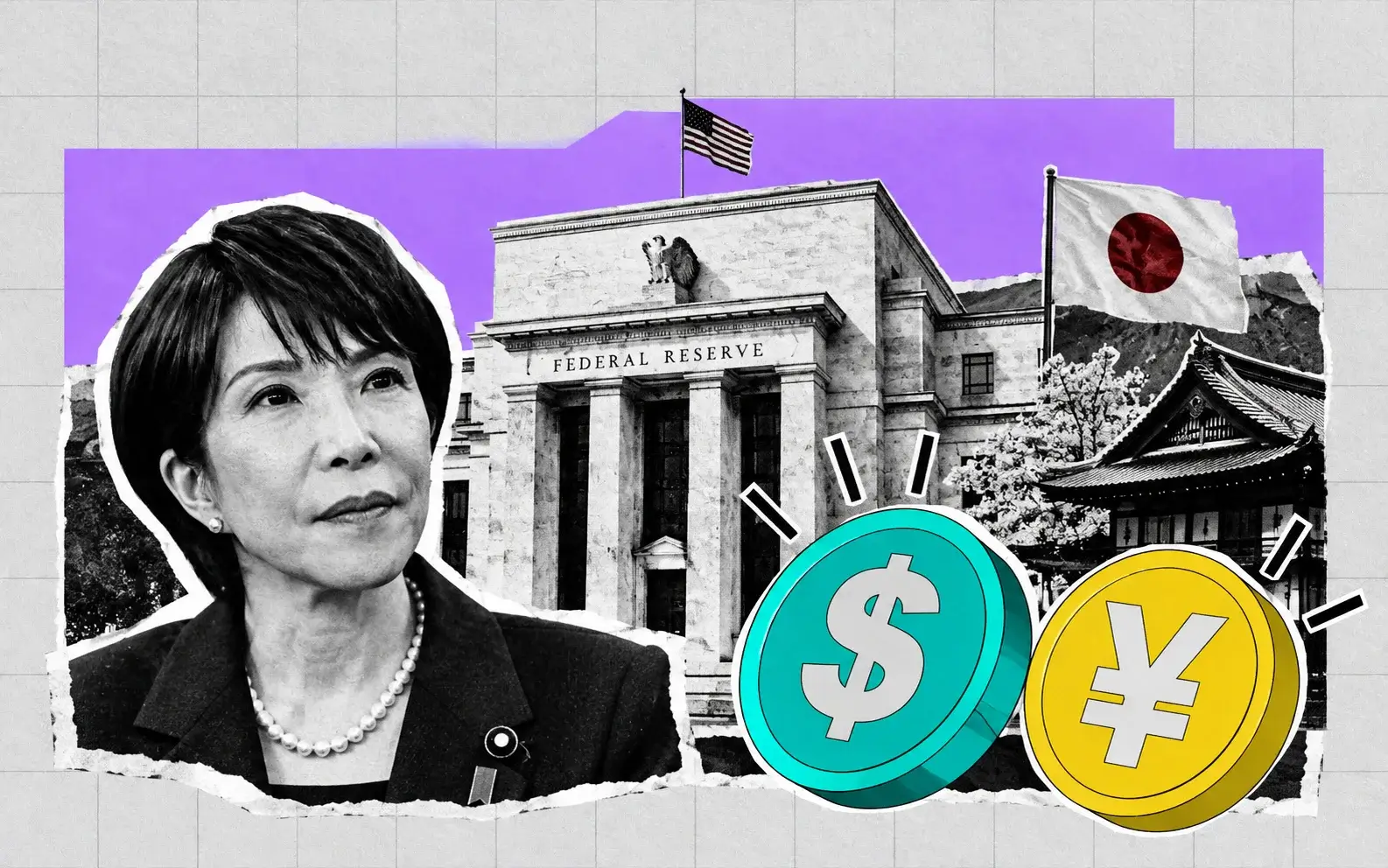
Dollar-Yen Back at 160.80 as $53B Buys 18 Hours — Resistance 163.98, Support 157.95
Bessent called the yen very undervalued and U.S. authorities ran a rate check | That's TradingNEWS
Key Points
- USD/JPY fell 3.3% to 157.95 on intervention, then reclaimed 160 within eighteen hours.
- Japan spent roughly ¥8.45 trillion, or $53 billion, in likely its largest single-day operation.
- The Fed-BoJ policy differential remains 262.5 basis points at 3.625% against 1.00%.
Dollar-yen traded 160.80 on Friday, up 0.78% on the session, less than eighteen hours after Japan executed what appears to be the largest single-day currency intervention in its history.
The overnight move was violent. USD/JPY fell as much as 3.3% during the New York session, dropping from above 163 to as low as 157.95 — the yen jumped from around ¥162.80 to the ¥157 handle inside a single hour beginning near 10:30 p.m. Tokyo time. It closed Thursday with a loss of nearly 2.5%, the largest single-day yen gain since August 2024.
Then it went straight back up. Dollar-yen rose 113 pips through the Asian session, cut through 160.00, and continued 63 pips higher before the Bank of Japan announcement. By the time Governor Kazuo Ueda finished his press conference the pair sat at 160.80.
The scale of what produced that reversal is what makes the session significant. Bank of Japan account data compared against money broker forecasts put Thursday's operation at roughly ¥8.45 trillion, or approximately $52.8 billion to $53 billion. That would be the largest single-day intervention Tokyo has ever executed, and it bought roughly six yen of appreciation that lasted less than a day.
The yen had reached a 40-year low of 164 in the prior session, with the July high printing near 163.98 after the pair tested the 164.00 area earlier in the week. Over the past four weeks USD/JPY has lost 1.19%; over twelve months it has gained 6.52%.
The Bank of Japan held its policy rate at 1% — the highest since September 1995 — following June's 25 basis point hike from 0.75%. Board member Hajime Takata proposed raising the short-term target to 1.25% and was voted down by the majority.
That combination is why the intervention failed to hold. A central bank holding at 1% against a Fed at 3.50% to 3.75% leaves a 262.5 basis point differential intact, and $53 billion of spot selling does not change a differential. It changes the price for a session.
Cross-rates confirmed the yen strength was broad rather than dollar-specific. EUR/JPY fell 1.9% Thursday and GBP/JPY lost about 1.7%, both of which have also been partially retraced.
$53 Billion Bought Six Yen for Eighteen Hours
The economics of Thursday's operation deserve to be stated plainly because they define the constraint Tokyo is operating under.
Japan spent approximately ¥8.45 trillion — around $52.8 billion — to move USD/JPY from above 163 to 157.95. That is roughly $8.8 billion per yen of appreciation. By Friday morning the pair had recovered to 160.18 and by the afternoon 160.80, meaning about half the move was surrendered inside a single session.
The comparison to prior operations shows escalating scale for diminishing effect. Ministry of Finance data showed $74.2 billion of selling in the month to May 27, and an earlier round deployed ¥11.73 trillion across April and May. Thursday's single-day figure at ¥8.45 trillion approaches those multi-week totals.
Officials have not confirmed the intervention. Nikkei and Bloomberg both reported Japan intervened, and both reported the U.S. conducted a rate check on the currency pair. Japan's Finance Minister Satsuki Katayama declined to answer questions about coordination while noting Tokyo stands ready to act urgently, and the country's FX chief offered no direct confirmation.
The timing was deliberate and it was early. One economist noted the intervention came sooner than expected given the likelihood of action after the July 30-31 meeting, and characterized it as responding carefully to signals from the Bank of Japan.
The most plausible reading is tactical rather than directional. The operation may have been conducted to create room for the BoJ to deliver a dovish hold without immediately inviting another wave of yen selling. Had intervention not occurred, leaving policy unchanged risked a far stronger market reaction and a push toward fresh multi-decade highs.
On that interpretation, the intervention worked exactly as intended. USD/JPY sits at 160.80 rather than 165, the BoJ held without triggering a crisis, and Tokyo spent $53 billion buying a policy option.
The risk for anyone chasing dollar-yen higher is that this playbook comes in waves. Japanese authorities have historically intervened across several consecutive days rather than as a single event, and a second operation from 160.80 would be considerably more effective than one from 163.
Washington Endorsed the Move and That Changes the Setup
The most consequential element of Thursday was not the size of the operation but who supported it.
U.S. Treasury Secretary Scott Bessent stated in an overnight Fox Business interview that the Japanese yen appeared very undervalued. Reports indicated U.S. authorities conducted a rate check on the pair — a direct call to dealers asking for pricing, which functions as an unmistakable signal that Washington is watching. The U.S. did not push back at all on the intervention, and Bessent appeared to endorse it.
That is a material change from prior episodes. Unilateral Japanese intervention against a passive or mildly disapproving Treasury has a poor track record because traders know the operation is unsupported and finite. Intervention conducted with explicit American verbal backing and a rate check attached carries a different implied threat: that the next operation could be genuinely coordinated with U.S. balance sheet participation.
Markets have not priced that possibility. USD/JPY reclaiming 160 within hours says traders are treating this as another unilateral Japanese operation rather than the opening move of a coordinated regime.
The strategic logic for Washington is straightforward. A yen at 164 makes Japanese exports structurally cheaper against American manufacturers at exactly the moment tariff policy is meant to close that gap. A dollar strong enough to require intervention also tightens U.S. financial conditions through the trade channel.
The complication is that American rate policy is the cause. The Fed held at 3.50% to 3.75% on July 29 in a 9-3 vote with three regional presidents dissenting for a hike, and September hike odds sit near 63%. The 10-year Treasury jumped to 4.731%, the highest since January 2025, and the 30-year hit 5.263%. Washington cannot verbally support a stronger yen while its own long end prices tighter policy and expect the currency market to respond to the words rather than the yields.
Verbal support plus a rate check plus $53 billion moved the pair six yen for less than a day. The market's read is that the words are cheaper than the differential.
The BoJ Held and Takata Voted for 1.25%
The policy decision that followed the intervention was, on its face, the dovish outcome the operation was designed to accommodate.
The Bank of Japan left the policy rate unchanged at 1%, in line with expectations, keeping borrowing costs at their highest level since September 1995 following June's 25 basis point increase from 0.75%. Board member Hajime Takata proposed raising the short-term interest rate target to 1.25%, and his proposal was turned down by majority vote.
Research desks had anticipated dissents from both Takata and Naoki Tamura. Getting one rather than two reads marginally less hawkish than positioning, which contributed to the yen giving back its gains.
The statement language shifted in a specific direction. The BoJ noted that significant downside risks to economic activity and significant upside risks to prices have both decreased, while acknowledging that a risk remains of underlying CPI inflation deviating upward above the 2% price stability target.
That formulation — risks in both directions declining, but the upside inflation risk persisting — is a central bank describing a normalizing economy rather than one requiring emergency accommodation.
Ueda reiterated in the post-meeting press conference that the year-on-year rate of CPI increase is likely to accelerate to a level clearly above 2% from the second half of fiscal 2026, before declining toward around 2% in the second half of the projection period. He said the bank expects to keep raising rates and adjusting the degree of easing in response to the economy, prices and financial conditions.
He also made the currency connection explicit, noting that recent yen falls are likely to lead to price increases mainly in durable goods. A central bank governor stating that currency weakness is feeding through to consumer prices is the closest thing to a policy signal the yen has received this cycle.
The updated projections moved higher. The Board's core CPI median forecast for fiscal 2027 rose to 2.4% from 2.3% in April, with fiscal 2028 held at 2.0%. Real GDP for fiscal 2026 was revised up to 0.6% from 0.5%.
That is a bank revising growth and inflation higher while holding at 1%. The gap between the forecasts and the policy rate is what the market is now trading.
A 262 Basis Point Gap That Neither Side Is Closing Fast
The differential is the mechanism, and it has barely moved despite both central banks tightening this cycle.
The Bank of Japan sits at 1.00%. The Fed's target range is 3.50% to 3.75%, giving a midpoint of 3.625%. The nominal gap runs 262.5 basis points in the dollar's favor. Every intervention Tokyo executes fights that spread with spot flow, and spot flow does not persist.
The forward pricing narrows it slowly. MUFG's global and Japan teams forecast the BoJ delivering faster hikes than markets price — one in September 2026 and one in January 2027 — which would take the policy rate to 1.50% by early next year. U.S. markets carry roughly 63% odds of a single September hike taking the Fed midpoint to 3.875%.
If both paths deliver in full, the differential compresses from 262.5 basis points to 237.5. That is a 25 basis point improvement across six months against a pair that has moved seven yen in the last week alone.
Real rates make the picture worse for the yen. Japanese CPI is running toward a level clearly above 2% by Ueda's own forecast, against a 1% policy rate, producing a deeply negative real rate. U.S. core PCE runs 3.3% against a 3.625% midpoint, giving a small positive real rate. On the measure that actually drives capital allocation, Japan is still easing in real terms.
MUFG's framing captures the constraint precisely: a durable retracement lower in USD/JPY requires real interest rates to rise substantially and market concerns around fiscal sustainability to be addressed. Neither condition is close to satisfied.
The long end compounds it. A 30-year Treasury at 5.263% — a 19-year high — against Japanese long yields that remain structurally suppressed by decades of accumulated Bank of Japan holdings creates an enormous term-premium incentive for Japanese institutional capital to hold dollar assets.
That is the carry trade, and it is not a speculative position. It is Japanese life insurers and pension funds funding domestic liabilities with foreign yield because domestic yield does not exist at the required level.
Energy Imports Make Japan a Structural Dollar Buyer
The flow that intervention cannot offset is commercial rather than speculative, and it has intensified all year.
Soaring LNG and petrol prices driven by the war in Iran have raised dollar bids from Japanese energy importers directly. Japan imports nearly all of its hydrocarbons, invoiced in dollars, which means every increase in the energy bill converts mechanically into yen selling regardless of what the currency is doing.
The magnitudes are large. Brent closed July at $90.36, up 22% on the month and its steepest gain since March, with WTI at $85.41. The Strait of Hormuz — which carries roughly 93% of Qatar's LNG exports and 96% of the UAE's, together about 19% of world LNG trade — is running at 30% to 35% of pre-war throughput. Iran attacked two tankers under U.S. escort on Friday.
Japan is among the world's largest LNG buyers and sources materially from Qatar and the UAE. Constrained supply through a contested strait raises both the delivered price and the freight cost of every cargo, and both are paid in dollars.
The second-order damage runs through corporate margins. Higher import costs compress Japanese manufacturer profitability, which pressures growth and reduces the case for aggressive BoJ tightening — the exact channel that keeps the differential wide.
That circularity is the trap. Energy costs weaken the yen, a weaker yen raises energy costs in local terms, higher costs pressure growth, weaker growth constrains the BoJ, and a constrained BoJ weakens the yen further. Ueda acknowledged the price transmission directly when he noted recent yen falls are feeding into durable goods prices.
The intervention arithmetic against that flow is unfavorable. Thursday's $53 billion is roughly comparable to a few months of Japan's incremental energy import bill at current prices. Tokyo can offset the flow temporarily; it cannot eliminate it without either the conflict resolving or the rate differential closing.
A durable ceasefire that collapses Brent from $90 toward $70 would do more for the yen than another $53 billion of spot intervention, and it would cost nothing.
The Food Tax Cut Is Adding Yen Supply
The fiscal channel has become the third pressure on the currency, and it accelerated this month.
Japan's domestic tax panel reiterated a proposal to cut food consumption taxes to 1% from the current 8%. That measure adds to the supply of yen through fresh debt issuance, and the market has been pricing it as a structural negative for the currency alongside energy and rates.
Prime Minister Takaichi's funding approach for the food consumption tax cut has been flagged by research desks as a key variable going forward. A tax cut funded by borrowing in a country carrying the developed world's largest debt-to-GDP ratio is a straightforward yen-negative regardless of its domestic merits.
Fiscal concerns were named explicitly alongside elevated energy costs and wide interest rate differentials as the three drivers that pushed the yen to a 40-year low earlier this month. Two of those three are policy choices Tokyo controls and has chosen not to change.
The parallel with the United Kingdom this week is close enough to be instructive. UK gilt yields hit G7 highs at 5.01% on the 10-year after a new Prime Minister invoked fiscal flexibility, and sterling fell 0.3% on the language alone. Japan faces the same dynamic without the bond market discipline, because the Bank of Japan's balance sheet still absorbs the supply that would otherwise push yields higher.
That absorption is precisely what transmits the fiscal pressure into the currency instead of into rates. A country that suppresses its bond yields while expanding its deficit exports the adjustment to its exchange rate. Japan has been running that trade for a decade and the yen is at a 40-year low against the dollar.
The intervention response is fighting the symptom. Selling $53 billion of reserves to support a currency being weakened by domestic fiscal expansion and suppressed domestic yields treats the price rather than the cause, which is why the effect lasted eighteen hours.
Resolving it requires either faster BoJ normalization that lets JGB yields find a market-clearing level, or fiscal consolidation. Neither is on the near-term agenda.
Intervention Comes in Waves, Not Single Events
The tactical risk for anyone positioned long dollar-yen at 160.80 is that Thursday was the first move rather than the whole operation.
If Japanese authorities revert to the playbook seen earlier this year, intervention comes in waves across several days rather than as a single event. That pattern was visible in the April-May episode, which deployed ¥11.73 trillion across a multi-week campaign, and in the $74.2 billion of MoF selling recorded in the month to May 27.
The risk of further operations remains elevated even though the market reaction suggests otherwise. Tokyo has demonstrated it will act from the mid-163 area, and it now has both a lower starting point and explicit American verbal support.
The strategic calculus favors a follow-up. A second intervention launched from 160.80 rather than 163.50 costs less per yen because the position is less crowded and the momentum is already broken. Authorities that spend $53 billion establishing a level rarely abandon it within a week.
What would signal the campaign has ended is price. Reclaiming 160.73 and holding above it suggests intervention-related selling has run its course, which is the threshold that would allow traders to consider fresh long positions. The pair sits at 160.80, marginally through that level, which makes Friday's close the most informative data point available.
The counterargument for a durable dollar-yen rally is the calendar. The August 7 U.S. payrolls print determines September Fed hike pricing. A firm number pushes the 10-year through 4.80% and widens the differential right into the level Tokyo just defended, which is the configuration most likely to trigger the next operation.
For risk management the practical guidance across trading desks has been consistent: avoid USD/JPY during intervention headlines, reduce leverage, and require confirmation before acting on any breakout. The pair produced a 3.3% intraday move and a 2.5% daily close on Thursday, then recovered 1.8% Friday. Normal position sizing does not survive that.
The month-end distortion adds another layer. The final trading day can produce portfolio rebalancing flows that temporarily overwhelm technical patterns, which means Friday's move requires follow-through next week to be treated as directional.
Read More
-
Yen Stalls at 160 Despite a 3% JGB and Tokyo Core CPI at 2.0% — Intervention Sits at 164, Friday's Payrolls Decide
02.09.2026 · TradingNEWS ArchiveEnergy
-
QQQI ETF Pays 13.96% While The Nasdaq-100 Rolls Over — Why Section 1256 Is Worth More Than The Yield
14.09.2026 · TradingNEWS ArchiveStocks
-
XRP ETFs Took $19M In A Week After A $110M Record — Why The Filings Tell A Different Story Than The Flows
14.09.2026 · TradingNEWS ArchiveCrypto
-
US Gas Holds $2.88 While Europe Pays $28 — Why Only A Tenth Of The War Premium Reaches Henry Hub
14.09.2026 · TradingNEWS ArchiveCommodities
-
Yen Holds Near February Highs As Tokyo Prepares Its Highest Rate Since 1995 — Why The Yield Gap Will Not Move
14.09.2026 · TradingNEWS ArchiveForex
The Carry Trade Runs Through Every Cross
The yen's weakness is not a dollar story alone, and the cross-rates confirm how broad the funding trade has become.
EUR/JPY fell 1.9% and GBP/JPY lost about 1.7% during Thursday's intervention, both moving in near-lockstep with dollar-yen. That correlation says the position being liquidated was short yen against everything, not long dollar specifically.
The rate differentials explain it. The ECB deposit rate sits at 2.25% with markets fully pricing 2.75% by early 2027 after eurozone Q2 GDP grew 0.4% and July HICP accelerated to 2.9%. UK Bank Rate is 3.75% with three MPC members voting for 4.00% and UK 10-year gilts yielding 5.01%. Against a Japanese policy rate of 1%, every major funding pair pays positive carry.
The Japanese equity market benefits from the same weakness. The Nikkei 225 rose 4.03% to 64,362.02 on Friday as part of the Asian technology rebound that also produced a record 17.91% single-day gain in Korea's Kospi. A weak yen inflates the reported earnings of Japanese exporters, which is why Tokyo equities and yen weakness have traded together throughout this cycle.
That linkage is a genuine political constraint on intervention. Successfully strengthening the yen toward 150 would remove a substantial portion of the translation benefit currently supporting Japanese corporate earnings and the index.
The carry trade's vulnerability is that it unwinds violently rather than gradually. Thursday's 3.3% intraday move happened without any change in fundamentals — one operation forced a cascade through stop levels across every yen cross simultaneously. The August 2024 episode that produced the last comparable single-day yen gain triggered a global risk unwind that took weeks to resolve.
Nothing comparable happened this time. The move was absorbed inside a session and reversed inside a day, which indicates positioning was cleaner going in than it was in 2024.
Cleaner positioning cuts both ways. It means less fuel for a squeeze, and it means the pair can rebuild the short-yen position from here without hitting congestion.
The Technical Map: 160.73 Decides the Next Leg
The chart carries one level that separates continuation from reversal, and price is sitting on it.
USD/JPY trades 160.80 against a Thursday low of 157.95 and a prior-session high of 164 — a 40-year peak. The July high printed near 163.98 with the pair testing the 164.00 area, and the weekly range before intervention ran roughly 163.25 to 164.00.
The immediate reference is 160.73. Reclaiming and holding above it suggests intervention-related selling has run its course and reopens the upside. The pair closed the Asian session marginally through it, which makes the level a live retest rather than a settled break.
Resistance above runs at 162.80, where Thursday's collapse began, then 163.98 and the 164.00 four-decade high. Clearing 164 puts the pair into price discovery with no historical reference above it, which is the specific scenario Tokyo intervened to prevent.
Support is defined by the intervention itself. The 158 handle marks Thursday's low at 157.95 and is now the level authorities have implicitly defended. Below it, 156.10 and 153.08 appear on forecast paths, and 152.70 from February 14 is the year's low.
Moving average structure remained bullish through the shock. As of July 27 the pair traded near its 8-day EMA, 0.55% above the 21-day, 1.14% above the 50-day and 1.87% above the 100-day. Thursday's drop tested but did not break that alignment, and Friday's recovery restored it.
The dollar index provides the cross-check. Traders are watching 100.00 as immediate support with 100.50 as the first upside confirmation zone. DXY holding 100.00 and clearing 100.50 supports dollar longs broadly; losing 100.00 without reclaiming it flips the setup.
The path since February frames the trend. USD/JPY bottomed at 152.70 on February 14 and has climbed roughly 7.2% since, oscillating between ¥152 and ¥160 through the first quarter, trading ¥155-159 in March, reaching ¥159.46 by late May, and pressing toward 164 in July. That is a persistent uptrend with a single sharp countertrend event.
One session of intervention has not broken it.
Forecast: 160.73 Holds or Tokyo Comes Back
The base case into the first two weeks of August is range trade between 158 and 163, with direction set by U.S. payrolls on August 7 and by whether Tokyo executes a follow-up operation.
The bull path for the dollar requires only continuation. The differential sits at 262.5 basis points and neither central bank is closing it quickly. The 10-year Treasury at 4.731% and the 30-year at 5.263% keep Japanese institutional capital flowing into dollar assets. Energy importers remain structural dollar buyers with Brent at $90.36 and Hormuz at a third of capacity. The food consumption tax cut adds yen supply through fresh debt. A firm August 7 payrolls print takes September Fed hike odds toward certainty and pushes the pair back through 162.80 toward 163.98 and the 164 high. Published paths carry 161.18 in one month.
The bear path needs Tokyo rather than the data. A second intervention wave launched from 160.80 — cheaper per yen than Thursday's from 163.50 — would be considerably more effective, particularly with American verbal backing and a rate check already on the record. Below 157.95 the market would have to price a genuinely coordinated regime rather than a unilateral operation. Faster BoJ normalization is the durable version: MUFG models hikes in September 2026 and January 2027 taking the policy rate to 1.50%, which underpins a move below 160 over time. Quarterly forecast paths carry 159.12 by September, 157.82 by December and 156.10 by March 2027.
The structural read is that intervention treats the symptom. A durable retracement requires Japanese real rates to rise substantially and fiscal sustainability concerns to be addressed, and Ueda held at 1% while revising fiscal 2027 core CPI up to 2.4% and fiscal 2026 GDP up to 0.6%. A central bank raising its forecasts without raising its rate is the entire yen problem in one decision.
Targets: upside 160.73, then 162.80, then 163.98 and 164.00 on a confirmed reclaim. Downside 159.00, then 157.95, then 156.10 and 153.08 on a break.
Dollar-yen enters August above 160 having absorbed a $53 billion intervention in a single session, with a 262.5 basis point differential intact, Brent at $90.36, and Tokyo holding a playbook that historically comes in waves.