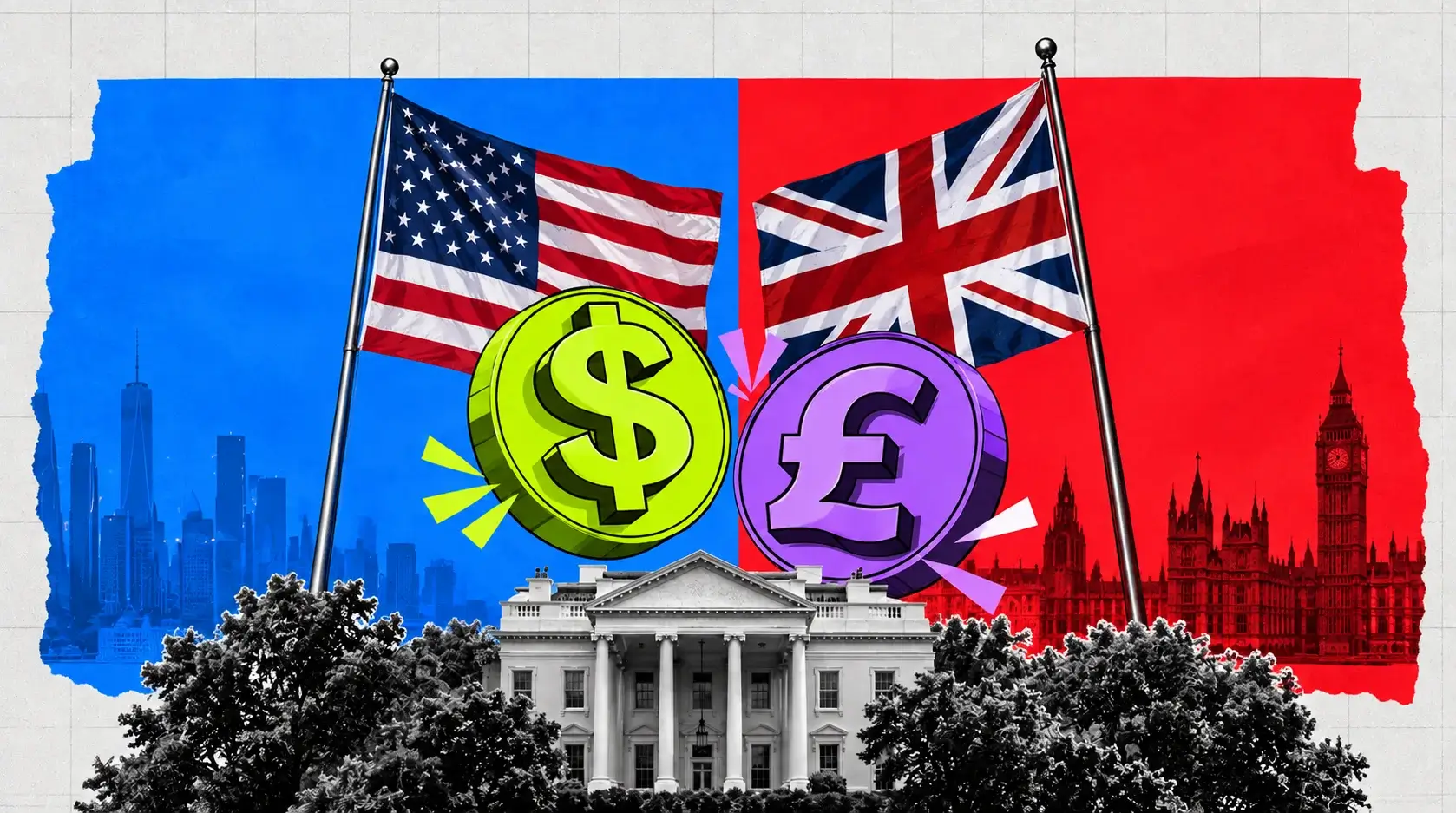
GBP/USD Price Forecast: Pound at 1.3392 Targets 1.3300 Support and 1.3200 Extension as DXY Breaks 99.13
Sterling extends its decline as the 1.341 rising channel support breaks and the 0.382 Fibonacci level near 1.3390 gives way | That's TradingNEWS
Key Points
- GBP/USD at 1.3392 down 0.31%; broke 1.3400 to six-week lows. Targets 1.3350, 1.3300, then 1.3200 extension.
- DXY broke 99.13 pivot targeting 99.40-99.66; 30-year U.S. yield hit 5.19% — highest since 2008 financial crisis.
- UK jobs market cracked in March, wage growth softened; BoE hike case weakened as pound trades like EM currency.
The pound is breaking down in textbook fashion, and the tape is forcing every G10 desk to rebuild the cable thesis from the ground up. GBP/USD is trading at 1.3392 during the New York session on Tuesday, May 19, 2026, down 0.31% intraday after touching a session high of 1.3437 and rolling over decisively below the 1.3400 psychological floor. The pair has collapsed from Monday's optimistic recovery toward 1.3450 to fresh six-week lows, fully reversing the bullish key reversal candle that printed on the daily chart yesterday and confirming the bearish continuation pattern that has been forming since the late-April peak near 1.3600. Sterling has now cracked through the 1.341 rising channel support that defined the entire April-May structure, and the trendline break is the cleanest technical signal traders have seen in the cross since the gilt rout began. The Greenback's strength is brutal, broad, and accelerating. The DXY has ripped through the 99.13 pivot to print a new ascending channel breakout with the Fibonacci extension zone at 99.40-99.66 as the next magnet. The combination of soaring U.S. Treasury yields, hot U.S. inflation data, a deteriorating UK labour market print, and a Bank of England that has gone hawkish but not hawkish enough to defend the currency has produced the most asymmetrically bearish setup on GBP/USD since the 1.20 lows of late 2022. Sterling is now the second-weakest G10 currency against the dollar year-to-date, and the textbook relationship between rising gilt yields and currency strength has completely broken down.
The Macro Catalyst: Hot U.S. Inflation Killed the Rate-Cut Trade
The proximate driver of Tuesday's collapse in GBP/USD is the repricing of Federal Reserve expectations after a Producer Price Index print of 6% — the hottest reading in nearly four years. That single data point has done more damage to the dovish Fed thesis than any other release in 2026. The market had spent most of the year quietly preparing for the wrong policy regime, pricing two rate cuts before year-end based on the assumption that the Fed would tolerate above-target inflation rather than push the economy into recession. The PPI print blew that assumption apart. Combined with persistent shelter inflation showing through in April CPI and a partial recovery in oil prices that is now feeding through to broader pipeline pressure, the path to rate cuts has effectively been postponed indefinitely. CME FedWatch now shows 53% probability of a hold at the next meeting and 47% pricing in a potential hike — a complete inversion of the cut-cycle narrative that defined the first quarter.
The repricing has crushed every short-dollar position simultaneously. Treasury yields at the long end have exploded higher, with the 30-year punching above 5.19% — the highest level since before the 2008 financial crisis — and the 10-year climbing to 4.674%. When the long end of the U.S. curve is pricing in a structural inflation premium of this magnitude, every G10 currency that is not actively hiking faster than the Fed gets pulverized. Sterling is in the worst possible position because the Bank of England has been openly debating rate hikes while UK labour market data is simultaneously deteriorating — the textbook stagflationary setup that destroys currency credibility.
UK Labour Market Crack: The March Print That Broke the Pound
The UK unemployment release confirmed that the labour market deteriorated in March, adding negative pressure on GBP/USD at exactly the moment the pair was most vulnerable to a credibility shock. The Tuesday morning print showed unemployment rising and the average weekly earnings excluding bonuses figure — the single most important release the BoE watches for domestically generated inflation — coming in soft enough to undercut the case for the two additional Bank of England hikes that markets had been pricing for the rest of 2026. The deterioration matters disproportionately because the BoE's tightening case has rested entirely on the assumption that wage growth would remain sticky enough to force policy action. Without that wage signal, the central bank loses its anchor for further hikes — but the inflation problem from imported energy costs does not disappear. That is the worst possible combination for sterling: dovish data on the labour side, hawkish data on the energy side, and a central bank caught between supporting growth and defending the currency.
The political backdrop is compounding the damage. Labour leadership challenger Andy Burnham helped ease fiscal fears Monday by ruling out changes to Chancellor Rachel Reeves' fiscal rules if he becomes PM, which briefly relieved pressure on long-end gilts. But the relief proved short-lived. Tuesday's data has reignited the underlying concerns surrounding Britain's fiscal outlook, political instability, and inflation risks. The headlines about gilt yields hitting the highest levels since the 1990s have not gone away — they have just rotated into the FX market.
Sterling Is Starting to Trade Like an Emerging-Market Currency
The single most important narrative shift in the GBP/USD market over the past month is the breakdown of the rising-yields-equals-stronger-currency relationship. In a normal G10 environment, higher UK gilt yields should translate to a stronger pound through the interest-rate-parity channel. Instead, every gilt yield spike has been met with sterling weakness because the market is pricing the yield increases as a credit-risk premium rather than a policy-driven move. That is the same dynamic that defines emerging-market FX behavior. When investors demand higher yields to hold a country's debt because they are worried about fiscal sustainability, the currency weakens rather than strengthens — exactly the opposite of the G10 textbook. Sterling cracking through 1.3400 to its lowest level since early April confirms that the EM-style trading pattern has become the dominant regime, not a temporary aberration.
DXY Breakout Is the Single Biggest Headwind for GBP/USD
The U.S. Dollar Index technical setup is unambiguously bullish. The 4-hour chart shows powerful green engulfing candles that have broken above the 98.80 red 50-period moving average and the white descending trendline that capped every dollar rally through April. The clean breakout into the new blue ascending channel features higher highs and higher lows from the May lows, with the 99.00 pivot decisively reclaimed and the RSI pushing above 55 to confirm the momentum shift. The Fibonacci extension from April projects the 99.40-99.66 zone as the next resistance target, and a break above that band opens the path to 100.60 — a level the DXY has not seen since late 2022. The volume profile shows buyers in clear control with 98.80 becoming the new dynamic floor. Every dollar rally over the past three weeks has been bought aggressively. Every dollar dip has been shallow and short-lived. That structural bid is the single biggest reason GBP/USD cannot sustain any meaningful bounce.
The 1.3400 Breakdown Is Technical Confirmation of the Bearish Thesis
The GBP/USD chart is now in confirmed bearish continuation mode. The red candles on the 2-hour timeframe have broken below the white ascending trendline support and the 0.382 Fibonacci retracement level near 1.3390, which sits perilously close to current spot. The recent break down from the 1.3600 high is the textbook lower-high, lower-low structure that defines downtrends. The 1.345 red moving average is now functioning as dynamic overhead resistance, and the RSI has slipped below 50 — confirming bullish momentum has fully evaporated. The volume profile shows 1.344 as a failed fair-value zone, meaning the buyers who tried to hold that level have been overrun. The next major support cluster sits at 1.335-1.339. A break below 1.341 flips the structure decisively bearish, and that line is now firmly behind the market.
The bullish key reversal that printed on Monday's daily chart — the one that had pound bulls excited about a recovery toward 1.3500 and 1.3550 — has been completely invalidated by Tuesday's price action. The pair was supposed to rest on the confluence of the 50-day and 200-day moving averages and use that base for a push toward the 100-day MA at 1.3500. Instead, the cross was rejected hard at 1.3437 and is now testing the levels that would normally come into play only after a sustained breakdown. The headline-driven environment that David Scutt at FOREX.com flagged as a genuine risk of a false bullish signal has played out exactly as warned. The setup now reverses: shorts can be considered on rallies into the 50/200-day MA zone with stops above for protection, targeting Monday's low of 1.3304 initially and the early-April lows below 1.3300 as the next major magnet.
Bank of England's Hawkish Pivot Is Not Enough to Defend Cable
Markets are pricing at least two more Bank of England rate hikes by year-end, and BoE rate-setter Megan Greene has explicitly warned policymakers can no longer afford to "look through" successive supply shocks. That hawkish messaging would normally be supportive for GBP/USD — but the cross has just collapsed despite it. The reason is straightforward: the Fed is repricing toward hawkish hold or potential hikes faster than the BoE is repricing toward additional tightening. The rate differential is moving against sterling, not in favor of it, even as both central banks make more hawkish noises. UK CPI data due 24 hours after the labour market print will be the next major test. The market will be watching whether higher energy prices are bleeding through supply chains into broader pricing behavior, with the core, services, and producer price measures carrying the heaviest signal weight. If UK services inflation continues to stick above 4%, the BoE rate path holds. If it softens, sterling has nothing left to defend it.
Fed Governor Christopher Waller's upcoming speech is the wildcard. His views on the inflation impulse hitting the U.S. economy and any potential changes to the FOMC's monetary policy framework — including the possible shift in inflation measurement that has been quietly discussed — could either accelerate or pause the dollar rally. A more hawkish Waller takes GBP/USD through 1.3300 quickly. A dovish surprise from Waller might generate a relief bounce toward 1.3450-1.3500, but the structural setup remains bearish until the macro picture shifts.
The Iran Conflict and Oil Channel Is Compounding the Damage
The broader macro environment is exactly the wrong backdrop for sterling. The Iran conflict that began on February 28 has pushed Brent crude above $110 and is now feeding through to UK inflation through both direct fuel costs (UK petrol at 158.5p per litre, the highest level since the war began, with diesel at 185.9p) and broader supply-chain pressure. The IEA has warned that Europe has roughly six weeks of jet fuel remaining at current consumption rates, and the UK government has formally authorized airlines to cancel summer flights in advance if fuel shortages materialize. That kind of operational stress is structurally negative for sterling because it threatens consumer spending power, corporate margins, and the broader UK growth outlook all at the same time. Trump's overnight postponement of the planned Iran strike — at the request of Qatar, Saudi Arabia, and the UAE — has done nothing to compress the geopolitical premium because the Strait of Hormuz remains effectively closed and JP Morgan expects oil above $100 for the rest of 2026.
Read More
-
Yen Stalls at 160 Despite a 3% JGB and Tokyo Core CPI at 2.0% — Intervention Sits at 164, Friday's Payrolls Decide
02.09.2026 · TradingNEWS ArchiveEnergy
-
Rocket Lab Fund Captures Neutron Delay as RKLB Slides 17.5% in Two Days — $50 RKLB Floor Defines Next Move
15.10.2026 · TradingNEWS ArchiveStocks
-
XRPI and XRPR Follow XRP Off the $1.29 Floor as the Only Crypto ETF Group Still Taking In Money — $1.42 Upside, $1.20 Risk
15.10.2026 · TradingNEWS ArchiveCrypto
-
Henry Hub Climbs to $3.26 as Storage Build Falls 23 Bcf Short of Normal — Break of $3.283 Opens $3.50
15.10.2026 · TradingNEWS ArchiveCommodities
-
Dollar Retreats to 157.79 From 159.00 High as Yields Fall and Tokyo Guards 160 — Range Holds Into Fed and BoJ
15.10.2026 · TradingNEWS ArchiveForex
Sterling Crosses Show the Same Story
The relative weakness in GBP/USD is being mirrored across sterling crosses. GBP/JPY is trading around the 213.00 mark, eroding part of Monday's recovery gains from a one-and-a-half-week low, with the cross attracting fresh sellers in the mid-213.00s despite a broadly weaker yen. The fact that sterling cannot rally meaningfully against an even weaker JPY tells the structural story cleanly. GBP/AUD sits near 1.8775, eyeing the downtrend from the late-March swing high at 1.9400, with minor resistance at 1.8825 as the immediate trend-break test. The setup on GBP/AUD is the only sterling cross showing constructive structure, but even there the bullish momentum signals from RSI and MACD have not yet confirmed.
Fibonacci Levels and Volume Profile Confirm the Bearish Setup
Beyond the obvious psychological round numbers, the Fibonacci structure on GBP/USD is decisively bearish. The 0.382 retracement near 1.3390 has now been tested and is being violated as support, opening the path to the 0.500 retracement near 1.3350 and the 0.618 golden-ratio level near 1.3300. A break below 1.3300 removes the last major technical defense before the early-April lows in the 1.3200 zone come into play. The volume profile shows clear distribution wicks on the recent attempts to hold above 1.3400, indicating that institutional selling has been absorbing every retail bid into the rally attempts. That is the hallmark of a distribution phase rather than an accumulation phase, and it strongly suggests the path of least resistance remains lower.
What Would Invalidate the Bearish Case
The bear thesis on GBP/USD can be neutralized by three specific catalysts. First, UK CPI tomorrow printing materially above consensus — particularly in the services and core components — would force markets to fully price in the two BoE hikes that are currently only partially in the curve, generating a relief rally toward 1.3500. Second, a dovish surprise from Fed Governor Waller's upcoming speech could compress the DXY rally and allow cable to retest 1.3450-1.3500 as resistance. Third, a verified Iran ceasefire with reopened Strait of Hormuz transit would compress the broader risk-off bid for the dollar and provide a tactical floor for sterling. None of these three catalysts are currently base-case, but they are the cleanest invalidation triggers to monitor.
What Confirms the Bearish Continuation
The bear case strengthens if (a) UK CPI prints soft on the services side, removing the BoE rate-hike anchor, (b) Waller delivers hawkish messaging that reinforces the DXY breakout, and (c) the 30-year U.S. yield extends above 5.30% toward the 5.50% zone that would mark a generational shift in the long-end of the curve. Any two of those three confirming would take GBP/USD through 1.3300 quickly and open the path to the 1.3200 and 1.3100 zones over the medium term.
The Verdict: Sell GBP/USD on Rallies Toward 1.3450-1.3500
The setup on GBP/USD is unambiguously bearish across every timeframe that matters for capital deployment. The pair has cracked the rising channel support at 1.3410, broken below the 0.382 Fib retracement, lost the 50-day and 200-day moving average confluence on a closing basis, printed lower highs and lower lows since the 1.3600 late-April peak, and is now grinding into multi-week lows at 1.3392 with the 1.3300 psychological floor as the next major test. The DXY breakout above 99.13 is structurally bullish for the dollar with 99.40-99.66 as the next target and 100.60 thereafter. UK labour market deterioration has undermined the BoE rate-hike case, while the 30-year U.S. yield at 5.19% and the 10-year at 4.674% are forcing global capital into dollar-denominated assets and out of every G10 currency that is not actively defending its rate differential.
The actionable call on GBP/USD is Sell for short-term tactical exposure. Sell rallies into the 1.3445-1.3500 band with stops above 1.3550 for protection. The immediate downside target is 1.3350-1.3360, the medium-term target is 1.3300 (the early-April low), and the extension target is 1.3200 if the macro setup remains hostile. Dips into 1.3300 can be tactically covered, but the structural bias remains lower until either UK CPI surprises decisively to the upside or the Fed pivots dovish. The risk-reward is clean: roughly 50-80 pips of upside risk on a stop versus 150-200 pips of downside potential to the 1.3200 target. The bullish thesis on sterling is not dead — it is just deferred until either the BoE delivers explicit defense of the currency through hawkish forward guidance or the dollar rally exhausts itself against a Fed dovish pivot. Until one of those two catalysts materializes, GBP/USD is a sell on every rally, and the path of least resistance is toward 1.3200 over the medium term. The UK has lost the relative-yield argument, lost the labour-market argument, and lost the political-stability argument simultaneously — and the pound is now paying the price in real time.