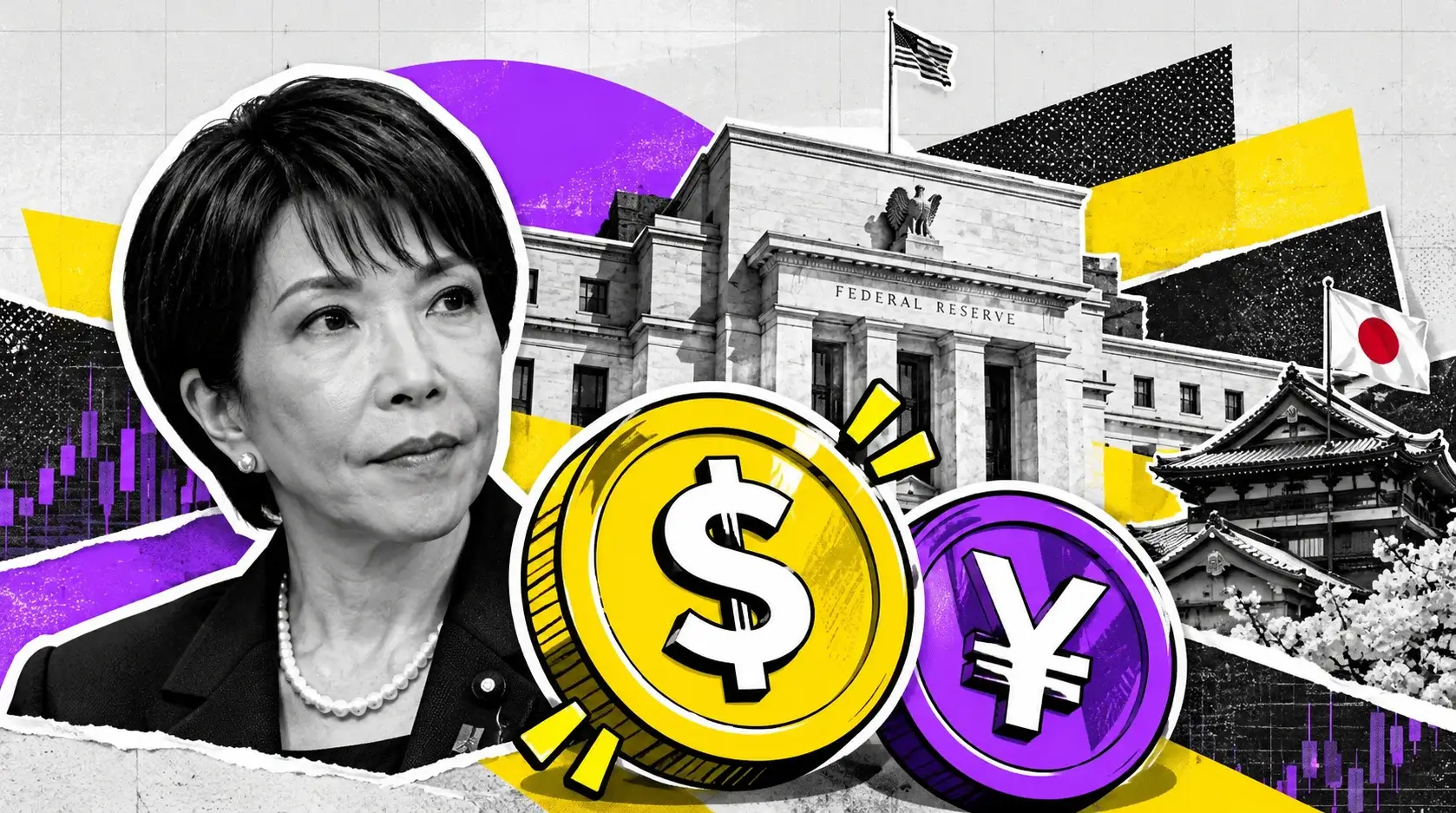





USD/JPY (157.86) Squeezed Between a 2.8-Point Carry Edge and Tokyo’s 160 Line — BoJ Hawkish Hold Friday Sets the Break
The Bank of Japan is expected to hold at 1.25% on Friday after hiking in September | That's TradingNEWS
Key Points
- USD/JPY rose 0.22% to 157.86 on Tuesday, recovering from Friday’s five-week low near 156 on AI stock selling.
- The U.S.-Japan two-year yield spread stood at 2.792 percentage points, keeping carry demand for dollars strong.
- The Bank of Japan is expected to hold at 1.25% on Friday, with a December hike to 1.50% the market’s base case.
USD/JPY traded at 157.86 in European hours on Tuesday, up 0.22% on the day, after opening at 157.50 and setting an early range of 157.41 to 157.77. The pair extended Monday’s 0.41% gain, when it rose from 156.81 to 157.45, and it now sits 1.9 yen above Friday’s five-week low near 156. The yen gave back half of last week’s rally in two sessions, and it underperformed every major currency on Tuesday: it lost 0.19% to the dollar, 0.37% to the New Zealand dollar, 0.19% to the Australian dollar, 0.15% to the Swiss franc and 0.13% to the Canadian dollar.
The broader picture shows a pair pinned near multi-decade highs. USD/JPY sits 3.7% above its level of 12 months ago and within a 52-week range of 151.54 to 164.00. It touched 158.95 on October 14 after a hot U.S. inflation reading and traded near 158.5 around October 20 on reports that the Bank of Japan was leaning against an October rate hike. Last Friday, a global selloff in technology and AI stocks sent haven flows into the yen and pushed USD/JPY down toward 156, its lowest in five weeks. Tuesday’s move reverses that haven rally as risk appetite returns.
The dollar side is firm. The U.S. Dollar Index traded at 102.20, near a two-week high, after durable goods orders rose 1.8% in September and consumer confidence jumped to 91.7. U.S. equities rallied, with the Nasdaq up 1.33% on AI optimism, a risk-on backdrop that typically weakens the yen as investors unwind safe-haven positions and return to carry trades.
The week holds two central bank decisions. The Federal Reserve announces at 2:00 p.m. ET Wednesday, with a hold at 3.75%-4.00% priced above 90% and a December hike close to fully priced. The Bank of Japan concludes its two-day meeting on Friday, October 30, with a hold at 1.25% expected and a December hike to 1.50% the market’s base case. Governor Kazuo Ueda’s press conference follows at 06:30 GMT Friday.
The yield gap remains the dominant force. The U.S.-Japan two-year yield spread stood at 2.792 percentage points on Monday, after narrowing 14.7 basis points. Investors earn nearly 2.8 percentage points a year to hold dollars over yen at the two-year tenor, a carry advantage that keeps steady demand for USD/JPY even as the BoJ tightens.
The thesis for this forecast is direct. USD/JPY is caught between carry and intervention. The rate differential favors the dollar and keeps buyers active on every dip toward 156. But Tokyo’s finance ministry has warned repeatedly that it stands ready to act, and the 160 level, where Japan intervened earlier this year, caps the upside. Both central banks are likely to hold this week, which leaves the pair in a 156 to 159 range until either the BoJ accelerates or Tokyo steps into the market.
How Tuesday’s Session Unfolded: Asia Bid, Europe Extends, Carry Resumes
The session followed the pattern of a market rebuilding carry positions after last week’s haven scare. USD/JPY opened in Asia at 157.50, near Monday’s close, and held a tight range through the Tokyo morning as Japanese markets digested data showing services producer prices rising 3.7%, a reading that supports the case for further BoJ tightening.
The Asian session saw little movement despite the hawkish data. Traders who expect a hold on Friday saw no reason to buy the yen on a single price index, and the pair traded between 157.41 and 157.67 into the European open. Japanese equities rallied with the Kospi and other regional markets on AI optimism after Anthropic’s IPO filing in the U.S., and risk-on sentiment in Asia weighs on the yen.
Europe extended the move. USD/JPY broke above 157.77, the Asian high, and climbed to 157.86 by 07:22 GMT, up 0.22%. The pair was trying to return above its 20-day exponential moving average on the daily chart, a level it lost during Friday’s haven rally. The dollar index firmed to 102.20, adding support.
The U.S. data added fuel. Durable goods orders rose 1.8% to $345.4 billion in September, and orders excluding transportation rose 0.5%. Consumer confidence jumped 7.5 points to 91.7, the highest since June and far above the 81.0 forecast. Strong U.S. data supports the Fed’s hawkish stance, which keeps the yield gap wide.
The cross-asset tone was risk-on. U.S. technology stocks rallied, the Philadelphia Semiconductor Index rose 3% and bitcoin held near $80,000. In that environment, the yen’s haven appeal fades and carry traders, who borrow in yen to buy higher-yielding assets, return to the market.
Tuesday’s move reversed most of Friday’s flight to safety. On Friday, the AI stock selloff drove investors into the yen, and USD/JPY dropped toward 156. Monday and Tuesday saw that haven demand unwind as equities recovered, taking the pair back toward 158.
For the forecast, the session confirms that the yen remains a funding currency in calm markets and a haven only in stress. Without a risk-off shock or a hawkish BoJ surprise, carry flows push USD/JPY higher toward the 158 to 158.50 resistance zone.
The Bank of Japan: A Hawkish Hold at 1.25% With December in Sight
The Bank of Japan is the force that should be strengthening the yen, and it is tightening at its fastest pace in decades. The BoJ raised its policy rate to 1.25% in September from 1.0%, in a 7-2 vote, three months after a hike in June. The September move took the rate to its highest level in 31 years and accelerated the hiking pace from roughly once every six months to once every three months.
Governor Ueda has shifted the bank’s focus. After nearly 14 years of trying to push inflation up to 2%, the BoJ now sees the risk running the other way. Speaking in Bangkok on October 16, Ueda said that with underlying inflation now close to 2%, the bank can no longer tolerate further increases and its main goal is to stabilize inflation around that level. At the October policy meeting, the BoJ is expected to declare victory over deflation and emphasize the risk that prices could overshoot.
This week’s decision is set up as a hawkish pause. The BoJ is expected to hold at 1.25% at the meeting ending Friday, October 30, by a majority vote. Ueda has said there is no need for back-to-back hikes, and that oversized or consecutive increases are reserved for situations where inflation rises rapidly beyond target. Market pricing gives a hold roughly 86% odds. Two board members, Takata and Tamura, may dissent in favor of a hike, which would signal the committee is leaning toward December.
December is the base case for the next move. Economists expect the BoJ to raise rates to 1.50% in December and maintain a quarterly pace. The policy rate at 1.25% now sits within the range of 1.1% to 2.5% that BoJ staff estimate as Japan’s neutral rate, the level that neither stimulates nor restrains the economy. The bank is expected to stress that financial conditions remain loose, signaling room for further hikes before the rate reaches neutral.
Thursday’s data will shape expectations. Japan releases October CPI data and September unemployment before the decision, giving the BoJ a final read on inflation and labor conditions.
For USD/JPY, three outcomes matter. A hawkish hold with clear December guidance and two dissents would lift the yen modestly, pushing the pair toward 156.50. A hold with cautious language that lets hike expectations drift toward January would weaken the yen and send the pair toward 158.50. A surprise hike to 1.50%, priced near 14%, would trigger a yen rally toward 155.
The Fed on Wednesday: Hold at 3.75%-4.00%, December Hike Priced
The Federal Reserve decision lands two days before the BoJ, and it will set the dollar side of USD/JPY for the week. The FOMC began its two-day meeting Tuesday and announces its decision Wednesday at 2:00 p.m. ET, with Chair Kevin Warsh’s press conference at 2:30 p.m. ET. Fed funds futures price a hold at 3.75%-4.00% above 90% probability, with a December hike to 4.00%-4.25% close to fully priced. Markets see no Fed rate cuts in 2026.
The Fed is still tightening. It raised rates in September as the U.S.-Iran war’s energy shock pushed CPI to 3.7% year over year and the Fed’s preferred PCE gauge to 3.4% in August. The October 14 CPI release, which beat forecasts, sent USD/JPY to 158.95, its high for the month, as traders priced a more aggressive Fed.
The U.S. data gives Warsh no reason to soften. Jobless claims fell to 194,000 in the week ended October 17, the lowest since late July. The U.S. flash composite PMI sits near a five-year high at 57.6, with selling prices rising at the sharpest rate since August 2022. Durable goods and consumer confidence beat forecasts Tuesday.
The two central banks are tightening in parallel, which keeps the yield gap wide. The Fed is at 3.75%-4.00%, the BoJ at 1.25%, a policy gap of 250 to 275 basis points. If both hike in December as priced, the Fed would move to 4.00%-4.25% and the BoJ to 1.50%, leaving the gap unchanged. That parallel tightening explains why the yen has not strengthened despite the BoJ’s fastest hiking pace in decades.
The three Fed outcomes matter for USD/JPY. A hold with neutral language that stresses data dependence and declines to commit to December would weaken the dollar and push the pair toward 156.50. A hold with explicit December guidance, the base case, would keep the dollar firm and support a test of 158.50. A surprise hike, priced below 10%, would send USD/JPY toward 159 to 160 and into Tokyo’s intervention zone.
The sequencing adds volatility. Wednesday’s Fed decision sets the dollar’s direction for Thursday’s Japanese data and Friday’s BoJ decision. A hawkish Fed followed by a cautious BoJ would be the most bullish combination for USD/JPY. A dovish Fed followed by a hawkish BoJ would be the most bearish.
The 2.8-Point Yield Gap: Why the Yen Stays Weak
The interest-rate differential is the structural force behind USD/JPY, and it remains wide despite the BoJ’s tightening. The U.S.-Japan two-year yield spread stood at 2.792 percentage points on Monday. Investors who borrow yen at Japan’s low rates and invest in dollar assets earn nearly 2.8 percentage points a year before currency moves.
The spread narrowed on Monday. It compressed by 14.7 basis points, yet USD/JPY rose 0.41% the same day, a divergence that showed carry demand dominating spot action. When the spread narrows but the currency pair rises anyway, it signals that investors are adding carry positions based on the absolute level of the gap rather than its daily changes.
The long end tells a similar story. The U.S. 10-year Treasury yield sat at 5.00% on Tuesday. Japanese government bond yields have risen as the BoJ tightened, but they remain far below U.S. levels. The gap at the 10-year tenor keeps Japanese institutional investors, such as life insurers and pension funds, buying foreign bonds, which requires selling yen.
The carry trade is the mechanism. Global investors borrow yen cheaply and use the proceeds to buy higher-yielding assets in dollars, Australian dollars, New Zealand dollars and emerging markets. That trade weakens the yen steadily in calm markets. It unwinds violently in stress, when investors sell risky assets and repay yen loans, which is what happened on Friday when the AI selloff pushed USD/JPY toward 156.
The trade-off creates the pattern traders see. In risk-on sessions, the yen weakens on carry demand. In risk-off sessions, the yen strengthens on haven demand and carry unwinds. Tuesday was a risk-on session, and the yen fell against every major.
The gap will not close quickly. With both central banks expected to hike in December, the spread stays near 2.8 points into year-end. Only a Fed that signals the end of its hiking cycle while the BoJ keeps tightening would narrow it meaningfully.
For the forecast, the yield gap provides a floor under USD/JPY near 155 to 156. Carry demand will keep buyers active on dips until the gap narrows below 2.5 percentage points or a risk-off shock triggers a broad unwind.
Tokyo’s 160 Line: Intervention Risk Caps the Upside
The upside for USD/JPY is limited by Japan’s finance ministry, which has shown this year that it will act. On April 30, 2026, Japan intervened in the currency market by buying yen and selling dollars, its first intervention since 2024. The yen surged by as much as 3% that day, the biggest single-day gain in more than three years. Hours earlier, Finance Minister Satsuki Katayama said the timing to take “decisive action” was nearing, and top currency diplomat Atsushi Mimura described his remarks as the “final evacuation warning” to markets.
Japan has since acted in coordination with Washington. Mimura has highlighted close cooperation with the United States on currency policy, citing a joint accord from September 2025 and strong ties that led to a joint yen intervention. That coordination makes intervention more potent, because it signals that both governments want to stop excessive yen weakness.
The warnings have continued this fall. In late September, Mimura said Japan was neither satisfied nor reassured by the yen’s moves and dismissed concerns that funding constraints could limit intervention, saying he had “absolutely no such concern.” The yen spiked through 157 to 156.75 on his remarks. In mid-October, with the pair near 158, Katayama warned speculators she was ready to act again. Japanese authorities have said they remain ready to take decisive action against excessive depreciation near the 160 level.
The 160 line is the market’s reference point. Japan’s intervention history shows action tends to come when USD/JPY approaches or breaks 160, particularly after rapid moves. The 158.95 high on October 14 came within 1.05 yen of that line, and the warnings intensified. A move from 157.86 to 160 would require a 1.4% rally, which a hawkish Fed surprise could deliver in a single session.
Intervention is costly and temporary on its own. Japan sells dollar reserves to buy yen, which can move the pair 3% to 5% in hours, but without a change in fundamentals, the rate differential pulls the pair back over weeks. Intervention works best when combined with BoJ tightening, which is why Tokyo’s warnings carry more weight this year as the BoJ hikes.
For the forecast, intervention risk caps USD/JPY near 159 to 160. Traders who buy above 158.50 face asymmetric risk: a 1% to 2% gain to 160 against a potential 3% to 5% drop if Tokyo steps in.
Japan’s Inflation: Services Prices at 3.7% and the 2% Victory
Japan’s inflation picture has transformed, and it supports the BoJ’s hawkish turn. Services producer prices rose 3.7% in the latest reading released this week, an acceleration that shows price pressures spreading from goods into services. Services inflation is the measure the BoJ watches most closely for evidence that inflation is becoming self-sustaining through wages.
Underlying inflation has reached the target. Ueda said on October 16 that underlying inflation is now close to 2%, the target the BoJ has pursued for nearly 14 years through negative rates, yield curve control and massive bond purchases. The bank is expected to declare victory at this week’s meeting and shift its focus to preventing an overshoot.
Energy is pushing inflation higher. Japan imports nearly all of its oil and gas, and the U.S.-Iran war has pushed Brent crude up 80% this year to $114. Higher energy import costs feed directly into consumer prices and weaken Japan’s trade balance, which adds pressure on the yen as importers sell yen to buy dollars for oil.
The weak yen amplifies the effect. A yen near 158 per dollar makes every imported barrel more expensive in yen terms, which feeds inflation further. That feedback loop is one reason the BoJ is tightening and one reason Tokyo is threatening intervention: both want to break the cycle of a weak yen driving import inflation.
Global inflation pressures are rising together. The BoJ, the Fed and the European Central Bank are all expected to raise rates or keep tightening by year-end as AI-driven demand and the energy shock worsen inflation. U.S. CPI sits at 3.7%, euro-area inflation at 3.8%, UK inflation at 3.5%. Japan’s inflation, while lower, is now firmly at target.
Thursday’s October CPI release will be the last major data point before the BoJ decision. A reading above expectations would strengthen the case for dissenting votes and a hawkish message, supporting the yen. A softer print would reinforce the hold and keep the yen weak.
For the forecast, Japan’s inflation supports a gradually stronger yen over the medium term as the BoJ hikes toward neutral. But the near-term effect is offset by the U.S. inflation picture, which keeps the Fed hiking at the same pace.
The Haven Question: Why the Yen Rallied Friday and Fell Tuesday
The yen’s behavior over the past week shows its dual role, and understanding it is key to trading USD/JPY around risk events. On Friday, October 23, a global selloff in technology and AI stocks sent investors into safe havens. The yen strengthened toward 156 per dollar, its highest level in five weeks, before paring gains. Strong Japanese inflation data added support.
The selloff was severe. The Nasdaq fell 2.6% on October 22, the Philadelphia Semiconductor Index dropped 6.72%, and AMD lost 8.1%, as Lam Research warned on supply constraints, Meta’s capital spending turned its free cash flow negative and an oil spike revived inflation fears. In that environment, carry trades unwound: investors who had borrowed yen to buy risky assets sold those assets and bought yen to repay loans.
The reversal came this week. Anthropic’s IPO filing on Monday and Meta’s $25 billion stock sale revived AI sentiment. The chip index rose 2.82% on Monday and 3% on Tuesday, and the Nasdaq gained 0.82% and 1.33%. As risk appetite returned, carry traders rebuilt positions, selling yen again. USD/JPY rose 0.41% Monday and 0.22% Tuesday, giving back half of the yen’s haven gains.
The pattern repeats across cycles. The yen strengthens in risk-off episodes because carry trades unwind and investors seek safety in Japan’s large net foreign asset position. It weakens in risk-on episodes because carry trades rebuild. In 2026, with the gap between U.S. and Japanese yields near 2.8 points, the carry incentive is strong enough to dominate in calm markets.
The week’s earnings calendar matters. Microsoft and Alphabet report after the close Wednesday, and Amazon on Thursday. Together they carry more than $10 trillion of market value. A disappointment on AI spending or cloud growth could trigger another tech selloff, which would send the yen higher through carry unwinding. Strong results would extend the risk-on mood and push the yen weaker.
Gold offers a reference point. Gold traded at $4,023, 28% below its January record, because the U.S.-Iran war has strengthened the dollar and lifted yields. The yen has partly taken gold’s haven role during equity selloffs.
For the forecast, risk sentiment is a short-term driver. A tech selloff would push USD/JPY toward 156; continued AI enthusiasm supports a move toward 158.50.
The Dollar Index at 102.20 and Cross-Market Signals
The dollar’s broad strength supports USD/JPY, and the cross-currency picture shows where the yen sits. The U.S. Dollar Index traded at 102.20 on Tuesday, near a two-week high, after falling to 101.45 last week, its lowest since October 1. The 102.50 level is the next resistance; a break above it would target 102.95 to 103.30.
The dollar is gaining against most currencies. EUR/USD fell for a fifth straight day to 1.1144 on French fiscal stress and Fed-ECB policy divergence. GBP/USD slipped for a fourth day to 1.3310 ahead of Wednesday’s UK budget. The yen’s 0.19% decline against the dollar on Tuesday was in line with the euro’s and slightly worse than sterling’s.
The yen is weaker against risk currencies. It fell 0.37% to the New Zealand dollar and 0.19% to the Australian dollar, two commodity currencies that benefit from higher energy and metals prices and from risk-on flows. GBP/JPY held near 210 and EUR/JPY near 176, both close to multi-year highs.
Commodity prices add pressure. Brent crude near $114 hurts Japan’s trade balance, as importers need more dollars to buy oil. Japan’s energy import bill rises with every dollar on the barrel, creating steady yen selling that supports USD/JPY.
The bond market sets the tone. The U.S. 10-year at 5.00% keeps Japanese institutional investors buying foreign debt. Even as Japanese government bond yields rise, the gap remains large enough to justify overseas allocations, which requires selling yen.
The Fed-BoJ sequencing matters for cross-currency positioning. Traders often position in USD/JPY ahead of the Fed and in yen crosses ahead of the BoJ. A hawkish Fed on Wednesday would lift USD/JPY. A hawkish BoJ on Friday would hit yen crosses more broadly, including EUR/JPY and AUD/JPY.
For the forecast, the dollar index near 102.20 supports USD/JPY near 158. A break above 102.50 on a hawkish Fed would push the pair toward 159; a drop below 101.50 on a dovish Fed would send it toward 156.
Technical Map: 156 Floor, 158.50 Pivot, 160 Intervention Ceiling
The chart has drawn clear levels, and USD/JPY sits in the upper half of its recent range.
Support begins at 157.41, Tuesday’s session low, and 157.00, a round number where Mimura’s late-September warning triggered a sharp yen spike to 156.75. Below that, 156.81 marks Monday’s open, and 156.00 is Friday’s five-week low, set during the AI selloff. A daily close below 156.00 would break the post-September range and open a move toward 155.00, then 154.00. Below 154, the next support sits near 151.54, the 52-week low.
Resistance starts at 157.86, Tuesday’s European high. The pair is trying to reclaim its 20-day exponential moving average, which it lost during Friday’s haven rally. Above that, 158.00 to 158.50 is the key resistance zone, where the pair stalled in mid-October. A daily close above 158.50 would open 158.95, the October 14 high set after the hot U.S. CPI print. Above 158.95, the 159.50 level sits just below Tokyo’s 160 line. The 52-week high at 164.00 marks the year’s peak, set before Japan’s intervention campaign.
The trend is sideways to higher. USD/JPY has traded in a 156 to 159 range since mid-September, with buyers defending the lower end on carry demand and sellers capping the upper end on intervention fears. The October 14 high at 158.95 and the October 23 low near 156 define the near-term boundaries.
The intervention zone changes the technical picture. Above 159, traditional technical targets matter less than Tokyo’s reaction function. A move toward 160 would likely trigger stronger verbal warnings from Katayama and Mimura, followed by actual intervention if the move continues. Traders should treat 159 to 160 as a ceiling regardless of chart patterns.
The range has asymmetric risk. Downside to 156 is 1.2% from spot; upside to 159 is 0.7%, with intervention risk beyond. That asymmetry favors selling rallies above 158.50 rather than chasing them.
The trading range for the week is 156.00 to 158.95, with a mild bullish bias toward 158.50 as long as the pair holds above 157.
Read More
-
Yen Stalls at 160 Despite a 3% JGB and Tokyo Core CPI at 2.0% — Intervention Sits at 164, Friday's Payrolls Decide
02.09.2026 · TradingNEWS ArchiveEnergy
-
JPM ($335.79) Holds $330 as NII Guide Rises to $106.2B but Expenses Climb to $108.6B — $345 Breakout Opens $366.50
27.10.2026 · TradingNEWS ArchiveStocks
-
IBIT ETF Captures 100% of $110.3M as Spot Funds Snap Outflow Streak, but October Stays $202M Negative Ahead of the Fed
27.10.2026 · TradingNEWS ArchiveCrypto
-
NG($3.002) Takes the Front Month Near a Multi-Month Low as Record Production Meets Mild Weather — Break of $2.945 Opens $2.80
27.10.2026 · TradingNEWS ArchiveCommodities
-
Nasdaq Rips 1.3%, S&P 500 Hits 7,728, Dow Stalls as BA Drops to $171
27.10.2026 · TradingNEWS ArchiveMarkets
-
GBP/USD (1.3310) Can’t Cash In on 5.43% Gilt Yields as Budget Risk Meets a Firm Dollar — Break of 1.3274 Opens 1.3200
27.10.2026 · TradingNEWS ArchiveForex
What Could Break the Range: BoJ Surprise, Fed Pivot, Tech Selloff, Tokyo
The 156 to 159 range is stable only as long as carry demand and intervention fears stay balanced. Four developments could break it.
The first is a hawkish BoJ surprise. A rate hike to 1.50% on Friday, priced near 14%, would catch markets off guard and trigger a sharp yen rally. Even without a hike, dissents from Takata and Tamura combined with explicit guidance toward December would signal the BoJ is moving faster than priced. Either outcome would push USD/JPY toward 156 and possibly 155.
The second is a dovish Fed. If Warsh signals on Wednesday that the hiking cycle is near its end, declining to commit to December and stressing data dependence, the dollar would weaken broadly. Combined with a hawkish BoJ, the yield gap would narrow and carry trades would start to unwind. USD/JPY could fall through 156 toward 154.
The third is a tech selloff. Microsoft and Alphabet report Wednesday and Amazon Thursday. A disappointment on AI spending or cloud growth could trigger another selloff like October 22, sending investors into the yen. A risk-off shock combined with a hawkish BoJ would be the most bearish scenario for USD/JPY, potentially driving it toward 154 within days.
The fourth is intervention. If a hawkish Fed and a cautious BoJ push USD/JPY through 159 toward 160, Tokyo would likely act. Japan’s April 30 intervention moved the yen 3% in a day. A similar move from 160 would take the pair toward 155.
On the upside, the triggers are a hawkish Fed with explicit December guidance, a cautious BoJ that lets hike expectations drift to January, strong AI earnings that extend the risk-on mood, and an oil spike that worsens Japan’s trade deficit. Together, those would push USD/JPY toward 159 and test Tokyo’s resolve.
The midterm elections on November 3 and U.S. GDP and PCE data later this week add secondary catalysts.
USD/JPY Price Forecast: Three Scenarios Into November
The forecast splits into three paths, with Wednesday’s Fed decision, Friday’s BoJ decision and Big Tech earnings deciding which plays out.
The base case, with the highest probability, is a range between 156.50 and 158.95 through the first week of November. The Fed holds at 3.75%-4.00% with language that keeps December open, and the BoJ holds at 1.25% with a hawkish message pointing to December and one or two dissents. The two decisions roughly offset, leaving the yield gap near 2.8 points. Big Tech earnings land without a major shock, and carry demand keeps buyers active near 157. In this scenario, USD/JPY trades near 157.50 to 158.50 by early November, with Tokyo’s warnings capping any move toward 159.
The bull case requires a daily close above 158.95. The triggers would be a hawkish Fed with explicit December guidance, a BoJ hold with cautious language that pushes hike expectations toward January, strong AI earnings and a dollar index break above 102.50. In that scenario, USD/JPY would clear 158.95 and target 159.50 to 160.00, a gain of 1.4% from 157.86. Beyond 160, intervention becomes highly likely, and the target would be capped by Tokyo’s response. This scenario carries the highest intervention risk.
The bear case requires a daily close below 156.00. The triggers would be a BoJ hike to 1.50% or a strongly hawkish hold with two dissents and clear December guidance, a Fed that softens its December signal, and a tech selloff that triggers carry unwinding. In that scenario, USD/JPY would break 156 and target 154.00, a decline of 2.4% from spot. A broader carry unwind could extend the move toward 151.54, the 52-week low.
Weighing the scenarios, the balance is neutral to mildly bullish within the range. The 2.8-point yield gap, a firm dollar and risk-on equity sentiment support USD/JPY. Intervention risk near 160 and a BoJ moving toward neutral cap the upside, and a hawkish BoJ surprise or tech selloff could trigger a sharp drop.
The 30-day price target is 158.50, the top of the key resistance zone, with upside capped near 160 by intervention risk. A daily close below 156.00 would shift the target to 154.00.
Verdict: Range-Bound Between Carry and Tokyo, 158.50 Target With 160 as the Wall
USD/JPY at 157.86 is a pair held in place by two opposing forces that neither central bank meeting this week is likely to resolve. The dollar side is strong: the Fed sits at 3.75%-4.00% with a December hike close to fully priced, U.S. data keeps beating forecasts with consumer confidence at 91.7 and durable goods up 1.8%, the dollar index sits at 102.20 near a two-week high, and the 10-year Treasury yields 5.00%. The U.S.-Japan two-year spread at 2.792 percentage points keeps carry traders active, and Tuesday’s risk-on mood saw the yen underperform every major currency.
The yen side is gaining strength slowly. The BoJ raised rates to 1.25% in September, its highest in 31 years, after a hike in June. Underlying inflation has reached 2%, services prices are rising 3.7%, and Ueda says the bank can no longer tolerate further increases. A hawkish hold on Friday is expected, with dissents possible and a December hike to 1.50% the market’s base case. Tokyo’s finance ministry intervened on April 30, acted jointly with Washington since, and has warned repeatedly that it stands ready to act again near 160.
The verdict is range-bound with a mild bullish tilt. USD/JPY should trade between 156.50 and 158.95 into early November as the Fed and BoJ hold and the yield gap stays near 2.8 points. A daily close above 158.95, triggered by a hawkish Fed and a cautious BoJ, would target 159.50 to 160.00, where intervention risk becomes acute and traders should expect Tokyo to act. A daily close below 156.00, triggered by a BoJ surprise hike, a dovish Fed or a tech selloff that unwinds carry trades, would target 154.00. The 30-day target is 158.50, and every rally above that level carries more risk than reward with Tokyo watching from 160.