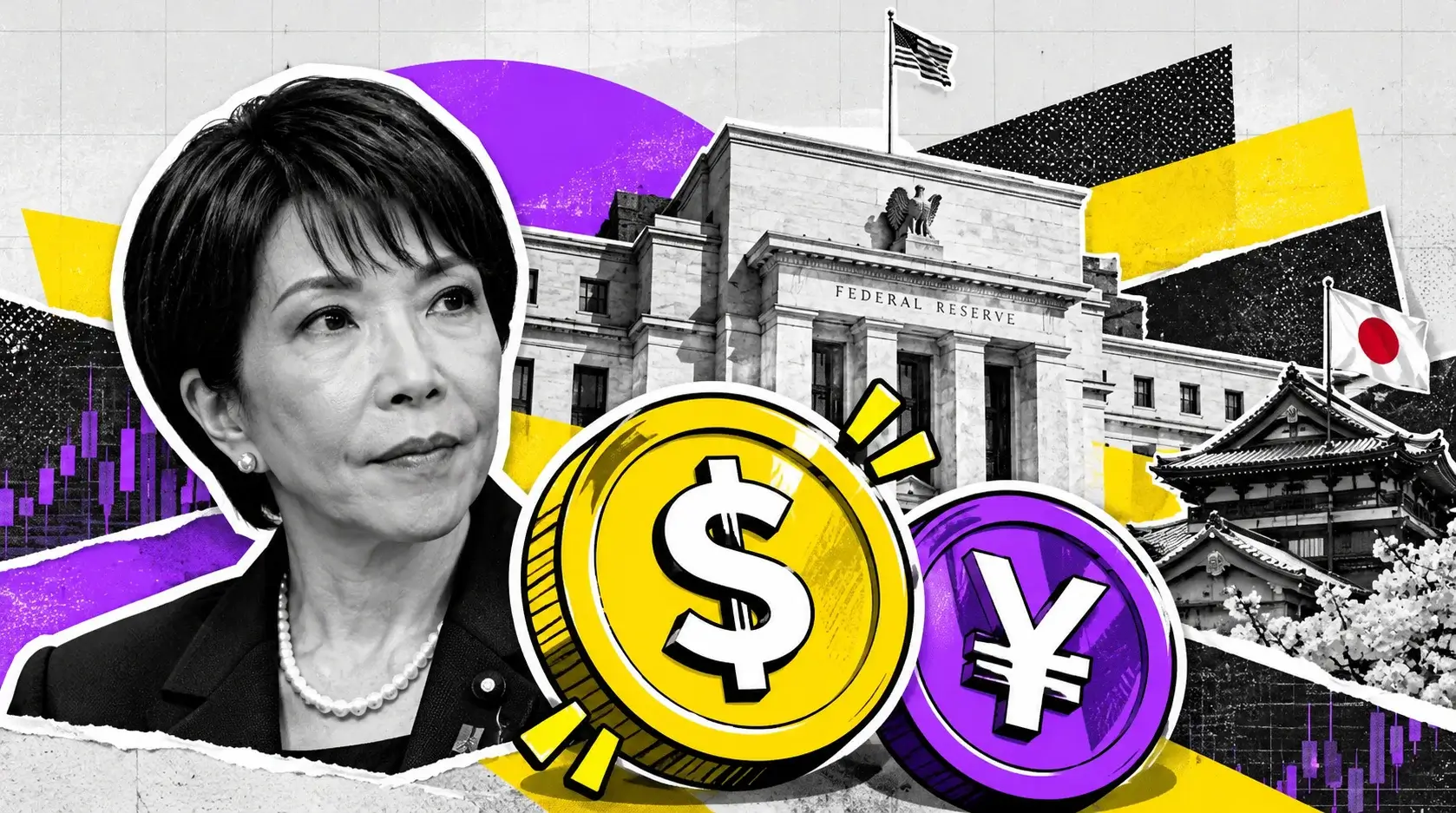
USD/JPY Price Forecast - USDJPY=X Jumps Toward 154 as Warsh Shock and Fed Pause Reprice the Yen
Pair bounces from 152.10 lows, with traders now watching 152–156, NFP, Japan election and BOJ intervention risk to define the next USD/JPY leg | That's TraidngNEWS
Fed pause at 3.50%–3.75% ignites fresh upside in USD/JPY
The latest Fed decision to hold the target range at 3.50%–3.75% after a 10–2 vote keeps US policy clearly above Japan’s near-zero rates and immediately fed into a stronger US Dollar and a firmer USD/JPY. Two governors argued for a 25 bp cut, but the majority emphasised “solid” economic growth, a labour market that has only “stabilised” rather than cracked, and inflation that remains “somewhat elevated” despite progress. The Dollar Index rebounded toward 96.70 after recently touching four-year lows, while USD/JPY pushed toward 153.9–154.5, gaining close to 1% on the day as yields ticked higher across the curve and US equities reacted in mixed fashion, with the S&P 500 printing a record intraday high near 7,002.28, the Nasdaq edging up about 0.3% and the Dow nearly flat. For USD/JPY, the message is straightforward: as long as the Fed keeps policy well above the 3.50% floor and refuses to pre-commit to a rapid easing cycle, rate differentials still favour the dollar side of the pair.
Kevin Warsh risk premium supports USD/JPY beyond the initial Fed reaction
The Fed chair race has become a second driver for USD/JPY, and the shift in betting toward Kevin Warsh changes the profile of US policy risk for currency markets. Warsh is not an unknown outsider; he sat at the table as a Fed governor through the 2006–2011 crisis period, and he has consistently questioned an over-reliance on a bloated balance sheet and ultra-easy policy. That history makes him the least dovish of the remaining candidates and a clear contrast to names the market had priced as aggressively pro-cut. His emergence at the front of the race has pushed investors to re-assess the “debasement” trade in the dollar and unwind part of the premium embedded into bearish USD positions. You can see that in USD/JPY price action: after a flush lower earlier in the week, the pair has rebounded through the 154 handle as the prospect of a more orthodox, inflation-focused Fed chair reduces the appeal of leaning short the dollar into political uncertainty.
Hot US producer inflation and curve dynamics keep the dollar bid against the yen
Beyond personalities, the data backdrop is not friendly to yen bulls. US producer prices firmed, with headline PPI up 0.5% month-on-month after 0.2% previously and running at roughly 3.0% year-on-year, while the core gauge jumped 0.7% on the month and 3.3% on the year, signalling upstream price pressure has not fully relaxed. At the same time, the US 2s10s curve briefly steepened to levels last seen in early 2022 even as outright yields eased after the Warsh headlines, an unusual combination that shows markets are starting to price a different mix of growth and inflation risk rather than a straight-line collapse in rates. For USD/JPY, that matters: a steeper curve and sticky producer inflation argue against an aggressive near-term cutting cycle, particularly when Fed officials are split, with one influential governor still calling for a 25 bp reduction while others urge patience. The net effect is that dollar funding remains expensive relative to yen, and the path to materially lower US yields – the main fuel for sustained USD/JPY downside – is not yet open.
Japanese inflation rollover and weak demand undercut the yen side of USD/JPY
On the Japanese side of USD/JPY, the data flow is quietly removing support for further rapid normalisation by the Bank of Japan. Tokyo headline CPI slowed to around 1.5% year-on-year from 2.0% the previous month, core dropped back to roughly 2.0%, and the core-core gauge eased to about 2.4%, all softer than consensus. That is not a deflation shock, but it is enough to cool the argument for back-to-back BoJ hikes, especially after a sharp yen rally earlier in the month already trimmed imported inflation. December retail sales missed as well, falling roughly 0.9% year-on-year instead of posting the modest gain economists expected, highlighting fragile domestic demand. Rate markets have responded by pushing out BoJ tightening hopes: the probability of a move in March has faded while April is now seen as the earliest realistic window for another hike. For USD/JPY, that widening policy gap – a Fed still holding 3.50%–3.75% with no schedule for cuts, against a BoJ that can afford to wait – justifies the rebound from the lows around 152 and keeps speculative money biased toward buying dollar dips.
Politics, Fed independence and the narrative battle inside USD/JPY
Kevin Warsh’s nomination also matters because of what it signals about the relationship between the White House and the central bank. Markets had positioned for a chair who would validate repeated political calls for aggressively lower rates; instead they now face a candidate with his own track record of challenging easy policy. That helps reduce the tail risk of an overtly politicised Fed willing to tolerate much higher inflation in exchange for short-term growth, and it directly hits the “permanent dollar debasement” narrative that fueled yen strength earlier. For USD/JPY, it means every incremental piece of US data – from JOLTS and ADP to ISM services and jobless claims – will be interpreted through a more balanced lens: traders now have to consider that hot numbers might actually delay cuts under a Warsh-led Fed rather than being waved away. That shift explains why the pair rallied despite producer inflation surprising to the upside and some policymakers still talking openly about cuts; the market is repositioning for a Fed that talks less dovish than pricing implied a week ago.
Japan election jitters, JGB curve and intervention risk frame the upside in USD/JPY
Domestic politics and bond markets in Japan define how far USD/JPY can run before intervention fears dominate the chart. Earlier in the month, the long end of the JGB curve briefly sold off hard, forcing traders to price the risk of more aggressive BoJ tightening and more expansionary fiscal policy under a potential landslide win for pro-stimulus leadership. Over the last two weeks, that move has largely reversed: both the 2s10s and 2s30s curves have flattened again as markets reassess how strong a mandate the ruling party might actually secure and as the BoJ signals it stands ready to buy more bonds to stabilise the market. Upcoming 10- and 30-year auctions will test demand, but the immediate pressure on yields has faded, reducing one source of support for the yen. At the same time, the threat of direct FX intervention has not gone away. Recent rate checks by the Ministry of Finance pushed USD/JPY down toward 152.10, a three-month low, before US officials made it clear Washington would not join any yen-support operations. That effectively told speculators Japan is acting alone, which blunts but does not eliminate the deterrent. As USD/JPY climbs back through 154.45 toward 156.00–157.00, those levels overlap with zones where past intervention or heavy jawboning has occurred, meaning every extra figure on the upside will increase headline risk even if the medium-term macro still favours dollar strength.
Read More
-
Yen Stalls at 160 Despite a 3% JGB and Tokyo Core CPI at 2.0% — Intervention Sits at 164, Friday's Payrolls Decide
02.09.2026 · TradingNEWS ArchiveEnergy
-
AMD ($560.68) Rebounds 10% From Its October Low on the Meta Helios Win — November 3 Report Holds the Key to $649
27.10.2026 · TradingNEWS ArchiveStocks
-
Ethereum ($2,312) Lags Bitcoin and AI Stocks as BitMine Nears Its 5% Cap — Break of $2,295 Opens $2,200
27.10.2026 · TradingNEWS ArchiveCrypto
-
Brent ($113.88) Trades a $2.35 Range as Houthi Strikes Meet Saudi-Iran Diplomacy — Break of $117 Unlocks $120
27.10.2026 · TradingNEWS ArchiveCommodities
-
Nasdaq Rips 1.3%, S&P 500 Hits 7,728, Dow Stalls as BA Drops to $171
27.10.2026 · TradingNEWS ArchiveMarkets
-
GBP/USD (1.3310) Can’t Cash In on 5.43% Gilt Yields as Budget Risk Meets a Firm Dollar — Break of 1.3274 Opens 1.3200
27.10.2026 · TradingNEWS ArchiveForex
Positioning, CFTC flows and “smart money” signals underneath USD/JPY
Futures positioning adds an “insider” layer to the story. The latest CFTC data show non-commercial traders still net short the yen, with JPY non-commercial net positions sitting near –33.9K contracts versus around –44.8K previously. That tells you two things at once. First, the market remains structurally biased against the yen, which supports USD/JPY on pullbacks because crowded shorts tend to defend profitable levels. Second, some of the most aggressive bearish yen exposure has already been trimmed, meaning the violent squeeze lower to 152.10 earlier in the week has flushed out weaker hands without fully reversing the longer-term trend. When you overlay that with options activity and reported stop-loss clusters, the pattern is typical of a market that has shaken out late sellers but still has core funds positioned for higher USD/JPY. If the pair grinds higher toward 156.00–157.00, those same players will be watching for official Japanese selling, but until they see it, the path of least resistance remains up rather than down.
Technical structure of USD/JPY: from failed breakdown to rebuilding an uptrend
On the technical side, USD/JPY has shifted from a failed breakdown into a rebuilding phase with clearly defined levels. The latest downside flush stalled twice just above 152.00, with intraday lows around 152.10 marking the lower boundary of a support band that extends down toward 151.00 and coincides with trend support dating back to the April 2025 volatility spike. That zone now acts as the line the bears failed to cross. From there, the pair has climbed back above 154.45, a level that acted as both support and resistance late last year and again this week. Closing back above that pivot is the first sign that selling pressure has lost control. Above spot, the next obvious targets are 156.00 and then roughly 157.00, with the 50-day moving average sitting between those handles and likely to serve as a near-term checkpoint for trend followers. Momentum indicators confirm the shift in tone rather than a full-blown reversal. Daily RSI(14) has turned higher from oversold territory and is grinding back toward the neutral 50 line, signalling fading downside momentum rather than euphoric buying. MACD is still negative but curling toward its signal line, a typical pattern when a strong down-leg exhausts and the market transitions into a consolidation or recovery phase. Earlier in the week, USD/JPY dipped below the lower Bollinger Band and has now re-entered the band from below, another textbook sign that an oversold episode is giving way to mean reversion. At the same time, price continues to gravitate around big psychological figures – 152, 154, 156 – which is consistent with a market dominated by macro and policy headlines rather than clean technical trends.
Event risk ahead: payrolls, labour data and the next volatility window for USD/JPY
The next catalyst cluster for USD/JPY comes from the US labour market. With the Fed having removed language about “rising downside risks” to employment from its statement, markets know that any sign of renewed labour strength carries more weight than soft data that simply confirms deceleration. Over the coming days, traders face JOLTS job openings, ADP private payrolls, ISM services employment components, weekly jobless claims, Challenger layoff announcements and, crucially, the January non-farm payrolls report. The headline jobs gain will drive the first reaction, but for the Fed and for USD/JPY the unemployment rate, participation and broader underemployment will matter more. A combination of falling underemployment and steady or rising participation would reinforce the Fed’s narrative that policy is not “significantly restrictive,” making it harder to justify early or deep cuts and thereby supporting US yields and the dollar. At the same time, Japanese releases like household spending and the outcome of JGB auctions will be watched for signs of a demand-driven inflation cycle that could eventually force the BoJ to lean less dovish. For now, the risk skew is asymmetrical: a strong US labour print can re-ignite dollar buying quickly, while weak data may generate only a temporary dip in USD/JPY if investors believe the Fed will look through one soft report.
Trading stance on USD/JPY: buy on dips while 151.00–152.00 holds, with intervention risk as the main cap
Putting the macro, positioning and technical pieces together, the weight of evidence still leans bullish for USD/JPY rather than neutral or bearish. The Fed is holding 3.50%–3.75% with no firm roadmap for rapid easing, US producer inflation remains sticky, and the likely next chair is a known, balance-sheet-skeptical hawk rather than a political dove. Japan, by contrast, is printing 1.5% Tokyo headline CPI, around 2.0% core, negative retail sales and is facing an election where the scale of any fiscal push is now less certain than a month ago. CFTC data show speculative accounts still essentially short the yen, even after a cleansing squeeze, and the chart tells you sellers could not sustain a break below 152.10. With spot recovering above 154.45 and momentum turning, the cleaner call is to treat USD/JPY as a buy-on-dips market while the 151.00–152.00 band holds as support, targeting a grind toward 156.00 and potentially 157.00 as long as US data do not collapse and the Fed does not pivot sharply more dovish. The main brake on that view is not valuation or carry but the threat of unilateral Japanese intervention if the move accelerates. That risk argues for disciplined sizing and tight downside triggers rather than a different directional stance. On balance, given the current mix of rates, inflation, data and flows, USD/JPY is a Buy, with pullbacks toward the low-152s offering better entry than chasing strength near the upper end of the recent range.