EUR/USD Price Forecast - Eur Falls From 1.20 Breakout to 1.18 on Warsh-Driven Dollar Rebound
Warsh’s nomination, hot 3.0% US PPI and 4.25% US yields overpower a 0.3% Eurozone GDP beat and 2.1% German inflation, flipping EUR/USD from 1.20 highs back toward 1.18 | That's TradingNEWS
EUR/USD Price: Warsh Shock, Hot PPI and an Uncomfortable ECB
EUR/USD under Warsh’s nomination: dollar regains control
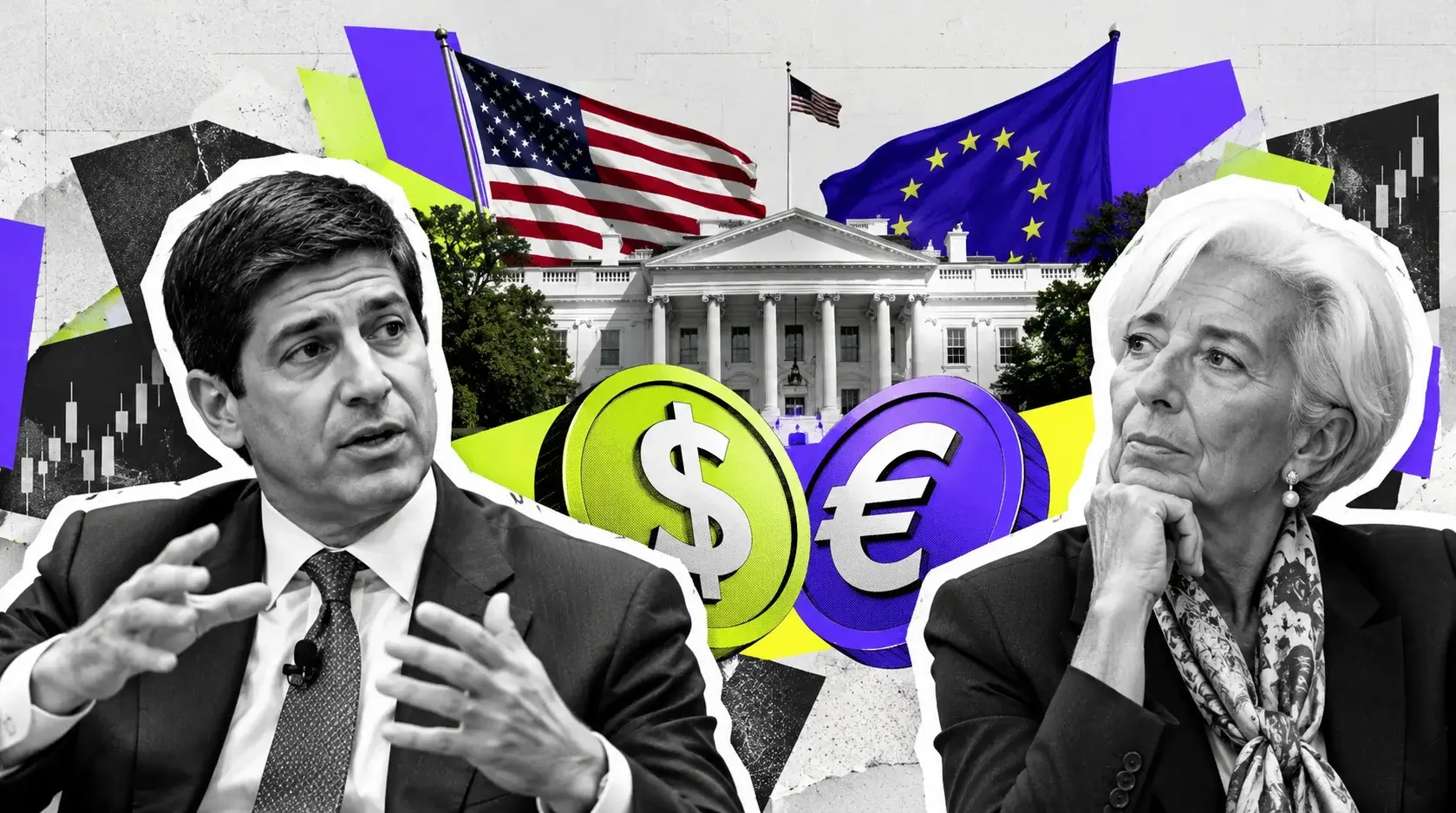
The immediate driver for EUR/USD is the pivot in Fed expectations after Kevin Warsh was confirmed as the next Fed Chair. The pair had just tested the multi-year psychological barrier at 1.2000 and briefly pushed above it, but once Warsh’s nomination hit the tape and the dollar bid returned, EUR/USD reversed hard from the 1.1970–1.2000 zone back into the low 1.19s. Intraday, the pair traded around 1.1880–1.1890 after touching a daily high near 1.1974, effectively handing 70–90 pips back to the dollar in a single session.
On the dollar side, the DXY broke cleanly above the 96.35–96.50 resistance band and pushed toward the 97.00 handle, with traders already eyeing 97.10–97.25 as the next upside pocket. That nearly 1% jump in the index coincided with EUR/USD slipping below the prior 2025 high at 1.1918 and briefly testing under 1.1850, signaling that the euro bull trend is no longer in one-way mode.
This is a classic regime shift: for months, the narrative was a tired Fed and a structurally weaker dollar. Warsh’s reputation for hawkish discipline, combined with a White House that suddenly sounds more tolerant of a firm currency, has flipped the script just as EUR/USD became stretched above 1.2000.
EUR/USD and macro data: hot US PPI versus firmer Eurozone growth
The Warsh story landed on top of an already dollar-friendly US data print. Producer prices for December came in much hotter than the market was positioned for. Headline PPI rose 0.5% m/m versus expectations of 0.2%, and core PPI surged 0.7% m/m against the same 0.2% consensus. On a yearly basis, headline PPI held at 3.0% y/y instead of easing to 2.7%, while core PPI accelerated to 3.3% y/y from 3.0%, defying forecasts for a drop to 2.9%.
These numbers tell you why US 10-year yields pushed up to roughly 4.24–4.25% and held there. With upstream inflation stuck around 3% and moving the wrong way in the core, rate-cut fantasies had to be repriced. Markets now price more than a 70% probability of a 25 bp hike by the March Fed meeting, compared with roughly 45% just a week earlier. That repricing is exactly what a dollar rebound looks like.
On the euro side, the macro picture is quietly constructive but not spectacular. Eurozone Q4 GDP grew 0.3% q/q, beating the 0.2% consensus, while annual growth for the bloc hovered around 1.4% y/y versus expectations near 1.2%. Germany, the core of the euro area, delivered 0.3% q/q in Q4 and roughly 0.4% y/y growth, modest but clearly not recessionary. Inflation in Germany, measured by HICP, ticked up from 2.0% to 2.1% y/y, sitting right on top of the ECB’s target zone.
So the growth-inflation mix is not what is knocking EUR/USD down. The driver is the relative shift: US inflation surprised higher just as the Fed gets more hawkish leadership; Eurozone data beat by a tenth here and there but do not force the ECB to tighten further. That divergence matters more than whether euro data are marginally “good” on their own.
EUR strength and ECB discomfort: how much upside can the euro carry
Even before EUR/USD probed above 1.2000, policymakers in Frankfurt were already signaling unease with a strong euro. A move from 1.17–1.18 toward 1.20 in a short span translates directly into tighter financial conditions via weaker export competitiveness and softer imported inflation.
Market commentary across desks converges on a similar line: the ECB is widely expected to keep the deposit rate anchored near 2.00% for an extended period and stay “data-dependent,” but not to follow the Fed into another tightening cycle. At the same time, there are the first open discussions of possible rate cuts down the road if euro strength and slower global trade start to choke growth. That is the opposite of what’s happening across the Atlantic, where a hawkish Fed Chair and sticky PPI push the conversation toward higher-for-longer.
This policy divergence caps upside for EUR/USD. When the pair traded above 1.2000 and even flirted with 1.2082 (the late-January high), the ECB risk became asymmetric: a few more hawkish hints from US officials or a single dovish sentence from Frankfurt is enough to take the air out of the euro. We are watching exactly that dynamic now.
Read More
-
Yen Stalls at 160 Despite a 3% JGB and Tokyo Core CPI at 2.0% — Intervention Sits at 164, Friday's Payrolls Decide
02.09.2026 · TradingNEWS ArchiveEnergy
-
AMD ($560.68) Rebounds 10% From Its October Low on the Meta Helios Win — November 3 Report Holds the Key to $649
27.10.2026 · TradingNEWS ArchiveStocks
-
Ethereum ($2,312) Lags Bitcoin and AI Stocks as BitMine Nears Its 5% Cap — Break of $2,295 Opens $2,200
27.10.2026 · TradingNEWS ArchiveCrypto
-
Brent ($113.88) Trades a $2.35 Range as Houthi Strikes Meet Saudi-Iran Diplomacy — Break of $117 Unlocks $120
27.10.2026 · TradingNEWS ArchiveCommodities
-
Nasdaq Rips 1.3%, S&P 500 Hits 7,728, Dow Stalls as BA Drops to $171
27.10.2026 · TradingNEWS ArchiveMarkets
-
GBP/USD (1.3310) Can’t Cash In on 5.43% Gilt Yields as Budget Risk Meets a Firm Dollar — Break of 1.3274 Opens 1.3200
27.10.2026 · TradingNEWS ArchiveForex
EUR/USD volatility, options flows and the 2014–2015 echo
Positioning and volatility confirm the shift. The euro had been bid for months on the back of a multi-year dollar down-cycle narrative. Funds built sizeable long EUR/USD positions as the dollar slid, and volatility stayed compressed. That changed this week.
The Cboe EuroCurrency Volatility Index (EVZ) jumped roughly 15% in a matter of days, signaling that options traders are aggressively repricing the probability of larger moves ahead. At the same time, demand for EUR/USD put options has picked up, with traders targeting downside levels like 1.1850 first and 1.1730 beyond that. Those strikes line up with key spot supports and show where hedging and speculative flows are clustered.
The structural backdrop will sound familiar to anyone who traded EUR/USD during 2014–2015. Back then, the Fed was moving toward normalization while the ECB remained in easing mode via QE, and the dollar embarked on a sustained rally. Today’s configuration is not identical, but it rhymes: a more hawkish Fed Chair, a domestic US inflation profile that refuses to die, and an ECB that is already quietly worrying about a “too strong” euro.
The difference this time is starting point. The dollar has already had a multi-year bull phase, and some houses still argue for a longer-term USD downtrend as global capital reallocates. That tension between long-term bearish USD narratives and short-term hawkish Fed repricing is what makes the EUR/USD tape choppy and sharp.
EUR/USD technical map: from the 1.2000 breakout back to the 1.18–1.19 battlefield
Technically, EUR/USD has transitioned from a clean uptrend to a corrective phase inside that trend. The pair broke through the 1.1900–1.1918 resistance cluster earlier in the week, tagged the psychological 1.2000 handle, and briefly pushed above toward 1.2082, a more than four-year high. Momentum indicators like daily RSI printed overbought readings above 70, a classic warning on any macro chart.
From that overextended zone, price has rotated sharply lower. The failure to hold above 1.2000 and the rejection near 1.2082 turned that area into a heavy supply zone. Selling accelerated once spot slipped back under 1.1900, with prints around 1.1882 showing that the former breakout level is no longer acting as consistent support.
Underneath, there is a hierarchy of supports that now define the battlefield:
-
The immediate floor is the 1.1900–1.1915 area that was previously resistance and has already been retested from above and below.
-
Just beneath sits the 1.1895 pivot, highlighted in multiple intraday reads, which marks the line where bears first “took control.”
-
The next layer is the open bullish gap around 1.1830, aligned with a 1.1835–1.1850 demand band.
-
Below that, the market will focus on the round 1.1800 figure, followed by the 20-day moving average near 1.1743 and a key Fibonacci pair around 1.1748 and 1.1686, which helped define the entire 2025 range.
As long as EUR/USD holds above 1.1800, the structure is a corrective pullback inside a broader uptrend. A decisive break under 1.1800 and especially below the 1.1740–1.1750 region would say the bull leg from last year is entering a deeper retracement phase.
On the topside, resistance is now stacked:
-
First, the 1.1900 handle has flipped back to resistance after the recent breakdown.
-
Above, 1.1950 is a tactical cap where several intraday rallies stalled.
-
The critical line in the sand is the 1.2000–1.2082 band. A daily close back above that range would signal that euro bulls have fully reclaimed the tape and are ready to press toward 1.2100 and 1.2200.
EUR/USD trading levels: where the risk–reward is shifting now
Given this backdrop, the risk–reward has turned more attractive on the short side at higher levels rather than chasing it lower in the middle of the range.
For directional traders, the clearest zone to fade EUR/USD strength is the 1.1950–1.2000 pocket. That region aligns a prior supply zone, a failed breakout level, and the area where Warsh’s nomination and hot US PPI knocked the pair back down. Selling rallies toward that zone with stops above 1.2082 leans directly into the new macro narrative: a firmer dollar on hawkish Fed repricing and an ECB that will not fight every tick lower in EUR/USD while it worries about competitiveness.
On the downside, the first logical profit band sits around 1.1850–1.1830, capturing both the recent downside target from options desks and the open gap. If the macro environment continues to favor the dollar—more strong US data, no dovish surprise from Warsh, and an ECB that leans soft on guidance—bears will eye an extension toward 1.1800 and then the 1.1740–1.1750 area, where the 20-day average and key Fib levels converge.
For medium-term players who still buy into a multi-year dollar down-cycle story, those 1.1800–1.1750 levels are where the risk-reward finally starts to favor rebuilding strategic long EUR/USD rather than pressing shorts. But that is a different trade horizon than the one driving price today.
EUR/USD outlook: short-term Sell, tactical bearish bias on the dollar reset
Putting all of the numbers together, EUR/USD is no longer a clean momentum long. The pair has reversed from above 1.2000, is trading near 1.1880–1.1900, and sits on top of layered support that can still break if the macro shock continues.
The US side has just delivered 3.0% y/y PPI and 3.3% y/y core PPI, 0.5% and 0.7% m/m surges, a 10-year yield near 4.25%, and a Fed market path that now prices a 70%+ chance of a March hike. Europe has printed 0.3% q/q / 1.4% y/y GDP for the bloc, 0.3% q/q / 0.4% y/y for Germany, and 2.1% German HICP—solid, but not enough to force ECB tightening when the euro is already strong.
Volatility has jumped, EVZ has risen about 15%, and demand is building for EUR/USD downside protection via puts aimed at 1.1850–1.1730. Technically, the rejection at 1.2082 and loss of 1.1900 turned the tape from trend to correction, with next meaningful supports at 1.1830, 1.1800, and 1.1740–1.1750.
On that basis, the clean call here is:
Short-term view on EUR/USD: Sell / bearish.
Bias: fade rallies into the 1.1950–1.2000 band, targeting a move toward 1.1850–1.1800, with a deeper extension toward 1.1750–1.1700 if the Warsh-driven dollar reset and sticky US inflation story persist. A daily close above 1.2082 would invalidate the bearish setup and reopen the path toward 1.2100–1.2200.