XRP ETF: $1.51B of Inflows Worth $964M as Ripple's 300M Monthly Escrow Dwarfs Fund Demand
Monthly flows fell from $131.94M in May to $27.29M in July to roughly $1M weekly in August | That's TradingNEWS
Key Points
- Weekly XRP ETF inflows fell 93% to $1.01M; net assets slid to $964M against $1.51B cumulative inflows.
- Seven funds hold 992.5M tokens, 1.48% of supply, versus Ripple's 300M monthly escrow release worth $302M.
- XRPC at $11.36, XRPZ $11.62, GXRP $20.73, XRPR $8.75, XRPI $5.87 — all at or near all-time lows.
Seven US spot XRP exchange-traded funds hold 992.5 million tokens with combined assets under management of approximately $1 billion as of August 11. That figure sits against cumulative net inflows of roughly $1.51 billion since the category launched, which means the capital deployed into these products is worth about a third less than what investors paid.
The flow collapse is the defining event of the past month. US spot XRP ETFs took in only $1.01 million during the week ending August 8, a 93% decline from the $14.86 million the funds attracted the prior week. Net assets slid to $964 million on that measurement, and the complex ranks as the weakest performer among major crypto fund categories tracked this month.
The monthly deceleration is steeper still. Flows fell from $131.94 million in May to $59.46 million in June to $27.29 million in July, a 79% decline from the peak. The 2026 contribution to cumulative flows totals $329 million across roughly seven months, averaging $47 million monthly, against $650 million in November 2025 alone.
Share prices sit at or near all-time lows across the category. XRPC trades at $11.36, XRPZ at $11.62, GXRP at $20.73, XRPR at $8.75 against a prior close of $8.63, and the leveraged XRPI vehicle at $5.87. XRPI has broken its $6.50 June floor and lost 23% across four months on daily-reset drag. XRPR has moved through its $9.50 floor.
The underlying asset explains the price levels. XRP traded at $1.006 on Tuesday, down 3.2% on the session and grinding against the $1.00 line that has held for 18 months. The token sits roughly 69% below its mid-2025 highs near $3.35 to $3.66 and was down 41.51% year-to-date at a recent measurement, with market capitalization near $63 billion to $65 billion.
Grayscale's XRP Trust sold 103.41 million tokens worth $180.78 million during the first half of 2026, cutting holdings from 122.23 million to 55.04 million.
$1.01 Million In A Week Is A 93% Collapse
The single most important number in this category is the current weekly inflow, and it has fallen to a level that removes the funds from price discovery entirely.
The week ending August 8 delivered $1.01 million in net inflows across seven products, down 93% from $14.86 million the prior week. Against a category holding roughly $1 billion in assets, that represents 0.1% of the complex.
The scale comparison against the underlying asset is what matters. XRP's daily trading volume ran at $732 million, up from $670 million the prior session. A full week of ETF inflows at $1.01 million equals 0.14% of a single day's spot turnover. Spot XRP ETF inflows now account for less than 1% of the token's daily volume.
That figure means institutional flow has ceased to be a price-setting participant. Whatever moves XRP this week, it will not be the ETF complex.
The trajectory from launch quantifies the deterioration. November 2025 produced $650 million. May 2026 delivered $131.94 million. June brought $59.46 million. July fell to $27.29 million, with one measure placing it at $12.3 million. August is running at roughly $1 million weekly.
The largest single inflow day of July reached $6.78 million, and the concentration on that day was extreme: Bitwise contributed $4.41 million, or 65.0% of the total, and Franklin's XRPZ added $2.38 million, or 35.1%. Canary's XRPC, 21Shares' TOXR, and Grayscale's GXRP recorded nothing.
A category whose best day of a month is $6.78 million from two of seven funds is a category operating below the threshold at which flow data carries information about institutional conviction.
There have been isolated counter-signals. A daily net inflow of $5.66 million printed on a session when competing crypto products bled capital, indicating that dip buyers with long horizons remain active. Four consecutive sessions of positive flows occurred in early August with inflows reaching $15.4 million across that streak.
Those streaks are real and immaterial at this scale.
$1.51 Billion Of Inflows Is Now Worth $964 Million
The gap between capital deployed and capital remaining is the arithmetic that explains why the flows stopped.
Cumulative net inflows across the seven products reached a record $1.51 billion, with one measure placing net inflows at $1.42 billion since the funds went live. Net assets stand between $964 million and $1 billion depending on the measurement date, with $988.78 million and $993 million recorded at recent points.
Investors contributed $1.51 billion and hold $964 million. The $546 million difference is price, not redemption. Roughly $500 million was erased by the token's decline while the capital was arriving.
The implied average entry price makes the position explicit. Dividing $1.51 billion of inflows by 992.5 million tokens held produces an average cost near $1.52 per token. XRP at $1.006 sits 33.8% below that level, which means the entire ETF cohort is underwater and requires a 51% advance to reach breakeven.
That structure creates an overhang rather than support. A move toward $1.50 would bring the ETF holder base to breakeven, and breakeven historically triggers redemption pressure rather than accumulation. The path back toward the January high runs through supply that has been waiting since 2025.
The comparison across crypto fund categories sharpens the position. Ether's complex carries cumulative inflows above $11.2 billion with assets near $10.2 billion, a gap of roughly 9%. Bitcoin's complex holds $78.16 billion in net assets against $51.3 billion to $58 billion of cumulative inflows, which places it in net gain.
XRP is the only major category where cumulative inflows substantially exceed current assets. That distinction is the measure of how badly the timing of institutional entry aligned with the token's price.
Net assets equal to 1.48% of XRP's market capitalization sit against bitcoin's 6.08%. Matching bitcoin's share would require the funds to hold roughly 3.8 billion tokens against 992.5 million today.
Three Issuers Control 93% Of Deployed Capital
The concentration inside the category is extreme and it explains the flow pattern precisely.
By cumulative net inflows, Bitwise leads at $510.21 million, Canary Capital's XRPC sits second at $468.12 million, Franklin Templeton's XRPZ third at $426.53 million, and Grayscale's GXRP fourth at $131.46 million. Three issuers account for roughly $1.39 billion of the $1.50 billion cumulative total, or 93% of all capital deployed.
The asset breakdown tracks it. Bitwise leads at $312.82 million, Franklin's XRPZ holds roughly $254 million to $258 million, and Canary's XRPC carries $250.20 million to $253.20 million. Those three total approximately $818 million against a complex-wide figure near $997 million, which is 82% of category assets across three of seven products.
The tail is small and shrinking. 21Shares' TOXR manages approximately $110.39 million to $116.70 million and remains the only fund in the category still carrying negative cumulative net inflows since launch. Grayscale's GXRP has fallen to roughly $56.08 million to $59.40 million from a $131.46 million cumulative inflow figure, which means it has given back more than half of what it raised.
REX-Osprey's XRPR and the Bitwise 10 Index vehicle round out the seven, alongside a leveraged ProShares Ultra XRP fund. Custody runs through institutional providers including Coinbase and BitGo.
The structural consequence of that concentration is fragility. When two funds supply 100% of a category's best inflow day, the aggregate figure depends on decisions at two firms rather than on broad allocator demand. A single institutional client at Bitwise redeeming would turn the category negative for a month.
Bitwise at 33% of cumulative flows and Canary at 31% means two products account for 64% of everything raised. That is not a diversified institutional base. It is two distribution channels.
What would change the category is platform-scale allocation from wirehouses and model portfolios, and that requires something the flows cannot provide on their own.
Grayscale Sold 103.41 Million Tokens In The First Half
The largest confirmed seller in the category is a fund manager, and the disclosure is specific.
Grayscale's XRP Trust ETF sold 103.41 million XRP worth $180.78 million during the first half of 2026, reducing holdings from 122.23 million tokens at the end of 2025 to 55.04 million by June 30. The value of those holdings fell from $223.36 million to $57.41 million across the same period.
The trust recorded a $34.16 million realized loss on XRP sold for share redemptions, along with a $17.47 million unrealized loss on its remaining position. Combined, that is $51.63 million of losses on a position that began the year at $223.36 million.
The decomposition matters. Holdings fell 55% in token terms while value fell 74%, which means roughly two-thirds of the value decline came from price and one-third from redemptions. Investors withdrew, the fund sold tokens to meet those withdrawals, and the price fell while it was selling.
That mechanism is how a fund structure amplifies a decline. Redemptions require token sales, authorized participants handle creation and redemption, and the selling arrives in a market already under pressure. The 103.41 million tokens Grayscale disposed of represent roughly 10% of the entire category's current 992.5 million holdings.
The position's collapse from a leading share at the end of 2025 to fourth at $56.08 million is the clearest available measure of institutional retreat within the category.
The offsetting reading is that concentrated redemption pressure from a single vehicle is finite. A fund that has already shed 55% of its holdings has proportionally less remaining to sell, and the 992.5 million tokens locked across seven products form a base from which further redemptions would be smaller in absolute terms.
Two accumulating cohorts, ETFs and whales, sit against escrow releases and long-term holder distribution. At $1.006, the sellers are winning.
Ripple's 300 Million Monthly Escrow Release Offsets Everything
The supply side is the variable no other major digital asset carries, and its arithmetic dominates the demand side by a factor of hundreds.
Ripple's escrow releases approximately 300 million tokens monthly on a net basis. The company released 1 billion XRP from escrow on August 1 as part of its scheduled monthly unlock, having historically returned a substantial portion of each release to escrow rather than putting all tokens into circulation.
At $1.006 per token, 300 million tokens represents roughly $302 million of monthly supply. Against August ETF inflows running near $1.01 million weekly, or roughly $4 million monthly at that pace, the supply exceeds institutional demand by a factor of approximately 75.
That relationship is the mechanical explanation for why 992.5 million tokens locked in ETFs has not produced a supply squeeze. The funds removed the equivalent of roughly three months of net escrow supply across nine months of operation. Escrow put more back than the funds took out.
Reversing it requires monthly ETF inflows above $302 million on a sustained basis, which would exceed the November 2025 peak of $650 million only if maintained across quarters. Estimates place potential post-legislation monthly inflows near $667 million, which would be more than double what escrow releases and would take coins off the market faster than escrow puts them back.
The structural criticism extends beyond the monthly arithmetic. Ripple holds billions of XRP in escrow and releases portions monthly. While the company has reduced programmatic sales in recent quarters, the existence of a large, concentrated holder with the ability to sell at any time creates a persistent overhang that no other major cryptocurrency faces.
Bitcoin's supply schedule is algorithmic and declining. Ether's is offset by a fee-burn mechanism and 33.98% staking participation at an all-time high. XRP's is determined by a corporate treasury decision made monthly.
ETF inflows are effectively the only credible mechanism for absorbing the supply released from escrow. That is why the flow collapse to $1.01 million weekly matters more for this asset than an equivalent collapse would matter for bitcoin.
The Launch Was The Most Successful Of 2025 By Volume
The category's history establishes what it is capable of when conditions align, which is what makes the current state notable.
XRPR arrived first on September 18, 2025. XRPC debuted on Nasdaq on November 13 and produced the most successful exchange-traded fund launch of 2025 by first-day trading volume across any asset class. Bitwise's product followed on November 20. Grayscale's GXRP listed on NYSE Arca on November 24. XRPZ and TOXR followed shortly after.
Across that entire first month, US spot XRP funds did not record a single net outflow day. Cumulative inflows crossed $1 billion by December 16, 2025, making XRP the fastest digital asset to reach that milestone since ether's ETF launch. By early March 2026 cumulative inflows exceeded $1.50 billion with 769 million tokens locked across five funds.
The growth accelerated from $617 million in October 2025 to $1.94 billion by January 2026, more than doubling again by April 2026 on one measure of category assets.
That performance surprised participants who had assumed institutional adoption of XRP would lag bitcoin and ether. It did not. The products came to market on the back of a resolved SEC case and generic listing standards issued in September 2025.
The first outflow session did not arrive until January 7, 2026, when $40.8 million left the funds, nearly two months after the primary launch wave.
The distinction between then and now is the price. Capital arriving in November and December 2025 bought XRP between roughly $2.00 and $3.00. Capital arriving in August 2026 buys it at $1.006. The first cohort has lost more than half its value, and its experience is what the marginal allocator now evaluates.
Money kept arriving while the asset kept falling, and the 2026 contribution of $329 million demonstrates genuine loyalty from a narrow base with no ability to scale that base. Persistent, positive, and immaterial.
XRPI At $5.87 And XRPR At $8.75 Show The Structural Damage
The share-price levels across the complex quantify what holders have experienced, and the leveraged product illustrates the compounding problem.
XRPI trades at $5.87, having broken its $6.50 June floor and lost 23% across four months on daily-reset drag. XRPR sits at $8.75 after moving through its $9.50 floor, against a prior close of $8.63. XRPC trades at $11.36, XRPZ at $11.62, and GXRP at $20.73. Every product sits at or near an all-time low.
The XRPI figure requires explanation because it is not a spot product. A leveraged vehicle with daily reset compounds losses in a range-bound or declining market, which means the fund loses value even when the underlying finishes flat across a period. Losing 23% over four months while XRP fell roughly 7% to 8% over 30 days demonstrates that decay operating.
The spot products track more cleanly. XRPC, XRPZ, and GXRP moved 1.04% to 1.07% higher during one recent session while the token rose comparably, which confirms the arbitrage mechanism functions and the funds deliver the exposure they promise.
That is the honest framing of the category's problem. The products work. The wrapper is efficient, custody is institutional through Coinbase and BitGo, and the tracking is accurate. What they wrap has fallen 69% from its mid-2025 high.
The July 22 measurement provides the trajectory: XRPI closed at $6.24 and XRPR at $9.27 with share prices down roughly 43% on the year against $1.49 billion of cumulative inflows. Three weeks later those levels are $5.87 and $8.75, declines of 5.9% and 5.6%.
Trading activity has thinned alongside the flows. A category with $989 million of assets traded $10.35 million in a session at one measurement, which is roughly 1% of assets turning over daily.
The July flow record was better than August's. Since the start of July, XRP ETFs experienced only a handful of outflow sessions, the largest a $7.29 million withdrawal on July 8, with most days attracting fresh capital or finishing neutral.
Read More
-
Yen Stalls at 160 Despite a 3% JGB and Tokyo Core CPI at 2.0% — Intervention Sits at 164, Friday's Payrolls Decide
02.09.2026 · TradingNEWS ArchiveEnergy
-
Dow Jones Hits 3-Week High at 51,913 as S&P 500 Stalls at 7,814, Nasdaq Falls on MU -3.1%
12.10.2026 · TradingNEWS ArchiveStocks
-
Bitcoin Fades From $84,243 as 5.24% Yields Bite — $87,000 Breakout Needs a Soft CPI
12.10.2026 · TradingNEWS ArchiveCrypto
-
Gold Fails at $4,218 as Fed Hike Odds Hit 85% for December — $4,109.90 Low Now in Focus
12.10.2026 · TradingNEWS ArchiveCommodities
-
EUR/USD (1.1180) Slides as 175bp U.S.-Bund Yield Gap Widens — 1.1160 Support Faces CPI Test
12.10.2026 · TradingNEWS ArchiveForex
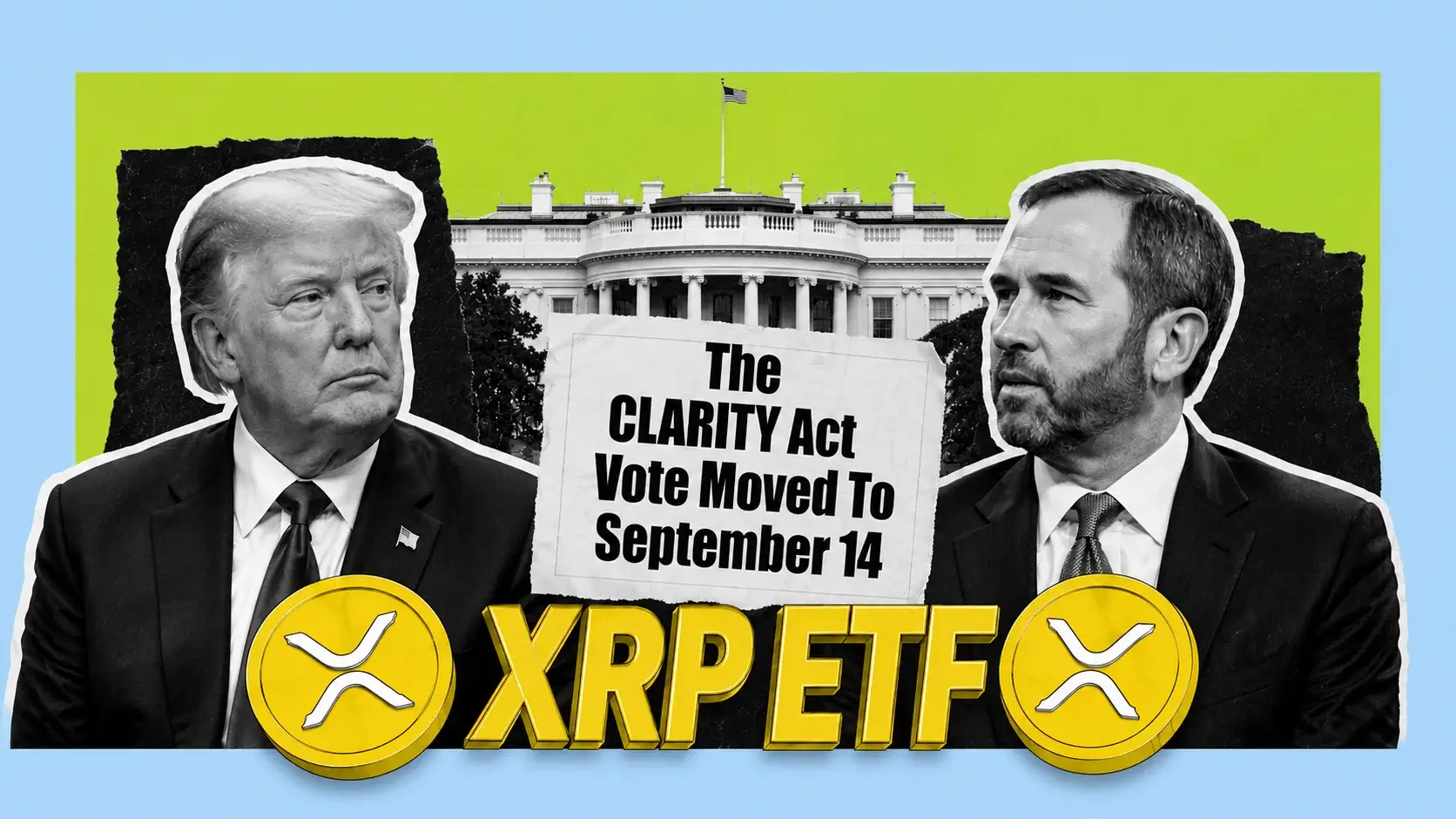
The CLARITY Act Vote Moved To September 14
The regulatory catalyst that the entire institutional case depends on has been postponed, and the delay is the proximate reason inflows stalled.
The Senate postponed a floor vote on the CLARITY Act until after its August recess, with the next opportunity in September and lawmakers returning September 14. A procedural vote has been indicated for mid-September.
If passed, the legislation would provide greater regulatory clarity for digital assets in the United States, potentially improving institutional confidence and supporting broader adoption of XRP-related investment products. The link between ETF flows and the legislation is the crux of the entire thesis.
The mechanism runs through mandate rather than sentiment. Institutional allocators operating under fiduciary constraints require legal classification before committing capital at scale. XRP's regulatory history makes that classification more consequential for this asset than for bitcoin or ether, both of which received clearer treatment years earlier.
Estimates place the potential unlock near $667 million in monthly ETF inflows following passage, which would exceed Ripple's roughly $302 million of monthly escrow supply by more than double and would reverse the net supply dynamic for the first time.
That figure is the entire bull case reduced to a single number, and it is contingent on legislation that has already slipped once.
The bearish reading is that a catalyst repeatedly delayed is a catalyst the market stops pricing. XRP fell 5% to 6% over the past week in part because the delay removed the September event from the near-term calendar and pushed it into a window where the Federal Reserve's September 15-16 meeting competes for attention.
Legislative outcomes are also not binary. Partial passage, amended language, or committee revision each produce results between the current state and the $667 million scenario, and none arrive before the current $1.00 test resolves.
What would change this category is platform-scale allocation from wirehouses and model portfolios, and legal clarity is the precondition for that access.
XRP At $1.006 Is Grinding Against An 18-Month Floor
The underlying asset determines the funds' value, and it sits at the most consequential level on its chart.
XRP traded at $1.006 on Tuesday, down 3.2% on the session, having touched $1.01 during the European session after a 2.7% decline over 24 hours. Daily closes tracked a gradual retreat from the low- to mid-$1.10s through early August, with recent trading confined between $1.00 and $1.04.
The token has fallen roughly 5% to 6% over the past week and 7% to 8% over 30 days, placing it among the weakest large-capitalization digital assets during the latest pullback. Bitcoin at $64,279 fell 0.9% and ether at $1,874 declined 2.8% across the same window.
The $1.00 level has functioned as support for 18 months. Below it, the structure is layered: the $0.97 Fibonacci zone first, then $0.94, then the broader $0.94 to $0.86 band. Above spot, $1.036 is the first reclaim level bulls need, with genuine resistance at $1.11, $1.19, and $1.30, and $1.45 the level that would improve the long-term outlook.
Momentum offers no support for a bounce. The daily relative strength index has dropped to approximately 34.2, close to oversold without reaching the conventional 30 threshold, which allows further declines before the token becomes technically stretched.
Every moving average sits above price. The 7-day sits at $1.0739, the 14-day at $1.0858, the 30-day at $1.0945, the 20-day EMA at $1.0843, the 50-day EMA at $1.1165, the 100-day EMA at $1.1972, and the 200-day near $1.36 to $1.37.
The offsetting on-chain signal is whale accumulation. Large holders continued building positions through the decline, buying hundreds of millions of tokens near the $1 level despite muted institutional flows. The monthly Tom DeMark Sequential has flashed a buy signal, pointing toward a possible macro shift.
For the ETF complex, XRP at $1.006 means the 992.5 million tokens held are worth roughly $998 million, consistent with the reported asset figures.
RLUSD Crossed To The XRP Ledger At $810 Million
The most constructive development in the ecosystem this month has been largely unpriced by the funds.
For the first time, more of Ripple's RLUSD stablecoin lives on the XRP Ledger than on Ethereum, with $810 million representing 51.7% of the total against $756 million at 48.3%. One month ago Ethereum led by more than $300 million.
That crossover matters because RLUSD has been the company's most successful product and, until now, it grew without generating XRP demand. A dollar-denominated stablecoin issued primarily on Ethereum generates Ethereum activity and Ethereum fees while the XRP token captures nothing.
The migration reverses that. Stablecoin settlement on the ledger requires XRP for transaction fees and for the bridge currency function connecting illiquid corridors. As volume shifts toward the ledger, the bridge mechanism begins generating real XRP demand for the first time.
The magnitude of the shift is notable: a $300 million Ethereum lead becoming a $54 million deficit inside one month represents roughly $350 million of relative migration.
The metric that determines whether it converts into demand is transaction volume rather than the static balance. Balances can sit idle. Volume generates fees and bridge usage. If volume follows the balance shift, the demand channel opens. If it remains concentrated on Ethereum despite the crossover, RLUSD growth stays XRP neutral.
Network fundamentals support the case that usage is real. The XRP Ledger has processed over 4 billion transactions since inception, real-world asset tokenization reached above $474 million with total represented value approaching $1.5 billion and one measure placing tokenized assets at $4.3 billion, and daily transactions hit 3 million on March 15, 2026, a threefold increase from mid-2025 averages driven by AMM pools, tokenized assets, and RLUSD-denominated settlement flows.
Institutional inflows are therefore not disconnected from underlying utility. The infrastructure is being used.
The scale limitation applies. RLUSD at $1.57 billion combined across both chains is small against a $63 billion XRP market capitalization, and the fee revenue from settling that volume is measured in thousands of dollars.
No Burn Mechanism Makes The Ether Comparison Unflattering
The tokenomics distinction is the structural argument that survives every price recovery, and it explains the relative fund performance.
Ethereum's fee burn mechanism creates deflationary pressure proportional to network usage. Every transaction removes supply. Combined with 33.98% of supply staked at an all-time high of 41.41 million ETH and exchange balances near 12% and falling, ether's float contracts as the network is used.
XRP has no equivalent. Its supply is fixed at issuance and escrow releases create a dynamic closer to a company selling treasury stock than a protocol with organic tokenomics. Network usage generates no supply reduction.
That distinction determines how each asset converts adoption into price. Ether's 2 million daily active addresses and 182 million non-empty wallets translate into supply removal through burn. XRP's 3 million daily transactions translate into fees that are negligible and produce no scarcity.
The consequence is that XRP requires demand-side flows to appreciate while ether can appreciate on usage alone. When ETF inflows collapse from $650 million to $1.01 million weekly, XRP loses its only price mechanism.
The fund category performance reflects it. Ether's complex holds $10.2 billion in assets against $11.2 billion of cumulative inflows, a 9% shortfall. XRP's holds $964 million against $1.51 billion, a 36% shortfall. Bitcoin's holds $78.16 billion against $51.3 billion to $58 billion, a net gain.
Ether recorded $92.15 million of inflows in a single August session and $245 million across the prior week. XRP's entire seven-fund category took $1.01 million across a week.
That is the measurable cost of lacking a value-capture mechanism, and it is why the XRP ETF category has underperformed every peer despite launching with the most successful first-day volume of 2025.
Wednesday's CPI Is The Only Near-Term Catalyst
The macro variable determines direction for the funds because the token's own catalysts have been removed from the calendar.
July US CPI arrives Wednesday at 8:30 a.m. Eastern Time. Consensus places headline at 0.2% month over month and 3.4% year over year, easing from 3.5% in June, with core at 0.2% and 2.5% annually, down from 2.6%. The Producer Price Index follows Thursday.
Money markets carry 22 basis points of Federal Reserve tightening by the end of 2026, up from 17 basis points on Friday, with September hold odds at 53.9%. The US 10-year sits at 4.726%, approaching a seven-month high, and the Dollar Index holds 99.826.
The cross-asset context on the day the funds were last measured is instructive. Friday delivered the category's strongest inflow of that week alongside gains in ether and Solana products, while bitcoin ETFs drew $233.13 million led by BlackRock's IBIT at $183.38 million. XRP participated at a fraction of the scale.
That pattern repeats consistently: when regulated crypto capital moves, it moves into bitcoin first, ether second, and XRP at roughly 0.5% of the bitcoin figure. A cool CPI print produces the same distribution at larger absolute numbers.
Bitcoin's own complex recorded $144.67 million in net outflows on August 10, ending a five-session streak that had delivered $853.54 million the prior week. Ether ETFs lost $14.6 million on the same session. When the largest categories reverse, the smallest has no independent bid.
A hot core print at 0.3% or higher pushes the 10-year through 4.85% and compresses the entire high-beta complex. XRP loses $1.00, tests $0.97 and $0.94, and the funds mark down proportionally with XRPC toward $10.50 and XRPZ toward $10.70.
The September window carries both the CLARITY Act procedural vote on the legislative calendar after September 14 and the FOMC decision on September 15-16. Those two events land within two days of each other, which means the category's next genuine catalyst arrives in a week dominated by rate policy.
XRP ETF: Levels, Scenarios And Invalidation
The base case holds the category between $900 million and $1.1 billion in assets through the CPI reaction and into the September legislative window, tracking XRP between $0.94 and $1.11, with the $1.00 spot level as the operative pivot.
The bullish path requires three confirmations. First, four consecutive weeks of net inflows above $10 million, which would signal a trend reversal from the current $1.01 million weekly pace. Second, XRP reclaiming $1.036 and then the 20-day EMA at $1.0843 on a closing basis, which would lift the funds proportionally with XRPC toward $12.20 and XRPZ toward $12.50. Third, CLARITY Act passage after September 14 delivering the estimated $667 million monthly inflow scenario, which would exceed Ripple's $302 million escrow release and reverse the net supply dynamic for the first time. Clearing all three targets category assets above $1.5 billion and XRP at $1.19 to $1.30.
The bearish path requires two. Four consecutive weeks of net inflows below $5 million, which would confirm the August collapse is structural rather than seasonal. Then a decisive weekly close below $1.00 on the token, which invalidates the 18-month support and opens $0.97, $0.94, and the $0.94 to $0.86 band. That sequence takes category assets toward $850 million and every share price to fresh all-time lows.
Invalidation for the bullish case is a weekly close below $1.00 in the underlying. Invalidation for the bearish case is a daily close above $1.0843.
The medium-term structure is negative and the supply arithmetic is why. Ripple's escrow releases roughly 300 million tokens monthly worth $302 million against August inflows near $4 million annualized from the current weekly pace. Seven funds hold 992.5 million tokens equal to 1.48% of the 62.5 billion supply against bitcoin's 6.08%. Cumulative inflows of $1.51 billion are worth $964 million, leaving the cohort 33.8% underwater at an implied $1.52 average cost. Grayscale cut holdings from 122.23 million tokens to 55.04 million with $51.63 million of combined losses. Three issuers control 93% of deployed capital. There is no burn mechanism.
The medium-term support is narrower and real. Whales bought hundreds of millions of tokens at $1.00 and are absorbing the escrow release. RLUSD crossed to the XRP Ledger at $810 million against $756 million on Ethereum for the first time, opening a demand channel that did not previously exist. Ledger transactions tripled from mid-2025 levels with tokenized assets at $4.3 billion on one measure. Monthly Tom DeMark Sequential has flashed a buy signal. Since July began the category recorded only a handful of outflow sessions, the largest $7.29 million.
The trade is XRP at $1.00 and the flow threshold at $10 million weekly. Above both, the category has a path. Below either, the funds continue marking down a token that institutional capital has decided not to buy at any pace that matters.