XRP-USD Slips 1.73% to $1.13 as Whales Accumulate 600M Coins and CLARITY Act Odds Fall From 46% to 38%
Wallets holding 100,000 to 100 million XRP added 600 million tokens worth roughly $678 million over five weeks | That's TradingNEWS
Key Points
- XRP trades at $1.13, down 1.73%, with the 50-day EMA at $1.11 and the July 20 low of $1.08 as the levels that decide the bull flag.
- Wallets holding 100,000–100 million XRP added 600 million tokens worth about $678 million over five weeks to July 22.
- The seven US spot XRP ETFs hold 977.4 million tokens and roughly $1 billion in assets, against a first-year forecast of $4–$8.4 billion.
XRP traded at $1.13 on Thursday, down 1.73% on the session, on roughly $980 million of daily volume. The token has spent the week compressed between the 50-day exponential moving average at $1.11 and a resistance shelf that has repeatedly capped it in the $1.15 to $1.20 zone.
The chart pattern traders are watching is a bull flag, and its invalidation level is precise: a move below the 50-day EMA at $1.11 brings sellers back and opens the July 20 low of $1.08.
Two datasets are pointing in opposite directions underneath that price, which is the most interesting feature of XRP right now.
On the spot side, large wallets have been accumulating aggressively. Addresses holding between 100,000 and 100 million XRP increased their positions by 2.8% over the five weeks to July 22, purchasing roughly 600 million coins worth approximately $678 million at current prices. That is a meaningful bid from a cohort that historically front-runs directional moves.
On the derivatives side, participation is draining away. Open interest has fallen 1.17% to $2.50 billion, down from $2.96 billion on June 1 — a decline of roughly 15.5% across seven weeks. Traders have been closing futures positions rather than establishing new ones.
Spot accumulation with falling leverage is not a bearish configuration. It is a quiet one. It describes a market where speculative money has left and patient money is stepping in, which typically precedes either a long base or a violent repricing once a catalyst arrives.
The macro backdrop offered nothing constructive. Brent crude crossed $100.64, the 10-year Treasury yield sat at 4.695%, September Fed hike odds firmed near 78%, and US equities opened sharply lower. Bitcoin held between $64,000 and $66,800 near $65,500 with dominance at roughly 59% — capital consolidating into the senior asset rather than rotating down the risk curve.
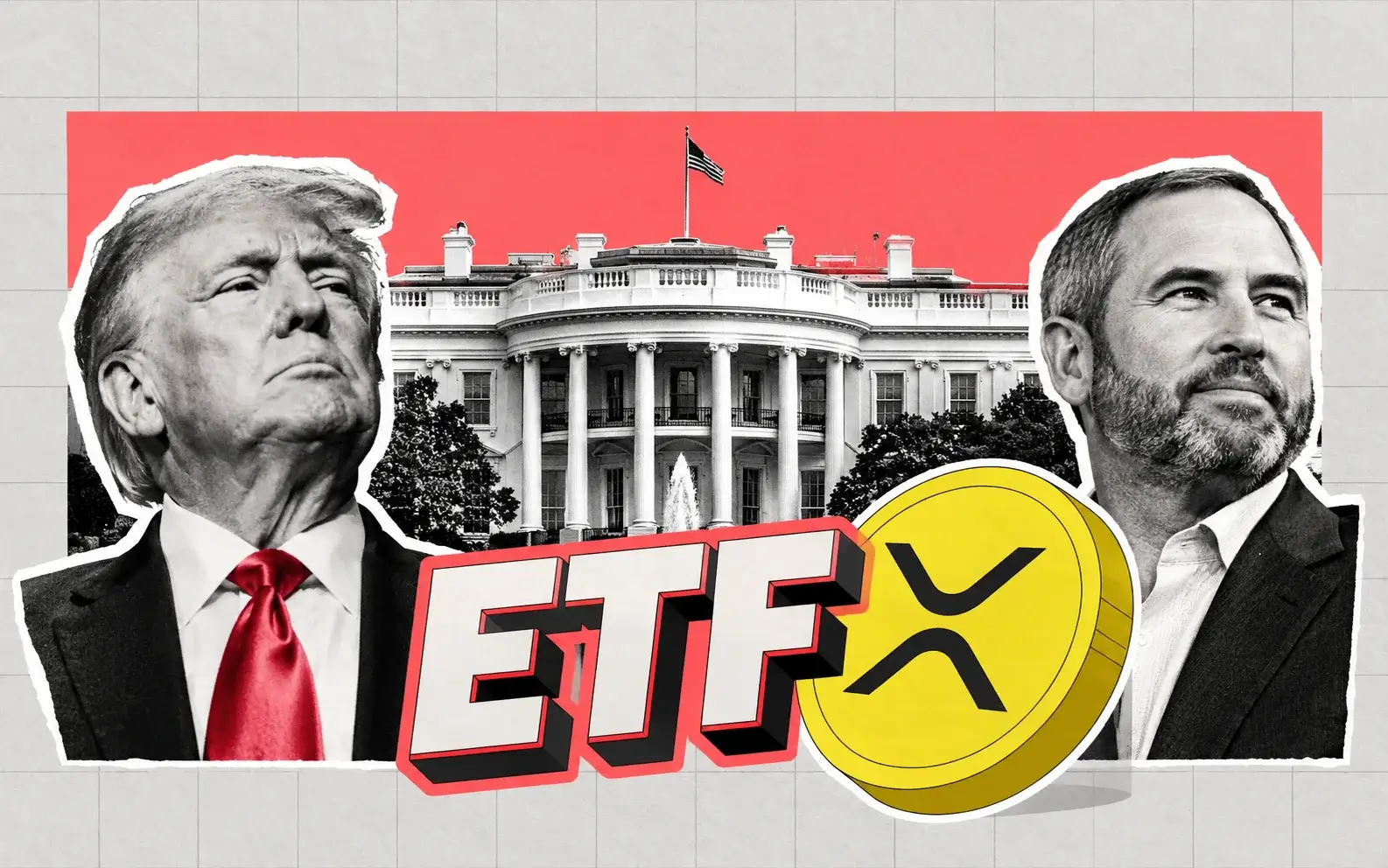
The XRP-specific catalyst also deteriorated. Prediction market odds of the Digital Asset Market Clarity Act becoming law fell from 46% to 38% after Senate Democrats declared the latest draft insufficient. For a token whose entire institutional case runs through US regulatory clarity, that is the single most consequential headline of the day.
The 2026 Collapse: From $2.42 in January to $1.04 in June
Context matters here because XRP's drawdown has been steeper than the broader market's and the reasons are partly idiosyncratic.
The year opened strongly. XRP surged 12% to $2.42 on January 6 amid heavy ETF trading volumes and institutional interest, trading at $2.35 the following day with a 24-hour range of $2.14 to $2.42. Relative strength readings hit 75 — overbought and momentum-driven, with reduced short positioning and volumes supporting the breakout.
Everything after that was downhill. XRP entered June around $1.30 and slid through almost the entire month, closing near $1.04 — its weakest level since late 2024 and a decline of roughly 20% across four weeks. Bitcoin fell comparably and slipped below $59,000, with Ethereum, Solana and BNB all dropping, so the selling was market-wide rather than XRP-specific. The Fear and Greed Index sank into Extreme Fear at 25.
The recovery since has been modest. XRP broke above $1.07 resistance in early July on a cluster of catalysts including favourable escrow handling, ledger upgrades and renewed ETF activity, gaining 3.71% in a five-hour window on July 2. It has since traded a narrow band, printing a low of $1.08 on July 20 and failing repeatedly at $1.15 to $1.20.
At $1.13, XRP sits more than 50% below its January highs and roughly 69% below its cycle peak of $3.65 to $3.66 set on July 18, 2025.
The performance gap against the rest of the majors is the uncomfortable part. Bitcoin has rallied more than 13% from its July 1 low of $57,750. Ether has recovered roughly 23% from $1,566 and has outperformed Bitcoin over the past month. XRP has managed a fraction of that, and one recent analysis summarised the problem bluntly: the post-inflation-data rally gave XRP a nudge and the coin barely moved.
Volatility has compressed alongside the price. Over the past thirty days XRP has posted 17 green days out of 30 and price volatility of roughly 2.89% — subdued for an asset with this beta profile, and consistent with a market waiting for information rather than trading a view.
Whales Bought 600 Million Coins While Everyone Else Left
The accumulation data is the strongest bull-case evidence available, and it deserves precision rather than enthusiasm.
On-chain analytics show wallets holding between 100,000 and 100 million XRP — the shark-and-whale cohort — increased their holdings by 2.8% across the five weeks ending July 22. That translates to roughly 600 million tokens, worth approximately $678 million at $1.13.
Two features make it notable. First, the buying occurred during a period when the price went essentially nowhere, which means it was absorbed by supply rather than chasing momentum. Second, it coincided with declining derivatives participation, which rules out the possibility that it reflects leveraged positioning dressed up as spot accumulation.
The stated rationale from market commentary is anticipation that the Senate will pass the CLARITY Act before the August recess. Ripple's chief executive has been publicly urging Congress to act on that timeline, and Senate Republicans released an updated version of the bill text on July 22.
That framing is worth treating with care, because it makes the accumulation a bet on a binary legislative outcome rather than on a fundamental revaluation. If the bill passes, buyers positioned ahead of it are rewarded. If it stalls into September, 600 million tokens purchased at an average price near current levels become a source of overhead supply.
The counterweight is the ETF custody data, which shows a different type of buyer behaving similarly. Roughly 970.9 million XRP now sit in custody across the US spot exchange-traded fund complex — approximately 1.7% of circulating supply removed from the open market. Custodied tokens have grown 26% since March, and critically, that growth occurred while the price was falling. Institutions accumulated the decline rather than redeeming into it.
Two distinct cohorts — large private wallets and regulated fund vehicles — adding exposure into weakness is the most defensible bullish datapoint XRP currently has. Neither is large enough in absolute terms to move a market with $980 million of daily turnover on its own, but both signal that the marginal holder at these levels has conviction rather than a stop-loss.
The Spot ETF Complex Went From Structural Bid to Standstill
Seven US spot XRP exchange-traded funds are trading, with combined assets under management of approximately $1 billion and 977.4 million XRP tokens held as of July 23. Cumulative net inflows since the November 2025 launch stand at roughly $1.47 billion.
For most of this year the flow picture was the cleanest bull argument in the asset. The complex ran an eight-week unbroken inflow streak through July 8, and early-July single-day inflows reached $83 million — a 2026 high that put the month on track to be the strongest of the year. Net creations force authorised participants to buy XRP on the open market, making ETF flows the single most direct demand channel that exists for the token.
Then it stopped.
July 8 logged $7.29 million in net outflows, one of the largest single-day losses since March 2026. July 10 pulled in just $107,000 — a rounding error for a product complex that had absorbed more than $100 million in a single month two months earlier. Several other sessions this month recorded flat zero inflows. The pace of accumulation decelerated from a structural bid to a near-standstill inside six weeks.
One mitigating detail: the concentration of July's outflows in a single issuer suggests fund-specific redemption pressure rather than a coordinated institutional exit. That distinction matters, and it is the thing to track as August flow data develops.
The scale problem is harder to explain away. One large US bank forecast first-year XRP ETF inflows of $4 billion to $8.4 billion. The actual figure at roughly $1.47 billion after eight months sits at the low end of a third of that range. The products launched, the institutions came, and the money arrived at a fraction of the anticipated pace.
Set that against the comparison assets. Spot Bitcoin ETFs carry roughly $74 billion in net assets. Spot Ether products hold above $13 billion with $10.48 billion of cumulative net inflows. XRP's $1 billion complex is an order of magnitude smaller than Ether's and nearly two orders below Bitcoin's.
That is the honest framing of institutional adoption in XRP: the access exists, the vehicles work, and the demand has been modest.
Institutional Names Are on the Register and the Flows Still Stopped
The roster of institutions holding XRP ETF positions is genuinely impressive, which makes the flow data harder to dismiss as a distribution problem.
One major US investment bank disclosed a $153.8 million position across multiple XRP ETF products in early 2026. A large asset manager opened XRP access to approximately 13,000 financial advisors. A major European bank and a dedicated digital asset manager also hold positions. More recently, a nearly 90-year-old US asset manager launched a multi-crypto exchange-traded fund holding Bitcoin, Ethereum and XRP, with five managers hand-picking constituents rather than tracking an index — a notable vote of confidence given that firm's historical aversion to speculative assets.
Distribution, custody, regulatory approval and institutional endorsement are all in place. The capital has not followed at scale.
There is a countervailing signal from the index world that helps explain why. A major index provider launched a digital asset index in 2026 that excludes both Bitcoin and XRP, citing a revenue-generation requirement for inclusion. The index holds 18 tokens led by Ethereum, BNB, Solana, Tron and Hyperliquid. Whatever one thinks of the methodology, it captures how a segment of institutional allocators now frames the question: does the token capture economic value from the network's activity, or does it merely denominate it?
For Bitcoin, exclusion on that basis is arguably a category error — it is monetary collateral, not a cash-flow asset. For XRP, the question lands harder, because XRP's entire pitch has been utility rather than monetary premium.
The regulatory improvements are real and substantial. Ripple's protracted SEC litigation is resolved. Spot ETFs made institutional participation possible. The company secured full MiCA authorisation through a Luxembourg licence on July 6, 2026, allowing regulated crypto payments across all 30 EEA countries, and Ripple Payments Europe joined the MiCA register alongside 14 other firms, bringing the bloc's authorised provider count to 294.
Every structural obstacle that existed two years ago has been removed. The price is down 69% from its cycle high anyway, and that gap between improving fundamentals and deteriorating price is the puzzle every XRP holder is trying to solve.
CLARITY Act Odds Fell From 46% to 38%, and That Is the Whole Catalyst
XRP is more sensitive to US digital asset legislation than any other major token, and the odds moved sharply against it on Thursday.
Senate Republicans released updated text for the Digital Asset Market Clarity Act on July 22, negotiated alongside the White House. The revised bill includes a strict ethics package barring the president, vice president, members of Congress, federal judges and other covered officials — along with their spouses — from issuing or sponsoring digital assets for compensation while in office through January 20, 2029, with Justice Department fines of up to $250,000 per day for violations.
That draft supported crypto prices through midweek. It did not survive Thursday. A coalition of influential Senate Democrats issued statements declaring the latest version insufficient on ethics standards and other vital components. Prediction market odds of the bill becoming law dropped from 46% to 38% immediately.
Roughly fifteen legislative days remain before the August recess. Ripple's chief executive has been publicly urging Congress to act within that window, and one prominent asset manager's chief investment officer argued this week that passage before the recess would end crypto winter outright.
The reason this matters more for XRP than for Bitcoin is structural. Bitcoin's investment case does not depend on a US regulatory framework for digital asset market structure — it is monetary collateral with an established ETF complex and a global holder base. XRP's case depends on institutions being able to use the token inside regulated payment infrastructure at scale, and that requires the legal clarity the bill would provide. The Senate majority leader has signalled a vote; the arithmetic for passage looks considerably harder than it did forty-eight hours ago.
The trading implication is uncomfortable but clear. The whale accumulation of 600 million tokens over five weeks was explicitly framed as a CLARITY bet. Odds falling from 46% to 38% means that bet is now underwater on probability even before it is underwater on price. If the bill slips past the recess, the most likely outcome is that those buyers become sellers into any strength, and the $1.15 to $1.20 resistance zone that has capped every rally this month gets harder rather than easier to clear.
RLUSD Flipped Ethereum, and It Does Almost Nothing for XRP
The most-cited XRP bullish headline this month is also the one that requires the most careful reading.
Ripple's dollar-pegged stablecoin RLUSD now hosts the majority of its supply on the XRP Ledger rather than on Ethereum. As of July 11, the ledger held approximately 863.2 million RLUSD against Ethereum's 676.1 million — a 56.1% to 43.9% split — out of roughly $1.539 billion in total supply. The flip occurred on June 26 and the gap has widened since. XRP Ledger supply has more than doubled in two months, up roughly 128% since mid-May.
The adoption metrics around it are substantial. RLUSD has crossed $1.5 billion in market capitalisation, entering the global top ten stablecoins. It drove approximately $2.5 billion in settlement volume on the XRP Ledger. It is live on Binance, listed across 280 trading pairs on another major exchange as institutional-grade margin collateral, and operating in Japan through a major financial group with approval from the country's Financial Services Agency.
Here is the part that gets omitted from the bullish framing: minting RLUSD does not require buying XRP.
Issuing a dollar-pegged stablecoin on the XRP Ledger requires dollars and a smart contract, not the native token. Ledger transactions do consume small XRP-denominated fees, and those fees are burned — but the amounts are negligible relative to circulating supply and do not function as a meaningful price mechanism. Stablecoin volume moving from point A to point B on the ledger is not the same thing as XRP being bought and sold inside a transfer as a bridge asset.
The distinction is the whole argument. RLUSD growth is unambiguously good for Ripple, the company. It is largely neutral for XRP, the token.
That is not a fringe bearish take — it is the analytical consensus among people who model the token rather than the narrative. The demand channels that would actually lift XRP are spot ETF inflows, which have stalled, and genuine bridge-asset volume in cross-border corridors, which has not materially expanded. Meanwhile RLUSD's success arguably competes with XRP for the settlement use case it was designed to serve.
Read More
-
Yen Stalls at 160 Despite a 3% JGB and Tokyo Core CPI at 2.0% — Intervention Sits at 164, Friday's Payrolls Decide
02.09.2026 · TradingNEWS ArchiveEnergy
-
S&P 500 Slides 0.80%, Nasdaq Loses 1.03% And Dow Drops 0.54% As Chips Get Smoked And Oil Rips To $109
14.09.2026 · TradingNEWS ArchiveStocks
-
XRP ETF Flows: 7 Funds Split $1.682B With the Complex at Just 1.68% of Market Cap
10.09.2026 · TradingNEWS ArchiveCrypto
-
NG Breaks $2.90 With Production at 113 Bcf/d and LNG Feedgas Capped at 18.3 Bcf/d
10.09.2026 · TradingNEWS ArchiveCommodities
-
USD/JPY Holds Below the 157.23 Average as 2 Central Banks Tighten in 48 Hours
10.09.2026 · TradingNEWS ArchiveForex
The Value-Capture Problem Is XRP's Central Question
Strip away price action and the question every XRP holder must answer is whether network growth converts into token demand. The evidence is mixed and leans negative.
The network is genuinely expanding. Daily transactions on the XRP Ledger reached 3 million in March 2026, a threefold increase from mid-2025 averages. Roughly $4 billion in tokenized real-world assets now live on the network, up from a few hundred million earlier in the year. Native lending is coming in the ledger's next major upgrade, and an Ethereum-compatible sidechain is already live, opening the network to Solidity developers.
Ripple the company is executing well. Full MiCA authorisation covers 30 EEA countries. Partnerships extend through Türkiye, Japan and beyond. The SEC case is behind it. RLUSD is a top-ten stablecoin with real institutional distribution.
Every one of those developments improves Ripple's commercial position. None of them mechanically requires anyone to buy XRP at scale.
That is the paradox one analysis captured precisely this month: XRP's fundamental story is far more robust than it was a year ago — SEC risk gone, more than $1.4 billion in spot ETF inflows, expanding ledger utility — and the price sits more than 50% below its January levels. The remaining question is about value capture.
The bull rebuttal is that fee burn scales with activity, that tokenized assets on the ledger eventually require XRP liquidity for settlement, and that the payments funnel Ripple is building will route volume — and fee burn — through the ledger over time. That case is coherent. It is also a multi-year argument being asked to support a token that has fallen 69% in twelve months.
The honest framing for anyone allocating here is that XRP is two assets stacked in one ticker. One is a bet on US regulatory clarity unlocking institutional flows into a $1 billion ETF complex that should be far larger. The other is a bet that ledger activity eventually accrues to the token. The first has a defined catalyst and a fifteen-day window. The second has no timeline at all.
Supply Is the Structural Headwind That Cannot Be Retired
The escrow overhang is XRP's permanent asterisk, and no amount of adoption news changes the arithmetic.
Roughly 37.5 billion XRP remain outside circulation against a 100 billion total supply, a substantial portion held in escrow with scheduled monthly releases. Ripple holds approximately 35.8% of total supply in that escrow structure. Every scheduled release adds tokens to the tradeable float, and new supply entering the market works directly against price.
Management of that mechanism has improved, and July's handling was the clearest example. Ripple locked roughly 70% of the unlocked tranche straight back into escrow, releasing exactly 300 million XRP — approximately $319 million — into circulation. The sizing was deliberate: it matched average daily volume running near $1.6 billion at the time, ensuring the release could be absorbed without generating excess sell pressure. An additional 700 million tokens went back into escrow.
That behaviour is disciplined rather than dilutive, and the market read it that way. The move sparked a 3.71% rally on July 2 as sentiment shifted away from dilution fears, with viral framing around roughly $1.5 billion of XRP being locked out of immediate circulation. The release represented less than 1% of Ripple's locked assets.
But the structural position is unchanged. Compare the two numbers that matter: US spot ETFs hold 977.4 million XRP, approximately 1.7% of circulating supply. Ripple's escrow holds roughly 35.8% of total supply. The entire institutional accumulation of eight months amounts to less than 5% of what a single entity can release at its discretion.
That asymmetry caps how much a supply-shock narrative can ever do for this token. Bitcoin's investment case rests on a fixed, verifiable, unchangeable issuance schedule. Ether's rests on 33.51% of supply locked in consensus with an empty exit queue. XRP's supply is governed by a corporate escrow policy that has been managed responsibly and could, in principle, be managed differently.
Exchange supply has been tightening and treasury accumulation removes float at the margin. Neither offsets 37.5 billion tokens sitting outside circulation.
Derivatives Say Traders Are Leaving, Not Positioning
The futures market tells a story that neither the bulls nor the bears want to hear: participation is draining out of XRP.
Open interest stands at $2.50 billion, down 1.17% on the session and down from $2.96 billion on June 1. That is a decline of roughly 15.5% across seven weeks, and it occurred while the price traded a narrow range between $1.04 and $1.20. Falling open interest on flat price means positions are being closed rather than rolled or replaced.
That has three implications worth thinking through.
First, it removes forced-selling risk. A market that has already de-levered cannot be liquidated into a cascade the way it could in June. The $2.96 billion of open interest that existed at the start of the drawdown has been substantially cleared, and what remains is a thinner, more cash-based book.
Second, it removes fuel for a squeeze. Rallies in crypto are frequently manufactured by short liquidations, and there is materially less short exposure to squeeze at $2.50 billion than at $2.96 billion. Any advance from here has to be bought rather than forced.
Third, it amplifies moves in both directions. A market with $980 million of daily spot volume, thin derivatives depth and 600 million tokens recently accumulated by large wallets has very little resting liquidity to absorb a shift in flow. That is the same structural point that applies across crypto right now — markets that climb on thin participation travel quickly in either direction.
The composite read from the positioning data: speculative money has left XRP, spot money has been quietly accumulating, and the asset is coiled inside a compressed range waiting for a legislative decision. That is not a market anyone should be sizing aggressively in either direction, but it is a market where a catalyst produces an outsized response.
Sentiment readings support the interpretation. The Fear and Greed Index across crypto has recovered to 39 from lows at 25, still below neutral with sellers described as dominant. XRP-specific technical sentiment has been reading bearish at roughly 59% even as the price holds.
Levels: $1.11 and $1.08 Decide Whether the Base Holds
The technical map is unusually tight because XRP has spent three weeks in a range of roughly twelve cents.
Immediate support sits at the 50-day exponential moving average at $1.11. That level is the invalidation point for the bull flag pattern currently in place — a move below it brings sellers back and exposes the July 20 low of $1.08. Beneath that, the June closing area near $1.04 is the next reference, and then the $1.00 psychological level that XRP was "right on the edge of" when July began.
Overhead, the pair faces a resistance band at $1.15 to $1.20 that has capped every attempt this month. The $1.20 level functions as the trigger for anything more constructive — clearing it on volume would confirm the base rather than the range. Above $1.20, technical models point to $1.26 as the upper boundary of 2026 expectations. Beyond that there is very little trading history until the January range in the $2.30s, which is both an opportunity and a warning about how thin the structure is.
The moving average configuration is mildly constructive. On shorter timeframes the 50-period average has been rising, and XRP has held above the $1.07 level it broke through in early July. Thirty-day statistics show 17 green days out of 30 and volatility of approximately 2.89% — a market grinding rather than trending.
Model-based projections cluster tightly around current levels, which is itself informative about how little conviction exists. July expectations centre on an average of $1.14 with a range of $1.13 to $1.15. August projections average $1.23 with a floor near $1.19 and a peak at $1.26. September estimates average $1.13 with a range of $1.08 to $1.18. The full-year 2026 model puts the minimum at $1.08, the maximum at $1.26 and the average at $1.17.
Those figures describe a market that quantitative models expect to do essentially nothing for the rest of the year — which is precisely the outcome that a fifteen-day legislative window has the power to invalidate in either direction.
Forecast Dispersion: $0.85 to $2.80 on the Same Twelve Months
Published targets for XRP span a range that reduces to a single binary, and it is worth stating the endpoints clearly.
The bull case carries a $2.80 target, predicated on CLARITY Act passage unlocking the institutional flows that the $4 billion to $8.4 billion first-year ETF forecast anticipated, combined with continued custody accumulation and a broader crypto risk-on rotation. That would represent roughly a 148% advance from $1.13 and would still leave XRP below its July 2025 cycle high of $3.65.
The bear case carries $0.85, predicated on the bill stalling past the August recess, ETF flows remaining at the near-zero pace of the past six weeks, escrow releases continuing to add supply, and the value-capture question remaining unanswered. That would represent a 25% decline and would take XRP to levels not seen since 2024.
The trigger level identified between them is $1.20 — the top of the current resistance band and the price above which the technical structure changes character.
Institutional forecasts have been converging downward. One major US bank cut its twelve-month Ether target to $2,240 from $3,175 in early July citing negative flows and limited regulatory momentum; the same logic applies with more force to XRP, which has less flow support and more regulatory dependence.
The dispersion is not analytical disagreement about XRP's technology or Ripple's execution. Both camps accept that the SEC case is resolved, that MiCA authorisation is real, that RLUSD is succeeding, and that ledger activity is growing. The disagreement is entirely about whether US market structure legislation passes and whether, if it does, institutional capital arrives at a scale that matters against 37.5 billion tokens outside circulation.
That framing should govern position sizing. A binary outcome with a 38% implied probability and a payoff distribution running from minus 25% to plus 148% is an options-style exposure, not a core allocation. Anyone treating XRP as a buy-and-hold at $1.13 is implicitly making a legislative forecast, whether they realise it or not.
Forecast: Range Between $1.08 and $1.20 Until Washington Decides
The base case into month-end is continued range trading between $1.08 and $1.20, with the bias marginally lower given Thursday's deterioration in CLARITY odds. The evidence: three failed attempts at the $1.15 to $1.20 band, ETF flows at a near-standstill after an eight-week streak, open interest down 15.5% from June levels, and a macro backdrop of Brent above $100 with September Fed hike odds near 78%. XRP has no independent catalyst before the recess deadline.
The bearish scenario activates on a daily close below the 50-day EMA at $1.11. That invalidates the bull flag and opens the July 20 low of $1.08 immediately, with $1.04 and then $1.00 beneath it. Triggers: the CLARITY Act failing to reach a floor vote before the August recess, a resumption of ETF outflows on the July 8 scale, a hawkish FOMC statement on July 28-29, or Brent sustaining above $100 into August. On a break of $1.00, the $0.85 bear target becomes the operative reference.
The bullish scenario requires clearing $1.20 on expanding volume. The realistic route is legislative: Senate passage before the recess, which one asset manager argued would end crypto winter outright. Secondary supports would be a resumption of ETF inflows toward the $83 million single-day pace seen in early July, further whale accumulation beyond the 600 million tokens already purchased, and evidence that ledger fee burn is scaling with the $4 billion of tokenized assets now live. That path opens $1.26 and then, with genuine flow behind it, the $1.50 to $1.80 zone that has no meaningful resistance inside it.
The calendar is compressed. Roughly fifteen legislative days remain before the August recess. The FOMC decides July 28-29. Ripple's monthly escrow release lands at the start of August, and the market will watch whether management repeats July's discipline of locking 70% straight back. ETF flow prints publish daily and are the highest-frequency read available.
What would change this framework entirely is evidence that bridge-asset volume — XRP actually being bought and sold inside cross-border transfers rather than stablecoins moving between points — is scaling. That is the only development that resolves the value-capture question without waiting on Congress, and nothing in the current data suggests it is happening yet.