



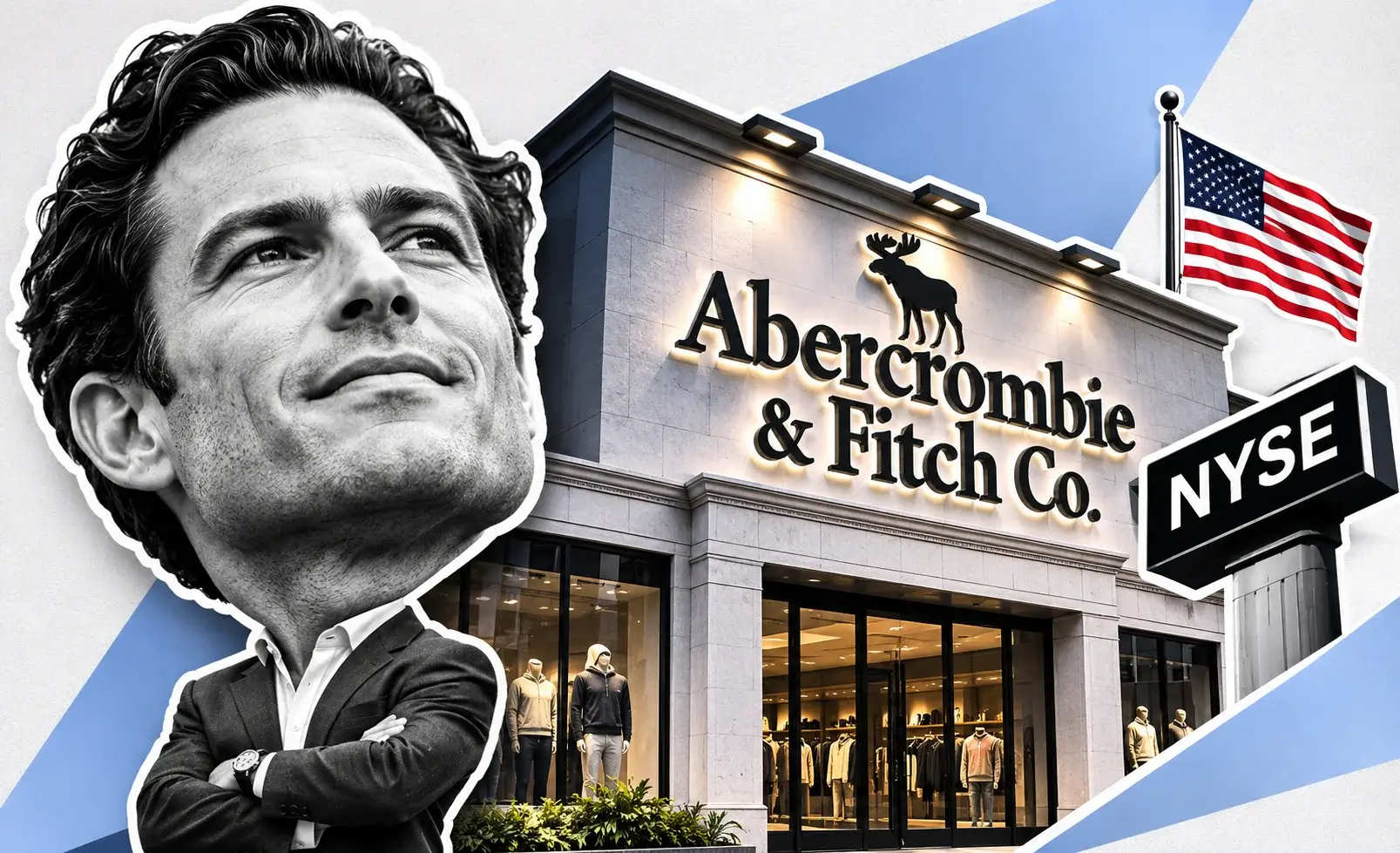
Abercrombie Soars 24.6% to $174.95 on $3.82 EPS Beat and Raised Guide, Setting Up a $200 Run
ANF targets $200 as Hollister and Abercrombie grow 11–12% and FY2026 EPS guidance rises | That's TradingNEWS
Key Points
- ANF closed at $174.95, up 24.6%, its third 20%-plus earnings-day jump in 12 months and highest close since July 2024.
- Q3 EPS of $3.82 beat the $3.10 consensus; excluding the $20M tariff refund, EPS of $3.42 still beat by 11%.
- FY2026 EPS guidance rose to $13.70–$13.90, with inventory up 4.4% against 11% sales growth and 9% fewer shares.
Abercrombie & Fitch Co. (NYSE: ANF) closed Tuesday, November 24, at $174.95, up $34.50, or 24.6%, from Monday's $140.45 close. Intraday the stock reached $176.92, a 26.0% gain. It was ANF's highest close since July 2024. The move came on the same day the Nasdaq Composite fell more than 400 points and the S&P 500 slipped 0.7% in morning trading. While technology sold off, the retail sector rallied: the SPDR S&P Retail ETF rose 2.52% to $89.87, Burlington Stores gained 8.84% and Dollar Tree climbed 11.1%.
The rally built as the day went on. Before the open, ANF traded at $154.55, up 10.04%, after the 7:30 a.m. ET release of fiscal third-quarter results. By 10:00 a.m. the stock had reached $172.09, up 22.5%. After the 8:30 a.m. ET conference call, buyers kept adding through the session and pushed the stock past $176 before it settled at $174.95. The gap between the premarket price and the close, $20.40, shows that investors grew more confident as they digested the details, rather than selling into the headline.
This is the third time in 12 months that ANF has gained more than 20% on an earnings day. In November 2025 the stock rose 37.5% after its third-quarter fiscal 2025 report. On August 26, 2026, it rose 35.7%, closing at $147.75 after trading between $130.24 and $154.58. Those two moves rank as the best single sessions since ANF listed in 1996. Tuesday's 24.6% gain is the third-largest earnings move in that sequence.
The pattern also says something about expectations. Before each report, the stock had fallen back from its previous peak. After the August jump to $147.75, ANF drifted down to $140.45 by Monday, a 4.9% pullback over three months that went into earnings with low expectations. Each time, the company reported results well above forecasts and the stock re-rated sharply. ANF's 52-week low is $65.45. At Tuesday's close the stock is 167% above that low.
The swings cut both ways. ANF has had 34 moves greater than 5% over the past year. In January 2026, when the company narrowed its holiday guidance, the stock fell more than 17% in a day. In March 2026, after the fourth-quarter report, shares fell 7.8% in the morning session on a weak outlook for fiscal 2026. Traders who buy at $174.95 are buying a stock that has repeatedly delivered 20%-plus moves in both directions on company news.
At the closing price and 43.0 million diluted shares, ANF's market value stands at $7.52 billion, up from $6.04 billion on Monday.
Third-Quarter Numbers: $1,435.4 Million in Sales, $3.82 EPS, 15.5% Operating Margin
According to the company's third-quarter results filed with the SEC, net sales for the quarter ended October 31, 2026, rose 11% to $1,435.4 million from $1,290.6 million a year earlier. It was the highest third-quarter revenue in company history and the 16th consecutive quarter of sales growth. Comparable sales rose 6%. Sales beat the $1.37 billion consensus estimate by $65.4 million, or 4.8%.
Diluted earnings per share rose 62% to $3.82 from $2.36. The consensus estimate was $3.09–$3.10, so the beat was 72–73 cents, or 23%. Net income attributable to Abercrombie & Fitch was $164.4 million. Pre-tax income was $230.1 million and income tax expense was $65.6 million, an effective tax rate of 28.5%.
Operating income rose 44% to $223.2 million from $155.0 million. Operating margin widened 350 basis points to 15.5% from 12.0%. In August, management had guided to an operating margin of 13% to 14% for the quarter. The result came in 150 to 250 basis points above that range.
Gross margin, derived from cost of sales excluding depreciation and amortization, stood at 65.0% of sales, compared with 62.5% a year earlier. That 250-basis-point improvement was the main driver of operating leverage. Some of it reflects lower tariff costs, covered in the next section, and some reflects lower promotional activity as inventory stayed tight.
The quarter's share count shows the effect of buybacks. Diluted weighted-average shares fell to 43.0 million from 47.9 million a year earlier, a 10.2% reduction. On the same net income, that drop alone would have raised EPS by 11%. Net income rose 48% year over year, from $112.9 million implied by the prior-year EPS and share count, to $164.4 million. Shrinking the share count added the rest of the 62% EPS growth.
For the first 39 weeks of fiscal 2026, net sales rose 6.1% to $3,816.0 million from $3,596.5 million. Operating income rose 21.9% to $564.7 million, a 14.8% margin against 12.9% a year earlier. Diluted EPS for the period reached $9.39, against $6.83 on a GAAP basis and $6.24 adjusted a year earlier. Diluted weighted-average shares for the year to date were 44.2 million.
The third quarter is ANF's back-to-school period, the second-largest selling season after the holidays. The results show a business accelerating into the fourth quarter. Growth rates for each brand and region rose from second-quarter levels, according to CEO Fran Horowitz.
The $20 Million Tariff Refund: How Much of the Beat Is One-Off
The headline numbers include a one-time item that investors need to separate out. In the third quarter, ANF recorded an IEEPA tariff refund of $20 million, refunds of duties collected under the International Emergency Economic Powers Act. The refund added 40 cents to diluted EPS and 150 basis points to operating margin.
Excluding the refund, third-quarter EPS was $3.42, still 32–33 cents, or 11%, above the $3.09–$3.10 consensus. Operating margin excluding the refund was 14.0%. That is 200 basis points above last year's 12.0% and at the top of management's 13% to 14% guidance. The underlying quarter beat expectations even without the refund, though by less than the headline suggests.
The refund is part of a larger pattern this year. In the second quarter, ANF recorded an IEEPA refund of $100 million, worth 790 basis points of margin. Including the third quarter, the year-to-date refund totals $120 million, adding 320 basis points to operating margin and $2.10 to diluted EPS. For the full year, the company expects the refund to contribute 220 basis points of margin and, including interest, $2.15 of EPS.
Tariff expense is still a cost. ANF paid $10 million in tariffs in the third quarter, down from $25 million a year earlier. In the first quarter it paid $20 million and in the second $15 million. Including the $20 million refund, the total tariff effect in the third quarter was a $10 million benefit, a 230-basis-point improvement year over year. For the rest of fiscal 2026, management expects an effective tariff rate of 10% to 12.5% on imports, net of mitigation.
The refund changes how the stock should be valued. Fiscal 2026 EPS guidance of $13.70–$13.90 includes $2.15 from the refunds. Excluding them, underlying EPS is $11.55–$11.75. Fiscal 2025 EPS was $10.39. Underlying earnings growth for fiscal 2026 is therefore 11–13%, not the 32–34% the headline guidance implies.
That 11–13% figure still represents solid growth for an apparel retailer, especially one with a share count falling 9% a year. But it means investors are paying for underlying earnings of $11.65 at the midpoint, not $13.80. At $174.95, the stock trades at 15.0 times underlying fiscal 2026 EPS and 12.7 times reported EPS.
The refunds do have lasting value in one respect. The $120 million in cash is real and has been used partly to fund share repurchases. A company that turns a one-time refund into a lower share count makes that benefit permanent on a per-share basis.
Hollister Up 11% to $746.6 Million: The Larger Brand Leads Back-to-School
ANF has two brand families. In the third quarter, the Hollister brands, which include Gilly Hicks, posted net sales of $746.6 million, up 11% year over year, with comparable sales up 5%. The Abercrombie brands, which include Abercrombie Kids and Your Personal Best, posted net sales of $688.8 million, up 12% from $617.3 million, with comparable sales up 6%.
Hollister is now ANF's larger brand by revenue. Its $746.6 million in sales accounted for 52.0% of the quarter's total. The back-to-school season matters more for Hollister, which targets teenagers, than for Abercrombie, which targets young adults in their mid-twenties and older. An 11% gain during back-to-school shows that Hollister's teen customers are spending on the brand during the period when they make their biggest clothing purchases of the year.
The Hollister story has driven ANF's last two years. In fiscal 2025, Hollister delivered mid-teens sales growth and a strong holiday season. That pace has slowed to 11%, but it is now growing from a much larger base. Hollister's comparable sales of 5% against total brand growth of 11% shows that new stores contribute about 6 percentage points of the brand's growth. That reflects ANF's ongoing store expansion.
The Abercrombie brand had a more difficult 2025, when its growth slowed and it faced tougher comparisons after years of strong gains. Third-quarter growth of 12% with comparable sales of 6% marks a clear recovery. According to Horowitz, growth at both brands accelerated from second-quarter levels. For Abercrombie, the brand with higher prices and margins, returning to double-digit growth matters for profitability.
The balance between the brands reduces risk. In 2023 and 2024, ANF's growth depended heavily on Abercrombie. In 2025 it shifted to Hollister. In the third quarter of 2026, both brands grew 11–12%. A company with two growing brands in different age groups is less exposed to a slowdown in any one customer segment.
Comparable sales growth of 6% for the total company is lower than the double-digit comparable gains ANF posted in 2023 and 2024. Those years benefited from a turnaround from a low base. Comps of 5–6% against strong prior-year results are a more sustainable pace. They also mean ANF is no longer a recovery story. It is a growth retailer with established brands, priced at 12.7 times reported earnings.
Regional Growth: APAC Up 24%, EMEA Up 12%, Americas Up 11%
All three regions posted double-digit sales growth in the third quarter. The Americas, ANF's largest market, generated net sales of $1,169.9 million, up 11%, with comparable sales up 5%. The region accounted for 81.5% of total sales. Its 11% growth, against 5% comparable sales, again shows the contribution of new stores.
EMEA, which covers Europe, the Middle East and Africa, posted net sales of $217.7 million, up 12%, with comparable sales up 4%. Management described that result as a significant improvement from the second quarter, when EMEA was the weakest region. Europe has been a challenge for apparel retailers over the past two years, with high energy costs and weak consumer confidence. A 12% gain in that environment shows the brands are gaining share.
Asia-Pacific grew fastest, with net sales of $47.9 million, up 24%, and comparable sales also up 24%. APAC is small, at 3.3% of total sales, but it is growing more than twice as fast as the company overall. Comparable sales equal to total growth means the gains came from existing stores and digital channels, not new store openings. That is the healthiest form of growth, since it reflects higher demand without additional capital spending.
Regional balance reduces ANF's dependence on the US consumer. The Americas still dominate, but EMEA and APAC together contributed $265.6 million, or 18.5% of sales. If US spending slows in 2027, international markets can offset part of the weakness.
Currency effects were neutral in the quarter. Adjusted EPS on a constant-currency basis was also $3.82. A year earlier, adjusted EPS had excluded a 7-cent foreign-exchange impact, bringing adjusted prior-year EPS to $2.43. On that adjusted basis, EPS growth was 57%.
ANF's real estate plan supports international growth. For fiscal 2026, the company plans 30 net new stores, from 50 openings and 20 closures, plus 80 remodels and right-sizes. Its store base totals 860 locations across North America, Europe, Asia and the Middle East. The company runs a "right-sizing" program, moving from large mall flagships to smaller stores in better locations, which has improved store productivity over the past four years.
International expansion remains a long-term opportunity. Abercrombie and Hollister have strong brand recognition in Europe and Asia but far fewer stores there than in the US. APAC comparable growth of 24% suggests unmet demand.
Raised Full-Year Guidance: Sales Growth to 6%, EPS to $13.70–$13.90
ANF raised its fiscal 2026 outlook for the third time this year. Net sales growth is now expected at around 6%, up from around 5% in August. Diluted EPS guidance rose to $13.70–$13.90 from $13.10–$13.60, a 45-cent increase at the midpoint, from $13.35 to $13.80. The new range sits above the consensus estimate of $13. Operating margin guidance stayed at 14.5% to 15.0%.
Other guidance items changed. The effective tax rate fell to around 28% from around 29%. Capital spending rose to around $260 million from around $250 million, reflecting store openings and remodels. Share repurchases remain at least $500 million, and diluted shares are expected to average 44 million for the year.
For the fourth quarter, ANF expects net sales to rise around 7%, operating margin of around 15.0%, an effective tax rate of around 28%, and diluted EPS of $4.40 to $4.60. The company plans at least $120 million in share repurchases during the quarter, with diluted shares averaging 43 million.
The guidance raises a valid question. Fourth-quarter sales growth of 7% is slower than the 11% in the third quarter. Investors who see that as a slowdown have a point. But the fourth quarter faces a tougher comparison. In fiscal 2025's fourth quarter, ANF guided to sales growth of 5% and EPS of $3.50–$3.60 after a strong holiday season for Hollister. Growing 7% on top of that is consistent with the year's trend.
ANF has a record of conservative guidance. In August, it guided third-quarter operating margin to 13–14% and delivered 15.5%, or 14.0% excluding the refund. If the fourth quarter follows the same pattern, sales growth above 8% and EPS near the top of the $4.40–$4.60 range are realistic. A $4.60 fourth quarter combined with $9.39 year-to-date EPS would produce full-year EPS of $13.99, above the top of the guidance range.
The fourth-quarter EPS guidance implies strong year-on-year growth. Fourth-quarter EPS of $4.50 at the midpoint would be 27% above the $3.50–$3.60 range the company guided for the same quarter last year. That growth does not appear to include a large tariff refund, so it reflects underlying earnings power and a lower share count.
Horowitz said the company was "energized by the momentum across our business as we enter the holiday season." The holiday period accounts for the largest share of ANF's annual profit. A strong start to November gave management confidence to raise guidance.
Buybacks: 3.9 Million Shares Retired, $468 Million of Authorization Left
Share repurchases are a core part of the ANF investment case. In the third quarter, the company bought back 0.7 million shares for $100 million, an average price of $142.86. Year to date, ANF has repurchased 3.9 million shares for $382 million, an average price of $97.95. That reduced shares outstanding by 9% since the start of the year. The cash flow statement shows $386.1 million in stock purchases for the 39-week period.
The average year-to-date price of $97.95 compares with Tuesday's close of $174.95. On paper, the shares retired this year have gained $300.3 million in value, a 79% return on the capital spent. Most of the buying happened in the first half, when the stock traded between $65 and $133. The buyback program has been well timed.
ANF has $468 million left under the authorization established in March 2025. The company plans to spend at least $120 million in the fourth quarter, bringing full-year buybacks to at least $500 million. At $174.95, $120 million would buy 0.69 million shares, 1.6% of the 43 million diluted share base.
The remaining $348 million after the fourth quarter could retire another 2.0 million shares at Tuesday's price, 4.6% of the diluted share count. A new authorization, if approved, would extend the program into fiscal 2027.
The effect on per-share earnings is significant. Diluted weighted-average shares fell from 47.9 million in the third quarter of fiscal 2025 to 43.0 million in the third quarter of fiscal 2026, a 10.2% decline. Even with zero growth in net income, EPS would rise 11.4% from the share reduction alone. That math has turned ANF's 6–11% sales growth into EPS growth of more than 30% this year.
Buybacks become less effective at higher prices. At $174.95, each dollar spent retires 44% fewer shares than at $97.95, the year-to-date average. If ANF keeps spending $500 million a year, the annual share reduction would fall from 9% to roughly 6.6% at Tuesday's price. Earnings growth from buybacks will slow in 2027 unless the stock pulls back.
The financial capacity is there. ANF generated $579.7 million in operating cash flow during the first 39 weeks of fiscal 2026. After $198.4 million in capital spending, free cash flow was $381.3 million, nearly equal to the $386.1 million spent on buybacks.
Balance Sheet: $724.1 Million in Cash, $1.2 Billion in Liquidity, Inventory Up 4.4%
ANF's balance sheet supports the buyback program and the store expansion. At October 31, 2026, the company held $724.1 million in cash and equivalents, up from $605.8 million a year earlier and down slightly from $759.5 million at the end of January. It also held $9.9 million in marketable securities. Total liquidity, including $450 million of net availability under its $500 million asset-based lending facility, stood at around $1.2 billion. A year earlier, liquidity was around $1.1 billion.
Inventory management is a highlight of the quarter. Inventory at the end of the third quarter was $762.6 million, up 4.4% from $730.5 million a year earlier. Sales grew 11% over the same period. When sales grow faster than inventory, a retailer carries fewer goods that need to be discounted. ANF's 65.0% gross margin, up 250 basis points from last year, reflects that discipline. Horowitz cited disciplined inventory management as one driver of the quarter's profitability.
Inventory rose from $601.2 million at the end of January, a seasonal build for the holiday quarter. The 4.4% annual increase heading into the holidays is lean. It positions ANF to sell most of its holiday inventory at full price, supporting fourth-quarter margin guidance of 15.0%.
Cash flow covers all major uses. In the first 39 weeks, ANF generated $579.7 million from operations, spent $198.4 million on capital projects and $386.1 million on buybacks. Investing cash flow totaled $183.4 million and financing cash flow totaled $430.2 million. The company's net cash position fell by $35.4 million from the start of the year while it shrank its share count by 9%.
Depreciation and amortization for the period totaled $129.2 million. Capital spending of $198.4 million exceeded depreciation by $69.2 million, reflecting net store growth and remodels. For the full year, capital spending of $260 million implies $61.6 million in the fourth quarter.
The balance sheet provides a cushion against downside scenarios. If consumer spending weakens in 2027, ANF can cut buybacks and capital spending while keeping more than $700 million in cash. It does not need outside financing to fund its plans. That flexibility makes the stock less risky than apparel retailers carrying heavy debt or lease obligations.
The main balance sheet risk is the cash return pace. Spending $500 million a year on buybacks and $260 million on capital projects uses $760 million, more than year-to-date operating cash flow. In a weaker year, ANF would need to scale back one or the other.
Valuation at $174.95: 12.7 Times Reported EPS, 15.0 Times Underlying
At $174.95, ANF trades at 12.7 times the midpoint of fiscal 2026 EPS guidance of $13.80. Excluding the $2.15 tariff refund benefit, underlying EPS of $11.65 at the midpoint puts the stock at 15.0 times. On trailing twelve-month EPS of $10.42 before Tuesday's report, the multiple was 13.5 times at Monday's $140.45 close. Updated for the third quarter, trailing EPS rises to $11.88 and the multiple at $174.95 is 14.7 times.
Those multiples are moderate for a retailer growing sales 6–11% and EPS more than 30%. Specialty apparel retailers have historically traded between 10 and 20 times earnings. ANF's re-rating on Tuesday moved it from the low end of that range toward the middle. Before the report, the stock had priced in a slowdown. After the report, it prices in steady growth but not acceleration.
The fiscal 2027 outlook determines where the stock goes next. If underlying EPS of $11.65 grows 10% in fiscal 2027, helped by 6% share reduction and 4% net income growth, fiscal 2027 EPS would reach $12.82. At 15 times, that supports a share price of $192.30. At 16 times, the price would be $205.12.
Comparing market value with cash flow gives another perspective. At a $7.52 billion market value and $734.0 million in cash and securities, ANF's enterprise value before lease obligations is $6.79 billion. Year-to-date free cash flow of $381.3 million, annualized with the fourth quarter typically ANF's strongest, points to full-year free cash flow above $500 million. That implies a free cash flow yield above 6.6% at Tuesday's market value, attractive for a company growing earnings.
Read More
-
Yen Stalls at 160 Despite a 3% JGB and Tokyo Core CPI at 2.0% — Intervention Sits at 164, Friday's Payrolls Decide
02.09.2026 · TradingNEWS ArchiveEnergy
-
Pinterest Jumps 12.7% to $19.05 on Change-in-Control Filing; Reclaiming $20 Opens $20.92
24.11.2026 · TradingNEWS ArchiveStocks
-
IBIT ETF Sheds $509.3M as Bitcoin ETF Outflows Hit Record $4.71B, Eyeing a $37.20 Rebound
24.11.2026 · TradingNEWS ArchiveCrypto
-
Natural Gas Rebounds to $3.731 as Record LNG and Storage Draw Risk Put $3.95 in Play
24.11.2026 · TradingNEWS ArchiveCommodities
-
Stock Market Today: Nasdaq IXIC Drops 2.4%, Dow DJI Green, S&P 500 SPX Eyes 7,400 as NVDA Sheds 8%
24.11.2026 · TradingNEWS ArchiveMarkets
-
USD/JPY Climbs Back to 159.55 as Dual Rate Hikes Keep Gap at 263bp, Eyeing 160.90
24.11.2026 · TradingNEWS ArchiveForex
aluation at $174.95: 12.7 Times Reported EPS, 15.0 Times Underlying
At $174.95, ANF trades at 12.7 times the midpoint of fiscal 2026 EPS guidance of $13.80. Excluding the $2.15 tariff refund benefit, underlying EPS of $11.65 at the midpoint puts the stock at 15.0 times. On trailing twelve-month EPS of $10.42 before Tuesday's report, the multiple was 13.5 times at Monday's $140.45 close. Updated for the third quarter, trailing EPS rises to $11.88 and the multiple at $174.95 is 14.7 times.
Those multiples are moderate for a retailer growing sales 6–11% and EPS more than 30%. Specialty apparel retailers have historically traded between 10 and 20 times earnings. ANF's re-rating on Tuesday moved it from the low end of that range toward the middle. Before the report, the stock had priced in a slowdown. After the report, it prices in steady growth but not acceleration.
The fiscal 2027 outlook determines where the stock goes next. If underlying EPS of $11.65 grows 10% in fiscal 2027, helped by 6% share reduction and 4% net income growth, fiscal 2027 EPS would reach $12.82. At 15 times, that supports a share price of $192.30. At 16 times, the price would be $205.12.
Comparing market value with cash flow gives another perspective. At a $7.52 billion market value and $734.0 million in cash and securities, ANF's enterprise value before lease obligations is $6.79 billion. Year-to-date free cash flow of $381.3 million, annualized with the fourth quarter typically ANF's strongest, points to full-year free cash flow above $500 million. That implies a free cash flow yield above 6.6% at Tuesday's market value, attractive for a company growing earnings.
The risks to the valuation are clear. Tariff refunds will not repeat in fiscal 2027, so reported EPS growth will look weaker than underlying growth. If investors focus on reported EPS falling from $13.80 to the underlying run rate, the stock could re-rate lower even with strong operations. The effective tariff rate of 10% to 12.5% also continues to weigh on gross margin.
Consumer conditions matter too. The Federal Reserve is priced to raise rates on December 9, which would raise borrowing costs for younger consumers who rely on credit. Higher interest rates have historically slowed spending on discretionary items such as clothing. The National Retail Federation projects holiday sales growth of 4.2% for November and December, a solid pace but not one that suggests a boom.
Technical Levels: $154.58 Gap Support, $176.92 High, $200 Target
Tuesday's 24.6% jump left a large gap on the daily chart. Monday's close was $140.45, and Tuesday's premarket indicated $154.55. The stock opened well above Monday's range and never came back down to fill the gap. The gap between $140.45 and the opening area near $154–$155 is the most important technical feature on the chart.
The first support is $154.58, the August 26 intraday high, which marks the previous post-earnings peak. Tuesday's breakout above that level turned former resistance into support. A pullback that holds above $154.58 would preserve the breakout. Below that, the August 26 close of $147.75 is the next support, followed by Monday's close of $140.45, which marks the bottom of the gap.
Resistance starts at $176.92, Tuesday's intraday high. Above that, there is little resistance on the chart until the stock's 2024 trading range. Tuesday's close was the highest since July 2024. The stock has not traded above $177 since that period. A move through $176.92 would open the path to $185, a round-number level, and then to the upside target of $200.
The $200 target represents a 14.3% gain from Tuesday's close. It equals 14.5 times the $13.80 midpoint of fiscal 2026 guidance and 17.2 times underlying EPS of $11.65. On fiscal 2027 estimates, assuming 10% underlying growth to $12.82, $200 equals 15.6 times. That multiple sits within the historical range for specialty apparel.
History suggests caution about chasing post-earnings moves. After the 37.5% jump in November 2025, ANF fell more than 17% in January 2026 when it narrowed holiday guidance. After the 35.7% jump in August 2026, the stock drifted down 4.9% over three months to $140.45. Both times, the stock gave back part of its earnings-day gain before the next catalyst.
The next major catalyst is the holiday sales update. ANF has a history of updating investors at the ICR conference in January. In January 2026, that update triggered a 17% decline. A strong holiday update in January 2027 would likely push the stock through $185 toward $200. A cautious update would test the $154.58 gap support.
Volume will indicate the strength of Tuesday's move. Daily volume on August 26 reached 17.18 million shares against an average of 1.03 million. A similar spike on Tuesday would confirm that institutions bought the breakout rather than shorts simply covering.
Risks: Tariffs, Comparisons, Consumer Credit and Fashion Cycles
ANF faces four main risks heading into fiscal 2027. The first is tariffs. The company expects an effective tariff rate of 10% to 12.5% on imports through the end of fiscal 2026. IEEPA refunds of $120 million this year offset part of that cost, but they will not recur. Without refunds, fiscal 2027 tariff costs will weigh fully on gross margin. Any increase in tariff rates on apparel from Asian manufacturing countries would raise costs further.
The second risk is tougher comparisons. ANF has grown sales for 16 consecutive quarters. Each quarter of growth raises the bar for the next. In the fourth quarter, the company guided to 7% growth against a strong holiday season last year. In fiscal 2027, it will face comparisons with this year's record results. Comparable sales of 5–6% will be harder to sustain as the base grows.
The third risk is the consumer. ANF's customers are teenagers and young adults, a group that depends heavily on discretionary income and credit. The Federal Reserve is priced to raise rates on December 9, and markets price more than two additional hikes by March. Higher rates increase credit card and student loan costs. If young consumers cut back, apparel is among the first categories to feel it.
The fourth risk is fashion. Apparel retailers depend on staying relevant to a customer base whose tastes change fast. Abercrombie went through a long decline in the 2010s when its brand fell out of favor. Its recovery since 2022 came from repositioning toward an older, more affluent customer. Hollister's growth reflects its popularity with today's teenagers. Neither brand is guaranteed to stay popular.
Valuation adds a fifth consideration. At 12.7 times reported EPS and 15.0 times underlying, the stock is no longer cheap. Before Tuesday, it traded at 13.5 times trailing earnings. After the 24.6% move, the margin of safety is thinner.
Against those risks, ANF has strengths. Its balance sheet holds $724.1 million in cash with no reliance on borrowing. Inventory is lean, up 4.4% against 11% sales growth. Buybacks continue to shrink the share count. And management has a record of guiding conservatively and beating its own targets. The third quarter's 15.5% operating margin came in 150 to 250 basis points above the August guidance.
The Retail Sector Backdrop on November 24
ANF's rally came on a split day for markets. Retail stocks rose as investors rotated away from technology. The Nasdaq Composite fell more than 400 points as AI-related stocks sold off. Retail stocks benefited from that rotation and from strong results across the sector.
Several retailers reported on Tuesday. Burlington Stores rose 8.84% to $255.94. Dollar Tree gained 11.1% to $154.54. Kohl's also moved higher. The SPDR S&P Retail ETF gained 2.52% to $89.87. The sector's strength suggests that consumer spending is holding up better than feared heading into the holidays.
Holiday spending forecasts are positive. The National Retail Federation projects November–December retail sales growth of 4.2% year over year. That pace supports ANF's fourth-quarter guidance of 7% sales growth, which would mean the company is taking market share from slower-growing competitors.
ANF's results stand out in specialty apparel. Its 11% sales growth and 15.5% operating margin compare favorably with peers. Specialty apparel has long been a difficult sector, squeezed by fast-fashion rivals, online competition and changing mall traffic. ANF has grown by investing in its brands, cutting promotions and resizing its store base.
The macro backdrop is mixed. Treasury yields above 5% raise borrowing costs across the economy. The Federal Reserve's priced December hike would add to that pressure. A strong dollar, with the Dollar Index at 104.19, reduces the dollar value of ANF's international sales, though the company reported no currency effect on third-quarter EPS.
For investors, the question is whether ANF's results reflect company-specific strength or a broader consumer rebound. The answer appears to be both. ANF's comparable sales growth of 6% and its regional balance point to brand strength. The sector's rally points to a resilient consumer. Both factors support the stock heading into the holidays.
The risk is that the consumer weakens in early 2027 as higher rates take effect. If that happens, retail stocks would likely fall together, and ANF's lower valuation and strong balance sheet would help it hold up better than more leveraged peers.
Verdict: Buy ANF Above $154.58, Upside Target $200
Abercrombie & Fitch delivered one of the strongest reports of the retail earnings season. Third-quarter sales rose 11% to $1,435.4 million, beating the $1.37 billion consensus by 4.8%. Diluted EPS of $3.82 beat the $3.09–$3.10 consensus by 23%, and underlying EPS of $3.42, excluding the $20 million tariff refund, still beat by 11%. Operating margin reached 15.5%, or 14.0% excluding the refund, both above August guidance. Both brands grew 11–12%, and every region grew at double-digit rates, led by APAC at 24%. Full-year EPS guidance rose to $13.70–$13.90, and fourth-quarter guidance of $4.40–$4.60 implies 27% growth at the midpoint.
The quality of the results supports the 24.6% jump to $174.95. Inventory rose only 4.4% against 11% sales growth, gross margin expanded 250 basis points, and the company retired 9% of its shares this year at an average price of $97.95. Liquidity of $1.2 billion and $724.1 million in cash leave room for at least $120 million of fourth-quarter buybacks and $468 million of remaining authorization.
The tariff refunds are the key caveat. They add $2.15 to fiscal 2026 EPS and will not repeat. Underlying EPS of $11.55–$11.75 represents 11–13% growth, a more realistic basis for valuation. At $174.95, the stock trades at 15.0 times underlying earnings, a reasonable multiple for a retailer with ANF's growth, margins and balance sheet.
The trading plan for ANF is to buy above $154.58, the August 26 high that now serves as support at the top of Tuesday's gap. Resistance stands at $176.92, then $185. A close above $176.92 opens the upside target of $200, 14.3% above Tuesday's close and 15.6 times estimated fiscal 2027 underlying EPS of $12.82. A close below $154.58 would signal that the post-earnings move is fading. A drop below $147.75 would expose a full gap fill to $140.45.
The verdict on Abercrombie & Fitch stock is Buy, with an upside target of $200. Strong results at both brands, lean inventory, a shrinking share count and conservative guidance outweigh the non-recurring tariff refunds and the risk of a slowing consumer. The stock's history of giving back part of its earnings-day gains argues for buying pullbacks toward $160–$165 rather than chasing above $176.92. The January holiday sales update is the next catalyst that could push ANF toward $200 or send it back to test the $154.58 support.