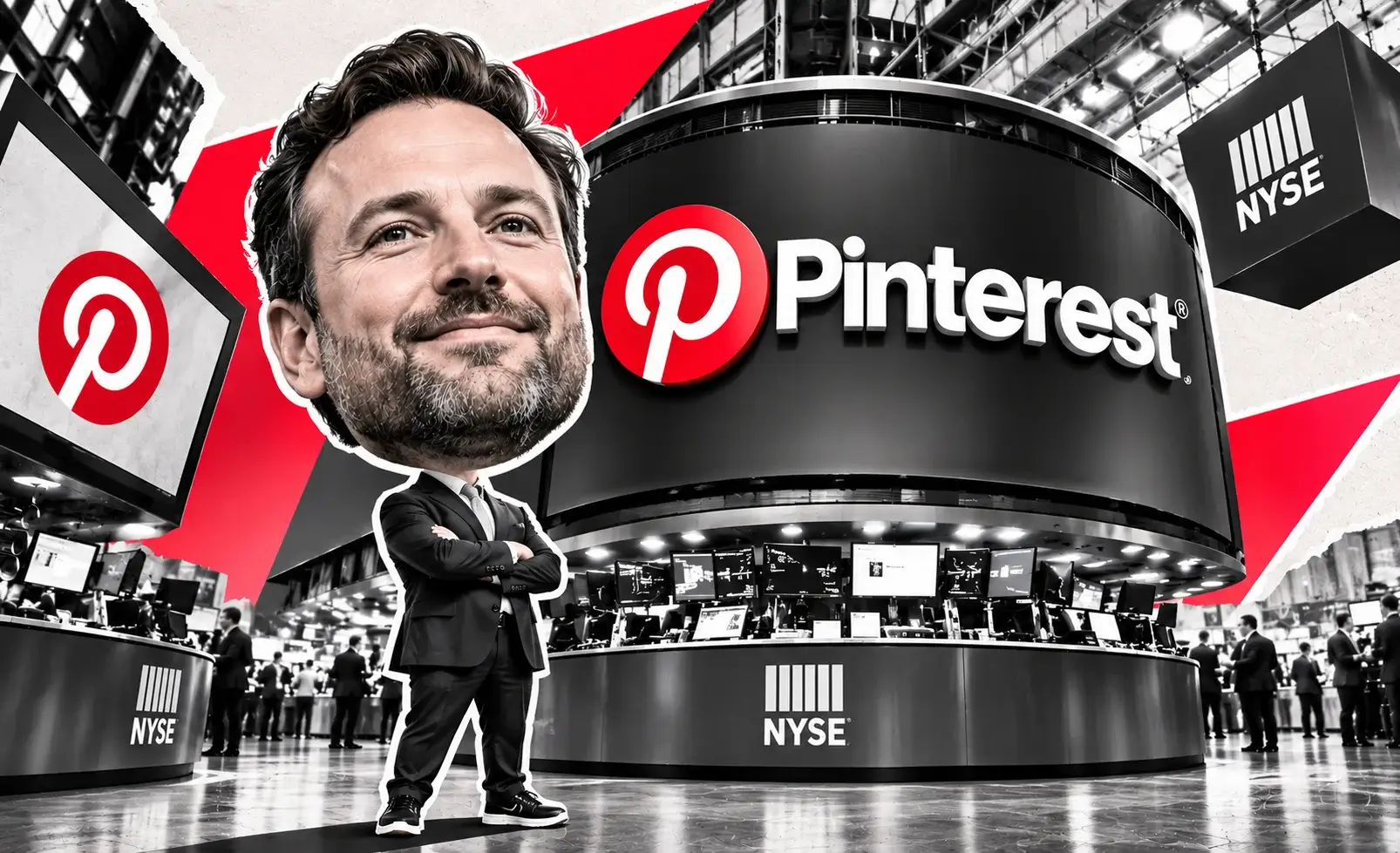
Pinterest Jumps 12.7% to $19.05 on Change-in-Control Filing; Reclaiming $20 Opens $20.92
Takeover bets lift PINS to $19.05; reclaiming $20 opens $20.92 | That's TradingNEWS
Key Points
- Pinterest rose 12.7% to $19.05, its biggest one-day gain since April 2025
- PSUs now vest at the greater of target or actual results in a qualifying change in control
- Q4 revenue guidance is $1.425B to $1.475B, implying 8% to 12% growth
Pinterest trades at $19.05, up $2.15 or 12.7% from Monday's $16.90 close. The intraday range runs from $17.10 to $19.36, and the stock briefly printed as high as $19.47. Volume reached 11.69 million shares by midday against a 16.16 million daily average, so the full session is on pace for well above-normal turnover. The move is seven times the stock's typical daily move of 1.7%. The last gain this large was a 14.0% jump on April 9, 2025, during a market-wide rally when the S&P 500 rose 10%. Today Pinterest is rising while the S&P 500 is down 1.12% and the Nasdaq Composite is off 2.40%.
The catalyst came after Monday's close. Pinterest filed a Form 8-K showing that the board's Talent Development and Compensation Committee had strengthened protections for senior employees' bonuses and stock awards if the company is acquired. The changes, approved November 18, cover employees in Level 21 positions and the executive severance and change-in-control agreements of CEO Bill Ready and Chief Legal Officer Wanji Walcott. There are no reported takeover talks. The rally rests on how investors read the filing: companies do not usually rewrite change-in-control terms unless a transaction is at least possible.
The move comes from a depressed base. Pinterest closed at $16.89 on November 19, down 4.5% that day and 34.8% for the year. The stock fell more than 24% in the month before Tuesday. It has a 52-week range of $13.84 to $27.96 and has lost 32% over the past year. It reached a 52-week high as far up as $39.93 within the past 12 months, which shows how far it has fallen. A cheap stock with $1.26 billion of trailing free cash flow and a filing that looks like deal preparation is a strong setup for speculative buying.
The thesis for this forecast is that Pinterest's operating business is solid but slowing, the stock was priced for that slowdown, and the change-in-control filing gives the market a reason to put a floor under it. Revenue growth slowed from 18% in the first half to 12% in the third quarter, and fourth-quarter guidance calls for 8% to 12%. Users hit a record 661 million. At $19.05, Pinterest trades at 2.3 times 2026 revenue and 7.7 times 2026 adjusted EBITDA on company guidance. The near-term forecast is a $17.10 to $19.92 range, with a $20.92 upside target that becomes live only after a daily close above $19.92.
What the Filing Actually Says
The November 18 Form 8-K amended and restated the Pinterest Severance and Change in Control Plan for employees in Level 21 positions, effective November 18, 2026. The plan had already been amended and restated effective September 30, 2026, as described in an October 2 filing. The November changes add two key provisions.
First, performance-based restricted stock units now vest at the greater of target or actual performance when a participant is terminated without cause or resigns for good reason within 12 months after a change in control, or in certain cases within 90 days before one. Before this change, PSUs could vest on actual performance only, which after a 34.8% share price decline could mean far below target. Under the new terms, executives would receive at least their target award in a sale.
Second, the plan's treatment of equity awards and annual bonuses now applies notwithstanding any contrary provision in an award agreement or bonus program. It also clarifies how bonuses and equity are treated for terminations where no plan benefits are provided, and lets executives whose individual agreements say so participate in the plan for its bonus and PSU provisions. In plain terms, the company removed ambiguity about how senior staff are paid if Pinterest changes hands.
The September 30 amendment had already moved in the same direction. It added a pro-rated target bonus for terminations without cause outside a change in control, a bonus tied to the higher of target or actual performance for change-in-control exits, and a single-trigger equity acceleration only when awards are not assumed, substituted, continued or replaced. It also expanded "good reason" to include a cut of more than 10% to a participant's target bonus.
Two amendments in seven weeks to the same plan is what drew attention. Companies often update change-in-control terms to retain staff during a weak share price, since depressed equity awards reduce retention value. That is a reasonable non-deal explanation, and the filing does not mention any transaction. But the specific change, guaranteeing target-level PSU payouts in a sale, is the kind of provision boards typically tidy up before engaging with potential acquirers. The market is pricing a higher probability of a deal, not a deal itself.
Takeover Math: What a Deal Could Look Like
No bidder has been reported, and there are no active takeover rumors or reports of deal talks. Still, the math explains why the market is willing to pay up. At $19.05, Pinterest's equity is worth $10.92 billion. A typical control premium of 30% would put a bid near $24.77 per share, a $14.2 billion deal. A 40% premium would mean $26.67, close to the $27.96 top of the 52-week range. Even at those prices, a buyer would pay 3.0 to 3.2 times 2026 revenue for a platform with 661 million monthly users.
Pinterest has the features acquirers look for. It has 661 million monthly active users, an all-time high, growing 10% year over year. It has a commercially oriented audience that uses the platform to plan purchases, which makes it valuable for shopping and advertising. It generated $1.26 billion of free cash flow over the trailing 12 months. And it has a strong balance sheet, with more cash than debt, a current ratio of 4.28 and a debt-to-equity ratio of 0.32.
The shareholder base adds pressure. Activist investor Elliott Investment Management invested $1 billion in Pinterest in March 2026. The company used the proceeds for a $1 billion accelerated share repurchase as part of a $3.5 billion buyback program. Elliott's involvement means a large, engaged holder is pushing for value. Activists often press for a sale when a stock trades well below what they believe the business is worth, and Pinterest at $19.05 is 47% below its March-to-date 52-week high of $39.93 and 32% lower over 12 months.
The risks to the deal thesis are real. Pinterest's dual-class share structure gives founders and insiders more control over any sale than their economic stake suggests. Antitrust review of a large tech acquirer buying a 661 million-user platform could be lengthy. Pinterest's own filings note that Delaware anti-takeover provisions may discourage or delay a change in control. A private-equity buyer would face financing costs with the 10-year Treasury at 4.916% and the Fed priced for a 96% probability of another hike on December 9.
For the forecast, takeover speculation sets a soft floor, not a target. If no bid emerges, the premium priced on Tuesday will fade over weeks, and the stock will trade back toward fundamentals. If a bid emerges, the stock would jump toward $25 and above. The base case is that speculation keeps the stock above $17.10 while fundamentals cap it near $20.
Price Map: $13.84 Low, $16.89 Base, $19.92 Ceiling
The stock's 2026 path explains where buyers and sellers sit. Pinterest hit its 52-week low of $13.84 in the first quarter, with its maximum drawdown of 60.63% recorded on February 13, 2026. It rebounded through the spring, trading at $20.21 after first-quarter results in May. On September 9, it fell 7.72% to $18.59 during an investor conference. It traded at $20.92 on October 28, closed at $19.92 on October 29 before third-quarter results, then fell 12.7% after hours on the earnings miss. It recovered to $20.31 on November 2 and then slid to $16.89 by November 19.
Tuesday's move takes the stock from the bottom of that range back to the middle. At $19.05, Pinterest is 12.7% above Monday's close, 37.6% above the $13.84 low, and 31.9% below the $27.96 top of the current 52-week range. It is 4.4% below the $19.92 October 29 close, the level where the stock traded before the third-quarter miss.
Support starts at $18.73, a level the stock held in the first hour, then $17.87 to $18.00. The intraday low of $17.10 is the level that marks where Tuesday's buyers stepped in. Below it, Monday's $16.90 close and the November 19 low of $16.89 are the floor. A daily close below $16.89 would mean the entire takeover premium has disappeared and would open a move toward $15.
Resistance starts at $19.36, Tuesday's intraday high, then $19.47, the brief spike. The $19.92 October 29 close is the key ceiling, since it marks the pre-earnings level that sellers have defended. Above it, $20.31 is the November 2 close and $20.92 the October 28 close, the upside target in this forecast. Reclaiming $20.92 would erase the full post-earnings decline and put the stock back where it traded before the third-quarter miss.
The stock is still trading below its 200-day simple moving average and near the bottom of its 52-week range. A one-day 12.7% move from a deeply oversold level often retraces part of its gain within days, especially when it rests on speculation rather than new financial data. The structure turns constructive only if the stock holds above $18.73 for several sessions and then breaks $19.92 on a daily close.
Third Quarter: Record Users, Missed Revenue
The third-quarter results, released October 29, showed a platform growing users and slowing revenue. Revenue was $1,174 million, up 12% on a reported and constant-currency basis. That missed the $1.21 billion consensus and came in below the company's own guidance range. Adjusted earnings were $0.46 per share, below the $0.49 consensus but up from $0.38 a year earlier. GAAP net income was $22 million and adjusted EBITDA was $339 million.
User growth was the strength. Global monthly active users rose 10% year over year to an all-time high of 661 million. The U.S. and Canada region had 107 million users, up 4%, Europe had 161 million, up 7%, and the rest of the world made up the balance with faster growth. This was the latest in a run of consecutive quarters with double-digit user growth, and every region grew users.
Revenue concentration is the issue. U.S. and Canada revenue was $894 million, up 14%, driven by retail, financial services and health care. That region produced 76% of total revenue from 16% of users. International revenue, by contrast, was hit by an outsized regulatory headwind in Europe, a pullback by cross-border sellers, and a restructuring of Pinterest's international go-to-market approach. Management said Europe faced a larger regulatory hit than expected.
Cash flow held up. Operating cash flow was $316 million and free cash flow was $300 million in the third quarter. Trailing 12-month free cash flow reached $1.26 billion. That cash generation is the foundation of both the buyback program and the takeover thesis.
The market's reaction to the report shows how sentiment had turned. The stock closed the October 29 regular session at $19.92, down 4.78% from $20.92, then lost another 12.7% after hours. It had already fallen more than 13% in the week before the report. A revenue miss on a slowing growth trajectory, paired with continued heavy stock-based compensation, pushed investors out of the name. Share-based compensation was $324.5 million in the second quarter alone, up $97.3 million year over year. That level of dilution is one reason GAAP profit remains thin despite strong EBITDA.
Fourth-Quarter Guidance and the 2026 Run Rate
Guidance points to further deceleration but not a collapse. Pinterest guided fourth-quarter revenue to $1.425 billion to $1.475 billion, 8% to 12% year-over-year growth, compared with $1,319 million in the fourth quarter of 2025. It guided fourth-quarter adjusted EBITDA to $538 million to $588 million, against $542 million a year earlier. The midpoint of $563 million implies modest EBITDA growth as the company keeps investing.
The full-year picture is still solid. First-quarter revenue was $1,008 million, up 18%. Second-quarter revenue was $1,180 million, up 18%. Third-quarter revenue was $1,174 million, up 12%. Adding the $1,450 million fourth-quarter midpoint gives 2026 revenue of $4,812 million, up 14.0% from $4,222 million in 2025. Full-year adjusted EBITDA on the same basis would be $1,420 million, up from $1,270 million in 2025, an 11.8% increase.
The trajectory is the concern. Growth slowed from 18% in the first half to 12% in the third quarter, and the fourth-quarter midpoint implies 10%. A company growing revenue at 10% while users grow at 10% is no longer expanding revenue per user. That is the core of the bear case: Pinterest's monetization of its international users is stalling, and the U.S. business, while growing 14%, cannot carry the whole company indefinitely.
There are signs of stabilization. Management said the European enterprise business, excluding cross-border sellers, re-accelerated in the fourth quarter to date, above its second-quarter growth rate. It also said international trends have stabilized and that U.S. strength continues. If those comments are right, the fourth quarter could land at the top of guidance, which would show the deceleration has bottomed.
For the stock, the fourth-quarter report in February is the next fundamental test. A print at or above $1.475 billion with 2027 guidance for low-double-digit growth would support a rerating toward $22 to $25 without any deal. A print at the low end, with 2027 guidance in the high single digits, would confirm the slowdown and cap the stock near $20, takeover talk or not.
Europe and International: The Weak Spot
International monetization is the gap between Pinterest's user growth and its revenue growth. Europe has 161 million users, 51% more than the U.S. and Canada's 107 million, yet the U.S. and Canada region generated $894 million of the third quarter's $1,174 million revenue. The rest of the world, with more than half of Pinterest's users, produced $280 million combined. Closing even part of that gap is the largest growth opportunity the company has.
The third quarter showed how fragile that opportunity is. Europe faced a larger-than-expected regulatory hit. European digital regulations, including rules on ad targeting and data use, have limited how platforms can personalize ads, which lowers the price advertisers will pay. Pinterest has less flexibility than larger rivals to absorb those costs, because it lacks the scale of Meta or Alphabet's ad systems.
Cross-border sellers were the second problem. Asian e-commerce sellers who advertise to Western consumers had been a fast-growing source of international ad revenue across platforms. Tariff changes and trade restrictions in 2025 and 2026 reduced that spending. Pinterest's exposure to those advertisers made its international revenue more volatile than its user base.
The go-to-market restructuring is the third factor. Pinterest is reorganizing how it sells ads outside the U.S., shifting resources toward larger enterprise advertisers and away from smaller accounts. Restructurings typically cost revenue in the short run before they pay off. Management's comment that European enterprise growth re-accelerated in the fourth quarter to date suggests the restructuring is starting to work.
For a potential acquirer, international under-monetization is part of the appeal. A buyer with an existing global ad sales force could plug Pinterest's 554 million non-U.S. users into its system and raise revenue per user far faster than Pinterest can on its own. That synergy argument is one reason takeover speculation finds an audience. For the standalone stock, international is the main reason revenue growth is decelerating, and the reason the stock trades at a discount to its user base.
AI Strategy: Visual Search and the Shopping Assistant
Pinterest's strategy under CEO Bill Ready centers on AI-driven visual search and shopping. Management said every pin is now served by AI, and new AI-powered assistant tools with visual search and follow-up question features have been rolled out to nearly all U.S. users. Ready has said the company has effectively turned the platform into an AI-powered shopping assistant for its users and has become a leader in visual search.
Ready frames Pinterest as different from other social platforms. He has said Pinterest is built around commercial intent and discovery rather than passive content consumption. Users come to Pinterest to plan purchases, home projects, recipes and outfits, which means they arrive closer to buying than users scrolling entertainment feeds. That makes Pinterest's ad inventory more valuable per impression for retailers, and the U.S. retail category was a leading growth driver in the third quarter.
AI is also the main fear around the stock. Generative AI search tools could take over the discovery and planning role that Pinterest plays. If users ask an AI assistant to plan an outfit or a room, they may never visit Pinterest. Concerns about AI disruption have weighed on Pinterest shares alongside macroeconomic worries throughout 2026. The stock's 45% decline over the 12 months to September reflected that fear.
Pinterest's defense is its data. Its library of user-saved images, boards and shopping intent signals is difficult to replicate, and visual search requires large-scale image data that general-purpose AI tools lack. If Pinterest can show that its AI tools increase engagement and ad prices, it can turn the AI threat into a growth driver. The record 661 million users suggest engagement is holding, but revenue growth slowing to 12% suggests monetization has not kept pace.
For an acquirer, the AI angle is significant. A large tech company building AI shopping tools would gain Pinterest's visual data, its commercial-intent user base and its image search technology. That strategic value is hard to put a number on but is part of why the market reacts strongly to any sign that Pinterest could be for sale.
Cash, Buybacks and Elliott's Stake
Pinterest's capital return program has been aggressive. In March 2026, Elliott invested $1.0 billion in the company, and Pinterest used the proceeds for a $1.0 billion accelerated share repurchase. The board authorized a new $3.5 billion buyback program and committed to $2.0 billion of near-term repurchases, including the accelerated buyback and $1.0 billion of open-market purchases. By the second quarter, the company had completed more than $2 billion of repurchases year to date at an average price of $18.17.
That average buyback price is a useful reference. At $19.05, the stock is 4.8% above the level where Pinterest bought back more than $2 billion of its own shares. The company spent roughly a fifth of its current market value on buybacks in the first half of 2026 at prices close to today's. If management saw value at $18.17, the board has a reason to keep buying, and the $3.5 billion authorization leaves room.
The balance sheet supports more returns. Cash, cash equivalents and marketable securities were $1.27 billion at June 30, down after the buyback. Trailing 12-month free cash flow is $1.26 billion, so the company replaces its cash balance roughly once a year. The current ratio is 4.28, and the debt-to-equity ratio is 0.32. Pinterest also has convertible notes outstanding, which could dilute holders if converted.
Elliott's involvement adds a catalyst. Activist investors typically push for one of three things: higher buybacks, cost cuts, or a sale. Pinterest has delivered the first two. The March investment came with a significant buyback, and the company has been restructuring its international business. If those steps do not lift the stock, the third option, a sale, becomes more likely. The change-in-control amendments fit that sequence.
Insider activity offers one more data point. New Chief Financial Officer James Dibbo received grants of 885,392 and 97,394 restricted stock units on November 9, vesting quarterly from March 2027 to December 2028. A new CFO receiving a multi-year equity package is consistent with a company planning to stay independent. It is also consistent with retention ahead of a possible transaction, since the November 18 amendments would protect those awards in a sale.
Valuation: 2.3 Times Sales, 7.7 Times EBITDA, an 11.5% Free Cash Flow Yield
Pinterest is cheap on cash flow. At $19.05, its $10.92 billion market value is 2.3 times 2026 revenue of $4,812 million based on guidance. It is 7.7 times 2026 adjusted EBITDA of $1,420 million. Trailing free cash flow of $1.26 billion gives an 11.5% free cash flow yield. Those multiples are low for a platform growing revenue 14% this year and users 10%.
The GAAP picture is less flattering. The stock trades at 75.2 times trailing GAAP earnings, because stock-based compensation and other charges consume most of the operating profit. Third-quarter GAAP net income was $22 million, against $339 million of adjusted EBITDA. The gap is mostly share-based compensation, which ran at $324.5 million in the second quarter. Investors who treat stock compensation as a real cost see a less attractive valuation, though buybacks offset some of the dilution.
Peers trade at higher multiples. Meta and Alphabet trade at significantly higher EBITDA multiples with faster or similar growth and far larger scale. Reddit trades at a premium on faster growth. Snap trades at a lower valuation with weaker profitability. Pinterest sits between Snap and the larger platforms, priced as a slowing mid-cap rather than as a strategic asset.
That discount is where takeover value lies. A strategic buyer paying 3.0 times revenue, the level implied by a 30% premium, would still pay less than the large platforms' own trading multiples. That makes Pinterest accretive for a large acquirer, especially one that can add revenue synergies by selling Pinterest ads through its own global sales force.
For the forecast, valuation supports the floor. At 7.7 times EBITDA and an 11.5% free cash flow yield, the stock has limited downside below $17 even without a deal, because the company can keep buying back shares at those prices. The upside is limited by slowing growth. Without a deal, a fair range is $18 to $22. With a deal, $24 to $27 becomes possible.
Competition and the Sector Backdrop
Pinterest competes for ad dollars with much larger platforms. Meta's Instagram and Facebook, Alphabet's Google search and YouTube, Amazon's retail media, TikTok, Snap and Reddit all chase the same advertising budgets. Pinterest's niche is shopping intent and visual discovery, which overlaps most with Instagram for inspiration and with Google and Amazon for purchase-oriented search.
The sector moved unevenly on Tuesday. Alphabet and Meta traded lower as the broad tech market fell, while Reddit rose 1.7% and Spotify gained 1.6%. Pinterest's 12.7% rally was company-specific, not a sector move. On Monday, social and ad stocks rallied with the broad tech upswing after Nvidia reinstated Jensen Huang.
The ad market is mixed. U.S. ad spending has held up in retail, financial services and health care, the categories that drove Pinterest's 14% U.S. and Canada growth. International spending is weaker because of tariffs, regulation and the pullback by cross-border sellers. Consumer confidence rose to 103.3 in November, its highest since January 2025, which supports retail ad budgets heading into the holidays. Holiday retail advertising is Pinterest's most important season, and fourth-quarter revenue is its largest of the year.
AI is reshaping competition. Large platforms are building AI shopping assistants that could compete directly with Pinterest's visual search. Pinterest's advantage is its specialized data and engaged shopping audience. Its disadvantage is scale: it cannot match the AI spending of Meta or Alphabet. That imbalance is a strategic argument for Pinterest to combine with a larger company, which supports the takeover thesis.
For the forecast, competition caps standalone upside. Pinterest can grow revenue at 10% to 14% in a stable ad market, but it is unlikely to reaccelerate to 18% without a major change in international monetization or AI-driven ad pricing. That growth rate supports a stock in the high teens to low twenties. The sector backdrop is neutral, with retail ad strength offset by international weakness and AI competition.
Technicals and Options Activity
The technical setup is a sharp breakout from oversold levels inside a longer downtrend. Pinterest is trading near the bottom of its 52-week range and below its 200-day simple moving average. Tuesday's 12.7% gap higher is the largest one-day move in 19 months. It takes the stock back above the $18.17 average price of its 2026 buybacks and toward the $19.92 pre-earnings close.
Options traders bought heavily. Call volume on Pinterest was unusually high on Tuesday, with traders positioning for further upside. Call buying on takeover speculation is typical: traders who expect a bid buy out-of-the-money calls for leveraged exposure to a jump. Heavy call activity also means market makers who sold those calls need to buy stock to hedge, which can amplify upward moves in the short term.
Volume confirms the move but not its durability. The 11.69 million shares traded by midday is on track to exceed the 16.16 million daily average by the close. Strong volume on a breakout is constructive. But speculative spikes on filings rather than earnings often fade within a week if no further news follows. The October earnings drop showed the stock can lose 12% to 17% quickly when sentiment turns.
The levels define the trade. Holding $18.73 into the close would show buyers defending the breakout. A close near the $19.36 high would leave the stock in position to test $19.92 over the next few sessions. A daily close above $19.92 would clear the post-earnings gap and open $20.31 and the $20.92 target. A close below $18.00 would mean the speculative premium is already fading, and $17.10 would come back into play.
The calendar is light on company-specific events. Pinterest's next scheduled catalyst is its fourth-quarter report in February. Until then, the stock will trade on takeover headlines, sector moves and holiday ad data. U.S. markets close Thursday for Thanksgiving and close early on Friday, so trading will be thin through the end of the week. Thin trading can extend speculative moves in either direction.
Read More
-
Yen Stalls at 160 Despite a 3% JGB and Tokyo Core CPI at 2.0% — Intervention Sits at 164, Friday's Payrolls Decide
02.09.2026 · TradingNEWS ArchiveEnergy
-
TSMC Slips to $347.93 After Taipei Limit-Up; Reclaiming $364 Opens $395
24.11.2026 · TradingNEWS ArchiveStocks
-
XRP Slips to $0.9193 After $1.026 Rejection; Reclaiming $1 Opens $1.08 Before Dec 1 Unlock
24.11.2026 · TradingNEWS ArchiveCrypto
-
WTI Holds $80.59, Brent $89.82 After Three-Month Lows; Targets $86.85 and $95 on Hormuz Risk
24.11.2026 · TradingNEWS ArchiveCommodities
-
Stock Market Today: Nasdaq IXIC Drops 2.4%, Dow DJI Green, S&P 500 SPX Eyes 7,400 as NVDA Sheds 8%
24.11.2026 · TradingNEWS ArchiveMarkets
-
GBP/USD Rebounds to 1.3113 From 19-Month Low; Clearing 1.3150 Opens 1.3250 on BoE Hawks
24.11.2026 · TradingNEWS ArchiveForex
Pinterest Forecast, Key Levels and Verdict
Pinterest heads into the holiday week as a cheap, cash-generating platform with slowing growth and a new takeover premium. The near-term forecast is a $17.10 to $19.92 range through year-end, with a $20.92 upside target that becomes live only after a daily close above $19.92.
Support starts at $18.73, the level held in Tuesday's first hour. Below it, $18.17 is the average price of more than $2 billion of 2026 buybacks, and $17.10 is Tuesday's intraday low. The floor is $16.89 to $16.90, the November 19 and Monday closes. A daily close below $16.89 would erase the takeover premium and open $15, with the $13.84 52-week low as the deeper reference.
Resistance starts at $19.36, Tuesday's high, then $19.47. The $19.92 October 29 close is the key ceiling. Above it, $20.31 is the November 2 close, and the $20.92 upside target is the October 28 close, the last level before the third-quarter miss. Beyond $20.92, a confirmed bid would be needed to drive the stock toward $24 to $27, the range implied by a 30% to 40% control premium.
The fundamentals are mixed. For Pinterest: a record 661 million monthly users growing 10%, U.S. and Canada revenue up 14%, $1.26 billion of trailing free cash flow, an 11.5% free cash flow yield, 7.7 times 2026 EBITDA, a strong balance sheet, $3.5 billion of buyback authorization, an activist investor with a $1 billion stake, and change-in-control amendments that guarantee target PSU payouts in a sale. Against it: revenue growth slowing from 18% to 12% with a fourth-quarter guide of 8% to 12%, a third-quarter revenue miss, international monetization hit by European regulation and cross-border seller pullback, heavy stock-based compensation, a 75 times GAAP earnings multiple, AI disruption risk, and no reported deal talks.
The verdict on November 24 is a speculative rally with a fundamental floor. Pinterest at $19.05 is a hold-the-$17 to $18 zone, sell-the-$19.92 market unless a bid materializes. A daily close above $19.92 opens $20.92. A confirmed approach from a buyer would send the stock toward $25. No news through year-end means the premium fades and the stock drifts back toward $17 to $18, where buybacks and an 11.5% free cash flow yield support it.