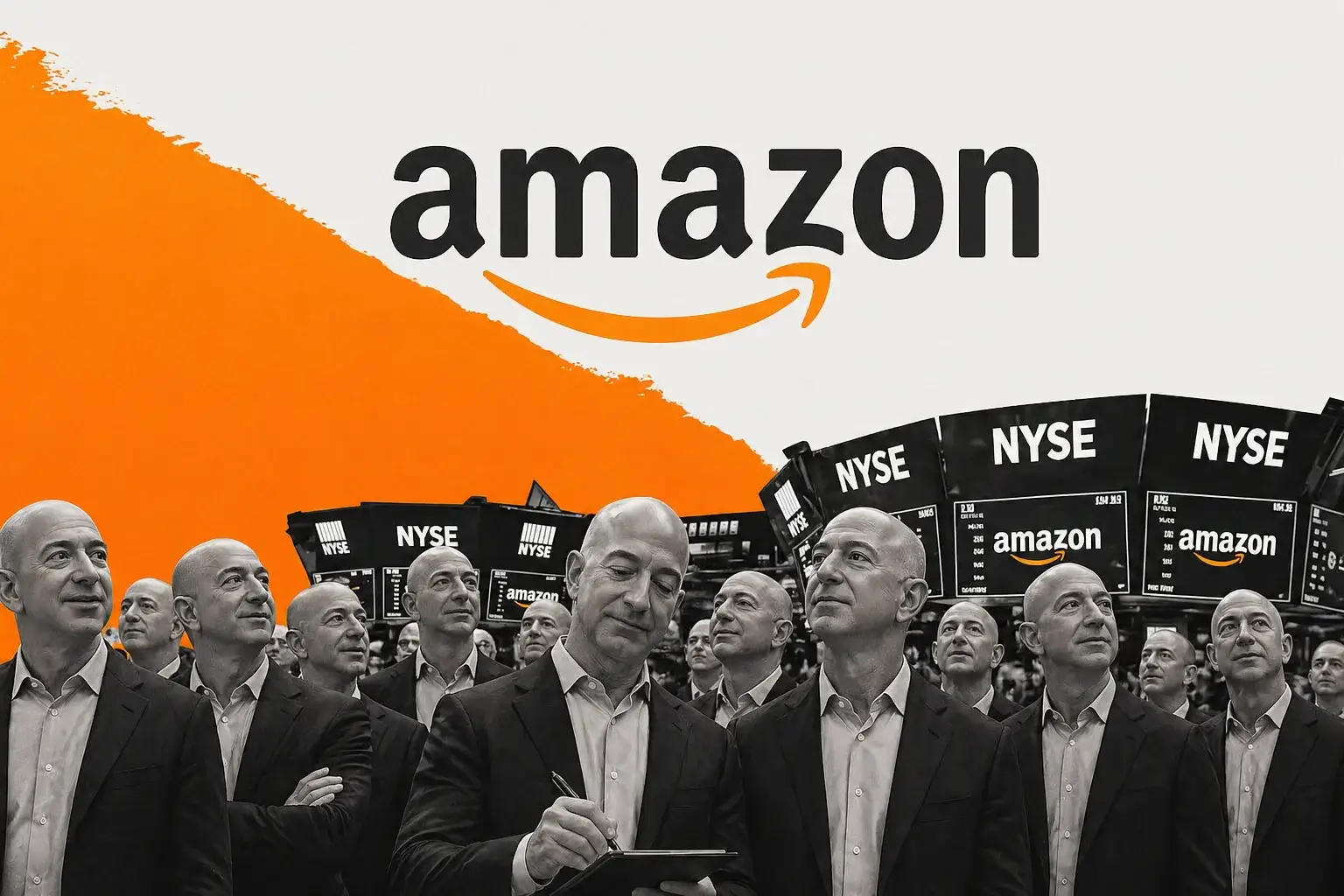
Amazon Stock Price Forecast: AMZN at $273 as AWS Backlog Tops $364B and Chip Business Ramps
Q1 revenue rips to $181.5B, AWS reaccelerates to 28% growth, and operating margin hits a record 13.1% | That's TradingNEWS
Shares of the e-commerce and cloud titan are changing hands at $273.12 in Tuesday's session, advancing 0.39% on the day with the market capitalization sitting at $2.93 trillion, the forward price-to-earnings ratio at 31.66, year-over-year revenue growth at 14.22%, short interest at 0.86%, and the previous close marked at $272.05. The 52-week range tells the structural repricing story in one line: AMZN has traveled from $185.01 to $277.64 over the past twelve months — a move of roughly 36% just since March 30 alone, when the post-earnings rally took the stock parabolic into fresh all-time highs. The Q1 print on April 29 has fundamentally rewritten what this business is worth, and the institutional bid has not faded the way bears were positioned for. Wall Street consensus sits at Strong Buy with a 4.62 score, the Seeking Alpha Quant rating reads Hold at 3.48, and the divergence between those reads captures the entire tension of the trade — fundamentals that justify the optimism against a valuation that already reflects most of it.
The Q1 Print That Detonated the Bear Thesis
The first-quarter result Amazon delivered is the document that put the CapEx skeptics on permanent defense. Total revenue hit $181.5 billion, up 17% year-over-year and beating consensus by $4.35 billion. Earnings per share landed at $2.78 against a $1.64 estimate — a $1.14 beat that was not a rounding error or a tax adjustment. AWS revenue grew 28% year-over-year to $37.6 billion, marking the fastest pace in 15 quarters and the third consecutive quarter of acceleration after the deceleration narrative that gripped 2023 and 2024. The sequential AWS revenue increase of $2 billion is the largest Q4-to-Q1 jump in the segment's entire history. AWS is now operating at a $150 billion annualized revenue run rate. The last time AWS grew this fast it was half its current size. That single statistic captures the whole story: the law of large numbers has not yet caught up with the demand pipeline.
The $364 Billion Backlog Is the Headline Number Nobody Is Talking About Enough
The remaining performance obligation disclosure is the single most consequential data point in the Q1 release. AWS backlog hit $364 billion at the end of Q1 — and that figure explicitly excludes the $100 billion Anthropic agreement. Pull the Anthropic deal back into the math and the contracted revenue visibility extends well beyond $464 billion. The implication for forward modeling is enormous: the demand uncertainty that historically discounted hyperscaler valuations has flipped to execution risk. Amazon does not need to win new contracts to drive multi-year revenue growth — it needs to convert the contracts already signed. That is a fundamentally different bet than the one the market was pricing two years ago when AWS was decelerating below 20%. The $150 billion run rate growing 28% generates the kind of compounding cash flow trajectory that justifies a premium multiple, and the backlog confirms that the trajectory is not optional — it is contractually committed.
The Custom Silicon Engine Is Where the Margin Story Lives
The hardware strategy is where Amazon has separated itself from the hyperscaler peer set, and the numbers are now speaking for themselves. Customers have reserved $225 billion in Trainium capacity. Trainium2 is sold out entirely. Trainium3 is already oversubscribed ahead of 2026 deployments. The chip business — which spans Trainium, Inferentia, and Annapurna silicon — is now operating at a $20 billion annualized run rate growing at triple-digit percentages year-over-year. CEO Andy Jassy explicitly told investors he expects the chips business to hit a $50 billion run rate. Trainium is saving Amazon tens of billions of dollars in capital expenditure annually and adding basis points of operating margin advantage by reducing dependency on third-party GPUs that carry 70%-plus gross margins. Graviton CPUs are handling reasoning and orchestration workloads behind enterprise AI agents — Meta has already reserved tens of millions of Graviton cores, validating the enterprise adoption thesis. Owning the hardware layer flips Amazon from a compute-rentier to a vertically integrated supplier capturing margin at every layer.
The Retail Margin Story Got Quietly Buried Under the AWS Headlines
The North America segment delivered operating income of $8.3 billion in Q1 versus $5.8 billion in the year-ago quarter — a 43% year-over-year jump on 12% revenue growth. The segment operating margin moved from 8.0% to 9.0% in twelve months. International operating income hit $1.4 billion against $1 billion the year prior. Total Q1 operating income reached $23.9 billion against guidance of $16.5–$21.5 billion — a beat of $2.4 billion at the high end of the range. The consolidated operating margin printed at 13.1%, the first time Amazon has exceeded 12% on a quarterly basis. Across the past nine quarters, the consolidated margin had only fallen into single digits twice, and the prior peak sat at 11.82%. Cracking 13.14% is not a one-off. It is the operating leverage from years of regional fulfillment network rebuild and same-day delivery capacity expansion finally showing up in the P&L. The trajectory toward 16% to 18% margins on $1 trillion in 2028 revenue is no longer a theoretical extrapolation — it is the visible glide path.
The Advertising Engine Is the S&P 500 Hidden Inside Amazon
Amazon's advertising revenue hit $17.24 billion in Q1, growing 24% year-over-year and beating the $16.87 billion consensus by $370 million. The trailing-twelve-month ad revenue base now exceeds $70 billion — roughly the size of Meta's entire 2018 ad business — and it is still compounding at 24%. Most of the revenue comes from sponsored product listings on Amazon's own marketplace, which has effectively become the cost of doing business for sellers. The advertising margin profile is closer to AWS than to retail because the marginal cost of running another sponsored placement on infrastructure that already exists is essentially zero. Pricing power here is structural rather than cyclical, and the platform stickiness compounds because sellers cannot opt out — visibility on Amazon drives a meaningful share of their total sales. Advertisers are now bidding on prompts inside Rufus, opening a fundamentally new ad inventory pool that did not exist twelve months ago.
The Software Agent Layer Is Building Quietly
Beneath the headline metrics sits the software agent business that does not get the attention it deserves. Developers using the QRO agent doubled quarter-over-quarter, with enterprise client usage of QRO climbing nearly 10x. The Transform agent saved customers 1.56 million hours during workload migrations. Quick application users expanded 4x sequentially. Bedrock penetration into the Fortune 100 sits at 80%, locking enterprise clients into the AWS ecosystem at the application layer. Rufus user metrics grew 115% with engagement up 400% year-over-year, integrating the consumer-facing AI assistant directly with the retail engine. The cumulative effect is that switching costs are now embedded into multiple layers — compute, silicon, models, agents, and applications — making competitive displacement increasingly difficult regardless of what Microsoft Azure or Google Cloud Platform deliver on a quarterly basis.
The Supply Chain Services Pivot Is the Optionality the Market Has Not Priced
Amazon Supply Chain Services is the most underappreciated strategic announcement of the Q1 cycle. The freight, distribution, fulfillment, and parcel shipping network has been opened to any business regardless of marketplace participation. The infrastructure attached to this business is genuinely massive: 80,000 trailers, 24,000 intermodal containers, more than 100 cargo aircraft, the largest US parcel volume per ShipMatrix, and two-decade-long status as the world's largest third-party logistics provider through marketplace seller fulfillment. The launch roster includes Procter & Gamble (PG), 3M (MMM), Lands' End, and American Eagle Outfitters (AEO) — anchor tenants that immediately validate the addressable market. The strategic logic mirrors AWS exactly: Amazon turned an internal cost center into a $150 billion run-rate business at 37.7% operating margin over roughly 18 years. If Supply Chain Services compounds at even a fraction of that trajectory, a new high-margin revenue line at logistics-network economics emerges by 2030 — sitting inside the existing infrastructure at zero incremental capital cost. FedEx and UPS just acquired a competitor with the deepest pockets and the longest runway in corporate America.
The CapEx Reality That Cannot Be Ignored
Working through the cash flow math is where the bull case meets its most disciplined challenge. Q1 capital expenditure ran $43.2 billion. Free cash flow contracted 95% year-over-year to $1.2 billion on a trailing-twelve-month basis. The contraction stems from a $59.3 billion year-over-year increase in property and equipment purchases. Management has guided full-year 2026 CapEx to a range of $180 billion to $190 billion. The capital intensity of AI infrastructure buildouts is the structural issue: Amazon must spend cash on land, power, buildings, chips, servers, and networking gear 6 to 24 months before billing customers for the capacity. CapEx growth therefore mechanically outpaces revenue growth during the deployment phase, and FCF contracts sharply. The cash depletion is a mathematical certainty before the new capacity monetizes. Supply chain inflation amplifies the squeeze — memory and storage component prices have jumped, and management explicitly admitted that supply constraints and price hikes are real. Amazon is paying peak prices for components that mechanically restrict the return on data center capital.
Read More
-
Yen Stalls at 160 Despite a 3% JGB and Tokyo Core CPI at 2.0% — Intervention Sits at 164, Friday's Payrolls Decide
02.09.2026 · TradingNEWS ArchiveEnergy
-
QQQ ETF ($739) Fades From an Early Tech Rally as a 77.9 ISM Prices Index Meets Micron's $61.5B Guide — $760 Record Test Ahead
01.10.2026 · TradingNEWS ArchiveStocks
-
XRPR and XRPI Follow XRP's $1.49 Test as Spot Funds Hold 1.16B XRP and a 1 Billion Token Escrow Release Lands — $1.70 in Play
01.10.2026 · TradingNEWS ArchiveCrypto
-
November NG Slips Below $3 as Decade-High Storage Meets Capped LNG Exports — $2.75 in Sight
01.10.2026 · TradingNEWS ArchiveCommodities
-
Dollar-Yen at 158 Presses Toward 160 as a 363 bp Carry Gap Meets Katayama-Bessent Intervention Risk — 159 in Sight
01.10.2026 · TradingNEWS ArchiveForex
Amazon Leo Adds Another Cash Drain
The satellite constellation business is the second leg of the capital outflow story. Management has flagged a year-over-year cost increase of $1 billion for Leo in Q2 alone. More than 20 satellites will launch in 2026, with more than 30 in 2027. Commercial service begins in Q3, with production and launch costs capitalized in Q4. Satellite constellations require front-loaded investment well in advance of profitability, and Leo is running parallel to the AI data center expansion — the cumulative drain on Amazon's cash reserves compounds rather than diversifies. The strategic logic for Leo is real: a global low-earth-orbit network that integrates with AWS Wavelength and provides connectivity-as-a-service to enterprise customers in underserved geographies. The financial reality is that the ROI clock starts ticking in 2027 at the earliest.
The Hyperscaler CapEx Race Is Now an Arms Race
Amazon is not spending alone. Microsoft has guided fiscal year 2026 CapEx to $190 billion. Alphabet's full-year 2026 CapEx range sits at $180 billion to $190 billion after a 3% upward revision from $175–$185 billion. Meta has lifted its 2026 CapEx range from $115–$135 billion to $125–$145 billion. The sector is collectively committing to over $700 billion in 2026 capital outlays, and that math forces Amazon to match or lose share. The market structure has effectively become a duopoly between the AI infrastructure landlords — AWS and Azure — with Google Cloud as the third major player and CoreWeave and a handful of neoclouds filling specific niches. The race conditions reward whoever can convert backlog to cash flow fastest while maintaining margin discipline. Amazon's Q1 print suggests it is winning that race against Microsoft on operating leverage despite trailing on the absolute revenue line.
The Q2 Guide Implies Acceleration, Not Deceleration
Management's guidance for the second quarter is the line that confirms operating leverage is showing up faster than CapEx absorption can drag it. The revenue range of $194 billion to $199 billion implies year-over-year growth of 16% to 19%. The midpoint represents acceleration relative to the 17% Q1 growth rate. Operating income guidance of $20 billion to $24 billion compares against $19.2 billion in Q2 2025 and follows the $23.9 billion Q1 print that came in $2.4 billion above the high end of guidance. Prime Day is hitting in June this year — a month earlier than the typical July window — which should pull forward both retail revenue and advertising spend into the Q2 print. The bear setup heading into Q1 was that the wide guidance range reflected CapEx absorption uncertainty. Q1 buried that thesis by overshooting the high end. If Q2 prints anywhere near the upper bound of the operating income range, the operating leverage narrative becomes the dominant story heading into the second half of 2026.
The Valuation Math Versus Walmart and Costco
The relative valuation argument is where the bull case gets clinical. Amazon trades at 32.7 times 2026 earnings. Walmart (WMT) trades at 44.9 times. Costco (COST) trades at 49.6 times. On the 2-year forward CAGR, AMZN earnings are projected to grow at 22.2%, while WMT and COST are growing revenue at 12.9% and 10.0% respectively. On 2028 earnings, AMZN trades at 21.9 times forward, against WMT at 35.2 times and COST at 40.8 times. Amazon is growing roughly twice as fast as either retail competitor while trading at less than half the multiple on the longer-dated estimates. Layer in AWS, the ad business, the chip ramp, the Supply Chain Services launch, and the satellite optionality, and the only honest read is that the sum-of-parts is being undervalued by the market relative to any traditional comparable framework. The comparable framework is wrong. AMZN is no longer a retail stock with a cloud kicker. It is a cloud and AI infrastructure platform with a retail engine attached.
Microsoft Comparison: The Honest Counterargument
The case for Microsoft (MSFT) over Amazon on relative valuation is real and worth respecting. Microsoft trades at a 24.7x trailing P/E versus Amazon's 32.5x. Microsoft posts a 46.8% trailing operating margin against Amazon's 11.5%. Microsoft generates $72.92 billion in trailing free cash flow versus Amazon's negative $2.47 billion. Microsoft's Rule of 40 reads 64.67% versus Amazon's 25.72%. Microsoft is also growing slightly faster on the top line — 17.87% versus 14.22%. Microsoft's enterprise software fortress at the application layer (Microsoft 365, Teams, GitHub, Copilot) is genuinely difficult to displace. Amazon's strategic premium rests on the chip business, the consumer marketplace, the ad engine, and the logistics platform — all genuine moats, but more capital-intensive to defend. The honest reading: Microsoft is the cleaner entry point for capital-discipline-focused holders, while Amazon is the higher-beta play on the AI infrastructure compounding curve with more optionality embedded.
Google's Position In the Triangle
Alphabet (GOOG) sits as the third leg of the AI hyperscaler stool with a fully integrated stack — flagship LLM, proprietary cloud infrastructure, custom TPU silicon, and dominant B2C distribution through search and YouTube. Google Cloud grew 63% year-over-year in Q1 to $20 billion, faster than both AWS and Azure on a percentage basis from a smaller base. The Cloud backlog of $462.3 billion already exceeds AWS's $364 billion (excluding Anthropic). The argument for Google over Amazon hinges on already-existing vertical integration and a relatively cheaper multiple at certain measurement points. The argument against Google is concentration risk in the advertising business and an enterprise distribution gap relative to Microsoft's Office franchise. A genuinely diversified AI portfolio probably owns all three names rather than picking winners between them.
The OpenAI and Anthropic Acquisition Thesis
The longer-term strategic outcome that the market has not yet fully priced is the potential vertical integration of the pure-play AI creators by the hyperscalers. OpenAI and Anthropic both face structural challenges to standalone profitability — the capital intensity of frontier model training combined with the lack of B2B and B2C distribution makes the path to sustainable economics genuinely difficult. Microsoft has invested heavily in OpenAI. Amazon has backed both Anthropic and OpenAI. Both hyperscalers have a vested interest in keeping their AI partners successful while extracting economic rent through cloud and silicon capture. The most logical endgame on a 3-to-5 year horizon is some form of integration — whether outright acquisition, expanded equity stakes, or deeper commercial agreements that transfer value to the cloud landlord. AWS already operates as the de facto landlord for Anthropic. Azure plays the same role for OpenAI. The economic gravity points toward consolidation of the supply chain around the players who control the compute layer.
Memory Inflation and the Component Squeeze
Beneath the operational story sits the supply chain reality that affects every hyperscaler simultaneously. Memory and storage component prices have surged in 2026, driving margin compression across the entire data center cohort. Amazon is paying peak prices for the components needed to expand capacity, which mechanically restricts the return on capital being deployed today versus what it would have produced 18 months ago. Power has become a genuine bottleneck — grid interconnection queues in Virginia, Arizona, and Oregon are getting longer, and data center site selection is increasingly constrained by transmission capacity rather than land or capital. Fuel inflation is hitting Q2 transportation costs in the retail segment, with Amazon implementing a fuel and logistics FBA surcharge that only partially offsets the margin erosion as shipping costs grew 12% and fulfillment expenses grew 9% against unit growth of 15%. Robotics deployment in fulfillment centers is the long-term offset, and Agentic Commerce rollout deepens ecosystem retention, but the near-term cost pressure is real.
Regulatory Overhang and the Antitrust Risk
The FTC antitrust case continues to grind through the courts. The probability of a forced breakup remains low on current evidence, but the existence of the litigation creates an overhang that limits multiple expansion above a certain ceiling. The OpenAI and Anthropic partnerships specifically draw the kind of competition concerns regulators have been flagging for years. If the litigation produces structural remedies — even short of a full breakup — the network effects embedded in the current valuation could compress materially. Investors holding AMZN need to monitor regulatory signaling alongside the operational metrics, because a single adverse ruling could reset the multiple by 200 to 400 basis points in a single session regardless of how clean the quarterly numbers look.
Positioning Stance: Bullish Lean With Defined Risk Discipline
Pulling the entire mosaic together for Amazon (NASDAQ: AMZN), the call leans bullish with disciplined caveats rather than blind enthusiasm. The constructive case stacks on the AWS reacceleration to 28% growth at a $150 billion run rate, the $364 billion backlog (excluding Anthropic), the chip business at $20 billion ramping toward $50 billion, the advertising engine at $70 billion compounding 24%, the consolidated operating margin breakthrough above 13%, the Supply Chain Services launch into a multi-trillion-dollar addressable market, the Q2 guidance implying acceleration, and the relative valuation discount versus retail peers WMT and COST that does not reflect the structural differences in the business. The bearish overlay sits on the $43.2 billion Q1 CapEx, the 95% trailing free cash flow contraction to $1.2 billion, the $180-$190 billion 2026 CapEx commitment, the Amazon Leo cash drain, the memory component inflation, the fuel inflation hitting retail margins, the regulatory overhang, the power grid bottlenecks, and the Microsoft comparable argument that flags a cleaner balance sheet at a meaningfully lower multiple. Both sides have legitimate evidence. The disciplined position is bullish into the next 12 months on AWS execution, with a stop-loss framework anchored beneath the $240 zone where any meaningful break would signal the bull thesis is breaking. Bulls have the data, the momentum, the analyst revisions, and the institutional flow on their side. Bears have the FCF compression, the power and component bottlenecks, and the OpenAI-Anthropic regulatory question. The trade is to lean long while AWS keeps printing 28%-plus growth and the chip business keeps ramping, with one hand on the exit door — exactly the posture that has worked for AMZN holders through the entire post-Q1 advance, and exactly the posture that will likely continue working until the FCF compression finally exhausts the institutional bid.