AMD Loses $500 As Chips Get Smoked — 2 Of The CEOs Calling For A Slowdown Are AMD's Own Customers
OpenAI, Meta and Anthropic have committed to 14 gigawatts of AMD deployments backed by 320M warrant shares | That's TradingNEWS
Key Points
- AMD fell 5.94% to $485.46 with a session range of $484.50 to $491.83 after a $516 close.
- Q2 2026 revenue reached $11.54 billion, up 50%, with data center doubling to $6.7 billion.
- At $842.6 billion market cap the stock trades at 24 times management's $20 EPS target.
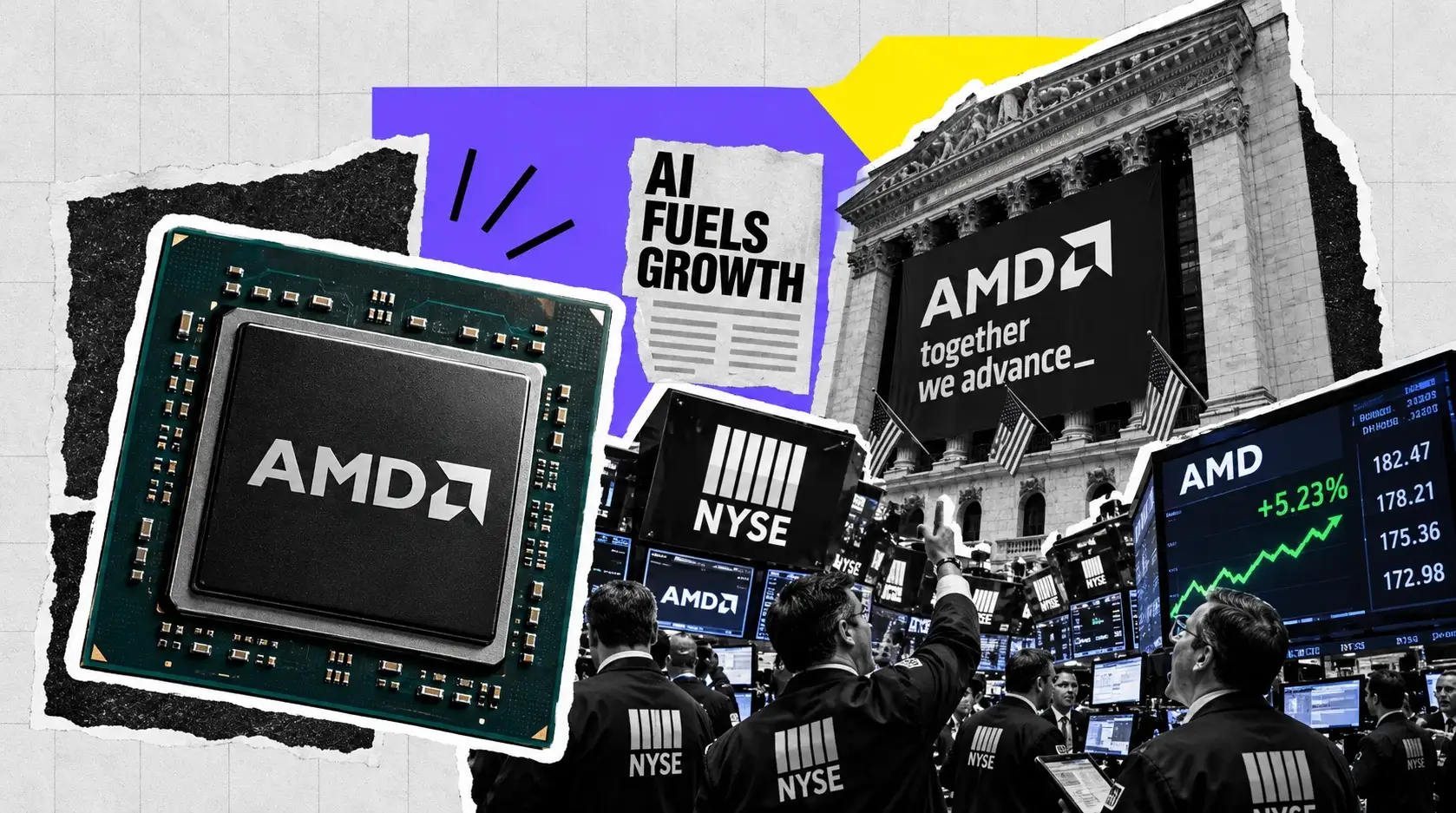
Advanced Micro Devices opened Monday with a gap and never recovered it. AMD traded at $485.46, down 5.94% from Friday's close near $516, after printing $487.07 in premarket — a 5.6% discount — and holding a session range of $484.50 to $491.83. Later prints showed the decline narrowing toward 3.85%, but the $500 handle was gone by the opening bell and stayed gone.
The catalyst was not a product, a customer or a guidance change. Anthropic chief executive Dario Amodei published an essay over the weekend arguing the AI industry should deliberately slow the pace of frontier model development. OpenAI's Sam Altman and Elon Musk backed the position. Investors spent Monday assessing whether a change in the pace of AI development would affect future infrastructure spending and demand for semiconductors.
AMD carries a beta of approximately 1.79, which means it amplifies sector moves in both directions, and Monday delivered a large one. The PHLX Semiconductor Index fell 5.7%. The iShares Semiconductor ETF dropped 4.97% to $500.90. Nvidia fell 2.91% to $211.94, Broadcom 4.21% to $346.76, Marvell 7% to $220.04, Micron more than 6% to $906, and SanDisk nearly 12%. The Nasdaq Composite fell between 1.03% and 1.8% across the session.
The magnitude of AMD's decline traces to how far the stock had run. AMD is up 141% year to date and sits 224% above its 52-week low of $149.85. The market capitalization stands at $842.6 billion on roughly 1.74 billion shares, with average daily volume near 25.4 million.
The broader context is a debate that has been running since late August rather than a single weekend event. Investors have been reassessing whether near-term AI revenues can justify the unprecedented capital spending commitments being made across the industry, and elevated Treasury yields have compounded the pressure on growth stocks with rich valuations. The US 10-year breached 5% Monday for the first time since October 2023.
That combination — a stretched high-beta name, a 5% risk-free rate and a narrative shock — produced a 6% move on no company news.
Two Of The Three CEOs Calling For A Slowdown Are AMD's Own Customers
This is the detail that makes Monday's selloff analytically strange, and it deserves to sit at the front of any forecast.
AMD's data center growth through 2027 rests on three named, contracted customers. OpenAI has committed to deploying up to 6 gigawatts of AMD GPUs, with the first gigawatt of MI450 series accelerators shipping in the second half of 2026. Meta Platforms signed its own agreement covering up to 6 gigawatts of custom GPUs and CPUs, with first shipments on the same timeline. Anthropic plans up to 2 gigawatts, with the first gigawatt beginning in the first half of 2027.
That is 14 gigawatts of committed compute across three counterparties.
The essay that took 6% out of AMD on Monday was written by the chief executive of the company that signed the 2-gigawatt agreement. It was endorsed by the chief executive of the company that signed the 6-gigawatt agreement. Neither of them cancelled anything, reduced anything or qualified anything about their compute commitments. Both argued for pacing capability advancement so safety research can keep up — a governance position, not a procurement decision.
The market treated the two as equivalent. They are not.
The distinction matters because AMD's revenue model is contractual rather than speculative. Gigawatt deployments are scheduled, warranted and tied to milestone vesting schedules running through October 2030. A company that has agreed to take 6 gigawatts of silicon does not stop taking delivery because its chief executive published an essay about evaluator access.
Where the risk is genuinely real: if frontier pacing slows enough to defer the fourth, fifth and sixth gigawatts of a 6-gigawatt schedule by a year, the back half of that revenue arrives later than modeled. That is a 2029 and 2030 problem being priced into a 2026 stock, and it is exactly the duration compression that hit every name downstream of the AI buildout on Monday.
Anthropic's own position undercuts the panic. The company generated $11.5 billion in second-quarter revenue, grew 14-fold year-over-year, reached $65 billion in annualized revenue by the end of July, and signed a $13.7 billion six-year GPU services contract last month. That is not the behavior of a company reducing compute demand.
The Technical Map: $484.50 Is The Floor And $515 Is Where Insiders Sold
The chart damage is clean and the reference levels are unusually well defined.
Monday's session range of $484.50 to $491.83 establishes the immediate band. The $484.50 low held on the open and is the first support on any retest. Beneath it, the stock has limited structure until the $450 area, which represents a further 7% decline and would mark the first meaningful break of the uptrend that carried AMD from $149.85 to above $500.
The $500 level is now resistance rather than support. Reclaiming it on a daily close is the minimum requirement before any recovery narrative is credible, and the stock failed to test it after the opening gap.
Above $500, the level that matters most is $515. That is where chief executive Lisa Su executed share dispositions near the recent trading peak, and it is roughly where Friday closed. A stock that gaps down from the exact level at which its chief executive sold has a psychological ceiling there regardless of what the fundamentals say.
The published targets sit well above. One desk maintains a Buy rating with a $575 price target, implying roughly 18% upside from Monday's price. Another reiterated a Buy citing the durability of the EPYC server CPU ramp. Technical sentiment signals still read as a buy even after the drop.
There is one structural level embedded in the capital structure worth knowing. Meta's performance warrant vests in tranches as shipments and the stock price climb, with the final tranche at $600. That $600 strike encodes a specific view: the counterparty and the company both negotiated on the assumption that AMD could reach that level within the deployment window. It is not a forecast, but it is the price at which a sophisticated customer agreed the last tranche should vest.
Volume is the variable into Tuesday. Against a 25.4 million share daily average, a 6% gap that trades meaningfully above that is institutional repositioning; anything at or below it is momentum unwinding with no new information.
The pattern to respect is that this stock has fallen hard twice in six weeks on days when nothing operational changed.
Q2 2026 Delivered $11.54 Billion On 50% Growth And The Stock Fell 8.94%
The most instructive event in AMD's recent history is the August earnings reaction, because it happened on numbers that were unambiguously strong.
AMD reported second-quarter 2026 results on August 4. Revenue reached $11.54 billion, up 50% year over year, with earnings of $1.66 per share, beating estimates on both lines. Data center revenue doubled year over year to $6.7 billion and now accounts for 58% of total sales. Results are published by AMD investor relations.
Third-quarter guidance came in at approximately $13 billion, implying 41% year-over-year growth at the midpoint. Management guided server CPU revenue up more than 80% in the second half of 2026 and more than 70% in 2027, with the data center segment set to more than double in 2027 on Helios and MI500 ramps. The company cited a $1.4 trillion AI accelerator market opportunity through 2030.
The stock rose 7% in the initial after-hours reaction and then fell 8.94%.
That reversal is the tell. The market absorbed 50% revenue growth, a doubling of data center revenue, a 41% forward guide and a multi-year server CPU ramp, and sold it. The reasons it found: gaming revenue fell 31% year over year, gross margin at 56% was solid rather than exceptional, and operating expenses rose 40% year over year to $3.4 billion amid heavy AI and research spending. Management also flagged tight server CPU supply and potential PC market weakness in the second half of 2026.
The opex line is the one that matters. Expenses growing 40% against revenue growing 50% is acceptable leverage, but it is thinner than the market wants from a company at this valuation, and it reflects the cost of building rack-scale systems rather than selling chips.
Segment composition adds nuance. Client revenue grew 23% in the latest quarter — a solid rate hidden inside a combined 8% figure because gaming fell 31% alongside it. At roughly $780 million a quarter, gaming may soon be too small for its declines to keep masking client strength.
Trailing annual figures give scale: revenue of $34.64 billion and net profit of $4.33 billion.
The 14-Gigawatt Order Book Is What Separates AMD From Every Other Chip Story
This is the structural argument and it is genuinely differentiated within the semiconductor complex.
The OpenAI agreement, announced in October 2025, covers deployments of up to 6 gigawatts of AMD Instinct accelerators, beginning with 1 gigawatt of MI450 series silicon in the second half of 2026. AMD has described the partnership as representing more than $100 billion of potential revenue over years. Details are published by AMD.
Meta's expanded pact covers up to 6 gigawatts of custom GPUs and CPUs on the same shipment timeline. Anthropic's covers up to 2 gigawatts, with its first gigawatt beginning in the first half of 2027.
What makes this different from a conventional supplier relationship is that the customers are equity-aligned. OpenAI received a warrant for up to 160 million AMD shares at $0.01 per share, vesting on deployment milestones through October 2030, with the first tranche vesting on the initial 1-gigawatt deployment and additional tranches as purchases scale to 6 gigawatts. Meta received a comparable performance warrant of up to 160 million shares vesting as shipments and the stock price climb, with the last tranche at $600.
The strategic consequence is larger than the revenue. Meta and OpenAI are now financially incentivized — to the tune of tens of billions of dollars — to optimize the open ROCm software stack, adopt the UALink-over-Ethernet fabric architecture, and port their internal models natively to MI450 and MI500 series silicon. That transforms AMD's historical weakness, software ecosystem inferiority, into a self-reinforcing alliance.
AMD became a first-class backend for Triton and shaped the MI450's design around OpenAI's real-world feedback, a multi-generation collaboration that began with MI300X and continued through MI350X.
The honest counterweight is dilution. Against approximately 1.63 billion basic shares outstanding, 320 million warrants represent roughly 20% potential equity dilution if fully vested. That optical EPS compression is real and becomes visible in 2027 and 2028 financials. The trade-off is guaranteed gigawatt-scale deployments from anchor customers for half a decade — an arrangement pure cash commitments could not replicate.
Management Has Guided 2027 Data Center Revenue Toward $70 Billion
The forward number is the one the entire valuation rests on, and it was raised recently rather than reaffirmed.
Management has lifted its 2027 data center outlook toward $70 billion in AI sales, with more than $40 billion of that expected from GPU revenue. Against trailing annual company revenue of $34.64 billion, a single segment reaching $70 billion in 2027 would represent a doubling of the entire business from one product line.
Helios is the product the number rides on. It is the rack-scale stack combining Instinct GPUs, EPYC CPUs and Pensando networking into a liquid-cooled, high-density system rather than a component sale. MI450 production shipments started in the third quarter with a larger ramp in the fourth quarter and into early 2027. Lisa Su has committed to launching a new rack-scale AI platform every year — for 2027 that means MI500 GPUs, Verona CPUs and both copper and optical interconnects. Customer work on MI500 is described as very strong, with the company expecting the largest generational leap in Instinct history.
AMD is tracking materially ahead of the November analyst-day model, which called for more than 35% revenue growth and $20 of annual earnings per share in the strategic window. Management now says it will beat both.
That $20 EPS target is the most useful valuation anchor available. At $485.46, AMD trades at roughly 24 times a figure management has publicly stated it expects to exceed. For a company guiding 41% revenue growth in the current quarter and a doubling of its largest segment next year, 24 times a target earnings number is not obviously expensive — provided the number arrives.
Read More
-
Yen Stalls at 160 Despite a 3% JGB and Tokyo Core CPI at 2.0% — Intervention Sits at 164, Friday's Payrolls Decide
02.09.2026 · TradingNEWS ArchiveEnergy
-
Marvell Loses 7% As The Chip Complex Gets Smoked — Does A Two-Year Guidance Raise Survive An AI Slowdown?
14.09.2026 · TradingNEWS ArchiveStocks
-
Spot Bitcoin ETFs Bleed Half A Percent And Bitcoin Fails At $80K — Why The Flow Data Is Now A Rate Trade
14.09.2026 · TradingNEWS ArchiveCrypto
-
US Gas Holds $2.88 While Europe Pays $28 — Why Only A Tenth Of The War Premium Reaches Henry Hub
14.09.2026 · TradingNEWS ArchiveCommodities
-
S&P 500 Slides 0.80%, Nasdaq Loses 1.03% And Dow Drops 0.54% As Chips Get Smoked And Oil Rips To $109
14.09.2026 · TradingNEWS ArchiveMarkets
-
Yen Holds Near February Highs As Tokyo Prepares Its Highest Rate Since 1995 — Why The Yield Gap Will Not Move
14.09.2026 · TradingNEWS ArchiveForex
The execution risk sits in the transition. Helios rack-scale architectures and MI450 accelerators move into volume production in late 2026, and any yield issues or supply chain bottlenecks could impair projected data center share gains. Rack-scale systems are a fundamentally different manufacturing and integration problem from selling packaged silicon, and AMD has never done it at this scale.
Valuation: $842.6 Billion Buys A Second Source To Nvidia That Actually Ships
The multiple is the reason this stock falls 6% on a narrative and it needs stating in several frames.
At $485.46 on roughly 1.74 billion shares, market capitalization stands at $842.6 billion. Annualize the third-quarter revenue guide of $13 billion and the run rate is $52 billion, putting the company at 16.2 times annualized sales. Against the 2027 data center target alone at $70 billion, the entire market capitalization is 12 times one segment's future revenue.
On earnings, second-quarter results delivered $1.66 per share. Annualizing at a slightly higher run rate consistent with the $13 billion guide produces roughly $7.50, implying a forward multiple near 65 times. Against management's $20 strategic-window EPS target, the multiple is 24 times.
The bull framing is that an $850 billion-plus market capitalization pays for a second source to Nvidia that actually ships racks rather than slides. There has never been a credible alternative to Nvidia at hyperscale, and AMD now has 14 gigawatts of signed commitments from three of the four most important AI labs in the world. If that translates into $70 billion of data center revenue in 2027, the current multiple compresses rapidly.
The bear framing has three parts. If MI450 yields slip, if HBM memory stays rationed, or if OpenAI and Meta digest capacity rather than continuing to build, the multiple compresses instead of the earnings expanding. The warrants dilute as the stock rises, which caps per-share upside precisely when the operational thesis is working. And Nvidia still owns training mindshare, which means AMD's share gains have to be won account by account rather than assumed.
The macro overlay is hostile. A 10-year Treasury yield at 5% for the first time since October 2023, a Federal Reserve hike priced at 86% to 90% for Wednesday, and market pricing carrying four increases by July 2027 raise the discount rate applied to every dollar of that 2027 and 2028 revenue. High-multiple semiconductors carry the most duration risk in the equity market, and AMD's 141% year-to-date gain made it the most exposed name in its own peer group.
The AI total addressable market slogan is $2 trillion. The operational question is narrower: can Su turn $13 billion of guided sales this quarter into a visible Helios run rate that makes $40 billion-plus of 2027 GPU revenue look like arithmetic rather than ambition?
Insider Selling Near $515 Has Amplified Institutional Caution
The insider record is a legitimate concern and it has been cited directly as a driver of Monday's decline.
Recent reports detailing executive insider selling, including share dispositions by chief executive Lisa Su near recent trading peaks around $515, have amplified institutional caution and exacerbated downside momentum. Insider selling has added caution among investors despite AMD's strong long-term growth potential.
The standard defense applies and it is reasonable. Executives at a company whose stock has gained 141% year to date and 224% off its 52-week low diversify, and most such sales execute through pre-arranged plans that remove discretion from the timing. A single disposition near a peak is a statistical inevitability when a stock spends months making new highs.
What makes it weigh more than usual here is the level. Su's sales clustered near $515, and $515 is approximately Friday's close and approximately the top of the recent range. The stock gapped down from that price two trading days later on a headline, which means the market now has a specific number attached to where informed selling occurred.
That creates a psychological resistance level independent of any chart. Buyers approaching $515 will be aware that the chief executive sold there, and sellers will be aware that buyers are aware.
Filings are available through SEC EDGAR.
The offsetting datapoint is that institutional sponsorship has held. Published targets at $575 and continued Buy ratings citing the durability of the EPYC ramp indicate the sell-side views the pullback as positioning rather than thesis. Technical sentiment signals still read as a buy.
Neither the insider selling nor the analyst targets tell you much about the next month. What matters operationally is whether MI450 ships in volume in the fourth quarter, and that will be visible in the late-October results.
The Sector Tape: Memory Fell Hardest And That Is The Duration Signal
Monday's ordering across the semiconductor complex is informative about what was actually being priced.
Micron fell more than 6% to $906. SanDisk dropped nearly 12%. Marvell lost 7% to $220.04. AMD fell 5.94%. Broadcom fell 4.21%. Nvidia fell 2.91%. The iShares Semiconductor ETF lost 4.97%. Globally, the Kospi sank 3.26%, the Nikkei 225 fell 0.81% to a six-week low, SoftBank dropped nearly 11%, SK Hynix lost 6.4%, Samsung Electronics fell 4.05%, Kioxia lost 7%, and Nokia fell over 9% in premarket on AI data center investment concerns.
Memory took the worst of it globally, and that is the cleanest evidence that Monday was a duration shock rather than a demand shock. Memory is the most cyclical, most capacity-committed and most forward-priced link in the AI supply chain. When the market shortens its assumed runway for the buildout, memory moves furthest because its capital commitments are made years ahead of the revenue.
Nvidia falling least is the second tell. The market is not questioning whether AI compute gets bought — it is questioning how long the compounding continues. The incumbent with the shortest revenue duration and the deepest installed base takes the least damage; the challenger with 2027 and 2028 revenue anchored to contracted ramps takes more.
Enterprise software went the other way entirely. CrowdStrike gained 14.52%, Palo Alto Networks 12.48% and Zscaler 12.50% as capital rotated out of hardware and into the application layer. That rotation is the defining feature of the session and it explains why the S&P 500 fell only 0.75% while the SOX fell 5.7%.
The comparison worth holding: a 5.7% single-day drop in the semiconductor index is roughly two-thirds of the entire DeepSeek episode in early 2025, which took 9% out of the SOX before the index recovered and ran more than 200% into its June 2026 high.
That precedent argues Monday was a sentiment reset. It does not guarantee the same outcome with a 5% risk-free rate.
Competition: Nvidia Owns Training, Intel Is Recovering, And Inference Is Fragmenting
The competitive picture for AMD is better than it has ever been and still carries three identifiable threats.
Nvidia remains the reference platform for frontier training and owns the mindshare that determines default procurement. AMD's counter is that the customers themselves are now equity-aligned to port workloads onto ROCm, MI450 and MI500 — which addresses the software gap that has historically kept share gains theoretical. Forrest Norrod, AMD's data center head, framed the OpenAI agreement as transformative for industry dynamics rather than just for AMD, and noted the commitment did not come from a casual engagement but from years of iterative roadmap collaboration.
Intel is the second threat and it is underweighted. An 18A process recovery would reintroduce a credible third x86 server option at exactly the moment AMD is guiding server CPU revenue up more than 80% in the second half of 2026 and more than 70% in 2027. EPYC share gains have been the quiet foundation of AMD's data center growth, and the durability of that ramp has been cited explicitly as the reason for Buy ratings.
The third is architectural rather than corporate. SRAM-first inference designs from Cerebras, MatX and Groq attack the specific workload — low-latency inference — that the industry is migrating toward. If inference economics move decisively away from HBM-attached GPUs, both AMD and Nvidia face a cost-per-token problem that scale does not solve.
Two operational constraints sit alongside those. HBM supply remains rationed, and AMD has pushed into Korean memory partnerships to secure next-generation capacity. China tariff exposure carries margin risk.
The advantage AMD holds over every other second source is that it ships complete racks. Helios integrates Instinct GPUs, EPYC CPUs and Pensando networking into a liquid-cooled system with exascale capability, built on open standards. Custom silicon vendors sell components into someone else's architecture. AMD sells the architecture.
That is a structurally better position than Marvell's or Broadcom's if it executes. It is also a harder manufacturing problem.
What Takes AMD To $575 And What Sends It To $450
The bull path has a clear sequence and the first checkpoint arrives in late October.
Third-quarter results against a $13 billion guide are the first test. A print at or above the guide with MI450 volume shipments confirmed, Helios customer deployments named, and the 2027 data center target of $70 billion reaffirmed would establish Monday's move as a sentiment reset. On that outcome AMD reclaims $500, tests $515, and the $575 target becomes reachable inside the quarter.
The second requirement is hyperscaler capital expenditure commentary in October. Meta, Microsoft, Alphabet and Amazon all report, and any confirmation that 2027 capex budgets remain intact removes the specific fear Monday created.
The third is macro. A Federal Reserve that hikes Wednesday without signalling a cycle, with a 2026 median dot that does not confirm four increases by July 2027, relieves the discount-rate pressure on every high-multiple semiconductor simultaneously.
The bear path needs only one of three things. A hawkish Wednesday with the 10-year holding above 5% compresses the multiple regardless of execution, and $484.50 fails with $450 as the next reference. Any MI450 yield problem or HBM shortfall disclosed in October breaks the $70 billion 2027 number and takes the stock materially lower than $450. Or the AI pacing debate gains regulatory teeth — government-imposed constraints on frontier development would be a genuine capex event rather than a governance one, and President Trump's immediate dismissal of the guardrail argument shows the politics are unsettled rather than settled.
Base case: AMD holds $484.50 to $515 into the October report, with the balance of risk determined by Wednesday rather than by anything in the business.
Verdict: the selloff is a multiple reset on a stock that had run 141% year to date, and the operating evidence contradicts the narrative that produced it. Second-quarter revenue of $11.54 billion grew 50% with data center doubling to $6.7 billion at 58% of sales, third-quarter guidance sits at $13 billion for 41% growth, server CPU revenue is guided up more than 80% in the second half, and management has raised its 2027 data center outlook toward $70 billion while stating it will beat a $20 EPS target it set in November. Fourteen gigawatts of committed deployments sit with OpenAI, Meta and Anthropic, two of whom are equity-aligned through 320 million warrants.
What has to be respected is that those same 320 million warrants represent 20% dilution, that the chief executive sold near $515 days before the gap, that the market has now sold two AMD beats in six weeks, and that a 10-year Treasury at 5% is the worst possible discount rate for a company whose thesis is a 2027 revenue number. At $485.46 and 24 times management's own EPS target, the risk-reward is better than it was Friday and still requires the argument that began Saturday to resolve in the company's favour.