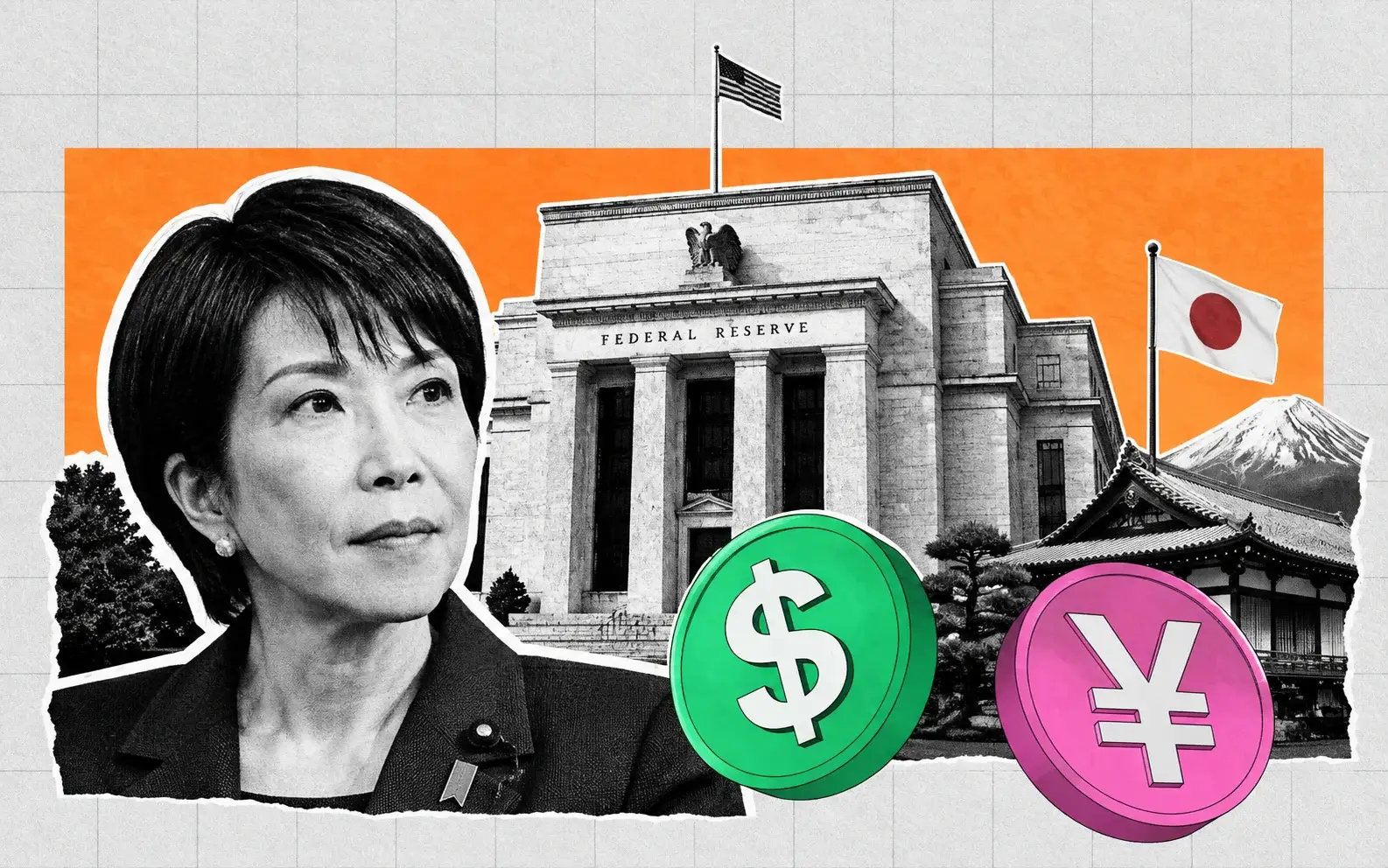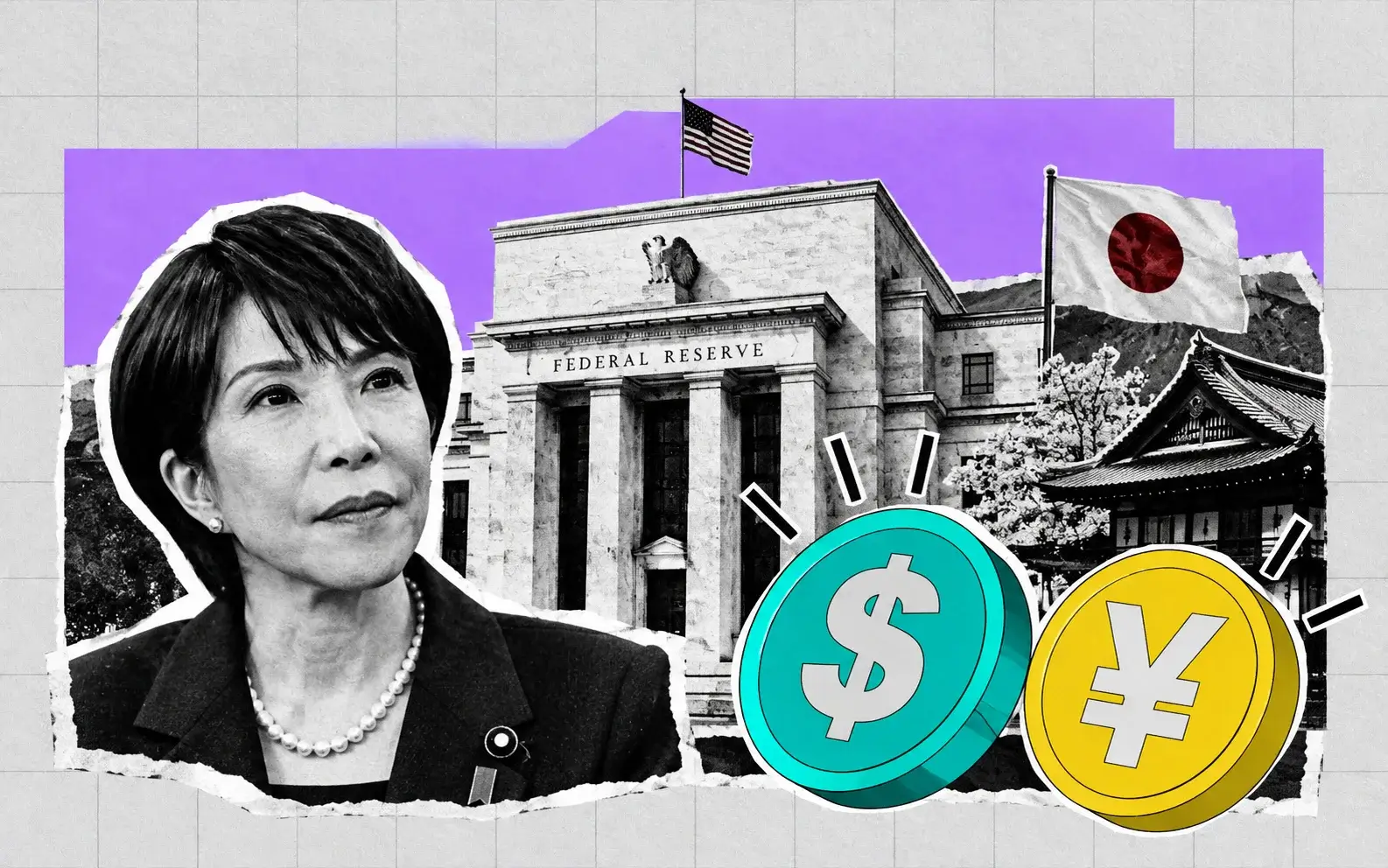
Yen Holds Near February Highs As Tokyo Prepares Its Highest Rate Since 1995 — Why The Yield Gap Will Not Move
Japan spent a record ¥15.4 trillion defending the currency between July 30 and August 26 | That's TradingNEWS
Key Points
- USD/JPY rose 0.44% to 154.20 but remains beneath its 20-day EMA at 156.69 with MACD at -0.814.
- The BoJ is expected to raise rates to 1.25% Friday, the highest level since April 1995.
- Japan spent a record ¥15.4 trillion on intervention between July 30 and August 26.
The dollar recovered against the yen on Monday without changing the trend that has defined September. USD/JPY traded at 154.20 in the European session, up 0.44% on the day, and tested toward ¥155 as New York arrived. The pair had climbed closer to 154.00 during Asian hours, reversing part of Friday's losses.
That bounce sits inside a much larger yen recovery. USD/JPY touched a near seven-month low last Tuesday, September 8, and remains close to its strongest yen levels since February. On September 3 the currency jumped more than 2% against the dollar in a single session, touching 155.28 — its firmest level since August 3.
The dollar index traded at 99.43, up 0.35%, before extending to 99.66 and a 0.58% gain — its largest single-session advance since June. USD/JPY rose less than the dollar rose against most other majors, which means the yen outperformed on the cross even while losing to the greenback.
The technical position confirms the recovery has stalled rather than reversed. USD/JPY holds beneath its 20-day exponential moving average at 156.69, which has capped every rebound attempt as dynamic resistance. The MACD reads -0.814 with the signal line below zero. The relative strength index sits at 33.848 and the Williams %R at 81.530, which is an oversold reading on the shorter timeframe.
Three things are driving the yen's strength and none of them is the interest rate differential. Expectations for more aggressive Bank of Japan tightening, the unwinding of carry trades, and signs of increased asset repatriation by Japanese domestic investors have combined to pull the currency off its lows despite a US 10-year Treasury yield that just breached 5%.
This week both central banks act. The Federal Reserve decides Wednesday with a hike priced between 86% and 90%. The Bank of Japan decides Friday with a 25-basis-point increase fully priced in swap markets. Monday's session was a positioning bounce into a calendar that could go either way.
Both Central Banks Hike This Week And The Differential Does Not Move
This is the structural fact that makes this week unusual and it is being widely misread.
The Federal Reserve's target range sits at 3.50% to 3.75%, a 3.625% midpoint, unchanged since the December 2025 cut that followed 75 basis points of easing across that year. CME FedWatch prices a 25-basis-point increase Wednesday at 90%, up from roughly 59.4% a week ago. Deliver it and the midpoint moves to 3.875%. Meeting materials are published by the Federal Reserve.
The Bank of Japan is widely expected to raise its policy rate to 1.25% on Friday, which would be its highest level since April 1995. Interest rate swap markets have fully priced that move and are highly sensitive to hawkish guidance. Decisions are published by the Bank of Japan.
Run the arithmetic. The current differential is roughly 262 basis points. Both central banks raise 25 basis points inside 72 hours, and the differential on Friday evening is roughly 262 basis points. Nothing changes.
That is why the pair has been trading on something other than rates all month. With the yield gap frozen, price discovery moves to flow — carry positioning, repatriation, intervention risk and the relative credibility of each central bank's forward path.
The guidance is where the asymmetry sits. The Federal Reserve is expected to hike into a 3.4% headline inflation rate driven by energy, with market pricing carrying four increases by July 2027 after a 200-basis-point hawkish repricing. The Bank of Japan is expected to hike with markets already anticipating another increase in December, and with a policy rate that officials themselves describe as below neutral.
So both are tightening and both have more to do. The currency question reduces to which central bank's path the market believes more, and Japan's has the larger gap between current policy and neutral.
Bank of Japan board member Kazuyuki Masu said last week that underlying inflation is approaching the 2% target and that the policy rate remains below its neutral level. That is as close to a pre-commitment as the institution gets, and it is the reason swap markets are fully priced.
Japan Spent A Record ¥15.4 Trillion And Washington Bought Yen Alongside It
The intervention episode of this summer changed the structure of this market permanently, and the numbers are extraordinary.
Japan spent a record ¥15.4 trillion — roughly $98 billion — to support the yen between July 30 and August 26, according to the finance ministry. That is the largest currency intervention in Japanese history by a wide margin.
The United States participated. Washington confirmed its involvement in a coordinated effort in late July in which it used its own foreign-currency holdings to buy yen, without disclosing the amount. A July 31 photograph of Treasury Secretary Scott Bessent's notepad showed the line "Buy Japanese Yen (JPY) $5-10 bil."
Joint US-Japan intervention is close to unprecedented in the modern era. Washington has historically declined to intervene in currency markets and has criticized others for doing so. A US Treasury Secretary buying yen alongside the Ministry of Finance signals a shared policy objective rather than a Japanese defensive operation, and the market has priced it as such.
Bessent has followed the intervention with sustained pressure on policy. He has repeatedly urged the Bank of Japan to pursue more aggressive tightening to prevent excessive yen weakness, told CNBC he believed the Japanese government and central bank would take action leading to a stronger yen, and privately urged officials to communicate the path of interest rates.
That last point is the operative one. Intervention buys time; it does not change fundamentals. A defense of the yen at this scale requires follow-through from macroeconomic policy — specifically faster rate hikes — or the market simply rebuilds the short position at a better level.
The stated concern on both sides is stability rather than level. Officials in Washington and Tokyo have expressed worry that disorderly yen moves could destabilize global markets. There is also a specific American interest: prolonged yen weakness could prompt Japanese domestic investors to reduce their holdings of US Treasuries, and with the 10-year at 5% and the Treasury already tripling its buyback of longer-dated debt to $6 billion, Washington does not want Japan's institutional bid to leave.
That makes this a Treasury-market story disguised as a currency story.
The Carry Trade Unwind Is The Flow That Actually Moved The Yen
Rate differentials explain levels. Positioning explains moves, and the yen's September recovery has been a positioning event.
Traders have been running from the carry trade, and it has become the dominant story in foreign exchange. The mechanics matter: borrow yen at near-zero cost, convert to dollars, buy Treasuries or risk assets, collect the spread. That trade has been the single largest source of structural yen supply for years, and it works only while the yen is stable or depreciating and Japanese rates stay anchored.
Both conditions are breaking. A Bank of Japan moving toward 1.25% with another hike priced for December raises the funding cost. A ¥15.4 trillion intervention with US participation raises the tail risk on the currency leg. And a yen that has appreciated from near ¥160 to ¥154 since the start of September generates mark-to-market losses on every open position, forcing unwinds that buy yen and accelerate the move.
That reflexivity is why the September 3 session produced a 2%-plus move in hours. Carry unwinds do not happen gradually.
The second flow is repatriation. There are signs of increased asset repatriation by Japanese domestic investors — institutions bringing capital home as domestic yields rise toward levels that make JGBs competitive against hedged foreign bonds. Japanese life insurers and pension funds hold enormous overseas portfolios, and the hedging math flips when domestic yields rise and hedging costs on dollar assets stay elevated.
Both flows are structural rather than speculative, which is what distinguishes this yen recovery from previous false starts. A sustainable rise in the yen probably requires a much more hawkish Bank of Japan and new initiatives to encourage domestic investment in Japan — and Friday is when the first half of that gets tested.
The counterweight is straightforward. Expectations for a Federal Reserve hike this month keep the dollar supported against the yen regardless of what happens in Tokyo, which is exactly what Monday's 0.44% bounce demonstrated.
The Technical Map: 156.69 Caps It And The 154 Handle Is The Battleground
The chart is bearish for the dollar with a well-defined ceiling and oversold conditions arguing against pressing shorts here.
The 20-day exponential moving average at 156.69 is the level that matters most. USD/JPY holds beneath it and every rebound has been capped there, which makes it dynamic resistance rather than a static line. A daily close above 156.69 would be the first genuine signal that the September yen recovery has ended.
Between spot and that average sits the ¥155 area, which the pair tested Monday and failed to clear decisively. A breakout above ¥155 would open the path toward ¥156.50 to ¥157, which runs directly into the 20-day EMA and completes the resistance cluster.
Momentum readings are split by timeframe and that split is informative. The MACD at -0.814 with its signal line below zero confirms selling momentum remains intact on the daily. The relative strength index at 33.848 is approaching oversold without reaching it. The Williams %R at 81.530 registers as oversold on the shorter window.
That configuration — bearish structure, oversold short-term momentum — is exactly what produced Monday's bounce. It also means the risk-reward on fresh dollar shorts at 154.20 is meaningfully worse than it was at 156.
Downside references come from the recent price history. The near seven-month low printed last Tuesday is the first target on any resumption. Beneath that, the pair has not spent meaningful time below ¥152 since January and February, when it oscillated in the ¥152 to ¥160 band with a sharp dip to ¥152 to ¥153 in late January before recovering.
The ¥149 level carries weight as a published year-end target, revised up from ¥152 following the intervention. Reaching it would require roughly 3.4% of further yen appreciation from Monday's level and would put the pair at its strongest since well before the 2026 highs.
Spot prices have been confined to a range held over the past week or so, and Monday did not break it. This is a market waiting for Wednesday and Friday rather than one establishing direction.
Wednesday's Fed Decision Is Priced At 90% And The Guidance Is Everything
The American side of the week is the more heavily discounted of the two events, which paradoxically makes it the larger source of surprise risk.
The Federal Open Market Committee convenes Tuesday for a two-day meeting, with the statement, updated Summary of Economic Projections and Chair Kevin Warsh's press conference scheduled for Wednesday, September 16. CME FedWatch shows a 90% probability of a quarter-point increase.
August inflation data drove the repricing. Headline CPI rose 0.4% on the month with the annual rate at 3.4%, while core rose 0.3% against a 0.2% forecast. Producer prices accelerated in August, with wholesale energy costs feeding through and annual producer inflation reaching 5.4%. Higher energy prices are adding directly to US inflation concerns and lifting Treasury yields. The consumer release comes from the Bureau of Labor Statistics.
The political dimension is live and it cuts against the hawkish read. President Trump has stressed that US interest rates should be the lowest in the world. Separately, commentary suggesting a developing appetite for higher rates strengthened the dollar Monday, which indicates the market is genuinely uncertain about how the political pressure resolves.
For USD/JPY the hike at 90% priced carries limited directional information. What matters is the 2026 median dot. A projection near 4.125% confirming a second increase before year-end widens the expected differential over the coming quarters and pushes USD/JPY back toward ¥156.69. Language framing Wednesday as an isolated adjustment does the opposite and leaves the yen free to resume its recovery into Friday.
The asymmetry is worth stating plainly. With the hike 90% priced and the Bank of Japan hiking two days later, a hawkish Federal Reserve produces a modest dollar gain. A Federal Reserve that hikes and declines to promise more, immediately followed by a Bank of Japan that signals December, produces a sharp move lower in USD/JPY because both legs move against the dollar at once.
August retail sales land Wednesday at 8:30 a.m. ET ahead of the decision. July retail sales fell 0.6% and preliminary September consumer sentiment dropped to 47.8 from 51.7.
Friday's BoJ Decision Takes The Policy Rate To Its Highest Since April 1995
The Japanese event is the one with genuine informational content, and the historical framing matters.
The Bank of Japan is expected to raise its policy rate to 1.25% on Friday, September 18. That would be the highest Japanese policy rate since April 1995 — a thirty-one year high in an economy that spent most of that period at or below zero. Markets fully price the 25-basis-point move and also anticipate another increase in December.
The case has been building. Masu's comment that underlying inflation is approaching the 2% target and that the policy rate remains below neutral is the clearest institutional signal available. With underlying inflation converging on target, the central bank is expected to raise rates to address upside risks to prices, and acting in September rather than waiting until October would demonstrate determination to get ahead of those risks.
Energy is doing to Japan what it is doing to every other importer. Brent above $108 with the Strait of Hormuz effectively closed and Saudi Arabia's East-West pipeline offline is a terms-of-trade shock for an economy that imports essentially all of its hydrocarbons, transmitted through a currency that has been historically weak. Imported inflation in yen terms is the mechanism that finally forced the Bank of Japan's hand.
Governor Kazuo Ueda's guidance is what the market will trade. A hike delivered with explicit acknowledgment that the policy rate remains below neutral and that further adjustment is warranted validates the December pricing and extends the yen's recovery. A hike delivered with the institution's customary ambiguity — data-dependent, meeting-by-meeting, no pre-commitment — leaves the market having bought the rumor with nothing to sell into.
The second risk is sequencing. The Bank of Japan decides two days after the Federal Reserve, which means Ueda will already know whether Warsh signalled a cycle. A hawkish Fed gives the Bank of Japan cover to be cautious, because the differential is already moving in the dollar's favor and a strong yen is no longer the immediate problem.
That dependency makes Friday's outcome partially a function of Wednesday's.
Read More
-
Yen Stalls at 160 Despite a 3% JGB and Tokyo Core CPI at 2.0% — Intervention Sits at 164, Friday's Payrolls Decide
02.09.2026 · TradingNEWS ArchiveEnergy
-
AMD Loses $500 As Chips Get Smoked — 2 Of The CEOs Calling For A Slowdown Are AMD's Own Customers
14.09.2026 · TradingNEWS ArchiveStocks
-
Spot Bitcoin ETFs Bleed Half A Percent And Bitcoin Fails At $80K — Why The Flow Data Is Now A Rate Trade
14.09.2026 · TradingNEWS ArchiveCrypto
-
US Gas Holds $2.88 While Europe Pays $28 — Why Only A Tenth Of The War Premium Reaches Henry Hub
14.09.2026 · TradingNEWS ArchiveCommodities
-
S&P 500 Slides 0.80%, Nasdaq Loses 1.03% And Dow Drops 0.54% As Chips Get Smoked And Oil Rips To $109
14.09.2026 · TradingNEWS ArchiveMarkets
-
Pound Loses 1.3500 With Gilt Yields At A 19-Year High — Why Rising UK Borrowing Costs Are Hurting Sterling
14.09.2026 · TradingNEWS ArchiveForex
Silver Week Creates The Intervention Window Immediately After The Decision
The calendar detail that most traders are underweighting sits in the days following the Bank of Japan meeting.
Japanese markets close for three days immediately after the decision for the Silver Week holidays, and the market is on watch with chatter that intervention could occur around those thin trading conditions. Thin liquidity amplifies the price impact of any given intervention size, which is precisely why authorities have historically chosen holiday windows and low-volume sessions for operations.
The precedent from this cycle is direct. The July 31 joint operation came at month-end, and the subsequent ¥15.4 trillion of Japanese buying ran through August 26 — a month in which the yen strengthened materially and then gave part of it back.
The strategic logic for intervening after the meeting rather than before is sound. A rate hike alone may not produce sustained yen appreciation if Ueda's guidance disappoints. Intervening into the post-decision window, with markets thin and any disappointment already priced, would let authorities defend the level without fighting the market's interpretation of policy.
What makes this cycle different from every prior Japanese intervention is American participation. A Japanese-only operation faces a market that knows the Ministry of Finance has finite reserves and a Federal Reserve working against it. A joint operation with the US Treasury buying yen using its own foreign-currency holdings, endorsed publicly by the Treasury Secretary, is a different proposition — and it is why the market has respected the level rather than testing it aggressively.
Coordination between Washington and Tokyo points to a shared objective, most plausibly the currency's long-term stability rather than a specific level. That framing suggests a broader policy response beyond FX intervention is available to support the yen over the longer term.
For positioning purposes, the practical implication is that dollar longs above ¥157 carry an asymmetric tail risk that dollar shorts below ¥152 do not.
The 2026 Arc: From ¥160 Resistance To A Seven-Month Low In Six Weeks
The year's price history frames how far this has moved and how quickly.
USD/JPY entered 2026 pressing against the key ¥160 resistance level after a strong fourth-quarter 2025 rally. January and February saw the pair oscillate in the ¥152 to ¥160 range, with a sharp dip to ¥152 to ¥153 in late January before recovering. March brought renewed buying, with the pair trading around ¥155 to ¥159.
The summer was where it broke. The joint Japan-US intervention on July 31 marked the top, followed by a partial dollar recovery through August as the market tested whether the operation had conviction behind it. By September 1 the pair was back near ¥159.70, approaching the upper boundary of its 2026 range and roughly where it started the year.
Then September delivered the reversal. The yen strengthened sharply from the start of the month on expectations of faster Bank of Japan tightening narrowing the yield gap. September 3 produced the 2%-plus jump to 155.28. By September 8 USD/JPY had reached a near seven-month low. Friday saw the yen weaken past 154 per dollar, retreating from near seven-month highs as the dollar recovered on the producer price data.
That is a round trip from ¥159.70 to a seven-month low and back to ¥154.20 inside two weeks.
The structural read on that arc: every dollar rally in 2026 has failed at or below ¥160, and the failures have become more decisive. The January dip found support at ¥152 to ¥153. The current move has taken the pair to levels last seen in February without a comparable bounce. The pattern is one of lower highs with the ¥160 ceiling holding.
Published forecasts have followed the price. The year-end target was revised to ¥149 from ¥152 following the intervention, with the third-quarter estimate lifted to ¥153 from ¥154 — implying the pair should be trading roughly a point below where it sits now and should fall a further 3.4% by December.
Three Scenarios Into Friday And The Levels Attached
The week resolves along three paths and each has a clean destination.
The base case, at roughly 45%, is a Federal Reserve hike with a hawkish dot plot Wednesday followed by a Bank of Japan hike with cautious, non-committal guidance Friday. Both central banks deliver, the differential stays at 262 basis points, and the market is left holding a fully priced outcome with nothing new. USD/JPY grinds back toward the 20-day EMA at 156.69, tests ¥155 and ¥156.50 on the way, and ends the week between ¥155.50 and ¥157.
The yen-bullish path, at roughly 35%, requires Warsh to hike without signalling a cycle Wednesday and Ueda to explicitly acknowledge that the policy rate remains below neutral Friday, validating December pricing. Both legs move against the dollar. USD/JPY breaks last Tuesday's near seven-month low and runs toward ¥152, with the ¥149 target becoming reachable inside the quarter. Intervention into the Silver Week window would accelerate rather than oppose that move, since authorities are buying yen.
The dollar-bullish tail, at roughly 20%, is a hawkish Federal Reserve with a 2026 median near 4.125% combined with a Bank of Japan that hikes and then signals a pause — or, less likely, holds entirely. That would be the worst outcome for yen longs, because the market is fully priced for a Japanese hike and a disappointment forces an unwind into a widening differential. USD/JPY clears 156.69, and ¥158 to ¥159.70 comes back into view.
Beyond this week, two variables dominate. The first is oil. Brent above $108 with no de-escalation catalyst on the calendar keeps importing an inflation shock into Japan, which supports further Bank of Japan tightening and therefore the yen. A Hormuz reopening cuts that support.
The second is the US Treasury market. If a 5% 10-year yield triggers genuine Japanese institutional selling of US bonds, repatriation accelerates and the yen strengthens regardless of what either central bank says.
Verdict: Yen-Positive Below 156.69 With ¥152 As The Objective
USD/JPY is a sell-the-rally market, and Monday's 0.44% bounce is the rally rather than the reversal.
The pair trades at 154.20 having tested ¥155, capped by a 20-day exponential moving average at 156.69 that has rejected every rebound this month. The MACD sits at -0.814 with its signal line below zero. The pair printed a near seven-month low last Tuesday and remains close to its strongest yen levels since February.
The fundamental case supports the technical one for reasons that have nothing to do with the interest rate differential, which stays frozen at roughly 262 basis points when both central banks hike this week. What is driving the yen is the unwinding of carry trades, asset repatriation by Japanese domestic investors, and a Bank of Japan moving toward 1.25% — its highest policy rate since April 1995 — with another increase already priced for December and a board member publicly stating the rate remains below neutral.
Behind all of it sits the largest currency intervention in Japanese history: ¥15.4 trillion between July 30 and August 26, executed alongside a US Treasury that bought yen with its own foreign-currency holdings and whose Secretary has since pressed Tokyo publicly and privately for faster tightening. That is a policy alliance rather than a defensive operation, and it changes the risk profile of holding dollar longs into any thin-liquidity window — including the three-day Silver Week closure that begins immediately after Friday's decision.
The honest counterweight: the Williams %R at 81.530 and an RSI at 33.848 show the yen trade is already stretched, the Bank of Japan hike is fully priced in swap markets leaving nothing to buy on the news, Ueda has a long record of declining to pre-commit, and a Federal Reserve hike at 90% probability with four more priced by July 2027 keeps the dollar structurally supported.
Trading plan: yen-positive while 156.69 caps, with the recent seven-month low as the first objective and ¥152 as the extension. Invalidation is a daily close above 156.69, which reopens ¥158. The largest risk to the yen is not Washington — it is a Bank of Japan that delivers the hike everyone expects and then refuses to promise December.