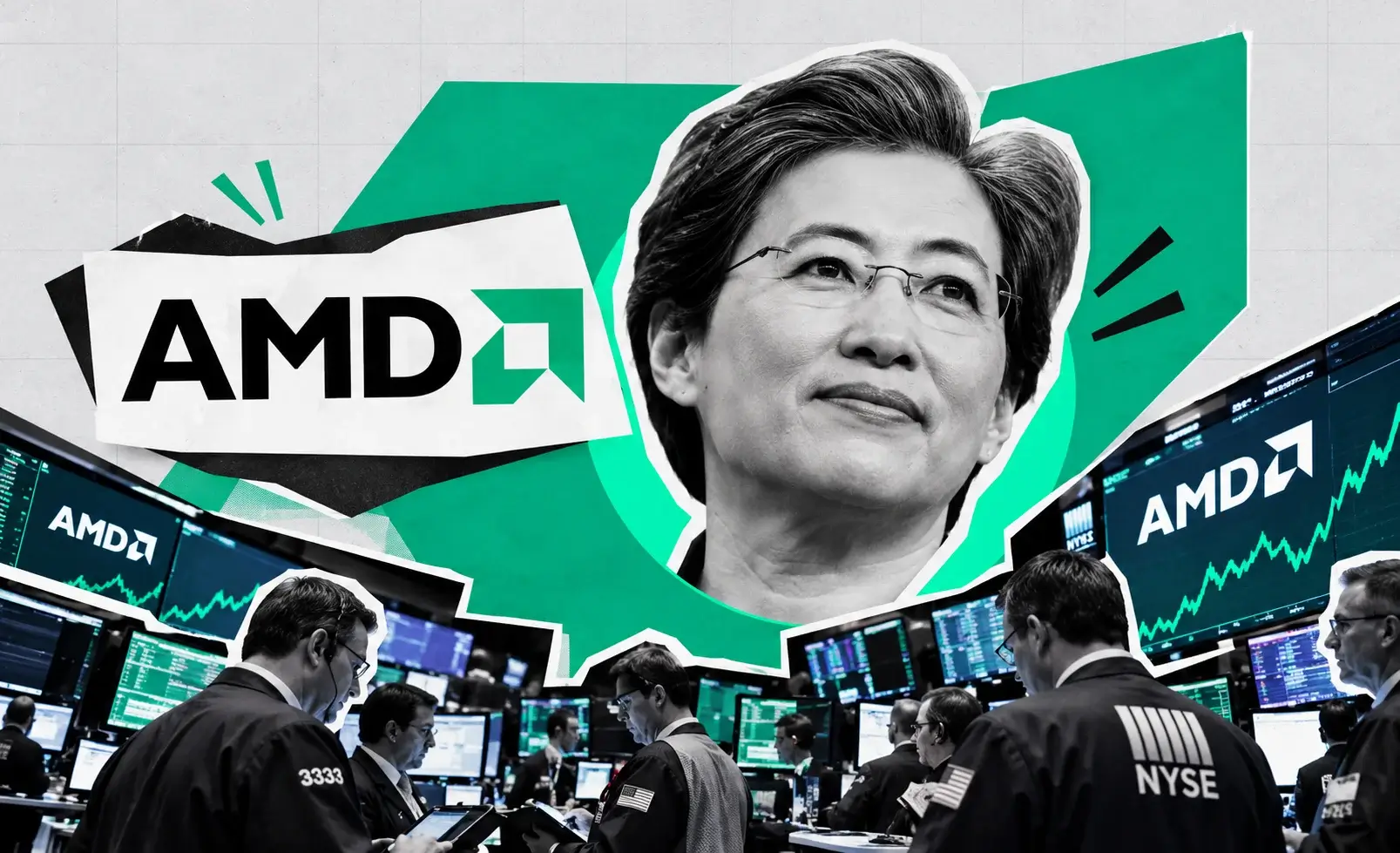
AMD Recovers to $542.71 as Helios Backlog and 41% Growth Guide Face November 3 Test After 19% Slide
AMD trades at 38.5 times 2027 earnings after the OpenAI revenue scare cut 6.4% in 3 sessions | That's TradingNEWS
Key Points
- AMD hit $524.60 on Tuesday, 19.2% below its $649.42 record close, before rebounding to $542.71.
- AMD guided Q3 revenue to $13.0 billion, up 41% year over year, ahead of its November 3 report.
- At $542.71, AMD trades at 38.5 times consensus 2027 EPS of $14.11, down from 46 times at its peak.
Advanced Micro Devices (NASDAQ:AMD) traded at $542.71 shortly after noon in New York on Tuesday, up $4.66, or 0.87%, from Monday’s close of $538.05. The session opened weak. AMD opened at $530.02, fell to a low of $524.60 as chip stocks extended last week’s slide, then rallied to a high of $548.11 when the Philadelphia Semiconductor index turned 1.2% higher. Volume reached 7.58 million shares by midday against a 21.85 million daily average. At $542.71, AMD carries a market value of $887 billion on 1.63 billion shares outstanding.
The thesis for this forecast is direct. AMD’s slide from a record close of $649.42 on October 6 to Tuesday’s $524.60 low was a 19.2% drawdown driven by fear about AI customer finances, not by any change in AMD’s own numbers. The company guided third-quarter revenue to $13.0 billion, up 41% from a year earlier, with data center sales expected to accelerate in the second half. Helios rack-scale systems are backed by gigawatt-scale commitments from OpenAI, Meta and Anthropic. The November 3 earnings report is the first chance for AMD to show that its order book is intact. Until then, the stock is trading on sentiment about its customers rather than on its own results.
The scale of the move explains the volatility. AMD started 2026 at $223.47. At $542.71, it is up 142.9% for the year, far ahead of the Philadelphia Semiconductor index’s 57% gain. The 52-week range runs from $188.22 to an intraday high of $658.52. AMD trades 17.6% below that high and 188% above the low. A stock that has nearly tripled in nine months will swing hard on any doubt about the story behind it.
The doubt arrived in October. On October 8, a report put OpenAI’s annualized revenue near $50 billion, about $20 billion below figures that had circulated. AMD fell 3.90% that day to $620.68 and 2.03% the next to $608.10. The slide continued through last week as chip stocks posted a nine-session losing streak, the longest in 20 years. AMD fell 15.36% over the week to Thursday, including a 4.23% drop that day. ASML’s warning that 2027 and 2028 manufacturing capacity would not fully meet demand added pressure.
Monday’s bounce gave AMD a 1.76% gain to $538.05, outpacing the Nasdaq Composite’s 1.11% rise. Tuesday’s recovery from $524.60 extended that, but the stock still trades below the levels it held before the OpenAI report. The levels that matter are clear: support at $524.60 and $500, resistance at $548.11, $570.62 and $608.10, and the record close at $649.42.
Q3 Guide of $13.0 Billion Implies 41% Growth
The fundamentals going into the November 3 report are the strongest AMD has produced. The company guided third-quarter revenue to approximately $13.0 billion, plus or minus $300 million, in its second-quarter earnings release on August 4. At the midpoint, that is 41% growth from $9.25 billion a year earlier. The range of $12.7 billion to $13.3 billion sat above the $12.4 billion consensus at the time of the guide. Non-GAAP gross margin is expected near 56%, flat with the second quarter.
The sequential step is large. Second-quarter revenue reached a record $11.5 billion, up 50% from a year earlier. The midpoint of the third-quarter guide implies 13% sequential growth, matching the jump from first-quarter revenue of $10.2 billion. AMD has now delivered six consecutive quarters of revenue growth above 30%.
The consensus for the third quarter sits close to the guide. Analysts expect non-GAAP EPS of $1.94 on revenue of $13.06 billion, against $1.20 per share and $9.25 billion a year earlier. That implies 62% EPS growth. In the second quarter, AMD earned $1.66 per share on a non-GAAP basis, beating the $1.62 consensus by 4 cents. GAAP diluted EPS reached $1.38.
The second-quarter profit picture shows operating leverage. Non-GAAP operating income reached $3.1 billion, and non-GAAP net income reached $2.8 billion. GAAP operating income was $2.0 billion, with GAAP net income of $2.3 billion. GAAP gross margin was 54% and non-GAAP gross margin 56%.
CFO Jean Hu set the expectation for the second half. She said AMD expects data center sales to accelerate in the second half of 2026, driving stronger overall revenue growth and continued earnings expansion. Both server CPUs and data center AI are expected to grow within that.
The full-year picture shows the scale of the turnaround. In 2025, AMD posted revenue of $34.64 billion and net income of $4.34 billion. At the run rate implied by the third-quarter guide, 2026 revenue is on track to exceed $47 billion. Consensus expects 2027 EPS of $14.11, which would more than double this year’s earnings.
The guide is the anchor for the forecast. If AMD delivers $13.0 billion or more on November 3 and guides the fourth quarter higher, the October selloff will look like a buying opportunity. If revenue lands at the low end or the fourth-quarter guide disappoints, the stock has further to fall.
Data Center Revenue Doubled to $6.7 Billion
The data center segment is the engine behind AMD’s rerating. Data center revenue reached $6.7 billion in the second quarter, up 107% from $3.2 billion a year earlier, according to AMD’s second-quarter 10-Q. Over the first half, data center revenue reached $12.5 billion, up 81% from $6.9 billion. The growth came from EPYC server processors and Instinct MI350 Series GPUs.
The segment’s weight in the business has jumped. Data center revenue represented 58% of total revenue in the second quarter, up from 42% a year earlier. A business that was once mainly about PC processors and gaming chips now earns most of its revenue from servers and AI accelerators.
The profit swing is larger than the revenue swing. Data center operating income reached $2.1 billion in the second quarter, a 31% margin, against an operating loss of $155 million a year earlier. The prior-year loss reflected inventory charges tied to U.S. export controls on the MI308 GPU for China. Over the first half, data center operating income reached $3.7 billion, up from $777 million.
The mix shift drives margins. Data center products carry higher gross margins than client and gaming products. As data center grows from 42% to 58% of revenue, and potentially higher, AMD’s overall margin profile improves. The guide for flat gross margin at 56% in the third quarter suggests that new product ramps, which carry lower initial margins, are offsetting part of that mix benefit.
EPYC is a quiet strength. AMD’s server CPUs have been taking share from Intel for years, and AI workloads are driving demand for general-purpose compute alongside accelerators. Agentic AI and production inference workloads require large numbers of CPUs to orchestrate GPU clusters and run the software around AI models. AMD’s server CPU business is a key focus for the November 3 report.
The Instinct GPU line is where the upside sits. The MI350 Series drove the second-quarter growth. The MI450, which powers the Helios rack-scale system, begins shipping in the second half of 2026. Oracle committed to 50,000 MI450 GPUs starting in the third quarter. OpenAI’s initial 1-gigawatt deployment begins in the second half. If those ramps show up in third-quarter data center revenue, the segment could exceed $8 billion.
Helios Is Backed by OpenAI, Meta and Anthropic at Gigawatt Scale
AMD’s AI strategy now rests on Helios, its rack-scale system built around the MI450 GPU. A rack-scale system integrates GPUs, CPUs, networking and cooling into a single unit that customers can deploy as a building block for AI data centers. It competes directly with Nvidia’s rack-scale offerings. CEO Lisa Su has said that customer pull for Helios is very strong and tracking ahead of initial forecasts.
The customer list is the foundation of the bull case. OpenAI signed a deal in October 2025 to deploy up to 6 gigawatts of AMD GPUs, starting with a 1-gigawatt phase in the second half of 2026. Meta has a gigawatt-scale commitment. Anthropic announced a partnership in August to deploy up to 2 gigawatts of MI450 GPUs, and Su said AMD was thrilled to deepen its partnership with Anthropic and deploy Helios at gigawatt scale. Oracle committed to 50,000 MI450 GPUs from the third quarter of 2026.
The warrant structure ties those customers to AMD’s stock. AMD issued OpenAI and Meta warrants for up to 160 million shares each. Together, those 320 million shares equal about 20% of AMD’s 1,632.48 million shares outstanding. The warrants vest as the customers deploy AMD GPUs and as the stock reaches price thresholds. OpenAI’s final tranche carries a $600 share-price threshold, which AMD traded above before the October selloff.
That threshold matters for the current price. At $542.71, AMD trades 9.6% below OpenAI’s $600 threshold. Above $600, GPU delivery milestones become the main gate for OpenAI’s final warrant tranche. Below it, the price condition adds a second gate. Investors watching the warrant structure will see $600 as a level that aligns OpenAI’s incentives with AMD’s shareholders.
The dilution is real but conditional. If all 320 million warrant shares vest, existing shareholders would own about 83% of an expanded share count. The warrants vest only as customers buy AMD hardware at scale, which means the dilution comes with the revenue. A 6-gigawatt OpenAI deployment alone represents tens of billions of dollars in potential sales over several years.
The concentration is the risk. Three customers, OpenAI, Meta and Anthropic, account for most of AMD’s committed AI GPU demand. If any of them slows its buildout, AMD’s growth path changes. That concentration is exactly what the market punished in October.
AMD also introduced Helion this month, a platform supporting up to 32,768 CPU cores slated for November 2026, extending its server CPU push alongside Helios. The product cadence shows AMD competing on both sides of the AI data center: accelerators and the CPUs that run them.
The OpenAI Revenue Report Cost AMD 6.4% in Three Sessions
The October selloff began with a single number about AMD’s largest AI customer. On October 8, a report put OpenAI’s annualized revenue run rate near $50 billion at the end of September, about $20 billion below the $70 billion figure that had circulated. Investors worried that lower OpenAI revenue could weaken its ability to pay for its large computing contracts.
AMD took the hardest hit among the major chipmakers. The stock fell 3.90% on October 8 to $620.68, after dropping as much as 4.55% intraday. Nvidia fell about 2.9% to around $230.60. AMD fell another 2.03% on October 9 to $608.10, a three-session decline of 6.36% from its October 6 record close. Oracle fell 8.83% over the same stretch, reflecting its $300 billion computing contract with OpenAI.
The reaction exposed a structural vulnerability. A handful of AI model developers account for a large share of the spending that justifies chipmaker and cloud valuations. OpenAI sits at the center of that web. Nvidia has taken a $30 billion direct equity stake in OpenAI. AMD supplies 6 gigawatts of GPUs and holds the warrant structure. Oracle provides $300 billion of computing capacity over five years. CoreWeave has multi-year capacity contracts. When the market questions OpenAI’s finances, every link in that chain gets repriced.
AMD’s exposure is the most pointed. Its multi-gigawatt MI450 commitments tied to OpenAI are a central part of its AI pitch. If OpenAI’s revenue grows more slowly than expected, the pace of its AMD deployments could slow, delaying revenue and the warrant vesting schedule.
The circular financing raises the stakes. Chipmakers investing in their customers, and customers paying for chips with money raised partly from those chipmakers, creates a loop that amplifies both upside and downside. Nvidia’s AI equity bets in 2026 total more than $40 billion. When confidence in the end customer weakens, the whole loop comes under scrutiny.
The credit market confirmed the stress on Tuesday. CoreWeave fell 5.70% to $57.63, and its five-year credit default swap spread rose to around 1,121 basis points. A Korean AI data center developer dropped as much as 35% after its IPO. The financing side of the AI buildout is under pressure, and AMD’s customers are part of that system.
AMD’s fundamentals have not changed since October 6. The guide, the customer commitments and the product roadmap are the same. What changed is the risk premium the market demands for exposure to AI customer finances.
Chip Stocks Snapped a Nine-Day Losing Streak, Then Wobbled Again
The sector backdrop amplified AMD’s decline. The semiconductor group posted a nine-session losing streak through last Friday, its longest in 20 years. The iShares Semiconductor ETF fell about 12% last week. The Nasdaq had its worst week since June. The selling hit every part of the AI supply chain: chip designers, equipment makers, memory producers and data center operators.
ASML added a specific concern. The Dutch lithography equipment maker reported record quarterly sales but warned that planned manufacturing capacity in 2027 and 2028 would not fully meet expected demand. Its Nasdaq-listed shares fell around 4% overnight, adding to the pressure on chip stocks including AMD. A supply constraint sounds bullish for chip demand, but it raised questions about whether AMD and its peers can get enough manufacturing capacity to meet their order books.
Monday brought relief. Chip stocks snapped their losing streak, and the Philadelphia Semiconductor index rose 1.61%. AMD gained 1.76% to $538.05, with Nvidia and Intel also bouncing. The rebound was narrow, though: roughly 70% of S&P 500 stocks fell that day, and the equal-weight index lost 0.3%.
Tuesday opened with the selling back in place. Asian chip stocks fell as Korea’s Kospi dropped 4% and SK Hynix led the decline. In New York, Nvidia fell 1.68% early, AMD dropped 1.64% to 1.89%, Lam Research lost 3.69% and KLA lost 3.27%. AMD’s euro-listed shares fell 4.19% in the European morning. The stock hit $524.60 shortly after the open.
The reversal came by mid-morning. The Philadelphia Semiconductor index turned 1.2% higher by 10:58 a.m., pulling the Nasdaq 100 up 0.6%. AMD rallied to $548.11. The broader market helped: the Dow gained 714 points, or 1.4%, and the S&P 500 rose 0.7% as earnings from industrial and defense companies beat expectations and oil fell from its morning spike.
The pattern of the last two sessions shows a market trying to find a floor. Chip stocks gap lower on overnight weakness, then recover during the U.S. session. A group that keeps filling its morning gaps is building a base. The test is whether the next rally can hold above the prior day’s high, which for AMD means a close above $548.11.
AMD Trades at 38.5 Times 2027 Earnings
AMD’s valuation is high but has come down sharply from its peak. At $542.71, the stock trades at 139.4 times trailing GAAP EPS of $3.90. That multiple reflects a company whose earnings are growing faster than any backward-looking measure can capture. The forward picture is more useful.
Consensus expects 2026 EPS of $6.49, nearly double the $3.27 earned in 2025. At $542.71, AMD trades at 83.6 times that figure. Consensus expects 2027 EPS of $14.11, an increase of 117%. At $542.71, AMD trades at 38.5 times 2027 earnings. At its record close of $649.42, the 2027 multiple was 46.0 times. The October selloff has compressed AMD’s forward multiple by 7.5 turns.
The comparison with peers is unfavorable on a static basis. AMD’s forward price-to-earnings ratio of around 40 times at its October 14 close compares with roughly 25 times for Nvidia and 19 times for Broadcom. AMD has posted slower recent revenue growth than both. The premium reflects the market’s expectation that AMD’s growth will accelerate as Helios ramps, while Nvidia’s growth moderates from a much larger base.
The growth rate justifies part of the premium. A 2027 EPS increase of 117% means AMD’s 38.5 times 2027 multiple falls to roughly 18 times on 2028 earnings if growth continues at even half that pace. For a company doubling its earnings, a multiple near 40 times next year’s earnings is not extreme. The question is whether that growth is reliable.
The warrant dilution affects the per-share math. If all 320 million warrant shares vest, the share count would rise from 1.63 billion to 1.95 billion, an increase of 19.6%. Consensus EPS estimates should already reflect expected warrant vesting, but any acceleration in deployments would bring both more revenue and more dilution.
The market value puts the scale in context. AMD crossed $1 trillion in market capitalization in early October when it closed at a record $633.91 on October 2 and touched $645 intraday. At $887 billion today, the stock has given back more than $150 billion in value. A return to the record close would add $173 billion.
The valuation is not cheap, but it is no longer stretched relative to the growth AMD is guiding. At 38.5 times 2027 earnings, the stock prices in strong execution but not perfection.
Technical Map: $524.60 Low, $548.11 Pivot, $608.10 Gap Target
The chart has drawn a clear range after the October selloff. AMD’s intraday high of $658.52 came in the first week of October, with the record close at $649.42 on October 6. The stock then fell through $645.86 on October 7, $620.68 on October 8 and $608.10 on October 9. By October 14, it closed at $570.62. On October 15, it fell 4.23% intraday toward $530. On Tuesday, it hit $524.60, a 20.3% decline from the intraday high.
Tuesday’s $524.60 low is the first support. It came close to last week’s $530 area and held after a test in the opening minutes. A daily close below $524.60 would mark a new low for the move and open the $500 round number, 7.9% below the current price. Below $500, the September breakout area becomes the next reference.
Resistance is layered above. Tuesday’s high at $548.11 is the immediate pivot. A daily close above it would mark a higher high after a higher low, the first sign of a short-term trend change. Above that, $570.62, the October 14 close, is the next level, 5.1% above the current price. The $600 level is a psychological marker and the price threshold for OpenAI’s final warrant tranche. The October 9 close at $608.10 is the gap target, 12.0% above the current price. The October 8 close at $620.68 sits above that.
The record close at $649.42 sits 19.7% above the current price. The intraday high at $658.52 sits 21.3% above. Those levels would require a strong earnings report and a recovery in AI sentiment.
AMD’s beta of 2.45 means it moves roughly two and a half times as much as the broader market. A 1% move in the S&P 500 tends to translate into a 2.5% move in AMD. That volatility cuts both ways. A broad market recovery would lift AMD faster than the index. A market selloff would hit it harder.
The volume confirms the shape of the bounce. Monday’s 20.2 million shares came in below the 21.8 million average, which shows the rebound was not driven by heavy buying. Tuesday’s midday volume of 7.58 million suggests a full-day total near the average. A strong close above $548.11 on above-average volume would confirm buyers are returning.
AMD vs Nvidia, Broadcom and Intel
AMD’s position among chipmakers has shifted this year. At its October peak, AMD crossed $1 trillion in market value, joining Nvidia and Broadcom in that club. Its 142.9% year-to-date gain is far ahead of the semiconductor index’s 57%. The stock has been rewarded for winning AI customers that once bought almost exclusively from Nvidia.
Nvidia remains the dominant AI accelerator supplier. Nvidia signed a deal with OpenAI for up to 10 gigawatts of annual power consumption, larger than AMD’s 6 gigawatts. It has invested $30 billion directly in OpenAI. Its forward multiple near 25 times is lower than AMD’s because its growth is expected to slow from a much larger base. On Tuesday, Nvidia fell 1.68% in early trading before recovering with the sector.
Broadcom competes in custom AI chips. Its forward multiple near 19 times reflects a different business model built on designing custom accelerators for specific hyperscalers. Broadcom has also extended a loan facility of up to $42 billion to Anthropic, which shows how chipmakers are financing their customers across the AI ecosystem.
Intel is a competitor in server CPUs and a potential partner in manufacturing. AMD has been taking server CPU share from Intel for years. Intel’s shares bounced 5.5% on Monday in the chip rebound and fell 2.75% to 2.92% on Tuesday morning.
The competitive picture for AMD comes down to two questions. Can Helios compete with Nvidia’s rack-scale systems on performance and total cost of ownership? Early customer commitments from OpenAI, Meta, Anthropic and Oracle suggest yes. Can AMD secure enough manufacturing capacity to deliver? ASML’s capacity warning raised that question.
The customer overlap is unusual. OpenAI, Meta and Anthropic are buying from both Nvidia and AMD. That dual sourcing helps AMD because it shows that the largest AI developers want a second supplier. It also means AMD’s growth depends on the same customers as Nvidia’s, so a slowdown in AI spending would hit both.
For investors choosing between the two, AMD offers higher growth and higher risk. Its earnings are expected to grow faster than Nvidia’s in 2027, but its customer base is more concentrated and its multiple is higher. The October selloff showed which stock the market sells first when AI sentiment turns.
Read More
-
Yen Stalls at 160 Despite a 3% JGB and Tokyo Core CPI at 2.0% — Intervention Sits at 164, Friday's Payrolls Decide
02.09.2026 · TradingNEWS ArchiveEnergy
-
MMM Rallies to $171.97 as 26.2% Margin, Raised $9.10–$9.15 Outlook and Amazon Optics Deal Drive Rerating
20.10.2026 · TradingNEWS ArchiveStocks
-
XRP-USD Bounces to $1.33 as 6.05B Token Exchange Deposits and Stalled ETFs Cap Rally Below $1.38
20.10.2026 · TradingNEWS ArchiveCrypto
-
Brent Reverses From $111 Peak to $106 as Russia Waiver and Unverified Saudi Strikes Drain Risk Premium
20.10.2026 · TradingNEWS ArchiveCommodities
-
Dow Jones Surges 1.4%, S&P 500 Gains 0.7%, Nasdaq Trails as BRZE Soars 51% and GM Sinks 7%
20.10.2026 · TradingNEWS ArchiveMarkets
-
Pound Hits 1.3359 as 102,000 Job Gain and 3.7% Pay Growth Push BoE Toward First Hike in 3 Years
20.10.2026 · TradingNEWS ArchiveForex
The Macro Backdrop: 5.10% Yields and a December Fed Hike
Interest rates matter more for AMD than for most stocks. High-growth companies whose value depends on earnings several years out are sensitive to the discount rate. The 10-year Treasury yield traded at 5.10% on Tuesday, near the 5.31% peak of October 5, its highest in 24 years. A year ago, it stood at 4.05%. That 105-basis-point rise has compressed valuations for long-duration growth stocks.
The Fed is still tightening. Fed funds futures price an 82% chance of a hold at the October 27 and 28 meeting and an 89% chance of a December hike. The Fed raised rates in September for the first time in three years. September consumer prices rose 3.7% and producer prices 6.3%. Inflation is running above target, driven in part by oil.
Oil swung sharply on Tuesday. Brent hit $111.75 in the morning on Houthi attack claims, then fell to $106.85. AMD’s low of $524.60 came near the oil peak, and its recovery tracked the oil reversal. Higher oil means higher inflation expectations, which means higher yields, which means pressure on growth stocks.
The AI financing question links directly to rates. Data centers are capital-intensive, and much of the buildout is financed with debt. CoreWeave’s debt yields 15%, and its credit default swaps trade above 1,100 basis points. When rates rise, the cost of financing AI infrastructure rises, which could slow the pace at which AMD’s customers deploy its GPUs.
Weak economic data offered some relief. U.S. housing starts fell 5.2% to 1.221 million in September, and pending home sales hit a record low. Weak data tends to pull yields lower. The 10-year eased from 5.14% before the open to 5.10% during the session.
The macro picture argues for caution until the Fed decision. A hold with guidance that leaves December open would lower yields and support AMD. A firm commitment to December would keep yields high and limit the stock’s rebound. The Fed meets six days before AMD reports, so the rate outcome will shape the market’s mood heading into earnings.
November 3 Earnings: What AMD Has to Prove
AMD reports third-quarter results after the market close on Tuesday, November 3, with a conference call at 5 p.m. Eastern, according to the company’s announcement. That report is the single biggest catalyst for the stock this quarter.
The first test is revenue. AMD guided to $13.0 billion, plus or minus $300 million. Consensus sits at $13.06 billion. AMD beat its revenue guide midpoint in the second quarter, reporting $11.54 billion. A third-quarter print of $13.3 billion or higher, at the top of the range, would show that demand has not slowed despite the October fears.
The second test is data center. Second-quarter data center revenue was $6.7 billion. With the MI450 starting to ship to Oracle and OpenAI’s first gigawatt beginning, investors will look for data center revenue above $8 billion. Sequential growth of that size would confirm that Helios is ramping on schedule.
The third test is the fourth-quarter guide. AMD’s guidance has driven the stock more than its reported results. A fourth-quarter revenue guide of $15 billion or more would signal that the MI450 ramp is accelerating. A guide below $14.5 billion would raise doubts about the second-half acceleration that management promised.
The fourth test is customer commentary. Investors will want to hear Lisa Su address the OpenAI deployment schedule directly, given the October report about OpenAI’s revenue. Any sign that OpenAI’s first gigawatt is shipping on time would ease the customer concentration concern. Updates on Meta and Anthropic deployments would show diversification.
The fifth test is gross margin. AMD guided to around 56%, flat with the second quarter. New product ramps typically carry lower initial margins. If margins hold at 56% while MI450 volume rises, it would show AMD can scale Helios profitably.
The consensus EPS figure of $1.94 implies 62% growth from $1.20. AMD has beaten EPS estimates in its recent quarters. A beat of 5 to 10 cents is likely if revenue lands at the top of the guide.
The reaction will be large either way. A stock with a beta of 2.45 that has fallen 19.7% from its record into earnings is set up for a sharp move. A strong report could push AMD back above $600 quickly. A weak one would likely test $500.
Risks: Customer Concentration, Supply Constraints and Valuation
Four risks could break the forecast. The first is customer concentration. OpenAI, Meta and Anthropic account for most of AMD’s committed AI GPU demand. The October report on OpenAI’s revenue showed how quickly that concentration can hit the stock. If OpenAI, or any of the three, slows its buildout or renegotiates its commitments, AMD’s growth path would change, and the warrant structure would vest more slowly.
The second is supply. ASML warned that planned manufacturing capacity in 2027 and 2028 would not fully meet expected demand. AMD relies on TSMC for manufacturing, and TSMC depends on ASML’s equipment. If capacity is constrained, AMD may not be able to ship enough MI450 GPUs to meet its commitments, which would delay revenue and give Nvidia, with its larger allocation, an advantage.
The third is valuation. At 38.5 times 2027 earnings, AMD prices in strong execution. Its multiple is above Nvidia’s near 25 times and Broadcom’s near 19 times. If growth disappoints, the multiple could compress further. A return to 30 times 2027 earnings would imply a price near $423, 22% below the current level.
The fourth is rates and AI financing. The 10-year Treasury at 5.10% and an 89% chance of a December Fed hike keep pressure on growth stock valuations. CoreWeave’s 1,121-basis-point CDS spread shows that credit markets are questioning the financing of AI infrastructure. If financing costs rise further, AMD’s customers could slow their deployments.
There are smaller risks. The warrants could dilute shareholders by up to 19.6% if fully vested. Export controls on China cost AMD an operating loss in the data center segment a year ago and could return. Client and gaming segments are smaller now but still exposed to consumer spending. And AMD’s beta of 2.45 means any broad market selloff hits it hard.
None of these risks is new, and the October selloff has priced much of the customer concentration risk. The supply constraint is the newest concern and the hardest to assess before AMD comments on November 3.
AMD Stock Forecast Verdict: Buy, Target $608, Then $649
The verdict on AMD is Buy, with a near-term target of $608.10, the October 9 close, 12.0% above the current price of $542.71. The extended target is the record close of $649.42, 19.7% above. AMD’s fall from $649.42 to a low of $524.60 on Tuesday, a 19.2% drawdown, priced the risk that OpenAI’s slower revenue could delay its 6-gigawatt deployment. AMD’s own numbers have not changed. The third-quarter guide of $13.0 billion implies 41% growth. Data center revenue doubled to $6.7 billion in the second quarter, reaching 58% of total sales with a 31% operating margin. Helios demand is tracking ahead of initial forecasts, backed by OpenAI, Meta, Anthropic and Oracle.
The valuation has reset. At $542.71, AMD trades at 38.5 times consensus 2027 EPS of $14.11, down from 46.0 times at its record close. Earnings are expected to grow 117% in 2027. For a company doubling its profits, that multiple prices strong execution without assuming perfection.
The risks are real. Customer concentration in three AI developers, manufacturing capacity limits flagged by ASML, a 5.10% 10-year Treasury yield and up to 320 million warrant shares all weigh on the story. AMD’s beta of 2.45 means the stock will swing hard on the Fed decision on October 28 and its own report on November 3.
The trade is to buy AMD at current levels or on dips toward $524.60, with a stop on a daily close below $520, targeting $570.62 first, then $608.10, then $649.42. That sets downside to the stop at 4.2% against upside to the first full target of 12.0%. A close above $548.11 confirms the short-term base. A close below $520 flips the view to neutral, with $500 as the next support.
The November 3 report is the event that decides the next leg. A print at the top of the $13.0 billion guide, data center revenue above $8 billion and a fourth-quarter guide above $15 billion would reverse most of the October selloff. AMD has fallen on fear about its customers. The earnings report is its chance to replace that fear with its own numbers.