
Dow Jones Surges 1.4%, S&P 500 Gains 0.7%, Nasdaq Trails as BRZE Soars 51% and GM Sinks 7%
Earnings beats from Northrop, 3M, RTX and Hasbro powered a 714-point Dow rally while chips reversed a 0.86% Nasdaq opening loss | That's TradingNEWS
Key Points
- The Dow Jones DJI rallied 714 points, or 1.4%, to 52,680 as industrial and defense beats led the session.
- Braze BRZE ripped 50.85% to $45.31 after Salesforce agreed to pay $47.50 per share in cash.
- GM fell up to 7.3% to $76.71 despite a $20 billion buyback as commodity costs neared $2 billion.
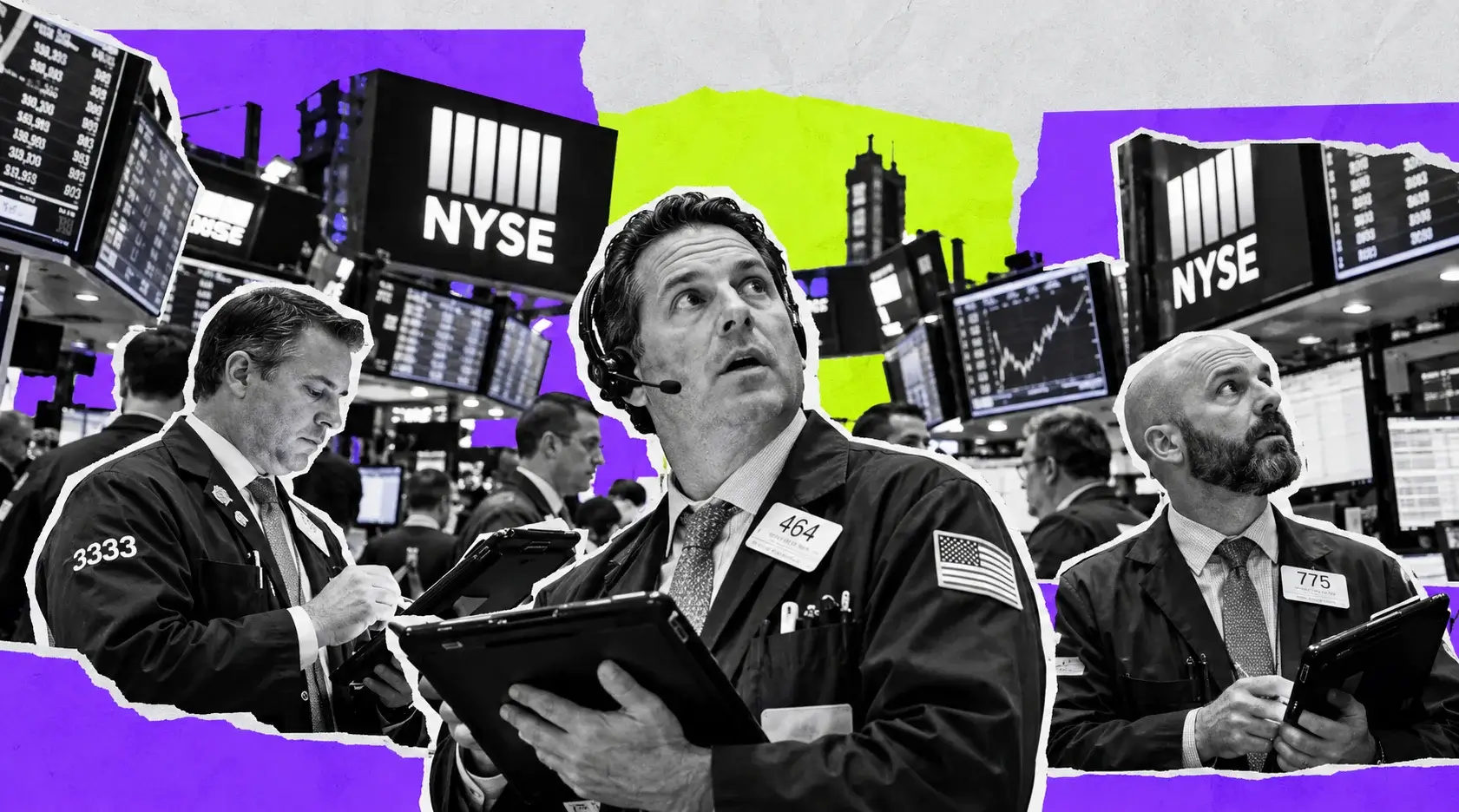
Tuesday’s session split Wall Street into two markets. One was made up of companies that walked in with third-quarter numbers, raised guidance and buybacks. The other was made up of AI infrastructure names that still owe the market an answer on how the buildout gets financed. The first group took the money. The Dow Jones Industrial Average (DJI) climbed 714 points, or 1.4%, from Monday’s close of 51,966.03 to trade near 52,680 by late morning in New York. The S&P 500 (SPX) gained 0.7% from 7,690.73 to the 7,744 area. The Nasdaq Composite (IXIC) lagged, inching up 0.25% to 26,496 after opening 0.86% lower at 26,204.33. The Russell 2000 added 0.91% to 2,753.
The spread between the Dow and the Nasdaq is the story of the day. A 1.4% gain in the blue-chip average against a quarter-point move in the tech index means the buying was concentrated in industrials, defense, healthcare, consumer names and financials. None of those groups need a fresh round of AI capex optimism to justify their prices. GE Aerospace, 3M, RTX, Northrop Grumman, General Motors and Hasbro all reported before the bell. In the morning tape, beats with cash returns got rewarded and beats carrying a cost problem got sold. Investors are separating quarterly results from narrative, and on this tape the results won.
The backdrop explains the caution. The Nasdaq finished last week with its worst week since June. The semiconductor group had just ended a nine-session losing streak on Monday, its longest in 20 years. That Monday bounce lifted the Nasdaq 1.11% and the S&P 500 0.41%, but roughly 70% of S&P 500 stocks still closed lower that day and the equal-weight index lost 0.3%. Monday was a narrow rally carried by a few megacaps. Tuesday reversed the shape: the Dow led, small caps outran the Nasdaq, and participation broadened well beyond the AI complex.
Three cross-currents shaped the day. Crude oil spiked to a five-month high on Middle East attacks and then rolled over. The 10-year Treasury yield sat at 5.10% to 5.11%, a level that leaves long-duration growth stocks little room. Housing data came in among the weakest prints in a generation. All of that played out before the evening reports from Netflix and SpaceX and ahead of Wednesday’s Tesla and Meta numbers. Those four reports decide whether the rotation into earnings-backed names has staying power.
From a Red Open to a 714-Point Dow Swing: How the Tape Turned
The overnight session gave no hint of a 700-point Dow day. Asia set a hostile tone. Korea’s Kospi lost 4% to 5,532 as SK Hynix dragged on memory names, and Japan’s Nikkei shed 1.4% to 64,024. Hong Kong’s Hang Seng gave up 1% to 23,949. The hit to Asian chip stocks undercut Monday’s U.S. semiconductor rebound before New York had a chance to build on it. Early futures reflected that. At 8:31 a.m. Eastern, Nasdaq 100 E-minis were down 238.5 points, or 0.8%. S&P 500 E-minis were off 28.25 points, or 0.37%, and Dow E-minis were down 54 points, or 0.1%.
The premarket tape was a sorting exercise. CoreWeave and Nebius Group each dropped 4.9% before the bell. Apple slipped 1.5% and Nvidia gave up 1%. General Motors lost 6.5% to 7.3%, trading as low as $76.71, despite a quarter that beat on revenue and earnings per share. Steel Dynamics fell 5.8% to $231.00 after a profit miss. Halliburton gained 3.9% on an earnings beat, and 3M jumped 4.4% to $169.20 ahead of its open. Braze was halted, then reopened more than 50% higher once its takeover terms were public.
The opening print looked like a continuation of last week’s tech selling. At 9:48 a.m., the Nasdaq Composite stood at 26,204.33, down 226.56 points, or 0.86%. The S&P 500 sat at 7,680.60, down 10.13 points, or 0.13%. The Dow was already up 297.69 points, or 0.57%, at 52,263.72, and the Russell 2000 held a 0.12% gain at 2,731.45. Inside the Nasdaq 100, Lam Research was down 3.69%, KLA 3.27%, Applied Materials 2.74%, Arm 4.07% and Marvell 3.49%.
The turn came in the first 90 minutes. By 10:58 a.m., the Philadelphia Semiconductor index had flipped to a 1.2% gain and pulled the Nasdaq 100 up 0.6%. Oil gave up its morning spike at the same time, which took pressure off yields and off the inflation narrative. The Dow kept adding. It was up 470 points, or 0.90%, at 52,436 by mid-morning, up 523 points as crude reversed, and up 714 points, or 1.4%, as the rally widened. The S&P 500 moved from a 0.13% loss to a 0.7% gain in the same stretch, a swing of more than 60 index points from the early low.
Days that open red and then rally tend to show who wanted to buy the dip and who sold into the bounce. On Tuesday the buyers favored companies with earnings in hand. The chip bounce was real, but it followed the Dow’s lead rather than driving it.
GE Aerospace Raised Everything and Still Got Sold
GE Aerospace (GE) delivered the cleanest beat-and-raise of the morning, and the stock fell anyway. That gap between results and reaction says more about positioning than about the quarter. The company reported third-quarter total orders of $19.0 billion, up 49%. GAAP revenue rose 16% to $14.1 billion and adjusted revenue climbed 18% to $13.3 billion. Operating profit jumped 30% to $3.0 billion, and operating margin expanded 220 basis points to 22.5%. Adjusted EPS came in at $2.25, up 36% from a year earlier and above the $2.00 consensus. The full numbers are in the company’s third-quarter earnings release.
Management raised guidance on every line. The 2026 adjusted EPS outlook moved to $8.00 to $8.10, up from $7.65 to $7.85, a 40-cent lift at the midpoint. Commercial engines and services revenue grew 21% to $10.34 billion, and commercial services orders rose 23%. The company said it now expects 2027 commercial services to grow at a low-double-digit rate, supported by a commercial services backlog above $170 billion. Year-to-date commercial services revenue and total engine deliveries are both up more than 20%, and internal shop visit output hit another record.
The shares rose 1.2% in premarket trading. They then reversed and traded 3.82% lower in the early session. Some of the pressure came from cash. Free cash flow fell 14% to $2.0 billion, and cash from operating activities dropped 14% to $2.2 billion. GAAP profit margin narrowed 80 basis points to 19.9% even as adjusted margins expanded. For a stock that had climbed to an all-time high near $300 and traded at a rich multiple of forward earnings, a decline in cash conversion was enough for holders to lock in gains. The quarterly filing also shows heavy buybacks: 5.0 million shares repurchased for $1.983 billion in the quarter, and 19.1 million shares for $6.206 billion over nine months.
GE was not alone in the electrification-adjacent group. GE Vernova fell 3.09% and Eaton dropped 4.39%. Overseas, ABB posted record third-quarter orders of $12 billion, up 40% with a triple-digit rise in data-center orders, and still fell 6%. Schneider Electric lost 3% and Siemens Energy gave up 4%. This group has been priced as a direct beneficiary of AI data-center construction. When the market questions how that construction gets financed, these stocks trade like the AI complex regardless of their own order books.
That is the clearest sign of what the tape is doing right now. GE’s quarter was strong on any fundamental measure. The selling shows that crowded, high-multiple industrials linked to the AI power buildout are being treated as part of the same risk as Nvidia and CoreWeave, and they need more than a beat to rally.
3M, RTX and Northrop: Industrial Beats That Actually Got Paid
Where GE got sold, the rest of the industrial and defense reporters got paid, and they did much of the Dow’s work. 3M (MMM) rose 5.09% after a quarter that beat on earnings and margin. GAAP sales of $6.6 billion rose 1.0%, and organic growth on an adjusted basis reached 3.3%. Adjusted operating margin expanded 110 basis points to 26.2%, and adjusted EPS of $2.50 grew 12% and cleared the $2.39 consensus. GAAP EPS jumped 70% to $2.63. Adjusted free cash flow reached $1.2 billion. The company raised its 2026 adjusted EPS guidance to $9.10 to $9.15 on its new reporting basis, per the 3M third-quarter release.
The bigger 3M catalyst arrived the night before. In an 8-K filed for October 19, 3M disclosed an expanded commercial relationship with Amazon and issued a warrant for up to 3,162,015 shares at $164.89 per share over seven years. Of those shares, 85% vest as Amazon pays for optical connectivity and other data-center products, with full vesting once cumulative payments hit $6 billion. The warrant is worth more than $521 million at current prices. It turns a 124-year-old industrial into a measurable supplier to hyperscale data centers, and the market priced that at a 5% premium on the day.
RTX (RTX) gained 1.61%. Third-quarter sales of $25.0 billion rose 11% on a reported basis and 12% organically. Adjusted EPS of $2.26 crushed the $1.78 consensus by 48 cents, and revenue topped the $24.08 billion estimate. The company raised its 2026 outlook for adjusted sales, adjusted EPS and free cash flow, according to its third-quarter release. Operating cash flow reached $2.9 billion, including $0.3 billion of tariff-refund recovery, and the quarter included multiyear Tomahawk and AMRAAM production contracts.
Northrop Grumman (NOC) was the standout, up 6.15% to $542.07. EPS of $7.89 beat the $7.18 estimate by 71 cents, while revenue of $11.12 billion came in just under the $11.14 billion forecast. Space segment sales rose 2% on restricted-program ramps despite $136 million of lower Commercial Resupply revenue tied to launch timing, and segment operating income rose 5%. The full detail is in Northrop’s third-quarter filing. Lockheed Martin rode along with a 1.63% gain.
Defense has a tailwind that does not depend on interest rates or AI spending. With Houthi attacks on Saudi infrastructure, mines in the Strait of Hormuz and threats against undersea cables, government demand for missiles, munitions and surveillance is not in question. That is why the group caught a bid even as the 10-year yield sat above 5%.
GM’s $20 Billion Buyback Could Not Outrun a $2 Billion Commodity Bill
General Motors (GM) posted one of the morning’s biggest dollar beats and one of its sharpest declines. Third-quarter revenue reached $50.0 billion, well above the $48.7 billion consensus. Adjusted EPS of $3.70 topped the $3.63 estimate. Net income attributable to stockholders came in at $3.3 billion, and EBIT-adjusted reached $4.1 billion, ahead of the $4.02 billion the market expected. Truck sales and subscription revenue drove the result.
The capital return was large. GM said it has completed the $6.0 billion repurchase program announced in January and that its board approved a new $20.0 billion multiyear authorization, per the GM third-quarter release. The share count has already fallen to 849 million at September 30, from 904 million at the end of 2025, 995 million at the end of 2024 and 1.2 billion at the end of 2023. That is a 29% reduction in under three years. At Tuesday’s lower price, a $20 billion program could retire close to a third of the remaining float.
The guidance changes were mixed. Adjusted automotive free cash flow guidance rose to $11.5 billion to $12.5 billion from $9.5 billion to $11.5 billion, a $1.5 billion lift at the midpoint. EBIT-adjusted guidance narrowed to $14.5 billion to $15.5 billion from $14.0 billion to $16.0 billion, which keeps the midpoint at $15.0 billion but removes the top end. Full-year EPS guidance landed at $12.75 to $13.75. Diluted EPS guidance of $9.72 to $10.72 reflects charges recorded through the year.
The stock dropped 6.5% to 7.3% in premarket trading on concerns that commodity inflation costs could approach $2 billion. Steel, aluminum and copper prices have climbed along with energy, and benchmark steel averaged around $1,250 per metric ton in the quarter, up from $850 a year earlier. A $2 billion cost headwind takes about 13% off GM’s guided EBIT midpoint, and narrowing the range rather than raising it told investors that management is absorbing that pressure, not offsetting it.
The steel tape confirmed the theme from the other side. Steel Dynamics (STLD) fell 5.8% after earnings and margins missed despite a revenue beat and a customer backlog up 50% from a year earlier that runs into 2027. Cleveland-Cliffs (CLF) dropped 8.33% to $12.94. Higher input prices are not translating into wider margins for the producers, and they are squeezing the buyers.
GM’s reaction fits the session’s pattern. The market paid for clean beats and punished any cost or cash-flow flaw.
Salesforce Pays $47.50 for Braze and the Software Bid Wakes Up
The single largest move among U.S. listed mid-caps came from a takeover. Braze (BRZE) ripped 50.85%, adding $15.27 to trade at $45.31, after Salesforce (CRM) agreed to buy the customer engagement platform in an all-cash deal. Braze Class A holders will receive $47.50 per share, a 58.1% premium to Monday’s $30.04 close and an enterprise value of $5.66 billion. The deal is expected to close in Salesforce’s fiscal 2028, subject to shareholder and regulatory approval, and Salesforce said it does not change its fiscal 2027 guidance.
Volume told the story. Braze traded 18.32 million shares by mid-morning against a three-month average of 2.45 million, a multiple of more than seven times. The stock’s market value rose to $5.15 billion. The remaining $2.19 gap to the $47.50 offer is a 4.8% merger-arbitrage spread, which shows the market expects the deal to close but is pricing a long regulatory timeline. Braze serves 2,770 customers, including Canva, Instacart, Urban Outfitters and Venmo. Its latest quarter showed revenue growth of 26.2% to $227.2 million.
Salesforce dipped as much as 3% before the open and traded down 0.6% to 2.76% through the morning. The acquirer discount reflects the price paid. Braze shares had lost 12.4% year to date before the bid on worries about competition and AI disruption of traditional software, and Salesforce is paying a premium near 60% for a company the market had been marking down. This is Salesforce’s second large AI-adjacent deal in a matter of months, following the $3.6 billion purchase of customer service platform Fin.
The deal lit up the rest of marketing and consumer data software. Klaviyo (KVYO) gained 11.62% to $19.56. Equifax (EFX) jumped 10.68% to $175.49, TransUnion (TRU) rose 6.69% to $78.01 and MSCI (MSCI) added 6.76% to $601.59. Inside the Nasdaq 100, Intuit rose 2.93% and Adobe added 2.24% while chip names were sliding. Software that had been sold on fears of AI disruption caught a bid the moment a buyer showed what one of those businesses is worth in cash.
Tradeweb added to the M&A tone, agreeing to acquire corporate bond platform Trumid for $2.0 billion. Management said the deal should add to adjusted EPS in the first full year after a closing targeted for the first half of 2027. Two cash deals totaling more than $7.6 billion in one morning gave the market something AI infrastructure could not: a hard valuation floor.
Chips Gave Back Monday, Then Clawed Toward Green
The semiconductor group had a full-cycle morning. Monday’s rebound snapped a nine-day losing streak in the chip index, the longest in 20 years. The iShares Semiconductor ETF had dropped 12% the prior week before recovering part of that loss in Monday’s 3.6% premarket jump. The Philadelphia Semiconductor index gained 1.61% on Monday’s close. That bounce did not survive the overnight session in Asia, where the Kospi’s 4% drop and weakness in SK Hynix set up a red open in New York.
The first hour was ugly across the supply chain. Nvidia fell 1.68% and AMD dropped 1.64% to 1.89%. Intel lost 2.75% to 2.92%, Micron gave up 1.43% and ASML declined 1.63%. Equipment makers took the worst of it: Lam Research down 3.69%, KLA down 3.27% and Applied Materials down 2.74%. Arm dropped 4.07%, Marvell 3.49%, Arista 2.75% and Dell 2.52%. Smaller names got hit harder, with Tower Semiconductor down 6.02% to $188.24, MaxLinear down 6.09% to $72.42, Semtech down 4.95% and FormFactor down 4.48%.
Then the bid came back. By 10:58 a.m. the SOX index had turned 1.2% higher and the Nasdaq 100 gained 0.6%. Part of the reversal was mechanical. Crude oil rolled over, the 10-year yield eased from its 5.14% premarket level toward 5.10%, and the pressure on long-duration valuations lifted with it. Part of it was positioning. After a 12% weekly drop and a nine-session slide, short sellers had little reason to press the trade into a morning of strong industrial earnings.
The recovery was not a clean reset. By mid-morning the Nasdaq Composite was up only 36.72 points, or 0.14%, at 26,467.61, while the S&P 500 was up 25.72 points at 7,716.45. A chip rebound that leaves the Nasdaq barely positive while the Dow climbs more than 1% is a defensive rebound. Traders are covering, not committing. The group needs to stop giving back every early bid before anyone can call a bottom, and Tuesday showed the opposite pattern: a gap down that buyers filled, following a Monday rally that sellers faded overnight.
Meta Platforms fell 3.06% in early trade ahead of Wednesday’s earnings. Alphabet slipped 0.65%, Amazon 0.58% and Tesla 0.60%. Microsoft lost 1.35% to 1.40%. The megacaps that carried Monday’s narrow rally were a drag on Tuesday morning, which is why the S&P 500 lagged the Dow by more than half a percentage point even as breadth improved.
CoreWeave Credit Swaps at 1,121 Basis Points and the Elice Flop
The AI financing problem has moved from equity analysts’ notes into the credit market, and the numbers are getting harder to ignore. CoreWeave (CRWV) fell 5.70% to $57.63 in early trading after a 4.9% premarket decline. The stock dropped 25% last week. It closed Monday at $61.12, down 0.44%, even after a Buy upgrade and a short-lived rally that faded before the close, leaving the shares near a fresh 52-week low.
The credit data is the alarming part. The spread on CoreWeave’s five-year credit default swaps rose to around 1,121 basis points, up 2.22% on the day and more than 17% over the prior week. A CDS spread of 1,121 basis points means it costs more than 11% of notional per year to insure the company’s debt against default. That is a high-yield distress level for a company at the center of the AI compute buildout. Nebius Group (NBIS), another neocloud, fell 4.9% before the open as well.
The pressure came from abroad too. Elice, a $750 million Korean data-center and AI developer, dropped as much as 35% after its public debut before recovering part of that loss. A failed AI IPO in a market that had been bidding up anything connected to the theme is a sign that the global investor base is now demanding proof before paying a premium. SoftBank’s credit default swap level hit the highest among major Japanese companies, putting another large AI funder under credit-market scrutiny.
The crypto-mining-to-AI-hosting names took the same hit. IREN (IREN) fell 6.92% to $25.81 and Cipher Digital lost 6.15% to $8.39. AST SpaceMobile dropped 5.92% to $39.39 and Sea Limited lost 6.09% to $83.08. These are high-beta names financed by capital markets that are tightening at the margin.
Rates make this worse. The 10-year Treasury yield traded between 5.10% and 5.14% on Tuesday, and it touched 5.31% on October 5, the high of the past 52 weeks. A year ago the same yield sat at 4.05%. A 105-basis-point rise in the risk-free rate in twelve months reprices every dollar of debt raised to build data centers. When CDS spreads on a leading AI cloud provider sit above 1,100 basis points, the cost of capital for the whole complex climbs.
Monday’s rally was a relief bounce. Tuesday’s credit numbers show the problem that sparked last week’s selloff is still unresolved.
Healthcare and Consumer Blue Chips Built the Dow’s Floor
Healthcare was the morning’s best-performing large group, and it provided the steady bid under the Dow while tech wobbled. Eli Lilly (LLY) climbed 4.68% to 4.75%, trading at $1,298.44. At that price, the drugmaker trades less than $2 below the $1,300 mark. Merck (MRK) gained 3.66%, Johnson & Johnson (JNJ) rose 2.40%, UnitedHealth Group (UNH) added 2.20%, and Amgen (AMGN) climbed 2.25%. Pfizer gained 2.51% and AbbVie rose 2.12%. Four of those names sit in the Dow, and together they added well over 100 points to the average.
The move into healthcare is a classic rotation response to the conditions on Tuesday. Pharmaceutical earnings do not depend on AI capex, and they hold up through a housing slowdown. The sector also trades at a large valuation discount to technology. When investors want equity exposure but do not want to add duration risk in tech, large-cap pharma and managed care are where that money goes.
Consumer blue chips joined in. Home Depot (HD) rose 2.13% even as housing starts fell to one of their lowest levels since 2020, and McDonald’s (MCD) gained 1.65%. Walmart (WMT) added 0.89%. Home Depot rallying on a day when single-family permits hit their lowest since March 2023 shows that buyers are treating it as a repair-and-remodel cash flow story rather than a new-construction play.
Financials helped too. JPMorgan Chase (JPM) gained 1.14%, American Express (AXP) rose 1.24%, and Visa (V) added 0.73%. BlackRock rose 1.99% and S&P Global gained 2.25%. That is a meaningful shift for a group under heavy pressure. The KBW Nasdaq Bank Index had fallen for six consecutive weeks through Monday, its longest losing streak since the summer of 2008, losing 11% since early September. JPMorgan, Bank of America, Citigroup and Wells Fargo set aside a combined $7.6 billion in credit provisions last quarter, down 3% from a year earlier, yet the stocks kept falling.
Hasbro (HAS) gave the consumer group its best earnings story. The stock gained 7.27% to $105.65 after Magic: The Gathering topped $600 million in quarterly revenue for the first time. The company posted a fourth straight quarter of double-digit revenue growth, raised its 2026 outlook and doubled its share repurchase target for the year, according to the Hasbro third-quarter release. Hasbro had traded at $89.54 before the report, so Tuesday’s price is an 18% gain in a matter of weeks.
The defensive groups did not just hold up on Tuesday. They led.
Read More
-
Yen Stalls at 160 Despite a 3% JGB and Tokyo Core CPI at 2.0% — Intervention Sits at 164, Friday's Payrolls Decide
02.09.2026 · TradingNEWS ArchiveEnergy
-
AMD Recovers to $542.71 as Helios Backlog and 41% Growth Guide Face November 3 Test After 19% Slide
20.10.2026 · TradingNEWS ArchiveStocks
-
XRP-USD Bounces to $1.33 as 6.05B Token Exchange Deposits and Stalled ETFs Cap Rally Below $1.38
20.10.2026 · TradingNEWS ArchiveCrypto
-
Brent Reverses From $111 Peak to $106 as Russia Waiver and Unverified Saudi Strikes Drain Risk Premium
20.10.2026 · TradingNEWS ArchiveCommodities
-
FDVV ETF ($61.42) Balances Nvidia, Apple and Microsoft Against Rate-Sensitive Income Holdings — $64.54 High in Reach if Yields Ease
19.10.2026 · TradingNEWS ArchiveMarkets
-
Pound Hits 1.3359 as 102,000 Job Gain and 3.7% Pay Growth Push BoE Toward First Hike in 3 Years
20.10.2026 · TradingNEWS ArchiveForex
Brent Tagged $111.75, Then Rolled Over: Hormuz, Houthis and the Oil Reversal
Crude oil drove the first half of the session and then helped flip it. Brent crude futures hit $111.75 per barrel in early trading, a five-month high, as Middle East supply risks escalated on several fronts. Iran-backed Houthi forces attacked Saudi Arabian energy, airport and military targets. Two oil tankers caught fire after striking naval mines in the Strait of Hormuz. A spokesperson for Iran’s Islamic Revolutionary Guard Corps threatened to target undersea communication cables in the waterway, which would put data and financial networks at risk alongside energy flows.
That spike did not hold. Brent fell more than 2% to trade near $106, a swing of almost $6 from the morning high. West Texas Intermediate dropped more than 1% to around $102. The reversal came without a clear de-escalation headline, which suggests the morning spike was driven by short-covering in a thin market after the November WTI contract expired. That contract had settled Monday up $2.25 at $103.66, its highest close since September 15, in trading distorted by the expiry. Brent had slipped 31 cents to $109.55 on Monday after the White House signed an executive order easing some sanctions and tariffs on Russian energy exports.
The oil reversal mattered for stocks in two ways. It cut the inflation risk that had pushed the 10-year yield to 5.14% before the open, and yields eased toward 5.10% as crude fell. It also removed a direct cost pressure on airlines, autos, chemicals and consumer names at the exact moment the market was weighing GM’s $2 billion commodity warning. The Dow’s acceleration from 470 points to 714 points lined up with the drop in Brent.
Energy equities did not follow crude in either direction. Chevron gained 0.20% while Exxon Mobil slipped 0.24%. Halliburton gained 3.9% before the open on a profit beat. On Monday, energy and consumer staples had gone from October’s best-performing sectors to the day’s worst as money rotated back toward chips. Energy stocks have priced in triple-digit oil for weeks, and the group is no longer reacting to each spike.
Oil at $102 to $106 is still a heavy tax on the economy. WTI has spent most of October above $100, and Brent has spent most of it above $105. Gold traded at $4,140.10 before the open, down $20, or 0.48%, which shows that the morning oil spike did not trigger a broad flight to safety. Bitcoin fell 1.48% to $81,285, in line with the weakness in other high-beta assets.
Housing Data Got Smoked: Starts at 1.221 Million, Pending Sales at a Record Low
Two housing reports on Tuesday painted the weakest picture of the residential market in years. At 8:30 a.m., the Census Bureau said September housing starts fell 5.2% to a seasonally adjusted annual rate of 1.221 million units. That was below every estimate in the consensus range, which had a median of 1.305 million. It was the lowest since May, which itself was the lowest since May 2020. August’s decline was revised deeper, to 5.9% from 2.6%. Starts were down 7.4% from September 2025.
The single-family data was worse. Single-family starts fell 4.6% to 859,000, the largest drop since April and the lowest since September 2025. Multifamily starts fell 7.2% to 349,000. Single-family completions were 840,000, the lowest since May 2020, and total completions rose 2.2% to 1.192 million. Building permits held up better, slipping 0.2% to 1.400 million against an expected 1.3% decline. That was only because multifamily permits jumped 5.9% to 503,000. Single-family permits fell 4.0% to 845,000, the lowest since March 2023.
At 10 a.m., pending home sales landed with a thud. Contract signings for existing homes fell 7.3% in September, the biggest drop since December and far worse than the 3.9% decline expected. The index fell to 66.0, a record low in data going back to 2001, below January’s previous record low of 70.8. All four regions declined, led by the West, which fell 9.2% from August and 15.0% from a year earlier.
Mortgage rates explain the collapse. The 30-year fixed rate averaged 6.86% in September, the highest since January 2025. With the 10-year Treasury yield above 5%, there is little room for mortgage rates to fall. The pending sales figure also excludes cancellations, which are climbing. Nationwide, 14.5% of homes fell out of contract in September, the highest share on record outside the early months of the pandemic.
Homebuilders sank on Monday ahead of these reports and stayed under pressure Tuesday. Weak housing feeds directly into the broader economy through construction jobs, furniture, appliances and mortgage originations.
The stock market’s reaction is the most telling part. A record-low pending sales print would normally weigh on the indexes. Instead, the S&P 500 rallied through the release. Weak housing data pulls yields lower and reduces the case for another Fed hike, and on Tuesday that rate relief mattered more to equity buyers than the economic damage behind it.
10-Year at 5.10%, a $1.992 Trillion Deficit and an October Hike Debate
The interest-rate backdrop is the ceiling on this market. The 10-year Treasury yield eased to 5.10% to 5.11% on Tuesday, down 3 basis points from Monday’s 5.13% to 5.14%. The two-year yield sat at 4.76%. The 10-year had fallen almost 15 basis points the prior week. Over the past year it has ranged from 3.97% to 5.31%, and the Federal Reserve’s H.15 release shows constant-maturity 10-year readings between 5.09% and 5.21% over recent sessions. The 2026 average so far is 4.50%, against a 2025 average of 4.29%.
Fiscal data is adding to the pressure on long-term rates. The Treasury reported a $1.992 trillion budget deficit for fiscal year 2026, driven by $7.396 trillion in outlays against $5.403 trillion in receipts. Spending was 37% above revenue. A deficit near $2 trillion with the 10-year above 5% means interest costs keep compounding on a growing debt stock, and every Treasury auction has to clear that supply.
The Federal Reserve is the next pressure point. Fed funds futures price an 82.8% probability that the central bank holds rates at its October meeting, leaving a 17% to 20% chance of a hike. Policymakers have already raised rates in 2026, and most of the committee backed two hikes this year. Core PCE inflation ran at 3.0% from a year earlier in August, and the September reading is expected near 3.1%. Depending on the monthly prints from October through December, core PCE could finish the year anywhere between 2.9% and 3.4%. Even monthly gains of 0.15%, an annualized pace below the Fed’s 2% target, would only bring the year-end rate down to 2.9%.
Chair Kevin Warsh is at the center of the debate. Earlier in the month, the 10-year slipped to 5.06% after dovish signals from Warsh led traders to scale back October hike bets. The October meeting falls six days before the elections, a timing that argues against a hawkish surprise. The September inflation beat was broad enough to offset the larger-than-expected downward revisions from the prior month, and the energy shock from $100-plus oil threatens to pass through into core prices.
The labor market is not forcing the Fed’s hand. The preliminary weekly hiring estimate for the four weeks ending October 3 slowed to 74,000, or 18,500 per week. The four-week moving average rose to 80,700, a seventh straight weekly gain and the best since July 11. Hiring is steady, not weak enough to justify cuts.
Equities on Tuesday were trading against a 5.1% risk-free rate. That is why money flowed toward companies with visible earnings, and away from those whose valuations depend on distant cash flows.
Netflix and SpaceX Tonight, Tesla and Meta Wednesday: What the Close Has to Prove
The rotation on Tuesday came from companies that report at the start of earnings season, and the next 36 hours shift the test to growth. Netflix (NFLX) and SpaceX (SPCX) report after the close. Tesla (TSLA) and Meta Platforms (META) follow Wednesday. United Airlines also reports Tuesday evening, while Intuitive Surgical, Chubb and Capital One round out a heavy after-hours calendar. The market has rewarded beats with cash returns, and that bar now applies to the megacaps.
Netflix is expected to post earnings of $0.82 per share on revenue of $12.87 billion to $12.88 billion. The stock carries a market capitalization near $293 billion, and the report covers streaming revenue, subscriber trends and the advertising tier. After its stock split, Netflix trades with a lower per-share price, but the expectations behind it are unchanged. Margins and engagement data will decide the reaction.
SpaceX is the wild card. The company, valued at $1.96 trillion, reports its third quarter for the first time as a listed stock. The consensus calls for earnings of $0.14 per share on revenue of $12.74 billion to $12.87 billion. Options traders are pricing a move of 7.12%, or $10.53, in either direction, implying a share price near $148. SPCX slipped more than 1% in premarket trading. A $10 swing on a near-$2 trillion company translates into more than $135 billion of market value.
Tesla closed Monday at $368.06, up $13.34, or 3.76%, after unveiling a redesigned Roadster. Its report Wednesday will focus on automotive margins, EV demand and forward guidance. That last point matters on a day when GM warned of a $2 billion commodity cost headwind. Meta’s Wednesday numbers will be judged on advertising revenue, AI spending and adoption of its Muse assistant. Meta fell 3.06% early Tuesday, and capex guidance will be the number that moves it.
These reports also act as a referendum on the AI trade. Meta’s capital expenditure plans feed directly into the revenue of Nvidia, Broadcom, Arista and the neoclouds. If Meta maintains or raises spending, the chip complex gets a fundamental anchor. If spending growth slows, CoreWeave’s 1,121-basis-point CDS spread starts to look like the market’s early warning.
Palantir reports November 2. Strategy reports later this month after its stock fell 10% on Friday on MSCI index-eligibility concerns, with the final list due November 11. The calendar is full, and each report adds to the separation between proven earnings and promised ones.
Session Verdict: Bullish for the Dow, Mixed for Tech
Tuesday was a bullish session for the broad market built on a defensive rotation, not on a revival of the AI trade. The Dow Jones Industrial Average (DJI) gained 714 points, or 1.4%, to the 52,680 area. The S&P 500 (SPX) rose 0.7% to 7,744, and the Russell 2000 added 0.91% to 2,753. Those three indexes moved together on industrial, defense, healthcare, consumer and financial strength. The Nasdaq Composite (IXIC) recovered from a 0.86% opening loss to a 0.25% gain at 26,496, but its leadership was borrowed.
The evidence for the thesis is in the reactions. Northrop Grumman rose 6.15%, Hasbro 7.27%, 3M 5.09% and RTX 1.61% on clean beats with raised guidance or cash returns. Braze jumped 50.85% on a $47.50 cash bid that set a hard price for AI-exposed software, and the rest of the data and marketing group followed. GE Aerospace fell 3.82% despite a 36% EPS jump, because free cash flow fell 14% and the stock is priced with the AI power trade. General Motors lost as much as 7.3% despite a revenue beat and a $20 billion buyback because commodity costs near $2 billion forced it to narrow, not raise, its EBIT range. Results carried the day, but only clean results.
The AI complex remains unresolved. Chip stocks reversed a red open to a 1.2% gain in the SOX index, but CoreWeave fell 5.70% to $57.63, its CDS spread sat at 1,121 basis points and a Korean AI IPO dropped 35% on debut. Credit markets are asking a question the equity bounce has not answered. With the 10-year yield at 5.10%, a $1.992 trillion fiscal deficit and a 17% to 20% chance of an October hike, the cost of capital for long-duration growth remains high.
The macro data was weak. Housing starts dropped 5.2% to 1.221 million, and pending home sales fell 7.3% to a record-low index reading of 66.0. Brent spiked to $111.75 before rolling over to about $106. The market took both as rate relief, a sign of how much equity buyers are focused on yields.
Bullish for the Dow, the S&P 500 and small caps. Mixed for the Nasdaq. The next verdict belongs to Netflix and SpaceX tonight and Tesla and Meta on Wednesday. If they deliver numbers as clean as Northrop, 3M and Hasbro, the bid broadens into tech. If they miss on margins or capex, Tuesday’s rotation becomes a rout in the AI names, and the Dow’s 714-point rally starts looking like a hiding place instead of a recovery.