Apple Stock Price Forecast: AAPL Shares Slip 2% to $267 as Tim Cook Steps Down and $4 Trillion Titan Hands Keys to John Ternus
Cook becomes executive chairman Sept 1 as Ternus takes CEO role after 2,000% stock return; Goldman targets $330
Key Points
- Apple (NASDAQ:AAPL) trades at $267.38 down 2.08% as Tim Cook steps down Sept 1 after 15 years as CEO.
- John Ternus becomes eighth Apple CEO; Goldman sees $330 target and Wedbush projects $350 implying 31% upside.
- April 30 earnings print seen as "clearing event"; Goldman EPS estimate $2.00 vs Street $1.93 with WWDC ahead.
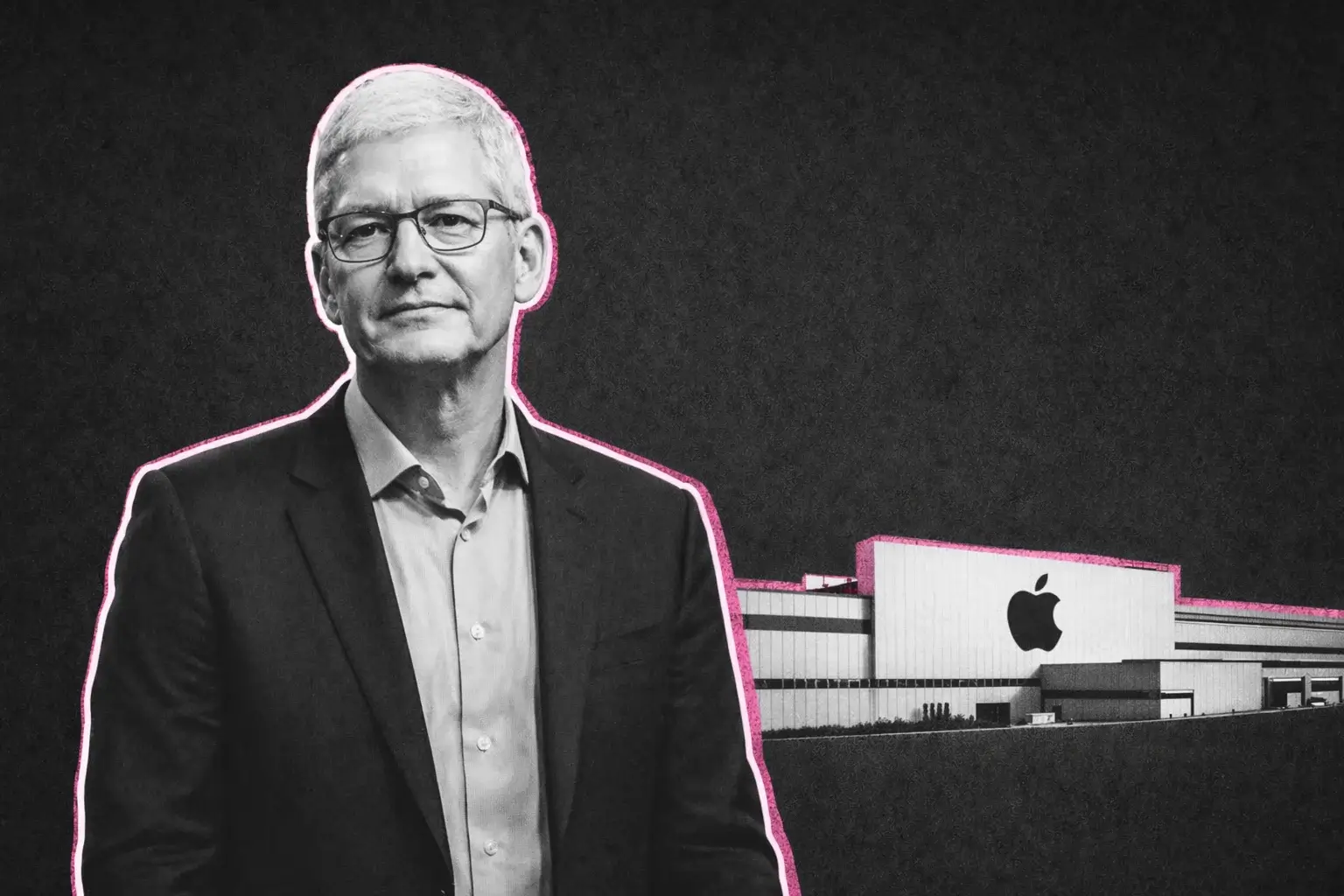
Apple (NASDAQ:AAPL) is changing hands at $267.38, down 2.08% on the session and extending the post-announcement slide that began Monday afternoon when the Cupertino giant stunned markets by formalizing the retirement of Tim Cook as CEO effective September 1, 2026. The stock has now given back roughly $7 from Friday's close and sits well off its recent highs as traders digest the succession framework, weigh the strategic implications of handing the corner office to hardware engineering chief John Ternus, and recalibrate earnings expectations ahead of the April 30 fiscal Q2 print. The $4 trillion market capitalization that Cook delivered over his 15-year tenure is now entering a transition window where every strategic move will be scrutinized against the backdrop of an AI race Apple has been accused of lagging, a memory cost crunch driven by explosive DRAM demand, Trump administration tariffs biting into hardware margins, and a $38 billion European fine hanging over unresolved audit documentation. The setup defining Apple right now is unusually layered — an elite operator stepping aside at the absolute peak of the cycle, a technically-oriented successor stepping in with a mandate to push through product cycles that include a rumored foldable iPhone Ultra and a rebuilt chatbot Siri, and a valuation priced for perfection that leaves minimal room for execution error during what Morgan Stanley is calling a potential "clearing event" earnings print.
Tim Cook's Final Chapter After Nearly 2,000% Stock Return
The departure announcement lands with the weight of one of the most successful CEO tenures in modern corporate history. Cook took the reins on August 24, 2011, just six weeks before Steve Jobs' death from pancreatic cancer left Apple without its iconic founder during what many observers described as an existential identity crisis. The stock has climbed approximately 1,970% since Cook's first day — a compounding machine that transformed the iPhone maker from a $350 billion company into the $4 trillion megacap titan that now sits at the absolute top of the global corporate hierarchy. Apple's market capitalization has multiplied more than 20-fold under his watch, a performance that permanently cements Cook's legacy as the operator who scaled Jobs' vision into the most valuable business on earth.
Cook, now 65 years old, will become executive chairman of Apple's board of directors on September 1, replacing Arthur Levinson who has served as non-executive chairman for the past 15 years. Levinson will shift into the lead independent director role effective the same date. Cook's 2024 total compensation reached $74.6 million including a $3 million base salary and the rest delivered through stock awards per regulatory filings, and Forbes pegs his personal net worth at approximately $3 billion. His final day as chief executive will be August 31, 2026, with the transition window through summer explicitly designed to allow Cook to work closely with Ternus on handover priorities. Cook spoke publicly last month during a Good Morning America interview, downplaying retirement rumors and saying he "can't imagine life without Apple" after 28 years with the company — a statement that now reads as deliberately misleading given the board's unanimous approval of the succession framework that was finalized Friday before the Monday announcement.
John Ternus Brings a Product Engineering DNA Closer to Steve Jobs
The appointment of John Ternus represents a deliberate philosophical pivot in how Apple wants to be led for the next decade. At 51 years old — almost precisely the age Cook was when he became CEO — Ternus carries an engineering pedigree that industry watchers immediately flagged as more aligned with Jobs' product-first instincts than Cook's operations-driven methodology. Ternus studied mechanical engineering at the University of Pennsylvania, graduated in 1997, competed on the varsity swim team, and briefly designed virtual reality headsets at Virtual Research Systems before joining Apple's product design team in 2001. By 2013 he had ascended to vice president of hardware engineering, and in 2021 he was promoted to senior vice president following Dan Riccio's shift to oversee what ultimately became the commercially disappointing Vision Pro project.
The board's selection of Ternus sends a clear signal about strategic priorities. Rather than elevating a finance executive, services head, or COO — the natural operational successor profiles — Apple chose a hardware engineer whose fingerprints are on most of what the company has shipped over the past decade. That preference for product DNA over operational continuity reflects the board's recognition that Apple's next growth phase depends on new hardware categories rather than squeezing additional margin from the existing iPhone franchise. The Apple Watch, AirPods, M-series silicon transition, and the foundational work on upcoming smart glasses all ran through Ternus-led teams at various points in the product development process. Johny Srouji simultaneously assumes a newly consolidated chief hardware officer role, taking over Ternus' prior hardware engineering responsibilities while expanding to include the broader hardware technologies function. This restructuring unifies Apple's hardware efforts under a single reporting line for the first time in years, which should accelerate coordination between silicon design and product integration teams.
The Stock Reaction Signals Market Uncertainty About Execution Risk
Apple shares responded immediately to the succession news with a 1% decline Monday to $269.54 in late-day trading, followed by the deeper 2.08% slide to $267.38 during Tuesday's regular session. Other data feeds show the stock trading at $266.22, down 2.5% or $6.83 on the session, reflecting continued post-announcement selling pressure as institutional allocators reposition around the leadership change. Volume has been elevated relative to average, with 31.49 million shares changing hands during Tuesday's session — a pace consistent with position rebalancing rather than panic selling.
The muted magnitude of the decline tells its own story. A 2% move on a CEO change of this magnitude at a $4 trillion company is genuinely restrained. Historical comparisons to major tech leadership transitions — Ballmer to Nadella at Microsoft, Bezos to Jassy at Amazon — show markets typically pricing in 3-5% volatility windows around such announcements. The fact that Apple is holding relatively steady reflects widespread confidence in Ternus as the successor, prior board signaling that a transition was being planned, and the extended four-month handover window that reduces execution discontinuity risk.
Wall Street Analyst Consensus Reveals a Moderately Bullish Positioning
The sell-side coverage landscape tells a precise story about Wall Street's reading of Apple's setup. Aggregated across 77 Wall Street analysts, AAPL carries a Strong Buy consensus with a median 12-month price target of $300.00 — implying roughly 12.2% upside from the current $267.38 price. The rating distribution skews bullish: 29 Buy recommendations, 16 Hold, and only 4 Sell ratings, with the composite analyst score at 8.0/10. Public.com's narrower 28-analyst panel shows a similar Buy consensus with a $292.95 median target.
Dan Ives at Wedbush represents the most aggressive bull case with a $350 price target reiterated on April 21, implying roughly 31-35% upside from current levels depending on the exact entry point. Wedbush has consistently argued that Apple's installed base of 2.2 billion active devices represents an underappreciated monetization runway once the services business matures further. Michael Ng at Goldman Sachs sits solidly in the bull camp with a Buy rating and $330 price target, published ahead of the April 30 earnings report. Ng's fiscal Q2 EPS estimate of $2.00 stands above the Street consensus of $1.93, with the upside case built around solid high-end iPhone demand, continued market share expansion in China, favorable currency backdrop, and improving gross margins supported by DRAM supply chain management.
On the other end of the rating spectrum, Ananda Baruah at Loop Capital carries the lowest price target at $215, which implies 17.1% downside from current levels. That bearish outlier reflects concerns about the AI competitive positioning gap, tariff exposure, and the risk that hardware category expansion fails to produce the revenue uplift bulls are pricing in. BNP Paribas upgraded Apple to a $300 price target on April 17, shifting from a prior neutral stance — a notable directional move that likely contributed to the pre-announcement buying pressure last week.
The April 30 Earnings Print Is Morgan Stanley's "Clearing Event"
The next hard catalyst sits just nine trading days away. Apple reports fiscal Q2 2026 earnings after market close on Thursday April 30, and Morgan Stanley has explicitly framed the release as a potential "clearing event" that could resolve several overhanging investor concerns. The Goldman Sachs EPS projection of $2.00 reflects expectations for iPhone revenue outperformance driven by the high-end mix shift, Mac segment strength as the M-series refresh cycle continues driving replacement demand, and Services revenue growth running at roughly 14% year-over-year. iCloud+, AppleCare+, and the advertising business have been singled out as the Services growth engines, while App Store growth remains modest given the regulatory pressures on platform fees.
The fiscal 2025 comparison benchmark is substantial. Apple reported record annual revenue of $416.16 billion for fiscal 2025, representing 6.43% year-over-year growth and accompanied by net income of $112.01 billion. The iPhone segment accounts for approximately 51% of total revenue — a concentration that remains the bull and bear case epicenter simultaneously. Bulls argue iPhone represents an irreplaceable category with structural upgrade cycles and premium pricing power; bears argue the revenue mix concentration creates meaningful risk if any single generational refresh disappoints. Services contribute roughly 25% of revenue and carry dramatically higher gross margins than hardware, making them the primary margin expansion lever for the next several years.
The AI Question Dominates Every Strategic Conversation
No discussion of Apple's setup can avoid the elephant in the room: the AI competitive positioning gap that has become the dominant narrative among skeptics. While Microsoft (MSFT), Alphabet (GOOG), Meta (META), and Amazon (AMZN) have been aggressively investing in foundation model development and deploying generative AI features across their product stacks, Apple has pursued a more measured on-device AI strategy that many analysts believe is falling behind the pace of innovation elsewhere in big tech. The "Apple Intelligence" platform announced last year has rolled out incrementally but has not demonstrated the transformational capabilities that ChatGPT, Claude, Gemini, or Microsoft Copilot deliver.
WWDC 2026 scheduled for June 8-12 represents the next major opportunity for Apple to address the AI gap directly. Speculation has been building that the event will feature a completely redesigned Siri — transformed into a chatbot-style conversational assistant with capabilities rivaling the leading generative AI platforms. If Apple delivers on that expectation, it could be the single most important catalyst for the stock this year, potentially triggering a re-rating higher as the "AI laggard" narrative gets dismantled. If the WWDC keynote disappoints, it becomes increasingly difficult to justify Apple's premium valuation multiple against the backdrop of more innovative competitors.
The Goldman Sachs framing around DRAM supply chain management is also strategically important. The explosive demand for AI chips has created a memory crunch across the semiconductor supply chain, with Micron (MU) alone accounting for 51% of all S&P 500 EPS revisions since the Iran war began according to Goldman research. Apple's ability to secure DRAM at favorable pricing becomes a direct margin lever for fiscal 2026 and 2027 — and the company has apparently been actively locking in supply agreements to protect against spot market price spikes. This kind of proactive supply chain management is precisely where Cook's operational excellence legacy continues to pay dividends even as the leadership transition unfolds.
The 2026 Hardware Roadmap Features the Rumored iPhone Ultra Foldable
Speculation about Apple's product roadmap for fiscal 2027 has intensified meaningfully in recent weeks. The rumored high-end foldable iPhone — possibly branded as the "iPhone Ultra" — would represent the first genuinely new form factor for the iPhone franchise since the Plus variants introduced pricing tier differentiation. If Apple successfully launches a foldable device in 2027 as speculation suggests, the average selling price uplift could be meaningful — foldables from Samsung (005930.KS) and Chinese competitors command $1,800-2,300 price points versus the $999-1,599 range for current iPhone Pro models. Even a modest 5-10% mix shift to foldable SKUs could add $15-25 billion to annual revenue at current iPhone volumes.
Apple's smart glasses launch remains targeted for 2027 per recent analyst coverage, positioned as the eventual evolution of the Vision Pro experiment into a consumer-friendly form factor. Apple's historical pattern of waiting until a product category is mature enough to redefine rather than pioneering new spaces creates a specific risk-reward profile — they rarely lead with the first iteration of a category, but when they do enter they tend to define the consumer experience for years. Meta's Ray-Ban smart glasses success has validated the category commercially, and Apple's entry in 2027 could capture the premium segment similar to what AirPods did in true wireless audio.
The $38 Billion European Fine and Regulatory Overhang
An often-overlooked risk factor hanging over Apple is the $38 billion European fine threat tied to missing audit documents. The regulatory scrutiny has been building across multiple fronts simultaneously — App Store fee disputes, privacy practices, market dominance concerns in mobile ecosystems, and the specific audit documentation issues that triggered the current $38 billion exposure. A worst-case regulatory outcome would represent roughly 1% of market capitalization, which is material but not catastrophic for a company generating $112 billion in annual net income.
The broader antitrust environment remains hostile. U.S. Senate Democrats continue pressuring Apple on App Store policies, the Trump administration tariff regime creates direct hardware cost pressure, and European regulators show no signs of softening their stance on platform fee structures. Ternus inherits these regulatory headwinds simultaneously with the CEO transition, which adds execution complexity to his first year in the role.
The China Market Share Story Provides Offsetting Bullish Tailwind
While the AI narrative and regulatory overhang create headwinds, Apple's continuing market share gains in China offer a meaningful counterweight. Greater China remains a critical geographic segment, and recent data suggests Apple is actually recovering share from domestic Chinese competitors like Xiaomi and Huawei after several quarters of pressure. The high-end iPhone mix in China has strengthened, which directly supports blended average selling price and gross margin metrics.
Goldman's Michael Ng specifically flagged China market share gains as supporting his bullish thesis, along with the broader operational leverage from improving margins and currency tailwinds as the dollar has stabilized against the yuan in recent weeks. If the US-China trade dynamic improves materially during Trump's remaining term — an uncertain proposition given the tariff escalation trajectory — Apple would be one of the single largest beneficiaries given the exposure both on the consumer demand side and the manufacturing supply chain side.
Valuation Framework Shows a Stock Priced for Execution Perfection
At $267.38 per share, Apple trades at a forward P/E multiple of approximately 31-32 on fiscal 2026 consensus earnings — a premium that reflects the quality of the franchise but leaves minimal room for operational disappointment. The valuation sits at the upper end of Apple's historical range, and the premium relative to broader market multiples stands near multi-year highs. Bulls defend the multiple through several arguments: the 2.2 billion active device installed base represents a recurring revenue annuity that commands higher multiples than pure hardware businesses; Services gross margins running above 70% support continued mix-driven margin expansion; the capital return program through dividends and buybacks provides shareholder yield on top of EPS growth; and the AI transition could add a new high-growth vector if WWDC delivers.
Bears attack the multiple on several fronts: the iPhone revenue concentration risk in a mature category; the AI competitive gap that could erode premium positioning over time; the regulatory overhang that caps upside optionality; the succession execution risk as an unproven CEO takes the wheel at absolute peak valuation; and the memory cost pressure that could compress margins through fiscal 2026 and 2027. The bear case math is straightforward — if the forward multiple compresses from 32x to 26x on AI narrative concerns or earnings disappointment, the stock could see $215-235 support relatively quickly even without any deterioration in fundamentals.
Technical Framework and Critical Price Levels
The technical ladder for AAPL maps with precision. Immediate support sits at $265 (Tuesday's intraday low zone), followed by $260 as the psychological anchor and recent consolidation floor, $255 as the deeper demand pocket, and $245-250 as the major structural support that aligns with the 200-day moving average. A break below $260 with volume would signal meaningful technical damage and open the path toward the $240-245 zone where longer-term buyers would be expected to step in aggressively.
On the upside, immediate resistance stacks at $273 (Friday's close area), then $280 (recent swing high), $290 (50-day moving average confluence with prior resistance), and $300 (the median analyst price target and psychological milestone). A clean break above $290 with volume would confirm the stock has absorbed the succession news without structural damage and open the path toward the Goldman $330 target and eventually the Wedbush $350 bull case.
Scenario-Weighted Paths Over the Next Three Months
The probability distribution for Apple over the coming 90 days breaks out with specific weights. The base case at roughly 45% probability has AAPL consolidating in the $255-285 range through the April 30 earnings report, with the print delivering in-line with or modestly above the Goldman $2.00 EPS estimate. Under this scenario, shares recover to the $275-280 zone by mid-May and drift toward $290-300 into WWDC 2026 in mid-June as AI expectations build. Year-end trajectory lands near the median $300 consensus target as Ternus smoothly takes over September 1 and delivers continuity messaging through the fall iPhone launch cycle.
The bullish scenario at 30% probability requires Q2 earnings clearly beating consensus, WWDC Siri rebuild delivering on AI expectations, China share gains accelerating, and Ternus projecting confidence and strategic clarity during his September onboarding. Under this path, AAPL rallies through $300 resistance and targets $330-350 by year-end, closing 2026 near all-time highs and potentially delivering 25-30% total return from current levels.
The bearish scenario at 25% probability involves earnings missing on iPhone revenue weakness, WWDC disappointing with incremental rather than transformational AI features, the $38 billion European fine advancing toward resolution on unfavorable terms, Ternus stumbling in early strategic communications, and the broader AI narrative continuing to favor Microsoft, Google, and Amazon over Apple. Under this scenario, AAPL flushes toward $240-245 support and potentially tests the Loop Capital $215 bear case if multiple compression accelerates.
Read More
-
Yen Stalls at 160 Despite a 3% JGB and Tokyo Core CPI at 2.0% — Intervention Sits at 164, Friday's Payrolls Decide
02.09.2026 · TradingNEWS ArchiveEnergy
-
CHAT Fund Holds $96.37 as Korean Memory and Chip Exposure Drive a 109.73% Year — Break of $98.02 Opens $105.20
18.09.2026 · TradingNEWS ArchiveStocks
-
First-Generation XRPR and XRPI Ride XRP's Rebound to $1.386 as Spot Funds Post First Outflow — Break of $1.40 Opens $1.54
18.09.2026 · TradingNEWS ArchiveCrypto
-
NG Holds $2.9255 as Storage Surplus Narrows From 5.5% to 3.7% in 3 Weeks — Break of $3.00 Opens $3.15
18.09.2026 · TradingNEWS ArchiveCommodities
-
Dollar Surges to 157.90 as BoJ's Divided Hike Fails to Lift the Yen — Break of 158.87 Opens 159
18.09.2026 · TradingNEWS ArchiveForex
Peer Comparison Context Against Magnificent Seven Cohort
Apple's positioning within the Magnificent Seven cohort of mega-cap tech stocks has drifted from leader to laggard on several key growth vectors. Microsoft (MSFT) at $425.64 continues to lead enterprise AI adoption with Copilot deployments; Alphabet (GOOG) at $331.28 has delivered strong search query monetization alongside Gemini rollouts; Amazon (AMZN) at $251.77 just announced an additional $5 billion Anthropic investment pushing total exposure to $25 billion; Meta (META) at $669.91 is aggressively deploying Llama models while rebuilding advertising ROI; Nvidia (NVDA) at $199.45 remains the essential infrastructure enabler for the entire AI buildout; Tesla (TSLA) at $386.42 reports earnings after the Wednesday bell and carries its own AI narrative around FSD and robotaxi economics. Apple's 2% pullback to $267.38 leaves it relatively flat on the year-to-date while several peers have delivered double-digit gains, reflecting the growing valuation compression risk if the AI gap persists through 2026.
My Apple Stock Call: Buy on Weakness With $300 Target and $245 Stop
Apple (NASDAQ:AAPL) at $267.38 is a Buy on any weakness toward the $255-260 zone, with a 12-month price target of $300 aligning with Wall Street median consensus, bullish case extending toward the Goldman $330 target and Wedbush $350 upside scenario, and clear stop-loss discipline below $245 that protects against multiple compression risk. The succession transition from Cook to Ternus represents a managed handover rather than a disruption event, and the four-month transition window through summer explicitly reduces execution risk during what would otherwise be a challenging changeover period. The Ternus appointment signals the board's prioritization of product DNA over operational continuity, which aligns Apple's leadership profile closer to the Jobs era that originally built the franchise than the Cook era that optimized it.
The April 30 earnings print will likely serve as the tactical inflection point that Morgan Stanley has been flagging. Goldman's $2.00 EPS estimate sitting above Street consensus at $1.93 creates a meaningful beat setup that could trigger the kind of "clearing event" that releases pent-up upside. China market share gains, Services revenue growth near 14%, DRAM supply chain management protecting margins, and continued iPhone premium mix shift all support the near-term operating thesis. The June WWDC catalyst then layers the AI narrative recovery opportunity on top of the post-earnings momentum — if Apple delivers a genuinely impressive Siri rebuild, the stock could rally hard through $290 resistance and target the $320-330 zone by early summer.
The risks are real and must be respected. Regulatory overhang from the $38 billion European fine threat, Trump administration tariff pressure on supply chain economics, the AI competitive gap that remains unresolved heading into WWDC, and execution risk around an unproven CEO during his first year all create scenarios where the stock could experience meaningful drawdown even from current levels. Position sizing should reflect those risks — Apple is not a conviction-maximizer trade at this valuation but rather a core holding for allocators who can tolerate 15-20% drawdowns in exchange for the exposure to one of the highest-quality franchises in global equity markets.
For active traders: the optimal entry zone is $255-265 on any further weakness, targeting $285-300 on a bounce and $320-330 on continuation through WWDC catalysts. Stops at $245 protect against the bear case multiple compression scenario. For long-term holders: Apple remains a core position and the succession transition does not alter the structural investment thesis, though trimming exposure modestly into the Ternus onboarding period to manage execution risk is defensible. The disciplined view is that Ternus inherits the best franchise on the planet at peak valuation with elevated expectations — which means the stock works if he delivers the AI roadmap and product cycle execution bulls are pricing in, but faces meaningful downside if he stumbles during year one. The next 90 days through earnings and WWDC will tell the story, and patient accumulation on weakness offers the cleanest risk-reward positioning into those catalysts.