Occidental Petroleum Stock Price Forecast: $56 Buffett-Backed Oil Play, OXY Targets $75
Berkshire holds 32% stake as OXY cuts debt to $15B and guides 2026 FCF to $6.1B baseline; each $1 oil move adds $265M in cash flow | That's TradingNEWS
Key Points
- Occidental (NYSE:OXY) trades at $56.15 up 3.07% as WTI jumps to $94 and Berkshire holds 32% of shares.
- 2026 FCF baseline guided at $6.1B; each $1 oil move adds $265M, pushing FCF toward $13B at current strip.
- Debt cut to $15B after $5.4B YTD paydown; 85% US revenue concentration drives $75 target and path to $90.
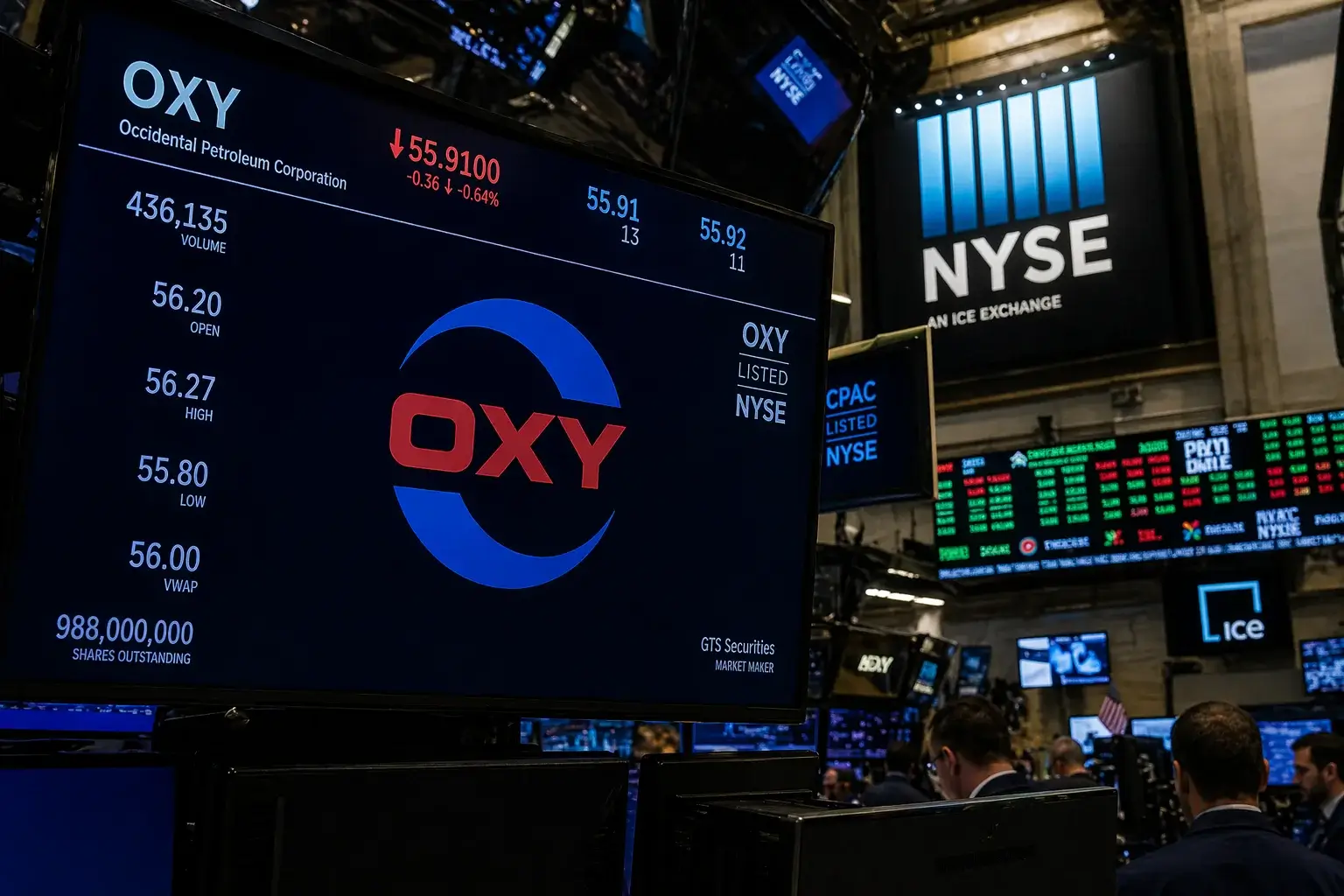
Occidental Petroleum (NYSE:OXY) is changing hands at $56.15, up 3.07% on the session as WTI crude rips 4.93% to $94.03 and Brent pushes to $98.52 following the U.S. Navy seizure of an Iranian-flagged cargo vessel in the Gulf of Oman. The stock has swung violently through the Iran war cycle — printing a 52-week high of $66.24 and a low of $38.81 — and now sits at a setup that combines exceptional operational execution, a radically cleaned-up balance sheet, Warren Buffett's durable 32% ownership stake, and one of the most leveraged exposures to sustained triple-digit oil prices anywhere in the large-cap energy complex. At current levels, shares trade roughly 10% below where Berkshire Hathaway has been actively accumulating, and the asymmetric setup offers meaningful upside if WTI holds above $90 into year-end with cleanly defined downside if the Strait of Hormuz reopens and crude floods lower. The numbers underneath the tape tell a story that most generalist allocators are still missing, and this walk-through unpacks every operational, financial, technical, and macro variable that actually matters for the next twelve months.
The Current Price Action Shows a Name That Has Round-Tripped Through the War
OXY opened 2026 near $45 and exploded higher through the initial Iran conflict phase, touching $66.24 as WTI spiked toward $120 in March on the peak of supply-disruption panic. The stock then compressed back toward $52 on the brief April 17 Hormuz reopening announcement that sent crude down 10% in a single session, before rebounding to the current $56.15 on Tuesday's vessel seizure and renewed supply-shock pricing. The 30-day trading range has been $52.14 to $67.35, and the one-year range of $38.81 to $66.24 demonstrates just how much volatility this name carries relative to the integrated majors like ExxonMobil (XOM) and Chevron (CVX). Market capitalization sits near $62 billion at current levels. Compared to Seeking Alpha's mid-April publication price of $62.89, shares are down 10.76% while the S&P 500 (^GSPC) rallied 7.26% over the same window — a brutal relative underperformance that creates exactly the dislocation opportunistic buyers like Buffett tend to exploit rather than avoid. The round-trip has flushed weak hands and rebuilt the technical base, which is historically the setup from which durable rallies begin.
Why U.S. Revenue Concentration Is the Hidden Structural Edge Nobody Is Pricing
Occidental generates 85% of its oil revenues from U.S. operations, with international production concentrated in Oman — which critically does not require transit through the Strait of Hormuz. That geography is effectively conflict-proof relative to the broader major oil complex right now. Compare that profile directly to ExxonMobil (XOM), which generates only 40% of total sales from the U.S. per its 10-K filings, with the remaining 60% spread across geographies carrying meaningful shipping-lane and geopolitical risk. Chevron (CVX) carries similar international exposure. Shell (SHEL) and BP (BP) are even more internationally diversified. In a world where supply chain disruptions are accelerating rather than fading — and where the International Energy Agency has now formally declared that Hormuz has "lost its status as a reliable energy route" — revenue concentration in the domestic U.S. market has transitioned from a diversification disadvantage into a genuine premium-commanding structural feature.
If the Hormuz disruption extends for months, which the current diplomatic tape increasingly suggests given both Washington's "no pressure" framing and Tehran's rejection of current negotiation formats, Middle East-exposed producers face shipping-lane risk, insurance premium blowouts, voyage-time escalation, and freight cost spikes that directly impair realized pricing on their barrels. Occidental simply doesn't carry those tail risks at anywhere near the same magnitude. Even in an extreme scenario where global shipping lanes face broader issues, the 70%-plus of revenue generated by U.S. production and sales provides a hard floor that integrated majors cannot match. This is the precise dynamic that makes OXY a fundamentally different investment in today's geopolitical regime than it was in 2019 when globalization was still the dominant paradigm.
The Oil Price Sensitivity Math Delivers $265 Million Per $1 Per Barrel
This is where the leverage embedded in OXY's financial structure becomes extraordinary and where serious allocators should spend most of their modeling time. Management has explicitly guided that each $1 per barrel move in oil translates to approximately $265 million in incremental annual cash flow, with the majority of that increment dropping directly to profit rather than being offset by variable costs. At baseline 2026 FCF guidance of $6.1 billion — which is built on 2025 average realized prices of $65 WTI and $69 Brent — current WTI at $94 is already $29 per barrel above the reference level, implying roughly $7.7 billion in additional annualized cash flow potential if prices simply hold at current strip. That pushes total 2026 FCF toward $13-14 billion against a $62 billion market cap. That math produces a double-digit FCF yield with substantial upside optionality layered on top.
The historical correlation of net income to oil prices confirms the sensitivity in hard numbers. In 2021 at an average realized oil price of $60/bbl, OXY earned $2.3 billion. At $76/bbl realized in 2023, net profit hit $4.7 billion. At $90/bbl average in 2022, net income exploded to $13 billion — a stunning demonstration of operating leverage. Revenue increases have historically passed through to the bottom line at roughly dollar-for-dollar rates, as seen when revenue increased by $10.6 billion in 2022 and net profit increased by $10.7 billion — effectively full flow-through. Using the linear sensitivity framework, $80 oil implies approximately $5.7 billion in annual net income (forward P/E of roughly 11 at current share price), $100 oil implies approximately $10 billion annually (P/E near 6), and $200 oil in the tail scenario of sustained Middle East disruption would theoretically allow OXY to earn its entire current market cap back within two years. These aren't projections — they're straight-line extrapolations of demonstrated historical relationships.
The Buffett Accumulation Thesis Speaks Louder Than Any Sell-Side Note
Berkshire Hathaway has been systematically accumulating OXY shares since 2022, with the majority of common equity purchases executed near $50 per share. Buffett's cumulative deployment of capital into OXY ranks among his largest position builds of the past decade when measured by cash actually deployed rather than current fair market value — a crucial distinction because Apple's (AAPL) apparent massive scale in the Berkshire portfolio dramatically overstates initial capital commitment versus mark-to-market appreciation that has compounded over many years. Today, Berkshire owns 32% of OXY's outstanding common shares, plus an additional $10 billion in preferred equity paying an 8% coupon ($800 million in annual distributions back to Omaha).
At $56.15, shares are trading roughly $6 above Buffett's average common-equity entry price — hardly a runaway rally that makes new buyers feel like they're chasing momentum at extended levels. Historically, when the stock has traded within 15-20% of Buffett's accumulation levels, it has delivered strong forward returns as Berkshire either added more or simply held through volatility. The preferred equity overhang is worth flagging for investors doing proper diligence: Occidental can redeem those preferred shares at 105% of face starting in 2029, or alternatively at 110% of share price under specified conditions. Management has signaled that retiring this obligation is a strategic priority. Eliminating the 8% preferred coupon would convert $800 million of annual cash drag into fully accretive common-equity returns — a major tailwind that sits on the medium-term horizon without currently being fully priced into shares.
Balance Sheet Transformation Is the Overlooked Story Behind the Setup
The operational execution story is where bulls build real conviction beyond just oil price speculation. OXY has reduced principal debt to $15 billion — a dramatic improvement from the $28.9 billion stack that existed immediately after the CrownRock acquisition closed. Year-to-date through Q1 2026, the company has paid down a massive $5.4 billion in debt, supported substantially by the $9.7 billion OxyChem sale to Berkshire Hathaway. The remaining debt carries a minimal short-term expiration profile and sits at levels that are sustainable even in scenarios where oil retraces to the $65-70 range. That balance sheet transformation is what allows management to now shift strategic focus toward capital return rather than continued survival-mode deleveraging.
Interest expenses are projected at $810 million for 2026 — entirely manageable against FCF generation capacity — and are likely to decline further as additional debt paydown occurs through the year. Management is now explicitly balancing further debt reduction against capital return priorities including dividend growth and share repurchases, which signals the balance sheet heavy lifting is effectively complete. Compare this to the precarious debt position that dogged OXY after the Anadarko acquisition in 2019 and forced the company into emergency capital raises during the COVID oil crash — the current setup is structurally stronger in every measurable dimension.
Permian Basin Dominance Drives $2.5 Billion in Targeted Cost Savings
The operational cost structure continues to improve at an accelerating pace that demonstrates OXY's positioning as one of the strongest operators in the entire Permian Basin. Domestic operating cost per barrel fell from $10.05 in 2023 to $8.35 in fiscal 2025 — a 17% reduction that flows directly to margins and amplifies the per-dollar-of-oil-price leverage. Annual production grew 8% year-over-year to 1.43 million barrels per day in 2025 while maintaining a 107% organic reserve replacement ratio, meaning the company added more proven reserves than it produced through exploration success and recovery improvements alone. That is genuinely elite performance in an industry where reserve replacement is frequently a struggle.
The company is targeting $2.5 billion in total cost savings through a combination of capex efficiency gains and operating cost reductions over coming years. For 2026, capex is guided at $5.7 billion (down from $6.23 billion in 2025) while still delivering approximately 1% production growth — the kind of capital discipline that converts the historically cyclical oil industry into sustainable FCF generation capacity. The 2026 FCF improvement breakdown is granular and auditable: $365 million in interest expense savings (supported directly by debt paydown and the OxyChem sale), $400 million in midstream savings (benefiting from crude contract optimization and reduced low-carbon spending), and $500 million in oil and gas capital and operating cost savings. Combined, that is $1.2 billion in year-over-year FCF improvement on top of the 2025 baseline — all of which would materialize even without oil prices rising from current levels.
The CrownRock Integration Creates a Multi-Year Flywheel
OXY's acquisition-driven growth strategy has built a lower-cost production base that takes several years to fully show up in corporate average metrics, and this is precisely where patient investors get rewarded. The Anadarko acquisition, first announced in 2019, took approximately three years before investors saw the full benefits materialize in fiscal 2022's record $13 billion net income result. The reason is mechanical — lower-cost wells gradually gain significance within the corporate production mix through a weighted-average process. Older, less-efficient production has to decline to the point where it no longer materially affects corporate averages. Meanwhile, companies often front-load depreciation on acquired assets to protect cash flow in early integration years through non-cash accounting choices, which keeps reported earnings artificially compressed during the first 24-36 months post-close.
The CrownRock acquisition, now fully closed and integrated, follows exactly the same pattern. Management has guided toward roughly 20% lower costs from acquired assets versus the pre-acquisition baseline. As those lower-cost barrels compound in the mix over coming years, corporate breakeven continues falling, and the leverage to rising oil prices mechanically expands further. This is precisely why Buffett accumulated the position — he's betting on a multi-year re-rating as acquisition synergies fully materialize rather than a quick flip on oil prices alone. Technology advances add another compounding multiplier layer: recovery techniques, drilling efficiency, reservoir management software, and AI-driven optimization all continue improving year-over-year, and OXY's scale position in the Permian gives it disproportionate capture of industry-wide efficiency gains.
Western Midstream (WES) Stake Adds $6.4 Billion in Hidden Asset Value
Occidental holds a 40% stake in Western Midstream (WES) worth approximately $6.4 billion — a double-digit percentage of total OXY market cap that rarely gets proper weighting in valuation discussions. The WES investment pays an almost 9% distribution yield, generating meaningful ongoing cash return back to OXY's parent balance sheet. The company recently monetized approximately $700 million of WES equity through a distribution, demonstrating active management willingness to pull strategic value from the stake when appropriate rather than treating it as a passive holding. That midstream exposure provides a structural layer of cash flow stability that partially offsets the inherent commodity price volatility of the upstream business. When oil prices correct and upstream earnings compress, midstream distributions typically hold relatively steady because pipeline economics are contract-driven rather than price-driven. That cushion is worth building into any OXY model.
Reserve Life and the 20-Year Production Horizon
OXY holds approximately 1.8 billion barrels of U.S. proven oil reserves against current production rates — producing roughly 10 years of proven reserve life on a simple static basis. However, the company has consistently added reserves through new discoveries and recovery improvements, with net reserve declines in 2024 and 2025 running at just several dozen million barrels annually despite aggressive production pace. Assuming that pace of replacement continues — which management's 107% organic reserve replacement ratio suggests is sustainable — reserve life effectively extends to two decades or more in practical operational terms. The recent U.S. Gulf of Mexico discovery announcement, which the company flagged as having "tieback potential" to existing infrastructure, further extends the production runway and signals that exploration capability remains sharp.
Compare this reserve trajectory to the broader industry context where many major producers are struggling to replace reserves and are essentially mining their existing resource base. OXY's geological position, particularly in the Permian, provides structural advantages that compound over time as production techniques improve. The Trump administration has explicitly urged ExxonMobil, Chevron, and other major oil companies to boost drilling amid the Iran war — signaling policy support specifically for domestic producers, which benefits OXY's U.S.-weighted footprint disproportionately.
Leadership Transition Risk Centers on Richard Jackson Succession
CEO Vicki Hollub announced her retirement, with current COO Richard Jackson reportedly positioned as the likely successor — though no formal announcement has yet been made. Leadership transitions at large integrated oil companies typically take several years before a new CEO makes a meaningful operational imprint, so the near-term strategy will focus on continuing optimization of existing assets and extracting remaining acquisition synergies rather than pursuing radical change. That continuity argument is actually a bullish setup rather than a bearish one — it means the strategic playbook that produced the 2022 record results and the current balance sheet transformation will remain intact.
The board at Occidental has historically been strong at addressing management mistakes quickly, which is a critically important variable for investors who remember the Anadarko acquisition's rocky early years when operational integration stumbled before ultimately delivering on thesis. The real test for Jackson — or whoever ultimately takes the role after formal announcement — will come in the next 18-24 months when strategic capital allocation decisions become necessary. Should surplus cash flow go primarily toward remaining debt paydown, preferred equity retirement, dividend growth, or buybacks? Each choice carries different implications for the stock's re-rating trajectory. Until the succession is formally named and the new CEO's capital allocation philosophy becomes clear, some uncertainty is appropriate.
Valuation Framework: Moderate Multiple With Extreme Upside Optionality
At the current $56.15 share price and $62 billion market capitalization, OXY trades at a forward P/E of approximately 11 assuming oil averages $80/bbl through 2026. At current WTI strip of $94, the implied forward P/E compresses toward 6-7, which is outright cheap for a company of this operational quality and Permian positioning. The FCF yield at baseline 2026 guidance of $6.1 billion is approximately 10% on current market cap — already attractive — and climbs toward 20%+ if current oil prices hold into year-end. These are valuation metrics that don't normally attach to large-cap integrated oil companies with proven operational execution and Buffett backing.
Compare to ExxonMobil (XOM) and Chevron (CVX) trading at forward P/Es of roughly 13-15x consensus earnings. OXY's discount to those larger peers is partially justified by higher operational leverage and greater sensitivity to oil price moves, but the degree of discount currently embedded feels excessive relative to balance sheet improvements and U.S. concentration benefits. The Quant scoring system at Seeking Alpha rates OXY a Strong Buy with a 4.79 composite score — driven by the combination of valuation, profitability, and growth metrics all scoring favorably simultaneously.
Read More
-
Yen Stalls at 160 Despite a 3% JGB and Tokyo Core CPI at 2.0% — Intervention Sits at 164, Friday's Payrolls Decide
02.09.2026 · TradingNEWS ArchiveEnergy
-
QQQ ETF ($739) Fades From an Early Tech Rally as a 77.9 ISM Prices Index Meets Micron's $61.5B Guide — $760 Record Test Ahead
01.10.2026 · TradingNEWS ArchiveStocks
-
XRPR and XRPI Follow XRP's $1.49 Test as Spot Funds Hold 1.16B XRP and a 1 Billion Token Escrow Release Lands — $1.70 in Play
01.10.2026 · TradingNEWS ArchiveCrypto
-
November NG Slips Below $3 as Decade-High Storage Meets Capped LNG Exports — $2.75 in Sight
01.10.2026 · TradingNEWS ArchiveCommodities
-
Dollar-Yen at 158 Presses Toward 160 as a 363 bp Carry Gap Meets Katayama-Bessent Intervention Risk — 159 in Sight
01.10.2026 · TradingNEWS ArchiveForex
Key Risks That Must Be Respected
The bear case on OXY is real and deserves direct, honest treatment rather than hand-waving. If the Iran conflict resolves peacefully with Hormuz reopening durably and a comprehensive diplomatic settlement, oil prices could retrace to $60/bbl within a matter of weeks, pushing OXY net income back toward $3 billion annually and compressing the investment thesis significantly. Shares would likely test $48-52 support under that scenario before stabilizing. Government policy is the second primary risk — bans on energy exports to suppress domestic prices, windfall profit taxes, or other mechanisms of transferring corporate profits to public coffers could cap upside even if oil prices stay elevated. Political pressure on domestic producers tends to intensify precisely when their profitability peaks, which is the uncomfortable reality of operating in a politically sensitive industry.
Long-term demand destruction is the third significant risk that doesn't get enough attention in bullish takes. Major economies responding to the current energy shock are accelerating renewable energy investments aggressively. Europe's EV sales jumped 51% in March as gasoline prices soared, and that kind of behavioral shift tends to persist even after crude prices normalize. The UK announced a 10GW clean power push specifically to break natural gas grip on electricity bills. China is reviving coal-to-gas megaprojects while also rapidly expanding nuclear capacity. Each of these policy responses chips away at the long-term oil demand trajectory even if the near-term setup remains bullish. The commodity industry is no longer considered a growth industry by allocators, which is why dividend and buyback discipline has become more important than production growth — a structural shift that caps the re-rating potential somewhat.
Analyst Rating Divergence Reveals the Opportunity
The rating divergence across sources tells the full asymmetric story. Wall Street sell-side consensus currently sits at Hold with a 3.32 composite score. Seeking Alpha analyst consensus is also Hold at 3.40. However, the Seeking Alpha Quant system ranks OXY at Strong Buy with an extraordinary 4.79 score — driven by the combination of valuation, profitability, and growth factors all scoring favorably simultaneously. When the quantitative system disagrees this sharply with fundamental analyst consensus, the opportunity typically lies with the quant reading because systematic scoring removes sentiment bias and focuses on measurable financial characteristics rather than narrative-driven concerns.
The Wall Street Hold rating likely reflects career risk aversion among sell-side analysts — being bullish on oil into a potentially peace-driven correction is a worse career outcome than being neutral and missing the upside. The Quant Strong Buy reflects the actual data: a stock trading at low valuation multiples, with strong profitability metrics, improving growth trajectory, and positive momentum. When fundamentals and sentiment diverge, fundamentals tend to win over 12-18 month horizons, which is precisely the timeframe relevant for long-term OXY holders.
Technical Framework and Key Price Levels for Active Traders
On the chart, OXY has well-defined technical levels that matter for positioning. Near-term support sits at $52.14 (recent 30-day range low), followed by $48 as the next meaningful demand zone where buyers stepped in aggressively earlier in the year, and $45 as the key structural floor from the early 2026 consolidation base. Resistance stacks at $60 (psychological and near-term pivot), $62.89 (the April 2026 level where shares topped out before the Hormuz reopening shock), $66.24 (52-week high), and $70 as the next major target on continuation through prior resistance. A clean break above $62 with volume confirmation opens the path to $70 and the 52-week high retest. Breakdown below $52 would signal deeper correction toward $48 support and potentially down to $45 if the Iran conflict resolves and oil retraces aggressively.
The 50-day moving average and 200-day moving average are both configured supportively for the intermediate bullish case. Volume patterns during the recent pullback have been relatively contained — no signs of aggressive institutional selling — which typically precedes continuation rather than breakdown.
Scenario-Weighted Price Path Over the Next 12 Months
The probability distribution for OXY shares over the next year breaks out as follows with specific numbers attached. The base case at roughly 45% weight assumes WTI averages $85-95 through year-end, OXY delivers 2026 FCF near $10 billion, and shares re-rate toward $70-80 over 12 months on the combination of cash generation, continued balance sheet improvement, preferred equity retirement progress, and acquisition synergy realization. The bullish scenario at 30% weight involves WTI sustained above $100 (potentially driven by Hormuz staying closed through summer and any Iran escalation), 2026 FCF exceeding $13 billion, and shares targeting $90-100 with room to approach or exceed the all-time highs. The bearish scenario at 25% weight involves a clean Iran diplomatic breakthrough, WTI retracing to $65-70, 2026 FCF compressing toward the $6 billion baseline, and shares testing $48-52 support before stabilizing and gradually recovering through the year.
The reward-to-risk math strongly favors the long side at current levels. Upside to the base case ($75 target) is approximately 33%. Upside to the bull case ($90) is approximately 60%. Downside to the bear case ($48) is approximately 14%. That asymmetry — roughly 3-to-1 favorable on probability-weighted expected returns — is the kind of setup that Buffett and other value-oriented large-cap investors specifically hunt for.
The Political Calculus That Matters More Than Most Recognize
The single variable most traders are underweighting in their OXY analysis is the Trump political calculus regarding Iran. His overall approval rating sits at 35% in the latest CNN poll, one point off his all-time low, with net approval on inflation running at -34 — worse than Carter or Biden at comparable points in their terms. The uncomfortable question is whether a president this deep in a polling hole still feels genuinely constrained by November midterms, or whether he has quietly accepted those midterms are lost and is now singularly focused on coming out of the Iran conflict as the perceived winner. His "no pressure" framing combined with hardening rather than softening of the naval blockade points strongly toward extended conflict rather than quick resolution.
If that interpretation is correct, duration risk on the Iran war is meaningfully higher than what the futures curve currently prices, which translates directly into higher sustained oil prices, which translates directly into OXY earnings exceeding consensus materially. The implication is that the base case outlined above may actually understate probability-weighted upside. Markets are generally betting on resolution; the politics are clearly pointing the other direction. That dislocation is where opportunistic capital gets deployed.
My OXY Call: Buy at $56 With $75 Target and $48 Stop
Occidental Petroleum (NYSE:OXY) at $56.15 is a Buy with a 12-month price target of $75, representing approximately 33% upside from current levels. The combination of Warren Buffett's 32% ownership providing a durable floor under shares, U.S. revenue concentration in an era of accelerating supply chain disruption, $6.1 billion in baseline 2026 FCF guidance with extraordinary upside optionality to $13+ billion at current oil prices, the $1.2 billion in identified cost savings flowing through next year, the cleaned-up balance sheet with debt reduced to $15 billion, and the 40% Western Midstream stake worth $6.4 billion creates an asymmetric reward-to-risk profile that is rare in the current large-cap energy landscape. Every structural variable points the same direction — quality, value, operational execution, scarcity of U.S.-concentrated pure-play oil exposure, and a Buffett-calibrated base.
The bearish case — Iran ceasefire holds definitively, Hormuz reopens durably, WTI retraces to $65 — is real but carries meaningfully lower probability than generalist consensus suggests, given that every current political signal from both Washington and Tehran points toward prolonged conflict rather than quick resolution. Trump's explicit "no pressure" framing on any deal, combined with the hardening of the naval blockade rather than softening, indicates the White House is not going to blink first. Tehran's public rejection of current negotiation formats combined with their complaints about U.S. ceasefire violations points the same direction. The Dated-to-Frontline Brent spread at $25 per barrel signals acute physical market tightness that paper pricing hasn't fully internalized yet.
For active traders: enter positions in the $55-57 zone, add aggressively on any pullback toward $52, place protective stops at $48 to cap downside at roughly 15% of capital, and target partial profit-taking at $65 and $70 with runners held through $80+ if the Iran war extends into summer or escalates further. Position sizing should reflect the volatility — OXY is not a conservative widow-and-orphan holding, it is a high-beta oil play that demands appropriate risk management.
For long-term holders: the Buffett thesis remains fully intact, the acquisition flywheel continues compounding, the reserve base supports 20-plus years of production, the preferred equity retirement pathway creates forward catalyst, and the U.S. revenue concentration is increasingly valuable as the world structurally re-prices supply chain concentration risk. Buy the dip, ignore the daily volatility, let the combination of Buffett's conviction, Permian dominance, operational cost reduction, and oil-price leverage compound over the multi-year horizon. The setup isn't perfect — it rarely is in commodity-exposed names — but the asymmetry of upside to downside at current levels is as favorable as OXY has offered in years, and the macro backdrop specifically favors U.S.-concentrated producers in ways that aren't yet fully reflected in the stock. The disciplined play is to establish or add to positions here, respect the technical levels, and let time work while Buffett continues accumulating alongside you.