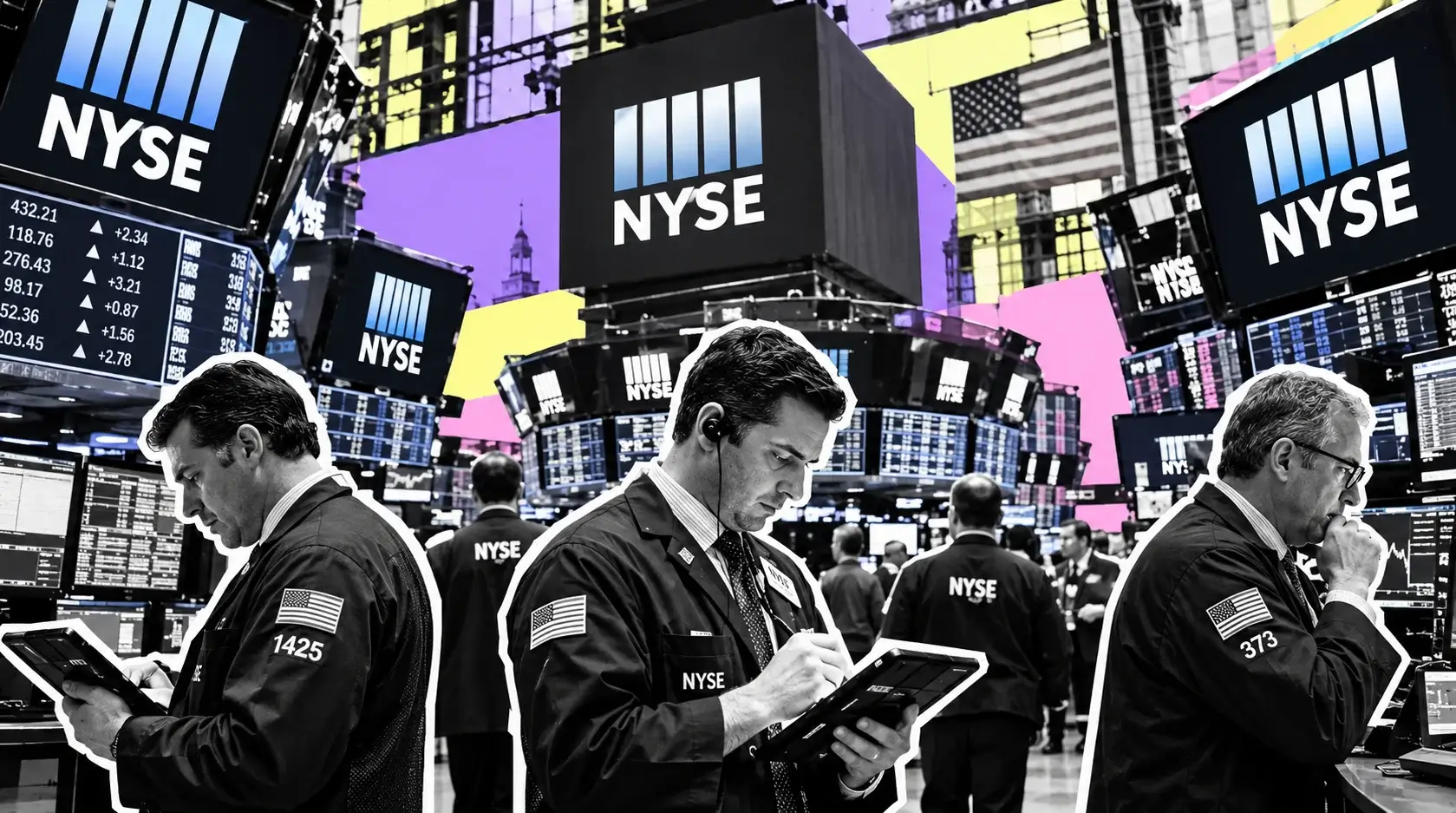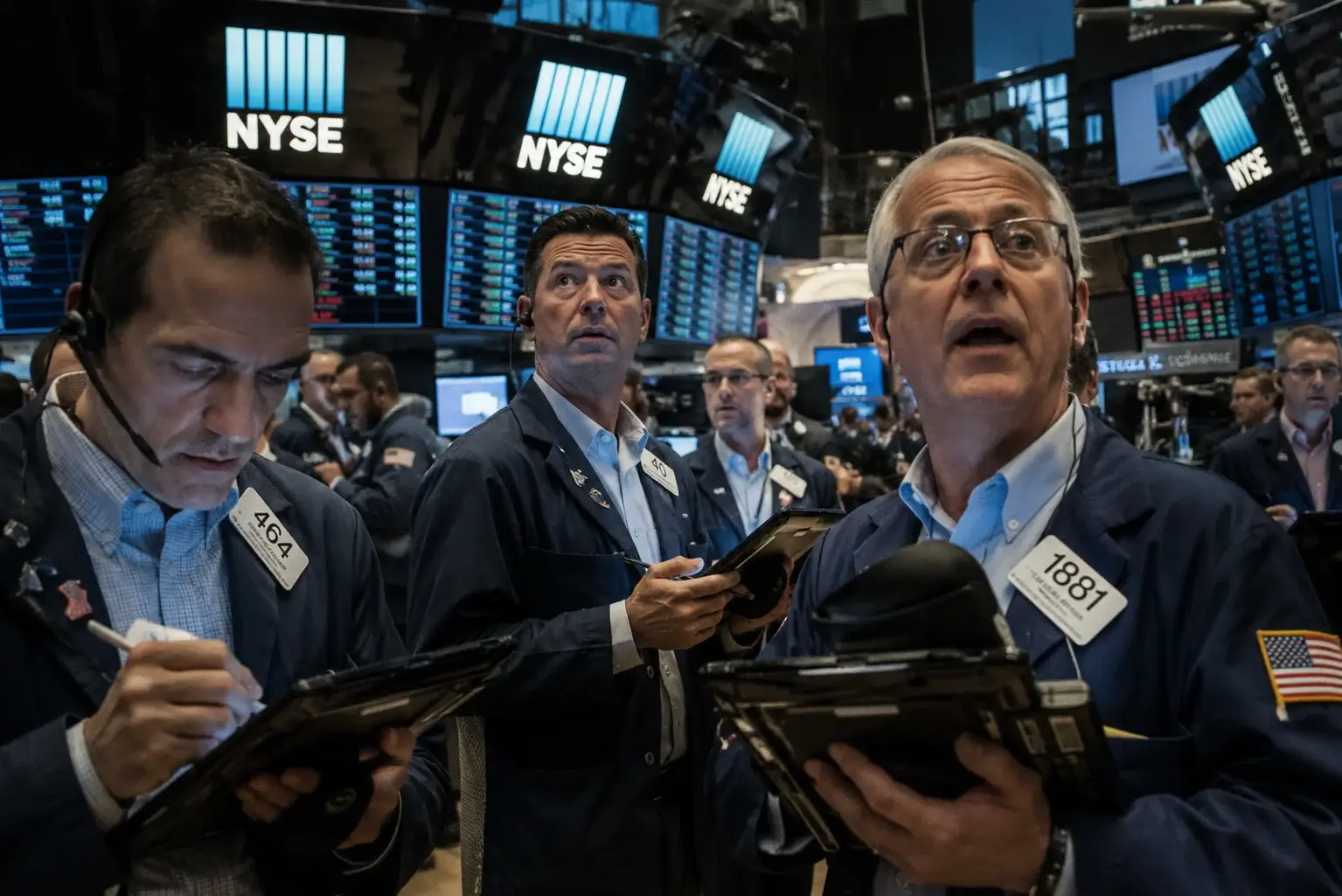
Chip Rout Drags Nasdaq Down 1.9% as Micron Sinks 11% Before Earnings; Dow Holds Flat
A 10% Kospi crash spread to Wall Street, smoking Qualcomm (-8.6%), Arm (-8.4%) and the SMH ETF (-6.5%). SpaceX kept bleeding after a $600B wipeout | That's TradingNEWS
Key Points
- S&P 500 slid 1.30% to 7,375.52 and Nasdaq fell 1.91% to 25,667.42 as a Seoul-born chip rout hit Wall Street; Dow held flat at 51,651.
- Micron sank 11.4% to $1,074.60 ahead of Wednesday earnings, dragging Qualcomm -8.6%, Arm -8.4%, TSM -5.2% and the SMH ETF -6.5%.
- VIX jumped 12.67% to 19.47; WTI fell to $73.23 on the US-Iran framework, with May PCE inflation data due Thursday.
The selling didn't begin in New York. It began overnight in South Korea, where the Kospi snapped 9.99% lower, its steepest intraday drop in more than three months, and tripped a circuit breaker that halted the exchange for 20 minutes to cool the panic. Samsung Electronics and SK Hynix, the two memory giants that together make up roughly half the Kospi's market value, each got smoked for more than 12%. That's not a wobble. That's overseas money dumping the chip complex after a rally that took the Kospi up 90% on the year and left it priced for perfection.
The fear didn't stay contained. Japan's Nikkei 225 rolled over 3.55% to 69,788, Hong Kong's Hang Seng faded 1.82%, and Shenzhen dropped 3.17%. By the time Europe opened, the Stoxx 600 Technology index was down 3%, with STMicroelectronics and Dutch equipment maker ASMI both off more than 7% and Germany's Infineon down more than 6%. The selling rode the sun straight into the U.S. open, and the AI trade — the engine under this entire bull market — is where it landed.
There was no clean catalyst. No data print, no policy shock, no single headline you can hang it on. What there was: a sector that ripped to records on the back of the AI buildout, valuations stretched to the point where it doesn't take much, and the biggest memory name in the world about to report earnings in 48 hours. When positioning gets that crowded and that one-sided, the tape doesn't need a reason to snap. It just needs a push, and Korea provided it.
The Scoreboard: Dow Flat, Nasdaq Smoked
The split across the indexes tells you everything about what kind of day this is. As of late morning trading, the S&P 500 was down 97.27 points, or 1.30%, to 7,375.52, after opening at 7,366.51 and carving a session range of 7,347.60 to 7,424.17 against Monday's close of 7,472.79. The Nasdaq Composite got the worst of it, sliding 499.19 points, or 1.91%, to 25,667.42 from a prior close of 26,166.60. The Nasdaq-100 was down a sharper 2.68%, which is what happens when the index's heaviest weights are the exact names getting sold.
The Dow Jones Industrial Average, by contrast, was barely scratched — off 61.30 points, or 0.12%, to 51,651.41, swinging on either side of unchanged through the morning. That gap, a Dow holding the line while the Nasdaq drops nearly 2%, is the whole story in one number. The Dow carries far less AI and semiconductor weight, so when the chip complex gets hit, it shrugs. The Russell 2000 gave back 23.61 points, or 0.79%, to 2,980.79, surrendering the 3,000 level it closed above for the first time ever just one session earlier at 3,004.40.
The fear gauge confirmed the tone. The VIX jumped 12.67% to 19.47, snapping back toward the 20 handle after spending most of June in the mid-teens. That's not a panic reading, but it's a clear shift from complacency, and it's climbing alongside a Nasdaq that's bleeding. Volume on the S&P was already north of a billion shares before noon, so this is real selling, not a thin-tape drift.
Micron Is the Whole Ballgame Wednesday
Everything routes through one print. Micron (MU) reports earnings Wednesday after the close, and the entire memory complex is trading like the desk wants out before it does. The stock got hammered for 11.4% to $1,074.60, the worst single name among the large-caps, and it dragged the rest of the group down with it.
The setup is brutal. Micron ripped to fresh highs into this report on the strength of the AI memory cycle — high-bandwidth memory feeding the data-center buildout has been the cleanest growth story in semis. That left the bar sky-high and the stock priced for a beat-and-raise. Now, with the Kospi unwinding the memory rally overnight and Korea's chip giants getting blown out, the money that chased Micron into the print is heading for the exit ahead of it. JPMorgan flagged the selling as anxiety before the report. Wedbush's Dan Ives framed it as another "gut check moment" in a trade he still believes is in its early innings, with the looming Micron number amplifying every nerve on the desk.
Here's the thesis, and it drives the rest of the day: this market doesn't have a broad problem. It has a concentration problem. The AI and memory trade is so large a share of the index that when it cracks, the whole tape cracks with it, and there's nothing else big enough to offset it. Micron's print Wednesday is the binary event that decides whether today was a shakeout in an intact uptrend or the first leg of something that forces a real repricing of AI exposure. The bid is gone until that number lands.
The Memory Trade Got Blown Out
Micron wasn't alone in the memory wreckage. Sandisk, Marvell Technology (MRVL), and Western Digital all got dumped, with Marvell off around 9% as the broad memory and storage complex came apart. These are the names that posted the biggest gains of the entire AI run, and they're now the names giving it back fastest. That's the signature of a momentum unwind — the leaders become the losers because they're where the crowded longs sit, and when the desk de-risks, it sells what it owns most.
The VanEck Semiconductor ETF (SMH), the cleanest read on the whole chip industry, dropped 6.5% to $625.62. A 6.5% move in a diversified sector fund in a single session is a violent repricing, not a rotation. It tells you the selling isn't surgical — it's the entire group getting marked down at once, the bid faded across the board, every name from memory to logic to equipment caught in the same downdraft.
What makes the memory names specifically vulnerable is the same thing that made them the stars: the AI buildout. The bull case was that hyperscaler capex on data centers would soak up every chip the industry could make for years. That case hasn't broken on any hard data. But the moment the market started questioning whether AI spending is sustainable at current levels — whether the capex is building real returns or just building a bigger Jenga tower — the memory names became the purest expression of that doubt, and they're trading like it.
Qualcomm, Arm, and the Broad Semi Leg Lower
The damage spread well past memory. Qualcomm (QCOM) snapped 8.59% lower even with a deal in the mix — Bloomberg reported the chipmaker is in advanced talks to buy AI software infrastructure firm Modular in a transaction valued around $4 billion. On a normal day, an AI-software tuck-in lifts the stock. On this day, the tape didn't care; the sector tone swamped the deal logic and Qualcomm got sold with everything else.
Arm Holdings (ARM) dropped 8.41%, Taiwan Semiconductor (TSM) faded 5.2% to $443.35, and the selling reached every corner of the supply chain. When Arm, the licensing backbone of mobile and increasingly AI silicon, gets hit for more than 8% in a session, that's the market questioning the entire architecture of the trade, not one company's quarter. The breadth of the move — memory, logic, fabless design, foundry, equipment, all red at once — is what separates today from a single-stock blowup. This is the AI complex repricing as a group.
The cleanest tell is that none of it required new information. Qualcomm's deal talk is arguably a positive. TSMC's business is fine. Arm's licensing model hasn't changed. The stocks fell anyway, because the move is about positioning and valuation, not fundamentals. When a sector has run this far this fast and the longs are this crowded, the unwind doesn't wait for an earnings miss. It front-runs one.
Nvidia Held the Line, Relatively
The one name that didn't get fully smoked was the biggest one. Nvidia (NVDA) fell 3.2% to $201.97 — an ugly day in isolation, but a relative win against a group dropping 6% to 11%. The market's largest company by value, and the single most important stock in the AI trade, took less damage than the memory and fabless names around it.
That relative resilience matters for what comes next. Nvidia is the anchor of the entire AI complex, and as long as it's only down 3% while Micron is down 11%, the desk is treating this as a memory-and-periphery problem rather than a wholesale rejection of the AI story. If Nvidia were leading the rout, that would signal the market questioning the core of the buildout. Instead, the selling is concentrated in the names with the most stretched valuations and the most crowded positioning, and Nvidia is acting like the last thing money wants to sell.
The Roundhill Magnificent Seven ETF (MAGS) was down 0.74% to $63.62, a far milder move than the chip carnage, which tells you the mega-cap complex broadly is holding up better than the pure-play semis. The pain is sharpest at the edges of the AI trade — memory, equipment, smaller logic — and lightest at the center. Whether that holds through Micron's print Wednesday is the question that decides the next leg.
SpaceX Keeps Bleeding After Its Record IPO
No stock has fallen further or faster than the one that owned the headlines two weeks ago. SpaceX (SPCX) kept sliding Tuesday, falling as much as 5% to about $147 — below its first-day opening price of $150 — extending a collapse that has now wiped out more than $600 billion in market value from a peak above $225 hit just one week ago. Monday alone erased roughly $400 billion, the second-largest single-session value destruction for any stock on record, behind only Nvidia's roughly $590 billion drop last year.
The trigger for the acceleration was the company's own move. SpaceX announced an inaugural bond offering, aiming to raise at least $20 billion in what could become a broader borrowing program to fund its AI ambitions — on top of the $85 billion it pulled in through its record IPO on June 12. The offering is scheduled to close June 24. A company that just raised $85 billion in equity coming back to the debt market for $20 billion more, weeks later, to fund AI infrastructure, is exactly the kind of capital intensity the market is now punishing.
The stock began trading June 12 after the largest IPO ever, ripped to its peak, and has rolled over for three straight sessions and counting. Even after shedding $600 billion, it still trades above its IPO price, which tells you how far the post-debut froth ran before it broke. SpaceX has become the poster child for the exact anxiety driving the broader tape: the fear that the AI buildout is being financed by an ever-bigger pile of capital chasing returns that haven't shown up yet.
Alphabet and the Talent Defection
Alphabet (GOOG, GOOGL) walked into this week already wounded. The stock swung roughly 5% lower Monday after a Reuters report that a high-profile scientist planned to leave Google DeepMind to join AI startup Anthropic. The defection of a senior AI researcher to a rival hit a nerve, because in the current market the perceived quality of a company's AI talent is treated as a direct read on its competitive position in the most important race in tech.
The bigger picture: Alphabet's been a battleground name all year, caught between its dominant search and cloud franchises and the market's anxiety about whether it's winning or losing the AI war. A single researcher's move doesn't change the fundamentals, but it crystallized the worry that the talent — and therefore the edge — is migrating to the pure-play AI shops. In a tape already primed to sell anything AI-adjacent, that was enough to knock 5% off one of the largest companies in the index.
The talent story sits underneath the whole AI selloff. Part of what's spooking the desk is the sense that the economics of AI are getting harder, not easier — the capex is exploding, the talent costs are soaring, the competition is brutal, and the returns remain a promise rather than a print. Alphabet's DeepMind departure is one data point in that larger unease, and the market treated it like a headline.
The Mag 7 Split Down the Middle
The mega-cap group didn't move as a bloc, which is itself a tell. Amazon (AMZN), Meta Platforms (META), and Microsoft (MSFT) all came under pressure as part of the AI-capex anxiety, with the hyperscalers specifically targeted on concern that their data-center spending is running ahead of returns. Amazon and Meta had already dropped 4.8% and 2.3% respectively Monday, with Microsoft off 3%, as the market started pricing in the cost of the buildout against an uncertain payoff.
The defensive end of the group held up far better. Apple (AAPL) has carried less of the AI-capex burden than the hyperscalers — it's a hardware and services franchise, not a company pouring tens of billions into data centers — and it's been treated accordingly, holding ground while the cloud names get sold. Tesla, the other Mag 7 outlier, trades on its own EV-and-robotaxi narrative that's largely decoupled from the memory-chip story driving today.
The fracture inside the Magnificent Seven is the rotation in miniature. Money isn't fleeing mega-cap tech wholesale — it's discriminating, dumping the names most exposed to runaway AI spending and holding the ones with cleaner balance-sheet stories. That's a healthier kind of selling than an indiscriminate flush, and it's part of why the broader index is down 1.3% rather than 3%. But it also means the hyperscalers are now the swing factor, and if AI-capex doubt deepens, there's a lot more weight that can come out.
The Dow's Quiet Day and Where Money Hid
While the Nasdaq burned, the Dow sat nearly flat, and that's not an accident — it's where the money went to hide. The index's price-weighted construction and light AI exposure made it the natural shelter on a day when the chip trade came apart. The standout had been Caterpillar (CAT), which ripped nearly 4% Monday and accounted for roughly 180 of the Dow's points that session, single-handedly carrying the index green. Strip out Caterpillar and Monday's Dow would have been lower; that's how narrow the support was.
The pattern Tuesday was the same in spirit: with the chip complex unwinding, the bid rotated into the corners of the market that don't live or die on AI. Banks had been firm earlier in the week, with the financials catching a bid as the yield curve stayed steep after the hawkish Fed. The defensive and industrial names that the Dow leans on became the relative safe harbor, soaking up money pulled out of semiconductors.
This is what an orderly de-risking looks like rather than a crash. The money leaving Micron and Qualcomm and Arm didn't leave the market — a chunk of it rotated into the lower-beta, non-AI parts of the tape, which is why the Dow is flat and the equal-weight picture is far less ugly than the cap-weighted Nasdaq. The risk is that if the AI selling intensifies past a shakeout, there isn't enough weight in the defensive corners to hold the whole index up. The Dow can't carry the S&P alone.
M&A Is Still Printing Through the Noise
Underneath the index carnage, the deal machine kept running, which is its own signal about where the real economy sits versus the AI froth. AbbVie agreed to buy Apogee Therapeutics in a $10.9 billion cash deal for its immunology portfolio, sending Apogee up sharply and putting a floor under a corner of biotech that's been quietly outperforming. The healthcare and biotech complex has been a relative winner precisely because it's the cleanest hiding spot from the AI repricing.
Qualcomm's roughly $4 billion talks to acquire AI software firm Modular showed that even on a brutal tape, the strategic buyers are still hunting — Qualcomm wants AI software infrastructure badly enough to chase it while its own stock drops 8%. And Energy Fuels announced a definitive agreement to acquire VAC in a cash-and-stock deal totaling $1.9 billion, a bet on the rare-earth and magnetics supply chain that the company called a transformational moment for the critical-minerals space.
Three deals in one morning, across pharma, semis, and critical minerals, while the index bleeds, tells you the selling is concentrated in a specific trade rather than reflecting broad economic stress. Corporate balance sheets are still deploying capital aggressively. The pain is in the stocks priced for an AI future that the market suddenly wants to discount, not in the underlying business of America. That distinction is the difference between a sector unwind and a recession scare, and right now it's firmly the former.
Read More
-
Yen Stalls at 160 Despite a 3% JGB and Tokyo Core CPI at 2.0% — Intervention Sits at 164, Friday's Payrolls Decide
02.09.2026 · TradingNEWS ArchiveEnergy
-
QQQ ETF ($706.22) Slides 7.4% Below Its High as the Market Reprices the AI Capex Bill — $686.57 Target if $700 Breaks
22.10.2026 · TradingNEWS ArchiveStocks
-
XRPI ($7.00) and XRPR ($10.74) Slide Toward 52-Week Lows as Spot XRP ETF Flows Stall at $708,510
22.10.2026 · TradingNEWS ArchiveCrypto
-
NG ($2.775) Decoupled From Europe’s €88 Gas Crisis as LNG Feedgas Hits 18.9 Bcf/d — $3.30 Upside on Cold Weather
22.10.2026 · TradingNEWS ArchiveCommodities
-
Dollar-Yen (157.35) Loses 157.65 as the Yen Rallies on Haven Demand — 155 Target if 156 Breaks
22.10.2026 · TradingNEWS ArchiveForex
Oil Keeps Fading on the Iran Framework
Crude kept sliding, taking some pressure off the inflation picture even as it weighed on energy names. WTI for August delivery slipped 0.85% to around $73.23, extending a multi-session retreat driven by the diplomatic thaw between Washington and Tehran. The U.S. authorized Iranian oil sales through August after what Treasury Secretary Scott Bessent called productive talks in Switzerland over the weekend, issuing a temporary 60-day general license for the production, delivery, and sale of Iranian crude as part of a broader framework aimed at a final deal within 60 days.
The supply story is straightforward: a path to restored Iranian barrels means more oil on the market, and the price is adjusting lower for it. That dynamic has been the single biggest relief valve on the energy-driven inflation fears that dominated the spring, when Middle East tensions and Strait of Hormuz worries had crude and volatility spiking. With the geopolitical premium draining out, energy commodities have rolled over, and that's quietly bullish for the rate path even on a day when equities are red.
The caveat is that the diplomacy is fragile. Iran's foreign ministry pushed back Tuesday on the idea of imminent nuclear inspections, contradicting Vice President JD Vance's optimism that UN inspectors could return within the week, and shipping traffic through Hormuz remains sparse. The framework is real but it isn't a signed deal, and any reversal would send the oil premium straight back in. For now, falling crude is one of the few things working in the market's favor, capping the inflation side of the Fed's problem.
The Fed Still Has the Safety Off
The macro backdrop hasn't gotten any friendlier. The Fed under new Chair Kevin Warsh came out of its June meeting with a hawkish tilt, holding the policy rate at 3.50–3.75% while signaling the bias runs toward another hike rather than a cut. The curve has been pricing that message, with futures building in roughly 70% odds of a rate hike by September and short-term yields climbing after the meeting, flattening the curve as the front end repriced for a Fed that isn't done.
That's the uncomfortable part of today's setup. A chip-led selloff would normally pull forward easing bets and put a bid under bonds, but the Fed's hawkish lean caps how much help the market can expect from that direction. The 10-year Treasury yield dipped only slightly even as equities sold off, a sign the bond market isn't treating this as a growth scare that forces the Fed's hand. Money can't lean on a dovish pivot to backstop the equity tape, because the pivot isn't on the table.
The next real test lands Thursday with the May reading on Personal Consumption Expenditures, the Fed's preferred inflation gauge, alongside the third estimate of first-quarter GDP. PCE is the shared catalyst the whole market is positioned around — a hot print hardens the case for the September hike the curve is already leaning toward and removes any cushion under risk assets, while a soft one gives the Fed room to stand pat and hands the market a reason to stabilize. Until then, the policy backdrop is a headwind, not a help.
What the Close Hinges On
Strip away the noise and the day reduces to one fact: this market is the AI trade, and the AI trade just took its hardest hit in weeks. A 1.30% drop in the S&P to 7,375.52 and a 1.91% slide in the Nasdaq to 25,667.42 are uncomfortable but not catastrophic — the index is still only about 5% off its early-June record, and the Dow holding flat shows the selling is concentrated, not systemic. This is a leadership group getting de-risked, not the market breaking.
The level that matters on the S&P is the session low at 7,347.60; a clean break below it on accelerating volume would signal the shakeout is turning into something that forces a broader repricing of AI exposure. Hold above it and the setup favors stabilization into Micron. The VIX at 19.47 is the other tell — push it through 20 and the hedging gets more aggressive; fade it back toward the mid-teens and the panic was a one-day affair.
But the real verdict doesn't come today. It comes Wednesday after the close, when Micron reports and the memory trade gets its answer. FedEx late Tuesday and Cerebras after the bell offer earlier reads on the macro and the AI-infrastructure demand picture, but Micron is the print that decides whether the chip complex stabilizes or keeps unwinding. Everything between now and then is positioning ahead of a binary event. The tape sold first and will ask questions Wednesday night. Until that number lands, the bid stays cautious, the leadership stays under pressure, and the entire market remains hostage to a single quarterly report from a single memory maker.