Pound Defends 11-Week Low at $1.3240 as Political Chaos, Fiscal Fears and a One-Year-High Dollar Squeeze Cable
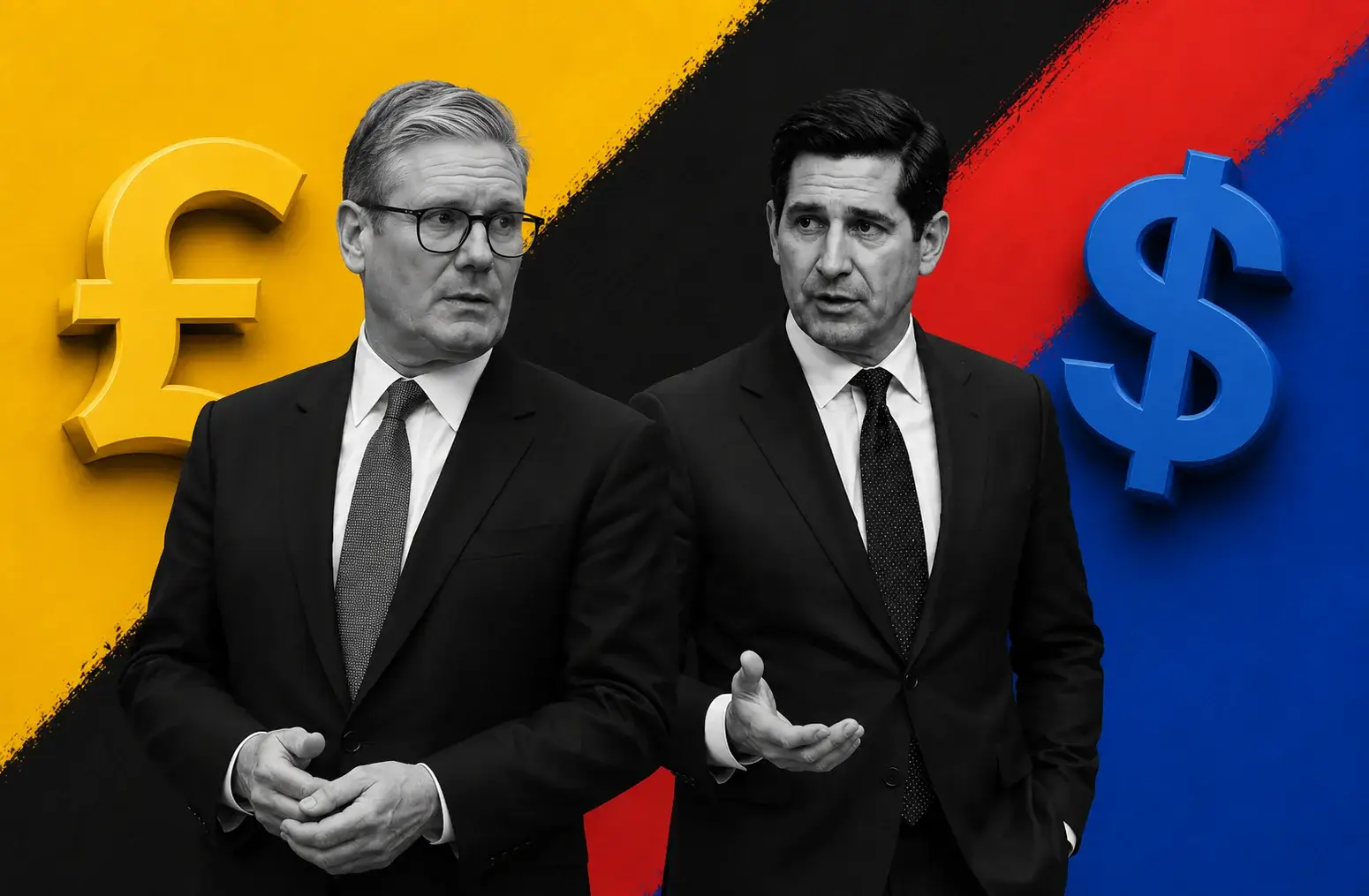
Starmer's resignation and fiscal-dove frontrunner Andy Burnham have lifted gilt yields and driven money out of pound assets | That's TradingNEWS
Key Points
- GBP/USD held near $1.3240, just above an 11-week low, as Starmer's resignation and fiscal-dove frontrunner Burnham lifted gilt yields and drove capital out of pound assets.
- Unlike the euro's hawkish ECB floor, the pound has no BoE defense — rates held at 3.75% with a cut inflation forecast — against a hawkish Fed and a one-year-high dollar.
- The 11-week low near $1.3200 is immediate support; $1.3009 is the 52-week-low line that matters, with May PCE Thursday and UK PMIs the catalysts.
GBP/USD is trading around $1.3240, hovering just above an 11-week low after sliding to its weakest level since March, as a convergence of political, fiscal, and monetary pressures pins the pound near the bottom of its range. The pair is little changed on the session but firmly on the defensive, weighed by UK political chaos on one side and a dollar near a one-year high on the other. Sterling has shed ground from its January high near $1.3824, and the technical picture has flipped firmly bearish, with the major rating systems flagging Cable as a Strong Sell.
The thesis here is that the pound faces a triple bind that makes it structurally weaker than its peers right now. First, the UK is in the middle of a leadership crisis — Prime Minister Keir Starmer has resigned, and the frontrunner to replace him is a fiscal dove who wants to spend more. Second, that fiscal expansion means more gilt issuance and a heavier debt burden, driving foreign money out of pound-denominated assets even though UK yields are already the highest in the G7. Third — and this is the crucial differentiator — the Bank of England is on hold and cautious, offering the currency no rate-driven floor, in stark contrast to a hawkish Fed that's threatening hikes. The pound has no central-bank defender at exactly the moment it needs one.
That's what separates Cable from the euro. The euro has a hawkish ECB underneath it, providing a floor even as the dollar presses it lower. The pound has a dovish-leaning BoE and a fresh fiscal-risk discount on top of the same dollar headwind. The thesis: GBP/USD is in a downtrend carrying a political-and-fiscal discount with no monetary floor, pinned near $1.32 with the $1.3009 52-week low as the real downside target if the Burnham fiscal story sours. The only things keeping it off that level are BoE caution preventing a dovish spiral and the orderly nature of Starmer's exit. The $1.3009 line is what matters, and PCE Thursday plus the UK fiscal picture are the catalysts.
The Scoreboard
Here's where Cable stands. GBP/USD is around $1.3240, with a previous close of $1.3253 and a tight session range of roughly $1.3239 to $1.3257 — the pair pinned just above its 11-week low after dipping to its weakest since March. The 52-week range runs from $1.3009 at the bottom to $1.3869 at the top, and sterling now sits in the lower portion of that band, closer to the floor than the ceiling. From the January 28 high near $1.3824, the pound is down roughly 4%, a steady erosion driven by the building political and monetary headwinds.
The technical posture is uniformly weak. Cable is trading below its 21-day, 50-day, and 100-day exponential moving averages — by roughly 0.6%, 1.0%, and 1.2% respectively — confirming a downtrend across multiple timeframes. The 50-day simple moving average sits around $1.32 as immediate overhead, with the 200-day near $1.34 marking the bigger resistance the bulls would need to reclaim to repair the trend. The Strong Sell rating across the daily, weekly, and monthly readings captures a market where the trend, the moving averages, and the momentum all point the same direction: down.
The character of the move is a grind lower punctuated by political shocks. The pound weakened to $1.32 on Monday, approaching its lowest level this year, before rebounding toward $1.33 intraday as Starmer outlined an orderly handover — then settling back into the low $1.32s. That volatility around the political headlines is the signature of a currency whose near-term direction is being driven by domestic politics layered on dollar strength. The scoreboard says sterling is at the soft end of its range, technically broken, and pinned just above the 11-week low that's now the line in the sand.
The Political Chaos: Starmer Out, Burnham In
The trigger for the latest leg of weakness is the leadership crisis at the top of UK politics. Prime Minister Keir Starmer resigned, stepping down as Labour leader and setting in motion a transition of power that the market has been bracing for. The pound came under pressure at the start of the week as the confirmation landed, with UK government borrowing costs moving higher as the market prepared for another change in leadership and the uncertainty that typically accompanies it.
The succession picture has clarified, which has softened the blow. The frontrunner is Andy Burnham, the long-time Greater Manchester mayor, who returned to Parliament after winning the Makerfield by-election last week and promptly announced his intention to seek the premiership. The path to a smooth transition improved when Wes Streeting, previously viewed as a potential challenger, declared his support for Burnham's candidacy — removing the prospect of a divisive contest. Starmer pledged to oversee an orderly handover with a Labour successor in place by the start of September, and that clearer process helped calm nerves and prevented a more pronounced sell-off.
The orderly nature of the transition is the one mercy in an otherwise bearish political backdrop. Sterling recovered some lost ground after Starmer outlined the timetable, and the pair avoided a disorderly collapse precisely because the succession looks manageable rather than chaotic. But "orderly" doesn't mean "bullish" — a leadership change still injects uncertainty, and the market's attention has shifted from the question of who leads to the question of what they'll do. And on that question, the early read is decidedly pound-negative, because the frontrunner's fiscal instincts point in a direction that worries the gilt market.
The Fiscal-Dove Problem
The deeper concern, and the one that makes this leadership change specifically bad for the pound, is Burnham's fiscal profile. He is seen as a fiscal dove who has called for higher government expenditure — a stance that, in the current environment, translates directly into pressure on sterling and upward pressure on gilt yields. A prime minister inclined to spend more means a government likely to borrow more, and more borrowing in an economy with already-stretched public finances is exactly what the bond market doesn't want to see.
The mechanism is straightforward and it's already playing out. Expectations of higher public spending under Burnham raise the prospect of increased gilt issuance to finance that spending, which pressures gilt prices lower and yields higher. Higher yields on a deteriorating fiscal trajectory aren't the good kind of yield — they reflect rising risk premium rather than rising growth expectations, and they drive foreign money out of pound-denominated assets rather than attracting it. The market is pricing the fiscal risk of a Burnham government before he's even taken office, and that anticipatory repricing is part of what's pinning sterling near its lows.
This fiscal-risk discount is what makes the pound's situation distinct from the euro's. The euro faces a strong dollar, but it has a hawkish ECB and no comparable fresh fiscal shock. The pound faces the same strong dollar plus a leadership change toward a higher-spending government in a country with fragile public finances and an elevated debt burden. The lack of concrete detail on Burnham's fiscal agenda compounds the uncertainty — the market is left to assume the worst on spending and issuance until it sees specifics. The fiscal-dove problem is the unique weight on sterling, and it's why the pound is the weaker of the two major European currencies right now.
The Gilt Market and Capital Flight
The fiscal concern shows up most clearly in the gilt market, and the dynamics there are unfriendly for the pound. UK gilt yields were already the highest among G7 members before the leadership crisis, reflecting the market's existing worries about Britain's debt and fiscal trajectory. The prospect of a higher-spending Burnham government has lifted yields further across the curve, and that combination — already-elevated yields rising on fiscal-expansion fears — is driving foreign money to pivot out of pound-denominated assets.
This capital flight is the channel through which the fiscal story hits the currency. When foreign holders of UK assets worry that increased gilt issuance will erode the value of their holdings or that the fiscal trajectory is unsustainable, they sell pound assets and repatriate the proceeds, which means selling sterling. Higher yields would normally attract capital, but when those yields are rising because of fiscal risk rather than growth or rate-hike expectations, they repel capital instead — the market demands a higher return to compensate for the deteriorating risk profile, and some money simply leaves rather than demanding more. The pound bears the cost of that exit.
The gilt dynamics create a self-reinforcing loop that's hard for sterling to escape. Fiscal-expansion fears lift yields, higher yields on a worsening fiscal backdrop drive capital out, capital flight weakens the pound, and a weaker pound can stoke imported inflation that complicates the BoE's job — which loops back to the policy questions. Britain's elevated debt burden and fragile public finances mean the market has little tolerance for fiscal slippage, and a leadership change toward higher spending tests that tolerance directly. Until there's clarity on Burnham's fiscal plans, the gilt market stays nervous and the capital-flight risk stays elevated, keeping a discount embedded in the pound.
No Central-Bank Floor: The Dovish BoE
The factor that leaves the pound most exposed is the Bank of England's posture, because unlike its peers, the BoE offers sterling no rate-driven floor. The central bank left interest rates unchanged at 3.75% this month and maintained a cautious stance, and it revised down its forecast for peak inflation in the fourth quarter of 2026 to 3.25% from a previous estimate of 3.6%. A lower inflation forecast and a cautious hold are the markings of a central bank that's leaning toward the end of its tightening, not one preparing to defend the currency with higher rates.
This is the crucial contrast with the European Central Bank. The ECB just hiked to a 2.25% deposit rate and is signaling more, giving the euro a hawkish floor that limits how far it can fall. The BoE, by contrast, is on hold at 3.75% with a cautious tone and a softening inflation outlook — a posture that provides no such floor for the pound. When a currency faces dollar strength and fiscal risk, a hawkish central bank can offset some of the pressure; a cautious one can't. The BoE's stance leaves sterling more exposed to the dollar and the fiscal story than the euro is, because there's no rate-hike defense underneath it.
There is a nuance worth drawing out, and it cuts slightly in the pound's favor. The BoE's caution, while it removes a rate floor, also means the bank isn't about to cut aggressively into the fiscal expansion — and some analysts argue the pound will find support in that caution, since a BoE that holds rather than eases prevents a dovish spiral that would crush the currency. The lowered inflation forecast gives the BoE room to stay patient rather than hike, but it also means the bank isn't rushing to cut. So the BoE isn't a floor in the hawkish ECB sense, but its caution is a brake on the downside — it won't actively undermine the pound with rapid easing. That's thin support, but it's something, and it's part of why the pound is grinding rather than collapsing.
The Fed-BoE Divergence Favors the Dollar
The core macro driver of Cable's weakness is the widening divergence between Federal Reserve and Bank of England policy expectations, and it runs entirely in the dollar's favor. The Fed under Chair Kevin Warsh is hawkish — holding at 3.50–3.75% but signaling possible hikes, with the market pricing roughly 70% odds of a September increase. The BoE is cautious — holding at 3.75% with a softening inflation outlook and no hike bias. A hawkish Fed against a cautious BoE means the rate differential is moving in the dollar's favor, and that divergence is the gravitational pull dragging GBP/USD lower.
The divergence is a clean reversal of the dynamic that supported the pound earlier in the cycle. For much of the past year, the market expected the Fed to cut faster than the BoE, which narrowed the rate gap in sterling's favor and supported Cable. The Fed's hawkish pivot flipped that — now the market sees the Fed potentially hiking while the BoE holds and leans dovish, which widens the gap in the dollar's favor. Capital flows toward the currency with the more hawkish central bank and the higher prospective return, and right now that's unambiguously the dollar. The pound is on the losing side of the policy divergence.
This is the engine underneath all the other pressures. The political chaos and fiscal risk are domestic shocks that weigh on the pound, but the Fed-BoE divergence is the steady, structural force pulling Cable lower regardless of the day's headlines. Even if the UK political situation stabilizes and Burnham's fiscal plans prove less alarming than feared, the rate divergence keeps the dollar bid and the pound capped until either the Fed turns less hawkish or the BoE turns more so. With the Fed threatening hikes and the BoE leaning the other way, that convergence isn't on the horizon, which is why the path of least resistance for GBP/USD stays lower.
The Dollar at a One-Year High
Completing the bearish picture is the dollar itself, which surged to an over-one-year high on the back of rising hawkish-Fed expectations and the risk-off mood. The greenback ended the previous week strongly and has retained a firm tone, supported by the Fed's hawkish lean, the safe-haven flows from the Middle East uncertainty, and now the global chip rout that's driving money out of risk assets and into the dollar. A dollar at a one-year high is a powerful headwind for every major currency, and the pound — with its domestic problems — is among the most exposed.
The dollar's strength today draws from multiple wells at once. The hawkish Fed and the September-hike pricing give it a rate advantage. The risk-off tape from the AI-trade unwind gives it a safe-haven bid, as money fleeing equities worldwide lands in Treasuries and the dollar that buys them. And the lingering uncertainty around the US-Iran framework, despite the progress toward a deal, keeps a residual safe-haven premium in the greenback. All three forces point the same way, and they've pushed the dollar to a level that pressures GBP/USD lower almost regardless of what the pound does on its own.
The dollar's one-year high is the ceiling that caps any sterling recovery. Even on days when the UK political picture improves or the pound tries to bounce, the firm dollar pulls Cable back down, the same way it's capping the euro below $1.15. For GBP/USD to mount a sustained recovery, it needs either the dollar to roll over — which likely requires the Fed to back off its hawkish stance — or a genuine positive catalyst from the UK side, neither of which is present. With the dollar this strong and the pound this burdened, the pair stays pinned near its lows, and the risk skews toward a test of the downside rather than a recovery.
The Technical Picture: $1.32 and the $1.3009 Floor
The chart leaves little ambiguity about the trend. GBP/USD is trading below its 21-day, 50-day, and 100-day EMAs, with the 50-day SMA around $1.32 acting as immediate overhead resistance and the 200-day near $1.34 marking the larger barrier. The major rating systems flag Cable as a Strong Sell across multiple timeframes, and the bearish technical posture reflects a market where every moving average sits above the price — the definition of a downtrend, where rallies run into overhead supply and the path of least resistance is lower.
The support map is what matters most here. The immediate floor is the 11-week low near $1.3200, which the pair is hovering just above. Below that, the critical level is the 52-week low at $1.3009 — the bottom of the entire trading range and the line that, if broken, would mark a fresh one-year low and signal that the political, fiscal, and monetary pressures have overwhelmed the currency. The round-number $1.30 sits just below, adding psychological weight to that zone. A clean break of $1.32 on the fiscal or dollar news opens the path toward $1.30 and the $1.3009 floor, and a break below there would be a significant bearish development.
On the upside, the resistance is layered and the hurdles are clear. Cable needs to reclaim the $1.33 area and then the 50-day and 200-day moving averages around $1.32 and $1.34 to even begin repairing the technical damage. The recent rebound toward $1.33 on the orderly-handover news showed the pair can bounce on positive catalysts, but each bounce has run into the overhead resistance and faded. The technical picture says the trend is down, $1.32 is the line being defended, and $1.3009 is the floor that defines whether this is a correction within a range or the start of a deeper decline. Until Cable reclaims its moving averages, the bias stays lower.
Read More
-
Yen Stalls at 160 Despite a 3% JGB and Tokyo Core CPI at 2.0% — Intervention Sits at 164, Friday's Payrolls Decide
02.09.2026 · TradingNEWS ArchiveEnergy
-
QQQ Tests Its $715 Floor as a $4.18B Exodus Meets Burry’s Nasdaq-100 Puts — Upside to $746
16.10.2026 · TradingNEWS ArchiveStocks
-
Spot Bitcoin ETFs Post a $5.06M Trickle After a $261M Exit as IBIT ETF Carries the Category — October Redemptions Near $535M
16.10.2026 · TradingNEWS ArchiveCrypto
-
Henry Hub ($3.19) Caught Between a Shrinking Storage Surplus and Mild Late-October Weather — $3.10 to $3.35 Range
16.10.2026 · TradingNEWS ArchiveCommodities
-
USD/JPY Price Forecast — Dollar-Yen (157.79) Caught Between a 216-Basis-Point Yield Gap and Tokyo’s 160 Intervention Line
16.10.2026 · TradingNEWS ArchiveForex
The Relief-Bounce Case
For all the bearish weight, there's a credible case for a near-term relief bounce, and it's worth taking seriously. The pound has already absorbed a lot of bad news — the political crisis, the fiscal fears, the dollar strength — and a short-term rebound is likely if the political anxieties take a back seat now that Starmer has gone and the succession looks orderly. Markets often sell the rumor and buy the news, and with the leadership uncertainty partly resolved by the clearer Burnham path, some of the political risk premium could unwind, allowing sterling to recover off its lows.
The BoE caution provides a second leg to the relief case. Some analysts argue the pound will find support in the Bank of England's cautious stance — a central bank that holds rather than cuts aggressively prevents the kind of dovish spiral that would crush the currency. The lowered inflation forecast gives the BoE room to stay patient, and patience is preferable to panic-easing from the pound's perspective. Combined with the technically oversold condition — Cable below all its key moving averages with a depressed momentum profile — the setup carries the ingredients for a counter-trend bounce if a catalyst sparks it.
But the relief-bounce case comes with a clear caveat: the building downside momentum is increasingly hard to ignore. A bounce within a downtrend is still a bounce within a downtrend, and the structural forces — the fiscal risk, the Fed-BoE divergence, the strong dollar — remain in place even if the political anxiety temporarily fades. Any relief rally is likely to run into the overhead resistance at $1.33 and the moving averages above, and to fade unless the underlying drivers shift. The relief bounce is a tactical possibility, not a trend change, and it would take a genuine improvement in the fiscal picture or a dollar reversal to turn a bounce into a sustained recovery.
PCE Thursday and the PMI Tests
The catalyst calendar this week is dense, and it cuts in both directions. The immediate tests come from the June flash Purchasing Managers' Index readings for both the UK and the US, which offer a real-time read on the relative health of the two economies. Soft UK PMIs would reinforce the case for BoE caution and weigh on the pound, while strong UK data could provide a modest lift. The US PMIs feed into the broader dollar story, with strong US data reinforcing the hawkish Fed narrative that's been driving the greenback higher.
The bigger event is the May PCE reading on Thursday — the Fed's preferred inflation gauge — which is the catalyst the entire dollar complex is positioned around. PCE directly informs whether the September Fed hike the market is pricing actually happens, and that hike is the dollar's primary fuel. A hot PCE print hardens the hawkish path, strengthens the dollar, and pressures GBP/USD toward $1.32 and a potential break toward $1.30. A soft print revives Fed-easing hopes, softens the dollar, and gives the pound room to mount the relief bounce back toward $1.33 and beyond.
The interplay of the US and UK data is what makes the week pivotal for Cable. The pair is a relative-value trade between the two economies and their central banks, so it responds to both sides. The cleanest bullish scenario for the pound would be soft US PCE combined with resilient UK PMIs — narrowing the policy divergence and easing the dollar. The cleanest bearish scenario is hot US PCE and weak UK data, widening the divergence and confirming the downtrend. The most likely outcome lies between those poles, with the dollar's strength and the UK's fiscal overhang biasing the risk toward the downside unless the US data delivers a clear dovish surprise.
GBP vs EUR: Why the Pound Is the Weaker Sister
A useful way to frame the pound's predicament is to compare it directly to the euro, because the two European majors face the same dollar but very different domestic backdrops. The euro is trapped in a two-hawk standoff — a hawkish ECB floor against a hawkish Fed ceiling — which keeps it range-bound near $1.14. The pound faces the same hawkish-Fed ceiling but has no hawkish-BoE floor, and on top of that carries a fresh fiscal-risk discount from the leadership change. That combination makes sterling the weaker of the two currencies right now.
The contrast shows up in the cross rate. With the euro supported by ECB hikes and the pound pressured by fiscal fears and BoE caution, EUR/GBP has been biased higher, with forecasts clustering around the 0.88–0.89 area as the euro outperforms its British counterpart. The pound is losing ground not just against the dollar but against the euro too, which isolates the UK-specific weakness from the broader dollar strength. When a currency is falling against both the dollar and a peer that's also under dollar pressure, it signals genuine idiosyncratic weakness rather than just a strong-dollar story.
The structural read is that the pound has more ways to lose than the euro. Both face the strong dollar, but the euro has a central-bank defender and the pound doesn't; the pound has a fiscal shock and the euro doesn't. For sterling to close the gap, it would need either the BoE to turn more hawkish — unlikely given the softening inflation forecast — or the fiscal picture to improve, which requires clarity and discipline from a Burnham government that's signaling the opposite. Until one of those shifts, the pound stays the weaker sister, vulnerable to the dollar on one flank and its own politics on the other.
Where the Forecasts Land
The forecast landscape reflects the bearish lean, with most projections pointing to continued sterling weakness. J.P. Morgan sees GBP/USD declining through the year — around $1.31 in September, $1.28 by December, and $1.30 by March 2027 — reflecting modest but persistent pound weakness as the Fed-BoE divergence and the fiscal overhang weigh. Algorithmic models skew bearish too, with the majority of technical indicators flashing sell signals and the moving-average structure pointing lower. The Long Forecast projections show a steady decline toward $1.30 by late 2026.
There's a bullish outlier worth noting for balance. Some forecasters see Cable firmer, projecting a recovery toward $1.3335 by mid-2026 and the mid-$1.35s by year-end and into 2027, on the view that the dollar's strength fades as the Fed eventually eases and the UK political situation stabilizes. That more constructive path depends on the dollar rolling over and the fiscal fears proving overblown — possible, but it requires a meaningful shift in the current drivers. The dispersion between the bearish consensus and the bullish outlier captures the genuine uncertainty, but the weight of the forecasts and the technical posture both lean lower.
The honest read is that the near-term bias is bearish with a fiscal-risk skew, while the medium-term path depends on whether the dollar's hawkish-Fed-driven strength persists. The pound's fate is tied to two things largely outside its control — the Fed's policy path and the dollar's trajectory — plus one thing very much within UK control: the fiscal credibility of the incoming government. If Burnham's fiscal plans reassure the gilt market and the Fed eases later in the year, the bullish path opens. If the spending fears materialize and the Fed stays hawkish, the bearish path toward $1.30 and below dominates. The forecasts cluster toward the latter, but the former isn't off the table.
The Verdict: $1.3009 Is the Line That Matters
Strip it down and the pound is fighting a three-front war with no central-bank ally. Sterling is pinned near $1.32, an 11-week low, because UK political chaos, a fiscal-dove frontrunner threatening higher gilt issuance, and a cautious BoE that offers no rate floor have converged with a dollar at a one-year high. Unlike the euro, the pound has no hawkish central bank underneath it and carries a fresh fiscal-risk discount on top — which makes it the weaker of the two major European currencies and skews the risk toward the downside.
The levels frame the path. The immediate floor is $1.3200, the 11-week low the pair is defending. The critical line is $1.3009 — the 52-week low, the bottom of the range, and the level that separates a correction from a fresh one-year-low breakdown. A clean break of $1.32 on hot US data or fiscal news opens the path toward $1.30 and $1.3009, while a hold and a relief bounce would need to clear $1.33 and the moving averages around $1.32 and $1.34 to repair the trend. The $1.3009 floor is the line that matters most — defend it and the range holds; break it and a deeper decline beckons.
The catalysts are PCE Thursday and the UK PMIs, with the Burnham fiscal agenda as the slow-burn domestic driver. A hot PCE and weak UK data widen the divergence and pressure $1.3009; a soft PCE and resilient UK data narrow it and fuel a relief bounce. The structural backdrop — the Fed-BoE divergence, the strong dollar, the fiscal overhang, the absence of a BoE floor — biases the pound lower until the Fed turns less hawkish or the UK fiscal picture clears. The one thing keeping sterling off its 52-week low is the orderly handover and the BoE's caution preventing a dovish spiral. The pound doesn't control the dollar or the Fed, but it does control its fiscal credibility, and that's the variable to watch. Until then, $1.3009 is the line, the dollar is the ceiling, and the bias is to fade the bounces toward $1.33.