Crude Breaks $97 On Kuwait Escalation While 17M Barrels A Day Move Through Hormuz
The ICE gasoil crack hit a record $79 and the US diesel crack trades above $100 | That's TradingNEWS
Key Points
- Brent trades at $96.20, up 57 cents, with WTI at $91.98 and crude up over 7% this week.
- Hormuz transits hit a wartime record 17 million barrels Monday versus 4.9 million in Q2.
- US crude stocks fell 4.5 million barrels to 424.5 million with refineries at 98% capacity.
Brent crude futures trade at $96.20 a barrel, up 57 cents, after breaking $97 earlier in the session. West Texas Intermediate for October delivery sits at $91.98, higher by 97 cents or 1.07%, leaving the Brent-WTI spread at $4.22. Both benchmarks have gained more than 7% this week.
The tape has been two-sided through the European hours, with Brent swinging between small gains and losses near $95 before the U.S. session pushed it higher on fresh escalation out of the Gulf. That whipsaw is characteristic of what this market has become: a flat price that reprices 2% on individual headlines while the underlying physical flow tells a different story.
Set the current level against the year and the range is extraordinary. Brent's 52-week intraday high is $120.88, printed April 30, 2026. The 52-week low is $58.66 from December 16, 2025. Between those two points sits a war that began in February. Brent traded above $114 in March, crashed 9.26% in a single session on March 11, fell as low as $69 on July 2 after a U.S.-Iran memorandum of understanding, and reached $105 on July 23 when that deal collapsed. At $96.20 the benchmark sits 20.4% below its 52-week high and 64.0% above the low.
Today's catalyst is Kuwait. The kingdom's armed forces said Thursday that the country faces ongoing Iranian aggression as its air defenses engaged missiles and drones. That follows a week in which the United States and Iran traded military strikes for the first time since July, with Washington targeting Tehran's capacity to attack ships transiting the Strait of Hormuz and Iran retaliating against American bases across the region.
The thesis running through this forecast is that the crude market has stopped pricing barrels and started pricing the plumbing that moves them. Seventeen million barrels a day passed through Hormuz on Monday — a wartime record — while the ICE gasoil crack hit an all-time high of $79 a barrel and the U.S. diesel crack traded above $100. Crude is flowing. Refined product is not.
That distinction sets the levels. Above $97, Brent runs at the July 23 high of $105. Below $92, the de-escalation trade reopens toward $85.
Kuwait Under Fire And The First US-Iran Exchange Since July
The escalation that reversed a month of relative calm has a specific sequence and it matters for how the risk premium behaves from here.
U.S. Central Command struck two rocket launchers on Iran's Larak Island, the first publicly acknowledged American attack in weeks. Washington then carried out further strikes on targets around the strategic waterway and threatened more devastating attacks. Iranian media reported strikes on multiple targets near the Strait, and Tehran said it had targeted American assets in response, firing drones and missiles at U.S. bases across the Middle East — a pattern it has run throughout the six-month conflict.
Kuwait is the new element. A Gulf state with its own export infrastructure engaging incoming missiles and drones widens the conflict beyond the Iran-U.S. axis and puts additional regional loading terminals inside the threat radius. That is a different risk than tanker interdiction in the Strait.
President Trump described the latest campaign as a very heavy attack while saying he does not think it will take too long, adding that the United States remains prepared to conduct another one. He reiterated the claim that Washington controls the Strait of Hormuz.
Tehran's position has not moved. Iran has said Hormuz stays closed until the United States meets six sweeping demands, and the foreign ministry has stated that as long as the American naval blockade continues, the conditions for reopening the Strait do not exist. Iran and Oman have been holding bilateral negotiations over shipping routes.
The diplomatic history explains why traders discount headlines in both directions. The two sides signed a memorandum of understanding on June 17 to open Hormuz to commercial shipping. Brent fell to $69 on July 2 as a result. The deal collapsed within weeks over which routes vessels could use, Iran attacked multiple tankers transiting under U.S. escort, and Brent was back at $105 by July 23.
That is a $36 round trip in three weeks driven entirely by the credibility of a diplomatic document. The same mechanism is live now, which is why the flat price carries far more two-way risk than the escalating military tape suggests.
Both sides are looking for off-ramps. Renewed talks deflate this price quickly.
17 Million Barrels Through Hormuz Is The Number That Contradicts The Price
Here is the datapoint that should temper anyone buying crude at $96.20 on war headlines.
The U.S. Energy Secretary said more than 17 million barrels of oil transited the Strait of Hormuz on Monday, the highest daily volume since the war began, moving under American military protection. Before the conflict started in February, roughly 20 million barrels per day of crude and products passed through the waterway, with fourth-quarter 2025 flows averaging 21.6 million barrels a day.
Seventeen million against a 20 to 21.6 million pre-war baseline is roughly 79% to 85% recovery. That is a functioning chokepoint, not a closed one.
The improvement from the trough is dramatic. Crude oil and petroleum liquids through Hormuz averaged 4.9 million barrels per day in the second quarter of 2026. Monday's print is 3.5 times that figure. Even the current running average of approximately 8 million barrels a day is 63% above the second-quarter level.
The counterweight is volatility in the daily numbers. Tanker tracking showed four commodity vessels transiting Hormuz on Tuesday, down from ten on Monday. Some cargoes have been leaving the Persian Gulf with transponders switched off, which means observed flows understate actual volumes while also indicating operators are managing genuine interdiction risk. Two supertankers have been hit by unknown projectiles in the Strait.
The alternative routing has absorbed part of the displacement. Volumes through the Bab el-Mandeb strait averaged 8.1 million barrels per day in the second quarter, up from 5.4 million in the fourth quarter of 2025, as Saudi Arabia redirected crude away from Hormuz through the East-West pipeline to Yanbu on the Red Sea. That workaround carries its own exposure — a blockade threat against Saudi exports through Bab el-Mandeb was one of the drivers that pushed Brent to $105 in July.
The synthesis: physical crude availability has improved materially from the second-quarter emergency, and the price has not fully reflected it because each escalation headline resets the risk premium before the flow data updates. A market at $96.20 with 17 million barrels a day moving is carrying a premium that a single credible de-escalation removes.
The Real Scarcity Is Diesel, And The Cracks Just Hit Records
Crude is not where the shortage is. Refined product is, and the margins prove it.
The ICE gasoil crack — the spread between a barrel of crude and the diesel refined from it — hit a record high of $79 per barrel on Tuesday. The U.S. diesel crack trades well above $100 per barrel, hovering near the all-time highs set last month. Put that number next to Brent at $96.20 and the arithmetic is startling: the refining margin on diesel exceeds the price of the crude feedstock itself.
Timespreads confirm the tightness rather than contradicting it. The ICE gasoil September-November spread trades at a backwardation of $80 per tonne, meaning prompt barrels command an enormous premium over deferred ones. Backwardation of that magnitude signals immediate physical scarcity, not speculative positioning.
The historical scale is worth registering. Distillate crack spreads at New York Harbor averaged $1.42 per gallon in March, the highest monthly level since 2022 and more than double the 2021-2025 five-year average of 68 cents. Those margins have since gone higher.
The causes are structural rather than cyclical. Middle East diesel exports are constrained by the same Hormuz and Gulf disruptions affecting crude, and Russian product exports have been hit hard by a separate campaign. Ukrainian drone and missile strikes have targeted Russian refineries and export terminals, forcing Moscow to send crude to Kazakhstan for refining as domestic fuel shortages deepen — and the available foreign capacity is far too small to close the gap.
Two of the world's largest diesel export sources are impaired simultaneously, with little sign of imminent recovery, heading into seasonally stronger demand.
The trading implication runs against the consensus crude call. If the war de-escalates and Hormuz reopens fully, crude falls hard while diesel cracks stay elevated, because reopening the Strait does not rebuild Russian refining capacity or replace lost Middle East distillate yield. The refined product squeeze has a longer duration than the crude risk premium.
For the crude price specifically, high cracks are supportive at the margin — they encourage refiners to buy more feedstock and run harder. But margin-driven demand is a second-order support, and it disappears the moment product cracks normalize.
U.S. Crude Stocks At 424.5 Million Barrels With Refineries Running At 98%
The domestic inventory picture supports the bulls, with a caveat that undermines the support.
Commercial crude stocks excluding the Strategic Petroleum Reserve fell 4.5 million barrels to 424.5 million in the week ended August 28, the first decline since late July. Refineries operated at 98% of capacity during the week — an exceptional utilization rate that reflects exactly the margin incentive the diesel cracks are creating.
A 4.5 million barrel draw with refineries at 98% is a demand-driven number, not a supply-constrained one. Refiners are pulling crude out of tanks because turning it into distillate is the most profitable trade available, and they cannot run any harder than they already are.
That is the caveat. Utilization at 98% means there is no incremental refining capacity to bring online. Any further increase in product demand or any further loss of foreign product supply has to be met from inventory, because the U.S. refining system is already maxed. It also means the crude draws will continue mechanically as long as cracks stay where they are, which will keep producing bullish weekly headlines that describe a refining phenomenon rather than a crude shortage.
The forward view is not encouraging on the restocking side. The federal forecast has U.S. commercial crude inventories remaining below the 2021-2025 five-year low through the end of 2026. Domestic buffers are thin and staying thin.
Refinery utilization exceeded the five-year range through the first quarter of 2026 as well, driven by the same distillate margin incentive, helped by a heavy autumn 2025 turnaround season that reduced the need for scheduled maintenance this year. That pull-forward has a cost: maintenance deferred is maintenance owed, and an unplanned outage at 98% utilization has nowhere to be absorbed.
Watch the weekly report for two things over the coming month. Distillate inventories matter more than crude here, because they are the binding constraint. And any utilization print below 95% would mark the start of autumn turnarounds, which would tighten product further while loosening crude — pushing cracks higher and flat price lower at the same time.
The Strategic Petroleum Reserve Below 300 Million Barrels Is A Cushion That Is Gone
The most consequential number in this entire market receives almost no attention, because it does not print weekly headlines.
U.S. Strategic Petroleum Reserve holdings have fallen below 300 million barrels, the lowest level since January 1983. That is a 43-year low, reached while a war is disrupting the world's most important oil chokepoint.
The significance is not the barrel count. It is the loss of optionality. The SPR is the instrument Washington uses to break a price spike, and it has been the mechanism that capped every previous supply shock since it was created. Releasing from a reserve at 300 million barrels is a materially different decision than releasing from one at 700 million, both because the absolute cushion is smaller and because drawing it further raises genuine energy security questions in a conflict with no defined end.
Continued SPR draws have been part of what kept commercial inventories from collapsing faster. That support is now nearly exhausted.
The practical consequence: the ceiling on oil prices in a genuine escalation scenario is higher than it has been in four decades, because the tool that historically enforced that ceiling is unavailable. If Hormuz flows fall back toward the second quarter's 4.9 million barrels a day, there is no strategic release large enough to bridge the gap.
That is the argument behind the more aggressive upside scenarios. One institutional framework holds that if blockades persist and reserves cannot cushion supply, oil could climb toward $120 a barrel — a level Brent already touched at $120.88 on April 30. The same framework assesses that a genuinely recessionary shock would require crude above $140, alongside a sharp equity selloff.
Against that, the reserve's depletion is a slow-burning risk rather than a daily driver. It changes the shape of the tail, not the base case. The base case is still governed by how many vessels transit Hormuz this week.
For traders, the SPR level is the reason to respect upside gaps in this market even when the flow data looks constructive. There is no circuit breaker left.
A 1.8 Million Barrel Daily Deficit And 410 Million Barrels Drawn Since February
The global balance data is the strongest fundamental support for current prices, and the numbers are severe.
The international energy agency now expects the global oil balance to show a deficit of 1.8 million barrels per day in the third quarter of 2026, more than double the roughly 800,000 barrels per day estimated a month earlier. Global observed inventories plunged by 69 million barrels in July — 2.2 million barrels a day — dragged lower almost entirely by a drop in oil on water as renewed disruptions to Gulf and Caspian exports cut floating volumes.
By the end of July, observed stocks had fallen below 7.9 billion barrels for the first time since April 2025. Cumulative draws between the end of February and the end of July reached 410 million barrels, an average of 2.7 million barrels a day across five months.
Those are the numbers that justify $96 crude. A market drawing 2.7 million barrels a day for five straight months is a market in genuine physical deficit, and the fact that most of the July decline came from oil on water reflects the mechanical reality of a constrained chokepoint: barrels that cannot transit do not become inventory anywhere.
The forward assessment cuts the other way. The market is projected to return to surplus toward the end of this year, with the caveat that risks remain substantial and the urgency of reopening the Strait has increased as previously available inventory buffers deplete.
That word — surplus — is the one bulls need to reckon with. The deficit is a function of blocked transit, not of insufficient production capacity. Restore the transit and the barrels that have been shut in return, and a 1.8 million barrel deficit inverts inside two quarters.
Production shut-ins averaged 5.5 million barrels per day in July, with the assessment raised for August on the assumption that Hormuz transits stayed severely constrained through the month before slowly increasing in September.
Monday's 17 million barrel transit says that September increase has begun. If it holds, the shut-in barrels start returning, and the entire deficit case dissolves.
5.5 Million Barrels A Day Of Shut-In Production Is The Swing Factor
Every credible bear case for oil runs through one number, and it is the largest single variable in the market.
Shut-in production averaged 5.5 million barrels per day in July. Those are barrels with wells drilled, infrastructure built and buyers waiting, sitting idle because the export route is impaired. They are not lost capacity. They are deferred capacity, and they come back the moment logistics permit.
For scale, 5.5 million barrels a day exceeds the total production of every OPEC member except Saudi Arabia. It is roughly 5% of global supply held out of the market by a shipping constraint rather than by geology, policy or investment.
The federal assessment is that most shut-in production will be largely restored in the first quarter of 2027, after which global inventories start building again. That is the mechanism behind the projected slide to a $69 average in 2027 — not demand destruction, but the return of barrels that already exist.
The timing is what the market is trading. Monday's record 17 million barrel Hormuz transit is evidence the restoration has started earlier than the August assumption contemplated. If September flows average meaningfully above the 8 million barrel running rate, the shut-in figure falls, inventories stop drawing, and the deficit that supports $96 crude narrows fast.
The bull counter is that restoration is not linear. Vessel transits fell from ten on Monday to four on Tuesday. Iran has attacked tankers moving under U.S. escort. Two supertankers were struck by projectiles. Kuwait engaged incoming missiles and drones today. Insurance and charter costs for Gulf transits remain punitive, and shipowners will not commit tonnage to a route where their vessels are being hit regardless of what the daily volume statistic says.
The honest read: shut-in restoration is happening, unevenly, with a wide error band. That argues for a flat price that grinds lower over months while spiking violently on individual incidents — which is precisely the pattern of the past six months.
Position accordingly. Selling rallies has been the better trade than buying dips for two quarters.
Read More
-
Yen Stalls at 160 Despite a 3% JGB and Tokyo Core CPI at 2.0% — Intervention Sits at 164, Friday's Payrolls Decide
02.09.2026 · TradingNEWS ArchiveEnergy
-
QQQ ETF ($706.22) Slides 7.4% Below Its High as the Market Reprices the AI Capex Bill — $686.57 Target if $700 Breaks
22.10.2026 · TradingNEWS ArchiveStocks
-
XRPI ($7.00) and XRPR ($10.74) Slide Toward 52-Week Lows as Spot XRP ETF Flows Stall at $708,510
22.10.2026 · TradingNEWS ArchiveCrypto
-
NG ($2.775) Decoupled From Europe’s €88 Gas Crisis as LNG Feedgas Hits 18.9 Bcf/d — $3.30 Upside on Cold Weather
22.10.2026 · TradingNEWS ArchiveCommodities
-
Dollar-Yen (157.35) Loses 157.65 as the Yen Rallies on Haven Demand — 155 Target if 156 Breaks
22.10.2026 · TradingNEWS ArchiveForex
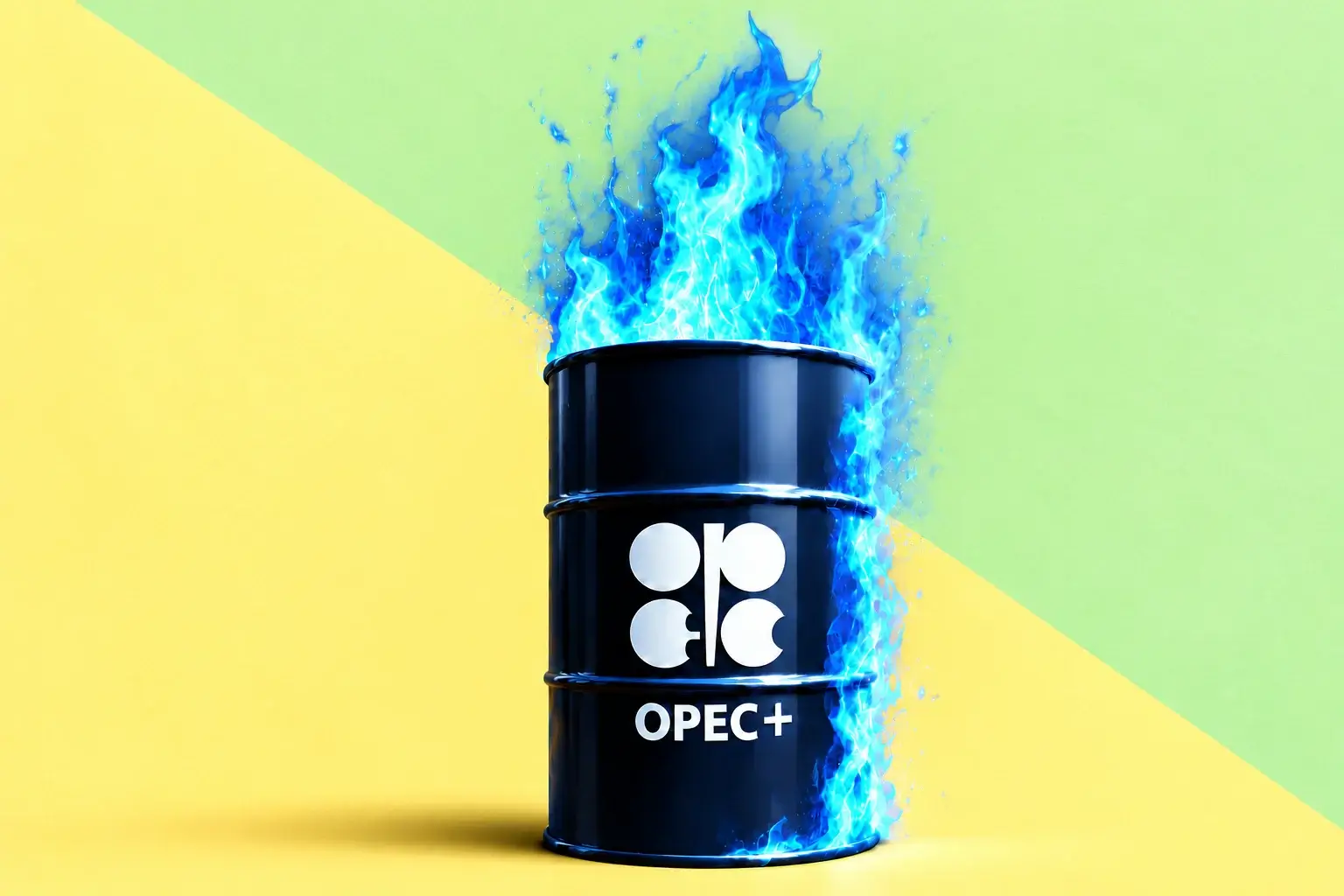
OPEC+ Meets Sunday And Is Expected To Do Nothing
The producer group's role in this market has become passive, which is itself informative.
Seven core OPEC+ members meet Sunday and are expected to leave October production policy unchanged. The group has completed the planned rollback of a 1.65 million barrel per day production cut, meaning the voluntary curbs that defined its strategy through 2024 and 2025 have been unwound.
The disconnect is that actual supply has lagged the planned increases, because disruptions are affecting several exporters. The group is nominally producing more and physically delivering less, which means its quota decisions have stopped being the price-setting variable they were for two decades.
That matters for the forecast in two ways. On the upside, it means there is limited spare capacity available to answer a genuine escalation — the barrels that would normally cushion a shock are either already committed or sitting shut in behind a blocked strait. On the downside, it means that when Hormuz normalizes, the group has no mechanism in place to withhold the returning volumes, because the cut structure has already been dismantled and reassembling it requires unanimous agreement among members who have spent two years losing market share.
A do-nothing meeting on Sunday is therefore mildly bearish for the medium term even though it reads as neutral. Doing nothing preserves a supply architecture designed for a market that was heading into surplus before the war started.
The historical parallel is instructive. Before the conflict, the group was managing a growing global surplus, pausing production increases specifically because of it. The war converted an oversupplied market into a deficit through logistics rather than through demand, and the moment logistics resolve, the surplus that was building underneath reasserts itself.
Watch the Sunday statement for any language on compensation volumes or on the pace of restoring the remaining cuts. A signal that the group intends to defend price into a normalization would be the single most bullish medium-term development available, and there is no indication it is coming.
The market is not positioned for OPEC+ to matter. That is a reasonable position, and it removes a support that used to exist under every oil selloff.
The Official Model Says $78 By Fourth Quarter And $69 In 2027
The federal short-term forecast is the most important published number in this market, and it is materially below the current strip.
The August outlook, completed August 6 and released August 11, projects the Brent spot price averaging around $85 a barrel in the third quarter of 2026 — a figure already raised $11 from the prior month. It then forecasts prices falling to an average of $78 by the fourth quarter as Hormuz traffic increases and shut-in production restarts, with most restoration complete in the first quarter of 2027 and inventories rebuilding, taking Brent to an average of $69 in 2027.
Measured from $96.20: the third-quarter average of $85 is 11.6% below the current price, the fourth-quarter $78 is 18.9% below, and the 2027 $69 is 28.3% below.
That is a forecast of a collapse, published by the agency with the best visibility into shut-in capacity and transit volumes. It is worth taking seriously precisely because it is unglamorous — it assumes no diplomatic breakthrough, no de-escalation, simply the mechanical restoration of blocked logistics over two to three quarters.
The next update lands September 9, and it is a genuine catalyst. If the model marks up the third-quarter average toward $90 and pushes the fourth-quarter figure above $80, it confirms the disruption is lasting longer than assumed and validates current pricing. If it holds $78 for the fourth quarter while acknowledging Monday's 17 million barrel transit, the message is that the agency sees normalization arriving faster than the market does.
The forecast has already been wrong in both directions this year, which argues for humility. Brent traded as low as $69 on July 2 and as high as $105 on July 23 — the model's full-year range compressed into three weeks.
What it provides is a reference for what the price should be absent a war premium. At $96.20 against an $85 third-quarter fundamental estimate, roughly $11 of the current Brent price is geopolitical risk premium. That is the number at stake on any de-escalation headline, and it is the reason a single credible diplomatic development can take 10% out of this market in a session.
The March Precedent: Brent Fell 9.26% In A Single Session On One Headline
Anyone treating this as a one-way bullish market should study March 11, 2026.
Iranian attacks on infrastructure and tankers had pushed Brent above $114 earlier that month amid fears of a broader energy crisis. Then reports emerged that Washington was considering military action to seize control of the Strait, restore tanker passage and avert a blockade. Traders unwound long positions immediately in anticipation of a supply surge. West Texas Intermediate fell $8.22 to $86.55, down 8.67%. Brent dropped $9.16 to $89.80, a 9.26% decline. Murban fell 7.28% to $102.20.
That is roughly $9 of war premium evaporating inside hours on a report about a contemplated policy, not an executed one.
The July sequence repeated the pattern with a longer arc. The June 17 memorandum of understanding took Brent from the high $80s to $69 by July 2 — a 20%-plus decline on a diplomatic document. The document's collapse took it back to $105 by July 23.
Three observations follow. First, the war premium in this market is large, explicitly quantifiable at roughly $11 against the fundamental estimate, and it unwinds far faster than it builds. Second, the trigger for that unwind does not require the war to end — it requires only a credible signal that transit is being restored, which is exactly what a 17 million barrel Monday represents. Third, positioning is heavily long into headlines that have repeatedly failed to sustain price.
The distinguishing feature of the current setup versus March is that the SPR cushion is now gone and inventories have drawn 410 million barrels. The physical market is genuinely tighter than it was, which should limit the depth of any de-escalation flush. A fall to $85 is defensible on fundamentals. A fall to $69 would require the shut-in restoration to arrive faster than any published model contemplates.
The trading conclusion: this market has negative skew at $96.20. The upside requires escalation beyond what has already happened — a full Hormuz closure, a strike on Saudi loading infrastructure, or direct damage to Kuwaiti export terminals. The downside requires only the absence of new escalation, which is the base case in any conflict where both sides are looking for off-ramps.
Russia, Kazakhstan And The Second Squeeze Nobody Is Pricing
There is a second supply disruption running in parallel to the Gulf, and it is the one driving the diesel cracks.
Ukrainian drone strikes on Russian refineries and export terminals have deepened domestic fuel shortages inside Russia to the point that Moscow is now sending crude to Kazakhstan for refining. The available foreign capacity is far too small to close the gap. A country that has historically been one of the world's largest diesel exporters is importing refining services.
Combine that with impaired Middle East product exports and the picture behind a record $79 gasoil crack becomes clear. Two of the largest distillate export sources are simultaneously constrained, and neither constraint responds to anything happening in the Strait of Hormuz. Reopening Hormuz restores crude flows. It does nothing for Russian refining capacity destroyed by drones.
The forward view from the product desks is that middle distillate cracks stay highly elevated and volatile given disruptions to Middle East and Russian diesel exports, with little sign of imminent recovery, particularly heading into seasonally stronger winter demand.
For crude specifically this creates an unusual configuration. Product tightness supports crude demand through refinery utilization — U.S. refiners running at 98% of capacity are buying every barrel they can process. But that support is derivative. If crude falls to $85 while diesel cracks hold above $100, refiners buy more, not less. The crack is the floor under demand, not under price.
The trade that follows is a relative one rather than a directional one. Long refined product against crude expresses the actual scarcity. Long flat-price crude expresses a war premium that has repeatedly evaporated.
For equity investors the read-through favours refiners with distillate-weighted yields over integrated producers levered to flat price, and it explains why the U.S. diesel crack spread has been described as sending a very different message than headline crude.
One risk to that framing: if the conflict widens to Kuwaiti or Saudi loading infrastructure, crude closes the gap violently and the relative trade goes the wrong way. Today's missile engagement over Kuwait is the first evidence that scenario is live.
Energy Equities Up 43% Year To Date Are The Cleanest Expression
The equity market has been the better way to own this shock, and the performance gap is wide.
Energy has led the S&P 500 in 2026 with a 43% gain and led the third quarter with a 22% advance, while industrials lag the quarter down 7% and consumer discretionary sits 2.3% lower on the year. The energy sector fund is up 47.3% year to date against 27.7% for technology — a 19.6-percentage-point gap in a year defined by artificial intelligence.
That outperformance is the market's verdict on where the shock actually accrues. Producers with barrels outside the disrupted regions capture the entire price move without bearing the transit risk, and refiners with distillate capacity are printing margins that exceed the cost of their feedstock.
The coal complex tells the opposite story today and is worth noting as a sentiment indicator. Alpha Metallurgical Resources fell 5.31% to $220.90, Peabody Energy 5.12% to $27.92, Warrior Met Coal 4.78% to $103.34 and Core Natural Resources 4.08% to $98.47. Those are names that rally on inflation and higher-for-longer rates, and they sold off hard on the same dovish Fed repricing that pushed the dollar index below 99.
The read-through: today's macro is bearish for the inflation trade and bullish for duration, which argues the energy complex's leadership is running against the prevailing flow. Energy has been the 2026 winner because rates were rising and oil was rising together. If Waller gets his hold on September 16 and the ten-year drifts from 4.75% back toward 4.50%, the rotation that has funded energy's outperformance reverses.
The structural case for the sector survives that. Global observed inventories below 7.9 billion barrels, a 43-year low in the strategic reserve, refineries at 98% utilization and record distillate margins are not rate-sensitive conditions.
But an investor buying energy equities at a 47.3% year-to-date gain is buying the second derivative of a war premium that the official forecast expects to unwind by the fourth quarter. That is a demanding entry point.
Verdict And Forecast: $105 Above $97, $85 On A De-Escalation
Brent at $96.20 and WTI at $91.98, up more than 7% on the week with Kuwait engaging Iranian missiles and drones, deserve a neutral-to-bearish stance despite a tape that looks unambiguously bullish.
The bull case is real and quantified. The global balance carries a 1.8 million barrel per day deficit in the third quarter, double the prior estimate. Global observed inventories plunged 69 million barrels in July and sit below 7.9 billion for the first time since April 2025, with cumulative draws of 410 million barrels since February. U.S. commercial crude fell 4.5 million barrels to 424.5 million with refineries at 98% of capacity, and federal projections keep inventories below the five-year low through year-end. The Strategic Petroleum Reserve has fallen under 300 million barrels, the lowest since January 1983, removing the instrument that historically capped price spikes. Roughly 5.5 million barrels a day of production sits shut in. OPEC+ meets Sunday with the 1.65 million barrel cut already unwound and no mechanism to defend price. And the ICE gasoil crack at a record $79 with the U.S. diesel crack above $100 shows genuine physical scarcity in the products that matter.
The bear case is the same story read forward. Seventeen million barrels transited Hormuz on Monday, a wartime record and 79% to 85% of the pre-war 20 to 21.6 million baseline, against a second-quarter average of 4.9 million. Shut-in production is deferred, not destroyed, and the official model has most of it restored by the first quarter of 2027. That model puts Brent at $85 for the third quarter, $78 by the fourth and $69 in 2027 — meaning roughly $11 of today's price is war premium. On March 11 that premium unwound 9.26% in a single session on a report about contemplated policy. On July 2 a signed memorandum took Brent to $69. Both sides are looking for off-ramps.
The forecast: Brent holds a $92 to $105 range with negative skew. A daily close above $97 opens the July 23 high of $105, worth 9.1%, and requires new escalation — a Hormuz closure, or damage to Saudi or Kuwaiti loading infrastructure. A close below $92 puts the $85 third-quarter fundamental estimate in play, 11.6% lower, and needs only the absence of fresh escalation. Watch the September 9 outlook update and Sunday's OPEC+ statement. Verdict: sell rallies into $100, and express the genuine scarcity through distillate cracks rather than flat price.