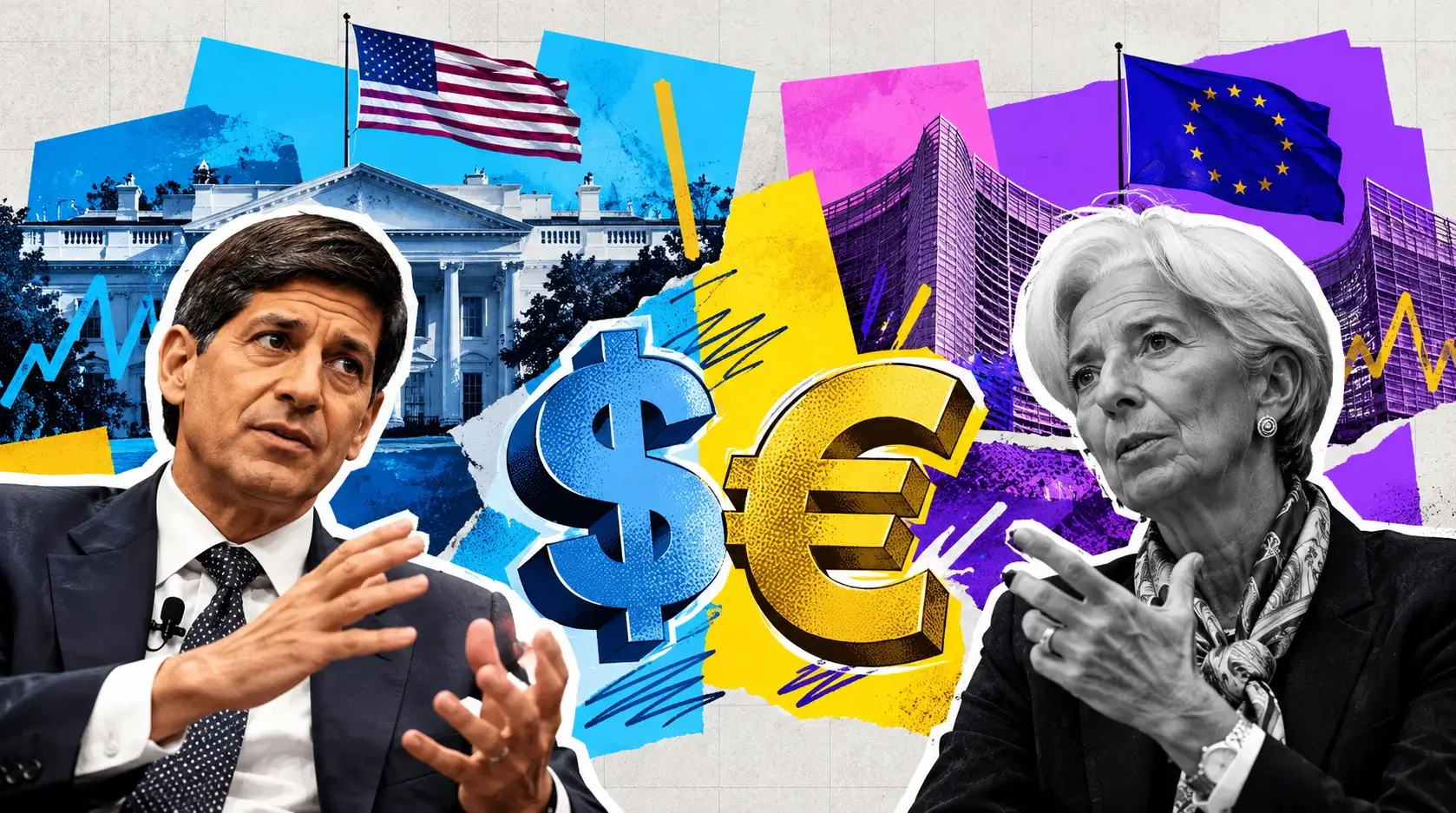
EUR/USD Price Forecast - Eur Surges to 1.1736 5-Week High as Dollar Collapses 1.4%
The 200-day SMA at 1.1672 flipped from resistance to support, DXY's mid-March trendline is broken | That's TradingNEWS
Key Points
- EUR/USD hit 1.1736, a five-week high, after a 136-pip weekly rally as the DXY crashed to 98.55 — its worst week since January.
- Core CPI missed at 0.2% vs. 0.3% expected, removing the Fed tightening case. The 200-day SMA at 1.1672 flipped to support. Next target: 1.1820.
- Islamabad weekend talks are the binary trigger — a Hormuz deal gaps EUR/USD to 1.1820; a breakdown risks 80-110 pips of downside to 1.1620.
EUR/USD is trading at 1.1736 on Friday — its highest print since early March — and the move is not a blip, a short squeeze, or a positioning accident. It's the fifth consecutive session of gains for the pair, representing a sustained directional shift that began the moment the U.S.-Iran ceasefire landed on Tuesday and accelerated every single day since. The U.S. Dollar Index (DXY) is sitting at 98.55, tracking for its largest weekly decline since January, and the number that frames this entire story is not the CPI print that dominated morning headlines — it's the 1% slide in the dollar earlier this week that nobody fully positioned for and that has not been meaningfully reversed despite oil's late-week stabilization. The EUR/USD bulls broke through a confluence zone that had been capping the pair for weeks, and the structure that's now in place argues for continuation rather than exhaustion — with the next significant resistance cluster sitting at 1.1742, then 1.1820, then 1.1931, and ultimately the prior swing high region near 1.2072. The downside, by contrast, is well-mapped and defended. The market has told you exactly where it believes in this pair, and right now it believes in it at 1.1736.
Why the Dollar Cracked This Week — and Why the Crack Is Not Being Repaired
The dollar's structural problem this week traces back to a single word: safe-haven. Through much of March, USD strength was entirely a function of fear-driven demand. Energy prices spiking on Hormuz closure, inflation expectations deteriorating, geopolitical risk premium piling into the world's reserve currency — all of it created a defensive dollar bid that had nothing to do with economic fundamentals and everything to do with crisis positioning. When the ceasefire arrived Tuesday, that bid evaporated. Safe-haven flows unwound fast, and they unwound hard. The DXY was near its mid-March starting point around the 100 level before the week began, and by Friday morning it was clinging to 98.55 — a move of roughly 1.4% in five trading sessions that represents an enormous shift in the dollar's global bid at a time when 1.4% weekly moves in major reserve currencies are exceptional rather than routine. The psychological 100 level on the DXY is not just a round number — it functions as a market-wide confidence threshold. Trading below it signals that global capital is not running toward the dollar the way it was during peak Middle East fear. The ceiling on any dollar recovery this week sat at 98.90-98.95, and every attempt to reclaim it has failed. There's a trendline from mid-March that had been guiding the DXY higher throughout the entire conflict period — it's now broken. Broken trendlines on the dollar don't heal in one session. They take catalysts to repair, and the only catalyst strong enough to reverse this move would be a complete collapse of the Islamabad peace talks, a full re-escalation of the conflict, and oil spiking back above $100 — a scenario the market is pricing as possible but not probable heading into the weekend.
The 1.1670 Breakout Was the Technical Signal That Confirmed the Trend Shift
The overnight session before Friday's CPI print delivered the technical event that gave EUR/USD bulls genuine structural confirmation. The pair broke through the 1.1670 confluence level — a zone where the 200-day Simple Moving Average and the 38.2% Fibonacci retracement of the January-to-March slide converge simultaneously. When two major technical reference points stack at the same price level, a breakout through that zone carries double the analytical weight of a single indicator breach. The 200-day SMA at 1.1672 is the line that separates the long-term bull regime from the long-term bear regime for any currency pair. The 38.2% Fibonacci retracement of a significant multi-month move represents the minimum retracement that characterizes a genuine trend reversal rather than a dead-cat bounce. Clearing both simultaneously is not a minor development. The RSI is hovering near 58 — constructive, directionally positive, and crucially not yet at overbought levels that would typically warn of an imminent reversal. An RSI of 58 with room to 70 before overbought territory means the momentum engine has fuel remaining. The MACD is in positive territory, confirming that the shorter-term moving average is now above the longer-term average — directional momentum confirmation that aligns with the price action rather than contradicting it. Three independent technical signals — price above the 200-day SMA, positive MACD, RSI with room to run — are all pointing the same direction simultaneously. That's not noise. That's a setup.
CPI at 3.3% Annually Didn't Stop EUR/USD From Rising — Here's Why
The March CPI release was the morning's headline event and it created genuine pre-release anxiety for EUR/USD longs. A hot inflation print would normally strengthen the dollar through its Fed policy implications — higher inflation means tighter policy for longer, which is dollar-positive. Headline CPI came in at 0.9% month-over-month and 3.3% year-over-year, sharply accelerating from February's 0.3% monthly and 2.4% annual readings. On the surface, that's the kind of number that sends the dollar higher and EUR/USD lower. But the composition of that print is what matters, and the composition is what the market read correctly and quickly. Core CPI — which strips out food and energy — printed at 0.2% month-over-month, below the 0.3% consensus forecast. Annually, core CPI edged up to just 2.6%, also coming in below the 2.7% expectation. The 0.1 percentage point miss on both monthly and annual core is small in absolute terms but enormous in policy implication terms: it tells the Fed that the energy shock driven by Hormuz closure is not bleeding into the broader inflation basket. The 3.3% headline is almost entirely a gasoline story — the gasoline index surged 21.2% in a single month and accounted for nearly three-quarters of the entire monthly price increase. The Fed has already telegraphed it is treating this as a supply shock rather than demand-pull inflation, which means Powell is not going to respond to a 3.3% CPI driven by war-era energy costs with rate hikes. That policy signal — rates on hold with a softening bias — is dollar-negative and EUR/USD-positive, which is exactly what the market priced in real time. The pair pushed higher on the CPI release, not lower. That itself is a powerful directional signal about where the market's conviction sits.
The Dollar Index at 98.55 Is Heading for Its Worst Week Since January — What That Means for EUR
The DXY's trajectory toward its biggest weekly loss since January deserves examination as a macro signal beyond just the EUR/USD relationship. The dollar index measures the dollar against a basket of six major currencies weighted toward the euro (57.6%), Japanese yen (13.6%), British pound (11.9%), Canadian dollar (9.1%), Swedish krona (4.2%), and Swiss franc (3.6%). A broad weekly loss of the magnitude being registered means the dollar isn't just losing to the euro — it's losing across virtually every major currency pairing simultaneously. That kind of synchronized weakness is a structural signal, not a bilateral quirk. It means the global capital flows that had been rotating into the dollar as a conflict hedge are now rotating out, and that rotation is happening faster than the geopolitical situation is actually improving. The Strait of Hormuz is still largely closed. WTI is at $98.39. The ceasefire is two weeks old and hasn't resolved anything permanently. Yet the dollar is down 1.4% for the week. The gap between the dollar's weakness and the degree of actual geopolitical resolution is the key analytical tension for the EUR/USD forward outlook. If the peace talks in Islamabad this weekend produce genuine progress toward Hormuz reopening, the dollar's retreat is justified and EUR/USD builds further. If they produce nothing, the dollar should recover some of what it lost this week — but the magnitude of that potential recovery is capped by the fact that the core CPI miss has already reduced the Fed's tightening bias, regardless of what happens at the negotiating table.
EUR/USD at 1.1736 — The Resistance Map From Here to 1.2072
With the 200-day SMA and the 38.2% Fibonacci level cleared at 1.1670, the EUR/USD resistance structure becomes the critical navigation tool for understanding how far this move extends. The immediate next barrier sits at 1.1742 — the 50% Fibonacci retracement of the January-to-March decline. Getting through 1.1670 was a momentum signal. Getting through 1.1742 would be a trend statement. At 1.1736, the pair is literally nine pips away from that next resistance point. If it clears 1.1742 on a daily close basis — and the current session's momentum suggests it will attempt to — the next layer activates at 1.1820, which represents the 61.8% Fibonacci retracement. The 61.8% level is the "golden ratio" retracement point that technicians place the most weight on — clearing it would signal that the January-to-March decline is being fully unwound and that the market is establishing a new directional regime rather than simply bouncing within an existing one. Above 1.1820, resistance emerges at 1.1931 and then the prior swing high zone near 1.2072. That 1.2072 level is the strategic target for a sustained EUR/USD bull run — getting there from the current 1.1736 represents approximately 2.9% of additional upside. In the short-term zone that matters for positioning right now, the 1.1750-1.1800 area is where the pair is likely to encounter its first meaningful resistance test. The move from 1.1670 to 1.1750 has been clean and fast. The move from 1.1750 to 1.1820 will require either a significant positive development from the weekend talks or a sustained continuation of dollar weakness that the current macro setup justifies but doesn't guarantee.
The $1.1667 Support Floor — The 200-Day SMA Is Now Working as Demand, Not Resistance
The technical structure of EUR/USD has undergone a textbook inversion at the 200-day SMA. Before the breakout, 1.1672 was resistance — the level the market repeatedly failed to clear during the March recovery attempts. After a clean break through it, the 200-day SMA switches roles and becomes support. This phenomenon, known as polarity reversal, is one of the most reliable signals in technical analysis precisely because the level maintains its significance while its directional role changes. Every pullback in EUR/USD that finds support at 1.1667-1.1672 is now a buy signal. That's not a speculative call — it's the mechanical implication of a successful breakout through a major moving average. Below the 200-day SMA, the first meaningful support clusters at 1.1667 — the 38.2% Fibonacci level — and then at 1.1605, which was Tuesday's high and now needs to hold as a support floor. The broader demand zone sits at 1.1578-1.1605, incorporating the January low that was recently reclaimed. A sustained daily close below 1.1578 would represent a complete reversal of the week's breakout structure and would signal that the move was a fakeout rather than a genuine trend change. The 23.6% Fibonacci level at 1.1568 and the March monthly swing low just ahead of the 1.1400 round number represent the deeper support architecture that only becomes relevant if the weekend talks collapse entirely and oil spikes back to triple digits.
The Strait of Hormuz Is Still the EUR/USD Macro Override — Nothing Else Gets Resolved Until It Does
The most honest framing of EUR/USD's current situation is that energy prices are the primary driver, not interest rate differentials, not growth divergence, not ECB-Fed policy gap — energy. The connection is mechanical and direct. When oil is expensive because Hormuz is restricted, European energy costs surge disproportionately because Europe imports a larger share of its energy than the U.S. does on a proportional basis. Higher energy costs in Europe raise inflation, complicate ECB rate decisions by creating a stagflationary dynamic, slow growth, and generally create a negative macro environment for the euro. When oil falls — which it did sharply after Tuesday's ceasefire — European energy cost pressure eases, ECB rate hike expectations fade, and the euro recovers relative to the dollar. The 1.4% move in EUR/USD this week is essentially a function of oil's behavior during the same period. Brent crude fell sharply on the ceasefire announcement but has since partially recovered on Saudi Arabia's disclosure of 600,000 barrels per day of lost production capacity from drone strikes. The late-week oil stabilization is why EUR/USD has been consolidating near 1.1700-1.1736 rather than surging through 1.1800 in a single session. The pair is being held in equilibrium by the tension between ceasefire optimism pulling oil lower (euro-positive) and supply damage pulling oil higher (euro-negative). The weekend talks in Islamabad are specifically about the Hormuz situation, which makes them the most important macro variable for EUR/USD over the next 72 hours by an enormous margin.
GBP/USD at 1.3420-1.3440 — Sterling Is Tracking the Same Theme With Its Own Layer
GBP/USD is running a parallel story to EUR/USD and the two pairs are highly correlated in the current environment because the primary driver — dollar weakness driven by ceasefire-related safe-haven unwinding — hits both with equal force. Cable is trading around 1.3420-1.3440, holding most of its week's gains, and the technical setup shows stabilization within a rising channel after the initial sharp rally. The key support structure at 1.3420 reflects a confluence of the 0.382-0.5 Fibonacci retracement zone from the recent swing low to high overlapping with rising channel support — a double technical demand zone that has been attracting buyers on every approach. The 50-period and 100-period EMAs are both below current price, confirming the near-term bullish structure is intact. The RSI at approximately 55 is neutral-to-positive — above the 50 midpoint but far from overbought, leaving room for further momentum extension. The immediate challenge for GBP/USD is clearing 1.3450 on a sustained basis — a break above that level opens the path toward 1.3500, which has been the week's stated target for cable bulls. British Prime Minister Keir Starmer's public frustration with energy price volatility — explicitly stating he's "fed up" with energy bills swinging on the decisions of Trump and Putin — reflects the direct political economy of the Hormuz situation for the UK, and any improvement in the geopolitical picture would be felt in sterling's energy-cost discount immediately. The stop structure for any long GBP/USD position is at 1.3380 — below that level, the rising channel support breaks and the near-term bullish case requires rebuilding.
Read More
-
Yen Stalls at 160 Despite a 3% JGB and Tokyo Core CPI at 2.0% — Intervention Sits at 164, Friday's Payrolls Decide
02.09.2026 · TradingNEWS ArchiveEnergy
-
SMCX ETF ($9.83) Delivers a Clean 2x Day on Super Micro’s Beat — Meta Capex and November 3 Cash Flow Decide $12.88 or $8.13
21.10.2026 · TradingNEWS ArchiveStocks
-
XRPR ($11.24) and XRPI ($7.45) Ride XRP’s Short Squeeze as Futures Basis Gives XRPI an 87bp Edge — Roll Costs Favor the Spot Wrapper
21.10.2026 · TradingNEWS ArchiveCrypto
-
NG ($2.829) Drops 7.5% in Two Sessions While TTF Holds $29 — Winter Strip Keeps a 35-Cent Premium
21.10.2026 · TradingNEWS ArchiveCommodities
-
USD/JPY (158.18) Stuck in a 200-Pip Range as BoJ Eyes 1.50% in December — Fed Guidance Sets the Path to 155.50 or 160
21.10.2026 · TradingNEWS ArchiveForex
What the ECB Does Next Is Completely Hostage to Energy — And That Makes EUR/USD Binary
The ECB's rate decision framework has been dramatically complicated by the energy shock, and understanding that complication is essential for any EUR/USD position held beyond the weekend. Before the Iran conflict began six weeks ago, the ECB was operating in an environment of gradually declining inflation and increasing confidence that the 2% target was within reach — a setup that was beginning to price in European rate cuts as a directional certainty. The Hormuz closure changed all of that. Energy-driven inflation in Europe reaccelerated sharply, creating a scenario where the ECB faces rising headline inflation on one side and slowing growth on the other — the classic stagflationary trap that central banks have the least effective toolkit for addressing. If the peace talks this weekend produce genuine progress toward Hormuz reopening and oil falls back toward pre-conflict levels — call it $75-$80 on Brent versus the current $96-$98 — European energy inflation pressure eases, the ECB gets back to cutting rates, and EUR/USD strengthens materially because lower European rates combined with a dovish Fed creates a compressed yield differential that reduces the dollar's relative attractiveness. If talks fail and oil re-escalates, the ECB faces renewed pressure to maintain or even tighten policy — a hawkish European central bank alongside a neutral U.S. Fed would normally be euro-positive, but in this case the negative growth implications of sustained $100-plus oil would overwhelm any rate differential benefit for the euro. The ECB meeting and its minutes — coming next week — will be the first formal institutional response to the ceasefire, and the market will be parsing every word for signals about whether the bank has shifted back toward a cutting bias or remains in inflation-fighting hold mode. The next major ECB data points, combined with U.S. PPI figures also due next week, will set the EUR/USD trajectory through the end of April.
The Sentiment Shift Is Real — But Not All of the Easy Gains Are Still Available
The character of this week's EUR/USD rally needs precise calibration. What happened from Monday to Wednesday was a genuine positioning reversal — the unwinding of long-dollar, short-euro positions that had been built as conflict hedges, and that unwinding was fast, clean, and mechanical. When a market reverses a positioning extreme, the move can be violent and rapid precisely because it doesn't require fundamental conviction — it just requires the fear that built the position to recede. That phase of the move is largely complete. The pair went from below 1.1600 at the start of the week to 1.1736 by Friday — a 136-pip rally in five sessions driven primarily by positioning reversal rather than fundamental re-evaluation. The next phase of the move — from 1.1736 toward 1.1820 and beyond — requires actual fundamental catalysts: a Hormuz agreement, a sustained decline in oil prices, clear ECB dovish signals, or another meaningful leg down in the dollar. Without one of those, the pair is likely to consolidate in the 1.1700-1.1750 range as the easy money from the positioning reversal gets absorbed and fresh catalysts need to develop. This doesn't mean the move is over. It means the character of the move has shifted from tactical positioning reversal to fundamental re-evaluation, and that second phase requires patience and catalyst confirmation rather than momentum chasing.
EUR/USD Is a BUY — With Precise Entry, Target, and Risk Parameters
The directional call is straightforward given the technical and fundamental setup. EUR/USD is a BUY. The 200-day SMA breakout at 1.1670 has been confirmed. The RSI at 58 provides momentum room. The MACD is positive. The dollar is structurally weakened by safe-haven unwind that won't fully reverse unless the conflict catastrophically re-escalates. The core CPI miss at 0.2% versus 0.3% expected reduces the Fed's tightening bias and removes the primary dollar-positive policy argument. The sequence of higher lows in EUR/USD over recent sessions confirms the momentum structure is intact. The $98.55 DXY level represents a broken mid-March trendline from which recovery attempts have repeatedly failed. The entry level for fresh long positioning is any pullback to the 1.1667-1.1680 zone — the 200-day SMA plus 38.2% Fibonacci support cluster that now acts as demand rather than resistance. From that entry zone, the first target is 1.1742 (50% Fibonacci), the second target is 1.1820 (61.8% Fibonacci), and the extended target for a sustained bull move is 1.1931 and ultimately the 1.2072 prior swing high. The stop belongs below 1.1578 — the January low reclamation level whose breach would invalidate the current breakout structure. The risk-reward from a 1.1680 entry to a 1.1820 primary target against a 1.1578 stop is approximately 1:1.37 — not the widest ratio but supported by the strength of the technical setup and the alignment of macro drivers. For the pair to fail this setup and trade back to the stop level, the weekend talks would need to completely collapse, Iran would need to re-escalate the Hormuz situation aggressively, oil would need to spike back above $100, and the dollar would need to recover its full safe-haven premium — a sequence that is possible but which the market is assigning low near-term probability to given the current restraint both sides are showing ahead of the Islamabad meeting.
The Weekend Binary and What Monday's Open Looks Like Under Each Scenario
Two scenarios define what EUR/USD does at Monday's open, and the gap between them is wide enough that anyone holding over the weekend needs to have thought through both explicitly. Scenario one: the Islamabad talks produce a credible framework for Hormuz reopening, Iran commits to a timeline for restoring shipping access, oil falls toward $85-$90 on the news, the dollar continues its structural retreat, and EUR/USD opens Monday near 1.1800-1.1820 with significant momentum toward the 61.8% Fibonacci level. That's the bull scenario and it represents roughly 60-70 pips of weekend gap upside from current levels. Scenario two: talks produce no agreement, Iran reasserts Hormuz restrictions possibly in response to Israeli Lebanon strikes, oil spikes back toward $100-$105, the safe-haven dollar bid returns partially, and EUR/USD opens Monday near 1.1620-1.1650 — testing but not necessarily breaking the 200-day SMA support. That's the bear scenario and it represents roughly 80-110 pips of weekend gap downside. The asymmetry slightly favors the downside in pips — which means position sizing for long EUR/USD over the weekend needs to account for the gap risk explicitly. The structural bias remains bullish. The weekend event risk argues for sizing discipline rather than position reduction. Holding EUR/USD long at 1.1736 through the weekend with a mental stop at 1.1578 and a target of 1.1820 is the correct tactical expression of a bullish conviction that the market's direction is established and the geopolitical overhang, while real, is more likely to resolve constructively than catastrophically given both sides' demonstrated preference for restraint in the days leading into the Islamabad talks.