Euro Drops to $1.1540 as a Hawkish Warsh Fed Powers the Dollar to a 13-Month High
EUR/USD broke to a three-month low after the Fed flagged possible 2026 hikes, lifting the dollar index near 100.7 | That's TradingNEWS
Key Points
- EUR/USD slid to ~$1.1540, its lowest since late March, well below the $1.2019 January high, as the dollar strengthened broadly.
- The Fed held at 3.50%–3.75% but the hawkish dot plot (9 of 18 projecting a 2026 hike) sent the DXY to a 13-month high near 100.7.
- The ECB hiked to ~2.25% last week, but markets now price under 30bp of further tightening as the Iran deal sinks oil.
The euro extended its slide Thursday, trading near $1.1540 against the dollar and sitting at its lowest level since late March, as the fallout from the most hawkish Federal Reserve signal in years continued to lift the greenback across the board. The pair has been knocked off its perch by a meeting that flipped the rate narrative on its head, and it now finds itself testing the lower reaches of its 2026 range with the dollar trading at multi-month highs. Where EUR/USD spent much of the spring grinding sideways in the high $1.16s, it has now broken decisively lower, and the path of least resistance points down so long as the Fed's new posture holds.
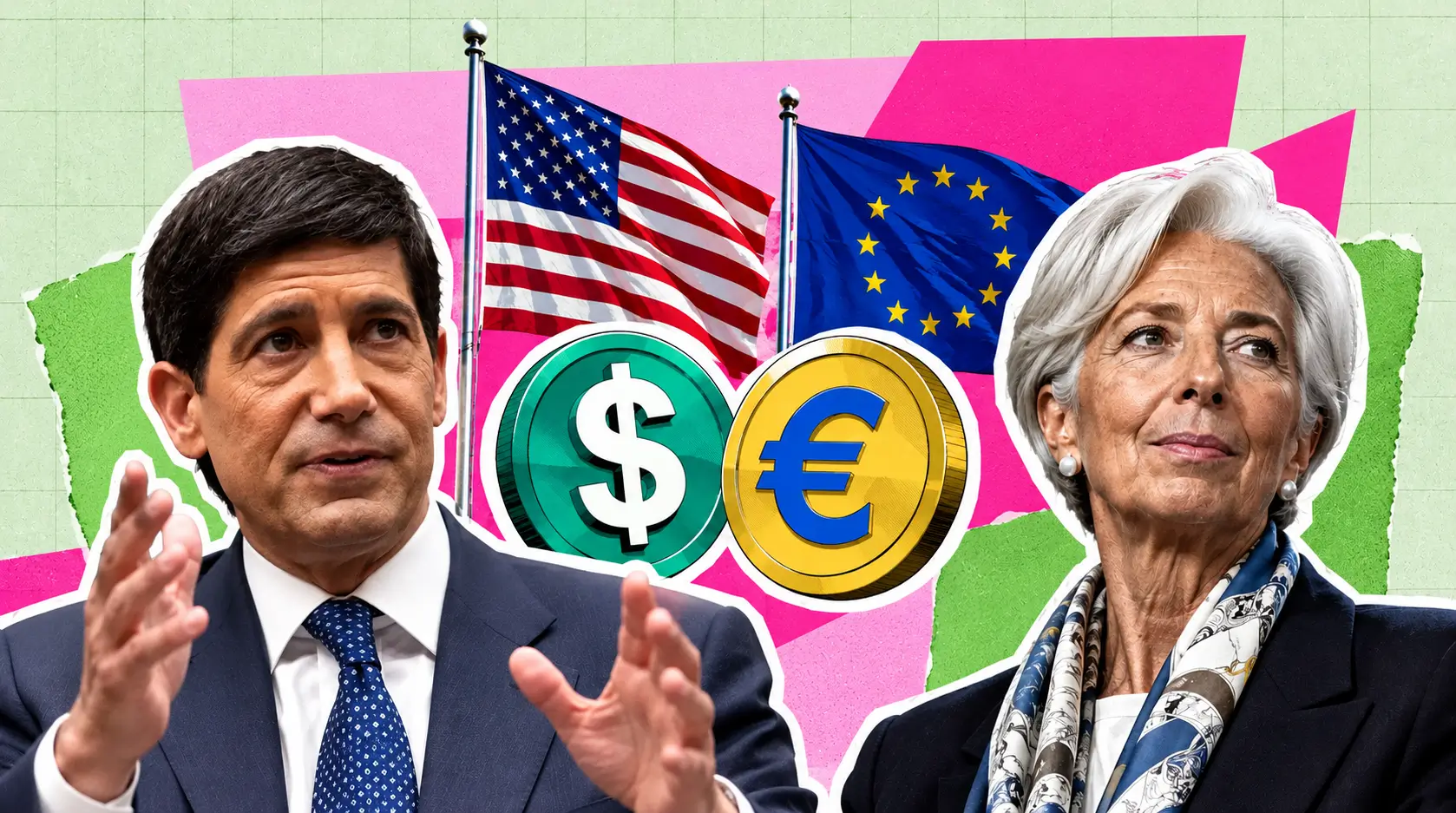
The catalyst was Wednesday's Federal Open Market Committee meeting, the first chaired by Kevin Warsh, which paired a rate hold with projections that stunned the market. With half the committee now projecting a rate hike before year-end and the inflation forecasts revised sharply higher, traders rushed to reprice the dollar higher and Treasury yields surged. The euro, already capped by a firm greenback through the spring, had little defense against a Fed that has shifted from contemplating cuts to flagging hikes, and the single currency tumbled toward $1.15 as the rate-differential story turned decisively against it.
Yet the picture is more nuanced than a simple dollar-strength story. The European Central Bank delivered its own rate hike last week and continues to lean hawkish, which under normal conditions would support the euro. The complication is that the signed US-Iran peace deal and the resulting collapse in oil prices have prompted money markets to scale back their bets on further ECB tightening, removing one of the euro's supports just as the dollar found a fresh tailwind. EUR/USD enters the long holiday weekend — with US markets closed Friday for Juneteenth — pinned at a three-month low, caught between a newly hawkish Fed and an ECB whose tightening path the market is increasingly doubting.
Where EUR/USD Trades Now: The Three-Month Low and the Dollar's Climb
The hard numbers frame the shift. EUR/USD changed hands near $1.1540 on Thursday after falling to $1.15 in the wake of the Fed meeting, its weakest level since late March. The move came as the dollar strengthened broadly, with the greenback jumping nearly 1% on Wednesday and extending those gains into Thursday. The pair had held around $1.16 ahead of the Fed decision, so the break lower represents a meaningful technical and sentiment shift rather than routine noise.
The dollar's strength is best captured by the US Dollar Index, which extended its advance for a second straight session and climbed toward the 100.6 to 100.7 region on Thursday, its highest level since May 2025. The index jumped nearly 1% on Wednesday alone and has gained well over a percent over the past four weeks, a clear signal that the hawkish Fed repricing has reignited dollar demand after a period of consolidation. Because the euro carries the largest weight in the dollar index by a wide margin, the euro's weakness and the dollar's strength are two sides of the same coin.
Context frames the severity of the move. EUR/USD trades well below its January high near $1.2019, the peak of a broader 2026 range that has stretched from roughly $1.1435 to that high, a spread of about 5%. The pair spent much of the first half of the year oscillating in the mid-to-high $1.16s, capped by a dollar that repeatedly refused to roll over despite widespread expectations of dollar weakness. The break to a three-month low now places the euro at the lower end of that range, and the $1.1435 floor that marked the 2026 low has come back into focus. Holding above $1.1500 becomes the immediate technical question, since a clean break of that round number would expose the year's lows and signal that the dollar's resurgence has further to run.
The Fed Repricing: How a Hawkish Dot Plot Sank the Euro
The proximate cause of the euro's slide was the Fed's projections, which delivered a genuine shock to currency markets. The committee held its benchmark rate steady in the 3.50% to 3.75% range, the fourth consecutive hold and a decision markets had fully anticipated. The bombshell came in the dot plot. Of the eighteen officials who submitted projections, nine now see rates rising before the end of 2026, with six penciling in at least two hikes and one projecting three. As recently as March, the committee had been pointing toward cuts.
The repricing in rate markets was swift and decisive. Traders moved to price a quarter-point hike into the curve by year-end, and the entire short end of the Treasury market shifted higher. For the dollar, this was straightforwardly bullish. A central bank leaning toward hikes attracts capital seeking higher yields, strengthens the currency through the interest-rate channel, and widens the gap against currencies whose central banks are closer to the end of their tightening cycles. The euro, sitting on the other side of that widening differential, bore the brunt of the adjustment.
What made the projections especially potent was the revision to the inflation outlook. The committee raised its core inflation forecasts sharply for this year and next, despite growing signs of cooling in parts of the labor market. The willingness to lean hawkish on inflation even as some employment indicators softened signaled a Fed singularly focused on price stability, a stance that supports the dollar by keeping real yields elevated. The euro had been relying on the expectation that the Fed would eventually ease, providing a tailwind for the single currency as the rate gap narrowed. That expectation evaporated on Wednesday, and EUR/USD adjusted lower in real time, with the three-month low the direct consequence of a Fed that changed the rules of the game for FX traders.
Warsh's First Meeting and the "Deliver Price Stability" Message
The hawkish surprise carried added weight because it came at Kevin Warsh's first meeting as chair, and it confounded the prevailing narrative about how he would steer policy. Many had assumed a Trump-backed chair would lean dovish and deliver the rate cuts the administration had pushed for. The messaging from the meeting pointed firmly in the opposite direction, and that confounding of expectations amplified the market reaction.
Warsh's communication style reinforced the hawkish substance. He declined to submit his own dot or offer guidance on the next policy move, consistent with his long-standing criticism of forward guidance and the dot-plot framework. The post-meeting statement was deliberately terse, and it closed with a pointed commitment that the committee would deliver price stability — about as hawkish a framing as a central bank can offer without actually raising rates. He stressed that inflation has remained above the Fed's 2% target for several years and reaffirmed the commitment to bringing it down, leaving no doubt about the committee's priorities.
The implications for the euro flow directly from this posture. A Fed chair who emphasizes price stability above all, who has stripped away the reassuring forward guidance markets had relied on, and who presides over a committee increasingly tilted toward hikes is a recipe for sustained dollar strength. The opacity around Warsh's own views adds a layer of uncertainty, but the tone of the statement and press conference was unambiguously hawkish, and that is what currency markets traded. For EUR/USD, the message was that the dollar's interest-rate advantage is set to persist or even widen, removing the central pillar that bulls had been counting on for a euro recovery and cementing the single currency's break to a three-month low.
The Dollar Index Breaks to a 13-Month High
The clearest expression of the post-Fed dynamic is the dollar index, which broke out to its highest level since May 2025. The gauge, which measures the greenback against a basket of major currencies, extended its gains for a second straight session and pushed toward the 100.6 to 100.7 area, decisively reclaiming the 100 mark after jumping nearly 1% on Wednesday. The breakout confirms that the hawkish Fed repricing has reignited broad dollar demand.
The euro's outsized weight in the index — well over half the basket — means that the dollar's strength and the euro's weakness reinforce each other mechanically. As EUR/USD falls, the index rises, and as the index rises on dollar-positive news, it drags the euro lower. This feedback loop has been a defining feature of the post-Fed price action, with the dollar's surge to multi-month highs and the euro's slide to a three-month low being two readings of the same underlying force. The index's gains over the past month and year underscore that the dollar's firmness is not a one-day event but a trend that the Fed meeting has accelerated.
The breakout matters for the technical outlook as well. A dollar index trading at a 13-month high with momentum behind it suggests the path of least resistance for the greenback points higher, which by extension caps the euro and tilts the risk for EUR/USD toward further downside. The dollar had defied widespread forecasts of weakness throughout 2026, supported by sticky inflation and an unresolved geopolitical picture, and the hawkish Fed has now given it a fresh reason to extend that strength. For the euro to mount a sustained recovery, it would likely need the dollar index to roll over from these highs, which in turn would require a shift in the Fed narrative that does not appear imminent.
The ECB's Dilemma: A Hike Delivered, but Bets Scaled Back
The euro's predicament is not purely a dollar story; the European side of the equation has its own complications. The European Central Bank raised interest rates by a quarter point last week, lifting its deposit rate as it continues to combat elevated inflation, a move that was in line with expectations and that would normally support the single currency. Eurozone inflation has run above target, with headline readings near 3% and core around the low 2s, and several ECB policymakers have signaled that upside inflation risks justify further tightening.
The complication is that the market has begun to doubt how much more tightening the ECB will deliver. Following the preliminary US-Iran agreement and the resulting collapse in oil prices, money markets scaled back their expectations for additional ECB hikes, now pricing in less than 30 basis points of further tightening this year — equivalent to roughly one more increase, down from nearly two before the central bank's recent move. The logic is that cheaper energy eases the inflationary pressure that had been driving the ECB's hawkish stance, reducing the urgency for further hikes. As those expectations were trimmed, one of the euro's supports weakened.
The ECB's messaging has tried to lean against this dovish repricing. Policymakers have reiterated that upside inflation risks continue to justify tightening, with some expecting at least one more hike to keep inflation expectations anchored, and the ECB president welcomed the Iran news while cautioning against past dashed hopes and warning of emerging second-round effects from the conflict. Officials have also noted that any relief in energy supply would take months to materialize, delaying the disinflation the market is pricing. This tension — between an ECB that wants to keep tightening and a market that increasingly expects it to stop — leaves the euro caught in the middle, lacking a clear hawkish catalyst to offset the dollar's strength.
The Iran Deal's Double Edge for the Euro
The signed US-Iran peace memorandum cuts both ways for the euro, and disentangling its effects is key to understanding the pair's recent behavior. On the risk-sentiment side, the deal was initially positive for the single currency. As investors embraced riskier assets following the agreement to end the conflict and reopen the Strait of Hormuz, the euro briefly rose toward $1.16 earlier in the week, benefiting from the improved global mood and the unwinding of safe-haven dollar demand.
On the monetary side, however, the deal worked against the euro. The collapse in oil prices that followed the agreement eased the inflationary pressures that had underpinned the ECB's hawkish stance, prompting the market to scale back its bets on further European tightening. Cheaper energy reduces eurozone inflation, which reduces the case for ECB hikes, which removes a pillar of euro support. The same disinflationary signal that markets read as friendly for risk assets thus undercut the rate-differential argument for the euro, leaving the single currency exposed to the dollar's hawkish-Fed tailwind.
The net effect has been negative for EUR/USD, because the monetary channel has dominated the sentiment channel. While the risk-on impulse provided a brief lift, the more durable force has been the repricing of central-bank expectations, which has favored the dollar on the Fed's hawkish turn and weighed on the euro as ECB tightening bets faded. The interim nature of the agreement adds uncertainty, since unresolved questions around Iran's nuclear program and the durability of the deal mean the geopolitical premium could partially return. But for now, the deal's primary FX consequence has been to reinforce the euro's weakness by easing the inflationary pressure that had kept the ECB hawkish, compounding the damage from the Fed meeting.
The Widening Rate Gap: Fed Hikes vs. ECB's Last Move
At the heart of EUR/USD's decline lies the shifting interest-rate differential between the Fed and the ECB. Currency pairs are driven heavily by the relative paths of their central banks, and that relationship has moved sharply against the euro. The Fed, holding in the 3.50% to 3.75% range, has pivoted toward potential hikes, while the ECB, having just raised to a deposit rate around 2.25%, is widely seen as near the end of its tightening cycle with perhaps one more move to come.
The math is unfavorable for the euro. A Fed that may hike while the ECB approaches a pause implies a widening gap in policy rates, and capital tends to flow toward the currency offering the higher and rising yield. The dollar's interest-rate advantage, already substantial, looks set to widen rather than narrow, which is the opposite of what euro bulls had been hoping for. Their thesis for a stronger euro rested on the rate gap closing as the Fed eased and the ECB tightened; the Fed's hawkish turn has reversed that convergence and reopened the divergence.
This rate-differential dynamic is the most durable of the forces weighing on EUR/USD, more structural than the day-to-day swings in sentiment or geopolitics. As long as the market believes the Fed is more likely to hike than cut while the ECB winds down its tightening, the differential will favor the dollar and cap the euro. A reversal would require either a dovish shift from the Fed — which would need cooler US inflation data to materialize — or a fresh hawkish impulse from the ECB strong enough to convince markets that European tightening has further to run. Absent one of those developments, the rate gap argues for the euro to remain on the defensive, with rallies likely to be sold and the three-month low vulnerable to a deeper test.
Inflation on Both Sides of the Atlantic
The inflation backdrop is the common thread running through both central banks' decisions, and it explains much of the euro's predicament. In the United States, the energy shock from the Middle East conflict pushed headline inflation sharply higher earlier in the year, reaching levels not seen in three years, with core measures also running well above the Fed's 2% target. That persistence removed the room the Fed had to cut rates and ultimately drove the hawkish turn that has powered the dollar.
In the eurozone, inflation has similarly been elevated, with the energy spike lifting headline readings near 3% and keeping core inflation above the ECB's comfort zone. The ECB has leaned hawkish in response, delivering rate hikes and signaling more could come. The crucial difference, though, is in how the market expects each central bank to respond to the oil decline that followed the Iran deal. For the Fed, the hawkish projections were set before the full disinflationary impact of cheaper oil could register, leaving the dollar supported. For the ECB, the market has moved quickly to assume that lower energy prices will ease eurozone inflation and curtail further tightening, undercutting the euro.
This asymmetry in market expectations is a key reason EUR/USD has fallen. Both economies face elevated inflation, but the dollar is benefiting from a Fed that has firmly committed to fighting it, while the euro is being penalized by a market that expects the ECB to soften its stance as energy costs ease. The upcoming inflation data on both sides of the Atlantic will be critical in resolving this divergence. Cooler US inflation would challenge the hawkish Fed narrative and could lift the euro, while persistent eurozone inflation that forces continued ECB tightening would support the single currency. Until those readings arrive, the inflation story tilts in the dollar's favor, reinforcing the euro's weakness.
The Bank of England Adds to the Dollar's Day
The broader dollar complex received additional support from the Bank of England's decision, which landed Thursday, the day after the Fed. The UK central bank was widely expected to hold its Bank Rate at 3.75%, with its governor having signaled the bank was in no hurry to move and the consensus leaning toward holds for the remainder of the year rather than hikes. A BoE on hold while the Fed leans hawkish reinforces the dollar's relative appeal across the major currencies.
While the BoE decision bears most directly on sterling, its effect ripples through the dollar index and the broader FX picture in ways that touch the euro. A day on which both the Fed turns hawkish and another major central bank holds steady tends to strengthen the dollar against the entire basket, and the euro, as the largest component of that basket, feels the pull. The contrast between a Fed flagging hikes and other central banks pausing or nearing the end of their cycles is precisely the kind of divergence that supports a broad dollar advance.
The interplay also matters for the euro through the cross-rate channel. The relative paths of the ECB, the BoE, and the Fed shape the web of currency relationships, and a configuration in which the Fed is the most hawkish of the three argues for dollar strength against both the euro and the pound. The euro's slide to a three-month low is thus part of a broader story of dollar resurgence driven by the Fed standing out as the most hawkish major central bank. For EUR/USD specifically, the takeaway is that the dollar's strength is not isolated to the euro but reflects a market-wide repricing in the greenback's favor, which makes the euro's recovery more difficult, since it would require the dollar to weaken against the entire complex rather than just the single currency.
Technical Picture: Support at $1.1500, the $1.1435 Floor in View
The chart frames the immediate stakes with clarity. With EUR/USD trading near $1.1540, the first line of defense is the $1.1500 round number, a psychologically important level that bulls need to hold to prevent a deeper decline. Below that sits the late-March low and, further down, the 2026 floor near $1.1435, the level that marked the bottom of the year's range. A decisive break below $1.1500 would expose those lower targets and confirm that the dollar's post-Fed surge has the momentum to push the euro to fresh year-to-date lows.
To the upside, resistance is layered and now more formidable after the break lower. The immediate hurdle is the $1.1600 area, which the euro surrendered in the wake of the Fed meeting and which now acts as resistance rather than support. Above that, the cluster of moving averages near $1.16 to $1.17 represents a more significant barrier, since the pair now trades below these key trend gauges. Reclaiming the $1.17 region, where the longer-term averages and the classic pivot reside, would be needed to suggest the downtrend is losing steam and to open the door toward the higher levels the euro held earlier in the year.
The break to a three-month low has shifted the technical bias firmly to the downside in the near term. The euro trades below its key moving averages, which now provide overhead resistance, and the momentum that drove the post-Fed slide remains intact. The $1.1500 support and the $1.1435 floor are the levels that matter most, since a successful defense would suggest the decline is finding a base, while a break would signal a deeper move lower. The configuration is one of a currency under pressure, pinned below resistance and testing support, with the dollar's strength dictating the terms. Until the euro can reclaim its moving-average structure, rallies are likely to be capped and the path of least resistance points down.
Read More
-
Yen Stalls at 160 Despite a 3% JGB and Tokyo Core CPI at 2.0% — Intervention Sits at 164, Friday's Payrolls Decide
02.09.2026 · TradingNEWS ArchiveEnergy
-
ZTAX Fund Jumps 7.36% to $22.83 After a Holiday Plunge to $21.26 Exposed a 10% Discount to NAV
13.10.2026 · TradingNEWS ArchiveStocks
-
XRP ETF Price — Bitwise Drives $11.31M Weekly Inflow as XRP Slides to $1.345 and ETF Holders Sit $230M Underwater
13.10.2026 · TradingNEWS ArchiveCrypto
-
Henry Hub Climbs to $3.26 While Europe Pays €86.93 — Record 111.5 Bcf/d Output Caps the Upside Near $3.41
13.10.2026 · TradingNEWS ArchiveCommodities
-
Dollar-Yen Pinned at 158.42 Between Carry and Intervention — 159 Caps Upside, 157 Opens on Soft CPI
13.10.2026 · TradingNEWS ArchiveForex
Moving Averages and Momentum: The Euro Below Its Trend
Beyond the horizontal levels, the euro's relationship with its moving averages reinforces the cautious near-term picture. EUR/USD now trades below both its shorter-term and longer-term moving averages, a configuration that typically accompanies a currency in a downtrend. The 50-day and 200-day averages, which had been clustered in the $1.16 to $1.17 zone, now sit overhead as dynamic resistance, and the pair's failure to hold above them confirms the bearish shift.
Momentum indicators have followed the price lower, with the post-Fed slide pushing the pair's technical readings toward a more negative posture. The break below the 20-day exponential moving average, which the euro had struggled to reclaim even before the Fed meeting, was an early warning that the pair's upside was capped, and the subsequent decline validated that signal. The momentum picture suggests the euro has room to fall further before reaching genuinely oversold territory, leaving the door open to additional downside if the dollar's strength persists.
There is a longer-term consideration worth noting, however. Some forecasting models continue to project the euro stabilizing or even recovering modestly over the medium term, with the rate differential expected to narrow eventually as the ECB's tightening and any future Fed easing converge. This reflects the view that the dollar's current strength, while powerful, may not be sustainable indefinitely if US inflation cools and the Fed's hawkish projections prove too aggressive. The tension between near-term bearish momentum and medium-term recovery potential captures the euro's situation: under pressure now from a hawkish Fed, but with structural forces that could reassert themselves if the macro picture shifts. The euro's ability to defend the $1.1500 support will be the key near-term determinant of which scenario prevails.
The Long View: From the $1.2019 January High to a Capped Range
Stepping back reveals the broader arc of EUR/USD this year. The pair reached a high near $1.2019 in January 2026, the peak of a recovery that had carried the euro up from the low $1.03 region at the start of 2025. That rally reflected a softer-dollar narrative, diverging ECB-Fed policy paths, and a general loss of confidence in the greenback. From that January high, the euro has drifted lower into a capped range, repeatedly failing to sustain moves above $1.17 as the dollar refused to weaken as forecasters had expected.
The reason the dollar held up better than anticipated comes down to the inflation shock and the unresolved geopolitical picture. The energy spike from the Middle East conflict pushed US inflation sharply higher, removing the Fed's room to cut and keeping the dollar supported even as many had forecast its decline. The euro, meanwhile, struggled to break higher despite the ECB's tightening, because the rate gap remained wide and the dollar's resilience capped any rallies. The result was a year of range-bound trading, with EUR/USD oscillating in the mid-to-high $1.16s for much of the spring before the Fed meeting knocked it lower.
The break to a three-month low places the euro at a critical juncture within that range. After spending months capped near the top of the range, the pair has now broken toward the bottom, and the question is whether it will find support at the $1.1435 floor or break to new lows for the year. The longer-term forecasts from major banks remain divided, with some projecting a stronger euro toward $1.20 or beyond as the rate gap eventually narrows, and others expecting the dollar's strength to persist. The resolution depends heavily on the inflation data and the relative paths of the two central banks. For now, the euro sits at the lower end of its range, with the hawkish Fed having tilted the near-term balance firmly toward the dollar.
Macro Crosscurrents: Oil, the PCE Print, and the Path Back
The euro's path forward is tangled in the same macro crosscurrents shaping the broader market. The signed US-Iran deal and the prospect of a reopening Strait of Hormuz have driven oil sharply lower, a disinflationary force with mixed implications for EUR/USD. On the European side, cheaper energy eases eurozone inflation and reduces the case for further ECB tightening, which weighs on the euro. On the US side, lower oil-driven inflation could eventually soften the Fed's hawkish stance, which would weaken the dollar and lift the euro — but only with a lag and only if confirmed in the data.
The crucial test arrives with the US personal consumption expenditures price index, the Fed's preferred inflation gauge, due later in the month. The reading will either validate or undercut the hawkish projections that drove the dollar higher. A cooler-than-expected print, perhaps aided by the oil decline, would challenge the rate-hike narrative, push US yields down, and likely provide a meaningful boost to the euro by narrowing the rate gap. A hot reading would do the opposite, cementing the hawkish dot plot, keeping the dollar supported, and extending the euro's weakness toward the year's lows.
The eurozone inflation data carries weight as well. Persistent European inflation that forces the ECB to continue tightening would support the euro by keeping the rate gap from widening further, while signs of cooling that confirm the market's dovish repricing would add to the pressure. The interplay between US and eurozone inflation, the trajectory of oil prices, and the relative central-bank responses will determine EUR/USD's direction. These crosscurrents leave the euro's near-term path dependent on the data, with the upcoming inflation prints on both sides of the Atlantic shaping up as the decisive variables for whether the three-month low holds or gives way.
EUR/USD Price Forecast: Scenarios for the Days and Weeks Ahead
Synthesizing the drivers produces a forecast built around competing scenarios, given how decisively the Fed meeting has tilted the near-term balance. In the bearish case, the hawkish Fed continues to dominate, the dollar index extends its advance from multi-month highs, the market keeps scaling back ECB tightening bets as oil stays low, and the euro loses the $1.1500 support. A break below that level would expose the late-March low and the $1.1435 floor, with a move to fresh 2026 lows possible if the dollar's momentum persists and US inflation data validates the hawkish projections.
In the constructive case, the euro defends $1.1500, the ECB leans against the dovish repricing with firmer hawkish guidance, and cooler US inflation data challenges the Fed's hawkish stance, narrowing the rate gap. That path would set up a recovery attempt toward the $1.1600 resistance, then the cluster of moving averages near $1.17, with a sustained break above that region needed to suggest the downtrend has run its course. A renewed geopolitical risk premium, given the interim nature of the Iran deal, could also support the euro by reviving the kind of two-way uncertainty that complicates the dollar's advance.
The base case sits between these poles: continued pressure on the euro with choppy, range-bound trading in the low-to-mid $1.15s as the market waits for the inflation data to resolve the rate question. With US markets closed Friday for the holiday, thinner liquidity could exaggerate moves in either direction over the long weekend, making risk management essential. The defining force remains the rate differential, which currently favors the dollar after the Fed's hawkish turn. Until the inflation data shifts the central-bank narrative, EUR/USD is likely to trade with a downward bias, with the $1.1500 support and the $1.1435 floor as the key levels and rallies toward $1.1600 likely to be sold.
What to Watch Next
The catalysts that will determine EUR/USD's direction are now clustered in the weeks immediately ahead. The US personal consumption expenditures inflation print stands as the single most important release, since it will either confirm or challenge the Fed's hawkish projections and, by extension, set the trajectory for the dollar and Treasury yields that drive the pair. A soft reading would be the cleanest bullish trigger for the euro; a hot one would likely extend the decline toward the year's lows.
The eurozone inflation data and ECB communication deserve close attention as the European counterweight. Any signs that eurozone inflation remains sticky enough to force continued ECB tightening would support the euro by preventing the rate gap from widening further, while confirmation of the market's dovish repricing would add to the pressure. Traders should also monitor the dollar index, since its breakout to a 13-month high is the clearest expression of the post-Fed dynamic, and any reversal from these highs would signal that the euro's recovery prospects are improving.
Finally, the geopolitical and oil tracks remain relevant, since the pace of the Strait of Hormuz reopening and the durability of the US-Iran agreement will shape both the inflation picture and the risk sentiment that influence the euro. A breakdown in the deal could revive volatility and complicate the dollar's advance. EUR/USD enters the holiday weekend at a three-month low, pinned between a hawkish Fed and an ECB whose tightening path the market increasingly doubts, defending support near $1.1500. The resolution will come from the inflation data and the central-bank narratives in the days ahead, and for now the prudent stance is to respect the levels, watch the rate differential, and let the macro picture clarify before committing to a directional conviction.