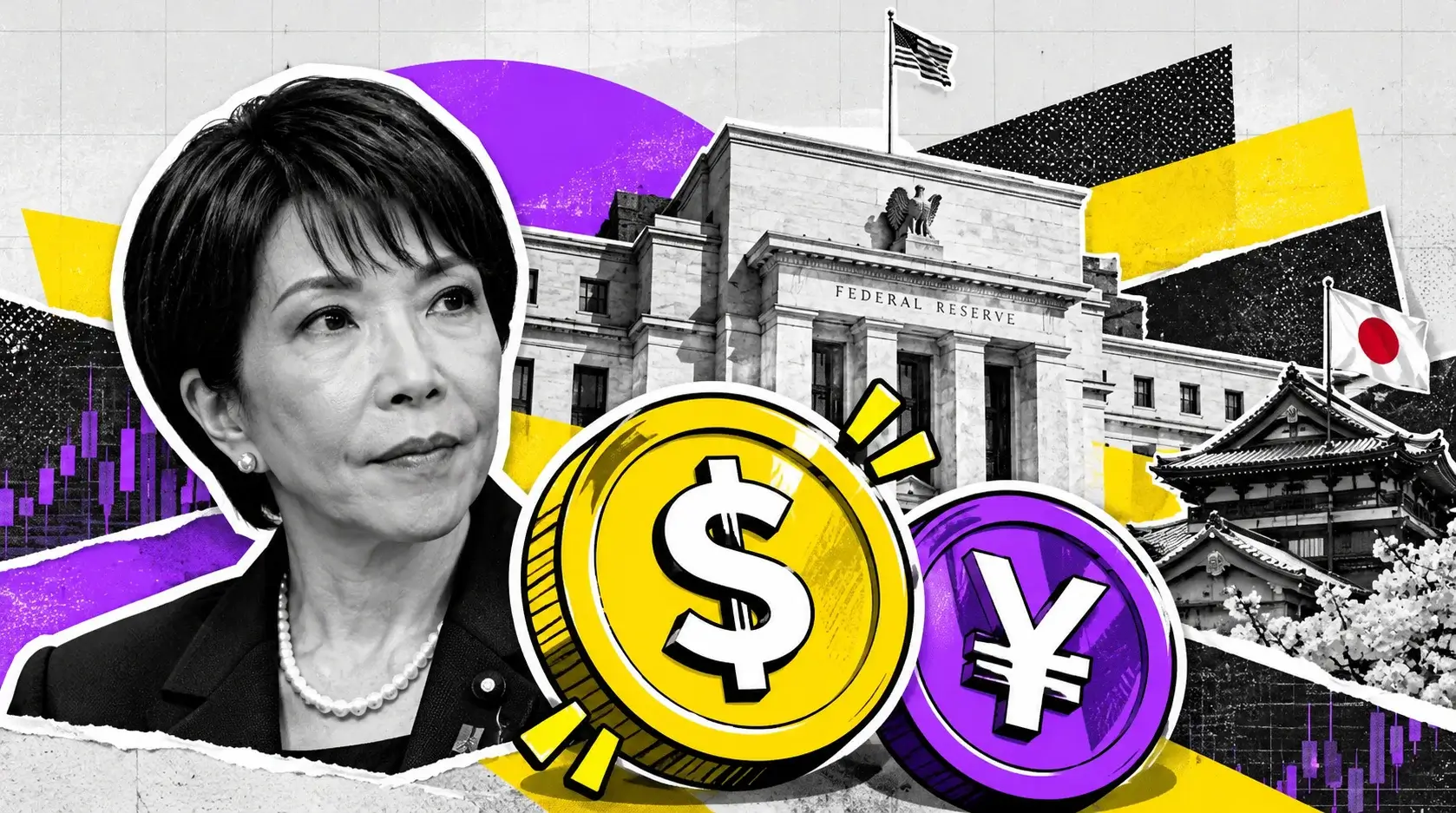
Yen Clings to 160 After the BoJ's Historic Hike to 1% Falls Flat, Leaving Intervention and the Fed to Decide the Next Move
USD/JPY holds 160.19 after the Bank of Japan raised rates to a 31-year-high 1% — a move 80% priced that the carry trade shrugged off | That's TradingNEWS
Key Points
- USD/JPY near 160.19, just above the 160 intervention line, after the BoJ hiked to a 31-year-high 1% that was 80% priced.
- The hike failed to lift the yen; only intervention or aggressive forward guidance pushes USD/JPY below 160.
- The Fed dot plot in 24 hours is the swing: a hawkish print widens the ~250-275bp gap and pressures the yen toward intervention.
The Bank of Japan did everything textbook policy prescribes and the yen barely moved. USD/JPY is trading at 160.19, up 0.17% on the session in a tight 159.90–160.38 range, sitting just above the 160.00 handle — the line in the sand for Japanese authorities — a day after the BoJ raised its benchmark rate to 1%, the highest level in 31 years. A three-decade-high rate hike from the central bank meant to defend the yen, and the currency is still sitting on the floor.
The paradox is the story. The BoJ delivered a quarter-point hike to 1% that had been roughly 80% priced for weeks, which left the decision nearly a non-event — the yen strengthened only marginally to 160.22 against the dollar after the announcement before drifting back. The rate increase alone failed to bring USD/JPY below 160 because the market had already discounted it; the yen would have gained more had the BoJ delivered an aggressively hawkish surprise, but that didn't happen. A historic hike, fully anticipated, produced a non-reaction.
The setup now is a binary standoff. With the BoJ hike behind the market, the next move for USD/JPY hinges on two things: the Federal Reserve's dot plot at 2 PM ET today — 24 hours after the BoJ — and the looming threat of currency intervention by Japanese authorities. The rate hike acts as a fundamental floor under the yen, but the actual teeth guarding the 160 line are the prospect of Tokyo stepping into the market to dump dollars and buy yen, after having already spent a record ¥9.2 trillion defending the level.
The one-line thesis for the forecast: USD/JPY is pinned at 160.19 because the BoJ's hike to a 31-year-high 1% was 80% priced and lacked an aggressively hawkish surprise, leaving the carry trade selling yen into the 160 intervention line — and the swing factors are the Fed dot plot 24 hours later, which sets the dollar side of the ~250-275bp rate gap, and whether Tokyo intervenes or delivers explicit rapid-hike guidance, with only those forcing USD/JPY below 160.
The setup is a currency pinned against its intervention line, where a historic rate hike couldn't move it and the next catalysts are a foreign central bank's projection and the threat of official intervention. The dot plot is hours away; the 160 line is the battleground.
The BoJ Hike to 1%: A 31-Year High, Fully Priced
The headline event was historic in scale. The Bank of Japan raised interest rates to their highest level in 31 years, a 25-basis-point hike lifting the reference rate to 1% — the highest since 1995. For a central bank that spent decades at zero and negative rates, the move marks another step in the historic normalization away from ultra-loose policy that began when the BoJ finally moved off negative rates. A 1% policy rate in Japan is a milestone.
But the decision was nearly a non-event for the currency. The quarter-point step to 1% had been roughly 80% priced for weeks, which meant the market had already discounted it — and a fully anticipated hike doesn't move the exchange rate. The yen strengthened only marginally, to 160.22, after the announcement before settling back around 160.15, a muted reaction that reflected how thoroughly the move was expected. The hike was historic in scale but unremarkable in market impact.
The focus shifted to the guidance and the quantitative tightening. With the rate decision priced, the market focused on the press conference, the JGB purchase plans, and any signal about the pace of future hikes. The BoJ said it would continue raising rates, and markets have begun pricing whether looming domestic stagflation pressures will allow the central bank to reach a projected 1.25% by late 2026. The forward path, not the hike itself, became the variable.
The inflation backdrop justified the move. The BoJ cited mounting inflationary pressures alongside the yen's weakness as the rationale, even though Japan's consumer inflation has been running below 2% due to government measures to reduce the household burden of higher energy prices. The hike was meant to address both the inflation risk and the currency weakness — but as the muted yen reaction showed, a priced-in hike addresses neither effectively without an accompanying hawkish surprise.
For the forecast, the BoJ hike is the fundamental floor that's already in the price. The move to a 31-year-high 1% is historic but discounted, which is why the yen didn't rally. The hike establishes a higher rate floor under the yen, but it's not the catalyst for a move below 160 — that requires either intervention or an aggressive forward-guidance surprise. The hike is done; the guidance and the Fed are the variables.
Why the Hike Couldn't Move the Yen
The deeper reason the historic hike fell flat is structural: the carry trade keeps selling yen regardless of the BoJ's moves. With the Fed at 3.50–3.75% and the BoJ at 1%, the rate differential of roughly 250-275 basis points still heavily favors the dollar — and as long as that gap persists, the carry trade of borrowing cheap yen to buy higher-yielding dollars continues to pressure the currency lower. A 25-basis-point hike barely dents a 250-basis-point gap.
The math of the differential is the yen's burden. Even at 1%, Japanese rates sit far below US rates, which means holding yen costs carry while holding dollars earns it. That structural disadvantage keeps speculative and corporate flows tilted against the yen, and a single quarter-point hike doesn't change the calculus — the gap would need to compress dramatically, through either aggressive BoJ hikes or Fed cuts, to reverse the carry-trade pressure. The hike narrowed the gap marginally; it didn't close it.
The lack of a hawkish surprise sealed the muted reaction. For the yen to rally on a hike, the BoJ would have needed to deliver more than the market expected — an explicit signal of rapid upcoming hikes alongside an aggressive reduction in the JGB buying program. Instead, the BoJ delivered the priced-in hike with measured guidance, giving the carry trade no reason to unwind. The currency that the central bank meant to defend sat on the floor because the policy, however historic, didn't shift the structural dynamic.
The intervention question looms because policy alone isn't working. The plain reality is that the BoJ can do everything textbook policy prescribes — hike to a three-decade high, signal more tightening — and still watch the yen languish at 160, because the carry trade overwhelms the rate moves. That's why the conversation has shifted to intervention: when monetary policy can't lift the currency, the Ministry of Finance's direct market intervention becomes the only short-term tool. The hike proved policy's limits.
For the forecast, the structural carry-trade pressure is why the hike couldn't move the yen and why USD/JPY stays pinned at 160. The 250-275bp differential keeps the yen heavy regardless of the BoJ's incremental hikes, and only a dramatic compression of the gap or official intervention reverses it. The hike addressed the fundamentals at the margin; the carry trade still drives the price. That's the yen's predicament.
The 160 Line and the Real "Teeth": Intervention
The genuine defense of the yen isn't the rate hike — it's the threat of intervention. The 160.00 line is the line in the sand for Japanese authorities, the level usually seen as triggering official action, and the rate hike acts as a fundamental floor while the actual teeth guarding 160 are the looming threat of authorities stepping into the market to forcefully dump US dollars and buy yen. Policy sets the floor; intervention enforces it.
The mechanics of intervention are blunt and powerful. When the Ministry of Finance intervenes, it sells dollars and buys yen in massive size, directly pushing USD/JPY lower — a forceful, immediate move that can reverse the carry-trade pressure temporarily. Unlike the slow grind of rate policy, intervention is a sudden shock that the market can't fully position for, which is why the threat alone helps cap USD/JPY near 160. The uncertainty of when and whether Tokyo acts is itself a deterrent.
But intervention's power may be fading. There's a growing question of whether the 160 line still holds the psychological power it once did — if the market begins to believe intervention is no longer enough to defend 160, the level could give way. Intervention without a change in domestic monetary policy has been likened to tapping the brake while keeping a foot firmly on the accelerator: at best a temporary effect, at worst burning through resources without changing the trend. The carry trade keeps pushing, and intervention only buys time.
The combination is the current defense. The rate hike provides the fundamental floor, the intervention threat provides the immediate teeth, and together they've kept USD/JPY pinned just above 160 rather than breaking decisively higher. But neither has pushed the yen below 160 — the hike was priced, and intervention only resets the level temporarily. The 160 line is holding, but it's under constant pressure from the carry trade.
For the forecast, the 160 line and the intervention threat are the near-term defense of the yen. The rate hike is the floor; intervention is the teeth. As long as Tokyo's intervention threat is credible, USD/JPY struggles to break decisively above 160 — but if the market tests Tokyo's resolve and intervention proves insufficient, the level could give way. The 160 line is the battleground, and intervention is the weapon.
The Record ¥9.2 Trillion Defense
The scale of Japan's commitment to defending the yen is staggering, and it's the context for the intervention threat. Japan's Ministry of Finance has previously spent a record-breaking ¥9.2 trillion to defend the 160 line — an enormous deployment of reserves to push back against the yen's slide. That record sum demonstrates Tokyo's willingness to act aggressively when USD/JPY approaches the line in the sand, and it's why the intervention threat carries weight.
The May intervention added to it. After reportedly spending ¥11.7 trillion — roughly $73.5 billion — on intervention operations in May, the yen weakened again, touching the 160 level and languishing there for most of June. That sequence is telling: even after a massive intervention, the yen returned to 160, which illustrates the limits of intervention against the structural carry-trade pressure. Tokyo can spend enormous sums and still watch USD/JPY drift back to the line.
The diminishing returns are the concern. Each intervention burns through reserves and buys progressively less time, because the underlying carry-trade dynamic that pushes the yen lower doesn't change. The brake-and-accelerator metaphor captures it: intervening without changing the monetary policy stance — without closing the rate gap — only slows the yen's decline temporarily while consuming resources. The ¥11.7 trillion in May bought a few weeks before the yen returned to 160.
The political dimension constrains intervention. The BoJ and the MoF refrain from frequent intervention partly due to political concerns with Japan's main trading partners — currency intervention can draw accusations of manipulation, which limits how often and how aggressively Tokyo can act. That political constraint means intervention is a tool of last resort, deployed at critical levels like 160, rather than a continuous defense. The threat is credible but bounded.
For the forecast, the record intervention history frames the 160 defense. Tokyo has spent ¥9.2 trillion at the record and ¥11.7 trillion in May defending the line, demonstrating commitment but also the limits — the yen keeps returning to 160 because intervention doesn't change the rate gap. The intervention threat caps USD/JPY near 160, but the diminishing returns and the political constraints mean it buys time rather than reversing the trend. The defense is massive but not permanent.
Ueda Hospitalized and Uchida's Hawkish Press Conference
The BoJ delivered its historic hike under unusual circumstances, with Governor Kazuo Ueda hospitalized and unable to attend. Ueda, sidelined by a liver cyst infection, missed the meeting — leaving Deputy Governor Ryozo Himino to chair the policy meeting and Deputy Governor Shinichi Uchida to hold the press conference. Ueda is expected to return at the next meeting, scheduled for the end of July. A historic rate decision made without the governor present.
Uchida's press conference was the hawkish element. Known for his direct speaking style, Uchida flagged inflation risks explicitly, stating that due to elevated inflation expectations, there is a risk of the core inflation measure breaking above the bank's target again — and he announced that the bank will continue to raise rates. That direct hawkish framing was the closest the BoJ came to the aggressive guidance the yen needed, signaling the tightening path continues. Uchida's bluntness was the hawkish counterweight to the priced-in hike.
The Iran comments added nuance. Uchida welcomed the framework agreement between the US and Iran, which should eventually bring down energy prices — calling it a welcome move — but tempered it by noting uncertainty on the pace of improvement in oil distribution. The plain reading: the BoJ is pleased with the peace news but will believe in normalized oil flows when it sees normalcy in the Strait of Hormuz. That caution reflects the BoJ's awareness that energy prices drive Japanese inflation, which is the variable behind its policy.
The leadership question matters for the guidance. With Ueda hospitalized and Uchida and Himino handling the meeting, the market is parsing whether the hawkish guidance reflects the full committee's stance or the deputies' framing — and Ueda's return at the end-July meeting will be the next opportunity for the governor to set the tone. The continuity of the hawkish message through the leadership disruption is the question, and it bears on whether the BoJ delivers the aggressive guidance the yen needs.
For the forecast, the leadership situation and Uchida's hawkish presser are the guidance variable. Uchida's direct flagging of inflation risks and his commitment to continued hikes were hawkish, but not the aggressive rapid-hike signal that would push the yen below 160. Ueda's return in July is the next catalyst for the guidance. The hawkish framing supports the yen at the margin; it's not enough to break 160 on its own.
The JGB Taper and Quantitative Tightening
Beyond the rate hike, the BoJ's balance-sheet policy is the other lever, and the plan is gradual. The central bank said it will continue reducing its government bond purchases by ¥200 billion per calendar quarter before halting the taper and maintaining monthly JGB purchases of ¥2 trillion from April 2027. That measured quantitative tightening schedule reflects the BoJ's cautious approach to unwinding its massive balance sheet without disrupting the bond market.
The JGB taper is the yen's potential second engine. An aggressive reduction in the JGB buying program would push Japanese bond yields higher, narrowing the rate gap with the US and supporting the yen — and an aggressive taper is one of the two things the market identified as necessary to push USD/JPY below 160. But the BoJ's plan is gradual: ¥200 billion per quarter, then a halt at ¥2 trillion monthly from April 2027. The measured pace doesn't deliver the aggressive QT the yen needs.
The bond market responded modestly. Yields on the 10-year Japanese Government Bond climbed 3 basis points to 2.615% after the decision — a modest rise reflecting the rate hike and the continued taper, but not the sharp move higher that aggressive QT would produce. The 2.615% JGB yield is historically elevated for Japan, reflecting the normalization, but the gap with US Treasuries near 4.47% remains wide, which keeps the carry-trade pressure on the yen intact.
The gradualism is the constraint on the yen. Just as the priced-in rate hike couldn't move the currency, the gradual JGB taper doesn't deliver the yield shock that would narrow the rate gap meaningfully. The BoJ is normalizing carefully — gradual hikes, gradual taper — which is appropriate for financial stability but insufficient to reverse the yen's structural weakness. The aggressive QT that would help the yen isn't on the BoJ's agenda.
For the forecast, the JGB taper is the gradual second lever that isn't moving fast enough to help the yen. The ¥200 billion quarterly reduction and the halt at ¥2 trillion monthly from April 2027 reflect caution, not the aggressive taper that would push USD/JPY below 160. The 10-year JGB at 2.615% is elevated but far below US yields. The taper supports the normalization narrative; it's not the catalyst for a yen rally.
The Fed Dot Plot 24 Hours Later
With the BoJ hike priced and behind the market, the dominant near-term catalyst is the Fed at 2 PM ET — 24 hours after the BoJ. The BoJ acted a day before the FOMC and a fresh dot plot, which means the dollar side of the USD/JPY equation gets set today. The rate is a near-certain hold at 3.50–3.75%, leaving the dot plot — the committee's projection of the rate path — as the event that moves the pair.
The mechanism is the rate differential. A hawkish dot plot that projects hikes — confirming the market's 50.5% hike probability — would widen the gap with the BoJ's 1% rate, strengthening the dollar and pushing USD/JPY higher toward and through the 160 intervention line. A dovish lean that signals the Fed is done would compress the gap, weakening the dollar and helping the yen pull back from 160. The dot plot sets the dollar half of the most rate-sensitive pair in the market.
The asymmetry around 160 is the key. With USD/JPY already pinned just above the intervention line, a hawkish dot plot that pushes the pair higher would drive it deeper into intervention territory — raising the odds that Tokyo acts. A dovish print that weakens the dollar would relieve the pressure on the yen and pull USD/JPY away from 160 without intervention. The Fed decision effectively determines whether Tokyo faces an intervention decision in the coming days.
The Warsh wildcard amplifies the stakes. A new Fed Chair running his first meeting means his 2:30 press conference carries outsized weight, and his framing of the inflation backdrop and rate path will move the dollar in real time. The US-Iran peace optimism and the oil collapse have softened the dollar into the meeting, which has helped cap USD/JPY — but a hawkish Warsh surprise would reverse that and push the pair higher. The dollar's direction runs through Warsh's words.
For the forecast, the Fed dot plot is the dominant near-term swing for USD/JPY. With the BoJ hike priced, the dollar side set by the dot plot determines the next move: a hawkish print widens the gap and pushes the pair toward intervention, a dovish one helps the yen retreat from 160. The Fed decision 24 hours after the BoJ is the catalyst, and it could force Tokyo's intervention hand. The dot plot is at 2 PM; the yen hangs on it.
Read More
-
Yen Stalls at 160 Despite a 3% JGB and Tokyo Core CPI at 2.0% — Intervention Sits at 164, Friday's Payrolls Decide
02.09.2026 · TradingNEWS ArchiveEnergy
-
QQQ ETF ($706.22) Slides 7.4% Below Its High as the Market Reprices the AI Capex Bill — $686.57 Target if $700 Breaks
22.10.2026 · TradingNEWS ArchiveStocks
-
XRPI ($7.00) and XRPR ($10.74) Slide Toward 52-Week Lows as Spot XRP ETF Flows Stall at $708,510
22.10.2026 · TradingNEWS ArchiveCrypto
-
NG ($2.775) Decoupled From Europe’s €88 Gas Crisis as LNG Feedgas Hits 18.9 Bcf/d — $3.30 Upside on Cold Weather
22.10.2026 · TradingNEWS ArchiveCommodities
-
Dollar-Yen (157.35) Loses 157.65 as the Yen Rallies on Haven Demand — 155 Target if 156 Breaks
22.10.2026 · TradingNEWS ArchiveForex
The Rate Differential: 250-275bp and Compressing
The structural framework for USD/JPY is the rate gap, and it's compressing slowly. With the Fed at 3.50–3.75% and the BoJ at 1%, the differential sits around 250-275 basis points — down from roughly 325 basis points in early 2026 as the BoJ hiked and the Fed held. The pace of that compression determines whether the yen bulls or the dollar bulls are right, and it's the single most influential factor for the pair.
The compression is the yen's hope. As the BoJ raises rates toward a projected 1.00–1.25% by late 2026 and the Fed eventually eases, the gap narrows, reducing the carry-trade incentive and supporting the yen. The structural thesis for a stronger yen rests on this convergence — the BoJ tightening while the Fed eventually cuts, shrinking the differential that's driven USD/JPY to multi-decade highs. The direction of travel favors the yen over the medium term.
But the compression has stalled on the Fed side. The original projections assumed the Fed would cut to 3.50–3.75% while the BoJ hiked — but the Fed's rate-hike repricing, with a 50.5% probability of a 2026 hike, has frozen the US side of the convergence. If the Fed holds or hikes rather than cuts, the gap stays wide and the carry trade keeps pressuring the yen, regardless of the BoJ's hikes. The dot plot today is the test of whether the convergence resumes or stalls further.
The differential still heavily favors the dollar. At 250-275 basis points, the gap remains wide enough to sustain the carry trade and keep the yen heavy — the compression from 325bp helps at the margin but doesn't reverse the dynamic. The yen needs the gap to narrow much further, through aggressive BoJ hikes or Fed cuts, before the carry-trade pressure meaningfully eases. The current differential keeps USD/JPY pinned near 160.
For the forecast, the rate differential is the structural driver. The 250-275bp gap, compressing from 325bp, favors the dollar and sustains the carry trade — and the pace of compression decides the medium-term direction. A hawkish Fed dot plot that keeps US rates high stalls the convergence and keeps the yen heavy; a dovish one that revives the Fed-cut path accelerates the compression and helps the yen. The differential is the framework; the Fed sets its trajectory.
The Takaichi Politics and the Reflation Trade
The political backdrop adds a complication unique to the yen. Prime Minister Sanae Takaichi's administration is reflationary, having enacted a supplementary budget of ¥3 trillion to shield households from rising energy costs — fiscal stimulus that works against the BoJ's tightening. The tension between a reflationary government and a tightening central bank is a defining feature of the 2026 yen story, and it constrains how aggressively the BoJ can act.
The weak-yen dilemma is the government's bind. A weak yen boosts the competitiveness of Japan's exports, which Takaichi's reflationary instincts might welcome — but it also increases imported inflation and pressures government finances as the administration spends to cushion households from rising prices. The ¥3 trillion energy subsidy budget is a direct response to the imported inflation a weak yen creates, which means the currency weakness is costing the government fiscally even as it helps exporters.
The government-BoJ relationship is the wildcard. There's a history of the Japanese government seeking to influence the BoJ, and Takaichi's reflationary stance creates pressure on the central bank to avoid hiking too aggressively. But the new government, despite its reflationary credentials, may not want to embrace a weak yen given the imported-inflation cost — which gives the BoJ room to continue hiking. The alignment between the government's fiscal stance and the BoJ's monetary tightening is uncertain.
The fiscal-monetary tension shapes the yen's path. If Takaichi's reflation dominates and constrains the BoJ, the yen stays weak; if the government allows the BoJ to tighten to defend the currency and fight imported inflation, the yen gets more support. The ¥3 trillion energy budget signals the government feels the imported-inflation pain, which argues it will tolerate BoJ hikes — but the reflationary instinct pulls the other way. The politics are a swing factor on the BoJ's resolve.
For the forecast, the Takaichi politics are the domestic complication. The reflationary government's ¥3 trillion energy subsidy reflects the imported-inflation cost of the weak yen, which argues for tolerating BoJ hikes — but the reflationary stance constrains how aggressive the BoJ can be. The fiscal-monetary tension is a unique yen risk that constrains the aggressive guidance the currency needs to break 160. The politics pull both ways.
The Carry Trade Dynamic
The force that overwhelms the BoJ's policy is the carry trade, and understanding it explains the yen's persistent weakness. The carry trade involves borrowing yen at low rates to buy higher-yielding dollar assets, pocketing the rate differential — and with the gap at 250-275 basis points, the trade remains highly profitable. As long as it pays to borrow yen and hold dollars, speculative and corporate flows sell yen, keeping USD/JPY elevated.
The trade's resilience is the yen's burden. The BoJ's hike to 1% narrowed the differential marginally, but not enough to make the carry trade unprofitable — the 250-275bp gap still pays handsomely. That's why the historic hike couldn't move the yen: the carry trade kept selling regardless, because the fundamental incentive remained intact. The trade unwinds only when the differential compresses sharply or a risk-off shock forces a rapid reversal.
The unwind risk is the yen's hidden upside. Carry trades are stable until they aren't — a sudden risk-off shock, an aggressive BoJ surprise, or a sharp Fed dovish pivot can trigger a rapid unwind, where the yen rallies violently as the trades reverse. The yen's safe-haven reputation means that during global risk-off episodes, capital flows into yen, which can force a carry-trade unwind and a sharp USD/JPY drop. That latent unwind risk is why Goldman recommends hedging via short USD/JPY rather than betting directionally.
The safe-haven dimension is the offsetting force. The yen carries a long-standing reputation as a safe-haven currency, and during periods of global uncertainty or risk-off sentiment, capital often flows into yen regardless of the rate differential. The US-Iran conflict and the broader uncertainty have provided intermittent safe-haven support, but the benign risk environment has largely left the carry trade dominant. A genuine risk-off shock would flip the dynamic and trigger the unwind.
For the forecast, the carry trade is the structural force keeping the yen weak. The 250-275bp differential sustains the profitable trade, which sells yen regardless of the BoJ's hikes — explaining why the historic move couldn't lift the currency. The latent unwind risk and the safe-haven dimension are the yen's hidden upside, triggered by a risk-off shock or a sharp differential compression. The carry trade drives the price; its unwind is the tail risk.
The Forecast Split
The analyst community is genuinely divided on USD/JPY, reflecting the two-way risks. On the dollar-bull side, J.P. Morgan projects year-end at 164, citing persistent US yield advantages — the view that the wide rate differential keeps the yen weak through 2026. The most aggressive scenarios see USD/JPY climbing toward ¥162-166 through summer 2026 and potentially ¥176-180 by year-end if dollar strength persists, which would represent a dramatic extension of the yen's weakness.
On the yen-bull side, the forecasts point lower. ING forecasts a gradual decline to 153 by the fourth quarter and as low as 148, reflecting the view that the BoJ's tightening and the eventual rate-gap compression support the yen. Scotiabank targets 150, and the yen-bull case rests on the convergence thesis — the BoJ hiking toward 1.25% while the Fed eventually eases, narrowing the differential and pulling USD/JPY back toward the low 150s and below.
Goldman sits in the middle with two-way risks. Goldman Sachs discusses the two-way risks and recommends hedging via short USD/JPY rather than a directional bet — capturing the genuine uncertainty about which force dominates. The carry-trade pressure and US yield advantage argue for higher USD/JPY; the BoJ tightening, the intervention threat, and the latent unwind risk argue for lower. Goldman's hedge recommendation reflects the balanced risk.
The near-term forecasts cluster around 159-163. Algorithm-driven models see USD/JPY holding around 159 in June, drifting to 158 in July, then climbing back toward 161-163 by year-end — a relatively flat path that reflects the standoff between the carry trade and the intervention defense. The wide dispersion between the 148 yen-bull case and the 180 dollar-bull case captures how much depends on the pace of the rate-gap compression and whether intervention holds.
For the forecast, the analyst split frames the two-way risk. The dollar bulls (JPM 164, extension to 176-180) see the carry trade and yield gap keeping the yen weak; the yen bulls (ING 153/148, Scotiabank 150) see the BoJ tightening and gap compression supporting the yen; Goldman sees two-way risks and recommends hedging. The Fed dot plot is the near-term swing between them, and the pace of differential compression decides the medium-term direction.
Scenarios and the Levels That Decide
The forecast resolves into a near-term binary around the Fed and intervention. The hawkish path: a hawkish Fed dot plot widens the rate gap, pushes USD/JPY above 160 toward 161-162, and raises the odds of Japanese intervention — with the record ¥9.2 trillion defense and the May ¥11.7 trillion the precedent for what Tokyo might deploy. A break above 161 into multi-decade-high territory would be the trigger for forceful intervention.
The dovish path: a dovish Fed dot plot weakens the dollar, compresses the gap, and pulls USD/JPY back from 160 toward the high 150s — relieving the pressure on the yen without intervention. A dovish print plus the BoJ's hawkish guidance from Uchida would be the combination that lets the yen retreat, easing the standoff at 160. That's the yen-bull scenario in the near term.
The intervention scenario sits underneath both. If USD/JPY pushes above 160 and tests Tokyo's resolve, the Ministry of Finance could intervene forcefully, dumping dollars and buying yen to defend the line — a sudden shock that would push the pair sharply lower temporarily. But the diminishing returns of intervention mean it buys time rather than reversing the trend; the yen would likely drift back to 160 as the carry trade reasserts. The intervention threat caps the upside but doesn't change the structural picture.
The confirmations to watch: the 160.00 line is the immediate battleground — a decisive break above it toward 161 risks intervention, while a retreat below it eases the pressure. The dollar index is the fastest tell on the Fed reaction. Japanese officials' verbal warnings are the intervention tell — escalating rhetoric signals action is near. And the 10-year JGB yield at 2.615% reflects the BoJ's tightening trajectory; a sharp rise would signal aggressive QT that supports the yen.
The structural backdrop stays constant: a 250-275bp rate gap sustaining the carry trade, a BoJ at a 31-year-high 1% but tightening gradually, the intervention threat guarding 160 with diminishing returns, and the Takaichi government's reflationary stance constraining aggressive BoJ guidance. The carry trade keeps the yen heavy; only intervention, a dovish Fed, or an aggressive BoJ surprise pushes USD/JPY below 160.
The bottom line for the forecast: USD/JPY is pinned at 160.19 because the BoJ's historic hike to 1% was 80% priced and lacked an aggressively hawkish surprise, leaving the carry trade selling yen into the 160 intervention line. The hike is the fundamental floor; intervention is the real teeth, with Tokyo having spent a record ¥9.2 trillion defending the level. The Fed dot plot 24 hours later is the near-term swing — a hawkish print pushes the pair toward intervention, a dovish one helps the yen retreat. Only intervention, a dovish Fed, or an explicit rapid-hike and JGB-taper signal forces USD/JPY below 160. The BoJ hiked and the yen didn't move; now the Fed and Tokyo decide.
That's TradingNEWS