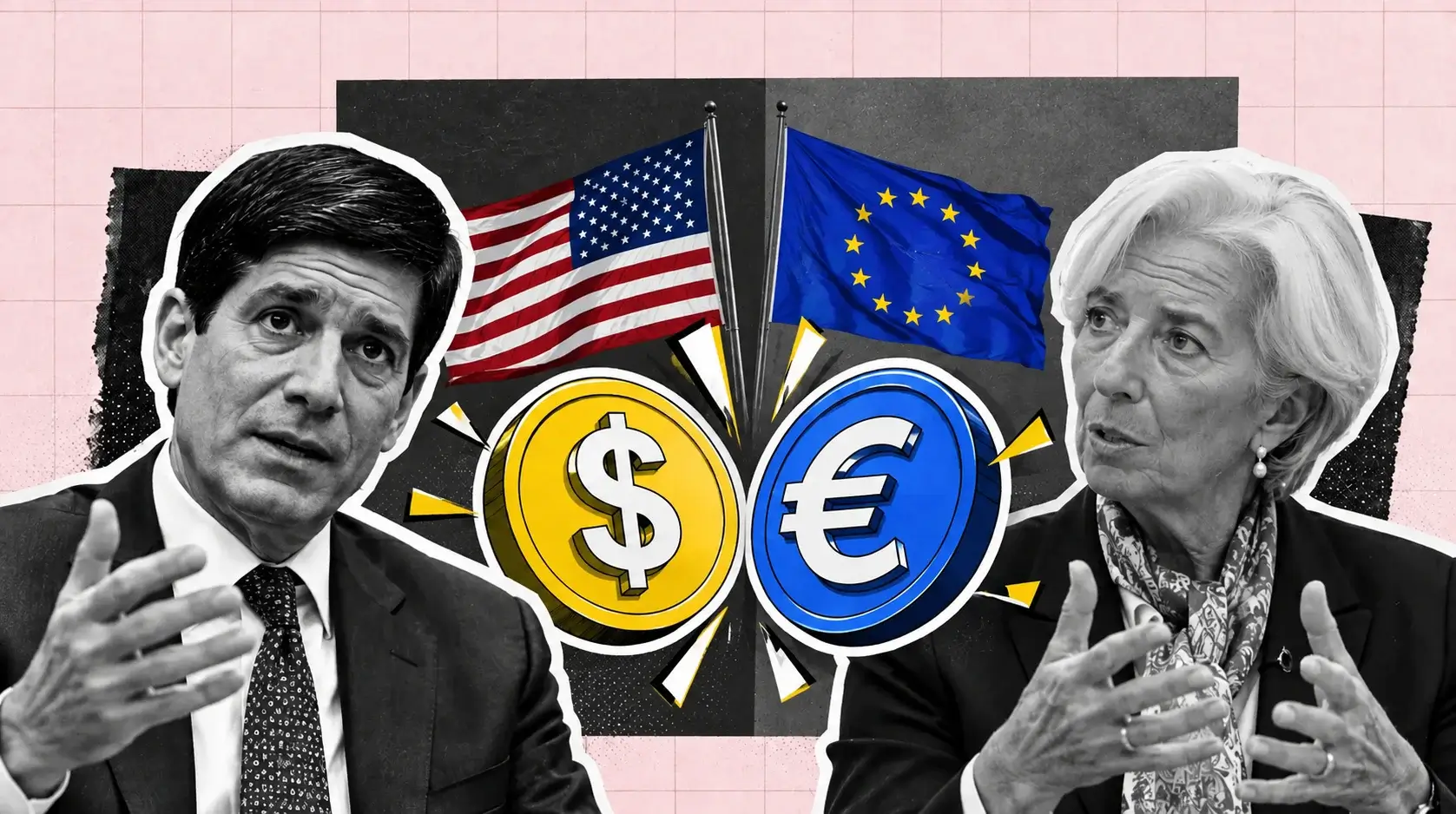
Euro Slides Back Toward Its 17-Month Low as the Dollar Index Hits 102.45 — Sell Rallies to 1.1285, Downside to 1.1068
The euro ignored a 2% jump in German industrial output and lost 71 pips as Brent reached $101.94 and French fiscal worries returned | That's TradingNEWS
Key Points
- EUR/USD trades at 1.1192, down 0.63%, just 32 pips above Monday's 17-month low of 1.1160.
- French 10-year yield stands at 4.76% with the spread over Germany at 146bp, widest since 2011.
- Resistance sits at 1.1285 and 1.1362; downside targets are 1.1145, 1.1068 and 1.0990.
The euro traded at 1.1192 against the dollar on Wednesday, October 7, down 71 pips or 0.63% from Tuesday's 1.1263 close. The session range ran from 1.1266 at the high to 1.1186 at the low. That low sits 26 pips above Monday's 1.1160 trough, the weakest level for the single currency since May 19, 2025.
Tuesday had offered a reprieve. The pair climbed to 1.1275 and posted its largest one-day gain in seven weeks after the frontrunner in next spring's French presidential election laid out plans to cut government spending by €25 billion a year. French 10-year yields fell 11 basis points to 4.76%, the dollar softened and U.S. Treasury yields eased. By Wednesday morning in Europe every part of that move had reversed. The pair broke 1.1225, then 1.1200, and settled into the 1.1190 area ahead of the U.S. session.
Two forces are working together. On the European side, France's fiscal position has pushed its borrowing costs to the highest since the eurozone debt crisis, Spain is heading to a snap election, and Brent crude at $101.94 is draining income from an energy-importing bloc. On the American side, the 10-year Treasury yield is at 5.345%, its highest since 2002, and the Dollar Index is at 102.45, a level last seen in April 2025.
The euro is being sold for European reasons and the dollar bought for American ones, and neither set of reasons eased on Wednesday. Tuesday's bounce was a relief rally inside a downtrend that has carried the pair from 1.2016 in late January to within 30 pips of a 17-month low. Until French spreads narrow in a lasting way or U.S. yields peak, the path of least resistance runs through 1.1160 toward 1.1068.
The Federal Reserve's September minutes arrive at 2:00 p.m. ET, shortly after a $39 billion 10-year Treasury auction. Both events fall on the dollar side of the pair, and both carry more risk for euro bulls than for bears.
From 1.2016 to 1.1192: Nine Months of Decline
The euro began 2026 near 1.1750 and rallied to 1.2016 by late January, its high for the year. That peak coincided with a weak dollar and a European Central Bank that described inflation as being in a good place. The pair has lost 824 pips, or 7%, since then, and it is down 5% year to date.
The decline came in stages. The first leg followed the outbreak of the U.S.-Iran conflict in late February, which sent oil higher and pushed investors toward the dollar. By mid-July EUR/USD had fallen to 1.1420, a one-year low at the time, even as the ECB shifted from holding rates to raising them. A partial recovery through August took the pair back above 1.1500, and on September 18 it was still quoted at 1.1487.
The second leg has been faster. EUR/USD lost 3% in September. It opened October at 1.1330 and has shed another 138 pips in five sessions. Along the way it broke a triple-bottom support at 1.1362 that had held through the summer. The speed of that breakdown drove the daily relative strength index to 19 at the start of this week, an extreme reading that set up Tuesday's bounce.
The sequence of the past four sessions shows how the market is behaving at these levels. On Friday, October 2, the pair traded at 1.1245. On Monday it dropped to 1.1160 during Asian hours, recovered and closed at 1.1221, a 0.28% loss. On Tuesday it rallied to 1.1275 and finished at 1.1263. On Wednesday it fell back to 1.1192.
Two features stand out. The first is that Monday's plunge to 1.1160 came without a clear increase in downward momentum, which is why the pair recovered 61 pips by the close. The second is that the recovery on Tuesday stopped 10 pips short of 1.1285, the level that would have signaled the decline was stabilizing. The market tested whether sellers were exhausted and found they were not.
At 1.1192 the euro sits at the lower end of its 2026 range of 1.1160 to 1.2016, with 32 pips separating it from a new 17-month low.
France: The Core of the Euro's Problem
The euro's weakness starts in Paris. French public debt is projected to reach 122% of gross domestic product next year. The 2027 budget unveiled last week aims to cut the deficit from 5.4% of GDP to 5.0%, a reduction that would keep the shortfall from widening to 6.5% but would not stabilize the debt ratio. The government's own fiscal watchdog met the proposals with skepticism.
The bond market delivered its judgment quickly. The French 10-year yield reached 4.989% on October 1, within a basis point of 5% for the first time since 2002. It closed Friday at 4.856%, opened Monday at 4.917% and eased to 4.76% on Tuesday. The spread over German 10-year debt widened to 146 basis points, the largest gap since 2011, after the biggest weekly increase in 17 years. For the first time, French yields rose above those of Italy and Greece.
Politics is the reason the market does not trust the numbers. France holds a presidential election next spring. None of the main candidates had presented a detailed plan for which spending would be cut or how the debt ratio would be stabilized, which is why Tuesday's €25 billion-a-year proposal from the frontrunner moved markets. A specific figure from the candidate most associated with fiscal populism was enough to pull French yields down 11 basis points in a session and lift the euro 54 pips from Monday's close to Tuesday's high.
One day later the relief had faded. A campaign pledge is not a budget, and the legislative calendar offers plenty of room for disappointment. The two budget bills were due to be filed at the National Assembly by October 6. Plenary debate begins on October 13. The key votes fall between late November and mid-December, and a modified budget is the most likely outcome in a parliament without a stable majority. A scheduled rating review this month, with France currently at Aa3, adds another date for the market to worry about.
Every one of those events is a potential trigger for wider spreads. EUR/USD has tracked the French-German spread closely for three weeks, falling when it widens and bouncing when it narrows. That relationship held again on Wednesday.
Spain's Snap Election and the Contagion Question
France is not the only source of political risk. Spain is heading to a snap election, and the announcement on Monday coincided with the euro's drop to 1.1160. Two of the eurozone's four largest economies now face electoral uncertainty at a moment when borrowing costs are rising across the developed world.
Spanish bonds have held up far better than French ones. The 10-year yield traded between 4.07% and 4.09% on Monday, leaving its premium over German debt at 65 basis points, less than half the French spread. A decade ago the ranking would have been reversed. Spain's steadier fiscal trajectory has earned it a degree of insulation, and so far the market is treating its election as a political event without fiscal consequences.
The concern is what happens if that changes. Unsettled trading in French debt spilled over into other peripheral bond markets by the end of last week, the first sign of contagion in this episode. A eurozone crisis that stays confined to France is a problem for the euro. One that spreads to Spain and Italy is a different order of problem, because it raises questions about the currency union's cohesion that markets have not had to price since 2012.
For EUR/USD, contagion would show up as a break from the pattern of the past three weeks. Until now the pair has traded as a function of one spread. Wider stress would bring a broader repricing of euro-area assets, with equity outflows adding to bond outflows. French stocks hit a one-month low as borrowing costs climbed, an early indication that the pressure is not limited to fixed income.
Christine Lagarde addressed the comparison directly, saying that debt near 120% of GDP that is not on course to be controlled is a serious matter, and adding that the situation is not 2008 or 2011. The second half of that statement is accurate on the facts. Eurozone banks are better capitalized, the ECB has tools that did not exist then, and no member is close to losing market access.
The currency market is pricing the first half. The euro's 17-month low is a statement that investors see European fiscal risk as higher than at any point since the pandemic, and Spain's election extends the period over which that risk stays elevated.
The ECB Is Boxed In
The European Central Bank faces a conflict between its two jobs. Eurozone inflation came in at 3.8% in September against a 3.6% consensus, which argues for higher rates. French bond yields near 5% and spreads at a 15-year high argue for caution. The ECB has chosen caution, and the euro has paid for it.
Remarks from the ECB president over the past two weeks were read as surprisingly dovish. In testimony to the European Parliament's economic committee she noted that long-term interest rates have risen notably since the September meeting, which will slow growth and dampen price pressures by more than the bank had projected. One estimate puts the tightening effect of the bond selloff as equivalent to another 25-basis-point policy hike. The bar for an October rate increase is now very high, and markets have scaled back expectations for further ECB tightening.
That shift matters for the exchange rate because it widens the policy gap with the United States. The Fed raised rates in September and futures price an 86% chance of another hike by December. The ECB, which began hiking earlier this year, is now on hold with inflation running hotter than forecast. A central bank that pauses with inflation at 3.8% is accepting lower real rates, and lower real rates weaken a currency.
The ECB's backstop offers less comfort than it should. The Transmission Protection Instrument, created in 2022 to buy the bonds of members facing unwarranted market stress, has never been used. Its eligibility conditions require a country to be in compliance with European fiscal rules. France's difficulty is that its stress stems from its own fiscal choices, which makes activation legally and politically awkward. Speculation is building over how severe the turmoil would need to become before the bank steps in, and the threshold remains high.
Leadership uncertainty compounds the problem. Several senior positions at the ECB turn over in the coming months, including the presidency, and the head of the Bundesbank is among the likely candidates. A change in personnel could change how the institution views intervention.
The result is a central bank that cannot hike without worsening France's position and cannot buy French bonds without a legal fight. Currency traders see an institution with limited freedom to act, and they are selling the euro accordingly.
German Data: A Headline Collapse and a Quieter Recovery
Germany delivered two conflicting signals in two days. On Tuesday, factory orders for August fell 10.6% month on month against expectations for a 1% decline. It was the largest drop since January and sent EUR/USD back toward its lows after the release. On Wednesday, industrial production rose 2.0% on the month, reversing a prior 1.2% decline and beating the 0.5% forecast. Year over year, output increased 2.3% after a 1.6% contraction.
The orders number looks worse than it is. The collapse was concentrated in one category: orders for other transport equipment, which covers aircraft, ships and military vehicles, fell 61.5% after more than doubling in July on exceptionally large contracts. Excluding large-scale orders, new industrial orders slipped 0.1%. July was revised up to a 3.2% gain from 2.5%. On a three-month basis, orders from June through August were 1.3% higher than in the previous three months.
The breakdown by origin is less reassuring. Domestic orders fell 17.3%. Foreign orders dropped 5.4%, with demand from inside the eurozone down 5.4% and from outside it down 5.5%. Weakness that broad points to more than one lumpy contract.
Wednesday's production figure should have helped the euro and did not. The pair traded through the release without reacting and continued lower as oil rose and the dollar firmed. A currency that ignores good news is being driven by something else, and for the euro that something is France and the rate gap. German manufacturing data rank well below both.
The underlying picture for the eurozone's largest economy is one of resilience under strain. Output is growing year over year despite an energy shock that has kept Brent above $100 for most of the autumn. But German industry is among the most energy-intensive in the developed world, and each additional month of elevated oil and gas prices erodes margins that were already thin. The orders data suggest forward demand is softening even as current production holds.
For the exchange rate, German data would need to be strong enough to revive ECB hike expectations. A 2% monthly gain in output does not clear that bar when French yields are within 25 basis points of 5%.
The Dollar Side: 5.345% Yields and a 102.45 Index
The euro's problems would matter less if the dollar were weak. It is the opposite. The U.S. Dollar Index rose 0.4% on Wednesday to 102.45, holding near levels last seen in April 2025. Buyers stepped in at 101.80 on Tuesday, and the index remains well above its 50-day and 200-day moving averages.
Treasury yields are the engine. The 10-year note climbed to 5.345% on Wednesday, half a basis point below Monday's 5.349% peak, which was the highest since April 2002. The 30-year bond reached 5.724%, a 24-year high. The 2-year sat at 4.818%. Traders extended short positions in Treasuries into the session, betting on still-higher yields.
A French 10-year at 4.76% and a spread of 146 basis points put the German 10-year in the low 3.3% range. That leaves the U.S. 10-year yielding around 200 basis points more than its German equivalent. A gap of that size pulls capital across the Atlantic. An investor can earn two full percentage points more in Treasuries than in Bunds, in a currency that has been appreciating, backed by a central bank that is still tightening.
The comparison with French debt is more striking. At 5.345%, the U.S. 10-year yields 59 basis points more than French OATs at 4.76%, with none of the political risk attached to a country running a 5.4% deficit into a presidential election.
The dollar's strength on Wednesday was broad. The pound fell 0.23% and the yen weakened even after a Bank of Japan board member said she would back further rate increases. The euro's 0.63% loss was the largest among the majors, which shows the European-specific component layered on top of general dollar demand.
Oil reinforces the split. Brent rose 1.4% to $101.94 as Iran stepped up attacks on tankers in the Strait of Hormuz. The United States is a net energy exporter. The eurozone imports the bulk of its oil and gas, pays for it in dollars, and sees its trade balance deteriorate with every increase in crude. Higher oil is a terms-of-trade loss for Europe and a mild gain for America, and that difference feeds directly into EUR/USD.
Fed Minutes and the 10-Year Auction: Two Tests in One Afternoon
Two scheduled events on Wednesday afternoon will set the dollar's tone into the end of the week. The Treasury sells $39 billion of 10-year notes, and at 2:00 p.m. ET the Federal Reserve publishes the minutes of its September 15-16 meeting.
The auction comes first and may matter more. Dealers pushed yields higher through the morning to build in a concession ahead of the sale. If demand is solid, the 10-year could retreat toward Tuesday's 5.27%, the Dollar Index would likely give back part of its 0.4% gain, and EUR/USD could recover toward 1.1225 to 1.1255. If the auction clears at a yield above pre-sale levels, the 10-year breaks 5.349% and the pair is likely to test 1.1160 the same day.
The minutes cover the meeting at which the Fed raised rates for the first time in three years, by unanimous vote. Markets want to see how broad the underlying support was and how officials viewed the climb in long-term yields. The October meeting is close to settled: the probability of no change stands at 80%. December is the live question, with futures pricing an 86% chance of a hike by year-end.
Recent commentary from policymakers has been split. Kansas City Fed President Jeff Schmid said rates still need to rise to bring inflation down. San Francisco Fed President Mary Daly said the decision depends on whether the factors lifting inflation fade or persist. The data have softened since the meeting. The September jobs report was weak, and the four-week average of private payroll gains stands at 23,750. At the same time, the prices-paid component of the services survey hit its highest level in more than four years.
A slowing labor market with accelerating service-sector costs is the combination the Fed finds hardest to handle. For the dollar it has been supportive so far, because the Fed has chosen to prioritize inflation.
The asymmetry for EUR/USD is clear. Hawkish minutes would firm up December pricing and widen the policy gap with a sidelined ECB. Dovish minutes would trim the dollar's rate advantage at the margin, though they would do nothing about French spreads, which is the larger of the euro's two problems. A dollar-driven bounce in the pair is therefore likely to be shallower than a dollar-driven decline.
Technical Structure: A Descending Channel and Stacked Moving Averages
The chart is bearish on every time frame that matters. On the four-hour chart EUR/USD has traded inside a descending channel since mid-September. Each rally has stalled at the channel's upper boundary and each decline has extended to its lower one. The lower band currently sits near 1.1160, the same level as Monday's low.
On the daily chart the pair holds below the 20-period simple moving average that forms the middle of its Bollinger Bands and below the 100-day simple moving average. The lower Bollinger Band stands at 1.1168. Monday's dip to 1.1160 pierced it briefly and was rejected, and Wednesday's low at 1.1186 came within 18 pips of a retest. A clear break beneath the lower band would expose further weakness. Holding above it would leave room for consolidation under the moving-average resistance overhead.
That resistance is layered. As of Tuesday's close the pair traded 0.89% below its 21-day exponential moving average, 1.66% below the 50-day and 2.06% below the 100-day. Those gaps place the three averages near 1.1360, 1.1450 and 1.1495. The 21-day average coincides almost exactly with the broken triple-bottom at 1.1362, which turns that area into a major ceiling. Shorter and longer averages are aligned in descending order, the textbook configuration of an established downtrend.
Momentum has relieved its most extreme reading without turning. The daily RSI reached 19 at the start of the week, deep in oversold territory. Tuesday's rally lifted it, and the daily signal was upgraded from strong sell to sell, with 15 indicators pointing down against 6 pointing up. Oversold conditions produced the bounce they usually produce. They did not produce a reversal, because the bounce failed below the first meaningful resistance.
The breakdown of 1.1362 is the most important technical event of the past month. That level had held on three separate tests during the summer, and its loss converted a range into a trend. Triple-bottom failures tend to travel, because every buyer who relied on the support is now offside. The pair has fallen 170 pips since the break. Any rebound toward 1.1362 should be treated as corrective unless buyers reclaim it.
Volatility-based projections put this week's range at 1.1056 to 1.1324. The pair is trading in the lower half of it with three sessions remaining.
Support Levels: 1.1160, 1.1145, 1.1068 and 1.0990
Support begins a few pips below the market and extends in clear steps.
The first band runs from 1.1180 to 1.1187. This zone marked the downside level to watch before Monday's break and served as the base for the subsequent recovery. Wednesday's low at 1.1186 landed inside it. Below that, the lower Bollinger Band at 1.1168 and Monday's 1.1160 low form the next cluster, together with the daily pivot support at 1.1158 and the lower edge of the four-hour channel. Four references within 10 pips make 1.1158 to 1.1168 the most significant floor on the chart.
The character of Monday's test is relevant. The pair touched 1.1160 in thin Asian trading and bounced 61 pips by the close without any acceleration in selling. That price action showed buyers were willing to defend the level, at least once. A second test during European or U.S. hours, with full liquidity, would be a more reliable measure of how much demand actually sits there.
If 1.1160 gives way, the next objective is 1.1145, identified as the level the pair has a chance to test while it stays below 1.1285. It lies 47 pips under the current price.
The larger target is 1.1068. A daily close below 1.1157 would expose it, and it represents a further 124-pip decline from 1.1192. Beneath it, 1.0990 comes into view, a level that would take the euro below 1.10 for the first time in this cycle. The bottom of the volatility-implied weekly range at 1.1056 falls between those two levels.
Model-based forecasts for October lean lower still. One set of projections places the month's range between 1.0770 and 1.1470 with a close at 1.0930. Those are algorithmic estimates and carry little weight alone, though they are consistent with a trend that has delivered a 3% monthly loss in September.
The distance to each level frames the trade. From 1.1192, the pair is 32 pips from a new 17-month low, 47 pips from 1.1145 and 124 pips from 1.1068. With an average daily range that has run close to 80 pips this week, the first two are reachable in a single session and the third within two or three.
Read More
-
Yen Stalls at 160 Despite a 3% JGB and Tokyo Core CPI at 2.0% — Intervention Sits at 164, Friday's Payrolls Decide
02.09.2026 · TradingNEWS ArchiveEnergy
-
LLY Reclaims $1,200 as Mounjaro and Zepbound Deliver $14.9B a Quarter — Buy Rating, $1,292 High in Sight
07.10.2026 · TradingNEWS ArchiveStocks
-
XRP-USD ($1.42) Underperforms Bitcoin as Weekly ETF Inflows Fade to $4.74M — Hold, Buy Zone at $1.37 to $1.40
07.10.2026 · TradingNEWS ArchiveCrypto
-
Brent $101 and WTI $89 Split on War Risk and Recovering Supply — EIA Sees $105, Support at $88
07.10.2026 · TradingNEWS ArchiveCommodities
-
Dow Sheds 539 Points, S&P 500 Back Under 7,800, Nasdaq Off 0.75% as Yields Reach 2002 Highs; PENG +17%
07.10.2026 · TradingNEWS ArchiveMarkets
-
Pound Retreats From 1.3284 Trendline as U.S. Yields Hit 2002 Highs — Sell Rallies to 1.3303, Downside to 1.3139
07.10.2026 · TradingNEWS ArchiveForex
Resistance Levels and What Would Change the Picture
Resistance is dense and begins immediately. The daily pivot sits at 1.1214. The area from 1.1223 to 1.1234 capped the pair in early European trading on Wednesday before the slide to 1.1190. Above that, 1.1255 marked the top of the expected intraday range, and Wednesday's high at 1.1266 and Tuesday's at 1.1275 complete the near-term ceiling.
The level that matters most on a one-to-three-week view is 1.1285. It is the strong resistance that has been trailed lower from 1.1315 as the pair declined, and only a breach of it would indicate the selloff is stabilizing. Tuesday's rally peaked 10 pips beneath it. As long as the pair stays below 1.1285, the bias remains negative and the downside targets stay active.
Above 1.1285 the next barrier is the top of the weekly volatility range at 1.1324, followed by the zone that defines the medium-term trend: 1.1360 to 1.1362, where the 21-day exponential average meets the broken triple-bottom. A daily close back above 1.1362 would be the first sign that the breakdown is failing.
Turning neutral requires more. The band from 1.1478 to 1.1519 contains the 100-day exponential average and the mid-September congestion area, and it would need to be reclaimed before the bearish case could be set aside. A break above 1.1580 would invalidate the short-term bearish structure altogether.
Those levels are a long way off. From 1.1192, the pair would need to rise 93 pips to stabilize, 170 pips to challenge the breakdown, and 388 pips to overturn the trend.
The consensus of 27 forecasters still expects recovery, with a fourth-quarter average projection of 1.1541 inside a range of 1.1100 to 1.2000. That central estimate sits 349 pips above the market and was largely set before the French spread blew out. Forecasts of this kind adjust slowly, and the gap between consensus and spot is itself a risk: if those projections are revised down, the revisions add to selling pressure.
What would close the gap from the other direction is a specific list. French-German spreads would need to narrow well below 146 basis points and stay there. The U.S. 10-year would need to turn decisively away from 5.35%. Oil would need to fall back under $100. Any one of these would produce a bounce. A sustained reversal would likely require two of them together, and at present none is in sight.
Three Scenarios Into Mid-October
The base case is a grind lower with intermittent bounces. EUR/USD holds below 1.1285, retests 1.1160 within days and, on a break, extends to 1.1145. Tuesday's failed rally, Wednesday's 0.63% decline and the lack of reaction to strong German output data all point this way. The French parliamentary debate opening on October 13 and the pending rating review keep spread risk elevated, while an 86% probability of a December Fed hike keeps the rate gap wide. In this scenario the pair trades between 1.1100 and 1.1285 for the next two weeks, with a downward drift.
The bearish extension needs a catalyst on either side of the Atlantic. In Europe it would be a renewed surge in French yields through 5%, a rating downgrade, or visible contagion into Spanish and Italian debt. In the United States it would be a weak 10-year auction or hawkish minutes that push the 10-year above 5.349%. A daily close below 1.1157 would confirm the move and target 1.1068, with 1.0990 beyond. This outcome becomes more likely if both sides deteriorate at once, which is what happened on Monday.
The bullish scenario is a short squeeze. The pair remains technically stretched after a daily RSI of 19 earlier in the week, and positioning has had three weeks to lean short. A strong Treasury auction combined with minutes that cast doubt on a December hike could knock the Dollar Index below 101.80. If French spreads narrow simultaneously on further fiscal pledges from presidential candidates, the pair could clear 1.1285 and run toward 1.1324 and 1.1362. That would be a rally of 170 pips, and the broken triple-bottom would be the place to judge whether it had further to go.
A fourth possibility sits outside these three. If French bond stress intensified to the point where the ECB activated its bond-buying backstop, the initial reaction would likely be a sharp euro rally as spreads collapsed. The longer-term effect is harder to call, since purchases would amount to monetary easing with inflation at 3.8%. The threshold for that step remains high, and it would take considerably more turmoil than the market has seen so far to reach it.
Weighing the three, the base case and the bearish extension both point down and together account for the larger share of outcomes. The bullish scenario offers a tradable bounce inside a trend that it would not, by itself, reverse.
Verdict on EUR/USD: Bearish, Sell Rallies Toward 1.1255 to 1.1285, Targets 1.1145 and 1.1068
EUR/USD at 1.1192 is a Sell on rallies. The trend is down, the drivers are intact, and Wednesday's price action confirmed that Tuesday's rebound was corrective.
The evidence is consistent across every input. The pair has fallen 7% from its 1.2016 January high and sits 32 pips above a 17-month low. It broke a triple-bottom at 1.1362 and has not come within 85 pips of retesting it. It trades inside a descending channel, beneath the 21-day, 50-day and 100-day exponential averages near 1.1360, 1.1450 and 1.1495, with 15 of 22 daily indicators signaling sell. It ignored a 2% rise in German industrial output and fell on higher oil and a firmer dollar.
The fundamentals behind the chart have not improved. France's debt is heading for 122% of GDP with a spread over Germany at 146 basis points, the widest since 2011, and a budget debate that begins October 13. Spain faces a snap election. The ECB is on hold with inflation at 3.8% and a backstop it cannot easily use. Across the Atlantic the 10-year Treasury yields 5.345%, the Dollar Index is at 102.45, and the Fed is priced for another hike by December. Brent at $101.94 hurts the eurozone's trade balance and helps America's.
Selling at 1.1192, 32 pips above support that held on Monday, is poor placement. The better entry is a bounce into 1.1255 to 1.1285, with the position invalidated on a daily close above 1.1285. From that zone the first target at 1.1145 is 110 to 140 pips away and the second at 1.1068 is 187 to 217 pips away, against risk of 30 pips or less. A daily close below 1.1157 would confirm the next leg and justify adding.
The outlook shifts to neutral on a daily close above 1.1362 and turns constructive only above 1.1478 to 1.1519. Neither is likely without a material narrowing in French spreads or a clear peak in U.S. yields. The pair is oversold enough to produce sharp bounces, and traders should expect them, particularly around the Fed minutes and the Treasury auction. Each one so far has faded at lower levels than the last.
The euro's recovery depends on Paris delivering a credible budget and on Treasury yields peaking. Until one of those conditions is met, the pair remains headed for 1.1068, and rallies should be sold.