Stock Market Today: Nasdaq Drops 0.96%, S&P 500 Falls 0.65%, Dow Jones Slides 0.37% as 30-Year Yield Hits 5.20%
Russell 2000 tumbles 1.61% to 2,730.50 as bond vigilantes drive Treasury yields to multi-year highs; AMD, QCOM, WDC, STX bleed 4.5–6% in semiconductor rout | That's TradingNEWS
Key Points
- Nasdaq fell 0.96% to 25,840.85, S&P 500 lost 0.65% to 7,355.28, Russell 2000 sank 1.61% on yield surge.
- 30-year Treasury yield hit 5.20%, 10-year at 4.674%; TLT touched $82.77 matching the 2023 cycle low.
- CoreWeave dropped 7.5%, Nebius fell 6% after Google-Blackstone unveiled $5B AI cloud joint venture. You said: Skip to navigationSkip to main contentSkip to right column
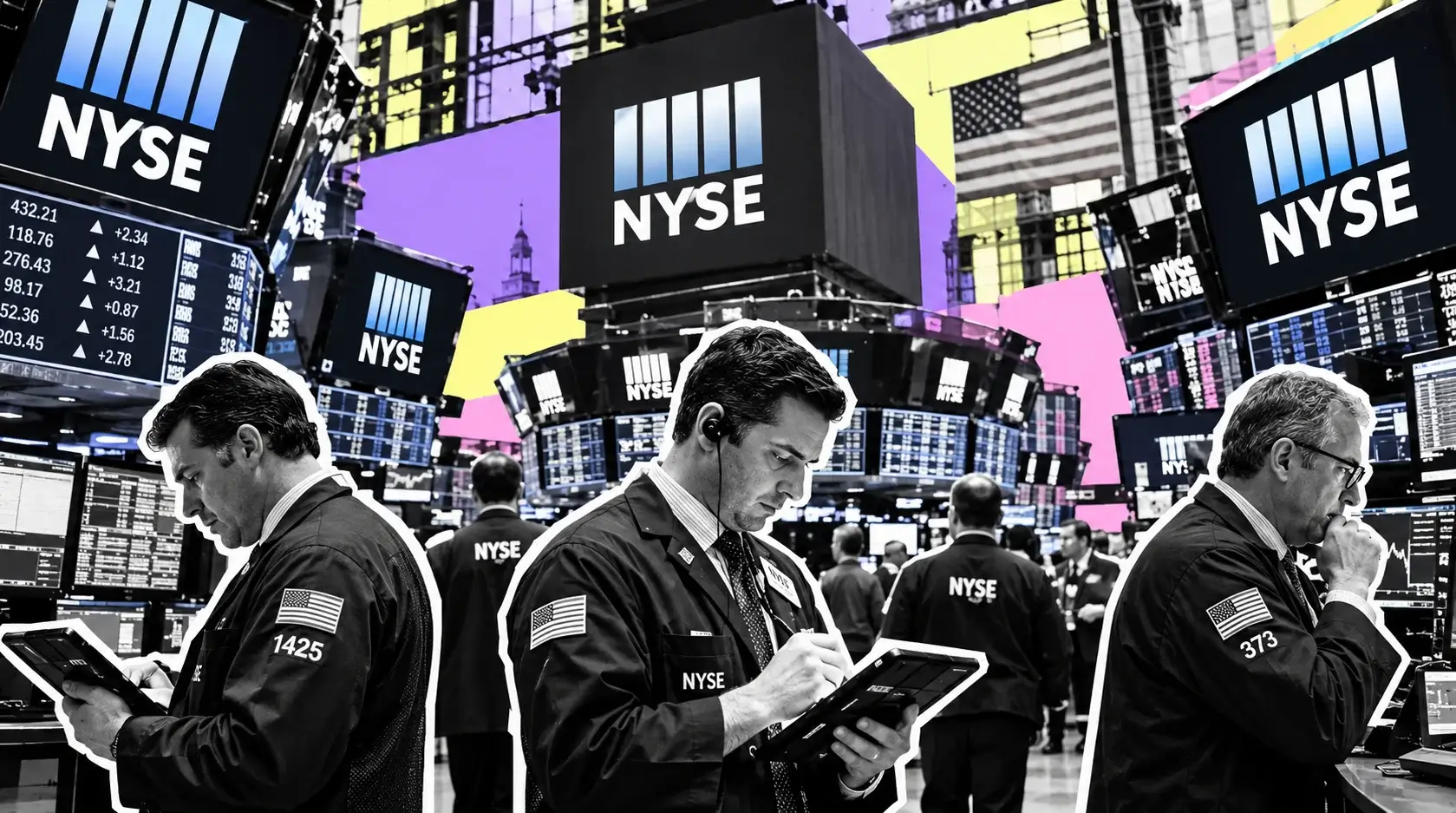
Tuesday, May 19, 2026, ended with every major U.S. equity benchmark in the red, and the damage tells you exactly what kind of session this was — not a rotation, not a sentiment wobble, but a forced repricing driven by the long end of the Treasury curve. The Nasdaq Composite absorbed the heaviest hit, falling 0.96% to 25,840.85, weighed down by a savage rotation out of semiconductors and high-multiple growth names. The S&P 500 dropped 0.65% to 7,355.28, while the Dow Jones Industrial Average posted a comparatively contained loss of 0.37% to close at 49,502.47 — the spread reflecting the Dow's lighter exposure to long-duration cash flow stories. The Russell 2000 told the most brutal story of the day, hemorrhaging 1.61% to 2,730.50. When small caps underperform megacaps by nearly a full percentage point on a single session, the message is unambiguous: domestic financial conditions are tightening, refinancing risk is back on the table, and the equity complex is being forced to absorb it through multiple compression rather than earnings degradation.
The 30-Year Becomes the Story of the Tape
The bond market did not merely participate in this session — it dictated it. The 30-year Treasury yield climbed roughly five basis points to 5.20%, knocking on the door of the highest level since July 2007. The 10-year benchmark (^TNX) added approximately six basis points to 4.674%, comfortably above the 4.60% threshold that strategists have repeatedly flagged as the line where equity multiples genuinely start to crack. The iShares 20+ Year Treasury Bond ETF (TLT) traded as low as $82.77 intraday — perfectly matching the 2023 cycle trough. That is not an arbitrary number. That is the floor where systematic and technical flows kick in if it breaks, with essentially no support below until prices not seen since the Global Financial Crisis era.
Bank of America's monthly global fund manager survey, conducted May 8 through 14, crystallized the institutional positioning. Nearly two-thirds of respondents now expect the long bond yield to push above 6% within twelve months. Only 20% see yields slipping back below 4%. Bond allocations were slashed to a net 44% underweight — the most extreme positioning since June 2022, when the Fed was deep into its most aggressive hiking cycle in four decades. That is not hedging. That is conviction selling at scale.
Oil Eases, but the Inflation Premium Is Stuck
Crude prices retreated on the session after President Trump backed away from a planned military strike against Iran, but the absolute price levels remain punishing. WTI crude settled down 0.88% at $107.70 per barrel, while Brent hovered between $110 and $112 intraday after closing above $112 on Monday. The six-month Brent future is still trading at roughly $90 per barrel — meaning the market is pricing in an elevated regime that persists well into late 2026.
The inflation read-through is exactly what is driving the bond market. Forty percent of fund managers in the BofA survey identified second-wave inflation as the single largest tail risk facing portfolios. Geopolitical conflict ranked second at 20%. The U.S. Dollar Index firmed 0.44% to 96.07, the kind of defensive bid that emerges when real rates are climbing and global risk appetite is contracting simultaneously. Gold fell 1.30% to $4,498.80 — counterintuitive given the geopolitical tape, but the math works when real yields are this aggressive. The opportunity cost of holding non-yielding bullion balloons when the long end pays north of 5%. Bitcoin slipped 0.50% to $76,448.67, holding up better than gold on a relative basis but offering no real haven characteristics.
Semiconductors Hand Back the Crown Jewels
If there was a single sector that defined the session's pain, it was chips. The Philadelphia Semiconductor Index fell 1.4% on the day, extending a three-session loss to more than 7%. The BofA survey confirmed the positioning vulnerability — global semiconductors were flagged as the single most crowded trade on the Street. When the most-loved trade meets the most aggressive bond selloff in over a year, the math is brutal.
Advanced Micro Devices (NASDAQ:AMD), Seagate Technology (NASDAQ:STX), Qualcomm (NASDAQ:QCOM), and Western Digital (NASDAQ:WDC) all bled between 4.5% and 6% on the session. Qualcomm sat down more than 3% in early trading and accelerated lower through the day. Broadcom (NASDAQ:AVGO) shed 1.8% despite no company-specific catalyst — a tell that systematic flows were dumping the entire complex rather than discriminating between fundamental narratives. NVIDIA (NASDAQ:NVDA) itself traded down between 0.5% and 1.5% intraday, posting its third consecutive session of declines, all heading directly into its fiscal Q1 print scheduled for Wednesday after the close.
Wolfe Research's Rob Ginsberg highlighted that large speculators in Nasdaq 100 futures have flipped to their largest net short position since the 2023 low, with the unwind happening precisely ahead of Nvidia's earnings. Bank of America's technical desk pointed out that price action in the VanEck Semiconductor ETF (SMH) has been "increasingly vertical, with multiple momentum indicators reaching record-stretched levels" over the past seven weeks — the kind of setup where mean reversion is not a question of if, but when.
Nvidia Becomes the Single Most Important Print of the Quarter
Wednesday's earnings release from NVIDIA (NASDAQ:NVDA) is the binary event that defines the next two weeks of trading. This is the world's most valuable public company by market capitalization, the last of the Magnificent Seven to report, and the bellwether for the entire AI capital expenditure thesis. Jed Ellerbroek at Argent Capital Management framed Tuesday's selloff as "a well-deserved breather after an epic rally," noting the timing — it comes "just a few trading days before the biggest chip stock in the world reports what will be outstanding earnings and guidance."
Seaport Research's Jay Goldberg offered a more cautious read, writing that "we see many stocks getting ahead of their fundamentals" and that "AMD and INTC have a good chance of growing into their numbers, but NVDA remains constrained by high expectations and serious supply constraints." The bar is so elevated that even a strong print risks a "sell the news" reaction if forward guidance does not extend the growth runway beyond what is already in consensus models. Combine that with the record short interest in Nasdaq 100 futures and you have the conditions for an outsized move in either direction.
Alphabet's $5 Billion Strike Levels the AI Compute Trade
The most consequential single-stock development outside the chip complex was the announcement that Alphabet (NASDAQ:GOOGL) and Blackstone (NYSE:BX) are launching a joint venture to build an AI cloud computing firm using Google's Tensor Processing Units. Blackstone is committing an initial $5 billion equity investment and holding the majority stake, with the first 500 megawatts of power expected online by 2027. Google has effectively created a hyperscaler-backed competitor to the pure-play AI compute lessors with infinite balance sheet behind it.
The market response was immediate. CoreWeave (NASDAQ:CRWV) dropped roughly 7.5% from Monday's close of $103.77 to a premarket print of $98.88, wiping out a meaningful chunk of its post-IPO premium. Nebius Group (NASDAQ:NBIS) fell approximately 6%. These are the two cleanest expressions of the "AI compute as a service" thesis on the public market, and both just had their competitive moats explicitly punctured by a Tier 1 hyperscaler partnership.
Alphabet itself slipped about 1.7% to roughly $391, pulling back from Monday's intraday record of $408.61. The two-day Google I/O developer conference kicked off Tuesday, with Alphabet's market cap brushing $5 trillion. The institutional disagreement around this name is the cleanest illustration of how stretched valuations have become at the top of the leaderboard. Berkshire Hathaway tripled its stake during Q1 to over $16.6 billion, making Alphabet the seventh-largest holding in the portfolio under the post-Buffett leadership of Greg Abel. Simultaneously, Bill Ackman's Pershing Square dumped 95% of its Alphabet position, cutting the stake from over $2.1 billion at year-end 2025 down to just $99 million. Ackman clarified on X that the sale "was not a bet against the company" but a source of funds for a new $2.1 billion stake in Microsoft (NASDAQ:MSFT). Alphabet shares have risen about 140% over the past twelve months and roughly 30% year-to-date, making it the best-performing name in the Magnificent Seven across both timeframes.
Megacap Tech Trades Heavy Across the Board
Beyond the Alphabet story, the rest of the Magnificent Seven traded mostly lower with the same rates-driven logic dragging them down. Apple (NASDAQ:AAPL), Microsoft (NASDAQ:MSFT), Amazon (NASDAQ:AMZN), and Meta Platforms (NASDAQ:META) all participated in the selling pressure as long-duration cash flow streams got discounted at higher rates. Tesla (NASDAQ:TSLA) faces an additional and increasingly acute headwind — the impending SpaceX (SPAX.PVT) initial public offering, with the prospectus expected to drop this week in what could be one of the largest IPOs ever recorded.
Joe Gilbert of Integrity Asset Management did not mince words: "This cannot be a positive for Tesla. We believe that Musk's focus will predominantly be lasered on SpaceX. Musk has proved to be able to balance multiple initiatives simultaneously in the past, but it feels like SpaceX is his new baby at the expense of Tesla." The capital rotation risk is real — retail investors who currently hold Tesla as their only proxy for Musk-aligned exposure will have a more focused vehicle, and the dilution of attention and capital away from the EV maker is structurally negative. The reported consideration of merging Tesla and SpaceX is itself an acknowledgment of this dynamic from within the Musk camp.
Home Depot Anchors the Consumer Read at $300
Home Depot (NYSE:HD) delivered the quarterly print that the market quietly needed in a session dominated by rates anxiety. Revenue grew roughly 5% year-over-year to $41.8 billion, beating the $41.6 billion consensus. Adjusted EPS came in at $3.43, topping the $3.41 Wall Street estimate. Same-store sales rose 0.6%, narrowly missing the 0.9% expectation, but the company reaffirmed its full-year 2026 outlook — and in this tape, that reaffirmation matters more than the marginal comp miss.
CFO Richard McPhail acknowledged the macro pressure directly: "There's no question that the average consumer is feeling pressure from rising fuel costs. Our customer tends to have higher incomes and higher housing wealth, but they do tell us that they're feeling the impact of fuel costs." Shares traded around $300 in the premarket — up from Monday's close of $299.81 — and held that level through the open. In a rates-driven selloff, holding ground is itself a win, and Home Depot delivered exactly that.
Amer Sports Crushes Q1 and Raises Across the Board
Amer Sports (NYSE:AS) — the parent of Salomon, Arc'teryx, and Wilson — was the unambiguous winner of the morning earnings cycle, advancing 4.5% in the premarket. Q1 adjusted EPS came in at $0.38 on revenue that surged 32% year-over-year to $1.95 billion, demolishing consensus estimates of $0.30 and $1.83 billion respectively. CEO James Zheng credited "exceptional Salomon Softgoods growth, a strong Arc'teryx omni-comp, and solid Wilson Tennis 360 growth" across "all segments, geographies, and channels."
The forward guidance was where the print really earned the move. Management lifted full-year revenue growth to 20% to 22% from the prior 16% to 18% range. EPS guidance moved up to $1.18 to $1.23 from $1.10 to $1.15. Operating margin guidance rose to 13.4% to 13.7% from 13.1% to 13.3%. That is a clean across-the-board raise on every key metric, delivered from a stock that entered the day down 11% year-to-date.
ServiceNow Extends Its AI Rerating With Another 7% Pop
ServiceNow (NYSE:NOW) added roughly 7% Tuesday on top of Monday's 8% rip after Bank of America initiated coverage with a buy rating built around the AI tailwind thesis. The cumulative two-day move has narrowed the stock's year-to-date losses to approximately 30% — still deep underwater, but no longer terminal. This is the cleanest example on the tape of a beaten-down enterprise software name getting relabeled an AI beneficiary by a major sell-side desk, and the market is willing to pay up aggressively for the pivot even as the broader semiconductor complex bleeds. AI exposure is no longer just about silicon — the rotation into software-layer beneficiaries is real, and it is happening in a tape that hates duration.
Jazz Pharmaceuticals Jumps 3.12% on UBS Upgrade
Jazz Pharmaceuticals (NASDAQ:JAZZ) added 3.12% to $236.72 after UBS upgraded the stock to buy with a $307 price target — implying roughly 33% upside from Monday's close of $229.56. Analyst Ashwani Verma built the thesis around accelerating uptake for Ziihera in gallbladder cancer ahead of its August 25 mandatory deadline, stable Sleep franchise revenues from Xywav and Xyrem despite expected Orexin competitive entry in 2H26, and the Modeyso brain cancer opportunity expected to generate meaningful sales over the next one to two years. The stock has now doubled over the past twelve months and is up 35% year-to-date — momentum the upgrade is essentially validating rather than initiating.
Agilysys and Akamai Move on Earnings
In after-hours action that bled into Tuesday's tape, Agilysys (NASDAQ:AGYS) jumped 16% following Q4 results. Adjusted EPS of $0.63 topped the year-ago figure of $0.54, and revenue of $82.9 million beat the $81.6 million FactSet consensus. The company guided full-year revenue to $365 million to $370 million, ahead of the $363.6 million Street estimate. Akamai Technologies (NASDAQ:AKAM) slipped 3% after announcing a proposed offering of convertible senior notes totaling $2.6 billion — dilution concerns hit immediately, as they typically do with convert raises of that size.
Trump Media Sinks to an All-Time Low
In the speculative tail of the market, Trump Media & Technology (NASDAQ:DJT) closed at an all-time low Monday and ticked lower again Tuesday. The stock is down approximately 87% from its 2024 peak — a brutal reminder that retail-driven, narrative-heavy names do not survive prolonged stretches of risk-off positioning. While DJT is an idiosyncratic story, the persistent bleed in the most speculative corners of the tape is a useful sentiment marker. Capital is not just rotating out of growth — it is fleeing the highest-risk corners entirely.
The Russell 2000 at 2,730.50 Sends the Loudest Warning
The Russell 2000's 1.61% drubbing deserves more attention than it typically gets. Small caps are the highest-beta expression of domestic risk appetite, the most vulnerable cohort on refinancing dynamics, and the segment that lives or dies on bank lending conditions. When the long end of the Treasury curve is rising aggressively and the KBW Nasdaq Bank Index is simultaneously down 0.59% to 162.93, the message is that financial conditions are tightening through both the rates channel and the credit channel at the same time.
Banks face a particularly nasty dynamic. The long end rising without short-end relief actually compresses net interest margins if deposit costs remain sticky. JPMorgan (NYSE:JPM), Goldman Sachs (NYSE:GS), Morgan Stanley (NYSE:MS), and Bank of America (NYSE:BAC) are all caught in this crosswind. That said, Wall Street leadership remains publicly bullish. JPMorgan's Kevin Brunner told a Bloomberg conference Tuesday that AI investment has moved "from hype to real execution and scaling" and that M&A dealmaking is heating up as clients position ahead of the AI buildout. Goldman international co-head Kunal Shah noted that "even though our clients don't have clarity" on the Iran war, "that hasn't actually held up activity." Executive confidence is useful — but it does not solve the math problem of margin pressure when curve dynamics work against you.
Volatility at 18.15 Climbs Without Panicking
The VIX rose 1.85% to 18.15, climbing but staying well below the 20 threshold that signals genuine institutional stress. This is the texture of orderly de-risking rather than capitulation. Dealers and systematic flows have not yet hit the unwind levels that feed back into accelerated selling. That can change in a heartbeat if 30-year yields breach 5.25% or 10-year yields take out 4.75% — those are the technical levels where forced selling becomes mechanical rather than discretionary. The fact that gold sold off while the dollar rallied and equities fell suggests that real money is rebuilding cash positions, not running to traditional safe havens. That is a different kind of fear than crisis-era flight.
Pending Home Sales Up 1.4%, Mortgage Rates at 6.68%
U.S. pending home sales delivered an upside surprise, rising 1.4% month-over-month in April to an index level of 74.8, beating the 1.0% consensus. NAR Chief Economist Lawrence Yun framed the data as "cautious optimism despite increasing economic uncertainty and a slight rise in mortgage rates." The optimism is being immediately tested — the average 30-year fixed mortgage rate climbed to 6.68% Monday, the highest reading since July 31, 2025 (when it printed at 6.75%). That move is a direct mechanical consequence of the 10-year yield's grind higher, and it explicitly takes affordability out of the spring buying cycle.
Canada's CPI accelerated to 2.8% year-over-year in April, driven primarily by another month of steeper gasoline prices, even as core measures remained contained. That is the second developed-market inflation print in a week showing energy bleeding into headline numbers. Japan's Q1 GDP came in at an annualized 2.1%, well above the 1.7% Reuters consensus and against 1.3% in the prior quarter — though those figures predate the full impact of the Iran war. Together, these prints reinforce the narrative that growth is holding up while inflation is reaccelerating — the worst possible combination for a central bank trying to defend a dovish pivot.
Read More
-
Yen Stalls at 160 Despite a 3% JGB and Tokyo Core CPI at 2.0% — Intervention Sits at 164, Friday's Payrolls Decide
02.09.2026 · TradingNEWS ArchiveEnergy
-
QQQ ETF ($706.22) Slides 7.4% Below Its High as the Market Reprices the AI Capex Bill — $686.57 Target if $700 Breaks
22.10.2026 · TradingNEWS ArchiveStocks
-
XRPI ($7.00) and XRPR ($10.74) Slide Toward 52-Week Lows as Spot XRP ETF Flows Stall at $708,510
22.10.2026 · TradingNEWS ArchiveCrypto
-
NG ($2.775) Decoupled From Europe’s €88 Gas Crisis as LNG Feedgas Hits 18.9 Bcf/d — $3.30 Upside on Cold Weather
22.10.2026 · TradingNEWS ArchiveCommodities
-
Dollar-Yen (157.35) Loses 157.65 as the Yen Rallies on Haven Demand — 155 Target if 156 Breaks
22.10.2026 · TradingNEWS ArchiveForex
Wall Street Caves as the Bond Market Tightens the Screws
Tuesday, May 19, 2026, ended with every major U.S. equity benchmark in the red, and the damage tells you exactly what kind of session this was — not a rotation, not a sentiment wobble, but a forced repricing driven by the long end of the Treasury curve. The Nasdaq Composite absorbed the heaviest hit, falling 0.96% to 25,840.85, weighed down by a savage rotation out of semiconductors and high-multiple growth names. The S&P 500 dropped 0.65% to 7,355.28, while the Dow Jones Industrial Average posted a comparatively contained loss of 0.37% to close at 49,502.47 — the spread reflecting the Dow's lighter exposure to long-duration cash flow stories. The Russell 2000 told the most brutal story of the day, hemorrhaging 1.61% to 2,730.50. When small caps underperform megacaps by nearly a full percentage point on a single session, the message is unambiguous: domestic financial conditions are tightening, refinancing risk is back on the table, and the equity complex is being forced to absorb it through multiple compression rather than earnings degradation.
The 30-Year Becomes the Story of the Tape
The bond market did not merely participate in this session — it dictated it. The 30-year Treasury yield climbed roughly five basis points to 5.20%, knocking on the door of the highest level since July 2007. The 10-year benchmark (^TNX) added approximately six basis points to 4.674%, comfortably above the 4.60% threshold that strategists have repeatedly flagged as the line where equity multiples genuinely start to crack. The iShares 20+ Year Treasury Bond ETF (TLT) traded as low as $82.77 intraday — perfectly matching the 2023 cycle trough. That is not an arbitrary number. That is the floor where systematic and technical flows kick in if it breaks, with essentially no support below until prices not seen since the Global Financial Crisis era.
Bank of America's monthly global fund manager survey, conducted May 8 through 14, crystallized the institutional positioning. Nearly two-thirds of respondents now expect the long bond yield to push above 6% within twelve months. Only 20% see yields slipping back below 4%. Bond allocations were slashed to a net 44% underweight — the most extreme positioning since June 2022, when the Fed was deep into its most aggressive hiking cycle in four decades. That is not hedging. That is conviction selling at scale.
Oil Eases, but the Inflation Premium Is Stuck
Crude prices retreated on the session after President Trump backed away from a planned military strike against Iran, but the absolute price levels remain punishing. WTI crude settled down 0.88% at $107.70 per barrel, while Brent hovered between $110 and $112 intraday after closing above $112 on Monday. The six-month Brent future is still trading at roughly $90 per barrel — meaning the market is pricing in an elevated regime that persists well into late 2026.
The inflation read-through is exactly what is driving the bond market. Forty percent of fund managers in the BofA survey identified second-wave inflation as the single largest tail risk facing portfolios. Geopolitical conflict ranked second at 20%. The U.S. Dollar Index firmed 0.44% to 96.07, the kind of defensive bid that emerges when real rates are climbing and global risk appetite is contracting simultaneously. Gold fell 1.30% to $4,498.80 — counterintuitive given the geopolitical tape, but the math works when real yields are this aggressive. The opportunity cost of holding non-yielding bullion balloons when the long end pays north of 5%. Bitcoin slipped 0.50% to $76,448.67, holding up better than gold on a relative basis but offering no real haven characteristics.
Semiconductors Hand Back the Crown Jewels
If there was a single sector that defined the session's pain, it was chips. The Philadelphia Semiconductor Index fell 1.4% on the day, extending a three-session loss to more than 7%. The BofA survey confirmed the positioning vulnerability — global semiconductors were flagged as the single most crowded trade on the Street. When the most-loved trade meets the most aggressive bond selloff in over a year, the math is brutal.
Advanced Micro Devices (NASDAQ:AMD), Seagate Technology (NASDAQ:STX), Qualcomm (NASDAQ:QCOM), and Western Digital (NASDAQ:WDC) all bled between 4.5% and 6% on the session. Qualcomm sat down more than 3% in early trading and accelerated lower through the day. Broadcom (NASDAQ:AVGO) shed 1.8% despite no company-specific catalyst — a tell that systematic flows were dumping the entire complex rather than discriminating between fundamental narratives. NVIDIA (NASDAQ:NVDA) itself traded down between 0.5% and 1.5% intraday, posting its third consecutive session of declines, all heading directly into its fiscal Q1 print scheduled for Wednesday after the close.
Wolfe Research's Rob Ginsberg highlighted that large speculators in Nasdaq 100 futures have flipped to their largest net short position since the 2023 low, with the unwind happening precisely ahead of Nvidia's earnings. Bank of America's technical desk pointed out that price action in the VanEck Semiconductor ETF (SMH) has been "increasingly vertical, with multiple momentum indicators reaching record-stretched levels" over the past seven weeks — the kind of setup where mean reversion is not a question of if, but when.
Nvidia Becomes the Single Most Important Print of the Quarter
Wednesday's earnings release from NVIDIA (NASDAQ:NVDA) is the binary event that defines the next two weeks of trading. This is the world's most valuable public company by market capitalization, the last of the Magnificent Seven to report, and the bellwether for the entire AI capital expenditure thesis. Jed Ellerbroek at Argent Capital Management framed Tuesday's selloff as "a well-deserved breather after an epic rally," noting the timing — it comes "just a few trading days before the biggest chip stock in the world reports what will be outstanding earnings and guidance."
Seaport Research's Jay Goldberg offered a more cautious read, writing that "we see many stocks getting ahead of their fundamentals" and that "AMD and INTC have a good chance of growing into their numbers, but NVDA remains constrained by high expectations and serious supply constraints." The bar is so elevated that even a strong print risks a "sell the news" reaction if forward guidance does not extend the growth runway beyond what is already in consensus models. Combine that with the record short interest in Nasdaq 100 futures and you have the conditions for an outsized move in either direction.
Alphabet's $5 Billion Strike Levels the AI Compute Trade
The most consequential single-stock development outside the chip complex was the announcement that Alphabet (NASDAQ:GOOGL) and Blackstone (NYSE:BX) are launching a joint venture to build an AI cloud computing firm using Google's Tensor Processing Units. Blackstone is committing an initial $5 billion equity investment and holding the majority stake, with the first 500 megawatts of power expected online by 2027. Google has effectively created a hyperscaler-backed competitor to the pure-play AI compute lessors with infinite balance sheet behind it.
The market response was immediate. CoreWeave (NASDAQ:CRWV) dropped roughly 7.5% from Monday's close of $103.77 to a premarket print of $98.88, wiping out a meaningful chunk of its post-IPO premium. Nebius Group (NASDAQ:NBIS) fell approximately 6%. These are the two cleanest expressions of the "AI compute as a service" thesis on the public market, and both just had their competitive moats explicitly punctured by a Tier 1 hyperscaler partnership.
Alphabet itself slipped about 1.7% to roughly $391, pulling back from Monday's intraday record of $408.61. The two-day Google I/O developer conference kicked off Tuesday, with Alphabet's market cap brushing $5 trillion. The institutional disagreement around this name is the cleanest illustration of how stretched valuations have become at the top of the leaderboard. Berkshire Hathaway tripled its stake during Q1 to over $16.6 billion, making Alphabet the seventh-largest holding in the portfolio under the post-Buffett leadership of Greg Abel. Simultaneously, Bill Ackman's Pershing Square dumped 95% of its Alphabet position, cutting the stake from over $2.1 billion at year-end 2025 down to just $99 million. Ackman clarified on X that the sale "was not a bet against the company" but a source of funds for a new $2.1 billion stake in Microsoft (NASDAQ:MSFT). Alphabet shares have risen about 140% over the past twelve months and roughly 30% year-to-date, making it the best-performing name in the Magnificent Seven across both timeframes.
Megacap Tech Trades Heavy Across the Board
Beyond the Alphabet story, the rest of the Magnificent Seven traded mostly lower with the same rates-driven logic dragging them down. Apple (NASDAQ:AAPL), Microsoft (NASDAQ:MSFT), Amazon (NASDAQ:AMZN), and Meta Platforms (NASDAQ:META) all participated in the selling pressure as long-duration cash flow streams got discounted at higher rates. Tesla (NASDAQ:TSLA) faces an additional and increasingly acute headwind — the impending SpaceX (SPAX.PVT) initial public offering, with the prospectus expected to drop this week in what could be one of the largest IPOs ever recorded.
Joe Gilbert of Integrity Asset Management did not mince words: "This cannot be a positive for Tesla. We believe that Musk's focus will predominantly be lasered on SpaceX. Musk has proved to be able to balance multiple initiatives simultaneously in the past, but it feels like SpaceX is his new baby at the expense of Tesla." The capital rotation risk is real — retail investors who currently hold Tesla as their only proxy for Musk-aligned exposure will have a more focused vehicle, and the dilution of attention and capital away from the EV maker is structurally negative. The reported consideration of merging Tesla and SpaceX is itself an acknowledgment of this dynamic from within the Musk camp.
Home Depot Anchors the Consumer Read at $300
Home Depot (NYSE:HD) delivered the quarterly print that the market quietly needed in a session dominated by rates anxiety. Revenue grew roughly 5% year-over-year to $41.8 billion, beating the $41.6 billion consensus. Adjusted EPS came in at $3.43, topping the $3.41 Wall Street estimate. Same-store sales rose 0.6%, narrowly missing the 0.9% expectation, but the company reaffirmed its full-year 2026 outlook — and in this tape, that reaffirmation matters more than the marginal comp miss.
CFO Richard McPhail acknowledged the macro pressure directly: "There's no question that the average consumer is feeling pressure from rising fuel costs. Our customer tends to have higher incomes and higher housing wealth, but they do tell us that they're feeling the impact of fuel costs." Shares traded around $300 in the premarket — up from Monday's close of $299.81 — and held that level through the open. In a rates-driven selloff, holding ground is itself a win, and Home Depot delivered exactly that.
Amer Sports Crushes Q1 and Raises Across the Board
Amer Sports (NYSE:AS) — the parent of Salomon, Arc'teryx, and Wilson — was the unambiguous winner of the morning earnings cycle, advancing 4.5% in the premarket. Q1 adjusted EPS came in at $0.38 on revenue that surged 32% year-over-year to $1.95 billion, demolishing consensus estimates of $0.30 and $1.83 billion respectively. CEO James Zheng credited "exceptional Salomon Softgoods growth, a strong Arc'teryx omni-comp, and solid Wilson Tennis 360 growth" across "all segments, geographies, and channels."
The forward guidance was where the print really earned the move. Management lifted full-year revenue growth to 20% to 22% from the prior 16% to 18% range. EPS guidance moved up to $1.18 to $1.23 from $1.10 to $1.15. Operating margin guidance rose to 13.4% to 13.7% from 13.1% to 13.3%. That is a clean across-the-board raise on every key metric, delivered from a stock that entered the day down 11% year-to-date.
ServiceNow Extends Its AI Rerating With Another 7% Pop
ServiceNow (NYSE:NOW) added roughly 7% Tuesday on top of Monday's 8% rip after Bank of America initiated coverage with a buy rating built around the AI tailwind thesis. The cumulative two-day move has narrowed the stock's year-to-date losses to approximately 30% — still deep underwater, but no longer terminal. This is the cleanest example on the tape of a beaten-down enterprise software name getting relabeled an AI beneficiary by a major sell-side desk, and the market is willing to pay up aggressively for the pivot even as the broader semiconductor complex bleeds. AI exposure is no longer just about silicon — the rotation into software-layer beneficiaries is real, and it is happening in a tape that hates duration.
Jazz Pharmaceuticals Jumps 3.12% on UBS Upgrade
Jazz Pharmaceuticals (NASDAQ:JAZZ) added 3.12% to $236.72 after UBS upgraded the stock to buy with a $307 price target — implying roughly 33% upside from Monday's close of $229.56. Analyst Ashwani Verma built the thesis around accelerating uptake for Ziihera in gallbladder cancer ahead of its August 25 mandatory deadline, stable Sleep franchise revenues from Xywav and Xyrem despite expected Orexin competitive entry in 2H26, and the Modeyso brain cancer opportunity expected to generate meaningful sales over the next one to two years. The stock has now doubled over the past twelve months and is up 35% year-to-date — momentum the upgrade is essentially validating rather than initiating.
Agilysys and Akamai Move on Earnings
In after-hours action that bled into Tuesday's tape, Agilysys (NASDAQ:AGYS) jumped 16% following Q4 results. Adjusted EPS of $0.63 topped the year-ago figure of $0.54, and revenue of $82.9 million beat the $81.6 million FactSet consensus. The company guided full-year revenue to $365 million to $370 million, ahead of the $363.6 million Street estimate. Akamai Technologies (NASDAQ:AKAM) slipped 3% after announcing a proposed offering of convertible senior notes totaling $2.6 billion — dilution concerns hit immediately, as they typically do with convert raises of that size.
Trump Media Sinks to an All-Time Low
In the speculative tail of the market, Trump Media & Technology (NASDAQ:DJT) closed at an all-time low Monday and ticked lower again Tuesday. The stock is down approximately 87% from its 2024 peak — a brutal reminder that retail-driven, narrative-heavy names do not survive prolonged stretches of risk-off positioning. While DJT is an idiosyncratic story, the persistent bleed in the most speculative corners of the tape is a useful sentiment marker. Capital is not just rotating out of growth — it is fleeing the highest-risk corners entirely.
The Russell 2000 at 2,730.50 Sends the Loudest Warning
The Russell 2000's 1.61% drubbing deserves more attention than it typically gets. Small caps are the highest-beta expression of domestic risk appetite, the most vulnerable cohort on refinancing dynamics, and the segment that lives or dies on bank lending conditions. When the long end of the Treasury curve is rising aggressively and the KBW Nasdaq Bank Index is simultaneously down 0.59% to 162.93, the message is that financial conditions are tightening through both the rates channel and the credit channel at the same time.
Banks face a particularly nasty dynamic. The long end rising without short-end relief actually compresses net interest margins if deposit costs remain sticky. JPMorgan (NYSE:JPM), Goldman Sachs (NYSE:GS), Morgan Stanley (NYSE:MS), and Bank of America (NYSE:BAC) are all caught in this crosswind. That said, Wall Street leadership remains publicly bullish. JPMorgan's Kevin Brunner told a Bloomberg conference Tuesday that AI investment has moved "from hype to real execution and scaling" and that M&A dealmaking is heating up as clients position ahead of the AI buildout. Goldman international co-head Kunal Shah noted that "even though our clients don't have clarity" on the Iran war, "that hasn't actually held up activity." Executive confidence is useful — but it does not solve the math problem of margin pressure when curve dynamics work against you.
Volatility at 18.15 Climbs Without Panicking
The VIX rose 1.85% to 18.15, climbing but staying well below the 20 threshold that signals genuine institutional stress. This is the texture of orderly de-risking rather than capitulation. Dealers and systematic flows have not yet hit the unwind levels that feed back into accelerated selling. That can change in a heartbeat if 30-year yields breach 5.25% or 10-year yields take out 4.75% — those are the technical levels where forced selling becomes mechanical rather than discretionary. The fact that gold sold off while the dollar rallied and equities fell suggests that real money is rebuilding cash positions, not running to traditional safe havens. That is a different kind of fear than crisis-era flight.
Pending Home Sales Up 1.4%, Mortgage Rates at 6.68%
U.S. pending home sales delivered an upside surprise, rising 1.4% month-over-month in April to an index level of 74.8, beating the 1.0% consensus. NAR Chief Economist Lawrence Yun framed the data as "cautious optimism despite increasing economic uncertainty and a slight rise in mortgage rates." The optimism is being immediately tested — the average 30-year fixed mortgage rate climbed to 6.68% Monday, the highest reading since July 31, 2025 (when it printed at 6.75%). That move is a direct mechanical consequence of the 10-year yield's grind higher, and it explicitly takes affordability out of the spring buying cycle.
Canada's CPI accelerated to 2.8% year-over-year in April, driven primarily by another month of steeper gasoline prices, even as core measures remained contained. That is the second developed-market inflation print in a week showing energy bleeding into headline numbers. Japan's Q1 GDP came in at an annualized 2.1%, well above the 1.7% Reuters consensus and against 1.3% in the prior quarter — though those figures predate the full impact of the Iran war. Together, these prints reinforce the narrative that growth is holding up while inflation is reaccelerating — the worst possible combination for a central bank trying to defend a dovish pivot.
Trump Blinks on Iran, Crude Still Won't Come In
Oil's session pullback masks the underlying anxiety in energy markets. Brent closed above $112 Monday before retreating, and WTI has spent weeks trading above $100. Trump's social media post acknowledging that Saudi Arabia, Qatar, and the UAE asked him to "hold off" on the planned Iran strike provided the relief catalyst, but the same post made clear the U.S. remains "prepared to attack if an acceptable deal isn't reached" — and no deadline was set. Tehran did not immediately confirm the renewed discussions.
Mark Malek, CIO at Muriel Siebert, captured the volatility risk: "The president's calling off tomorrow's scheduled attack is a positive. The change of plans just shows how stochastic the situation is with negotiations." Energy stocks are not tracking cleanly with crude prices because the market is pricing in a fat right tail of either a peace deal that unleashes trapped Persian Gulf supply or a fresh escalation that closes the Strait of Hormuz for an extended period. Neither tail is being aggressively positioned for, which means whoever ends up offside gets hurt badly when resolution arrives.
The Bond Vigilante Thesis Has Real Teeth
Ed Yardeni's framing has moved from contrarian to consensus: the bond vigilantes are signaling that the Fed is behind the curve on inflation. New Fed Chair Kevin Warsh is scheduled to be sworn in at the end of the week, and Yardeni argues the central bank should hike rates in July to credibly address the inflation reacceleration. But the BofA fund manager survey shows half of respondents still expect a rate cut over the next twelve months — a sharp disagreement that helps explain why the long end is moving so violently.
If Warsh signals hawkishness in his first public appearance, TLT breaks $82.77 decisively and equity multiples have to compress further. Piper Sandler chief investment strategist Michael Kantrowitz laid out the math with clarity: "The simple thing is that if rates don't go down here, the price-to-earnings multiple on the equal-weighted S&P 500 is not going to rebound higher, and it's going to get more difficult and challenging for equities to make gains, even in a strong earnings backdrop." That is the bear case in two sentences. The bull case requires either the long end to cooperate or earnings to massively exceed already-elevated expectations.
Asia Telegraphed the Tape Overnight
The overseas session foreshadowed the U.S. weakness with precision. South Korea's Kospi cratered roughly 3.5% to 7,249.73 by midday — pure semiconductor contagion. Samsung Electronics slipped 3.8% and SK Hynix dropped 4%, both tracking the Wall Street tech selloff overnight. Japan's Nikkei 225 closed 0.44% lower at 60,550.59 despite the upside GDP surprise, the rally giving way once the macro tone turned defensive.
Australia's S&P/ASX 200 added 1.17% to 8,604.70, a clean reflection of its commodity-heavy index composition benefiting from elevated oil and the resource trade. Mainland China's CSI 300 rose 0.4% to 4,852.88, and Hong Kong's Hang Seng added 0.48% to 25,797.85. Standard Chartered, listed in Hong Kong, gained 2.44% after raising its 2028 return target to 15% from 12%, and announcing plans to cut corporate functions roles by 15% by 2030. CEO Bill Winters framed the workforce reduction as "replacing in some cases lower-value human capital with the financial capital and the investment capital we're putting in." That is the AI capex displacement story playing out in real-time at the C-suite level.
The Labor Tell Hiding Behind the AI Narrative
Bank of America's Savita Subramanian flagged a metric worth paying attention to: 40% of April's layoffs were concentrated in the technology sector, posing real risks for consumption growth. "The engine of consumption growth from the 80s onward — skilled professional services, filled by college grads — is gumming up," she wrote. "April's layoffs were in Tech; the college grad unemployment rate is at recessionary levels." The cumulative payroll dollar impact of these reductions is "very significant," in her words. That is the macro overhang behind the headline AI productivity story — enterprises are deploying AI aggressively, and the labor market disruption is creating consumption tail risk that has not yet shown up cleanly in the data.
United Airlines Expects 53 Million Summer Travelers
United Airlines offered one of the more constructive single-stock data points of the morning, telling investors it expects 53 million travelers this summer — roughly 3 million more than last summer — despite the war and the inflation backdrop. That kind of demand resilience in the discretionary services space matters because it argues that the consumer is bifurcating rather than rolling over. High-income consumers are still spending; lower-income consumers are getting squeezed by gasoline. The same dynamic showed up in Home Depot's commentary about its customer mix.
Walmart Thursday: $127 or $139?
The other major earnings event this week is Walmart (NYSE:WMT) Thursday before the bell. Current options pricing implies the stock could swing up to 5% by week's end, which would either push shares above $139 — surpassing the February record — or pull them back below $127. Walmart has gained roughly 20% year-to-date as investors bet on the retailer's ability to capture share from inflation-pressured competitors. This will be the first quarter under new CEO John Furner, who took over in February. Oppenheimer analysts expect a solid Q1 but see the company likely keeping full-year guidance steady given persistent fuel cost pressure. Morgan Stanley framed Walmart as "capitalizing on value-seeking behavior and playing to its strengths in price gaps, convenience, and eCommerce leadership." Both Walmart and Home Depot are revealing the same theme — consumer trade-down and value-seeking behavior is intensifying.
Deutsche Bank Maps Out What Would Break the Tape
Deutsche Bank strategist Henry Allen laid out the conditions for a real summer correction. "So far, it's tough to argue we have any of these," Allen wrote. "The closest is the point on the 'sustained' oil shock, as markets are increasingly pricing in a longer period of elevated oil prices. But even there, the six-month Brent future is still only just above $90 a barrel, and declining energy intensity means that a given level for oil prices doesn't create the economic shock it used to." His read is that the current weakness reflects normal de-risking rather than the beginning of a structural drawdown — but his framework also makes clear that one more leg higher in oil or yields would change the calculus.
Reading the Tape: Bearish With Conviction
This was an unambiguously bearish session by every meaningful internal measure. Broad declines across all four major indexes — Nasdaq down 0.96%, S&P 500 down 0.65%, Dow off 0.37%, Russell 2000 down 1.61%. Leadership came from defensive corners while cyclicals and small caps bled. Semiconductors erased weeks of gains in three sessions. Treasury yields broke technical levels that matter, with the 30-year at 5.20% and the 10-year at 4.674%. The dollar firmed to 96.07, gold fell to $4,498.80, and credit-sensitive sectors underperformed — the classic fingerprint of real institutional de-risking rather than headline-driven panic. The VIX at 18.15 rose but did not explode, telling you this is positioning rebalancing rather than capitulation. That is actually a more dangerous setup in some ways, because there is more selling left to do if the bond market does not cooperate.
The breadth of the damage matters too. Six of the eleven S&P sectors closed lower with technology and consumer discretionary leading the bleed. The advance-decline line on the NYSE skewed firmly negative. New 52-week highs collapsed against new lows in a way that has not been seen since the spring volatility episode. Crowded longs in semiconductors and AI compute names took the brunt of it — the Philadelphia Semiconductor Index down 1.4% on the session and 7% over three days — while defensive pockets like consumer staples and utilities held up on a relative basis but did not provide enough lift to offset the weakness elsewhere. The S&P GSCI Spot Index at 758.41 fell 0.91%, removing the commodity offset as well. This is not a market where rotation is doing the work — this is a market where the discount rate is the work. Until the bond complex relents, the equity tape will keep playing defense, and the Wednesday Nvidia print at the close will either ignite a reflexive rally or accelerate the existing damage.