
GBP/USD Price Forecast: Sterling Rebounds to $1.3332 but the $1.30 Target Is Intact
UK inflation projected at 4% while GDP growth is cut to 0.7%, the BoE governor says markets are getting "ahead of themselves" on hikes | That's TradingNEWS
Key Points
- GBP/USD hit $1.3332 but remains 5% below its $1.3869 January peak as UK inflation heads to 4% while GDP growth is slashed to 0.7% — a textbook stagflation trap.
- The ISM Prices Paid index surged to 78.3, a near four-year high, while the U.S. gains structurally from $100 oil as a net exporter — the dollar's advantage sterling cannot match.
- Bank of America targets $1.30, a death cross is forming on the daily chart, and BoE Governor Bailey warned markets are "ahead of themselves" on rate hikes.
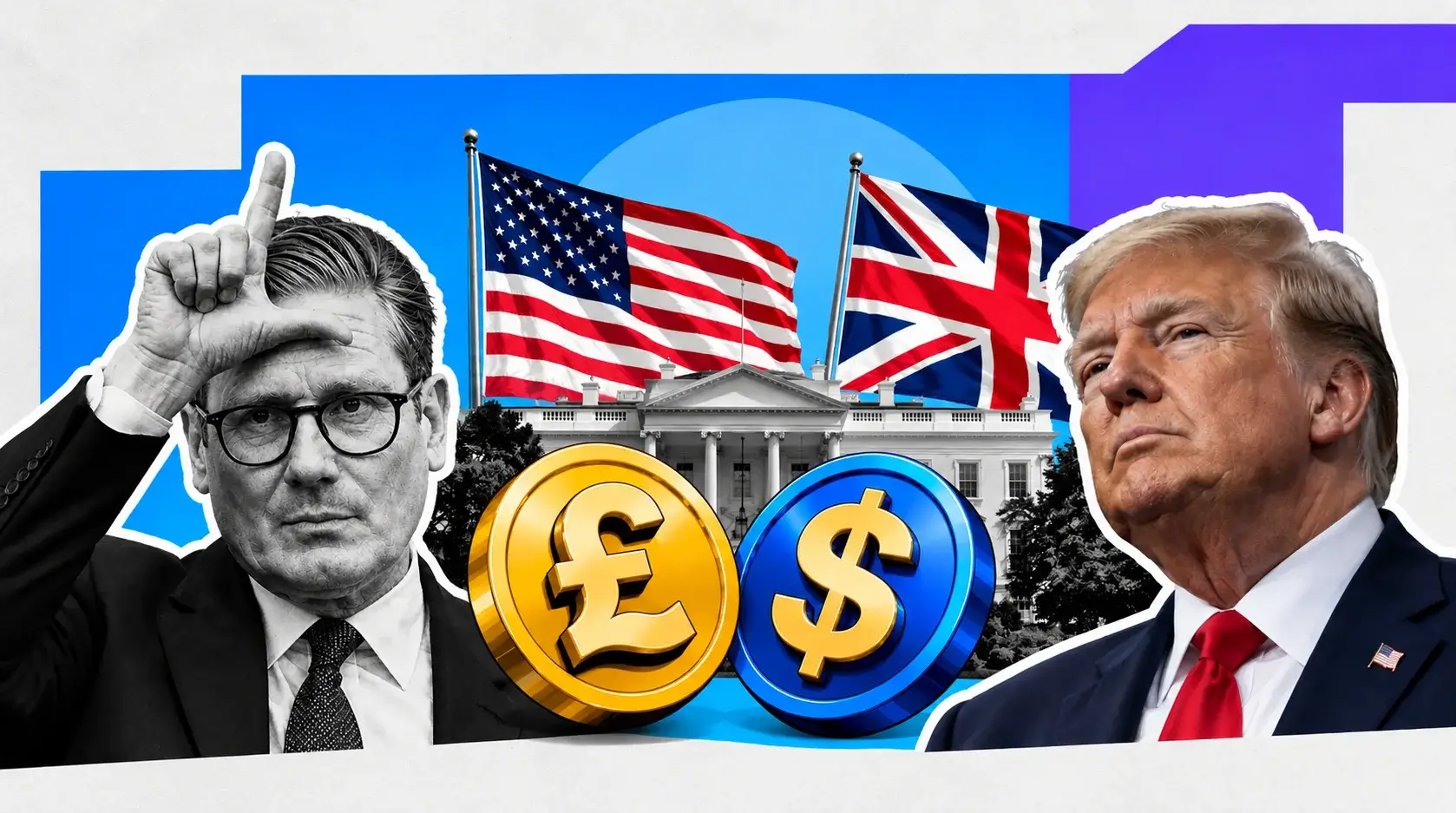
GBP/USD is trading at $1.3332 Wednesday, up over 0.70% on the session after bouncing off a daily low of $1.3216, with the pair reclaiming the 1.3300 handle on Trump's Iran exit comments and broad dollar weakness. The Dollar Index sits at 99.247, down 0.51%, while the British Pound is the strongest G10 currency against the dollar this week with a 0.53% gain. Those are the Wednesday numbers. The quarter numbers are a completely different story. GBP/USD peaked at $1.3869 on January 27 — the strongest level since September 2021 — and has since declined to the current $1.3332 range. That is a 5% quarterly decline in a major currency pair, which is not a routine correction. It is a structural repricing of every assumption that drove sterling higher through Q4 2025 and January 2026. Bank of England hawkishness that never materialized. Dollar weakness that reversed into safe-haven demand. UK economic resilience that evaporated the moment oil surged 55% in a single month. The quarterly picture defines the medium-term direction. Wednesday's bounce is tactical. The trend is not.
The Five-Day Losing Streak That Ended Tuesday and the Technical Levels That Now Define the Trade
Before Tuesday's recovery, GBP/USD had posted five consecutive daily declines, dropping from above $1.3400 to as low as $1.3150 — the level where a hammer candlestick formation signaled short-term seller exhaustion without confirming any structural reversal. The 0.236 Fibonacci retracement at $1.3233 was the level the pair was defending ahead of Tuesday's bounce. Wednesday's advance to $1.3332 and the intraday high has the pair approaching the first meaningful resistance cluster. The 9-day EMA sits at $1.3291 — already reclaimed Wednesday. The 50-day EMA is at $1.3412, declining and capping recovery attempts. The clustered simple moving averages around $1.3500 on the daily chart represent the structural cap that confirms the loss of momentum from the late-$1.3800 range. The pair is oscillating between an ascending support trendline from $1.3035 and a descending resistance line from $1.3869, creating a broad consolidation with a downside tilt that becomes more pronounced with each failed recovery attempt. Initial resistance is at the confluence of the descending trendline and grouped daily averages around $1.3500, with a break there exposing $1.3600. On the downside, immediate support is at $1.3200, ahead of the rising trendline just above $1.3100. A daily close below $1.3100 confirms the next leg toward $1.3000 — Bank of America's explicit price target. The 4-hour RSI has recovered from oversold toward the mid-40s on Tuesday's bounce, creating room for a move toward $1.3278 to $1.3291 before the trend reasserts. The tactical setup remains unchanged: short on any rally toward $1.3278 to $1.3300, stop above $1.3350, primary target $1.3150, then $1.3000.
The Death Cross Is Approaching — and When It Confirms, Algorithmic Selling Amplifies the Move
The most consequential technical development for GBP/USD in the immediate term is not Wednesday's bounce or the RSI recovery — it is the approaching death cross formation on the daily chart, where the 50-day EMA is tracking toward a cross below the 200-day EMA. In major currency pairs, confirmed death cross formations trigger sustained directional momentum as algorithmic trend-following systems pile into the confirmed direction systematically. The pair currently trades below both the 9-day EMA at $1.3291 and the 50-day EMA at $1.3412, both declining. On the weekly chart, GBP/USD has broken below its 50-week simple moving average at $1.34, with the weekly RSI below 50, confirming sellers retain structural control of the longer-term picture. When the death cross confirms on the daily chart — which is approaching rather than hypothetical given the current EMA trajectories — it mechanically adds algorithmic selling pressure regardless of day-to-day fundamental developments. UoB captured the near-term setup precisely: "Downward momentum is building rapidly, and from here GBP is likely to break $1.3220 and head toward $1.3160." That call was made before Wednesday's relief bounce. The structure that produced it has not changed.
UK Stagflation Is No Longer a Risk — It Is the Base Case, and Sterling Is Pricing the Paralysis
The fundamental driver that makes every GBP/USD recovery a selling opportunity rather than a trend reversal is the UK's macro positioning, which has deteriorated from "challenged" to "stagflationary" in the five weeks since the Iran conflict began. Before February 28, UK inflation stood at 3.0% headline, 3.2% core, and 4.3% services — all above the Bank of England's 2% target. That was already a difficult backdrop for a central bank trying to manage the growth-inflation trade-off. The Iran war added an energy shock onto an already-hot inflation environment. The Bank of England lifted its inflation forecast to 3.5% by Q3 at its March meeting. The OECD now expects UK inflation to reach approximately 4% in 2026 — the highest in the G7 alongside Italy. Simultaneously, UK growth forecasts have been slashed. The OECD cut UK 2026 GDP growth from 1.2% to 0.7% — one of the sharpest single-revision downgrades in the latest interim outlook. Flat January GDP at 0.0% month-over-month was the leading indicator of that deterioration. The S&P Global UK Manufacturing PMI for March fell to 51, missing the preliminary estimate of 51.4. The combination of 4% projected inflation and 0.7% projected growth is textbook stagflation. The Bank of England cannot cut rates into 4% inflation without destroying credibility. It cannot hike into 0.7% growth without amplifying the contraction. The policy paralysis is not a temporary condition — it is structural, and sterling prices the paralysis directly through reduced institutional demand.
The ISM at 52.7, Prices Paid at 78.3, and the U.S. Data That Is Keeping the Dollar Bid
Wednesday's U.S. macro data is providing the dollar with a structural foundation that sterling cannot match. ISM Manufacturing PMI for March came in at 52.7, exceeding estimates of 52.3 and improving from February's 52.4 — the third consecutive reading above 50, confirming the manufacturing sector is expanding. The ISM Prices Paid sub-component is the number that matters most for monetary policy: it surged to 78.3, the highest level in nearly four years. A Prices Paid reading at 78.3 confirms that input cost inflation is accelerating across the U.S. manufacturing sector — driven in part by energy cost pass-through from oil at $100 — and it directly reinforces the Federal Reserve's "higher for longer" posture. February Retail Sales grew 0.6% month-over-month, the largest increase in seven months and above the 0.5% consensus, with January revised to -0.1%. The ADP private sector employment number came in at 62,000 for March — above the 40,000 consensus, marginally below February's 66,000. Richmond Fed President Thomas Barkin stated that the rate hike scenario "would be around inflation expectations starting to move finally." St. Louis Fed President Alberto Musalem said policy is "well-positioned," is "appropriate," and sees no need to move rates while warning of potential inflation risks from the conflict. Two Fed officials on the same day expressing inflation concern and comfort with current policy levels is unambiguously dollar-supportive. Every U.S. data point Wednesday — ISM, Prices Paid, Retail Sales, ADP — has reinforced the case for dollar strength relative to sterling.
The BoE's April 30 Meeting Is the Single Most Important Catalyst for GBP/USD in Q2
Financial markets are currently pricing two full rate hikes and a meaningful probability of a third from the Bank of England in 2026. Before the Iran conflict began five weeks ago, markets were pricing one to two rate cuts across the full year — the repricing from two cuts to two-to-three hikes represents one of the most dramatic shifts in central bank expectation in recent memory across any major currency. That repricing provides sterling with partial support in the near term through carry trade mechanics and rate differential arguments. But it also creates the most significant near-term reversal risk for GBP/USD: if the BoE disappoints those elevated hike expectations at its April 30 meeting by signaling patience rather than action, the position unwind from priced-in hikes to actual hold produces a sharp sterling selloff that could be more violent than the gradual grind of the past five weeks. BoE Governor Andrew Bailey told Reuters that markets are "getting ahead of themselves" regarding rate hikes — the exact language of a central bank attempting to manage expectations downward from what markets are pricing. That statement is a significant signal. When a central bank governor explicitly says markets are ahead of themselves, the path of least resistance for those expectations is lower, and lower rate expectations mean lower sterling. The April 30 meeting is the pivot: deliver or disappoint. The current setup prices delivery. The governor's language signals disappointment.
Dollar Structural Advantage: Net Oil Exporter Versus Net Energy Importer — the $100 Oil Asymmetry
The energy exposure differential between the United States and the United Kingdom is the structural argument for GBP/USD weakness that persists regardless of any single data point or geopolitical headline. The U.S. is a net oil exporter — when WTI (CL=F) rises from $70 to $100, what American consumers lose at the pump, domestic oil producers gain. The net purchasing power impact on the U.S. economy is closer to zero than the headline pump price suggests. The UK is a net energy importer. When Brent (BZ=F) surges 55% in a month, the UK absorbs that cost without an offsetting domestic production windfall. The energy import bill rises, the current account deficit widens, and the BOE faces inflation it cannot control through domestic demand management because the source is imported commodity prices. Fiona Cincotta of StoneX articulated the mechanism directly: the U.S. dollar "continues to benefit from safe-haven demand and higher oil prices as it's the next net exporter of oil" — the structural advantage is not just geopolitical safe-haven flow, it is the terms-of-trade improvement the U.S. experiences at $100 oil that the UK does not. That asymmetry does not reverse when oil drops from $120 to $101. It reverses only when oil returns to pre-war levels near $70, and Commerzbank's base case of $80 post-war — their most optimistic scenario — still leaves the UK paying more for energy than before the conflict began.
Houthis at Bab el-Mandeb, Kharg Island, and the Scenario Where GBP/USD Tests $1.27
The tail risk scenario for GBP/USD is not $1.30 — it is significantly lower than that, and the conditions that would produce it are not implausible given what happened Wednesday alone. Yemen's Houthis fired ballistic missiles at Israeli military targets on Saturday, marking their first direct engagement in the U.S.-Israel-Iran conflict. MUFG analysis flagged that Houthis are actively considering closing the Bab el-Mandeb Strait — the chokepoint at the southern end of the Red Sea through which 4 to 5 million barrels per day flow. A simultaneous closure of both Hormuz and Bab el-Mandeb would represent the most severe energy supply shock since the 1970s, removing upward of 24% to 25% of global daily oil flows from the market in two separate geographic locations. Societe Generale already put $150 Brent as the April stress scenario under single-chokepoint conditions. Full dual-closure pushes oil toward Macquarie's $200 scenario. GBP/USD at $1.30 is the market pricing $100-$110 Brent. GBP/USD at $1.27 is the market pricing $140-$150 Brent. GBP/USD approaching the 200-week simple moving average at $1.27 and the 2025 low at $1.21 is the market pricing full dual-chokepoint closure with no near-term ceasefire resolution — a scenario where the UK's energy import dependency becomes an existential economic challenge rather than merely a growth headwind. Gulf allies are privately urging Trump to continue fighting rather than withdraw, specifically because they understand a premature U.S. exit without a verifiable Hormuz reopening exposes the entire Gulf energy infrastructure to continued Iranian proxy action. That lobbying is another variable the market is not fully pricing.
Read More
-
Yen Stalls at 160 Despite a 3% JGB and Tokyo Core CPI at 2.0% — Intervention Sits at 164, Friday's Payrolls Decide
02.09.2026 · TradingNEWS ArchiveEnergy
-
T-Rex 2X Inverse MSTR ($4.39) Rips 10.44% as Strategy Pauses Bitcoin Buys for a 2nd Week — $4.63 Close Opens $5.27
15.09.2026 · TradingNEWS ArchiveStocks
-
XRPR ($10.59) and XRPI ($7.04) Open at Highs and Close at Lows After Senate Kills CLARITY Act
15.09.2026 · TradingNEWS ArchiveCrypto
-
NG ($2.908) Holds Above $2.80 Low as LNG Feedgas Hits 18.8 Bcf and TTF Trades 9.2x Henry Hub
15.09.2026 · TradingNEWS ArchiveCommodities
-
USD/JPY (155.09) Faces 275bp Policy Gap as BOJ Prepares 31-Year-High Rate — Close Below 154 Opens 153.40
15.09.2026 · TradingNEWS ArchiveForex
UK Political Risk: Labour Trailing in Polls, Local Elections in May, and the Starmer Discount
GBP/USD's fundamental challenges are not limited to energy and monetary policy — they include a political dimension that is receiving insufficient attention from macro analysts. UK Prime Minister Keir Starmer is facing his first major political test with local elections in May 2026. Current polling has Labour trailing the populist Reform Party and showing weakness to the Green Party — a pattern that, if reflected in local election results, would raise serious questions about Starmer's political durability and Labour's ability to govern through an energy crisis of this magnitude. The UK's refusal to be dragged further into the Iran war — Starmer explicitly declined to support deeper U.S.-Israeli military action — has strained UK-US relations at a moment when economic support from Washington would be valuable. Starmer held a Downing Street press conference Wednesday warning of a "storm coming" on cost-of-living pressures while holding off emergency measures — a political posture that satisfies neither the markets that want decisive fiscal action nor the public that wants immediate relief. Political uncertainty in the UK adds a risk premium to sterling that is not quantified in standard macro models but is priced by currency traders who have seen British political dysfunction destroy sterling value before — most notably in September 2022 when the Truss mini-budget sent GBP/USD to a record low of $1.0327. The current scenario is less extreme but the directional logic is similar: political uncertainty into a macro storm reduces institutional appetite for sterling assets.
Friday's NFP Is the Swing Variable — A Weak Number Gives Sterling a Temporary Lifeline
The U.S. nonfarm payrolls report Friday is the most significant near-term catalyst for GBP/USD direction, and it runs in both directions with asymmetric implications. The February official count showed a nonfarm payroll decline of 92,000 — a shocking deterioration that was the single largest monthly employment miss in years outside of COVID-19. Consensus forecasts for March are approximately 55,000 net new jobs with unemployment holding at 4.4%. The JOLTS data released Tuesday showed job openings dropping to 6.882 million versus the 6.9 million consensus, with hiring collapsing to 3.1% — the lowest level since April 2020. That labor market softening data creates the conditions for another NFP miss on Friday. If the March payroll number is weak — below 40,000 or negative — Federal Reserve rate cut expectations rebuild rapidly, the dollar sells off sharply, and GBP/USD gets a temporary push toward $1.3400 to $1.3460. That bounce would be tactical, not structural. A strong payroll number — above 100,000 — reinforces the Fed's hold posture, keeps rate expectations elevated, supports the dollar, and sends GBP/USD back toward $1.3150 within 24 to 48 hours. The base case is a soft number given the JOLTS deterioration and ADP's 62,000 print — which gives sterling a brief window of relief before the structural bear trend reasserts.
The Verdict on GBP/USD at $1.3332: Sell the Rally, Target $1.30, Stop Above $1.3350
GBP/USD at $1.3332 is a sell on strength. The tactical entry is any rally toward $1.3278 to $1.3300, with a stop above $1.3350 and a primary target of $1.3150. A confirmed break of $1.3150 opens the path toward $1.3085 and then the psychologically critical $1.3000 level that Bank of America has explicitly targeted. The structural reasons for that target are consistent and reinforcing: UK stagflation with projected 4% inflation against 0.7% GDP growth, a Bank of England governor actively warning markets they are overpricing rate hikes, a U.S. economy posting ISM Manufacturing at 52.7 with Prices Paid at 78.3, the dollar benefiting from net oil exporter status at $100 crude while the UK absorbs the full cost as a net importer, an approaching death cross on the daily chart that will activate algorithmic selling, Houthi re-engagement threatening a second chokepoint that sends oil to $150 or $200, and UK political uncertainty heading into May local elections. The only scenarios that change the directional call are a verified Strait of Hormuz reopening bringing oil back toward $70, a dramatically weak U.S. NFP that breaks the dollar's structural support, or a BoE surprise rate hike at the April 30 meeting that exceeds all current market pricing. None of those scenarios is the base case. Wednesday's 0.70% bounce is a dead-cat rally in a structural bear trend — the kind of move that separates those who trade the trend from those who fight it.