GBP/USD Price Forecast: Sterling at 1.3400 After the Most Violent BoE Policy U-Turn Since 1992
With BoE-Fed Rate Parity at 3.75%, UK Input Prices at Highest Since the 1992 Sterling Crisis, Brent Above $103, and a Falling Wedge Targeting $1.3500 on a Break of $1.3430 | That's TradingNEWS
Key Points
- BoE 150bp Policy Swing in 23 Days — From Two Cuts to Four Hikes — Futures moved from pricing the BoE cutting to 3.25% before the war to now pricing four quarter-point hikes to 4.75% — the most violent UK rate expectation swing since the 1992 Sterling crisis
- 2. UK PMI Collapses to Six-Month Low, Input Prices Worst Since 1992 — The UK Composite Flash PMI fell from 53.7 to 51.0 in March — the sharpest monthly drop in six months
- Sell the Rally to $1.3430 — Buy Only on a Confirmed Break Above It — GBP/USD hit $1.3223 during Monday's Asian session before recovering to $1.3445 on Trump's Iran post — a 222-pip swing driven entirely by oil, not BoE policy — with the falling wedge and inverted head-and-shoulders both targeting $1.3500-$1.3560
GBP/USD is trading at 1.3382 on Tuesday, March 24, 2026 — down 0.16% on the session after hitting a daily high of 1.3445 in early trading before sellers reasserted control at the exact level that has been capping every meaningful rally attempt for weeks. The pair is caught between two forces that are almost perfectly matched in their magnitude and directly opposed in their directional implication: a Bank of England that has just executed one of the most dramatic policy pivots in recent UK monetary history, and a U.S. dollar that is being fed by a safe-haven and petrocurrency premium from Brent crude trading above $103 that shows no sign of reversing as long as the Strait of Hormuz remains effectively closed. The result is a pair that has been unable to escape a defined range — $1.3223 on the floor established during Monday's Asian session low and $1.3477 as the next resistance ceiling — despite having more fundamental cross-currents than almost any other G10 currency pair in the market right now.
The GBP/USD intraday range on Monday alone captured the entire psychological battlefield. The pair opened under pressure, trading as low as $1.3223 during Asian hours as dollar safe-haven demand overwhelmed everything else with Brent crude pushing toward $113. Then Trump's Truth Social post claiming "COMPLETE AND TOTAL" resolution discussions with Iran sent the DXY from above 100.06 crashing back toward 98.83 — a dollar weakening that mechanically lifted Cable above $1.3400. The FTSE 100 was simultaneously down 0.24% at 9,894. GBP/EUR traded at 1.1560. The intraday swing from $1.3223 to $1.3457 — a 234-pip range in a single session — is not normal Cable behavior. It is a currency pair that has surrendered its own fundamental identity and become a pure proxy for the oil-driven dollar premium that the Iran war has created.
The BoE's March Meeting and the 150 Basis Point Swing That Changed Everything for GBP
Before the Iran war started on February 28, futures markets were pricing the Bank of England to cut its repo rate from 3.75% to 3.25% by year-end 2026 — two quarter-point reductions that would have taken UK borrowing costs to their lowest level since before the post-pandemic inflation surge. Governor Andrew Bailey had been signaling exactly that trajectory, and the market was pricing it with high conviction. The war changed every single assumption in that framework within 23 days. Following the BoE's unanimous March decision to hold rates at 3.75%, Bailey stated explicitly that the Middle East conflict represents "a shock to the economy" that will push inflation substantially higher in the near term — and characterized restoring safe shipping through the Strait of Hormuz as "key to addressing energy price rises." Those two sentences from a central bank governor are among the most consequential statements made by the Bank of England in years, because they amount to an explicit acknowledgment that UK monetary policy is now hostage to a geopolitical variable the BoE cannot influence.
The derivatives market's response was immediate and dramatic. Before the March meeting, futures implied two rate cuts. After the meeting, the market began pricing an 80% probability of rates rising to 4.25% and a 33% probability of an increase to 4.5%. As of current trading on March 24, the market is pricing four quarter-point BoE rate hikes this year — a swing from -50 basis points of expected easing to +100 basis points of expected tightening. That is a 150 basis point shift in expected policy direction over 23 days, and it represents one of the most violent repricing events in UK rate expectations since the 1992 ERM crisis when Sterling was forced out of the European Exchange Rate Mechanism. The BoE is forecasting consumer prices to reach 3.5% in March and 5% by year-end 2026. Even the Committee's dovish members voted for holding rates — a unanimous 9-0 vote that signals the full Committee has been converted by the inflation outlook, not just the hawkish faction. Analysts at JP Morgan and Barclays have both published forecasts predicting two BoE rate hikes this year, with the first expected in April.
Without the Iran war, the BoE might have cut rates to 3.5% at the March meeting. Instead, it held at 3.75% with an explicit hawkish bias pointing toward 4.25% to 4.5%. The repo rate is currently at exactly the same 3.75% level as the Fed funds rate — a configuration of BoE-Fed rate parity that is historically unusual and analytically important for GBP/USD. EUR/USD faces a 160 basis point yield disadvantage, with the ECB at 2.15% versus the Fed at 3.75%. GBP/USD faces no such disadvantage at current settings. The dollar's strength against Sterling is not coming from yield differential — it is coming entirely from the petrocurrency premium, the phenomenon where oil price surges benefit the dollar because the U.S. is the world's largest oil producer and exporter. When Brent was at $113, the petrocurrency bid was maximum. When it crashed to $99 on Monday, the bid retreated and GBP/USD recovered from $1.3223 to $1.3445. That mechanical relationship defines everything about GBP/USD's near-term trajectory.
UK PMI at Six-Month Low, Input Prices at Their Highest Since the 1992 Sterling Crisis — The Economic Damage Is Already Printing
The S&P Global UK Flash PMI data released Tuesday confirmed that the Iran war's economic impact on Britain is not theoretical — it is already appearing in hard survey data at a speed that is alarming. The UK Composite Flash PMI collapsed to 51.0 in March from 53.7 in February — a deterioration of 2.7 points that represents the sharpest monthly decline in business activity in six months. The Services PMI fell from 53.9 to 51.2 — services representing approximately 80% of the UK economy, so this reading carries disproportionate weight for the overall growth outlook. Manufacturing PMI slipped from 51.7 to 51.4. Both readings remain above 50, the expansion-contraction threshold, but the directional trend is unambiguous — UK business activity growth is decelerating sharply, and it is doing so while input prices are accelerating simultaneously. The UK Flash PMI showed that manufacturing input prices reached their highest level since the 1992 Sterling crisis — the same crisis that forced GBP out of the European Exchange Rate Mechanism and produced one of the most traumatic episodes in modern Bank of England history. That specific historical reference — the 1992 Sterling crisis — is not a rhetorical flourish. It is the technical benchmark that survey compilers use when describing the severity of the current inflationary pressure on UK businesses.
The context behind those PMI numbers is the real-economy cost transmission that is already hitting UK households and businesses before the full war-duration inflation is priced in. Farmers in Wiltshire are paying £1.20 to £1.30 per litre for red diesel — compared to 65p before the war. That is a 90-100% increase in agricultural fuel costs that will transmit directly into food prices over the coming months as higher production costs are passed through the supply chain. The National Farmers' Union has confirmed food price increases are coming. Heating oil has more than doubled from pre-war levels. The RAC confirms petrol has risen 9% at ordinary UK filling stations and diesel has risen 17%. Households with gross income around £55,000 — a middle-income UK household — are already cutting spending on leisure and dining by £40 per week according to official figures, and those cuts are occurring before the fertilizer cost increases and food price transmission have fully materialized. The combination of higher energy, higher food, and reduced consumer discretionary spending is a textbook stagflation demand destruction pattern.
Pantheon Macroeconomics has cut its 2026 UK GDP forecast from 1.3% to 0.6%. KPMG and Barclays now expect GDP growth to slow to 0.7%, down from previous estimates of 1% to 1.1%. If the futures market is correct and the BoE raises rates four times to 4.75%, that additional 100 basis points of tightening landing on a 0.6%-0.7% growth economy could tip the UK into recession. Societe Generale and ANZ Research have both published estimates suggesting oil prices are unlikely to return to pre-war levels of $65 to $70 per barrel by end of 2026 even if the Strait of Hormuz reopens tomorrow — meaning the inflation pressure that is forcing the BoE's hawkish pivot is not going away quickly, and neither is the growth headwind that makes hiking into that inflation so dangerous.
GBP/USD Technical Architecture: The $1.3430 Neckline That Must Break to Change the Trend
The technical structure of GBP/USD at current levels is among the most precisely defined and analytically actionable setups in the major currency pairs right now. The pair is trading at 1.3382 on the daily chart, having pulled back from a daily high of 1.3445. The near-term bias is mildly bearish — price has slipped below the clustered simple moving averages around 1.3500, turning that area from support into an overhead cap after having acted as support through most of the recent range. The pair is also retreating from the descending resistance trendline that runs from the 1.3869 high, which has repeatedly contained rallies and reinforces the concept of fading tops in the mid-1.36s region. The long-running ascending support line from 1.3035 still underpins the broader advance, but the latest pullback toward its vicinity signals waning upside momentum.
On the 2-hour chart, GBP/USD is trading firm around 1.3439, holding above the previously stubborn 1.3387 resistance level that had been a ceiling until buyers staged a recovery from the 1.3254–1.3299 support zone. Price is currently above the 200-period moving average at 1.3380 while the shorter 50-period average is turning upward at approximately 1.3360 — the short-term outlook is improving from a pure momentum standpoint. Key resistance ahead sits first at 1.3477, then 1.3530, and 1.3575. The RSI is slowly moving back toward 60, showing renewed upside momentum that is not yet in overbought territory — meaning there is technical room to push toward 1.3477 before any exhaustion concern becomes relevant.
The most analytically important technical formation on the GBP/USD daily chart is the simultaneous development of a falling wedge and an inverted head-and-shoulders pattern that multiple technicians are now flagging as potential reversal setups. A falling wedge — formed by two converging downward-sloping trendlines where selling pressure compresses and loses momentum — is most powerful when it forms after a sustained downtrend from a significant high to a significant low. GBP/USD has provided exactly that context, having fallen from a high of approximately $1.3470 to a low of $1.3223 in compressed time. The inverted head-and-shoulders overlaid on the same timeframe shows a left shoulder at approximately $1.3300, a head at $1.3223, and a right shoulder forming near $1.3300-$1.3320. The neckline of this inverted head-and-shoulders coincides with the $1.3430 resistance level — the Bollinger Band middle and the 100-day EMA — creating a dual-pattern confirmation point where a daily close above $1.3430 would simultaneously confirm the inverted head-and-shoulders neckline break and the falling wedge breakout. The measured target from both patterns produces objectives of $1.3500 as the immediate destination and $1.3560 as the extended target. The Percentage Price Oscillator on the daily chart has formed a bullish crossover — a momentum signal that has preceded significant Cable recoveries in prior cycle analogues. RSI positive divergence at the $1.3223 low — where RSI was making higher lows while price tested the same support — is the classic exhaustion signal that precedes trend reversal.
Immediate resistance sits at 1.3450, followed by the 1.3500 region where the descending resistance line converges with the moving average cluster, then the recent highs near 1.3650. On the downside, initial support sits just above 1.3300 along the rising trend line from 1.3035, with a break exposing the late-November pivot at 1.3220 and then the psychological 1.3100 area. A daily close back above 1.3500 would relieve current pressure and reopen the path toward 1.3650, while sustained trading below the ascending support line would confirm a transition into a more decisive bearish phase. The DXY technical picture reinforces the GBP/USD analysis — the dollar index is bouncing around 99.20, clinging to the 200-period moving average at 99.00 as near-term support after being rejected at 100.15 resistance. The 99.40–99.45 zone is acting as a supply ceiling preventing major dollar recoveries. If the DXY loses 99.00, targets of 98.89 and 98.58 come into focus — which would mechanically lift GBP/USD through 1.3430 and potentially confirm the dual bullish reversal patterns simultaneously.
The BoE-Fed Rate Parity Paradox: Why GBP/USD Is Fighting on Equal Footing While Every Other G10 Pair Suffers
The current configuration of BoE policy rate at 3.75% versus Fed funds rate at 3.75% creates a condition for GBP/USD that most G10 currency pairs would envy. EUR/USD bears a 160 basis point yield disadvantage — the ECB sitting at 2.15% while the Fed sits at 3.75%. AUD/USD, NZD/USD, and CHF/USD carry even larger yield deficits. GBP/USD is the only major dollar pair where the counterparty central bank matches the Fed on nominal yield. The strategic implication is significant: the dollar's strength against Sterling is not structurally supported by the most powerful macro force that drives long-term currency direction — yield differential. It is supported entirely by the petrocurrency premium that oil above $100 creates. When oil falls, that premium evaporates and GBP/USD recovers mechanically. When oil rises, the premium rebuilds and Cable falls. The pair's future direction is therefore more accurately modeled as an oil price call option than as a traditional interest rate differential trade — which is both its near-term challenge and its medium-term opportunity.
The BoE-Fed rate parity also creates a different trajectory for GBP/USD relative to EUR/USD if the Iran war de-escalates. In a ceasefire scenario where Brent falls from $103 toward $80, the dollar loses its petrocurrency premium across all pairs. EUR/USD recovers, but from a deeply disadvantaged yield position. GBP/USD recovers from a yield-neutral position — meaning Cable's recovery should be faster and more sustained than EUR/USD's, because Sterling doesn't need to overcome an interest rate headwind to appreciate. The BoE's four expected hikes, if delivered, would actually push UK rates above U.S. rates — from parity at 3.75% to GBP advantage at 4.75% versus Fed at 3.75% — creating the first meaningful GBP yield premium over USD in years. That scenario would be powerfully bullish for GBP/USD on a 12-month horizon. However, the path to that scenario runs through a UK recession risk that is real and documented in the PMI data, the GDP forecast cuts, and the agricultural and household spending data described above.
Read More
-
Yen Stalls at 160 Despite a 3% JGB and Tokyo Core CPI at 2.0% — Intervention Sits at 164, Friday's Payrolls Decide
02.09.2026 · TradingNEWS ArchiveEnergy
-
QQQ ETF ($706.22) Slides 7.4% Below Its High as the Market Reprices the AI Capex Bill — $686.57 Target if $700 Breaks
22.10.2026 · TradingNEWS ArchiveStocks
-
XRPI ($7.00) and XRPR ($10.74) Slide Toward 52-Week Lows as Spot XRP ETF Flows Stall at $708,510
22.10.2026 · TradingNEWS ArchiveCrypto
-
NG ($2.775) Decoupled From Europe’s €88 Gas Crisis as LNG Feedgas Hits 18.9 Bcf/d — $3.30 Upside on Cold Weather
22.10.2026 · TradingNEWS ArchiveCommodities
-
Dollar-Yen (157.35) Loses 157.65 as the Yen Rallies on Haven Demand — 155 Target if 156 Breaks
22.10.2026 · TradingNEWS ArchiveForex
The Diplomatic Dimension: Starmer's Phone Call and What It Means for UK Energy Exposure
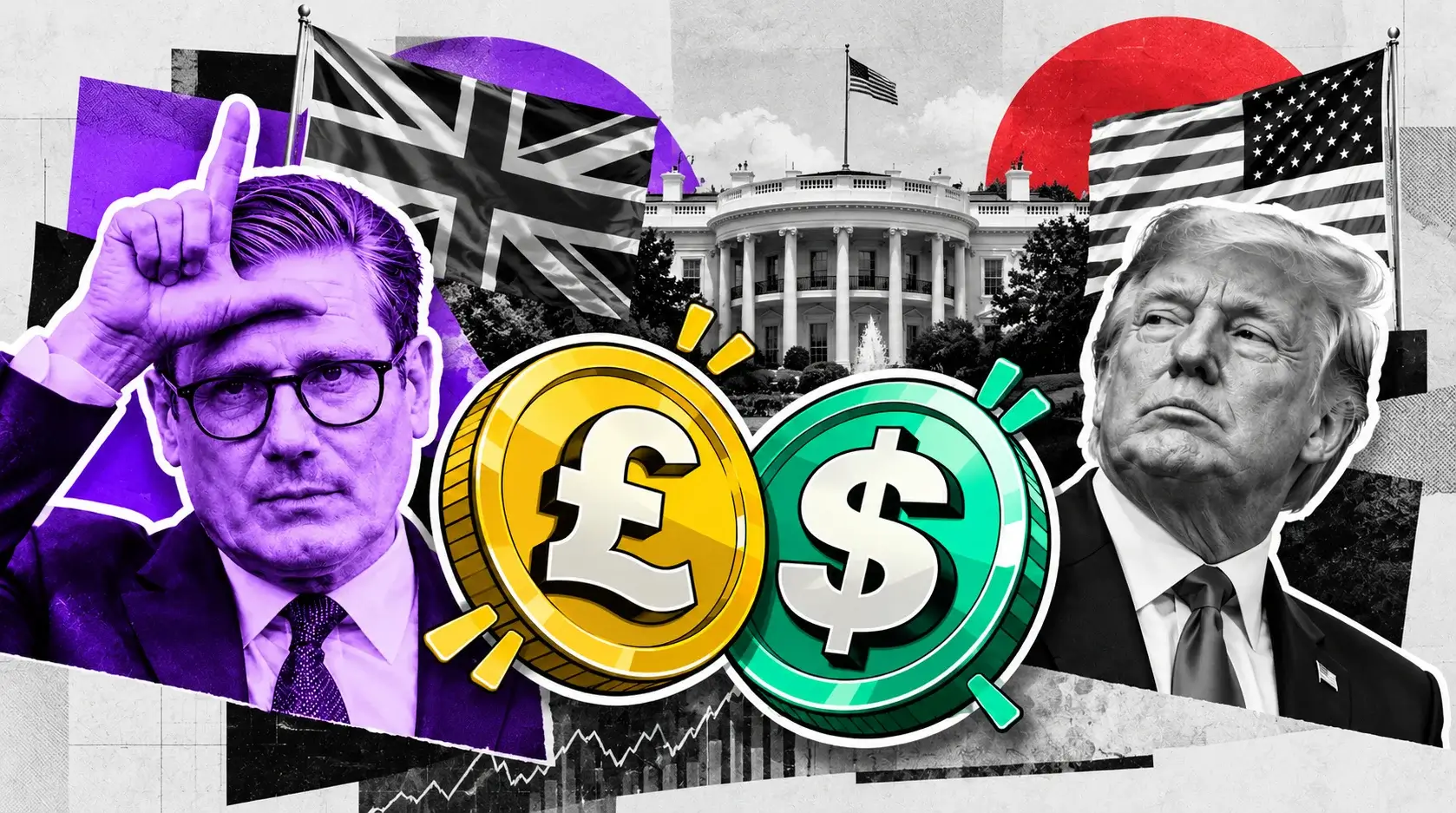
One element of the GBP/USD framework that extends beyond pure central bank and technical analysis is the diplomatic involvement of UK Prime Minister Keir Starmer in the Iran ceasefire process. Starmer held a 20-minute phone call with Trump on Sunday evening — the night before Trump's Truth Social ceasefire announcement — in which the two leaders discussed halting trade disruption through the Strait of Hormuz. The timing of that phone call, immediately preceding Trump's post by hours, raises the possibility that UK diplomatic engagement contributed to the pressure architecture that led Trump to announce the five-day pause. This matters for GBP/USD because UK diplomatic participation in any Hormuz resolution framework could reduce the UK's exposure to the energy shock asymmetrically — the UK imports a significant proportion of its energy from Middle East-linked sources, and a Hormuz reopening would specifically relieve the most acute pressure driving UK stagflation fears and forcing the BoE's hawkish pivot.
However, the subsequent developments have undermined that diplomatic optimism. Iran fired a new wave of missiles on Tuesday after denying Trump's claims. Iranian Deputy Speaker Ali Nikzad stated the Strait would not be returned to its previous state and there would be no negotiations. The Iranian Foreign Minister separately stated the Strait is "open" but countries at war with Iran are excluded — a distinction without operational difference since the primary oil-shipping nations are either at war with Iran or allied with those who are. Iran is reportedly charging some ships for safe passage through the Strait — a de facto toll extraction that signals Iran views the Strait as leverage to be monetized rather than a neutral international waterway to be reopened. The five-day diplomatic window that Trump announced — and Starmer's Sunday phone call preceded — is being denied by every Iranian official with credibility on the matter.
The Stagflation Paradox and Why the BoE Rate Hike Is Both Bullish and Bearish for GBP/USD Simultaneously
The most intellectually challenging aspect of the GBP/USD fundamental picture is that the BoE's hawkish pivot is simultaneously near-term bullish and medium-term bearish for Sterling — a paradox that explains much of the pair's inability to find sustained directional momentum despite having a central bank that is now more hawkish than almost any other in the developed world. Near-term bullish because: BoE at 4.25% to 4.75% versus Fed at 3.75% creates a GBP yield premium that attracts carry-trade flows. Near-term bullish because: the four expected rate hikes demonstrate policy credibility in fighting the inflation shock, which supports Sterling's safe-haven characteristics relative to currencies from economies that are less willing to fight inflation aggressively. Medium-term bearish because: the BoE is hiking into a UK economy with GDP growth projected at 0.6% to 0.7% — an economy already at the margin of recession that may tip into contraction under the weight of higher borrowing costs stacked on top of energy cost pressure stacked on top of consumer spending contraction. Medium-term bearish because: if the BoE hikes four times and the UK enters recession, the subsequent rate cutting cycle that follows a recession would be deeper and faster than any hiking cycle could offset, ultimately pushing Sterling lower on a multi-year basis.
The market is currently pricing the near-term bullish channel of the BoE hawkish pivot through the yield support mechanism. It is not yet pricing the medium-term bearish consequence of hiking into stagflation because that consequence is contingent on the recession materializing — which requires Brent to remain above $100 for long enough that the energy cost transmission into food prices, consumer spending, and business investment produces the contraction that the GDP forecast cuts already imply. Pantheon Macroeconomics at 0.6% GDP growth, KPMG at 0.7%, Barclays at 0.7% — those forecasts were published before the full energy price impact is transmitted into Q2 and Q3 2026 economic data. If oil remains above $100 through June, the Q2 UK GDP print could be negative — the first negative quarterly print since the pandemic — and at that point the medium-term bearish consequence of the stagflation paradox would assert itself with full force against Sterling.
The GBP/USD Trade Decision: Conditional Buy Above $1.3430, Short Below $1.3223, With Oil the Decisive Variable
Buy GBP/USD on a confirmed daily close above $1.3430. Stop at $1.3225. Targets: $1.3500 first, $1.3560 extended. Flip short on a daily close below $1.3223 with target $1.3160 and $1.3100 as the extended bear case.
The falling wedge and inverted head-and-shoulders patterns are actionable setups — but they require the neckline break at $1.3430 to confirm. Do not buy ahead of that level. The BoE-Fed rate parity removes the structural yield headwind that is preventing EUR/USD and other G10 pairs from recovering, which means GBP/USD has a more favorable fundamental foundation for a breakout trade than almost any other dollar pair. The four expected BoE hikes — from 3.75% to 4.75% — would create the first GBP yield premium over USD in years, and the market would front-run that premium well before the actual hike schedule is fully delivered. Monday's $1.3223 low held on two separate tests — Asian session and prior week's extreme — creating the double-bottom technical structure that precedes the inverted head-and-shoulders neckline break at $1.3430.
The bear case is equally concrete and conditional: a daily close below $1.3223 invalidates the inverted head-and-shoulders, confirms the falling wedge has resolved bearishly, and opens GBP/USD toward $1.3160 first and $1.3100 as the extended target where the psychological floor of the entire post-2023 recovery structure sits. Below $1.3100, the next meaningful reference is $1.30 — a level that would represent a full repricing of the UK economic outlook into recession territory and would likely coincide with the BoE reversing course from hiking to cutting as stagflation recession materializes. LiteFinance's analysis confirms this framework: short positions below 1.338 and 1.3355 are warranted if those support levels give way, reflecting the medium-term stagflation recession risk that the near-term yield support narrative does not yet fully price.
The decisive variable is oil. GBP/USD is not an interest rate pair right now. It is an oil call option where the underlying is Brent crude. Every $5 move in Brent below $100 is worth approximately 30-40 pips of GBP/USD upside through the dollar petrocurrency premium erosion mechanism. Every $5 move in Brent above $105 is worth a similar amount of GBP/USD downside. Goldman Sachs targets $115 Brent in April. Citi's bull case sits at $150. If either scenario materializes, GBP/USD is heading toward $1.3100 and potentially $1.30. If the five-day diplomatic window produces a genuine Hormuz reopening and Brent falls toward $85-90, GBP/USD breaks $1.3430, confirms the dual bullish pattern, and targets $1.3500-$1.3560 with room toward $1.3650 on extension. The trade is clear. The condition is the oil price. Watch Brent, not the PMI.